|
시장보고서
상품코드
2122426
강재 제품 : 시장 점유율 분석, 업계 동향과 통계, 성장 예측(2026-2031년)Finished Steel Products - Market Share Analysis, Industry Trends & Statistics, Growth Forecasts (2026 - 2031) |
||||||
 Mordor Intelligence
Mordor Intelligence에 따르면 2026년 강재 제품 시장 규모는 18억 9,000만 톤으로 추정되고 있으며, 2025년 17억 9,000만 톤으로부터 확대하며, 2031년에는 24억 7,000만 톤에 달할 것으로 예측됩니다.
2026-2031년 동안 연평균 성장률(CAGR) 5.50%로 성장할 것으로 전망됩니다.
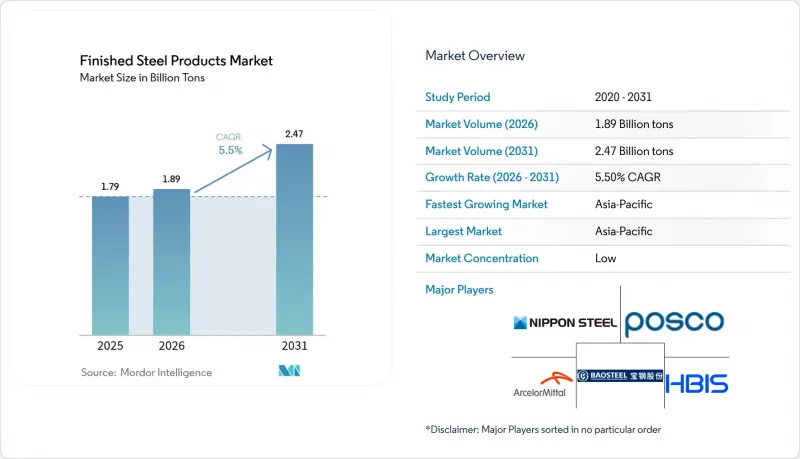
이 보고서는 형태별(강판, 강대, 봉강, 형강, 강관, 선재, 기타 형태), 공정별(열간압연, 냉간 압연, 단조, 주조, 기타), 최종사용자 산업별(건설 인프라, 운송, 에너지,컨테이너·포장, 전기·전자기기, 기타), 지역별(아시아태평양, 북미, 유럽, 남미, 중동 및 아프리카)로 분류되어 있습니다.
세계 철강 제품 시장의 동향 및 인사이트
아시아와 아프리카의 인프라 붐
아시아에서는 연간 1조 7,000억 달러, 아프리카에서는 676억-1,075억 달러에 달하는 인프라 수요로 인해 구조용 봉강, 형강, 철근의 수요가 확대되고 있습니다. 중국의 ‘일대일로’ 구상은 140개국에 걸쳐 지역 제철소에 대량의 수주를 가져다주고 있습니다. 2025년까지 1조 4,000억 달러 규모로 예상되는 인도의 국가 인프라 계획은 국내 생산 능력 확대를 지속적으로 지원하고 있습니다. 이에 따라 주요 생산업체들은 프로젝트 현장과 가까운 곳에 하류 가공 거점을 설립하여 리드타임을 단축하는 동시에 철강 제품 시장을 강화하고 있습니다. 또한 현지화 추진은 장거리 운송에 따른 CO₂ 배출량 감축에도 기여하고 있습니다.
전기자동차(EV)에 의한 고장력강(AHSS)·전자강판 수요
현재, 첨단 고장력강(AHSS)은 일반 전기자동차 차체의 35-40%를 차지하고 있으며, 이는 기존 모델의 20%에서 증가한 수치입니다. 테슬라의 200만 대 분 생산 능력과 BYD의 적극적인 생산 확대에 힘입어, 2030년까지 자동차용 강재 소비량은 2,500만-3,000만 톤에 달할 것으로 전망됩니다. 800볼트 구동 모터에 필요한 결정립 배향 전자강판은 연간 15-20%의 속도로 수요가 확대되고 있으며, 프리미엄 가격 차이가 발생하고 있습니다. 각 공급업체들은 알루미늄 및 복합 소재와 같은 대체 소재에 대한 시장 점유율을 지키기 위해 신속한 합금 개발 주기, 핫 스탬핑 설비 확충, 코팅 기술 향상 등의 대응을 추진하고 있습니다. 자동차 제조사들이 무게, 안전성, 비용의 관점에서 소재 균형을 재검토하는 가운데, 이러한 투자는 완제품 철강 시장을 활성화시키고 있습니다.
원자재 비용 변동
2024년과 2025년에 공급 차질과 환율 변동이 수요 회복의 불균형과 겹치면서, 철광석과 코크스용 석탄 가격은 격렬하게 변동했습니다. 발레, 리오 틴토,BHP 등 3사는 해상 운송되는 철광석의 상당 부분의 점유율을 장악하고 있으며, 가동 중단이나 기상 재해 발생시 가격 변동이 더욱 확대됩니다. 유럽의 전력 가격 급등(아시아나 미국의 2-3배에 달하는 경우도 많음)은 현지 제철소의 경쟁력을 약화시키고 있습니다. 이러한 동향으로 인해 철강 제조사들은 철강 제품 시장에서 EBITDA 마진을 지키기 위해 장기 공급 계약 체결, 헤지 프로그램 도입, 수직 통합을 어쩔 수 없이 추진하고 있습니다.
부문별 분석
스트립 제품은 자동차용 패널, 가전제품용 케이스, 건설용 외장재의 수요에 힘입어 2025년에는 31.78%의 점유율을 차지하며 최대 생산량을 기록했습니다. 모노코크 차체 플랫폼 및 표준화된 건축자재에 대한 견고한 수요로 인해 제철소의 가동률은 높은 수준을 유지하고 있습니다. 표면 품질에 대한 요구가 높아짐에 따라 스트립 제품의 완제품 강재 시장 규모는 꾸준한 성장을 유지할 것으로 예상됩니다. 관 제품의 생산량은 적지만, 파이프라인 확장, 재생에너지용 타워, HVAC 설비 설치에 힘입어 2031년까지 연평균 성장률(CAGR) 6.24%로 가장 높은 성장률을 달성할 것으로 예측됩니다. 자동차 연료 라인 및 항공우주용 유압 시스템용 정밀 파이프는 높은 이익률을 자랑하며, 첨단 용접 및 검사 시스템에 대한 투자를 촉진하고 있습니다.
신흥 시장의 지속적인 인프라 투자가 두꺼운 강판의 판매를 지원하는 한편, 봉강과 선재는 철근 콘크리트 수요의 혜택을 받고 있습니다. 형강과 선재는 엔지니어링 구조물 및 전자기기 용도에서 틈새 시장 지위를 확립하고 있습니다. 생산자들은 최종 시장의 동향에 따라 스트립과 튜브 제품의 생산을 전환할 수 있도록 생산 라인의 유연성을 지속적으로 최적화하고 있으며, 이를 통해 철강 제품 시장에서 경쟁력을 유지하고 있습니다.
지역별 분석
아시아태평양은 2025년에 60.88%라는 최대 점유율을 차지할 것으로 예상되며, 막대한 내수 소비와 수출 능력을 겸비하여 연평균 성장률(CAGR) 6.12%로 확대될 것으로 전망됩니다. 중국의 조강 생산량은 2024년에 10억 톤을 넘어섰으나, 탄소 가격 제도의 도입 및 생산 능력 교환에 관한 규제로 인해 제철소들은 고품질 마감 가공 및 친환경 철강 프로젝트로 방향을 전환해야 하는 상황에 직면해 있습니다. 인도의 1조 4,000억 달러 규모의 ‘국가 인프라 계획’이 내수 수요를 가속화하고 있는 한편, 동남아시아에서는 전자기기 및 가전제품 제조 확대가 호재로 작용하고 있습니다. 수소를 연료로 하는 직접환원철(DRI)이나 스크랩을 원료로 하는 전기 아크로(EAF)에 대한 정책적 지원은 성장과 배출 감축 목표의 균형을 도모하고, 이를 통해 철강 제품 시장을 지속가능하게 하는 것을 목적으로 하고 있습니다.
북미에서는 2025년 3월부터 25%의 수입 관세가 부과됨에 따라 공급망의 안정성을 중심으로 한 재편이 진행되고 있습니다. 현대제철의 루이지애나주 프로젝트를 대표로 하는 전기로(EAF)의 확대는 풍부한 고철과 저렴한 에너지를 활용하고 있습니다. 지역내 OEM 기업은 관세 비용과 지정학적 리스크를 완화하기 위해 현지 조달을 점점 더 중시하고 있으며, 건설 산업의 경기 순환적 침체에도 불구하고 철강 제품 시장을 지탱하고 있습니다.
유럽은 ‘철강 행동 계획’에 따라 탈탄소화와 수입 세이프가드라는 과제에 직면해 있으며, 2026년까지 EU 역외로부터의 유입을 15% 감축하는 것을 목표로 하고 있습니다. 전력 가격 격차와 탄소세가 이익률을 압박하고 있지만, 수소를 연료로 하는 DRI 시범 사업과 순환형 경제에 기반한 스크랩 프로그램을 통해 유럽의 제철소는 저탄소 프리미엄 등급 부문의 선구자로 자리매김하고 있습니다. 남미는 풍부한 철광석 매장량과 재생 가능 전력을 활용하여 친환경 철강에 대한 투자를 유치하고 있습니다. 한편, 전 세계 DRI 생산량의 45%를 차지하는 중동 및 아프리카는 자원이 풍부한 지역과 유럽·아시아의 수요 거점을 연결하는 신흥 ‘친환경 철강 회랑’에 공급하는 것을 목표로 하고 있습니다. 이러한 지역 전략은 종합적으로 볼 때 철강 제품 시장의 장기적인 회복력을 지원할 것입니다.
기타 혜택
- 엑셀 형식의 시장 예측(ME) 시트
- 3개월간의 애널리스트 지원
자주 묻는 질문
목차
제1장 서론
제2장 조사 방법
제3장 개요
제4장 시장 구도
제5장 시장 규모와 성장 예측
제6장 경쟁 구도
제7장 시장 기회와 향후 전망
KSA 26.09.07According to Mordor Intelligence, finished steel products market size in 2026 is estimated at 1.89 billion tons, growing from 2025 value of 1.79 billion tons with 2031 projections showing 2.47 billion tons, growing at 5.50% CAGR over 2026-2031.
This report is Segmented by Form (Plate, Strip, Rod and Bar, Profile, Tube, Wire, Other Forms), Process (Hot-Rolling, Cold-Rolling, Forging, Casting, and More), End-User Industry (Construction and Infrastructure, Transportation, Energy, Containers and Packaging, Electrical and Electronics, and More), and Geography (Asia-Pacific, North America, Europe, South America, Middle-East and Africa).
Global Finished Steel Products Market Trends and Insights
Infrastructure boom in Asia and Africa
Annual infrastructure needs of USD 1.7 trillion in Asia and USD 67.6-107.5 billion in Africa are expanding demand for structural bars, beams, and rebar. China's Belt and Road Initiative spans 140 countries, funneling large tonnage orders to regional mills. India's National Infrastructure Pipeline, valued at USD 1.4 trillion through 2025, continues to stimulate domestic capacity additions. Major producers are therefore establishing downstream finishing hubs nearer to project locations, shortening lead times and strengthening the finished steel products market. Intensified localization is also helping reduce CO2 emissions tied to long-haul shipping.
EV-driven demand for AHSS and electrical steels
Advanced high-strength steel (AHSS) presently constitutes 35-40% of a typical EV body, up from 20% in conventional models. Tesla's 2 million-unit capacity and BYD's aggressive scaling point toward automotive steel consumption reaching 25-30 million tons by 2030. Grain-oriented electrical steels required for 800-volt traction motors are growing 15-20% annually, fetching premium price differentials. Suppliers are responding with rapid alloy-development cycles, hot-stamping expansions, and coating upgrades to safeguard market share against aluminum and composite alternatives. These investments enhance the finished steel products market as automakers recalibrate material balances for weight, safety, and cost.
Raw-material cost volatility pressuring margins
Iron ore and coking coal prices fluctuated sharply during 2024 and 2025 as supply disruptions and currency changes intersected with uneven demand recovery. Vale, Rio Tinto, and BHP collectively control a significant share of seaborne ore, magnifying price swings during outages or weather events. Elevated power prices in Europe-often two to three times those in Asia or the United States-erode local mill competitiveness. These dynamics compel steelmakers to pursue long-term supply contracts, hedging programs, and vertical integration to shield EBITDA margins in the finished steel products market.
Other drivers and restraints analyzed in the detailed report include:
- Renewable-energy build-out driving steel intensity
- Scrap-availability surge enabling EAF capacity growth
- Lightweight substitutes challenging traditional applications
For complete list of drivers and restraints, kindly check the Table Of Contents.
Segment Analysis
Strip products generated the highest volume, capturing a 31.78% share in 2025 on the strength of automotive panels, appliance casings, and construction cladding. Robust demand from unibody vehicle platforms and standardized building components keeps mill utilization high. The finished steel products market size for strip products is forecast to maintain steady growth as surface-quality requirements rise. Tube products, although smaller in volume, are projected to achieve the fastest 6.24% CAGR through 2031, supported by pipeline expansions, renewable-energy towers, and HVAC installations. Precision tubes for automotive fuel lines and aerospace hydraulics command premium margins, encouraging investment in advanced welding and inspection systems.
Ongoing infrastructure spending in emerging markets supports heavy-section plate sales, whereas rod and bar benefit from reinforced-concrete demand. Profile and wire forms secure niche positions in engineered structures and electronic applications. Producers continue to optimize line flexibility to shift between strip and tube output as end-market signals evolve, preserving competitiveness within the finished steel products market.
Complete Report Scope:
- By Form
- Plate
- Strip
- Rod and Bar
- Profile
- Tube
- Wire
- Other Forms
- By Process
- Hot-Rolling
- Cold-Rolling
- Forging
- Casting
- Extrusion and Drawing
- Additive Manufacturing of Steel
- By End-user Industry
- Construction and Infrastructure
- Transportation
- Energy
- Containers and Packaging
- Electrical and Electronics
- Machinery and Equipment
- Defence and Security
- By Geography
- Asia-Pacific
- China
- India
- Japan
- South Korea
- ASEAN Countries
- Australia and New Zealand
- North America
- United States
- Canada
- Mexico
- Europe
- Germany
- United Kingdom
- Italy
- France
- Spain
- Russia
- Rest of Europe
- South America
- Brazil
- Argentina
- Rest of South America
- Middle-East and Africa
- Saudi Arabia
- South Africa
- Turkey
- Rest of Middle-East and Africa
- Asia-Pacific
Geography Analysis
Asia-Pacific generated the largest share at 60.88% in 2025 and is forecast to expand at a 6.12% CAGR, combining massive domestic consumption with export capability. China's crude-steel output exceeded 1 billion tons in 2024, though carbon-pricing trials and capacity-swap regulations are nudging mills toward high-quality finishing and green-steel projects. India's USD 1.4 trillion National Infrastructure Pipeline accelerates domestic demand, while Southeast Asia benefits from rising electronics and appliance manufacturing. Policy incentives for hydrogen-based direct-reduced-iron (DRI) and scrap-based EAFs aim to balance growth with emission commitments, thereby sustaining the finished steel products market.
North America is reorganizing around supply-chain security after the March 2025 imposition of 25% import tariffs. EAF expansions, such as Hyundai Steel's Louisiana project, exploit abundant scrap and inexpensive energy. Regional OEMs increasingly favor local sourcing to mitigate tariff costs and geopolitical risk, supporting the finished steel products market despite cyclical construction softness.
Europe faces decarbonization and import-safeguard challenges under its Steel Action Plan, targeting a 15% reduction in non-EU inflows by 2026. Power-price differentials and carbon taxes pressure margins, yet hydrogen-driven DRI pilots and circular-economy scrap programs are positioning European mills as early movers in low-carbon premium grades. South America leverages abundant iron-ore reserves and renewable power to court green-steel investments, while Middle East and Africa, responsible for 45% of global DRI, aim to serve emerging green-iron corridors linking resource-rich regions with demand centers in Europe and Asia. These regional strategies collectively support long-term resilience in the finished steel products market.
- ArcelorMittal
- Baosteel Group
- BMWIL
- China Ansteel Group Corporation Limited
- Gerdau S/A
- HBIS Group
- Hyundai Steel
- JFE Steel Corporation
- Jiangsu Shagang Group
- JSW Steel Ltd
- Nippon Steel Corporation
- Nucor
- Outokumpu
- POSCO
- Shougang Group
- SSAB AB
- Steel Authority of India Limited (SAIL)
- Tata Steel
- ThyssenKrupp AG
- United States Steel
- Voestalpine AG
Additional Benefits:
- The market estimate (ME) sheet in Excel format
- 3 months of analyst support
TABLE OF CONTENTS
1 Introduction
- 1.1 Study Assumptions and Market Definition
- 1.2 Scope of the Study
2 Research Methodology
3 Executive Summary
4 Market Landscape
- 4.1 Market Drivers
- 4.1.1 Infrastructure Boom in Asia and Africa
- 4.1.2 EV-driven demand for AHSS and electrical steels
- 4.1.3 Renewable-energy build-out (wind-tower, solar-frame plate)
- 4.1.4 Scrap-availability surge powering EAF capacity growth
- 4.1.5 Defence re-armament boosting Q&T armour plate
- 4.2 Market Restraints
- 4.2.1 Raw-material cost volatility
- 4.2.2 Lightweight substitutes (Al, CFRP) in transport
- 4.2.3 EU-CBAM and green-premium cost divergence
- 4.2.4 Structural over-capacity in China and GCC
- 4.3 Value Chain Analysis
- 4.4 Regulatory Landscape
- 4.5 Porter's Five Forces
- 4.5.1 Bargaining Power of Suppliers
- 4.5.2 Bargaining Power of Buyers
- 4.5.3 Threat of New Entrants
- 4.5.4 Threat of Substitutes
- 4.5.5 Degree of Competition
5 Market Size and Growth Forecasts (Volume)
- 5.1 By Form
- 5.1.1 Plate
- 5.1.2 Strip
- 5.1.3 Rod and Bar
- 5.1.4 Profile
- 5.1.5 Tube
- 5.1.6 Wire
- 5.1.7 Other Forms
- 5.2 By Process
- 5.2.1 Hot-Rolling
- 5.2.2 Cold-Rolling
- 5.2.3 Forging
- 5.2.4 Casting
- 5.2.5 Extrusion and Drawing
- 5.2.6 Additive Manufacturing of Steel
- 5.3 By End-user Industry
- 5.3.1 Construction and Infrastructure
- 5.3.2 Transportation
- 5.3.3 Energy
- 5.3.4 Containers and Packaging
- 5.3.5 Electrical and Electronics
- 5.3.6 Machinery and Equipment
- 5.3.7 Defence and Security
- 5.4 By Geography
- 5.4.1 Asia-Pacific
- 5.4.1.1 China
- 5.4.1.2 India
- 5.4.1.3 Japan
- 5.4.1.4 South Korea
- 5.4.1.5 ASEAN Countries
- 5.4.1.6 Australia and New Zealand
- 5.4.2 North America
- 5.4.2.1 United States
- 5.4.2.2 Canada
- 5.4.2.3 Mexico
- 5.4.3 Europe
- 5.4.3.1 Germany
- 5.4.3.2 United Kingdom
- 5.4.3.3 Italy
- 5.4.3.4 France
- 5.4.3.5 Spain
- 5.4.3.6 Russia
- 5.4.3.7 Rest of Europe
- 5.4.4 South America
- 5.4.4.1 Brazil
- 5.4.4.2 Argentina
- 5.4.4.3 Rest of South America
- 5.4.5 Middle-East and Africa
- 5.4.5.1 Saudi Arabia
- 5.4.5.2 South Africa
- 5.4.5.3 Turkey
- 5.4.5.4 Rest of Middle-East and Africa
- 5.4.1 Asia-Pacific
6 Competitive Landscape
- 6.1 Market Concentration
- 6.2 Strategic Moves
- 6.3 Market Share/Ranking Analysis
- 6.4 Company Profiles (includes Global level Overview, Market level overview, Core Segments, Financials as available, Strategic Information, Market Rank/Share for key companies, Products and Services, and Recent Developments)
- 6.4.1 ArcelorMittal
- 6.4.2 Baosteel Group
- 6.4.3 BMWIL
- 6.4.4 China Ansteel Group Corporation Limited
- 6.4.5 Gerdau S/A
- 6.4.6 HBIS Group
- 6.4.7 Hyundai Steel
- 6.4.8 JFE Steel Corporation
- 6.4.9 Jiangsu Shagang Group
- 6.4.10 JSW Steel Ltd
- 6.4.11 Nippon Steel Corporation
- 6.4.12 Nucor
- 6.4.13 Outokumpu
- 6.4.14 POSCO
- 6.4.15 Shougang Group
- 6.4.16 SSAB AB
- 6.4.17 Steel Authority of India Limited (SAIL)
- 6.4.18 Tata Steel
- 6.4.19 ThyssenKrupp AG
- 6.4.20 United States Steel
- 6.4.21 Voestalpine AG
7 Market Opportunities and Future Outlook
- 7.1 White-space and Unmet-need Assessment