
|
시장보고서
상품코드
2122436
자율 이동 로봇 : 시장 점유율 분석, 업계 동향과 통계, 성장 예측(2026-2031년)Autonomous Mobile Robot - Market Share Analysis, Industry Trends & Statistics, Growth Forecasts (2026 - 2031) |
||||||
 Mordor Intelligence
Mordor Intelligence에 의하면, 2026년 자율 이동 로봇 시장 규모는 51억 8,000만 달러로 추정되며, 2025년 44억 9,000만 달러에서 2031년에는 105억 6,000만 달러에 달할 것으로 예측됩니다.
또한 2026-2031년 연평균 성장률(CAGR)은 15.31%를 기록할 것으로 전망됩니다.
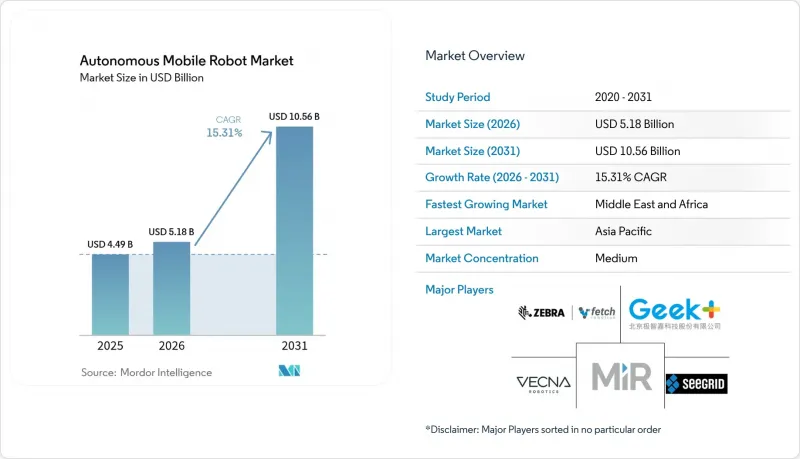
본 보고서는 유형별(무인 지상 차량, 휴머노이드 등), 내비게이션 기술별(LiDAR SLAM, 비전 기반, 자기/유도/QR 코드 유도 등), 최종 사용자 산업별(창고 및 물류, 제조, 자동차 등) 및 지역별로 분류되어 있습니다. 시장 예측은 금액(달러)으로 표시되어 있습니다.
전 세계 자율 주행 로봇 시장 동향 및 인사이트
급증하는 전자상거래 주문 처리 수요
현재 온라인 소매업은 ‘당일 배송’에 대한 기대에 달려 있습니다. 아마존은 2025년 7월까지 도입한 로봇 대수가 100만 대를 돌파했으며, DeepFleet의 플릿 인텔리전스를 통해 피킹 1회당 이동 시간을 10% 단축했습니다. 이를 통해 모바일 자동화가 동일한 인력으로 처리 능력을 4배까지 높일 수 있음이 입증되었습니다. Locus Robotics는 LocusOne 소프트웨어를 통합한 후 피킹 횟수가 30억 회를 돌파했습니다. 이로 인해 생산성이 2-3배 증가하는 동시에 부상 건수를 80% 줄였습니다. 따라서 소매업체들은 계절에 따른 업무량 변화에 유연하게 대응할 수 있고, 시설 변경을 최소화할 수 있는 소형 자율 이동 로봇 솔루션을 도입하고 있습니다. Geek+와 Intel이 공동 개발한 시스템에서 볼 수 있는 ‘비전 기반 내비게이션’은 고정 마커가 필요하지 않아 도입 비용과 시간을 절감합니다.
OECD 시장의 창고 인력 부족
OECD 회원국의 창고 운영 사업자들은 야간이나 성수기 근무 시 만성적인 인력 부족을 보고하고 있습니다. 유럽 직업안전보건청(EU-OSHA)은 노동 가능 연령 인구의 감소를 보완하기 위해 자동화가 필수적이라고 강조하고 있습니다. Skechers사는 컨베이어를 로봇으로 대체한 결과, 80%의 에너지 절감을 달성하며 숙련된 노동자가 부족한 상황에서도 투자 대비 효과를 입증했습니다. 현재 고용주들은 로봇의 감시 및 유지보수를 중심으로 업무 내용을 재설계하고 있으며, 이를 통해 창고 업무의 신체적 부담이 경감되어 더 매력적인 일자리가 되고 있습니다.
분산된 상호운용성 표준
ISO 3691-4 및 ANSI/RIA R15.08은 안전성을 상세하게 규정하고 있지만, 차량군의 통신 프로토콜에 대해서는 언급하지 않고 있어 구매자는 단일 공급업체의 생태계에 얽매이게 되고, 통합 비용이 증가하고 있습니다. 미들웨어 공급업체들은 이러한 격차를 메우기 위해 노력하고 있지만, 독자적인 사양의 데이터 형식이 도입을 지연시키고 구매자의 협상력을 약화시키고 있습니다.
부문 분석
2025년에는 무인 지상 차량이 매출의 45.42%를 차지했습니다. 휴머노이드 로봇은 등장한 지 얼마 되지 않았으나, 레이아웃 변경 없이 인간이 설계한 공간을 이동할 수 있기 때문에 연평균 성장률(CAGR) 18.74%를 나타낼 것으로 예측됩니다. 아마존은 리비안의 전기 밴에서 소포를 싣는 휴머노이드형 배송 로봇의 시범 운영을 진행 중이며, 이는 자율 주행 로봇 시장의 실외 진출을 시사합니다. 무인 항공기 및 무인 해양 로봇은 여전히 틈새 시장이지만, 에너지 자산 점검에 있어 매우 중요합니다. 휴머노이드형 자율 이동 로봇 시장 규모는 물체 집게 및 조작의 신뢰성이 창고 업무의 성능 기준에 도달하면 급속히 확대될 전망입니다.
기존의 로봇군은 특정 작업을 최적화하는 특수한 형태에 의존하고 있지만, 범용성이 부족합니다. 휴머노이드는 하나의 플랫폼으로 선반 정리부터 분류까지 역할을 전환할 수 있으므로, 로봇군의 단순화가 기대되고 있습니다. 그 결과, 투자는 순수한 이동용 하드웨어에서 인간의 손재주에 필적하는 인공지능을 통한 시각 인식 및 집게 능력으로 전환되고 있습니다. 이러한 전환을 통해 라이프사이클 비용이 절감되고, ‘로봇-어즈-어-서비스(Robot-as-a-Service)’와 같은 새로운 서비스 모델이 실현될 것입니다.
LiDAR SLAM은 혼잡한 통로에서도 mm 수준의 재현성을 실현할 수 있어, 2025년에는 40.88%의 점유율을 차지했습니다. 연평균 성장률(CAGR) 20.64%로 확대되고 있는 비전 기반 시스템은 고가의 센서나 반사 타겟이 필요하지 않아 중견 시장 사업자의 설비 투자를 절감할 수 있습니다. Geek+는 Intel RealSense 깊이 카메라와 온보드 AI를 활용하여 LiDAR와 동등한 정확도를 입증했습니다. 엣지 프로세서가 저전력으로 실시간 이미지 세분화을 처리할 수 있게 됨에 따라, 비전 내비게이션을 채택한 자율 이동 로봇 시장 규모는 더욱 확대될 전망입니다.
하이브리드 센서 퓨전은 카메라, LiDAR, 관성 센서를 결합하여 먼지, 눈부심, 대역폭 제약이 발생할 때 로봇 군이 모드를 전환할 수 있도록 합니다. 이러한 적응형 접근 방식은 현재 항만 창고에서 요구되는 실내·실외 혼합 운영을 지원합니다. 모달리티를 아우르는 성능을 인증하는 규격은 멀티 센서 도입을 가속화하고, 로봇이 공공 보도를 횡단할 때의 안전성을 보장합니다.
지역별 분석
아시아태평양은 2025년 매출의 37.12%를 차지했습니다. Geek+와 같은 중국 기업들은 비용 측면에서의 우위와 실증 실험을 신속화하는 정부의 지원 프로그램을 활용하여 생산량의 3분의 1 이상을 수출하고 있습니다. 현재 많은 일본 및 한국의 공장에서는 투자 회수 기간을 단축하기 위해 중국 브랜드의 로봇을 도입하고 있습니다. 북미는 아마존의 다수 거점으로의 확장 및 제3자 물류 사업자를 위해 오케스트레이션 계층을 맞춤화하는 소프트웨어 스타트업의 탄탄한 생태계 덕분에 여전히 자율 이동 로봇 시장에서 2위의 규모를 유지하고 있습니다.
유럽은 체계적인 보조금 제도의 혜택을 받고 있습니다. EU의 ‘미래 공장(Factory of the Future)’ 이니셔티브에서는 자동화 하드웨어 설비 투자액의 최대 20%가 보조되므로, 중견 제조업체들의 도입이 가속화되고 있습니다. 2025년 이후 보조금이 본격화됨에 따라, 유럽 내 자율주행 로봇 시장 점유율은 상승할 전망입니다. 중동 및 아프리카는 사우디아라비아의 ‘비전 2030’과 NEOM의 건설용 로봇 기술에 대한 7억 7,460만 달러 투자에 힘입어 연평균 성장률(CAGR) 18.46%로 가장 빠르게 성장하고 있는 지역입니다. 높은 물류 비용과 신규 창고 건설로 인해 사업자들은 도입 초기부터 로봇을 염두에 둔 설계를 할 수 있습니다.
남미는 여전히 초기 단계에 있습니다. 브라질과 멕시코에서는 수입 자동화 장비에 대한 관세 면제 조치로 실증 실험이 촉진되고 있지만, 환율 변동이 본격적인 도입을 저해하고 있습니다. 아프리카에서의 도입은 자동차 조립 공장이 생산 라인에 대한 적시 납품을 필요로 하는 남아프리카공화국과 모로코에 집중되어 있습니다.
기타 혜택:
- 엑셀 형식 시장 예측(ME) 시트
- 3개월간의 애널리스트 지원
자주 묻는 질문
목차
제1장 서론
제2장 조사 방법
제3장 주요 요약
제4장 시장 구도
제5장 시장 규모와 성장 예측
제6장 경쟁 구도
제7장 시장 기회와 향후 전망
LSH 26.09.03According to Mordor Intelligence, autonomous mobile robot market size in 2026 is estimated at USD 5.18 billion, growing from 2025 value of USD 4.49 billion with 2031 projections showing USD 10.56 billion, growing at 15.31% CAGR over 2026-2031.
This report is Segmented by Type (Unmanned Ground Vehicles, Humanoids and More), Navigation Technology (LiDAR SLAM, Vision-Based, Magnetic/Inductive/QR Guided and More), End-User Industry (Warehouse & Logistics, Manufacturing, Automotive and More), and Geography. The Market Forecasts are Provided in Terms of Value (USD).
Global Autonomous Mobile Robot Market Trends and Insights
Rapid e-commerce fulfilment demand
Online retail now hinges on same-day delivery expectations. Amazon surpassed 1 million deployed robots by July 2025 and cut travel time per pick by 10% through DeepFleet fleet intelligence, proving that mobile automation can quadruple throughput using the same headcount. Locus Robotics crossed 3 billion picks after integrating its LocusOne software, which doubled to tripled productivity while reducing injuries by 80%. Retailers are therefore adopting compact autonomous mobile robot market solutions that flex with seasonal volumes and require minimal facility changes. Vision-only navigation, showcased in the Geek+-Intel design, trims installation cost and time because no fixed markers are needed.
Scarcity of warehouse labour in OECD markets
OECD operators report persistent vacancies for night and peak-season shifts. The European Agency for Safety and Health at Work highlights automation as essential for offsetting shrinking working-age populations. Skechers logged 80% energy savings after replacing conveyors with robots, validating the return on investment where skilled labour is scarce. Employers now redesign rolls around robot supervision and maintenance, making warehouse jobs less physically demanding and more attractive.
Fragmented interoperability standards
ISO 3691-4 and ANSI/RIA R15.08 detail safety, yet they omit fleet communication protocols, forcing buyers into single-vendor ecosystems and inflating integration cost. Middleware suppliers attempt to bridge gaps, but proprietary data formats slow deployment and reduce bargaining power.
Other drivers and restraints analyzed in the detailed report include:
- Falling Li-ion battery cost below USD 70/kWh
- AI-enabled swarm orchestration platforms
- Cyber-physical security vulnerabilities
For complete list of drivers and restraints, kindly check the Table Of Contents.
Segment Analysis
Unmanned ground vehicles controlled 45.42% revenue in 2025. Humanoids, although young, are forecast to expand at 18.74% CAGR because they navigate human-designed spaces without layout changes. Amazon is piloting humanoid couriers that load parcels from Rivian electric vans, hinting at outdoor extension of the autonomous mobile robot market. Unmanned aerial and marine robots remain niche but critical for inspection in energy assets. The autonomous mobile robot market size for humanoids is likely to rise quickly once manipulation reliability reaches warehouse performance benchmarks.
Traditional fleets rely on specialized form factors that optimize one task but lack versatility. Humanoids promise fleet simplification because one platform can switch roles, from shelving to sorting. Investment has therefore shifted from pure mobility hardware to artificial intelligence vision and grasping capability that matches human dexterity. This transition will lower life-cycle cost and unlock new service models such as robot-as-a-service subscriptions.
LiDAR SLAM held 40.88% share in 2025 because of millimetre-level repeatability in congested aisles. Vision-based systems, expanding at 20.64% CAGR, eliminate expensive sensors and reflective targets, which reduces capital outlay for mid-market operators. Geek+ demonstrated LiDAR-equivalent accuracy through Intel RealSense depth cameras and onboard AI. The autonomous mobile robot market size for vision navigation will further increase as edge processors handle real-time image segmentation at lower power budgets.
Hybrid sensor fusion combines cameras, LiDAR and inertial sensors so fleets can switch modes when dust, glare or bandwidth constraints appear. This adaptive approach supports mixed indoor-outdoor operations that warehouses at ports now demand. Standards that certify performance across modalities will accelerate multi-sensor adoption, ensuring safety as robots cross public walkways.
Complete Report Scope:
- By Type
- Unmanned Ground Vehicles (UGV)
- Humanoids
- Unmanned Aerial Vehicles (UAV)
- Unmanned Marine Vehicles (UMV)
- By Navigation Technology
- LiDAR SLAM
- Vision-based (2D/3D camera)
- Magnetic / Inductive / QR Guided
- Hybrid & Multi-Sensor Fusion
- By Payload Capacity
- Up to 100 kg
- 100 - 500 kg
- 500 - 1,000 kg
- Above 1,000 kg
- By End-user Industry
- Warehouse and Logistics
- Manufacturing
- Automotive
- Food and Beverage
- Healthcare
- Retail and E-commerce
- Defense and Security
- Mining and Minerals
- Energy and Power
- Oil and Gas
- By Geography
- North America
- United States
- Canada
- Mexico
- Europe
- United Kingdom
- Germany
- France
- Italy
- Rest of Europe
- Asia-Pacific
- China
- Japan
- India
- South Korea
- Rest of Asia-Pacific
- Middle East
- Israel
- Saudi Arabia
- United Arab Emirates
- Turkey
- Rest of Middle East
- Africa
- South Africa
- Egypt
- Rest of Africa
- South America
- Brazil
- Argentina
- Rest of South America
- North America
Geography Analysis
Asia-Pacific generated 37.12% of 2025 revenue. Chinese firms such as Geek+ export over one-third of production, leveraging cost advantages and government support programs that expedite piloting. Many Japanese and Korean factories now source robots from Chinese brands to cut payback periods. North America remains the second-largest autonomous mobile robot market owing to Amazon's multi-site expansion and a deep ecosystem of software startups that tailor orchestration layers for third-party logistics providers.
Europe benefits from structured subsidies. The EU "Factory of the Future" initiative reimburses up to 20% of automation hardware capital expenditure, which accelerates adoption among mid-sized manufacturers. The autonomous mobile robot market share for Europe will rise as grants kick in post-2025. The Middle East and Africa is the fastest-growing region at a 18.46% CAGR, driven by Saudi Arabia's Vision 2030 and NEOM's USD 774.6 million commitment to construction robotics. High logistics spend and greenfield warehouses allow operators to design around robots from day one.
South America remains early stage. Duty exemptions on imported automation in Brazil and Mexico encourage pilots, yet currency volatility slows wide rollout. Africa's uptake concentrates in South Africa and Morocco where automotive assembly plants demand just-in-time delivery to lineside.
- Zebra Technologies Corporation (Fetch Robotics)
- Teradyne Inc. - Mobile Industrial Robots (MiR)
- Geek+ Technology Co., Ltd.
- Vecna Robotics, Inc.
- Seegrid Corporation
- Aethon, Inc. (ST Engineering)
- Omron Corporation
- Clearpath Robotics Inc. (OTTO Motors)
- HIK Robot Co., Ltd.
- SoftBank Robotics Group Corp.
- SMP Robotics Systems Corp.
- Locus Robotics Corp.
- Amazon.com, Inc. (Kiva/System Robotics)
- Agilox Services GmbH
- Balyo SA
Additional Benefits:
- The market estimate (ME) sheet in Excel format
- 3 months of analyst support
TABLE OF CONTENTS
1 INTRODUCTION
- 1.1 Study Assumptions and Market Definition
- 1.2 Scope of the Study
2 RESEARCH METHODOLOGY
3 EXECUTIVE SUMMARY
4 MARKET LANDSCAPE
- 4.1 Market Overview
- 4.2 Market Drivers
- 4.2.1 Rapid e-commerce fulfilment demand
- 4.2.2 Scarcity of warehouse labor in OECD markets
- 4.2.3 Falling Li-ion battery $/kWh below USD 70
- 4.2.4 Post-2025 EU "Factory of the Future" grants
- 4.2.5 5G-Advanced private network roll-outs
- 4.2.6 AI-enabled "swarm orchestration" platforms
- 4.3 Market Restraints
- 4.3.1 Fragmented interoperability standards
- 4.3.2 Cyber-physical security vulnerabilities
- 4.3.3 High up-front capex for heavy-payload AMRs
- 4.3.4 Union push-back on robot density limits
- 4.4 Value / Supply-Chain Analysis
- 4.5 Regulatory Landscape
- 4.6 Technological Outlook
- 4.7 Porter's Five Forces Analysis
- 4.7.1 Bargaining Power of Suppliers
- 4.7.2 Bargaining Power of Buyers
- 4.7.3 Threat of New Entrants
- 4.7.4 Threat of Substitutes
- 4.7.5 Intensity of Competitive Rivalry
5 MARKET SIZE AND GROWTH FORECASTS (VALUE)
- 5.1 By Type
- 5.1.1 Unmanned Ground Vehicles (UGV)
- 5.1.2 Humanoids
- 5.1.3 Unmanned Aerial Vehicles (UAV)
- 5.1.4 Unmanned Marine Vehicles (UMV)
- 5.2 By Navigation Technology
- 5.2.1 LiDAR SLAM
- 5.2.2 Vision-based (2D/3D camera)
- 5.2.3 Magnetic / Inductive / QR Guided
- 5.2.4 Hybrid & Multi-Sensor Fusion
- 5.3 By Payload Capacity
- 5.3.1 Up to 100 kg
- 5.3.2 100 - 500 kg
- 5.3.3 500 - 1,000 kg
- 5.3.4 Above 1,000 kg
- 5.4 By End-user Industry
- 5.4.1 Warehouse and Logistics
- 5.4.2 Manufacturing
- 5.4.3 Automotive
- 5.4.4 Food and Beverage
- 5.4.5 Healthcare
- 5.4.6 Retail and E-commerce
- 5.4.7 Defense and Security
- 5.4.8 Mining and Minerals
- 5.4.9 Energy and Power
- 5.4.10 Oil and Gas
- 5.5 By Geography
- 5.5.1 North America
- 5.5.1.1 United States
- 5.5.1.2 Canada
- 5.5.1.3 Mexico
- 5.5.2 Europe
- 5.5.2.1 United Kingdom
- 5.5.2.2 Germany
- 5.5.2.3 France
- 5.5.2.4 Italy
- 5.5.2.5 Rest of Europe
- 5.5.3 Asia-Pacific
- 5.5.3.1 China
- 5.5.3.2 Japan
- 5.5.3.3 India
- 5.5.3.4 South Korea
- 5.5.3.5 Rest of Asia-Pacific
- 5.5.4 Middle East
- 5.5.4.1 Israel
- 5.5.4.2 Saudi Arabia
- 5.5.4.3 United Arab Emirates
- 5.5.4.4 Turkey
- 5.5.4.5 Rest of Middle East
- 5.5.5 Africa
- 5.5.5.1 South Africa
- 5.5.5.2 Egypt
- 5.5.5.3 Rest of Africa
- 5.5.6 South America
- 5.5.6.1 Brazil
- 5.5.6.2 Argentina
- 5.5.6.3 Rest of South America
- 5.5.1 North America
6 COMPETITIVE LANDSCAPE
- 6.1 Market Concentration
- 6.2 Strategic Moves
- 6.3 Market Share Analysis
- 6.4 Company Profiles (includes Global level Overview, Market level overview, Core Segments, Financials as available, Strategic Information, Market Rank/Share for key companies, Products & Services, and Recent Developments)
- 6.4.1 Zebra Technologies Corporation (Fetch Robotics)
- 6.4.2 Teradyne Inc. - Mobile Industrial Robots (MiR)
- 6.4.3 Geek+ Technology Co., Ltd.
- 6.4.4 Vecna Robotics, Inc.
- 6.4.5 Seegrid Corporation
- 6.4.6 Aethon, Inc. (ST Engineering)
- 6.4.7 Omron Corporation
- 6.4.8 Clearpath Robotics Inc. (OTTO Motors)
- 6.4.9 HIK Robot Co., Ltd.
- 6.4.10 SoftBank Robotics Group Corp.
- 6.4.11 SMP Robotics Systems Corp.
- 6.4.12 Locus Robotics Corp.
- 6.4.13 Amazon.com, Inc. (Kiva/System Robotics)
- 6.4.14 Agilox Services GmbH
- 6.4.15 Balyo SA
- 6.5 Vendor Positioning Analysis
- 6.6 Investment Analysis
7 MARKET OPPORTUNITIES AND FUTURE OUTLOOK
- 7.1 White-space and Unmet-need Assessment