

|
시장보고서
상품코드
2122441
오소바이오로직스 : 시장 점유율 분석, 업계 동향 및 통계, 성장 예측(2026-2031년)Orthobiologics - Market Share Analysis, Industry Trends & Statistics, Growth Forecasts (2026 - 2031) |
||||||
 Mordor Intelligence
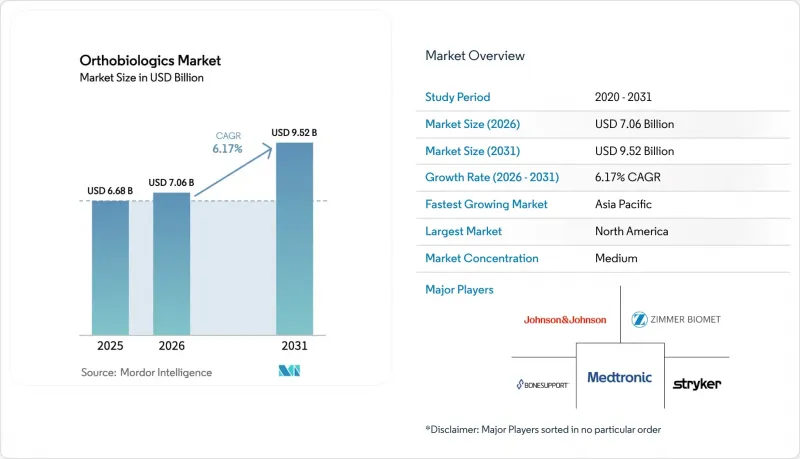
Mordor Intelligence에 의하면, 오소바이오로직스 시장 규모는 2025년 66억 8,000만 달러로 평가되었습니다. 2026년에는 70억 6,000만 달러로 확대되어 2031년까지 95억 2,000만 달러에 이를 것으로 예측되며, 2026-2031년에 걸쳐 CAGR 6.17%로 성장할 전망입니다.

본 보고서는 제품별(관절 내 보충 요법 제품, 기타), 수술 부위별(무릎, 고관절, 기타),투여 방법별(주사용 생물학적 제제, 기타), 용도별(척추 고정술, 기타), 최종 사용자별(병원·정형외과 센터, 외래수술센터(ASC), 기타), 지역별(북미, 유럽, 아시아태평양, 기타)로 분류되어 있습니다. 시장 예측은 금액(달러) 기준으로 제시되어 있습니다.
세계의 오소바이오로직스 시장 동향 및 인사이트
퇴행성 관절염 유병률 증가 및 고령화
평균 수명의 연장과 비만율 증가에 따라, 2030년까지 전 세계 퇴행성 관절염 환자 수는 7억 명을 넘어설 것으로 예측됩니다. 미국에서는 2024년 임상 진단을 통한 유병자 수가 성인 3,250만 명에 달하여, 2015년 대비 15% 증가했습니다. 수술 대기 시간이 길어지는 상황(일본 대도시권의 경우 인공 슬관절 치환술의 대기 기간이 9개월)에 직면함에 따라, 외과의사들은 가교 요법으로 관절 내 보충 요법이나 혈소판 풍부 혈장을 점점 더 많이 활용하고 있습니다. 2024년, 미국의 퇴행성 관절염 관련 직접 의료비는 1,850억 달러에 달했으며, 이에 따라 보험사들은 인공관절 치환술을 지연시킬 수 있는 생물학적 제제의 도입을 검토하고 있습니다. 그 결과, 오소바이오로직스 시장은 비수술적 생물학적 중재의 대상이 되는 환자층을 확대시키는 인구 통계학적 동향과 밀접한 관련이 있습니다.
저침습·외래 정형외과 수술로의 전환
2024년, 미국의 외래수술센터(ASC)에서는 520만 건의 정형외과 수술이 시행되었습니다. 이는 CMS(미국 의료보험서비스센터)가 복잡한 척추 및 관절 재건술을 보험 적용 대상에 추가함에 따라 전년 대비 12% 증가한 수치입니다. ASC에서는 신속한 처리 워크플로우에 적합한 일회용 혈소판 농축액 키트와 즉시 사용 가능한 동종 이식용 퍼티가 중요시되고 있습니다. 그 예로, 15분 이내에 표준화된 6mL의 농축액을 조제할 수 있는 Zimmer Biomet의 GPS III 혈소판 풍부 혈장(PRP) 시스템을 들 수 있습니다. 단일 수준 요추 고정술의 보험 지급액은 ASC에서는 평균 1만 8,000달러인 반면, 병원 외래 진료에서는 3만 5,000달러로, 이를 통해 고정 효과를 높이는 생물학적 제제에 예산을 배정할 수 있게 됩니다. 유럽에서는 아직 뒤처져 있지만, 독일의 보험사는 여전히 대부분의 척추 수술에 대해 입원을 의무화하고 있습니다. 그러나 선진 지역 전반에서 외래 진료로의 전환이 진행될 것으로 예상되며, 오소바이오로직스 시장 점유율은 ASC 사용에 최적화된 제품으로 이동할 것으로 전망됩니다.
높은 치료비와 불균일한 보험 적용 범위
메디케어는 골이식 대체재 비용을 부담하고 있지만, 대부분의 CPT 코드에서 다혈소판 혈장은 적용 대상에서 제외되어 있으며, 이러한 방침은 주요 민간 보험사에도 반영되어 있습니다. 민간 보험사는 자가혈 유래 제품을 ‘임상시험 중’으로 분류하고 있습니다. 그 결과, 환자는 혈소판 풍부 혈장 치료 1회당 1,500-2,500달러를 본인 부담해야 하는 경우가 많아, 그 이용은 경제적으로 여유가 있는 계층으로 한정되고 있습니다. 반면, 관절 내 보충 요법은 1회당 약 200달러로 더 광범위한 보험 적용을 받고 있지만, 사전 승인 기준은 해마다 엄격해지고 있습니다. 2024년 비용-효용 분석에 따르면, 혈소판이 풍부한 혈장은 무릎 관절 치환술을 2.1년 지연시켜 환자 1인당 1만 2,000달러의 비용을 절감할 수 있는 것으로 밝혀졌으나, 10년간의 결과 데이터가 부족하다는 이유로 보험사의 급여 거부가 계속되고 있습니다. 이러한 보험 급여를 둘러싼 교착 상태가 보급을 지연시키고 있으며, 오소바이오로직스 시장의 성장 곡선을 둔화시키고 있습니다.
부문별 분석
2025년, 관절 내 보충 요법은 20년에 걸친 메디케어의 끊임없는 보험 지급에 힘입어 42.92%라는 압도적인 점유율을 차지했습니다. 다혈소판 혈장(Plasma Rich in Platelets, PRP)은 몇 분 만에 균일한 농축액을 공급하고, 초기 원심분리 장치에서 문제가 되었던 편차를 줄여주는 포인트 오브 케어 시스템의 혜택을 받아 연평균 성장률(CAGR) 7.09%를 나타낼 것으로 예측됩니다. 골 이식 대체재와 DBM(골형성 단백질)은 합쳐서 매출의 약 30%를 차지하고 있으며, 이는 2024년에 시행된 55만 건 이상의 척추 고정술에 힘입은 결과입니다. 줄기세포 치료는 FDA가 섹션 361에 근거하여 비동종 사용에 대한 규제를 강화하고 있기 때문에 여전히 임상시험이나 비보험 진료 클리닉으로 제한되어 있습니다.
골형성 단백질(BMP)은 블랙박스 경고를 받아 시장 점유율이 8% 전후에서 정체되었으나, 유해 사건을 60% 감소시키는 저용량 BMP-2 제제가 수요를 다시 불러일으킬 가능성이 있습니다. 관절 내 보충 요법은 보험사의 엄격한 모니터링에 직면해 있으며, 앤섬(Anthem)사는 현재 반복 주사 승인 전에 유전자 검사를 통한 치료 효과 확인을 의무화하고 있어, 이는 향후 치료 건수 감소 압력을 시사합니다. 다혈소판혈장(트롬보사이트플라즈마) 기반 제품의 경우, 표준화된 의료기기의 등장과 최정상급 운동선수들의 추천으로 인해 이전의 우려가 완화되어, 이 카테고리 내에서 시장 규모가 가장 빠르게 확대될 전망입니다.
지역별 분석
북미는 2025년에 전 세계 매출의 43.17%를 차지했으며, 연간 55만 건의 척추 고정술과 세계 최대 규모의 병원 내 생물학적 제제 검사실 네트워크에 힘입고 있습니다. 섹션 232 관세로 인해 리쇼어링이 가속화되고, 정형외과용 임플란트에 대한 10-25%의 수입 관세에 대응하기 위해 가공 업체들은 사업 확장을 강요받고 있습니다. 캐나다의 단일 지불자 제도에서는 다혈소판 혈장(TRP)의 사용이 제한되고, 관절 내 보충 요법이 연간 3회로 제한되어 있어 일부 환자들은 치료를 받기 위해 국경을 넘어 여행하고 있습니다. 멕시코의 정형외과 부문은 의료 관광의 급증에 힘입어 2024년에 14% 성장했으나, 공적 보험과 민간 보험 간의 보상 제도는 여전히 분절된 상태입니다.
아시아태평양은 2025년 중국에서 12건의 재생의학 신속 승인이 이루어졌고, 인도에서 정형외과용 의료기기 수입이 22% 급증한 것을 호재로 삼아 2031년까지 연평균 성장률(CAGR) 11.27%를 나타낼 것으로 예측됩니다. 현재 중국의 1선 도시에서는 줄기세포 치료에 대한 보험 적용이 이루어지고 있지만, 지방 성에서는 뒤처져 있어 양극화된 시장이 형성되고 있습니다. 인도에서는 2025년 초에 혈소판 풍부 혈장(TRP)이 임상적으로 승인됨에 따라, 주로 자비 진료가 주를 이루는 환경에서 민간 부문에 의한 제공이 정당화되었습니다. 일본에서는 고령화가 진행되어 의료 제공 능력에 부담이 가중됨에 따라 인공 슬관절 치환술의 대기 기간이 길어지고 있어, 생물학적 브리지 요법의 이용이 촉진되고 있습니다. 호주는 2024년에 생물학적 제제에 관한 규제를 FDA와 조화시켜 승인까지의 기간을 10개월로 단축했습니다. 한국의 국민건강보험은 현재 척추 고정술에 사용되는 DBM을 급여 대상으로 하고 있으며, 이로 인해 2년 동안 이용률이 30% 상승할 것으로 전망됩니다.
유럽은 큰 수익원이 되고 있지만, MDR(의료기기 규정)과 관련된 지연으로 인해 제품 승인에 18개월 이상 소요되는 상황에 직면해 있습니다. 독일에서는 대부분의 척추 수술에 입원이 의무화되어 있어 ASC(외래수술센터(ASC))의 보급률은 8% 이하에 그치고 있지만, 뮌헨과 프랑크푸르트에서는 외래 모델을 시범적으로 도입하고 있습니다. 영국의 NICE는 2024년, 외측 상과염에 대한 혈소판 풍부 혈장을 승인하여 NHS에서 더 광범위하게 채택될 전망이 열렸습니다. 프랑스에서는 관절 내 보충 요법이 보험 적용 대상에서 제외되면서 이용률이 60% 감소했으나, 이에 따라 민간 의료 기관에서는 혈소판 풍부 혈장(TRP)으로의 전환이 진행되고 있습니다. 중동 및 아프리카 및 남미 지역에서는 GCC와 브라질이 수익의 대부분을 차지하고 있으며, 이는 민간 보험사와 골이식 대체재에 대한 선택적 보험 환급에 힘입은 것입니다.
기타 혜택
- 엑셀 형식 시장 예측(ME) 시트
- 3개월간의 애널리스트 지원
자주 묻는 질문
목차
제1장 서론
제2장 조사 방법
제3장 주요 요약
제4장 시장 구도
제5장 시장 규모 및 성장 예측
제6장 경쟁 구도
제7장 시장 기회 및 향후 전망
KTH 26.09.08According to Mordor Intelligence, the orthobiologics market size is expected to increase from USD 6.68 billion in 2025 to USD 7.06 billion in 2026 and reach USD 9.52 billion by 2031, growing at a CAGR of 6.17% over 2026-2031.
This report is Segmented by Product (Viscosupplementation Products and More), Surgical Site (Knee, Hip, and More), Delivery Method (Injectable Biologics and More), Application (Spinal Fusion and More), End-User (Hospitals & Orthopedic Centers, Ambulatory Surgical Centers, and More), and Geography (North America, Europe, Asia-Pacific, and More). The Market Forecasts are Provided in Terms of Value (USD).
Global Orthobiologics Market Trends and Insights
Rising Osteoarthritis Prevalence & Aging Demographics
Global osteoarthritis cases are forecast to top 700 million by 2030 as populations live longer and obesity rates climb. In the United States, clinically diagnosed prevalence reached 32.5 million adults in 2024, a 15% jump from 2015. Confronted with long surgical wait times, nine months for knee replacement in metropolitan Japan, surgeons increasingly deploy viscosupplementation and PRP as bridge therapies. Direct osteoarthritis care costs the United States USD 185 billion in 2024, prompting payers to consider biologics that may delay arthroplasty. As a result, the orthobiologics market is tightly linked to demographic trends that expand the candidate pool for non-operative biologic interventions.
Shift Toward Minimally-Invasive & Outpatient Orthopedic Procedures
Ambulatory surgical centers (ASCs) performed 5.2 million orthopedic cases in the United States during 2024, up 12% year on year after CMS added complex spine and joint reconstructions to its covered list. ASCs value single-use PRP kits and ready-to-use allograft putties that fit fast-throughput workflows, as evidenced by Zimmer Biomet's GPS III PRP system, which delivers a standardized 6 mL concentrate in under 15 minutes. Reimbursement for single-level lumbar fusion averages USD 18,000 in an ASC versus USD 35,000 in hospital outpatient departments, freeing budget for biologics that enhance fusion. Although Europe lags, Germany's insurers still require hospital admission for most spine work; the outpatient shift is expected to broaden across developed regions, redirecting share within the orthobiologics market toward products optimized for ASC use.
High Therapy Cost & Patchy Reimbursement Coverage
Medicare pays for bone graft substitutes but excludes PRP under most CPT codes, a policy mirrored by major commercial insurers, which label autologous blood-derived products as investigational. Consequently, patients often self-fund USD 1,500-2,500 per PRP series, restricting uptake to affluent demographics. Viscosupplementation enjoys broader coverage at about USD 200 per dose, though prior-authorization hurdles tighten annually. A 2024 cost-utility study found that PRP delayed knee arthroplasty by 2.1 years and saved USD 12,000 per patient, yet payers continue to deny coverage due to the absence of 10-year results. The reimbursement stalemate slows diffusion and moderates the growth curve of the orthobiologics market.
Other drivers and restraints analyzed in the detailed report include:
- Advances in Regenerative Biomaterials
- Increasing Sports Injuries Demanding Faster Recovery Solutions
- Stringent, Region-Specific Regulatory Pathways Slowing Approvals
For complete list of drivers and restraints, kindly check the Table Of Contents.
Segment Analysis
Viscosupplementation held a commanding 42.92% share in 2025, supported by two decades of uninterrupted Medicare reimbursement. Platelet-rich plasma is forecast to grow at a 7.09% CAGR, benefiting from point-of-care systems that deliver uniform concentrates in minutes, reducing the variability that bedeviled early centrifuge sets. Bone graft substitutes and DBM together account for about 30% of revenue, driven by more than 550,000 spinal fusion procedures performed in the United States in 2024. Stem cell therapies remain confined to trials and cash-pay clinics because of FDA enforcement against non-homologous use under Section 361.
Bone morphogenetic proteins plateaued near 8% share following black-box safety warnings, yet low-dose BMP-2 formulations that cut adverse events 60% could reignite demand. Viscosupplementation faces payer scrutiny; Anthem now requires genetic testing to confirm responders before approving multi-injection series, signaling future volume pressure. The orthobiologics market size for PRP-based products is likely to expand fastest within this category as standardized devices and elite-athlete endorsements mitigate earlier concerns.
Complete Report Scope:
- By Product Type
- Bone Graft Substitutes
- Demineralized Bone Matrix
- Allografts
- Bone Morphogenetic Proteins
- Viscosupplementation
- Stem Cell Therapy
- Platelet-Rich Plasma
- Other Product Types
- By Application
- Spinal Fusion
- Trauma & Fracture Repair
- Reconstructive Surgery
- Osteoarthritis & Joint Degeneration
- Other Applications
- By End User
- Hospitals
- Ambulatory Surgical Centers
- Orthopedic & Sports Medicine Clinics
- Research & Academic Institutes
- By Geography
- North America
- United States
- Canada
- Mexico
- Europe
- Germany
- United Kingdom
- France
- Italy
- Spain
- Rest of Europe
- Asia-Pacific
- China
- Japan
- India
- Australia
- South Korea
- Rest of Asia-Pacific
- Middle East & Africa
- GCC
- South Africa
- Rest of Middle East & Africa
- South America
- Brazil
- Argentina
- Rest of South America
- North America
Geography Analysis
North America generated 43.17% of global revenue in 2025, buoyed by 550,000 annual spinal fusions and the world's largest network of in-hospital biologics labs. Section 232 tariffs accelerated reshoring, prompting processors to expand to counter 10-25% import duties on orthopedic hardware. Canada's single-payer system restricts PRP and caps viscosupplementation to 3 injections per year, sending some patients cross-border for care. Mexico's orthopedics sector grew 14% in 2024 as medical tourism surged, but reimbursement remains fragmented across public and private insurers.
Asia-Pacific is projected to grow at an 11.27% CAGR through 2031, propelled by China's 12 regenerative-medicine fast-track approvals in 2025 and India's 22% jump in orthopedic-device imports. China's Tier 1 cities now reimburse stem cell therapies, while rural provinces lag, creating a two-speed market. India's clinical endorsement of PRP in early 2025 legitimized private-sector offerings in a predominantly cash-pay environment. Japan's aging population is putting pressure on capacity, extending wait times for knee replacements, and prompting the use of biologic bridge therapies. Australia harmonized its biologics rules with the FDA in 2024, slashing approval timelines to 10 months. South Korea's National Health Insurance now covers DBM in spinal fusion, expected to lift utilization 30% over two years.
Europe represented significant revenue but faces MDR-related delays that extend product approvals beyond 18 months. Germany's mandatory hospital admission for most spine surgery limits ASC penetration to under 8%, though pilots in Munich and Frankfurt test outpatient models. The United Kingdom's NICE backed PRP for lateral epicondylitis in 2024, opening prospects for wider NHS adoption. France's delisting of viscosupplementation cut its utilization 60%, spurring a shift toward PRP in private practice. GCC countries and Brazil account for the bulk of revenue in the Middle East & Africa and South America, driven by private payers and selective reimbursement for bone graft substitutes.
- AlloSource
- Arthrex
- Baxter
- Bioventus
- BoneSupport AB
- Johnson & Johnson
- Exactech
- Globus Medical
- Kuros Biosciences
- Medtronic
- MTF Biologics
- NuVasive
- Organogenesis
- Orthofix
- Sanofi
- Seaspine
- Smiths Group
- Stryker
- Terumo
- Zimmer Biomet
Additional Benefits:
- The market estimate (ME) sheet in Excel format
- 3 months of analyst support
TABLE OF CONTENTS
1 Introduction
- 1.1 Study Assumptions & Market Definition
- 1.2 Scope of the Study
2 Research Methodology
3 Executive Summary
4 Market Landscape
- 4.1 Market Overview
- 4.2 Market Drivers
- 4.2.1 Rising Osteoarthritis Prevalence & Aging Demographics
- 4.2.2 Shift Toward Minimally-Invasive & Outpatient Orthopedic Procedures
- 4.2.3 Advances in Regenerative Biomaterials
- 4.2.4 Increasing Sports Injuries Demanding Faster Recovery Solutions
- 4.2.5 Proliferation of In-Hospital Biologics Labs Enabling Point-of-Care Therapies
- 4.2.6 Tariff-Driven Reshoring Accelerating Localized Orthobiologic Manufacturing
- 4.3 Market Restraints
- 4.3.1 High Therapy Cost & Patchy Reimbursement Coverage
- 4.3.2 Stringent, Region-Specific Regulatory Pathways Slowing Approvals
- 4.3.3 Lack of Standardized Preparation Protocols Causing Outcome Variability
- 4.3.4 Physician Skepticism Due to Limited Long-Term Efficacy Data
- 4.4 Regulatory Landscape
- 4.5 Technological Outlook
- 4.6 Porter's Five Forces Analysis
- 4.6.1 Threat of New Entrants
- 4.6.2 Bargaining Power of Buyers
- 4.6.3 Bargaining Power of Suppliers
- 4.6.4 Threat of Substitute Products
- 4.6.5 Intensity of Competitive Rivalry
5 Market Size & Growth Forecasts
- 5.1 By Product Type
- 5.1.1 Bone Graft Substitutes
- 5.1.2 Demineralized Bone Matrix
- 5.1.3 Allografts
- 5.1.4 Bone Morphogenetic Proteins
- 5.1.5 Viscosupplementation
- 5.1.6 Stem Cell Therapy
- 5.1.7 Platelet-Rich Plasma
- 5.1.8 Other Product Types
- 5.2 By Application
- 5.2.1 Spinal Fusion
- 5.2.2 Trauma & Fracture Repair
- 5.2.3 Reconstructive Surgery
- 5.2.4 Osteoarthritis & Joint Degeneration
- 5.2.5 Other Applications
- 5.3 By End User
- 5.3.1 Hospitals
- 5.3.2 Ambulatory Surgical Centers
- 5.3.3 Orthopedic & Sports Medicine Clinics
- 5.3.4 Research & Academic Institutes
- 5.4 By Geography
- 5.4.1 North America
- 5.4.1.1 United States
- 5.4.1.2 Canada
- 5.4.1.3 Mexico
- 5.4.2 Europe
- 5.4.2.1 Germany
- 5.4.2.2 United Kingdom
- 5.4.2.3 France
- 5.4.2.4 Italy
- 5.4.2.5 Spain
- 5.4.2.6 Rest of Europe
- 5.4.3 Asia-Pacific
- 5.4.3.1 China
- 5.4.3.2 Japan
- 5.4.3.3 India
- 5.4.3.4 Australia
- 5.4.3.5 South Korea
- 5.4.3.6 Rest of Asia-Pacific
- 5.4.4 Middle East & Africa
- 5.4.4.1 GCC
- 5.4.4.2 South Africa
- 5.4.4.3 Rest of Middle East & Africa
- 5.4.5 South America
- 5.4.5.1 Brazil
- 5.4.5.2 Argentina
- 5.4.5.3 Rest of South America
- 5.4.1 North America
6 Competitive Landscape
- 6.1 Market Concentration
- 6.2 Market Share Analysis
- 6.3 Company Profiles (includes Global Level Overview, Market Level Overview, Core Segments, Financials as Available, Strategic Information, Market Rank/Share for Key Companies, Products & Services, and Recent Developments)
- 6.3.1 AlloSource
- 6.3.2 Arthrex
- 6.3.3 Baxter International
- 6.3.4 Bioventus
- 6.3.5 BoneSupport AB
- 6.3.6 DePuy Synthes (Johnson & Johnson)
- 6.3.7 Exactech
- 6.3.8 Globus Medical
- 6.3.9 Kuros Biosciences
- 6.3.10 Medtronic
- 6.3.11 MTF Biologics
- 6.3.12 NuVasive
- 6.3.13 Organogenesis
- 6.3.14 Orthofix Medical
- 6.3.15 Sanofi
- 6.3.16 SeaSpine
- 6.3.17 Smith & Nephew
- 6.3.18 Stryker Corporation
- 6.3.19 Terumo BCT
- 6.3.20 Zimmer Biomet Holdings Inc.
7 Market Opportunities & Future Outlook
- 7.1 White-space & Unmet-Need Assessment


