

|
시장보고서
상품코드
2122442
과민성 방광 치료 : 시장 점유율 분석, 업계 동향과 통계, 성장 예측(2026-2031년)Overactive Bladder Treatment - Market Share Analysis, Industry Trends & Statistics, Growth Forecasts (2026 - 2031) |
||||||
 Mordor Intelligence
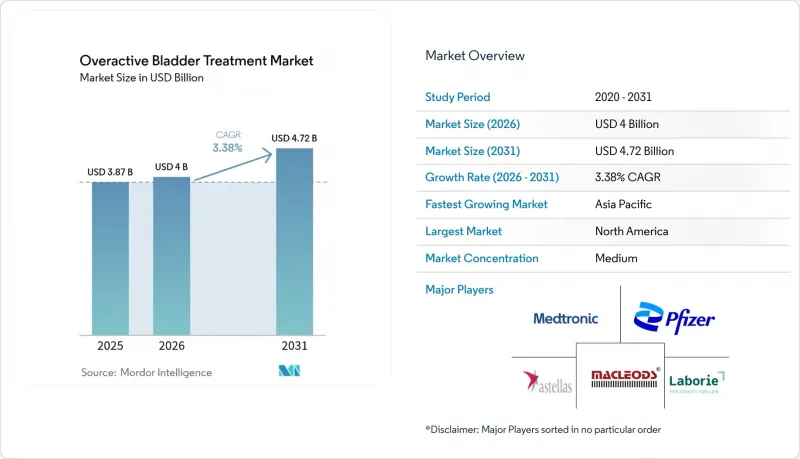
Mordor Intelligence에 의하면, 2026년 과민성 방광 치료 시장 규모는 40억 달러로 추정되며, 2025년 38억 7,000만 달러에서 2031년에는 47억 2,000만 달러에 달할 것으로 예측됩니다.
또한 2026-2031년 연평균 성장률(CAGR)은 3.38%를 기록할 것으로 전망됩니다.
본 보고서는 치료법(항콜린제, 보툴리눔툭신(보톡스) 주사, 방광 내 주입 등), 질환 유형(특발성 과활동성 방광 및 신경성 과활동성 방광), 투여 경로(경구, 경피 등), 최종 사용자(병원 등), 지역(북미, 유럽 등)별로 분류되어 있습니다. 시장 전망은 금액(달러) 기준으로 제시되어 있습니다.
전 세계 과활동성 방광 치료 시장 동향 및 인사이트
고령화와 요로 질환 유병률 증가
65세 이상 노인의 과활동성 방광 유병률은 30%를 초과하는 반면, 일반 성인 집단에서는 16-18%로 성장을 지속하고, 있습니다. 일본에서는 약 1,240만 명의 성인이 증상 관리가 필요하며, 이로 인해 보험사는 비용 대비 효과가 높은 치료 모델을 우선시하고 있습니다. 중국, 한국 및 유럽 국가들에서도 유사한 인구 통계학적 변화가 나타나고 있으며, 이는 과활동성 방광 치료 시장을 확대하는 동시에 비뇨기과 의료 체계에 대한 투자를 촉진하고 있습니다. 각국의 보험 제도가 요실금 관련 서비스를 보장 범위에 포함시키면서, 모든 경제 계층에서 약물 요법이나 의료기기를 이용한 치료법에 대한 수요가 증가하고 있습니다.
인지 기능에 미치는 영향이 긍정적인 B3 아드레날린 작용제의 도입
장기 연구에 따르면, 옥시부티닌은 65세 이상 여성에서 치매 위험을 12% 높이는 것으로 나타났으며, 이로 인해 임상의들이 B3 작용제로의 전환을 가속화하고 있습니다. 149만 명을 대상으로 한 일본의 코호트 연구에서는 미라베그론 및 비베그론에 의한 인지 기능 위험 감소가 확인되었습니다. 2024년 12월, 양성 전립선 비대증 관련 증상을 가진 남성을 대상으로 한 비베그론의 FDA 승인이 내려짐에 따라 새로운 대상 환자층이 개척되었으며, 안전성 평가가 한층 더 공고해졌습니다.
항콜린제의 장기 사용에 따른 인지 기능 안전성 우려
한국의 전국 코호트 연구에 따르면, 항콜린제는 B3 작용제와 비교하여 치매 발병률이 높은 것으로 밝혀져, 각 보험 플랜에서 약제 목록 재검토가 진행되고 있습니다. 미국 메디케어는 현재 인지 기능에 미치는 부담이 적은 치료 옵션을 우선시하고 있으며, 기존 약물의 처방량을 억제하는 한편, 새로운 작용기전을 가진 약물에 대한 투자를 촉진하고 있습니다. 임상의들은 증상 완화와 인지 위험을 저울질하는 공동 의사결정 도구를 채택하고 있으며, 이로 인해 항콜린제의 판매량은 감소 추세를 보이고 있습니다.
부문 분석
과활동성 방광 치료 시장에서 항콜린제 시장 규모는 2025년에 16억 9,000만 달러에 달하여 총 매출의 43.62%를 차지했습니다. 비용 면에서의 우위와 지침에 대한 정착으로 인해 항콜린제는 여전히 주도적인 위치를 유지하고 있지만, 인지 기능에 대한 우려가 높아지고 있어 성장이 억제되고 있습니다. B3 작용제는 2025년에 23.45%의 점유율을 차지할 것으로 예상되며, 연평균 성장률(CAGR) 7.92%로 확대될 것으로 전망되어 다른 모든 치료법을 능가하는 속도를 보일 것으로 보입니다. 이러한 급속한 성장의 배경에는 전립선 비대증이 있는 남성을 대상으로 한 비베그론의 새로운 적응증 확대가 있으며, 미라베그론의 장기 데이터가 안전성 평가를 뒷받침하고 있습니다. 보툴리눔툭신(보톡스)는 틈새 시장 지위에 머물러 있지만, 15년 동안 74.5%의 패드 완전 중단률을 자랑하며 난치성 환자를 유치하고 있습니다. 보스턴 사이언티피크(Boston Scientific)의 2024년 액소닉스(Axonics) 인수는 천골 신경 조절 요법 분야의 경쟁을 심화시켰으며, 차세대 리드 기술과 기기의 수명을 연장하는 충전식 IPG의 실현을 약속하고 있습니다.
임상 현장에서는 두록세틴·톨테로진과 같은 하이브리드 요법에 대한 임상시험이 점점 더 많이 진행되고 있으며, 혼합성 요실금 환자 집단에서 77.4%의 환자 만족도를 얻고 있습니다. 린코필린을 포함한 식물 유래 후보 물질은 M3 수용체 조절에 초점을 맞춘 탐색적 임상시험 단계에 접어들어, 저비용 혁신 계층을 추가하고 있습니다. 특허 만료로 인해 기존의 연구개발비가 억제되는 가운데, 디지털 진단 기업과 제약 기업의 제휴가 환자 식별을 가속화하여 과활동성 방광 치료 시장 전체에서 치료법의 보급을 촉진하고 있습니다.
특발성 사례는 2025년에 29억 1,000만 달러 시장 규모를 창출하며, 과활동성 방광 치료 시장 전체의 75.10%를 차지하고 있습니다. 검사 과정의 효율화와 1차 진료 현장에서의 높은 인지도가 안정적인 수요를 뒷받침하고 있습니다. 2025년에 9억 6,000만 달러 시장 규모가 예상되는 신경성 사례는 척수 손상, 파킨슨병, 다발성 경화증 환자군에 대한 모니터링 체계 강화에 힘입어 2031년까지 연평균 6.62% 성장할 전망입니다. 초음파 유도 하의 보툴리눔툭신(보톡스) 주사는 시술에 수반되는 위험을 줄이기 위해 의료 제공업체들에 의해 채택이 확대되고 있습니다. 의료기기를 이용한 치료법이나 복잡한 약제 제형에 대한 프리미엄 가격 책정은 처방량 감소를 상쇄하고, 환자 1인당 수익을 높여 제조업체의 이익률을 향상시키고 있습니다.
정책 입안자들은 적극적인 신경성 관리가 요로 감염 및 신장 합병증을 억제하여 하류 의료비 절감으로 이어진다고 지적하고 있습니다. 이러한 경제적 근거를 바탕으로 천골 신경 자극 요법이나 경골 신경 자극 요법과 같은 고가 치료법에 대한 보험 적용이 정당화되며, 과활동성 방광 치료 시장에서 신경성 관련 수익 기반이 강화되고 있습니다.
지역별 분석
북미는 2025년에 14억 9,000만 달러 시장 규모를 기록할 것으로 예상되며, 이는 과활동성 방광 치료 시장 전체의 38.55%에 해당합니다. 충실한 보험 적용과 B3 작용제의 조기 도입이 수익을 뒷받침하는 한편, 신경 조절에 관한 메디케어의 명확한 알고리즘이 의료기기 채널의 건전성을 유지하고 있습니다. 병원 시스템의 통합은 처방약 목록의 활용을 촉진하고, 승인된 새로운 인지 기능 보존형 분자의 신속한 도입을 보장하고 있습니다.
유럽은 2025년에 11억 2,000만 달러의 매출을 기록했습니다. 이는 2024년 7월 EU 전역에서 비베그론이 승인된 것이 뒷받침된 결과입니다. 표시 방식의 통일로 시장 출시 비용이 합리화되었으며, 의약품 안전성 감시 보고도 통일되었습니다. 특히 독일과 북유럽 국가에서는 각국의 국민건강보험 서비스가 장기적인 증상 관리를 평가하는 종합적 지불 방식의 시범 도입을 추진하고 있으며, 이는 의료기기 제조업체에 유리하게 작용하고 있습니다.
아시아태평양은 2025년에 8억 9,000만 달러 규모에 달할 것으로 예상되며, 2031년까지 연평균 성장률(CAGR) 7.46%를 기록할 전망으로, 모든 지역 중 가장 빠른 성장이 예상됩니다. 일본의 심각한 고령화 상황과 임상시험 인프라 덕분에 진료 지침 준수율이 향상되고 있습니다. 한편, 대만과 한국에서는 미라베그론의 지속 사용률이 68.5%인 반면, 항무스카린제의 지속 사용률은 60.4%입니다. 중국과 인도에서는 민관 협력을 통해 진단 역량을 확충하고 있으며, 과활동성 방광을 단순한 노화에 따른 정상적인 현상이 아닌 치료 가능한 질환으로 규정하고 있습니다. 의료기기 보험 환급 제도의 개선과 현지 제조 거점 확충을 통해 도입 비용이 절감되면서, 과활동성 방광 치료 시장에서 신경 조절 플랫폼의 보급이 더욱 확대되고 있습니다.
기타 혜택:
- 엑셀 형식 시장 예측(ME) 시트
- 3개월간의 애널리스트 지원
자주 묻는 질문
목차
제1장 서론
제2장 조사 방법
제3장 주요 요약
제4장 시장 구도
제5장 시장 규모와 성장 예측
제6장 경쟁 구도
제7장 시장 기회와 향후 전망
LSH 26.09.03According to Mordor Intelligence, the overactive bladder treatment market size in 2026 is estimated at USD 4 billion, growing from 2025 value of USD 3.87 billion with 2031 projections showing USD 4.72 billion, growing at 3.38% CAGR over 2026-2031.
This report is Segmented by Therapy (Anticholinergics, Botulinum Toxin Injections, Intravesical Instillation, and More), Disease Type (Idiopathic Overactive Bladder and Neurogenic Overactive Bladder), Route of Administration (Oral, Transdermal, and More), End User (Hospitals, and More), and Geography (North America, Europe, and More). The Market Forecasts are Provided in Terms of Value (USD).
Global Overactive Bladder Treatment Market Trends and Insights
Aging Population & Rising Prevalence of Urinary Disorders
People aged 65 years and older experience overactive bladder prevalence above 30%, compared with 16-18% in general adult cohorts. In Japan, roughly 12.4 million adults require symptom management, prompting payers to prioritize cost-effective care models. Similar demographic shifts in China, South Korea, and European countries enlarge the overactive bladder treatment market while encouraging health-system investment in urological capacity. As national insurance schemes expand to cover continence services, demand for pharmacologic and device-based therapies rises across all economic strata.
Adoption of B3-Adrenergic Agonists With Favorable Cognition Profile
Long-term studies link oxybutynin to a 12% higher dementia risk in women older than 65, accelerating clinician pivot toward B3-agonists. A 1.49-million-participant Japanese cohort confirmed lower cognitive risk with mirabegron and vibegron. The December 2024 FDA approval of vibegron for men with benign prostatic hyperplasia-related symptoms opens a new addressable population and reinforces the safety narrative.
Cognitive Safety Concerns of Chronic Anticholinergic Use
A Korean national cohort revealed increased dementia incidence with anticholinergics versus B3-agonists, triggering formulary re-ranking across insurance plans. U.S. Medicare now favors cognitive-sparing options, constraining legacy drug volumes while directing investment toward novel mechanisms. Clinicians adopt shared-decision tools that weigh symptom relief against cognitive risk, slowing anticholinergic unit sales.
Other drivers and restraints analyzed in the detailed report include:
- Expanding Reimbursement for Neuromodulation & Botulinum Toxin in Asia
- Growth in Tele-Urology & Digital Diagnostics
- Patent Cliffs for Leading Antimuscarinics Dampening R&D Spend
For complete list of drivers and restraints, kindly check the Table Of Contents.
Segment Analysis
The overactive bladder treatment market size for anticholinergics reached USD 1.69 billion in 2025, equal to 43.62% of total revenue. Cost advantage and guideline familiarity sustain their lead, yet mounting cognitive concerns restrain growth. B3-agonists captured 23.45% in 2025 and are forecast to expand at an 7.92% CAGR, outpacing all other modalities. Vibegron's new indication for men with benign prostatic hyperplasia underpins this surge, while mirabegron's long-term data reinforce safety perceptions. Botulinum toxin retains niche status but boasts 74.5% complete pad discontinuation over 15 years, attracting refractory cases. Boston Scientific's 2024 purchase of Axonics intensifies competition in sacral neuromodulation, promising next-generation lead technology and rechargeable IPGs that lengthen device life cycles.
Clinical practice increasingly trials hybrid protocols-such as duloxetine-tolterodine-returning 77.4% patient satisfaction in mixed incontinence cohorts. Plant-derived candidates, including rhynchophylline, enter exploratory trials focused on M3 receptor modulation, adding a low-cost innovation layer. As patent cliffs depress traditional R&D spend, alliances between digital diagnostic firms and pharma players accelerate patient identification, amplifying therapy uptake across the overactive bladder treatment market.
Idiopathic presentations generated USD 2.91 billion in 2025, translating to a 75.10% share within the overactive bladder treatment market. Streamlined work-ups and primary-care familiarity underpin consistent demand. Neurogenic cases, valued at USD 0.96 billion in 2025, will grow 6.62% annually through 2031, fueled by heightened surveillance in spinal cord injury, Parkinson's disease, and multiple sclerosis populations. Ultrasound-guided botulinum toxin injections reduce procedural risks, broadening provider adoption. Premium pricing for device-based regimens and complex pharmacologic formulations offsets smaller volumes, lifting revenue per patient and improving manufacturer margins.
Policy makers note that aggressive neurogenic management curbs urinary tract infections and renal complications, generating downstream savings. These economic arguments help justify payer coverage for high-ticket interventions such as sacral and tibial nerve stimulation, fortifying the neurogenic revenue pool in the overactive bladder treatment market.
Complete Report Scope:
- By Therapy
- Anticholinergics
- Beta-3-Adrenergic Agonists
- Botulinum Toxin Injections
- Neuromodulation & Sacral Stimulation
- Intravesical Instillation
- Combination Therapy
- Herbal & Nutraceuticals
- Other Emerging Therapies
- By Disease Type
- Idiopathic Overactive Bladder
- Neurogenic Overactive Bladder
- By Route of Administration
- Oral
- Transdermal
- Injectable
- Implantable / Device-based
- By End User
- Hospitals
- Specialty Clinics & Urology Centers
- Homecare & Telehealth
- Geography
- North America
- United States
- Canada
- Mexico
- Europe
- Germany
- United Kingdom
- France
- Italy
- Spain
- Rest of Europe
- Asia-Pacific
- China
- Japan
- India
- South Korea
- Australia
- Rest of Asia-Pacific
- Middle East and Africa
- GCC
- South Africa
- Rest of Middle East and Africa
- South America
- Brazil
- Argentina
- Rest of South America
- North America
Geography Analysis
North America produced USD 1.49 billion in 2025, equivalent to 38.55% of the overactive bladder treatment market. Robust insurance coverage and early uptake of B3-agonists sustain revenue, while Medicare's clear algorithms for neuromodulation keep device channels healthy. Hospital system consolidation encourages formulary leverage, ensuring rapid deployment of new cognitive-sparing molecules once licensed.
Europe contributed USD 1.12 billion in 2025, buttressed by the July 2024 pan-EU authorization for vibegron. Harmonized labeling streamlines launch costs and unifies pharmacovigilance reporting. National health services, particularly in Germany and the Nordics, pilot bundled payments that reward longitudinal symptom control, benefiting device makers.
Asia-Pacific, valued at USD 0.89 billion in 2025, is on track for a 7.46% CAGR to 2031, the fastest expansion among all regions. Japan's advanced aging profile and clinical trial infrastructure elevate guideline compliance, while Taiwan and South Korea report 68.5% persistence on mirabegron versus 60.4% for antimuscarinics. China and India ramp diagnostic capacity through public-private partnerships, framing overactive bladder as a treatable disorder rather than a normal aging outcome. Improved device reimbursement and local manufacturing hubs shrink acquisition costs, deepening penetration of neuromodulation platforms within the overactive bladder treatment market.
- Abbvie
- Astellas Pharma
- Pfizer
- Medtronic
- Endo International
- Hisamitsu Pharmaceutical
- Teva Pharmaceutical Industries
- Urovant Sciences (Sumitovant)
- Laborie Medical Technologies
- Macleods Pharmaceuticals Ltd.
- Johnson & Johnson
- Coloplast
- Axonics, Inc.
- Boston Scientific
- Alembic Pharmaceuticals Ltd.
- Vensica Medical
- Idorsia Pharmaceuticals Ltd.
- Organon
- Cogentix Medical
- Kyorin Pharmaceutical Co., Ltd.
Additional Benefits:
- The market estimate (ME) sheet in Excel format
- 3 months of analyst support
TABLE OF CONTENTS
1 Introduction
- 1.1 Study Assumptions & Market Definition
- 1.2 Scope of the Study
2 Research Methodology
3 Executive Summary
4 Market Landscape
- 4.1 Market Overview
- 4.2 Market Drivers
- 4.2.1 Aging Population & Rising Prevalence Of Urinary Disorders
- 4.2.2 Adoption Of Beta-3-Adrenergic Agonists With Favorable Cognition Profile
- 4.2.3 Expanding Reimbursement For Neuromodulation & Botox In Asia
- 4.2.4 Growth In Tele-Urology & Digital Diagnostics
- 4.2.5 AI-Assisted Discovery Accelerating Novel Small-Molecule Pipeline
- 4.2.6 Clinical Validation Of Plant-Derived Anti-Muscarinic Compounds
- 4.3 Market Restraints
- 4.3.1 Cognitive Safety Concerns Of Chronic Anticholinergic Use
- 4.3.2 Patent Cliffs For Leading Antimuscarinics Dampening R&D Spend
- 4.3.3 Limited Urologist Density In Low-Income Regions
- 4.3.4 Fragmented Payer Coverage For ?3-Agonists In US & EU
- 4.4 Porter's Five Forces Analysis
- 4.4.1 Threat of New Entrants
- 4.4.2 Bargaining Power of Buyers
- 4.4.3 Bargaining Power of Suppliers
- 4.4.4 Threat of Substitute Products
- 4.4.5 Intensity of Competitive Rivalry
5 Market Size & Growth Forecasts (Value, USD)
- 5.1 By Therapy
- 5.1.1 Anticholinergics
- 5.1.2 Beta-3-Adrenergic Agonists
- 5.1.3 Botulinum Toxin Injections
- 5.1.4 Neuromodulation & Sacral Stimulation
- 5.1.5 Intravesical Instillation
- 5.1.6 Combination Therapy
- 5.1.7 Herbal & Nutraceuticals
- 5.1.8 Other Emerging Therapies
- 5.2 By Disease Type
- 5.2.1 Idiopathic Overactive Bladder
- 5.2.2 Neurogenic Overactive Bladder
- 5.3 By Route of Administration
- 5.3.1 Oral
- 5.3.2 Transdermal
- 5.3.3 Injectable
- 5.3.4 Implantable / Device-based
- 5.4 By End User
- 5.4.1 Hospitals
- 5.4.2 Specialty Clinics & Urology Centers
- 5.4.3 Homecare & Telehealth
- 5.5 Geography
- 5.5.1 North America
- 5.5.1.1 United States
- 5.5.1.2 Canada
- 5.5.1.3 Mexico
- 5.5.2 Europe
- 5.5.2.1 Germany
- 5.5.2.2 United Kingdom
- 5.5.2.3 France
- 5.5.2.4 Italy
- 5.5.2.5 Spain
- 5.5.2.6 Rest of Europe
- 5.5.3 Asia-Pacific
- 5.5.3.1 China
- 5.5.3.2 Japan
- 5.5.3.3 India
- 5.5.3.4 South Korea
- 5.5.3.5 Australia
- 5.5.3.6 Rest of Asia-Pacific
- 5.5.4 Middle East and Africa
- 5.5.4.1 GCC
- 5.5.4.2 South Africa
- 5.5.4.3 Rest of Middle East and Africa
- 5.5.5 South America
- 5.5.5.1 Brazil
- 5.5.5.2 Argentina
- 5.5.5.3 Rest of South America
- 5.5.1 North America
6 Competitive Landscape
- 6.1 Market Concentration
- 6.2 Market Share Analysis
- 6.3 Company Profiles (includes Global level Overview, Market level overview, Core Segments, Financials as available, Strategic Information, Market Rank/Share for key companies, Products & Services, and Recent Developments)
- 6.3.1 AbbVie Inc.
- 6.3.2 Astellas Pharma Inc.
- 6.3.3 Pfizer Inc.
- 6.3.4 Medtronic plc
- 6.3.5 Endo International plc
- 6.3.6 Hisamitsu Pharmaceutical Co., Inc.
- 6.3.7 Teva Pharmaceutical Industries Ltd.
- 6.3.8 Urovant Sciences (Sumitovant)
- 6.3.9 Laborie Medical Technologies
- 6.3.10 Macleods Pharmaceuticals Ltd.
- 6.3.11 Johnson & Johnson (Ethicon)
- 6.3.12 Coloplast A/S
- 6.3.13 Axonics, Inc.
- 6.3.14 Boston Scientific Corp.
- 6.3.15 Alembic Pharmaceuticals Ltd.
- 6.3.16 Vensica Medical
- 6.3.17 Idorsia Pharmaceuticals Ltd.
- 6.3.18 Organon & Co.
- 6.3.19 Cogentix Medical
- 6.3.20 Kyorin Pharmaceutical Co., Ltd.
7 Market Opportunities & Future Outlook
- 7.1 White-space & Unmet-need Assessment


