|
시장보고서
상품코드
2122451
귀금속 촉매 : 시장 점유율 분석, 업계 동향과 통계, 성장 예측(2026-2031년)Precious Metal Catalysts - Market Share Analysis, Industry Trends & Statistics, Growth Forecasts (2026 - 2031) |
||||||
 Mordor Intelligence
Mordor Intelligence에 의하면, 귀금속 촉매 시장 규모는 2025년에 445.60톤으로 평가되었고, 2026년 449.12톤에서 2031년까지 467.14톤에 이를 것으로 예측되며, 예측 기간(2026년-2031년) CAGR은 0.79%를 기록할 전망입니다.
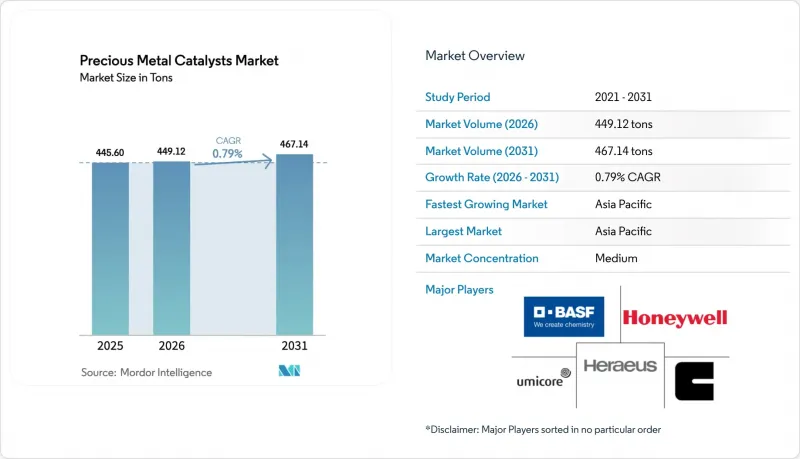
본 보고서는 금속 유형(백금, 팔라듐 등), 촉매 형태(분말, 펠릿/비즈 등), 제조 공정(초기 습윤 함침법, 무전해 도금 및 전기화학적 도금 등),용도(자동차, 의약품 등), 지역(아시아태평양, 북미, 유럽 등)별로 분류되어 있습니다. 시장 전망은 수량(톤) 단위로 제시되어 있습니다.
세계 귀금속 촉매 시장 동향 및 인사이트
더욱 엄격해진 배기가스 및 고정 배출원 배출 기준
유럽연합 집행위원회는 2027년 시행을 목표로 2025년 말에 ‘유로 7’을 최종 확정하고, 각 OEM 업체에 차량 1대당 로듐 및 팔라듐 적재량을 15-20% 늘릴 것을 의무화했습니다. 2024년 7월에 시행되는 중국의 ‘국가 VI-b’에 따라, 2025년에는 국내 자동차 제조업체의 PGM 촉매 수요가 12% 증가할 것으로 보입니다. 인도의 ‘바라트 스테이지 VII’(2028년 4월)에서는 실제 주행 배기가스 규제 상한선이 이륜차로도 확대되어 새로운 대상 부문이 생겨납니다. 또한, 미국 환경보호청(EPA)의 Tier 4 Final 기준에 따라 비도로용 디젤 엔진용 백금계 산화 촉매 수요도 동시에 증가하고 있습니다. 그 결과, 부가가치가 높은 제품 구성이 실현되어 내연기관(ICE) 판매 대수의 부진을 부분적으로 상쇄하게 될 것입니다.
석유 정제 업계의 고옥탄가 청정 연료로의 전환
국제해사기구(IMO)의 황 배출 상한 규제와 지역별 저유황 휘발유 의무화에 따라, 수소화 처리 공정에서 알루미나 지지 백금 촉매를 우선적으로 사용하는 정유시설의 설비 갱신이 진행되고 있습니다. 2024년에 가동을 시작한 사우디 아람코의 자잔 정유시설에서는 수소화 분해 라인 전체에 200톤 이상의 귀금속 촉매가 도입되었습니다. 릴라이언스 인더스트리즈는 잠나가르 공장의 BS-VII 규제 대응을 위해 2025년에 12억 달러를 계상하고 있으며, 이는 백금·레늄 촉매 수요 증가를 뒷받침하고 있습니다. 이러한 투자는 BEV(배터리 전기자동차)의 보급에 따른 자동차용 촉매 수요 감소를 상쇄하는 병행된 성장 경로를 뒷받침하고 있습니다.
PGM 가격의 지속적인 변동과 공급 충격
2025년, 남아프리카공화국의 광산 가동 중단으로 공급량이 18% 감소함에 따라, 로듐 가격은 온스당 9,200달러에서 1만 4,000달러 사이에서 변동했습니다. 러시아의 팔라듐 수출은 제재 조치로 인해 40톤 감소했으며, 유럽의 합금 제조업체들은 고가의 재활용 금속을 구매할 수밖에 없었습니다. 이리듐은 전해조 수주로 인해 35% 급등했으며, 일부 PEM 프로젝트가 연기되었습니다. 재활용 기능을 통합하지 않은 2차 공급업체들은 고정 가격 계약 하에서 400-600 베이시스 포인트의 마진 압박을 감수해야 했습니다.
부문별 분석
백금은 자동차용 촉매, 정유시설, 의약품 분야에서의 범용성을 강점으로 삼아 2025년에도 40.92%의 점유율을 유지했습니다. 이리듐은 절대량으로는 적지만, PEM 전해조 도입을 배경으로 연평균 성장률(CAGR) 3.01%로 확대되고 있습니다. 루테늄은 공정 경제성 향상을 목적으로 염소-알칼리 및 암모니아용 촉매 분야에서 틈새 시장을 개척하고 있습니다. AI를 통해 최적화된 나노 입자 덕분에 1MW 전해조에서의 이리듐 사용량이 절반으로 줄어들면서 ‘양보다 가치’라는 경향이 더욱 강화되고 있습니다.
여기서 중요한 것이 원자층 증착법입니다. 존슨 매시(Johnson Massey)사는 이산화티타늄 위에 이리듐 도트를 형성함으로써 산소 발생 속도를 50% 향상시키고, MW당 금속 사용량을 절반으로 줄이는 데 성공했습니다. 백금의 경우, 팔라듐과의 가격 차이가 줄어들면서 가격 상승 여지가 생겨, 배합에 대한 시행착오가 계속되고 있습니다.
분말 촉매는 2025년 수요의 52.98%를 차지하며, 재생이 용이하기 때문에 제약 업계의 배치 반응기나 정유시설의 고정층에서 주류를 이루고 있습니다. 자동차 및 고정식 배기가스 처리 시스템에서는 낮은 압력 손실이 중요시되므로, 워시 코팅된 모노리스는 연평균 성장률(CAGR) 1.66%로 성장하고 있습니다. 유미코어(Yumicore)사의 2025년형 로듐 프리 모노리스는 PGM 총 사용량을 30% 줄이면서도 유로 VI 규제 기준을 충족합니다. 펠릿 형태는 기계적 강도가 비용을 상쇄할 수 있는 수소화 반응기를 대상으로 합니다. 높은 통합 효율 덕분에 모노리스는 배기가스 제어 연구 개발의 최전선에 서 있지만, 배치 처리의 유연성이 중시되는 분야에서는 분말이 여전히 우위를 점하고 있습니다.
지역별 분석
아시아태평양은 2025년 시장 규모의 39.82%를 차지하고 있으며, 중국의 NEV 정책으로 인한 역풍에도 불구하고 연평균 성장률(CAGR) 1.22%로 성장할 전망입니다. 중국의 ‘국가 VI-b’ 기준에 따라 2025년에는 내연기관(ICE) 1대당 PGM 사용량이 14% 증가하여 촉매 수요 감소를 완화하고 있습니다. 일본의 3,000억 엔 규모의 전해조 보조금에 힘입어 공급망은 이리듐 재활용으로 전환되고 있으며, 타나카는 PEM 촉매 생산 능력을 3배로 확대되고 있습니다. 인도의 ‘바랏 스테이지 VII’에 따라 이륜차용 촉매 보급률은 현재 40% 미만에서 상승할 전망이며, 상당한 상승 여지가 생길 것으로 보입니다. 한국에서는 2025년에 1만 2,000대의 ‘NEXO’가 인도되면서 백금 음극 수요량이 견조하게 유지되었습니다.
북미는 여전히 고부가가치 시장입니다. 미국의 정제업체들은 2025년 Tier 3 황 규제 요건을 충족하기 위해 8톤의 백금 촉매를 도입했습니다. 유럽에서는 30억 유로 규모의 전해조 투자로 인해 이리듐 수요가 독일, 스페인, 네덜란드에 집중되고 있습니다. 남미에서는 브라질의 에탄올 혼합 의무화에 힘입어 백금·레늄계 개질 촉매 구매가 촉진되고 있습니다. 중동에서는 자잔에 신설된 수소화 분해 플랜트가 긍정적인 영향을 미치고 있으며, 남아프리카에서는 국내 PGM 광산을 활용하여 경쟁력 있는 재활용 물류를 실현하고 있습니다.
기타 혜택:
- 엑셀 형식 시장 예측(ME) 시트
- 3개월간의 애널리스트 지원
자주 묻는 질문
목차
제1장 서론
제2장 조사 방법
제3장 주요 요약
제4장 시장 구도
제5장 시장 규모와 성장 예측
제6장 경쟁 구도
제7장 시장 기회와 향후 전망
LSH 26.09.03According to Mordor Intelligence, the precious metal catalysts market size was valued at 445.60 tons in 2025 and is estimated to grow from 449.12 tons in 2026 to reach 467.14 tons by 2031, at a CAGR of 0.79% during the forecast period (2026-2031).
This report is Segmented by Metal Type (Platinum, Palladium, and More), Catalyst Form (Powder, Pellet/Bead, and More), Manufacturing Process (Incipient Wetness Impregnation, Electroless and Electrochemical Deposition, and More), Application (Automotive, Pharmaceutical, and More), and Geography (Asia-Pacific, North America, Europe, and More). Market Forecasts are Provided in Terms of Volume (Tons).
Global Precious Metal Catalysts Market Trends and Insights
Stricter Tail-Pipe and Stationary-Emission Standards
The European Commission finalized Euro 7 in late 2025 for 2027 implementation, forcing OEMs to raise rhodium and palladium loadings by 15-20% per vehicle. China's National VI-b, effective July 2024, triggered a 12% increase in PGM catalyst demand among domestic automakers in 2025. India's Bharat Stage VII (April 2028) will extend real-driving-emission caps to two-wheelers, creating a fresh addressable segment. U.S. EPA Tier 4 Final standards are simultaneously boosting platinum-based oxidation catalysts for non-road diesel engines. The net result is a value-accretive mix enrichment that partially offsets stagnant ICE volumes.
Petro-Refinery Shift to Higher-Octane Clean Fuels
International Maritime Organization sulfur caps and regional low-sulfur gasoline mandates are driving refinery upgrades that favor platinum-on-alumina catalysts for hydroprocessing. Saudi Aramco's Jazan refinery, commissioned in 2024, deployed more than 200 tons of precious-metal catalysts across its hydrocracking trains. Reliance Industries earmarked USD 1.2 billion in 2025 for BS-VII compliance at Jamnagar, anchoring incremental demand for platinum-rhenium catalysts. These investments underpin a parallel growth avenue that balances BEV-driven autocatalyst attrition.
Persistent PGM Price Volatility and Supply Shocks
Rhodium vacillated between USD 9,200 and USD 14,000/oz in 2025 after South African mine outages cut supply by 18%. Russian palladium exports fell 40 tons under sanctions, forcing European formulators to buy higher-priced recycled metal. Iridium jumped 35% on electrolyzer orders, deferring several PEM projects. Tier 2 suppliers without integrated recycling absorbed a 400-600 bp margin compression under fixed-price contracts.
Other drivers and restraints analyzed in the detailed report include:
- Platinum Substitution for Palladium in Tri-Metal Autocatalysts
- Green-Hydrogen Build-Out Spurring Ir/Pt Catalyst Demand
- EV Penetration Shrinking ICE Autocatalyst Demand
For complete list of drivers and restraints, kindly check the Table Of Contents.
Segment Analysis
Platinum retained a 40.92% share in 2025, anchored by its versatility across autocatalyst, refinery, and pharmaceutical platforms. Iridium, though small in absolute terms, is expanding at a 3.01% CAGR on the back of PEM electrolyzer deployment. Ruthenium is carving a niche in chlor-alkali and ammonia catalysts for process-economic gains. AI-optimized nanoparticles are halving iridium intensity in 1-MW electrolyzers, reinforcing a value-over-volume trajectory.
Atomic-layer deposition is crucial here: Johnson Matthey demonstrated 50% higher oxygen-evolution rates with iridium dots on titanium oxide, cutting metal intensity per MW in half. For platinum, narrowing discounts to palladium are opening price headroom that sustains formulation experimentation.
Powder catalysts accounted for 52.98% of 2025 demand, dominating pharmaceutical batch reactors and refinery fixed beds thanks to easy regeneration. Wash-coated monoliths are growing at a 1.66% CAGR, as automotive and stationary emission systems prize low pressure drop. Umicore's 2025 rhodium-free monolith meets Euro VI limits with 30% less total PGM. Pellet forms target hydrogenation reactors where mechanical strength offsets costs. Integration efficiencies place monoliths at the forefront of emission-control research and development, while powders retain primacy where batch flexibility prevails.
Complete Report Scope:
- By Metal Type
- Platinum
- Palladium
- Rhodium
- Iridium
- Ruthenium
- Other Metal Types (Osmium, Gold, Silver)
- By Catalyst Form
- Powder
- Pellet / Bead
- Extrudate and Honeycomb
- Wash-coated Monolith
- By Manufacturing Process
- Incipient Wetness Impregnation
- Electroless and Electrochemical Deposition
- Chemical Vapour / Atomic Layer Deposition
- Sol-Gel / Precipitation
- Other Advanced Nano-structuring
- By Application
- Automotive
- Pharmaceutical
- Petrochemicals
- Other Applications (Electronics and Semiconductor, Fuel Cells, etc.)
- By Geography
- Asia-Pacific
- China
- Japan
- India
- South Korea
- ASEAN Countries
- Rest of Asia-Pacific
- North America
- United States
- Canada
- Mexico
- Europe
- Germany
- United Kingdom
- France
- Italy
- Rest of Europe
- South America
- Brazil
- Argentina
- Rest of South America
- Middle East and Africa
- Saudi Arabia
- South Africa
- Rest of Middle-East and Africa
- Asia-Pacific
Geography Analysis
Asia-Pacific controlled 39.82% of the 2025 volume and is set to grow at a 1.22% CAGR despite China's NEV policy headwinds. China's National VI-b raised PGM loadings per ICE by 14% in 2025, cushioning catalyst volume decline. Japan's JPY 300 billion electrolyzer subsidy is pivoting the supply chain toward iridium recycling, with TANAKA tripling PEM catalyst capacity. India's Bharat Stage VII will boost two-wheeler catalyst penetration from below 40% today, adding significant upside. South Korea's 12,000 NEXO deliveries in 2025 kept platinum cathode volumes buoyant.
North America remains value-dense: U.S. refiners installed 8 tons of platinum catalysts to meet Tier 3 sulfur requirements in 2025. Europe's EUR 3 billion electrolyzer funding is funneling iridium demand into Germany, Spain, and the Netherlands. South America leans on Brazil's ethanol blend mandate, driving platinum-rhenium reforming catalyst purchases. The Middle East benefits from new hydrocracking trains at Jazan, while South Africa leverages domestic PGM mining for competitive recycling logistics.
- ALS
- American Elements
- BASF
- Catalytic Products International
- CHIMET
- Clariant
- Evonik Industries AG
- Heraeus Precious Metals
- Honeywell International, Inc.
- Kaili Catalyst New Materials Co., Ltd.
- ReMetall Deutschland AG
- Sabin Metal Corp.
- Shaanxi Kaida Chemical Co., Ltd.
- Stanford Advanced Materials
- Takasago International Corporation
- TANAKA Precious Metal Group Co., Ltd.
- Thermo Fisher Scientific Inc.
- Umicore
- Valterra Platinum Limited
Additional Benefits:
- The market estimate (ME) sheet in Excel format
- 3 months of analyst support
TABLE OF CONTENTS
1 Introduction
- 1.1 Study Assumptions and Market Definition
- 1.2 Scope of the Study
2 Research Methodology
3 Executive Summary
4 Market Landscape
- 4.1 Market Overview
- 4.2 Market Drivers
- 4.2.1 Stricter tail-pipe and stationary-emission standards
- 4.2.2 Petro-refinery shift to higher-octane clean fuels
- 4.2.3 Platinum substitution for palladium in tri-metal autocatalysts
- 4.2.4 Green-hydrogen build-out spurring Ir/Pt catalyst demand
- 4.2.5 AI-designed reaction pathways trimming PGM loadings
- 4.3 Market Restraints
- 4.3.1 Persistent PGM price volatility and supply shocks
- 4.3.2 EV penetration shrinking ICE autocatalyst demand
- 4.3.3 Rising recycling rates denting primary demand
- 4.4 Value Chain Analysis
- 4.5 Porter's Five Forces
- 4.5.1 Threat of New Entrants
- 4.5.2 Bargaining Power of Suppliers
- 4.5.3 Bargaining Power of Buyers
- 4.5.4 Threat of Substitutes
- 4.5.5 Competitive Rivalry
5 Market Size and Growth Forecasts (Volume)
- 5.1 By Metal Type
- 5.1.1 Platinum
- 5.1.2 Palladium
- 5.1.3 Rhodium
- 5.1.4 Iridium
- 5.1.5 Ruthenium
- 5.1.6 Other Metal Types (Osmium, Gold, Silver)
- 5.2 By Catalyst Form
- 5.2.1 Powder
- 5.2.2 Pellet / Bead
- 5.2.3 Extrudate and Honeycomb
- 5.2.4 Wash-coated Monolith
- 5.3 By Manufacturing Process
- 5.3.1 Incipient Wetness Impregnation
- 5.3.2 Electroless and Electrochemical Deposition
- 5.3.3 Chemical Vapour / Atomic Layer Deposition
- 5.3.4 Sol-Gel / Precipitation
- 5.3.5 Other Advanced Nano-structuring
- 5.4 By Application
- 5.4.1 Automotive
- 5.4.2 Pharmaceutical
- 5.4.3 Petrochemicals
- 5.4.4 Other Applications (Electronics and Semiconductor, Fuel Cells, etc.)
- 5.5 By Geography
- 5.5.1 Asia-Pacific
- 5.5.1.1 China
- 5.5.1.2 Japan
- 5.5.1.3 India
- 5.5.1.4 South Korea
- 5.5.1.5 ASEAN Countries
- 5.5.1.6 Rest of Asia-Pacific
- 5.5.2 North America
- 5.5.2.1 United States
- 5.5.2.2 Canada
- 5.5.2.3 Mexico
- 5.5.3 Europe
- 5.5.3.1 Germany
- 5.5.3.2 United Kingdom
- 5.5.3.3 France
- 5.5.3.4 Italy
- 5.5.3.5 Rest of Europe
- 5.5.4 South America
- 5.5.4.1 Brazil
- 5.5.4.2 Argentina
- 5.5.4.3 Rest of South America
- 5.5.5 Middle East and Africa
- 5.5.5.1 Saudi Arabia
- 5.5.5.2 South Africa
- 5.5.5.3 Rest of Middle-East and Africa
- 5.5.1 Asia-Pacific
6 Competitive Landscape
- 6.1 Market Concentration
- 6.2 Strategic Moves
- 6.3 Market Share (%)/Ranking Analysis
- 6.4 Company Profiles (includes Global level Overview, Market level overview, Core Segments, Financials as available, Strategic Information, Products and Services, and Recent Developments)
- 6.4.1 ALS
- 6.4.2 American Elements
- 6.4.3 BASF
- 6.4.4 Catalytic Products International
- 6.4.5 CHIMET
- 6.4.6 Clariant
- 6.4.7 Evonik Industries AG
- 6.4.8 Heraeus Precious Metals
- 6.4.9 Honeywell International, Inc.
- 6.4.10 Kaili Catalyst New Materials Co., Ltd.
- 6.4.11 ReMetall Deutschland AG
- 6.4.12 Sabin Metal Corp.
- 6.4.13 Shaanxi Kaida Chemical Co., Ltd.
- 6.4.14 Stanford Advanced Materials
- 6.4.15 Takasago International Corporation
- 6.4.16 TANAKA Precious Metal Group Co., Ltd.
- 6.4.17 Thermo Fisher Scientific Inc.
- 6.4.18 Umicore
- 6.4.19 Valterra Platinum Limited
7 Market Opportunities and Future Outlook
- 7.1 White-space and Unmet-need Assessment