

|
시장보고서
상품코드
2122458
실리콘 첨가제 : 시장 점유율 분석, 업계 동향과 통계, 성장 예측(2026-2031년)Silicone Additives - Market Share Analysis, Industry Trends & Statistics, Growth Forecasts (2026 - 2031) |
||||||
 Mordor Intelligence
Mordor Intelligence에 의하면, 실리콘 첨가제 시장 규모는 2025년에 20억 9,000만 달러로 평가되었고, 2026년22억 2,000만 달러에서 2031년까지 29억 8,000만 달러에 이를 것으로 예측되며, 예측 기간(2026년-2031년) CAGR은 6.11%를 기록할 전망입니다.
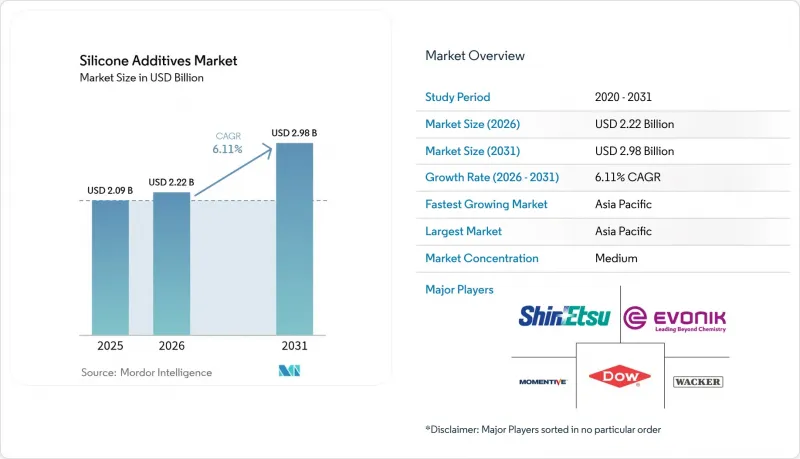
본 보고서는 제품 형태(유체·오일, 엘라스토머·검, 기타),용도(소포제, 유변학 조절제, 기타), 최종 사용자 산업(식품 및 음료, 플라스틱·복합재료, 기타), 지역(아시아태평양, 북미, 유럽, 남미, 중동 및 아프리카)별로 분류되어 있습니다. 시장 예측은 금액(달러) 기준으로 제시되어 있습니다.
세계 실리콘 첨가제 시장 동향 및 인사이트
퍼스널케어 업계 수요 증가
소비자들은 가볍고 끈적임 없는 텍스처를 선호하는 경향이 있으며, 이에 따라 제형 개발자들은 비단처럼 부드러운 발림성과 지속적인 보습 효과를 제공하는 실리콘 플루이드를 선호하여 채택하고 있습니다. 예를 들어, 신에츠 화학공업의 엘라스토머 인 오일(Elastomer-in-Oil) 제품 라인은 사이클릭 실록산에 대한 지역별 규제를 충족하면서, 바람직한 피부 감촉을 유지하는 안정적인 유중수형 에멀젼을 형성합니다. 각 공급업체들은 엘켐(Elkem)의 ‘PURESIL ORG’ 젤 등 식물 유래 C13-15 알칸계 캐리어를 잇달아 출시하며, 우수한 사용감과 ‘내추럴’이라는 포지셔닝을 동시에 달성할 수 있음을 입증하고 있습니다. 아시아태평양의 브랜드들은 이러한 특성을 활용하여 세계적인 프리미엄 브랜드와의 격차를 좁히고, 컬러 코스메틱 및 자외선 차단제 분야의 실리콘 첨가제 시장을 확대되고 있습니다.
페인트 및 코팅 분야에서 저VOC 제품에 대한 관심이 높아지고 있습니다.
유럽과 북미의 입법 기관은 허용되는 용제 함유량에 상한선을 설정하고 있어, 저VOC 준수는 단순한 특징이 아닌 필수 조건이 되었습니다. 에보닉(Evonik)의 ‘TEGO Guard 9000’은 친환경 라벨의 기준치를 초과하지 않으면서 외장용 도료에 초기 강우 내성을 부여합니다. 실텍(Siltech)은 장쇄 알킬 실리콘이 고형분 함량을 높이는 동시에 총 VOC량을 줄일 수 있음을 입증했으며, 이를 통해 제형 개발자는 내구성을 유지하면서 그린 씰(Green Seal) 및 LEED 목표를 달성할 수 있게 되었습니다. 이러한 파급 효과는 신흥 시장까지 미치고 있으며, 건설업체들은 오염을 방지하고 장기적인 발색 유지를 실현하기 위해 실리콘계 표면 첨가제가 배합된 수성 도료의 지정이 점점 늘어나고 있습니다.
고온 조건에서의 첨가제 이동
200°C를 초과하면 저분자량 시록산이 표면으로 스며나와 광학적 투명도를 저하시키거나 밀착력을 약화시킬 가능성이 있습니다. 고페닐 실리콘 고무에 대한 연구에서는 478°C에서 무게 손실이 불과 5%에 그치는 등 열 안정성이 향상된 것으로 밝혀졌지만, 고품질 등급은 비용 증가로 이어집니다. EV의 구동 모터나 항공우주용 덕트에는 휘발을 억제하는 배합이 요구되고 있어, 연구개발 예산에 부담이 가중되고 있습니다.
부문 분석
2025년 실리콘 첨가제 시장에서 실리콘 유체는 매출액 기준으로 38.87%를 차지했습니다. 이는 코팅, 퍼스널케어, 윤활제 분야에서 미끄럼제, 레벨링제, 열전달제로 널리 사용되고 있기 때문입니다. 낮은 표면 장력과 폭넓은 온도 안정성이 견고한 수요 기반을 뒷받침하고 있습니다. 에멀젼과 수지는 특히 건설용 실란트 분야에서 수성 시스템 및 구조용 마감을 가능하게 함으로써 유체를 보완하고 있습니다. 대조적으로, 엘라스토머는 지속적인 탄성이 요구되는 개스킷, 씰, 의료용 튜브와 같은 틈새 시장을 담당하고 있습니다.
분말 및 과립은 매출의 4분의 1 미만에 그치지만, 2031년까지 연평균 성장률(CAGR) 7.34%로 가장 높은 성장률을 보이고 있습니다. 이러한 건조 형태는 3D 프린팅 원료 및 마스터배치 배합에 유용하며, 배합 설계자에게 정밀한 유변학 제어와 분진 없는 계량을 실현해 줍니다. 새롭게 등장한 UV 경화형 폴리실록산 분말은 신속한 프로토타입 제작을 위한 온디맨드 가교를 간소화하여 설계부터 부품 완성까지의 주기를 단축하는 동시에, 적층 가공용 실리콘 첨가제 시장 규모를 확대되고 있습니다. 프린터 도입이 항공우주 분야에서 치과 및 소비재 분야로 확대됨에 따라, 분말 실리콘은 새로운 성장의 길을 열어가고 있습니다.
지역별 분석
아시아태평양은 2025년에 매출 점유율 46.81%로 실리콘 첨가제 시장의 선두를 차지할 것이며, 2031년까지 연평균 성장률(CAGR) 6.92%로 성장을 이어갈 전망입니다. 중국의 장자강 및 난징 클러스터는 와커(Wacker)와 엘켐(Elkem)에게 업스트림 실록산 생산 능력의 거점이 되어, 전자 및 전기차 배터리 대기업에 대한 공급의 근접성을 확보하고 있습니다. 인도의 ‘메이크 인 인디아(Make in India)’ 정책은 품질을 중시하는 코팅재 및 접착제에 대한 국내 수요를 자극하고 있으며, 현지 배합 제조업체들은 고급스러운 마감과 내구성을 실현하기 위해 실리콘 첨가제를 채택할 수밖에 없는 상황입니다. 일본과 한국은 각각 고도의 연구 개발을 추진하고 있으며, 실리콘 첨가제를 고주파 전자기기, 포토닉스, 특수 필름 분야에 활용하고 있습니다.
북미는 성숙해 가면서도 혁신이 풍부한 시장으로서 이를 뒤따르고 있습니다. 미국은 FDA/USP를 준수하는 실리콘 시스템을 활용하여 의료기기 및 항공우주용 복합재료로의 채택을 주도하고 있습니다. 미시간주에서 진행되고 있는 다우(Dow)사의 실리콘 재활용 시범 사업은 폴리디메틸실록산(PDMS)의 탄소 발자국을 50% 감축하는 것을 목표로 하고 있으며, ESG 요건을 중시하는 구매자들의 공감을 얻고 있습니다. 캐나다의 전기차(EV) 배터리 투자와 멕시코의 자동차 산업 클러스터는 열 관리용 첨가제 수요를 서서히 끌어올릴 것으로 기대됩니다.
유럽은 시장 규모 면에서는 3위이지만, 지속가능성 기준의 엄격함 면에서는 1위입니다. REACH 규정과 임박한 PFAS 금지 조치로 인해, 고리 구조를 포함하지 않는 실리콘 및 바이오 대체재에 대한 연구 개발이 활발해지고 있습니다. 에보닉의 ‘Smart Effects’ 사업부는 실록산과 유기 특수 화학 물질을 결합하여 경량화, e-모빌리티, 디지털 헬스 시장에 대응하고 있습니다. 독일과 프랑스는 자동차 전동화에 대한 보조금을 집중적으로 투입하고 있는 반면, 영국은 생명과학용 코팅을 중시하고 있어, 이를 통해 고수익률의 수주가 안정적으로 유입되는 상황이 유지되고 있습니다.
기타 혜택:
- 엑셀 형식 시장 예측(ME) 시트
- 3개월간의 애널리스트 지원
자주 묻는 질문
목차
제1장 서론
제2장 조사 방법
제3장 주요 요약
제4장 시장 구도
제5장 시장 규모와 성장 예측
제6장 경쟁 구도
제7장 시장 기회와 향후 전망
LSH 26.09.03According to Mordor Intelligence, the silicone additives market size was valued at USD 2.09 billion in 2025 and estimated to grow from USD 2.22 billion in 2026 to reach USD 2.98 billion by 2031, at a CAGR of 6.11% during the forecast period (2026-2031).
This report is Segmented by Product Form (Fluids and Oils, Elastomers and Gums, and More), Application (Defoamers, Rheology Modifiers, and More), End-User Industry (Food and Beverage, Plastics and Composites, and More), and Geography (Asia-Pacific, North America, Europe, South America, Middle East and Africa). The Market Forecasts are Provided in Terms of Value (USD).
Global Silicone Additives Market Trends and Insights
Increase in Demand from Personal Care Industry
Consumers gravitate toward light, non-oily textures, prompting formulators to favor silicone fluids for silky spread and lasting moisture. Shin-Etsu's elastomer-in-oil line, for example, builds stable oil-in-water emulsions that meet regional bans on cyclic siloxanes while sustaining the desired skin-feel. Suppliers are rolling out plant-origin C13-15 alkane carriers such as Elkem's PURESIL ORG gels, proving that sensory performance and natural positioning can coexist. Asia-Pacific labels are leveraging these attributes to bridge gaps with global premium brands, widening the silicone additives market in color cosmetics and sun care.
Growing Focus on Low-VOC Products in Paints and Coatings
Legislators in Europe and North America cap allowable solvent content, making low-VOC compliance a prerequisite rather than a feature. Evonik's TEGO Guard 9000 delivers early-rain resistance in exterior coatings without breaching eco-label thresholds. Siltech has shown that long-chain alkyl silicones lift solids content yet cut VOC totals, letting formulators maintain durability while meeting Green Seal or LEED targets. The ripple effect extends to emerging markets, where builders increasingly specify water-based paints fortified with silicone surface additives for stain repellence and long-term color retention.
Additive Migration at High Temperatures
Above 200 °C, low-molecular-weight siloxanes can bleed to surfaces, dulling optical clarity or weakening adhesion. Studies on high-phenyl silicone rubbers reveal improved thermal stability, with only 5% weight loss at 478 °C, yet premium grades raise costs. EV traction motors and aerospace ducting need formulations that curb volatilization, pressuring R&D budgets.
Other drivers and restraints analyzed in the detailed report include:
- Growing Demand from Food-Processing Industry
- Increasing Usage in Medical and Healthcare Applications
- Volatile Raw-Material Costs
For complete list of drivers and restraints, kindly check the Table Of Contents.
Segment Analysis
Silicone fluids accounted for 38.87% of the silicone additives market in 2025 by revenue, riding on wide use as slip, leveling, and heat-transfer agents in coatings, personal care, and lubricants. Their low surface tension and broad temperature stability underpin a resilient demand base. Emulsions and resins complement fluids by enabling water-borne systems and structural finishes, particularly in construction sealants. In contrast, elastomers address gasket, seal, and medical-tube niches needing lasting elasticity.
Powders and granules, although less than one-quarter of sales, post the fastest 7.34% CAGR through 2031. Their dry format aids 3D printing feedstocks and masterbatch compounding, granting formulators fine rheology control and dust-free dosing. Emerging UV-curable polysiloxane powders simplify on-demand cross-linking for rapid prototypes, shrinking design-to-part cycles and enlarging the silicone additives market size for additive manufacturing. As printer fleets spread beyond aerospace into dental and consumer goods, powdered silicones capture fresh avenues for growth.
Complete Report Scope:
- By Product Form
- Fluids and Oils
- Elastomers and Gums
- Resins
- Powders and Granules
- Emulsions
- By Application
- Defoamers
- Rheology Modifiers
- Surfactants
- Wetting and Dispersing Agents
- Lubricating Agents
- Adhesion Promoters
- Other Applications (Release Agents, etc.)
- By End-User Industry
- Food and Beverage
- Plastics and Composites
- Paints and Coatings
- Personal Care
- Adhesives and Sealants
- Paper and Pulp
- Oil and Gas
- Other End-User Industries (Electronics and Semiconductor, etc.)
- Geography
- Asia-Pacific
- China
- Japan
- India
- South Korea
- ASEAN Countries
- Rest of Asia-Pacific
- North America
- United States
- Canada
- Mexico
- Europe
- Germany
- United Kingdom
- France
- Italy
- Spain
- Russia
- NORDIC Countries
- Rest of Europe
- South America
- Brazil
- Argentina
- Rest of South America
- Middle East and Africa
- Saudi Arabia
- South Africa
- Rest of Middle East and Africa
- Asia-Pacific
Geography Analysis
Asia-Pacific sat atop the silicone additives market with 46.81% revenue share in 2025 and is marching at a 6.92% CAGR toward 2031. China's Zhangjiagang and Nanjing clusters anchor upstream siloxane capacity for Wacker and Elkem, ensuring supply proximity to electronics and EV battery giants. India's "Make in India" policy stokes domestic demand for quality-driven coatings and adhesives, compelling local formulators to incorporate silicone additives for premium finish and durability. Japan and South Korea each foster advanced R&D, channeling silicone additives into high-frequency electronics, photonics, and specialty films.
North America follows as a mature but innovation-rich arena. The United States leads adoption in medical devices and aerospace composites, relying on FDA/USP compliant silicone systems. Dow's silicone recycling pilot in Michigan aims to trim polydimethylsiloxane (PDMS) carbon footprints by 50% and resonates with buyers under ESG mandates. Canada's EV-battery investments and Mexico's automotive clusters promise incremental pull-through for thermal-management additives.
Europe ranks third in size yet first in sustainability stringency. REACH and impending PFAS bans intensify R&D for cyclic-free and bio-based silicone alternatives. Evonik's Smart Effects business line combines siloxane and organic specialties to tackle lightweighting, e-mobility, and digital health markets. Germany and France concentrate vehicle electrification grants, while the United Kingdom emphasizes life-science coatings, collectively protecting a steady flow of high-margin orders.
- AB Specialty Silicones
- Altana AG
- Bluestar Silicones
- BRB International
- Clariant AG
- Dow
- Elkem ASA
- Evonik Industries AG
- Jiangsu Maysta Chemical
- KCC SILICONE CORPORATION
- Momentive
- Shin-Etsu Chemical Co., Ltd.
- Silibase Silicone
- Siltech Corporation
- Supreme Silicones India Pvt. Ltd.
- The Lubrizol Corporation
- Wacker Chemie AG
Additional Benefits:
- The market estimate (ME) sheet in Excel format
- 3 months of analyst support
TABLE OF CONTENTS
1 Introduction
- 1.1 Study Assumptions and Market Definition
- 1.2 Scope of the Study
2 Research Methodology
3 Executive Summary
4 Market Landscape
- 4.1 Market Overview
- 4.2 Market Drivers
- 4.2.1 Increase in Demand from Personal Care Industry
- 4.2.2 Growing Focus on Low-VOC Products in Paints and Coatings
- 4.2.3 Growing Demand from Food-Processing Industry
- 4.2.4 Increasing Usage in Medical and Healthcare Applications
- 4.2.5 High Utilization from the Automotive Industry
- 4.3 Market Restraints
- 4.3.1 Additive Migration at High Temperatures
- 4.3.2 Volatile Raw-material Costs
- 4.3.3 Technical Challenges such as Migration and Adhesion Issues
- 4.4 Value Chain Analysis
- 4.5 Porter's Five Forces
- 4.5.1 Bargaining Power of Suppliers
- 4.5.2 Bargaining Power of Buyers
- 4.5.3 Threat of New Entrants
- 4.5.4 Threat of Substitutes
- 4.5.5 Degree of Competition
5 Market Size and Growth Forecasts
- 5.1 By Product Form
- 5.1.1 Fluids and Oils
- 5.1.2 Elastomers and Gums
- 5.1.3 Resins
- 5.1.4 Powders and Granules
- 5.1.5 Emulsions
- 5.2 By Application
- 5.2.1 Defoamers
- 5.2.2 Rheology Modifiers
- 5.2.3 Surfactants
- 5.2.4 Wetting and Dispersing Agents
- 5.2.5 Lubricating Agents
- 5.2.6 Adhesion Promoters
- 5.2.7 Other Applications (Release Agents, etc.)
- 5.3 By End-User Industry
- 5.3.1 Food and Beverage
- 5.3.2 Plastics and Composites
- 5.3.3 Paints and Coatings
- 5.3.4 Personal Care
- 5.3.5 Adhesives and Sealants
- 5.3.6 Paper and Pulp
- 5.3.7 Oil and Gas
- 5.3.8 Other End-User Industries (Electronics and Semiconductor, etc.)
- 5.4 Geography
- 5.4.1 Asia-Pacific
- 5.4.1.1 China
- 5.4.1.2 Japan
- 5.4.1.3 India
- 5.4.1.4 South Korea
- 5.4.1.5 ASEAN Countries
- 5.4.1.6 Rest of Asia-Pacific
- 5.4.2 North America
- 5.4.2.1 United States
- 5.4.2.2 Canada
- 5.4.2.3 Mexico
- 5.4.3 Europe
- 5.4.3.1 Germany
- 5.4.3.2 United Kingdom
- 5.4.3.3 France
- 5.4.3.4 Italy
- 5.4.3.5 Spain
- 5.4.3.6 Russia
- 5.4.3.7 NORDIC Countries
- 5.4.3.8 Rest of Europe
- 5.4.4 South America
- 5.4.4.1 Brazil
- 5.4.4.2 Argentina
- 5.4.4.3 Rest of South America
- 5.4.5 Middle East and Africa
- 5.4.5.1 Saudi Arabia
- 5.4.5.2 South Africa
- 5.4.5.3 Rest of Middle East and Africa
- 5.4.1 Asia-Pacific
6 Competitive Landscape
- 6.1 Market Concentration
- 6.2 Strategic Moves
- 6.3 Market Share(%)/Ranking Analysis
- 6.4 Company Profiles (includes Global level Overview, Market level overview, Core Segments, Financials as available, Strategic Information, Market Rank/Share, Products and Services, Recent Developments)
- 6.4.1 AB Specialty Silicones
- 6.4.2 Altana AG
- 6.4.3 Bluestar Silicones
- 6.4.4 BRB International
- 6.4.5 Clariant AG
- 6.4.6 Dow
- 6.4.7 Elkem ASA
- 6.4.8 Evonik Industries AG
- 6.4.9 Jiangsu Maysta Chemical
- 6.4.10 KCC SILICONE CORPORATION
- 6.4.11 Momentive
- 6.4.12 Shin-Etsu Chemical Co., Ltd.
- 6.4.13 Silibase Silicone
- 6.4.14 Siltech Corporation
- 6.4.15 Supreme Silicones India Pvt. Ltd.
- 6.4.16 The Lubrizol Corporation
- 6.4.17 Wacker Chemie AG
7 Market Opportunities and Future Outlook
- 7.1 White-space and Unmet-need Analysis
- 7.2 Growing Research and Development to Improve the Sustainability of Silicones


