

|
시장보고서
상품코드
2122469
구제역 백신 : 시장 점유율 분석, 업계 동향과 통계, 성장 예측(2026-2031년)Foot And Mouth Disease Vaccines - Market Share Analysis, Industry Trends & Statistics, Growth Forecasts (2026 - 2031) |
||||||
 Mordor Intelligence
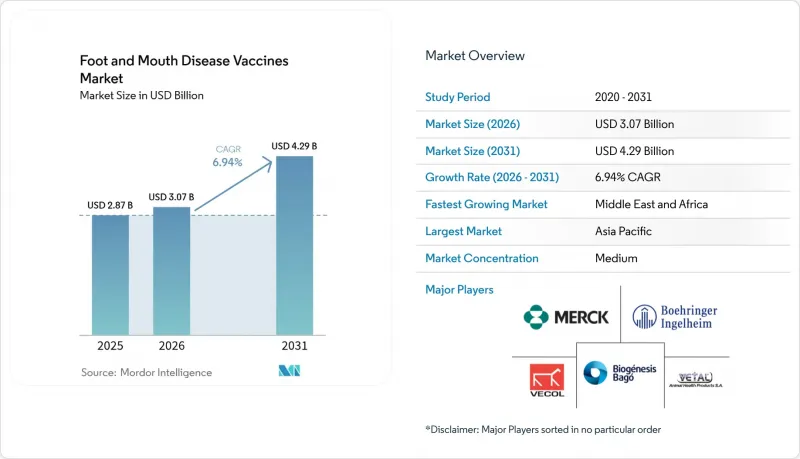
Mordor Intelligence에 의하면, 구제역 백신 시장 규모는 2025년에 28억 7,000만 달러로 평가되었고, 2026년30억 7,000만 달러에서 2031년까지 42억 9,000만 달러에 이를 것으로 예측되며, 예측 기간(2026-2031년) CAGR은 6.94%를 기록할 전망입니다.
본 보고서는 제품별(변형형/약독화 생백신 등), 투여 경로별(근육 내 주사 및 피하 주사), 동물 종별(소, 돼지 등), 유통 채널별(동물병원 및 진료소, 정부 기관 등), 지역별(아시아태평양, 중동 및 아프리카, 남미 등)로 분류되어 있습니다. 시장 규모 및 전망은 금액(달러) 기준으로 제시되어 있습니다.
전 세계 구제역 백신 시장 동향 및 인사이트
국경을 초월한 발생 및 인수공통감염병 증가
2025년 1월 독일에서 발생한 사례(독일에서는 1988년 이후 처음)는 5개 대륙에 걸친 수입 금지 조치를 촉발했으며, 단 1건의 유입만으로도 수십억 달러 규모의 무역 경로를 차단할 수 있음을 입증했습니다. 분자 추적 조사를 통해 동아프리카에서 SAT2 XIV 토포유형이 유입된 것으로 밝혀졌으며, 현대 물류가 역사적인 장벽을 어떻게 제거하고 있는지가 부각되었습니다. 2024년 리비아에서 발생한 피해에서는 백신 도착 지연으로 인해 미스라타의 가축 무리가 치명적인 타격을 입었으며, 사후 대응 전략의 대가가 여실히 드러났습니다. 이에 이웃 나라 오스트리아는 여러 국경 검문소를 폐쇄하는 조치를 취했습니다. 이는 감염 확산 억제가 더 이상 지역적인 검역 조치에만 의존하는 것이 아니라, 지역 전체의 백신 접종 체계 구축에 달려 있음을 시사합니다. 기후 변화에 따른 영향으로 한랭 지역에서의 바이러스 생존 기간이 길어짐에 따라, 과거에는 감염 사례가 없었던 지역에서의 예방 접종이 앞으로도 구제역 백신 시장을 지속적으로 확대할 것으로 예측됩니다.
동물성 단백질 수요 증가와 가축 사육두수 증가
아시아와 아프리카의 중산층 식생활이 풍요로워짐에 따라 구제역의 경제적 위험이 높아지고 있으며, 당국은 생산을 보호할 수밖에 없는 상황에 처해 있습니다. 동아프리카에는 아프리카 대륙 가축의 40%가 사육되고 있지만, 정기 예방접종률은 15% 미만에 그치고 있습니다. 이 격차를 해소하기 위해, 6개월간의 면역력을 강화하는 1,768만 달러 규모의 ‘AgResults’ 4가 백신 프로그램이 현재 시행되고 있습니다. 중국의 낙농업 확대(13개 성에서 BVDV 양성률 6.05%)는 백신 접종이 수출 허가의 기반이 되는 이와 같은 확대의 필요성을 반영하고 있습니다. 남아프리카공화국의 2024년 캠페인에서는 63만 4,000마리의 소에 백신 접종이 이루어졌으며, 식량 안보의 요구에 따라 산발적인 접종이 연례 행사로 변화하고 있음을 보여줍니다. 구제역(FMD) 비발생국이 누리고 있는 수출 프리미엄은 백신 접종에 대한 지출이 가격 상승을 통해 회수될 수 있음을 입증하고 있으며, 이를 통해 자금이 보다 광범위한 예방 접종 프로그램에 재투자될 수 있도록 보장하고 있습니다.
콜드체인과 보관 비용의 부담
전력망이 불안정한 지역에서는 2-8℃의 온도 관리를 유지하기 어렵습니다. 네팔에서 실시된 시험에서는 온도 변동으로 인해 백신의 효능이 저하되고, 부피가 큰 냉장 보냉함이 라스트 마일 운송의 걸림돌이 된다는 사실이 밝혀졌습니다. FAO의 지침에서는 콜드체인의 기능 부전이 농촌 지역의 예방 접종 캠페인 성과가 저조한 주된 원인이라고 반복해서 지적하고 있습니다. 동결건조법은 이 문제를 해결할 수 있지만, 수분 함량이 3-6%라도 감염력이 유지된다는 조사 결과가 있음에도 불구하고, 현재 높은 비용으로 인해 가격에 민감한 시장에서 도입이 저해되고 있습니다. 남미의 백신 접종률이 146.1%인 반면, 사하라 이남 아프리카에서는 소의 고작 5%만이 체계적인 예방접종을 받고 있어, 콜드체인의 미비가 구제역 백신 시장을 현저히 제한하고 있습니다.
부문 분석
이 부문에서는 2025년 매출의 56.12%를 불활성화 제제가 차지하고 있지만, 약독화 생백신 플랫폼은 연평균 7.64%의 성장이 예상됩니다. 이러한 성장은 더 강력하고 지속성이 높은 면역 효과와 DIVA 기준을 준수하는 약독화 균주의 가용성이 높아진 데 기인합니다. 차세대 보조제는 부작용을 줄이면서 체액성 및 세포성 면역 반응을 모두 향상시키기 때문에 신종 혈청형에 직면한 지역에서는 생백신이 우선적인 선택지가 되고 있습니다. 대조적으로, 불활성화 백신은 확립된 규제 경로에 의존하지만, 항원 드리프트가 생산 주기를 앞지르는 경우 폐기 위험에 직면합니다. 새롭게 등장한 mRNA 및 재조합 단백질 방식은 신속한 균주 업데이트를 약속하며, 향후 10년 동안 구제역 백신 시장을 재정의할 가능성이 있습니다.
2세대 제품은 제형과 투여 경로의 효율성을 결합하고 있습니다. 동결건조 펠릿, 유성 에멀젼 안정제, 나노 입자 운반체 등은 보존 기간 연장 및 콜드체인 의존도 최소화를 목표로 연구되고 있으며, 높은 성장률을 보이는 인프라가 미비한 지역 대응에 직접 기여하고 있습니다. 효능, 안정성, DIVA 적합성 간의 균형을 적절히 맞출 수 있는 제조업체는 확대되는 구제역 백신 시장에서 매우 큰 점유율을 확보할 전망입니다.
2025년에도 근육 내 주사는 매출 점유율 75.96%를 차지하며, 투여 기술별로는 구제역 백신 시장 규모에서 가장 큰 비중을 확보하여 여전히 주류로서의 지위를 유지하고 있습니다. 그럼에도 불구하고, 피하 투여는 정밀도가 그다지 필요하지 않고, 도육의 손상 위험을 줄이며, 동물 복지 규정에도 부합하기 때문에 연평균 성장률(CAGR) 7.72%로 증가하고 있습니다. 장시간 작용형 피하 데포 제제를 통해 투여 빈도는 조만간 절반으로 줄어들 것으로 예상되며, 이는 수의사의 방문이 불규칙한 축산 시스템에서 치료 순응도 향상으로 이어질 것으로 보입니다.
피하 투여용 제제의 맞춤화에는 흡수 속도의 느림을 보완하기 위한 에멀젼 점도 조절 및 항원 부하량 증가 등이 포함됩니다. 두 가지 투여 경로 모두에 대응하는 백신을 개발하는 기업은 신속성을 중시하는 대규모 상업 비육장뿐만 아니라 유연한 접근 방식이 필요한 소규모 농가에게도 어필할 수 있어, 구제역 백신 시장의 총 잠재 시장 규모를 확대할 수 있습니다.
지역별 분석
2025년, 아시아태평양은 구제역 백신 시장의 49.96%를 차지했습니다. 검사 대상 소 무리의 6.05%에서 BVDV 항체가 확인된 중국의 낙농 지역은 축산의 집약화가 백신 접종 예산 확대에 어떻게 기여하고 있는지를 보여줍니다. 인도 하리야나주에서 실시된 감시 조사에서는 NSP의 혈청 반응 양성률이 5.3%를 기록했으나, O형, A형 및 Asia-1형에 대한 높은 방어력을 가진 항체 역가는 예방 프로그램의 유효성을 시사합니다. 인도네시아가 호주로부터 400만 회분의 백신을 공급받은 것은 공급 안정을 위한 국경을 초월한 협력의 좋은 사례입니다. 주요 생산국에서는 접종률이 포화 상태에 가까워지고 있지만, 수출 지향형 축산 모델로 전환 중인 동남아시아의 신흥 경제국에서는 지속적인 성장이 예상됩니다.
중동 및 아프리카은 연평균 성장률(CAGR) 7.78%로 성장을 주도하고 있습니다. 리비아에서 2024년에 발생한 손실은 백신 공급이 수요를 따라가지 못할 경우의 취약성을 여실히 드러냈습니다. 남아프리카공화국에서는 동케이프주의 9만 7,000두를 포함해 총 63만 4,000두의 소에 백신 접종을 실시한 캠페인이, 선택적 예방접종에서 전면적 예방접종으로의 전환을 보여주고 있습니다. 동아프리카의 ‘AgResults’ 프로젝트에서는 6개월간 면역력을 보장하는 4가 백신을 개발 중이며, 그동안 농가의 접종 의지를 저해하던 효과의 격차를 해소해 나가고 있습니다. 에티오피아의 경우 규모는 크지만 서비스가 충분히 미치지 못하는 소 무리는 콜드체인에 대한 자금 조달 및 규제 절차가 신속해지면 잠재적 수요가 표면화될 가능성이 있음을 보여줍니다.
남미에서는 보급이 성숙 단계에 이르렀으나, 기후 변화로 인한 무병 상태에 대한 위협에 직면해 있습니다. 브라질의 사례는 백신 접종이 수출 확대로 이어진다는 것을 입증하고 있지만, 기상 패턴의 변화로 인해 위험이 재점화되어 수요가 다시 높아질 가능성이 있습니다. 한때 구제역(FMD)의 종식이 확인되었던 북미 및 유럽 시장에서도 새로운 감염 위험이 인식되고 있습니다. 2025년 독일에서 발생한 사례와 이에 이어 캐나다가 5,750만 달러 규모의 기금을 조성한 것은 온대 지역이 예방적 대응 능력을 어떻게 강화하고 있는지를 보여줍니다. 위험의 지리적 재분배로 인해 구제역 백신 시장 전체는 기존의 풍토병 지역을 넘어 확대되고 있습니다.
기타 혜택:
- 엑셀 형식 시장 예측(ME) 시트
- 3개월간의 애널리스트 지원
자주 묻는 질문
목차
제1장 서론
제2장 조사 방법
제3장 주요 요약
제4장 시장 구도
제5장 시장 규모와 성장 예측
제6장 경쟁 구도
제7장 시장 기회와 향후 전망
LSH 26.09.03According to Mordor Intelligence, the foot and mouth disease vaccines market size was valued at USD 2.87 billion in 2025 and estimated to grow from USD 3.07 billion in 2026 to reach USD 4.29 billion by 2031, at a CAGR of 6.94% during the forecast period (2026-2031).
This report is Segmented by Product (Modified/ Attenuated Live, and More), Route of Administration (Intramuscular and Subcutaneous), Animal Type (Cattle, Pigs, and More), Distribution Channel (Veterinary Hospitals and Clinics, Government Institutions, and More), and Geography (Asia-Pacific. Middle East and Africa, South America and More). The Market and Forecasts are Provided in Terms of Value (USD).
Global Foot And Mouth Disease Vaccines Market Trends and Insights
Rising Transboundary & Zoonotic Outbreaks
The January 2025 case in Germany, the country's first since 1988, triggered import bans across five continents and proved that a single incursion can shut billion-dollar trade channels . Molecular tracing showed the SAT2 XIV topotype arriving from East Africa, underscoring how modern logistics erase historical barriers. Libya's 2024 losses, where delayed vaccine arrival decimated Misrata herds, highlighted the cost of reactive strategies. Neighboring Austria responded by closing multiple border posts, signaling that containment now relies on regional vaccination readiness rather than local quarantine alone. Climate-linked shifts that lengthen viral survival in cooler zones suggest that preventive vaccination in once-free areas will continue to enlarge the foot and mouth disease vaccines market.
Growing Demand for Animal-Protein & Herd Size
Expanding middle-class diets in Asia and Africa increase the economic risk of FMD, compelling authorities to safeguard production. East Africa houses 40% of the continent's livestock, yet routine coverage is under 15%, a gap now targeted by the USD 17.68 million AgResults quadrivalent program that boosts six-month immunity. China's dairy expansion, with 6.05% BVDV positivity across 13 provinces, mirrors similar scale-up imperatives where vaccination becomes foundational to export licensing . South Africa's 2024 campaign vaccinated 634,000 cattle, showing how food-security mandates are turning sporadic inoculations into annual routines. Export premiums enjoyed by FMD-free nations prove that vaccination outlays pay for themselves via price uplift, ensuring capital flows back into wider coverage programs.
Cold-Chain & Storage Cost Burden
Maintaining 2-8 °C integrity is difficult where power grids are unreliable. Trials in Nepal found that temperature excursions cut potency and that bulky coolers hamper last-mile transport. FAO guidelines reiterate that cold-chain failure is the chief reason rural campaigns underperform. Freeze-drying can solve this, but current costs limit adoption in price-sensitive markets despite research showing 3-6% moisture content retains infectivity. As only 5% of cattle in sub-Saharan Africa receive systematic vaccination against 146.1% coverage in South America, cold-chain gaps materially restrict the foot and mouth disease vaccines market.
Other drivers and restraints analyzed in the detailed report include:
- Government-Funded Vaccination Programs & Mandates
- Trade-Friendly DIVA and Recombinant Vaccine Roll-outs
- Serotype-Matching Regulatory Delays
For complete list of drivers and restraints, kindly check the Table Of Contents.
Segment Analysis
The segment generated 56.12% of 2025 revenue from inactivated formulations, yet modified live platforms are forecast to rise 7.64% annually. The rise stems from stronger, longer-lasting immunity and the growing availability of DIVA-compliant attenuated strains. Next-generation adjuvants reduce adverse reactions while improving both humoral and cellular responses, positioning live vaccines as the preferred choice in regions confronting emergent serotypes. In contrast, inactivated doses rely on mature regulatory pathways but face waste risk when antigenic drift outpaces production cycles. Emerging mRNA and recombinant protein methods promise rapid strain updates and could redefine the foot and mouth disease vaccines market over the next decade.
Second-generation products link formulation with route efficiency. Freeze-dried pellets, oil emulsion stabilizers, and nanoparticle carriers are under study to extend shelf life and minimize cold-chain reliance, directly addressing high-growth but infrastructure-poor geographies. Manufacturers able to balance potency, stability, and DIVA compatibility stand to capture an outsized share of the expanding foot and mouth disease vaccines market.
Intramuscular injection remained dominant with 75.96% revenue share in 2025, securing the largest slice of the foot and mouth disease vaccines market size for delivery technologies. Nevertheless, subcutaneous delivery is rising at 7.72% CAGR as it requires less precision, lowers carcass blemish risk, and aligns with welfare regulations. Long-acting subcutaneous depots could soon halve dosing frequency, driving compliance in pastoral systems where veterinary visits are sporadic.
Formulation customizations for subcutaneous use include modified emulsion viscosities and higher antigen loads to compensate for slower uptake. Companies that tailor vaccines for both routes can appeal to large commercial feedlots prioritizing speed as well as smallholder farmers needing flexible techniques, broadening total addressable volumes within the foot and mouth disease vaccines market.
Complete Report Scope:
- By Product
- Modified/ Attenuated Live
- Inactivated (Killed)
- Others
- By Route of Administration
- Intramuscular
- Subcutaneous
- By Animal Type
- Cattle
- Pigs
- Sheep & Goats
- Others
- By Distribution Channel
- Veterinary Hospitals and Clinics
- Government Institutions
- Others
- By Geography
- Asia-Pacific
- China
- India
- South Korea
- Rest of APAC
- Middle East and Africa
- GCC
- South Africa
- Rest of Middle East and Africa
- South America
- Brazil
- Argentina
- Rest of South America
- Rest of the World
- Asia-Pacific
Geography Analysis
Asia-Pacific held 49.96% of the foot and mouth disease vaccines market in 2025. China's dairy provinces, where 6.05% of tested herds showed BVDV antibodies, signal how intensification fuels vaccination budgets. India's Haryana surveillance recorded 5.3% NSP seroreactors, yet high protective titers against serotypes O, A, and Asia-1 point to program effectiveness. Indonesia's receipt of 4 million doses from Australia demonstrates cross-border cooperation to stabilize supply. Although coverage is nearing saturation in tier-one producers, growth continues in emerging Southeast Asian economies shifting toward export-oriented livestock models.
The Middle East & Africa region leads growth at an 7.78% CAGR. Libya's 2024 losses emphasized vulnerability when vaccine shipments lag demand. South Africa's campaign that vaccinated 634,000 cattle, including 97,000 in Eastern Cape, illustrates the pivot from selective to blanket immunization. Eastern Africa's AgResults project is developing quadrivalent doses that secure six-month immunity, closing performance gaps that previously discouraged farmer uptake. Ethiopia's large but under-served herd underscores latent volume that could materialize if cold-chain financing and regulatory fast-tracking improve.
South America shows mature penetration but faces climate-driven threats to disease-free status. Brazil's experience proves vaccination can unlock exports; yet shifting weather patterns may re-introduce risk, renewing demand. North American and European markets, once considered post-FMD, have acknowledged new exposure. Germany's 2025 case and Canada's subsequent USD 57.5 million bank reveal how temperate regions are adding proactive capacity. The geographic redistribution of risk is enlarging the overall foot and mouth disease vaccines market beyond its historical endemic base.
- Biogenesis Bago
- Boehringer Ingelheim
- Brilliant Bio Pharma
- China Animal Husbandry (CAHIC)
- Indian Immunologicals
- Limor de Colombia
- Merck & Co. Inc. / MSD Animal Health
- VECOL S.A.
- VETAL Animal Health
- Biovet
- Ceva
- Zoetis
- Jinyu Bio-technology
- Cavsavac (Biopharma Morocco)
- Intervac
- Shchelkovo Agrohim
- Indian Immunologicals
- Phibro Animal Health
- Selevac
- Inovet
Additional Benefits:
- The market estimate (ME) sheet in Excel format
- 3 months of analyst support
TABLE OF CONTENTS
1 Introduction
- 1.1 Study Assumptions & Market Definition
- 1.2 Scope of the Study
2 Research Methodology
3 Executive Summary
4 Market Landscape
- 4.1 Market Overview
- 4.2 Market Drivers
- 4.2.1 Rising transboundary & zoonotic outbreaks
- 4.2.2 Growing demand for animal-protein & livestock herd size
- 4.2.3 Government-funded vaccination programs & mandates
- 4.2.4 Trade-friendly DIVA/recombinant vaccine roll-outs
- 4.2.5 Regional antigen banks securing bulk procurement
- 4.2.6 Climate-driven FMD migration into temperate zones
- 4.3 Market Restraints
- 4.3.1 Cold-chain & storage cost burden
- 4.3.2 Serotype-matching regulatory delays
- 4.3.3 Antigenic drift causing inventory obsolescence
- 4.3.4 Limited surge capacity for high-potency vaccines
- 4.4 Regulatory Landscape
- 4.5 Porters Five Forces Analysis
- 4.5.1 Threat of New Entrants
- 4.5.2 Bargaining Power of Buyers
- 4.5.3 Bargaining Power of Suppliers
- 4.5.4 Threat of Substitutes
- 4.5.5 Competitive Rivalry
5 Market Size & Growth Forecasts (Value, USD)
- 5.1 By Product
- 5.1.1 Modified/ Attenuated Live
- 5.1.2 Inactivated (Killed)
- 5.1.3 Others
- 5.2 By Route of Administration
- 5.2.1 Intramuscular
- 5.2.2 Subcutaneous
- 5.3 By Animal Type
- 5.3.1 Cattle
- 5.3.2 Pigs
- 5.3.3 Sheep & Goats
- 5.3.4 Others
- 5.4 By Distribution Channel
- 5.4.1 Veterinary Hospitals and Clinics
- 5.4.2 Government Institutions
- 5.4.3 Others
- 5.5 By Geography
- 5.5.1 Asia-Pacific
- 5.5.1.1 China
- 5.5.1.2 India
- 5.5.1.3 South Korea
- 5.5.1.4 Rest of APAC
- 5.5.2 Middle East and Africa
- 5.5.2.1 GCC
- 5.5.2.2 South Africa
- 5.5.2.3 Rest of Middle East and Africa
- 5.5.3 South America
- 5.5.3.1 Brazil
- 5.5.3.2 Argentina
- 5.5.3.3 Rest of South America
- 5.5.4 Rest of the World
- 5.5.1 Asia-Pacific
6 Competitive Landscape
- 6.1 Market Concentration
- 6.2 Market Share Analysis
- 6.3 Company Profiles (includes Global level Overview, Market level overview, Core Segments, Financials as available, Strategic Information, Market Rank/Share for key companies, Products & Services, and Recent Developments)
- 6.3.1 Biogenesis Bago
- 6.3.2 Boehringer Ingelheim
- 6.3.3 Brilliant Bio Pharma
- 6.3.4 China Animal Husbandry (CAHIC)
- 6.3.5 Indian Immunologicals
- 6.3.6 Limor de Colombia
- 6.3.7 Merck & Co. Inc. / MSD Animal Health
- 6.3.8 VECOL S.A.
- 6.3.9 VETAL Animal Health
- 6.3.10 Biovet
- 6.3.11 Ceva Sante Animale
- 6.3.12 Zoetis
- 6.3.13 Jinyu Bio-technology
- 6.3.14 Cavsavac (Biopharma Morocco)
- 6.3.15 Intervac
- 6.3.16 Shchelkovo Agrohim
- 6.3.17 Indian Immunologicals Ltd
- 6.3.18 Phibro Animal Health
- 6.3.19 Selevac
- 6.3.20 Inovet
7 Market Opportunities & Future Outlook
- 7.1 White-space & Unmet-need Assessment


