

|
시장보고서
상품코드
2122474
가교 폴리에틸렌(XLPE) : 시장 점유율 분석, 업계 동향과 통계, 성장 예측(2026-2031년)Cross-Linked Polyethylene (XLPE) - Market Share Analysis, Industry Trends & Statistics, Growth Forecasts (2026 - 2031) |
||||||
 Mordor Intelligence
Mordor Intelligence에 의하면, 가교 폴리에틸렌(XLPE) 시장 규모는 2026년에 101억 2,000만 달러로 추정되며, 예측 기간(2026-2031년)에 CAGR 5.56%로 성장을 지속하여 2031년에는 132억 6,000만 달러에 이를 전망입니다.
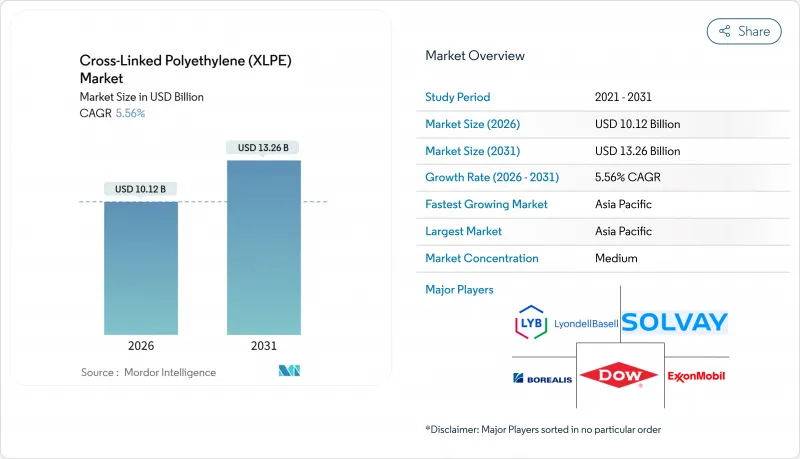
본 보고서는 유형별(고밀도 XLPE, 중밀도 XLPE, 저밀도 XLPE), 최종 사용자 산업별(건축 및 건설, 전기 및 전자, 자동차, 의료, 화학 산업, 기타 최종 사용자 산업), 지역별(아시아태평양, 북미, 유럽 등)로 분류되어 있습니다. 시장 전망은 금액(달러) 기준으로 제시되어 있습니다.
전 세계 가교 폴리에틸렌(XLPE) 시장 동향 및 인사이트력
XLPE의 저렴한 비용, 유연성 및 설치 용이성
2020년 이후, 미국에서는 주택용 배관공의 수가 감소하고 있습니다. 이러한 인력 부족으로 인해 건설업자들은 이음매 수와 공수를 줄일 수 있는 PEX 시스템을 채택하기 시작했습니다. 중전압 변전소에서는 XLPE 케이블이 기존의 종이 절연 케이블에 비해 더 좁은 굽힘 반경으로 구부릴 수 있습니다. 이러한 유연성 덕분에 배선 경로를 더 좁게 확보할 수 있어, 특히 지가가 높은 도시 지역에서 큰 가치를 지닙니다. 북미의 중전압 케이블 총 출하량에서 XLPE가 차지하는 비중은 시간이 지남에 따라 증가하고 있습니다. 이러한 노동력과 공간 측면의 이점으로 인해, 특히 공사 기간이 촉박한 상황에서 개보수 공사 및 신규 프로젝트 모두에서 도입이 가속화되고 있습니다. 시공업체들은 PEX의 배관 공사가 단 1일 만에 완료되는 반면, 동관 공사는 3일이 소요된다는 점이 뚜렷한 대조를 이루고 있으며, 숙련된 기술자가 부족한 상황에서도 프로젝트를 예산 범위 내에서 완료하는 데 도움이 되고 있다고 강조하고 있습니다.
배관·튜브(PEX) 수요 급증
2025년, PEX 튜브는 동파에 대한 내성과 매니폴드와의 호환성으로 인해 자재 낭비를 줄일 수 있다는 점이 높이 평가되어 북미 주택용 배관 시장에서 큰 점유율을 확보했습니다. 또한, 2024년 ‘국제 주거 코드(International Residential Code)’ 개정으로 인해 PEX는 주거용 스프링클러 시스템에 사용이 승인되었습니다. 유럽에서의 도입은 다소 뒤처져 있지만, 점차 탄력을 받고 있습니다. 독일에서는 지역 난방 개보수 추진에 따라 수명 50년을 자랑하는 폴리머 파이프의 사용이 의무화되어 있어, 사실상 PEX-a 또는 PEX-b를 선택하도록 권장되고 있습니다. 한국에서는 2025년에 바닥 난방 도입이 급증하고 있으며, 저온 히트펌프와의 호환성이 있어 신규 설치 시 PEX가 주류를 이루고 있습니다. 또한 매니폴드 방식을 채택함으로써 배관 거리를 단축할 수 있을 뿐만 아니라, 설치 시간을 단축하고 온수가 나오기까지의 대기 시간을 줄일 수 있어 가정의 효율 향상에 기여하고 있습니다.
에틸렌 및 첨가제 가격 변동
XLPE 컴파운드 비용 중 원자재비가 큰 비중을 차지하고 있어, 에틸렌 현물 가격의 변동은 고정 가격 계약의 안정성을 위협하고 있습니다. 2024년부터 2025년에 걸쳐 미국 멕시코만 연안의 에틸렌 가격은 크래커에 영향을 미친 NGL 공급 차질로 인해 변동했습니다. 러시아공급 제한으로 인해 유럽의 생산자들은 파이프라인 가스에서 나프타로 전환하는 과정에서 추가적인 비용 부담을 감수해야 했습니다. 2024년에는 쿠멘 공급 부족을 배경으로 과산화물 가교제의 가격이 상승했습니다. 이로 인해 컴파운드 제조업체들은 계약에 분기별 가격 조정 조항을 포함시켜, 리스크를 케이블 OEM 제조업체에게 전가하게 되었습니다. 이익률에 대한 압박이 심화되는 가운데, 업계 재편이 가속화되고 있으며, 후방 통합을 추진하고 있는 공급업체들은 뚜렷한 우위를 보이고 있습니다.
부문 분석
중밀도 XLPE는 2031년까지 연평균 성장률(CAGR) 6.14%를 나타낼 것으로 예측되며, 고밀도 XLPE가 2025년 가교 폴리에틸렌 시장 규모의 48.36%를 차지함에도 불구하고 그 성장률을 상회할 것으로 전망됩니다. 실란 그래프트 처리된 중밀도 등급인 PEX-b는 과산화물 경화형 PEX-a에 비해 비용 면에서 우위를 점하고 있으며, 더 높은 염소 농도에 대한 내성을 바탕으로 북미 주거용 배관 시장에서 상당한 점유율을 확보했습니다. 바닥 난방 시스템에서 요구되는 작은 굽힘 반경 요건 또한 이 제품의 매력을 더욱 높이고 있습니다. 고밀도 XLPE는 업계 기준을 충족하는 절연 내력 덕분에 중·고전압 케이블 분야에서 계속해서 주도적인 위치를 유지하고 있습니다. 2024년에 출시된 보레알리스(Borealis)사의 ‘Borlink LS4201DC’는 525 kV 직류 케이블에서 유전 손실을 저감함으로써 고밀도 등급의 우위를 확고히 하고 있습니다.
전자빔 가교(PEX-c)는 자동차용 와이어 하네스에서 주목을 받고 있으며, 높은 라인 속도를 실현하고 화학 잔류물을 남기지 않는다는 특징으로 고전압 EV 케이블 분야에서 우위를 발휘하고 있습니다. 한화가 2025년에 여수에서 진행할 저밀도 XLPE 생산 능력 확장은 EV 케이블 조립업체 수요에 부응하기 위한 것입니다. 유럽의 지역 난방 분야에서는 중밀도 PEX-b 수요가 급증하고 있습니다. 이는 EVOH 공압출 성형을 활용한 산소 차단층의 설치가 의무화되어 있기 때문이지만, 이 방법은 고밀도 수지에는 그다지 적합하지 않습니다. 결론적으로, 고밀도 등급은 매출액에서 계속해서 1위를 유지하고 있지만, 유연성, 내염소성, 비용 효율성 등의 요인으로 인해 중밀도 등급에 대한 수요가 증가하고 있습니다.
지역별 분석
아시아태평양은 2025년에 가교 폴리에틸렌 시장에서 47.52%의 점유율을 차지할 것으로 보이며, 2031년까지 연평균 성장률(CAGR) 5.93%로 성장할 전망입니다. 이러한 성장은 주로 재생에너지를 동부로 수송하고 발전 제한을 효과적으로 줄이기 위한 중국의 대규모 500kV XLPE 케이블 건설이라는 야심 찬 노력에 의해 주도되고 있습니다. 한편, 인도는 ‘국가 전력 계획’에 따라 2032년까지 막대한 양의 재생에너지를 전력망에 통합하는 것을 목표로 대규모 400 kV 송전선로 부설 사업을 추진할 예정입니다. 특히 주목할 점은 모든 프로젝트 입찰에서 특히 주변 온도가 50°C를 초과하는 환경에서의 XLPE 절연재 사용이 강조되고 있다는 점입니다. 이 지역 수요를 더욱 공고히 하고 있는 것은 2025년에 자금 조달을 확보한 아세안(ASEAN) 전력망의 라오스·태국·말레이시아·싱가포르 간 연결 프로젝트입니다. 이 프로젝트에서는 습하고 염분을 포함한 토양 조건에서 XLPE 케이블의 사용이 의무화되어 있습니다. 또한, 내진성을 높이기 위한 노력의 일환으로 일본의 도쿄전력은 2024년부터 2027년에 걸쳐 가공 배전선을 XLPE 케이블로 교체하여 지하화하는 프로젝트를 추진하고 있습니다.
미국의 송전망 현대화 보조금은 525 kV 직류 송전선에 고밀도 XLPE 사용을 규정하고 있어 북미의 동향에 큰 영향을 미치고 있습니다. 2024년, 캐나다는 대서양 연안의 해상 풍력 발전 프로젝트를 승인했는데, 이 프로젝트에서는 대량의 XLPE가 사용될 전망입니다. 멕시코에서는 2025년, 바하 반도의 태양광 발전소를 연결하기 위해 특별히 설계된 230 kV 송전선 입찰이 결정되었으며, 모든 구성 부품에 XLPE 사용이 의무화되었습니다. 또한, PEX는 미국 주택용 배관 시장에서 눈에 띄는 진전을 보였으며, 2025년에는 상당한 보급률을 달성하여 중밀도 유형 수요를 뒷받침했습니다.
유럽에서는 해상 풍력 발전으로 막대한 발전량을 목표로 하는 야심 찬 ‘REPowerEU’ 이니셔티브가 추진되고 있습니다. 이 프로젝트에는 대규모 해저용 XLPE 케이블이 필요합니다. 그러나 선박 부족으로 인해 시행이 차질을 빚고 있어 일정이 지연되고 있습니다. 독일에서는 폴리머 재질의 지역 난방용 배관 도입이 추진되면서 PEX에 있어 수익성이 높은 연간 시장이 형성되고 있습니다. 한편, 2024년에는 유럽화학물질청이 특정 알콕시실란에 대해 경고를 발령함에 따라, 배합 제조업체들은 에폭시나 아미노계 대체품으로의 전환을 강요받았습니다. 이러한 전환에는 추가적인 인증 비용이 발생합니다. 남미 및 중동 및 아프리카은 출발이 늦었지만, 빠르게 추격하고 있습니다. 예를 들어 브라질에서는 2024년에 대규모 XLPE 생산 라인이 경매에 부쳐졌으며, 사우디아라비아의 야심 찬 메가 프로젝트인 ‘NEOM’에서는 사막 지대에서의 케이블 부설 수요에 대응하기 위해 가교 절연재의 중요성이 강조되고 있습니다.
기타 혜택:
- 엑셀 형식 시장 예측(ME) 시트
- 3개월간의 애널리스트 지원
자주 묻는 질문
목차
제1장 서론
제2장 조사 방법
제3장 주요 요약
제4장 시장 구도
제5장 시장 규모와 성장 예측
제6장 경쟁 구도
제7장 시장 기회와 향후 전망
LSH 26.09.03According to Mordor Intelligence, the cross-Linked polyethylene (XLPE) market size is estimated at USD 10.12 billion in 2026, and is expected to reach USD 13.26 billion by 2031, at a CAGR of 5.56% during the forecast period (2026-2031).
This report is Segmented by Type (High-Density XLPE, Medium-Density XLPE, and Low-Density XLPE), End-User Industry (Building and Construction, Electrical and Electronics, Automotive, Medical, Chemical Industry, and Other End-User Industries), and Geography (Asia-Pacific, North America, Europe, and More). The Market Forecasts are Provided in Terms of Value (USD).
Global Cross-Linked Polyethylene (XLPE) Market Trends and Insights
Low-Cost Flexibility and Easy Installation of XLPE
Since 2020, the United States has seen a decline in residential plumbers. This shortage has led builders to turn to PEX systems, which can cut fitting counts and labor hours . In medium-voltage substations, XLPE cables can bend at a tighter diameter ratio compared to older paper-insulated cables. This flexibility allows for tighter routing, especially valuable in urban areas where land prices are high. XLPE's portion of North American medium-voltage cable volumes has increased over time. These advantages in labor and space are driving faster adoption in both retrofit and new projects, especially under tight construction timelines. Contractors highlight that PEX rough-in jobs, taking just a day, stand in stark contrast to the three-day copper work, helping keep projects within budget amidst a shortage of skilled trades.
Surge in Demand for Pipe and Tubing (PEX)
In 2025, PEX tubing captured a significant share of North America's residential plumbing market, bolstered by its freeze-burst resistance and manifold compatibility, which curtails material waste. Additionally, PEX received the green light for in-home fire-sprinkler systems, thanks to the 2024 update of the International Residential Code. While European adoption lags, it's gaining momentum. Germany's push for district-heating retrofits mandates polymer pipes boasting a 50-year service life, effectively steering the choice towards PEX-a or PEX-b. In South Korea, deployments of radiant floor heating surged in 2025, with PEX dominating new installations, thanks to its compatibility with low-temperature heat pumps. Moreover, the manifold approach not only shortens pipe runs but also trims installation time, cutting down hot-water wait periods, thereby boosting household efficiency.
Volatile Ethylene and Additive Prices
Feedstock accounts for a significant portion of the cost of XLPE compounds, and spot ethylene price volatility challenges the stability of fixed-price contracts. In 2024-2025, the United States Gulf Coast ethylene prices fluctuated due to disruptions in NGL supply that affected crackers. Due to curtailments from Russia, European producers incurred additional premiums when transitioning from pipeline gas to naphtha. In 2024, amid shortages of cumene, peroxide cross-linking agents experienced price hikes. This led compounders to incorporate quarterly price-adjustment clauses, transferring the risk to cable OEMs. As margin pressures mount, consolidation in the industry accelerates, with a clear advantage for suppliers that are backward-integrated.
Other drivers and restraints analyzed in the detailed report include:
- Grid-Upgrade and Renewable-Energy Cable Investments
- Rapid Asia-Pacific Urban Infrastructure Expansion
- Limited Recyclability of Thermoset XLPE
For complete list of drivers and restraints, kindly check the Table Of Contents.
Segment Analysis
Medium-density XLPE is expected to post a 6.14% CAGR through 2031, outpacing high-density despite the latter's 48.36% 2025 share of the Cross-Linked Polyethylene market size. PEX-b, a silane-grafted medium-density grade, captured a substantial portion of North American residential plumbing due to its cost advantage over peroxide-cured PEX-a and its ability to tolerate higher chlorine levels. Low-bend-radius requirements in radiant heating systems further heighten its appeal. High-density XLPE continues to lead in medium- and high-voltage cables, thanks to its dielectric strength meeting industry standards. Borealis's Borlink LS4201DC, launched in 2024, boasts a reduction in dielectric losses for 525 kV DC cables, solidifying high-density's premium position.
Electron-beam cross-linking (PEX-c) is gaining traction in automotive wire harnesses, achieving high line speeds and ensuring no chemical residues, an edge for high-voltage EV cables. Hanwha's 2025 expansion in Yeosu, adding low-density XLPE capacity, aims to cater to EV cable assemblers. Europe's district-heating sector is witnessing a surge in medium-density PEX-b, driven by mandatory oxygen-barrier layers that leverage EVOH co-extrusion, a method less viable for high-density resin. In conclusion, while high-density maintains its revenue lead, factors like flexibility, chlorine resistance, and cost-effectiveness are steering increasing demand towards medium-density grades.
Complete Report Scope:
- By Type
- High-density XLPE (HDPE-based)
- Medium-density XLPE (MDPE-based)
- Low-density XLPE (LDPE-based)
- By End-user Industry
- Building and Construction
- Electrical and Electronics
- Automotive
- Medical
- Chemical Industry
- Other End-user Industries
- By Geography
- Asia-Pacific
- China
- India
- Japan
- South Korea
- ASEAN Countries
- Rest of Asia-Pacific
- North America
- United States
- Canada
- Mexico
- Europe
- Germany
- United Kingdom
- France
- Italy
- Russia
- Rest of Europe
- South America
- Brazil
- Argentina
- Rest of South America
- Middle-East and Africa
- Saudi Arabia
- South Africa
- Rest of Middle-East and Africa
- Asia-Pacific
Geography Analysis
Asia-Pacific, with 47.52% Cross-Linked Polyethylene market share in 2025, is set to expand at 5.93% CAGR through 2031. This growth is largely driven by China's ambitious initiative to construct extensive 500 kV XLPE cables, facilitating the eastward transport of renewable energy and effectively reducing curtailment. Meanwhile, under its National Electricity Plan, India is set to roll out extensive 400 kV lines, aiming to integrate a staggering amount of renewable energy by 2032. Notably, all project bids emphasize the use of XLPE insulation, particularly for ambient temperatures exceeding 50 °C. Further solidifying the regional demand, the ASEAN Power Grid's Lao-Thailand-Malaysia-Singapore link, which secured financing in 2025, mandates the use of XLPE cables in humid and saline soil conditions. In a move to enhance seismic resilience, Japan's Tokyo Electric Power Company is in the process of burying overhead distribution lines with XLPE cables, a project slated between 2024 and 2027.
A grid-modernization grant in the United States significantly influences North America's trajectory, stipulating the use of high-density XLPE for 525 kV DC lines. In 2024, Canada greenlit an Atlantic offshore wind project, projected to utilize a substantial amount of compound. Mexico, in 2025, awarded a tender for a 230 kV line, specifically designed to link the Baja solar fields, with all components mandated to be XLPE. Additionally, PEX made significant inroads in the United States residential plumbing, achieving a notable penetration rate in 2025, bolstering the demand for medium-density variants.
Europe is navigating its course with the ambitious REPowerEU initiative, targeting a monumental amount from offshore wind. This endeavor necessitates extensive subsea XLPE cable. However, execution is hampered by vessel shortages, pushing timelines back. In Germany, the push for polymer district-heating pipes has birthed a lucrative annual market for PEX. Meanwhile, in 2024, the European Chemicals Agency raised alarms on specific alkoxy-silanes, compelling formulators to transition to epoxy or amino alternatives, a shift that incurs added qualification costs. While South America and the Middle East-Africa regions lag, they're rapidly catching up. Brazil, for instance, auctioned off extensive XLPE lines in 2024, and Saudi Arabia's ambitious NEOM megaproject has underscored the importance of cross-linked insulation for its desert cabling needs.
- 3H VINACOM CO., LTD
- Arkema
- Armacell
- Avient Corporation
- BASF
- Borealis AG
- Dow
- Exxon Mobil Chemical
- Hanwha Solutions Chemical Division Corporation
- LG Chem
- LyondellBasell Industries NV
- Nouryon
- SACO AEI Polymers
- Solvay SA
- Wanhua
- Zhejiang Wanma Macromolecule Material Group Co.,Ltd. All
Additional Benefits:
- The market estimate (ME) sheet in Excel format
- 3 months of analyst support
TABLE OF CONTENTS
1 Introduction
- 1.1 Study Assumptions and Market Definition
- 1.2 Scope of the Study
2 Research Methodology
3 Executive Summary
4 Market Landscape
- 4.1 Market Overview
- 4.2 Market Drivers
- 4.2.1 Low-cost flexibility and easy installation of XLPE
- 4.2.2 Surge in demand for pipe and tubing (PEX)
- 4.2.3 Grid-upgrade and renewable-energy cable investments
- 4.2.4 Rapid APAC urban-infrastructure expansion
- 4.2.5 Bio-based cross-linkable PE feedstocks emerging
- 4.3 Market Restraints
- 4.3.1 Volatile ethylene and additive prices
- 4.3.2 Limited recyclability of thermoset XLPE
- 4.3.3 Upcoming REACH-style limits on silane coupling agents
- 4.4 Value Chain Analysis
- 4.5 Porter's Five Forces
- 4.5.1 Bargaining Power of Suppliers
- 4.5.2 Bargaining Power of Buyers
- 4.5.3 Threat of New Entrants
- 4.5.4 Threat of Substitutes
- 4.5.5 Degree of Competition
- 4.6 Production Methods
- 4.6.1 Peroxide (PEX-a)
- 4.6.2 Silane Grafting (PEX-b)
- 4.6.3 Electron-Beam (PEX-c)
5 Market Size and Growth Forecasts (Value)
- 5.1 By Type
- 5.1.1 High-density XLPE (HDPE-based)
- 5.1.2 Medium-density XLPE (MDPE-based)
- 5.1.3 Low-density XLPE (LDPE-based)
- 5.2 By End-user Industry
- 5.2.1 Building and Construction
- 5.2.2 Electrical and Electronics
- 5.2.3 Automotive
- 5.2.4 Medical
- 5.2.5 Chemical Industry
- 5.2.6 Other End-user Industries
- 5.3 By Geography
- 5.3.1 Asia-Pacific
- 5.3.1.1 China
- 5.3.1.2 India
- 5.3.1.3 Japan
- 5.3.1.4 South Korea
- 5.3.1.5 ASEAN Countries
- 5.3.1.6 Rest of Asia-Pacific
- 5.3.2 North America
- 5.3.2.1 United States
- 5.3.2.2 Canada
- 5.3.2.3 Mexico
- 5.3.3 Europe
- 5.3.3.1 Germany
- 5.3.3.2 United Kingdom
- 5.3.3.3 France
- 5.3.3.4 Italy
- 5.3.3.5 Russia
- 5.3.3.6 Rest of Europe
- 5.3.4 South America
- 5.3.4.1 Brazil
- 5.3.4.2 Argentina
- 5.3.4.3 Rest of South America
- 5.3.5 Middle-East and Africa
- 5.3.5.1 Saudi Arabia
- 5.3.5.2 South Africa
- 5.3.5.3 Rest of Middle-East and Africa
- 5.3.1 Asia-Pacific
6 Competitive Landscape
- 6.1 Market Concentration
- 6.2 Strategic Moves
- 6.3 Market Share/Ranking Analysis
- 6.4 Company Profiles (includes Global level Overview, Market level overview, Core Segments, Financials as available, Strategic Information, Market Rank/Share for key companies, Products and Services, and Recent Developments)
- 6.4.1 3H VINACOM CO., LTD
- 6.4.2 Arkema
- 6.4.3 Armacell
- 6.4.4 Avient Corporation
- 6.4.5 BASF
- 6.4.6 Borealis AG
- 6.4.7 Dow
- 6.4.8 Exxon Mobil Chemical
- 6.4.9 Hanwha Solutions Chemical Division Corporation
- 6.4.10 LG Chem
- 6.4.11 LyondellBasell Industries NV
- 6.4.12 Nouryon
- 6.4.13 SACO AEI Polymers
- 6.4.14 Solvay SA
- 6.4.15 Wanhua
- 6.4.16 Zhejiang Wanma Macromolecule Material Group Co.,Ltd. All
7 Market Opportunities and Future Outlook
- 7.1 White-space and Unmet-need Assessment


