|
시장보고서
상품코드
2122484
전술 통신 : 시장 점유율 분석, 업계 동향 및 통계, 성장 예측(2026-2031년)Tactical Communication - Market Share Analysis, Industry Trends & Statistics, Growth Forecasts (2026 - 2031) |
||||||
 Mordor Intelligence
Mordor Intelligence에 의하면, 전술 통신 시장 규모는 2025년에 216억 달러로 평가되었습니다. 2026년 230억 달러에서 2031년까지 318억 달러에 이를 것으로 예상되며, 예측 기간(2026-2031년) CAGR은 6.69%를 나타낼 전망입니다.

본 보고서는 플랫폼별(지상, 항공기 탑재형, 해군, 우주), 구성 요소별(하드웨어, 소프트웨어, 서비스), 통신 유형별(보안 음성, 데이터, 영상, 기타),최종 사용자별(국방군, 국토안보), 지역별(북미, 유럽, 아시아태평양, 남미, 중동 및 아프리카)로 분류되어 있습니다. 시장 예측은 금액(달러) 기준으로 제시되어 있습니다.
세계의 전술 통신 시장 동향 및 인사이트
방위력의 현대화와 네트워크 중심전(NCW)의 부상
네트워크 중심전(NCW)에 따라 전술 통신은 단순한 지원 기능에서 핵심적인 군사 능력으로 변화하고 있습니다. 다중 영역 작전에서는 육상, 공군, 해상, 우주, 사이버 환경에 걸쳐 있는 센서, 의사 결정자, 전개 부대 간에 보호된 저지연 데이터 전송이 요구됩니다. 이러한 요구 사항으로 인해 전술 통신 시장에서 전술 무전기, 위성 통신 단말기, 엣지 네트워크 장비의 중요성이 높아지고 있습니다. 미 육군은 통합 지휘통제 접근 방식에 대한 노력을 거쳐 차세대 지휘통제(NGC2) 프로그램을 프로토타입 단계에서 2026년 납품 단계로 전환했습니다. 이 프로그램의 아키텍처에서는 무전기, 위성 단말기, 프라이빗 LTE 또는 5G 노드, 게이트웨이 소프트웨어가 관리형 데이터 패브릭으로 기능해야 합니다. 이러한 접근 방식에 따라 주요 주계약업체와 협력하여 상호 운용 가능한 소프트웨어 정의형 및 엣지 네트워킹 기능을 제공할 수 있는 공급업체에 대한 수요가 증가하고 있습니다.
전 세계 국방비 증가
2025년 전 세계 군사 지출은 2조 8,870억 달러에 달하며 11년 연속 증가세를 기록했습니다. 유럽에서는 14% 증가한 8,640억 달러를 기록했으며, 디지털 인프라 및 통신 현대화를 위해 더 많은 국방 예산이 배정되었습니다. 2025년 2월, 라인메탈(Rheinmetall)은 독일 연방군(Bundeswehr) 사단용으로 전개 가능한 전술 광역 네트워크(TaWAN)에 대한 10년간의 LBO(Logistics Business Operations) 기본 계약을 수주했으며, 초기 수주액은 18억 8,000만 유로(20억 3,000만 달러)에 달했습니다. 또한 에어버스(Airbus)도 2025년 2월, RIFAN 3단계 해군용 IP 네트워크와 관련된 4억 8,000만 유로(5억 1,800만 달러) 규모의 계약을 수주했습니다. 이러한 프로그램들은 현대화 예산이 인건비 및 운영비에서 통신 인프라로 전환됨에 따라 전술 통신 시장이 혜택을 볼 것임을 보여줍니다. 유럽 내 활동 속도를 고려할 때, 이 지역의 업데이트 주기는 여전히 초기 단계에 있는 것으로 보입니다.
주파수 대역의 혼잡과 대역폭 할당 제한
무인 시스템, 센서 노드, 멀티도메인 링크로 인해 군용 VHF 및 UHF 대역으로의 트래픽이 증가함에 따라 주파수 대역의 부족이 심화되고 있습니다. 많은 관할 구역에서 이러한 주파수 대역은 상용 사용자와 공유되고 있으므로, 작전이 집중되는 상황에서는 접근이 어려워질 가능성이 있습니다. 주파수 할당 절차는 경쟁이 치열한 작전 지역의 변화하는 상황을 가정하여 설계된 것이 아닙니다. 이 문제로 인해 전술 통신 시장 수요가 사라지는 것은 아니지만, 인증 및 시스템 배포가 지연될 가능성이 있습니다. 공급업체는 운영 요건을 충족하기 위해 주파수 애자일 설계 및 검사에 대한 투자를 더욱 확대해야 합니다. 이러한 요인들로 인해 개발 일정이 장기화되고, 고정 가격 프로그램의 이익률에 압박이 가해질 수 있습니다.
부문별 분석
2025년, 지상 부문은 전술 통신 시장 점유율의 45.76%를 차지했습니다. 이는 군이 구매한 맨팩형 무전기, 차량용 시스템, 지휘소용 단말기의 수량이 방대함을 반영합니다. 미 육군은 2025년 1월, ‘핸드헬드, 맨팩, 스몰 폼 핏(Handheld, Manpack, and Small Form Fit)’ 프로그램의 일환으로 L3Harris에 총액 약 3억 달러에 달하는 본격적인 양산 주문을 발주했습니다. 이번 수주는 지상 부대의 조달 규모가 지속되고 있음을 보여줍니다. 지상 시스템은 보병, 장갑차, 지휘소, 지원 부대를 연결하기 위해 여전히 필수적입니다. 항공 시스템에서도 유인 및 무인 항공기용 전술 데이터 링크와 위성 통신 연결이 필요합니다. 해군 수요는 프랑스의 RIFAN 3단계 프로그램을 포함한 함정-지상 간 통신 및 함대 통신 요건에 의해 뒷받침되고 있습니다.
우주는 가장 빠르게 성장하는 플랫폼 부문이며, 우주 부문의 전술 통신 시장 규모는 2026년부터 2031년까지 연평균 성장률(CAGR) 10.37%로 확대될 것으로 예측됩니다. 이러한 성장은 정지 궤도 위성 통신에서 저지연 및 뛰어난 내결함성을 갖춘 저궤도(LEO) 위성 군집으로의 전환을 반영합니다. 독일은 2025년 말, 2030년까지 군사 우주 역량에 350억 유로(395억 3,000만 달러)를 투자할 계획을 발표했습니다. 한편, 프랑스는 2026년부터 2030년까지 42억 유로(47억 4,000만 달러)를 투자하겠다고 약속했습니다. 이러한 투자는 단말기, 게이트웨이 장비 및 관련 소프트웨어 서비스에 대한 수요를 뒷받침할 수 있습니다. 또한, 유럽 보안 소프트웨어 정의 무선(European Secure Software Defined Radio) 컨소시엄은 지상 및 항공기 이용 사례를 아우르는 공통 파형 기능 개발도 추진하고 있습니다. 이 공통 아키텍처는 동맹국 전체 시스템의 향후 업그레이드에 기여할 가능성이 있습니다.
2025년 매출액 중 하드웨어가 57.37%를 차지하여 전술 통신 시장에서 가장 큰 비중을 차지하는 구성 요소가 되었습니다. 대규모 차량 군단에는 인증된 멀티밴드 무전기, 안테나, 암호화 장치, 차량 및 플랫폼에 통합하기 위한 장비가 필요합니다. 아키텍처가 점점 더 소프트웨어 정의형으로 변화하고 있음에도 불구하고, 하드웨어 매출은 여전히 중요한 위치를 차지하고 있습니다. 암호화 현대화 및 제로 트러스트(Zero Trust) 요구 사항으로 인해, 소프트웨어만의 업그레이드뿐만 아니라 하드웨어의 업데이트 주기를 동기화해야 할 필요가 발생할 수 있습니다. 이로 인해 무전기, 안테나, 암호화 장치의 가치가 지속적으로 유지될 것입니다. 또한, 하드웨어 공급업체는 가혹한 군사 환경에서의 장비 인증 요건으로 인해 혜택을 보고 있습니다.
서비스 부문은 2031년까지 연평균 성장률(CAGR) 8.27%를 나타낼 것으로 예측되며, 이는 각 구성 요소 중 가장 높은 성장률입니다. 멀티도메인 시스템에는 전체 수명 주기에 걸친 통합, 유지보수, 운영자 교육이 필요합니다. 무전기, 위성 단말기, 엣지 컴퓨팅 노드를 단일 데이터 환경에 연결하는 것은 많은 국방부에게 여전히 내부적으로 관리하기 어려운 과제입니다. 이 시장은 장기 지원 계약과 초기 도입 작업 모두로부터 혜택을 받고 있습니다. L3Harris의 FOXTROT 계약은 장비 공급 외에도 장기 지원 계약의 가치를 보여줍니다. 또한 파형 관리, 암호화 용도, 전술 네트워크 관리 도구 등을 통해 소프트웨어의 중요성도 높아지고 있으며, 이러한 요소들은 초기 배치 후에도 지속적인 수익을 창출할 수 있습니다.
지역별 분석
2025년, 아시아태평양은 전술 통신 시장 점유율의 35.95%를 차지하며 최대 지역 부문이 되었습니다. 인도의 국방 국산화 요건은 바라트 일렉트로닉스(Bharat Electronics)와 같은 국내 제조업체로부터의 조달을 촉진하고 있지만, 인도는 다른 경로를 통해 첨단 시스템도 도입하고 있습니다. 호주의 AUKUS 참여 또한 인도-태평양 전역의 첨단 통신 요구 사항에 영향을 미치고 있습니다. 중국의 군사 현대화는 인접 국가들의 조달 일정과 능력 기준에 계속해서 영향을 미치고 있습니다. 이러한 지역적 환경으로 인해 일부 국가에서 재정적 제약이 있음에도 불구하고, 전술 통신 시장 수요는 계속해서 뒷받침되고 있습니다.
북미는 2031년까지 연평균 성장률(CAGR) 7.94%를 나타낼 것으로 예측되며, 가장 빠르게 성장하는 지역이 될 전망입니다. 미 육군의 NGC2 구상은 전술 무전기, 위성 단말기, 프라이빗 5G, 네트워크 소프트웨어에 대한 수요를 뒷받침하고 있습니다. 국토안보 부문의 통신 수요는 기존의 국방부(DoD) 조달과는 별개로 추가적인 수요원을 창출하고 있습니다. NATO의 조사 방법론 업데이트에 따르면, 캐나다는 2025년에 국방비를 20% 가까이 증액했습니다. 북미 전술 통신 시장 규모는 국방 현대화와 동맹국 간 상호 운용성 강화 노력 모두로부터 혜택을 받고 있습니다.
유럽에서는 지난 30년 동안 가장 활발한 국방 현대화 주기가 진행되고 있습니다. 독일의 TaWAN LBO 계약에서는 배치 가능한 전술 네트워크를 위해 18억 8,000만 유로(20억 3,000만 달러) 규모의 초기 주문이 이루어졌습니다. 프랑스의 RIFAN 3단계 프로그램은 80척 이상의 해군 함정에 걸친 네트워크 개발 및 배치를 다루며, 2032년까지의 유지보수가 포함되어 있습니다. ESSOR 컨소시엄은 상호 운용 가능한 전술 파형에 대한 유럽 고유의 대안을 개발하고 있어, 미국 표준 시스템에 대한 의존도를 낮추고 있습니다. 중동 및 아프리카 수요는 이스라엘, 사우디아라비아, 아랍에미리트에 의해 지탱되고 있습니다. 한편, 남미는 여전히 지역별 부문 중규모가 가장 작으며, 브라질이 주요 조달 거점 역할을 하고 있지만, 예산 및 인프라 제약으로 인해 단기적인 성장은 제한적입니다.
기타 혜택
- 엑셀 형식 시장 전망(ME) 시트
- 3개월간 애널리스트 지원
자주 묻는 질문
목차
제1장 서론
제2장 조사 방법
제3장 주요 요약
제4장 시장 구도
제5장 시장 규모 및 성장 예측
제6장 경쟁 구도
제7장 시장 기회 및 향후 전망
KTH 26.09.08According to Mordor Intelligence, the tactical communication market size was valued at USD 21.60 billion in 2025 and is estimated to grow from USD 23.00 billion in 2026 to reach USD 31.80 billion by 2031, at a CAGR of 6.69% during the forecast period (2026-2031).
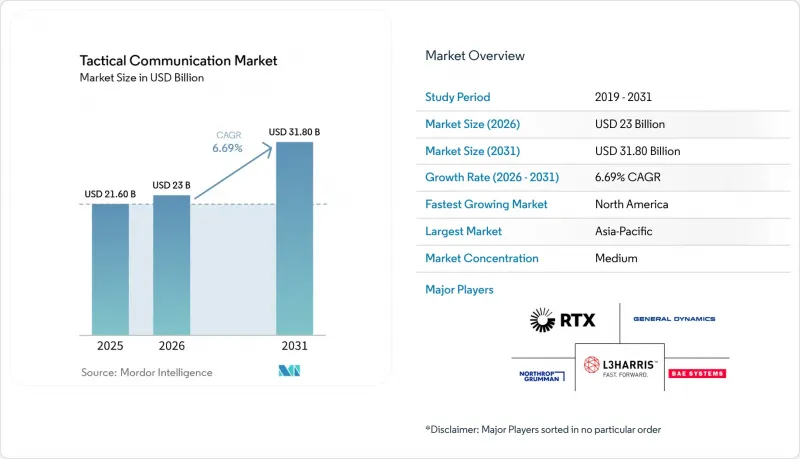
This report is Segmented by Platform (Land, Airborne, Naval, and Space), Component (Hardware, Software, and Services), Communication Type (Secure Voice, Data, Video, and Other), End User (Defense Forces and Homeland Security), and Geography (North America, Europe, Asia-Pacific, South America, and the Middle East and Africa). The Market Forecasts are Provided in Terms of Value (USD).
Global Tactical Communication Market Trends and Insights
Rising Defense Modernization and Network-Centric Warfare
NCW is changing tactical communication from a supporting function into a core military capability. Multi-domain operations need protected, low-latency data movement between sensors, decision-makers, and deployed units across land, air, maritime, space, and cyber environments. This requirement raises the importance of tactical radios, satellite communication terminals, and edge networking equipment in the tactical communication market. The US Army has moved its Next Generation Command and Control (NGC2) program from prototyping toward delivery workstreams in 2026, following work on an integrated command-and-control approach. The program architecture calls for radios, satellite terminals, private LTE or 5G nodes, and gateway software to work as a managed data fabric. This approach supports demand for suppliers capable of providing interoperable software-defined and edge-networking capabilities alongside larger prime contractors.
Growing Global Defense Expenditure
Global military spending reached USD 2.887 trillion in 2025, marking the 11th consecutive annual increase. Europe recorded a 14% increase to USD 864 billion, prompting more defense budgets to be directed toward digital infrastructure and communications modernization. In February 2025, Rheinmetall received a 10-year TaWAN LBO framework contract with an initial order valued at EUR 1.88 billion (USD 2.03 billion) for a deployable tactical wide-area network for a Bundeswehr division. Airbus also received a EUR 480 million contract (USD 518 million) in February 2025 for the RIFAN stage 3 naval IP network. These programs show that the tactical communication market benefits when modernization budgets shift from personnel and operating costs to communication infrastructure. The pace of European activity suggests that this regional replacement cycle remains in its early stages.
Spectrum Congestion and Limited Bandwidth Allocation
Spectrum scarcity is increasing as unmanned systems, sensor nodes, and multi-domain links place more traffic on military VHF and UHF bands. These bands are shared with commercial users in many jurisdictions, which can complicate access during dense operations. Frequency allocation processes were not designed for the changing conditions of contested operational areas. This issue does not remove demand from the tactical communication market, but it can delay certification and system fielding. Suppliers must invest more in frequency-agile designs and testing to meet operational requirements. These factors can extend development schedules and place pressure on margins for fixed-price programs.
Other drivers and restraints analyzed in the detailed report include:
- Demand for Secure, Resilient, High-Throughput Links
- AI-Driven Cognitive Radios for Dynamic Spectrum Use
- High Cyber-Hardening Costs Under Zero-Trust Mandates
For complete list of drivers and restraints, kindly check the Table Of Contents.
Segment Analysis
Land held 45.76% of the tactical communication market share in 2025, reflecting the high volume of manpack radios, vehicle-mounted systems, and command-post terminals purchased by military forces. The US Army gave L3Harris full-rate production orders totaling nearly USD 300 million in January 2025 under the Handheld, Manpack, and Small Form Fit program. This order demonstrates the recurring scale of ground-force procurement. Land systems remain essential because they connect dismounted personnel, armored vehicles, command posts, and supporting units. Airborne systems also require tactical data links and satellite connectivity for manned and unmanned aircraft. Naval demand is supported by ship-to-shore and fleet communication requirements, including France's RIFAN stage 3 program.
Space is the fastest-growing platform segment, and the tactical communication market size for space is forecast to rise at a 10.37% CAGR from 2026 to 2031. Its growth reflects a shift from geostationary satellite communications to lower-latency, more resilient low Earth orbit constellations. Germany announced plans in late 2025 to invest EUR 35 billion (USD 39.53 billion) in military space capabilities by 2030, while France committed EUR 4.2 billion (USD 4.74 billion) between 2026 and 2030. These investments can support demand for terminals, gateway equipment, and related software services. The European Secure Software Defined Radio consortium is also developing shared waveform capabilities across land and airborne use cases. This common architecture can contribute to future upgrades across allied systems.
Hardware accounted for 57.37% of revenue in 2025, making it the largest component of the tactical communication market. Large fleets require certified multiband radios, antennas, encryption devices, and vehicle- or platform-integration equipment. Hardware revenue remains important even as architectures become more software-defined. Encryption modernization and zero-trust requirements can require synchronized hardware refresh cycles rather than software-only upgrades. This supports the continuing value of transceivers, antennas, and cryptographic devices. Hardware suppliers also benefit from the need to qualify equipment for demanding military environments.
Services are forecast to grow at an 8.27% CAGR through 2031, the fastest rate among components. Multi-domain systems need integration, maintenance, and operator training throughout their lifecycle. Connecting radios, satellite terminals, and edge computing nodes into a single data environment remains difficult for many defense ministries to manage internally. The market benefits from both long-term support contracts and initial implementation work. L3Harris's FOXTROT agreement shows the value of extended support arrangements alongside equipment supply. Software is also growing in importance through waveform management, encryption applications, and tactical network management tools that can generate recurring revenue after initial fielding.
Complete Report Scope:
- By Platform
- Land
- Airborne
- Naval
- Space
- By Component
- Hardware
- Transceivers/Transmitters
- Receivers
- Antennas
- Encryption Devices
- Headsets and Microphones
- Other Hardware
- Software
- Waveform Software
- Encryption Software
- Network Management Software
- Services
- Integration
- Maintenance and Support
- Training
- Hardware
- By Communication Type
- Secure Voice
- Data
- Video
- Others
- By End User
- Defense Forces
- Homeland Security
- By Geography
- North America
- United States
- Canada
- Mexico
- Europe
- United Kingdom
- France
- Germany
- Russia
- Rest of Europe
- Asia-Pacific
- China
- India
- Japan
- South Korea
- Australia
- Rest of Asia-Pacific
- South America
- Brazil
- Rest of South America
- Middle East and Africa
- Middle East
- Saudi Arabia
- United Arab Emirates
- Israel
- Rest of Middle East
- Africa
- South Africa
- Rest of Africa
- Middle East
- North America
Geography Analysis
Asia-Pacific held 35.95% of the tactical communication market share in 2025, making it the largest regional segment. India's defense indigenization requirements support procurement from domestic manufacturers such as Bharat Electronics, while the country also acquires advanced systems through other channels. Australia's AUKUS commitments are also affecting advanced communications requirements across the Indo-Pacific. China's military modernization continues to influence procurement timelines and capability standards among nearby countries. This regional environment supports continued demand in the tactical communication market despite fiscal constraints in some countries.
North America is forecast to grow at a 7.94% CAGR through 2031, making it the fastest-growing region. The US Army's NGC2 effort supports demand for tactical radios, satellite terminals, private 5G, and network software. Homeland security communications needs create an additional demand stream outside conventional DoD procurement. Canada increased defense spending by nearly 20% in 2025, according to the updated NATO reporting methodology. The tactical communication market size in North America benefits from both defense modernization and commitments to allied interoperability.
Europe is undergoing its most active defense modernization cycle in 3 decades. Germany's TaWAN LBO contract has an initial order of EUR 1.88 billion, (USD 2.03 billion), for a deployable tactical network. France's RIFAN stage 3 program covers network development and deployment across more than 80 naval vessels, with maintenance through 2032. The ESSOR consortium is developing a European alternative for interoperable tactical waveforms, reducing reliance on US-standard systems. Demand in the Middle East and Africa is supported by Israel, Saudi Arabia, and the United Arab Emirates. At the same time, South America remains the smallest regional segment, with Brazil as its main procurement base and budget and infrastructure constraints limiting near-term growth.
- Thales Group
- L3Harris Technologies, Inc.
- Northrop Grumman Corporation
- RTX Corporation
- General Dynamics Corporation
- BAE Systems plc
- Terma Group
- Rafael Advanced Defense Systems Ltd.
- Lockheed Martin Corporation
- Elbit Systems Ltd.
- Curtiss-Wright Corporation
- Rohde & Schwarz GmbH & Co. KG
- Honeywell Aerospace Inc.
- Leonardo S.p.A.
- Saab AB
- Comtech Telecommunications Corp.
- HENSOLDT AG
- Silvus Technologies (Motorola Solutions Company)
- Bharat Electronics Limited
- Israel Aerospace Industries Ltd.
Additional Benefits:
- The market estimate (ME) sheet in Excel format
- 3 months of analyst support
TABLE OF CONTENTS
1 INTRODUCTION
- 1.1 Study Assumptions and Market Definition
- 1.2 Scope of the Study
2 RESEARCH METHODOLOGY
3 EXECUTIVE SUMMARY
4 MARKET LANDSCAPE
- 4.1 Market Overview
- 4.2 Market Drivers
- 4.2.1 Rising defense modernization and network-centric warfare (NCW)
- 4.2.2 Growing global defense expenditure
- 4.2.3 Demand for secure, resilient, high-throughput links
- 4.2.4 5G-NTN and private LTE enabling high-bandwidth ISR
- 4.2.5 AI-driven cognitive radios for dynamic spectrum use
- 4.2.6 Miniaturized SWaP-C soldier-worn mesh devices
- 4.3 Market Restraints
- 4.3.1 Spectrum congestion and limited bandwidth allocation
- 4.3.2 High cyber-hardening costs under zero-trust mandates
- 4.3.3 Export controls and ITAR slow multinational programs
- 4.3.4 Interoperability issues with legacy analog systems
- 4.4 Value Chain Analysis
- 4.5 Regulatory Landscape
- 4.6 Technological Outlook
- 4.7 Porter's Five Forces Analysis
- 4.7.1 Threat of New Entrants
- 4.7.2 Bargaining Power of Buyers
- 4.7.3 Bargaining Power of Suppliers
- 4.7.4 Threat of Substitute Products
- 4.7.5 Intensity of Competitive Rivalry
5 MARKET SIZE AND GROWTH FORECASTS (VALUE)
- 5.1 By Platform
- 5.1.1 Land
- 5.1.2 Airborne
- 5.1.3 Naval
- 5.1.4 Space
- 5.2 By Component
- 5.2.1 Hardware
- 5.2.1.1 Transceivers/Transmitters
- 5.2.1.2 Receivers
- 5.2.1.3 Antennas
- 5.2.1.4 Encryption Devices
- 5.2.1.5 Headsets and Microphones
- 5.2.1.6 Other Hardware
- 5.2.2 Software
- 5.2.2.1 Waveform Software
- 5.2.2.2 Encryption Software
- 5.2.2.3 Network Management Software
- 5.2.3 Services
- 5.2.3.1 Integration
- 5.2.3.2 Maintenance and Support
- 5.2.3.3 Training
- 5.2.1 Hardware
- 5.3 By Communication Type
- 5.3.1 Secure Voice
- 5.3.2 Data
- 5.3.3 Video
- 5.3.4 Others
- 5.4 By End User
- 5.4.1 Defense Forces
- 5.4.2 Homeland Security
- 5.5 By Geography
- 5.5.1 North America
- 5.5.1.1 United States
- 5.5.1.2 Canada
- 5.5.1.3 Mexico
- 5.5.2 Europe
- 5.5.2.1 United Kingdom
- 5.5.2.2 France
- 5.5.2.3 Germany
- 5.5.2.4 Russia
- 5.5.2.5 Rest of Europe
- 5.5.3 Asia-Pacific
- 5.5.3.1 China
- 5.5.3.2 India
- 5.5.3.3 Japan
- 5.5.3.4 South Korea
- 5.5.3.5 Australia
- 5.5.3.6 Rest of Asia-Pacific
- 5.5.4 South America
- 5.5.4.1 Brazil
- 5.5.4.2 Rest of South America
- 5.5.5 Middle East and Africa
- 5.5.5.1 Middle East
- 5.5.5.1.1 Saudi Arabia
- 5.5.5.1.2 United Arab Emirates
- 5.5.5.1.3 Israel
- 5.5.5.1.4 Rest of Middle East
- 5.5.5.2 Africa
- 5.5.5.2.1 South Africa
- 5.5.5.2.2 Rest of Africa
- 5.5.5.1 Middle East
- 5.5.1 North America
6 COMPETITIVE LANDSCAPE
- 6.1 Market Concentration
- 6.2 Strategic Moves
- 6.3 Market Share Analysis
- 6.4 Company Profiles (includes Global level Overview, Market level overview, Core Segments, Financials as available, Strategic Information, Market Rank/Share for key companies, Products and Services, and Recent Developments)
- 6.4.1 Thales Group
- 6.4.2 L3Harris Technologies, Inc.
- 6.4.3 Northrop Grumman Corporation
- 6.4.4 RTX Corporation
- 6.4.5 General Dynamics Corporation
- 6.4.6 BAE Systems plc
- 6.4.7 Terma Group
- 6.4.8 Rafael Advanced Defense Systems Ltd.
- 6.4.9 Lockheed Martin Corporation
- 6.4.10 Elbit Systems Ltd.
- 6.4.11 Curtiss-Wright Corporation
- 6.4.12 Rohde & Schwarz GmbH & Co. KG
- 6.4.13 Honeywell Aerospace Inc.
- 6.4.14 Leonardo S.p.A.
- 6.4.15 Saab AB
- 6.4.16 Comtech Telecommunications Corp.
- 6.4.17 HENSOLDT AG
- 6.4.18 Silvus Technologies (Motorola Solutions Company)
- 6.4.19 Bharat Electronics Limited
- 6.4.20 Israel Aerospace Industries Ltd.
7 MARKET OPPORTUNITIES AND FUTURE OUTLOOK
- 7.1 White-space and Unmet-Need Assessment