

|
시장보고서
상품코드
2122485
무인지상차량 : 시장 점유율 분석, 업계 동향 및 통계, 성장 예측(2026-2031년)Unmanned Ground Vehicle - Market Share Analysis, Industry Trends & Statistics, Growth Forecasts (2026 - 2031) |
||||||
 Mordor Intelligence
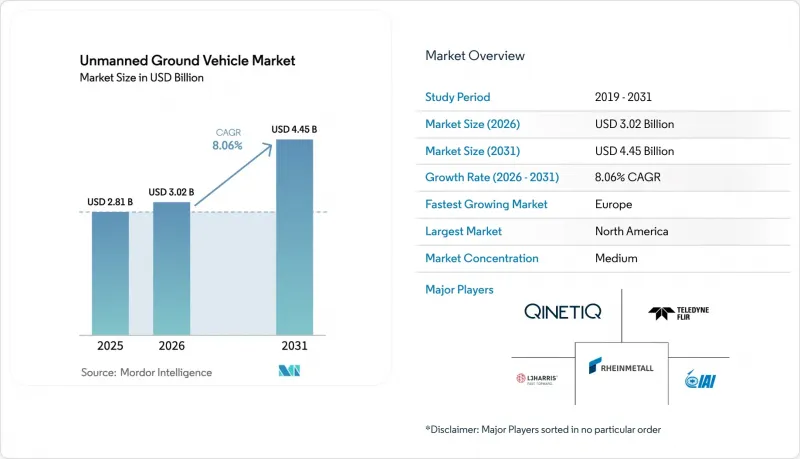
Mordor Intelligence에 의하면, 무인지상차량 시장 규모는 2025년 28억 1,000만 달러로 평가되었습니다. 2026년에는 30억 2,000만 달러로 확대되어 2026-2031년에 걸쳐 CAGR 8.06%로 성장을 지속하여, 2031년까지 44억 5,000만 달러에 이를 것으로 예측됩니다.

본 보고서는 용도별(군사, 민간 및 상업), 이동 방식별(바퀴식, 보행식, 트랙식),크기별(마이크로, 소형, 기타), 조작 방식별(원격 조작, 기타), 구성 요소별(하드웨어, 기타), 동력원별(전기 배터리, 기타), 지역별(북미, 유럽, 아시아태평양, 기타)로 분류되어 있습니다. 시장 예측은 금액(달러) 기준으로 제시되어 있습니다.
세계의 무인지상차량 시장 동향 및 인사이트
분쟁 지역 내 부상자 이송용 UGV에 대한 군사적 수요
각국 군은 의료 요원을 직접적인 포화에 노출시키지 않고 부상자를 구조하기 위해 설계된 트랙식 및 휠식 로봇을 배치하고 있습니다. 미국 육군은 2025 회계연도 예산에서 전술용 무인지상차량(UGV) 프로젝트에 9,250만 달러를 배정하고, 잔해가 흩어져 있는 지형에서 250kg의 부상자를 10km에 걸쳐 이송할 수 있는 능력을 명시했습니다. 유럽의 파트너 국가들도 이에 발맞추고 있으며, 밀렘 로봇(Milrem Robotics)은 들것을 장착한 ‘THeMIS’ 유닛을 우크라이나에 납품했습니다. 현지 피드백에 따르면, 시가전에서의 의료 요원 사상자가 30% 감소했다고 합니다. 대등한 세력 간의 분쟁에서 살상 능력이 높아짐에 따라 요원 보호가 최우선 과제가 되고 있으며, 로봇 도입에 따른 비용 증가를 상회하는 가치가 있는 것으로 간주되고 있습니다. 상호 운용성은 여전히 과제로 남아 있습니다. 이는 독자적인 사양의 데이터 링크가 ‘통합 시각 확대 시스템(IVAS)’ 등의 지휘통제 시스템과 연결될 수 있어야 하기 때문입니다. 시가지전이 확대되고 나토(NATO)의 전술 교리가 부대 보호를 중시함에 따라, 중·대규모 부상자 후송용 UGV는 무인지상차량 시장에서 더 큰 점유율을 차지하게 될 것으로 보입니다.
경로 확보 임무를 위한 대 IED 로봇 부대 전개
폭발물 처리(EOD) 부대는 단일 로봇을 활용한 전술에서 수송대 경로상의 위협을 정찰·표식·무력화하는 여러 대의 UGV로 구성된 함대로 전환되고 있습니다. 영국 국방부는 2024년, 조작 암과 파괴용 폭약을 갖춘 T4 로봇 최대 50대에 대한 계약을 L3Harris Technologies, Inc.에 발주했습니다. 운영자가 안전한 위치에서 여러 대의 로봇을 모니터링할 수 있기 때문에 함대 전술을 통해 경로 정리에 소요되는 시간이 40% 단축됩니다. ReconRobotics의 Throwbot과 같은 마이크로 로봇을 통해 보병 분대는 차량이 전진하기 전에 배수로를 점검할 수 있게 됩니다. 파괴성 탄약에 대한 규제상의 취급은 다양하며, 미국 주류·담배·화기·폭발물 관리국(ATF)은 원격 조종식 파괴 장치를 파괴 장치로 분류하고 있어, 이로 인해 확립된 방위 시스템 통합사업자들이 우대받고 있습니다. 반군 세력의 전술이 차량 탑재형 폭발물로 진화함에 따라, 마이크로 및 소형 폭발물 처리(EOD) 플랫폼에 대한 수요는 향후 10년 동안 지속될 것으로 예측됩니다.
독자적인 사양의 UGV 지휘통제(C2) 프로토콜 간의 상호 운용성 격차
UGV의 명령 인터페이스를 규정하는 주요한 보편적 표준은 존재하지 않습니다. NATO의 STANAG 4586은 무인 항공기를 대상으로 하고 있지만, 지상 차량에 관한 부록은 여전히 초안 단계에 머물러 있습니다. 그 결과, 제너럴 다이내믹스의 TRX, 텔다인의 FLIR PackBot, 밀렘의 THeMIS와 같은 로봇을 운용하는 여단은 여러 대의 제어 태블릿을 사용하여 훈련해야만 하여, 조작자의 업무 부담이 두 배로 늘어나고 있습니다. 채굴 작업자들도 유사한 과제에 직면해 있습니다. ISO 23725는 트럭의 상호 운용성을 향상시키고 있지만, 기존 코마츠, 캐터필러, 히타치 플랫폼에서는 여전히 미들웨어 계층이 필요하며, 이로 인해 지연이 증가하고 있습니다. 병렬 프로토콜 지원에 주요 계약업체의 소프트웨어 개발 예산의 최대 20%가 소요되고 있으며, 이로 인해 무인지상차량 시장에서 다중 공급업체 차량군의 확장 능력이 급속히 제한되고 있습니다.
부문별 분석
군사 프로그램은 2025년 매출의 69.63%를 차지해, 무인지상차량 시장에서 국방 예산이 얼마나 중심적인 역할을 하고 있는지를 여실히 보여줍니다. 한편, 민간 및 상업 부문 구매자는 2031년까지 연평균 성장률(CAGR) 8.27%를 나타낼 것으로 예측되며, 창고 운영사 및 대형 광산 기업들이 자율 주행 차량 군을 확대함에 따라 그 격차는 점차 좁혀질 것으로 보입니다. 아마존의 풀필먼트 센터만 해도 100만 대 이상의 로봇이 가동 중이며, 그 규모는 그 어떤 단일 국방 프로젝트보다도 훨씬 큽니다. 리오 틴토(Rio Tinto)나 BHP와 같은 주요 광업 기업들은 위험한 경사면에서 운전자의 피폭 위험을 제거해 주는 24시간 가동 무인 트럭에 의존하고 있습니다. 규제 체계는 크게 다릅니다. 군용 UGV는 국가 안보상의 면제 조치를 받고 있지만, 유럽의 AI법은 민간 플랫폼에 적합성 평가를 부과하고 있어, 이미 입지를 다진 통합업체들에게 유리하게 작용하고 있습니다.
방위 부문은 2024년 영국의 T4 EOD 계약에서 볼 수 있듯이, IED(임시 폭발 장치) 대응, 부상자 이송, 정찰과 같은 역할에 여전히 국한되어 있습니다. 반면, 민간 분야의 도입은 투자 회수 기간이 짧다는 장점이 있습니다. 임금 인플레이션율이 4% 이상의 상황에서 창고 로봇은 대부분의 경우 2년 만에 투자금을 회수할 수 있기 때문입니다. 농업, 건설, 검사 등 새로운 부문이 추가되면서 무인지상차량 시장은 새로운 잠재 시장 규모로 확대되고 있습니다. 설비 투자가 자율형 소프트웨어로 전환됨에 따라, 무인지상차량 시장 규모에서 민간 부문이 차지하는 비중은 2031년까지 35%를 넘어설 것으로 예측됩니다.
2025년 도입 대수의 50.89%를 바퀴식 플랫폼이 차지했으며, 포장 도로에서의 운용 및 유지보수가 간편하다는 점에서 선호되었습니다. 군 및 광산 사업자들은 진흙, 모래, 잔해 위를 주행할 수 있는 저접지압 차량을 요구하고 있어, 트랙식 유닛 시장은 연평균 성장률(CAGR) 9.11%로 확대될 것으로 예측됩니다. 밀렘 로봇사의 ‘THeMIS’는 우크라이나 분쟁 지역에서 참호를 횡단하는 기동력을 입증했습니다. 자율 주행형 운반 트럭은 운반로의 조건에 따라 여전히 바퀴식이지만, 크롤러식 불도저에는 현재 표토 제거용 자율 주행 키트가 탑재되어 있습니다.
보행형 이동 시스템은 아직 개발 단계에 있지만, 전략적으로 중요한 능력으로 남아 있습니다. 고스트 로봇(Ghost Robotics)사의 ‘Vision 60’이라는 사족 보행 로봇은 계단을 오르거나 바위가 많은 경사면에서 작동할 수 있습니다. 트랙식 시스템은 1,500시간마다 트랙 패드를 교체해야 하기 때문에 유지비가 높지만, 운용자들은 전술적 기동성을 얻기 위해 이 비용을 감수하고 있습니다. 시가지전이 격화되고 지형이 복잡한 지역에서 새로운 광산이 개발됨에 따라, 무인지상차량 시장에서 트랙식 차량의 점유율은 2031년까지 3분의 1에 육박할 것으로 예측됩니다.
지역별 분석
북미는 미국 국방부(DoD)의 자율 시스템에 대한 134억 달러 예산 배정과 캐나다의 광업 자동화에 힘입어 2025년 무인지상차량 시장 매출의 39.12%를 차지했습니다. 견고한 연구개발(R&D) 생태계와 안정적인 조달 예산이 국내 시스템 통합사업자를 뒷받침하는 한편, 아마존의 창고 로봇 군단이 상업 부문에서 큰 수요를 창출하고 있습니다.
유럽에서는 독일, 프랑스, 영국의 로봇 플라톤 프로그램에 더해, 규정 준수 대응 능력을 갖춘 기존 기업과의 계약을 우선시하는 EU의 ‘AI 법’ 적합성 평가에 힘입어 강력한 성장이 예상됩니다. 라인메탈의 ‘미션 마스터’ 시리즈는 여러 국가로부터 수주를 확보하고 있으며, 2026년에 법제화될 예정인 영국의 ‘커넥티드 앤 오토메이티드 비클 법안’은 공도 주행용 UGV(무인지상차량)에 대한 BVLOS(시야 외 비행)의 명확한 로드맵을 제시하고 있습니다.
아시아태평양에서는 국방력의 현대화가 급속히 진행되고 있습니다. 중국은 자체 개발한 ‘샤프 클로’와 ‘링크스’ UGV를 배치하고 있으며, 인도는 바라트 포지(Bharat Forge)사의 ‘카리야니 M4’를 시험 운용 중이고, 일본과 한국은 주변 경비용 로봇을 우선적으로 도입하고 있습니다. 중동 국가들은 이스라엘 에어로스페이스 인더스트리즈(Israel Aerospace Industries)와 엘빗 시스템즈(Elbit Systems)로부터 대 IED(임시 폭발 장치)용 로봇 및 주변 경비용 로봇을 구매하고 있습니다. 남미에서의 도입은 칠레와 페루의 자율형 운반에 중점을 두고 있는 반면, 아프리카의 초기 시장은 남아프리카공화국의 광산과 북아프리카의 폭발물 처리(EOD) 계약에 초점을 맞추었습니다. 동유럽이 지역적 위협에 대응하고 아시아태평양 국가들이 국경 방어를 강화하는 가운데, 전 세계 수요는 증가하고 있음에도 불구하고 지리적 분산으로 인해 북미 시장 점유율은 축소될 가능성이 있습니다.
기타 혜택
- 엑셀 형식 시장 예측(ME) 시트
- 3개월간의 애널리스트 지원
자주 묻는 질문
목차
제1장 서론
제2장 조사 방법
제3장 주요 요약
제4장 시장 구도
제5장 시장 규모 및 성장 예측
제6장 경쟁 구도
제7장 시장 기회 및 향후 전망
KTH 26.09.08According to Mordor Intelligence, the unmanned ground vehicle market size is expected to grow from USD 2.81 billion in 2025 to USD 3.02 billion in 2026 and is forecasted to reach USD 4.45 billion by 2031 at an 8.06% CAGR over 2026-2031.
This report is Segmented by Application (Military, and Civil and Commercial), Mobility (Wheeled, Legged, and Tracked), Size Class (Micro, Small, and More), Mode of Operation (Tele-Operated, and More), Component (Hardware, and More), Power Source (Electric Battery, and More), and Geography (North America, Europe, Asia-Pacific, and More). The Market Forecasts are Provided in Terms of Value (USD).
Global Unmanned Ground Vehicle Market Trends and Insights
Military Demand for Casualty-Evacuation UGVs in Contested Environments
Armed forces are fielding tracked and wheeled robots designed to rescue wounded personnel without exposing medics to direct fire. The US Army allocated USD 92.5 million in its fiscal 2025 budget for the Tactical Unmanned Ground Vehicle effort, specifying the ability to haul a 250 kg casualty across 10 km of rubble-strewn terrain. European partners follow suit; Milrem Robotics delivered stretcher-equipped THeMIS units to Ukraine, where field feedback indicates a 30% reduction in combat medic casualties during urban engagements. Increasing lethality in peer-level conflicts elevates the priority of personnel preservation, which outweighs the higher costs associated with robot acquisition. Interoperability remains a hurdle because proprietary data links must be able to connect with command-and-control suites, such as the Integrated Visual Augmentation System. As urban warfare proliferates and NATO doctrines emphasize force protection, medium- and large-casualty-evacuation UGVs will occupy a larger share of the unmanned ground vehicle market.
Deployment of Counter-IED Robot Fleets for Route-Clearance Missions
Explosive-ordnance-disposal (EOD) units are shifting from single-robot tactics to multi-UGV fleets that scout, mark, and neutralize threats along convoy routes. The UK MoD awarded L3Harris Technologies, Inc., a contract in 2024 for up to 50 T4 robots equipped with manipulator arms and disruptor charges. Fleet tactics reduce route-clearance time by 40% because operators can supervise several robots from a standoff position. Micro robots such as ReconRobotics' Throwbot enable infantry squads to inspect culverts before vehicles advance. Regulatory treatment of disruptive munitions varies, with the US ATF classifying tele-operated disruptors as destructive devices, favoring established defense integrators. As insurgent tactics evolve toward vehicle-borne explosives, the demand for micro and small EOD platforms is expected to persist throughout the decade.
Interoperability Gaps Across Proprietary UGV Command-and-Control Protocols
There is no major universal standard governing the command interfaces of UGVs. NATO STANAG 4586 covers unmanned aircraft, but ground-vehicle annexes remain in draft form. As a result, brigades operating General Dynamics TRX, Teledyne FLIR PackBot, and Milrem THeMIS robots must train on multiple control tablets, doubling operator workload. Mining operators experience similar friction; ISO 23725 improves truck interoperability, yet legacy Komatsu, Caterpillar, and Hitachi platforms still require middleware layers that increase latency. Support for parallel protocols consumes up to 20% of software development budgets within prime contractors, quickly limiting the unmanned ground vehicle market's ability to scale multivendor fleets.
Other drivers and restraints analyzed in the detailed report include:
- Rapid Adoption of Autonomous Logistics Carts in E-commerce Warehouses
- Mining Sector's Shift Toward Unmanned Haulage for Zero-Harm Initiatives
- Challenging SWaP Trade-offs for Long-Endurance Missions
For complete list of drivers and restraints, kindly check the Table Of Contents.
Segment Analysis
Military programs retained 69.63% of 2025 revenue, underscoring the centrality of defense budgets to the unmanned ground vehicle market. Civil and commercial buyers, however, are set to record an 8.27% CAGR through 2031, narrowing the gap as warehouse operators and mining majors expand autonomous fleets. Amazon's fulfillment centers alone host more than 1 million robots, a scale dwarfing any single defense project. Mining houses such as Rio Tinto and BHP rely on around-the-clock unmanned trucks that eliminate driver exposure to hazardous slopes. Regulatory frameworks diverge sharply: military UGVs enjoy national security exemptions, while the European AI Act imposes conformity assessments on civilian platforms, favoring established integrators.
Defense remains tethered to roles such as counter-IED, casualty evacuation, and reconnaissance, evidenced by the UK's T4 EOD contract in 2024. Civil adoption benefits from quicker payback periods, since warehouse robots often amortize in two years when wage inflation tops 4%. Agriculture, construction, and inspection add fresh verticals, stretching the unmanned ground vehicle market into new addressable volumes. As capital expenditure shifts toward autonomous software, the civil segment's share of the unmanned ground vehicle market size is expected to surpass the 35% threshold by 2031.
Wheeled platforms constituted 50.89% of 2025 deployments, which were favored for paved surfaces and simplified maintenance. Tracked units are forecast to expand at a 9.11% CAGR, as militaries and mining operators require low-ground-pressure vehicles that can traverse mud, sand, and rubble. Milrem Robotics' THeMIS demonstrated trench crossing agility in the conflict zones of Ukraine. Although autonomous haul trucks remain wheeled due to haul road conditions, tracked dozers now integrate autonomy kits for overburden removal.
Legged mobility remains a nascent yet strategic capability; Ghost Robotics' Vision 60 quadruped can climb stairs and operate on rocky slopes. Tracked systems incur higher maintenance costs, as track pads often need to be replaced every 1,500 hours; yet, operators accept this expense in exchange for tactical mobility. As urban warfare intensifies and new mines open in topographically complex regions, the share of tracked vehicles inside the unmanned ground vehicle market is expected to approach one-third by 2031.
Complete Report Scope:
- By Application
- Military
- Civil and Commerical
- By Mobility
- Wheeled
- Tracked
- Legged
- By Size Class
- Micro (Less than 10 kg)
- Small (10 to 200 kg)
- Medium (200 to 500 kg)
- Large (500 to 1,000 kg)
- Heavy (Greater than 1,000 kg)
- By Mode of Operation
- Tele-operated
- Autonomous/Hybrid
- By Component
- Hardware (Chassis, Sensors, Powertrain, Payloads)
- Software and AI Stack
- Services (Integration, MRO)
- By Power Source
- Electric Battery
- Hybrid-Electric
- Internal Combustion
- By Geography
- North America
- United States
- Canada
- Mexico
- Europe
- United Kingdom
- France
- Germany
- Russia
- Rest of Europe
- Asia-Pacific
- China
- India
- Japan
- South Korea
- Rest of Asia-Pacific
- South America
- Brazil
- Rest of South America
- Middle East and Africa
- Middle East
- Saudi Arabia
- United Arab Emirates
- Israel
- Rest of Middle East
- Africa
- South Africa
- Rest of Africa
- Middle East
- North America
Geography Analysis
North America accounted for 39.12% of the 2025 turnover in the unmanned ground vehicle market, bolstered by USD 13.4 billion in the US DoD's autonomous-system allocations and Canadian mining automation. Robust R&D ecosystems and stable procurement budgets sustain domestic integrators, while Amazon's warehouse robot fleet adds large commercial volumes.
Europe is projected to grow strongly, supported by Germany's, France's, and the UK's robotic-platoon programs, as well as the EU's AI Act conformity assessments, which favor contracts going to incumbents with compliance capacity. Rheinmetall's Mission Master family secured multi-country orders, and the UK Connected and Automated Vehicles Bill, set to become law in 2026, establishes a clear BVLOS pathway for public road UGVs.
The Asia-Pacific region is witnessing rapid defense modernization: China fields domestically developed Sharp Claw and Lynx UGVs, India is trialing Bharat Forge's Kalyani M4, and Japan and South Korea are prioritizing perimeter-security robots. The Middle East purchases counter-IED and perimeter robots from Israel Aerospace Industries and Elbit Systems. South American adoption centers on autonomous haulage in Chile and Peru, while Africa's early market focuses on South African mines and North African EOD contracts. As Eastern Europe counters regional threats and Asia-Pacific nations fortify their borders, geographic dispersion will likely lessen North America's share, even as global volumes rise.
- Teledyne FLIR LLC (Teledyne Technologies Corporation)
- General Dynamics Corporation
- Rheinmetall AG
- Oshkosh Corporation
- QinetiQ Group plc
- ASELSAN A.S.
- Leonardo S.p.A.
- Textron Inc.
- Milrem AS
- Robo-Team Ltd.
- Israel Aerospace Industries Ltd.
- Exail SAS
- HORIBA MIRA Ltd.
- L3Harris Technologies, Inc.
- Peraton Corp.
Additional Benefits:
- The market estimate (ME) sheet in Excel format
- 3 months of analyst support
TABLE OF CONTENTS
1 INTRODUCTION
- 1.1 Study Assumptions and Market Definition
- 1.2 Scope of the Study
2 RESEARCH METHODOLOGY
3 EXECUTIVE SUMMARY
4 MARKET LANDSCAPE
- 4.1 Market Overview
- 4.2 Market Drivers
- 4.2.1 Military demand for casualty evacuation UGVs in contested environments
- 4.2.2 Deployment of counter-IED robot fleets for route clearance missions
- 4.2.3 Rapid adoption of autonomous logistics carts in e-commerce warehouses
- 4.2.4 Mining sector's shift toward unmanned haulage for zero-harm initiatives
- 4.2.5 Advancements in solid-state LiDAR lowering navigation sensor costs
- 4.2.6 Defense funding for MUM-T concepts
- 4.3 Market Restraints
- 4.3.1 Interoperability gaps across proprietary UGV C2 protocols
- 4.3.2 Challenging SWaP trade-offs for long-endurance missions
- 4.3.3 Cyber-security vulnerabilities in remote tele-operation links
- 4.3.4 Regulatory lag for BVLOS ground autonomy on public roads
- 4.4 Value Chain Analysis
- 4.5 Regulatory Landscape
- 4.6 Technological Outlook
- 4.7 Porter's Five Forces Analysis
- 4.7.1 Bargaining Power of Buyers
- 4.7.2 Bargaining Power of Suppliers
- 4.7.3 Threat of New Entrants
- 4.7.4 Threat of Substitutes
- 4.7.5 Intensity of Competitive Rivalry
5 MARKET SIZE AND GROWTH FORECASTS (VALUE)
- 5.1 By Application
- 5.1.1 Military
- 5.1.2 Civil and Commerical
- 5.2 By Mobility
- 5.2.1 Wheeled
- 5.2.2 Tracked
- 5.2.3 Legged
- 5.3 By Size Class
- 5.3.1 Micro (Less than 10 kg)
- 5.3.2 Small (10 to 200 kg)
- 5.3.3 Medium (200 to 500 kg)
- 5.3.4 Large (500 to 1,000 kg)
- 5.3.5 Heavy (Greater than 1,000 kg)
- 5.4 By Mode of Operation
- 5.4.1 Tele-operated
- 5.4.2 Autonomous/Hybrid
- 5.5 By Component
- 5.5.1 Hardware (Chassis, Sensors, Powertrain, Payloads)
- 5.5.2 Software and AI Stack
- 5.5.3 Services (Integration, MRO)
- 5.6 By Power Source
- 5.6.1 Electric Battery
- 5.6.2 Hybrid-Electric
- 5.6.3 Internal Combustion
- 5.7 By Geography
- 5.7.1 North America
- 5.7.1.1 United States
- 5.7.1.2 Canada
- 5.7.1.3 Mexico
- 5.7.2 Europe
- 5.7.2.1 United Kingdom
- 5.7.2.2 France
- 5.7.2.3 Germany
- 5.7.2.4 Russia
- 5.7.2.5 Rest of Europe
- 5.7.3 Asia-Pacific
- 5.7.3.1 China
- 5.7.3.2 India
- 5.7.3.3 Japan
- 5.7.3.4 South Korea
- 5.7.3.5 Rest of Asia-Pacific
- 5.7.4 South America
- 5.7.4.1 Brazil
- 5.7.4.2 Rest of South America
- 5.7.5 Middle East and Africa
- 5.7.5.1 Middle East
- 5.7.5.1.1 Saudi Arabia
- 5.7.5.1.2 United Arab Emirates
- 5.7.5.1.3 Israel
- 5.7.5.1.4 Rest of Middle East
- 5.7.5.2 Africa
- 5.7.5.2.1 South Africa
- 5.7.5.2.2 Rest of Africa
- 5.7.5.1 Middle East
- 5.7.1 North America
6 COMPETITIVE LANDSCAPE
- 6.1 Market Concentration
- 6.2 Strategic Moves
- 6.3 Market Share Analysis
- 6.4 Company Profiles (includes Global level Overview, Market level overview, Core Segments, Financials as available, Strategic Information, Market Rank/Share for key companies, Products and Services, and Recent Developments)
- 6.4.1 Teledyne FLIR LLC (Teledyne Technologies Corporation)
- 6.4.2 General Dynamics Corporation
- 6.4.3 Rheinmetall AG
- 6.4.4 Oshkosh Corporation
- 6.4.5 QinetiQ Group plc
- 6.4.6 ASELSAN A.S.
- 6.4.7 Leonardo S.p.A.
- 6.4.8 Textron Inc.
- 6.4.9 Milrem AS
- 6.4.10 Robo-Team Ltd.
- 6.4.11 Israel Aerospace Industries Ltd.
- 6.4.12 Exail SAS
- 6.4.13 HORIBA MIRA Ltd.
- 6.4.14 L3Harris Technologies, Inc.
- 6.4.15 Peraton Corp.
7 MARKET OPPORTUNITIES AND FUTURE OUTLOOK
- 7.1 White-space and Unmet-Need Assessment


