

|
시장보고서
상품코드
2122487
그린 코팅 : 시장 점유율 분석, 업계 동향과 통계, 성장 예측(2026-2031년)Green Coatings - Market Share Analysis, Industry Trends & Statistics, Growth Forecasts (2026 - 2031) |
||||||
 Mordor Intelligence
Mordor Intelligence에 의하면, 그린 코팅 시장 규모는 2025년 1,464억 6,000만 달러에서 2026년에는 1,531억 4,000만 달러로 성장하고, 2026-2031년 CAGR 4.56%로 성장을 지속하여 2031년에는 1,913억 9,000만 달러에 달할 것으로 예측됩니다.
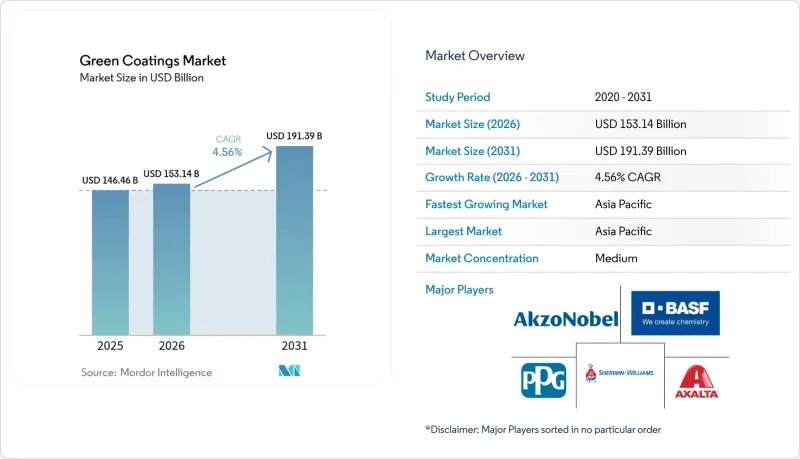
본 보고서는 유형별(수성, 분체, 기타), 용도별(건축용 도료, 산업 용도료, 기타), 지역별(아시아태평양, 북미, 유럽, 남미, 중동 및 아프리카)로 분류되어 있습니다. 시장 예측은 금액(달러) 기준으로 제시되어 있습니다.
세계 그린 코팅 시장 동향 및 인사이트
VOC 배출에 관한 엄격한 환경 규제
새로운 VOC 규제치로 인해 그린 코팅 시장에서 허용되는 배합 범위가 재정의되고 있습니다. 사우스코스트 대기질 관리국(AQMD)의 규정 제1151호에 따르면, 2025년 5월부터 자동차 수리용 제품에 대한 VOC 상한치 인하가 단계적으로 시행되어 2033년까지 가장 엄격한 기준치에 도달하게 되며,이로 인해 자동차 정비소는 수성 시스템으로의 전환을 강요받고 있습니다. 한편, EU의 ‘포장 및 포장 폐기물에 관한 규정’에서는 PFAS 함유량을 개별 물질당 25 ppb, 총량 250 ppb로 제한하고 있어, 이에 따라 포장 공급업체들은 불소계 화학 물질을 배제한 바이오 코팅으로의 전환을 강요받고 있습니다. 이미 규정을 준수하는 제품 포트폴리오를 보유한 기업은 선구자로서의 우위를 점할 수 있지만, 기존의 용제계 제품 라인에 얽매여 있는 제조업체는 규정 준수를 위한 추가 비용 발생이나 시장에서 배제될 가능성에 직면하게 될 것입니다.
저VOC 건축용 도료에 대한 수요 증가
주택 보수, 상업시설 개보수 및 친환경 건축 기준에 따라 건설 밸류체인은 저VOC 대체재로 계속 이동하고 있습니다. 셔윈 윌리엄스(Sherwin-Williams)는 주택 재도장 주문에서 재활용이 용이하고 탄소 배출량이 적도록 설계된 도료로의 뚜렷한 전환을 보고하고 있습니다. 현재 수성 도료는 용제형 도료와 동등한 광택 유지력과 내세정성을 실현하고 있습니다. 악소노벨(AkzoNobel)사의 ‘RUBBOL WF 3350’은 이러한 전환을 상징하는 제품으로, 20%의 바이오 성분을 함유하면서도 실내 및 실외 목재 마감에 있어 보증된 내구성을 갖추고 있습니다.
가혹한 환경 하에서 용제형 도료와의 성능 격차
선박 선체, 해양 플랫폼, 화학 약품 저장 탱크에서는 여전히 용제를 다량 함유한 고고형분 에폭시 도료가 지닌 장기적인 부착 생물 저항성과 차단 강도가 요구되고 있습니다. 자가복구형 실록산 하이브리드나 크롬 프리 억제제가 등장하고 있지만, 인증 절차가 장기간 소요되고 선주가 검증되지 않은 화학물질의 사용에 거부감을 보이기 때문에 상업적인 보급은 더딘 임베디드니다.
부문 분석
2025년, 수성 시스템은 그린 코팅 시장에서 54.62%의 점유율을 차지하며 선두 자리를 유지했습니다. 이러한 우위는 규제 대응의 용이성과 용제계 제품과 동등한 기계적 강도를 실현하는 끊임없는 수지 개량에 기인합니다. 마쓰다가 공장 전체에서 첨단 수성 탑코트로 전환한 것만으로도 쇼룸급 광택을 유지하면서 VOC 배출량을 57% 감축했습니다. 한편, 분체 도료는 가장 빠른 성장 궤도를 그리고 있으며, 2031년까지 연평균 성장률(CAGR) 6.18%로 확대될 것으로 전망됩니다. 촉매를 이용한 적외선 오븐 덕분에 현재는 약 225°C에서 두꺼운 도막을 불과 2-3분 만에 경화시킬 수 있게 되어, 생산 처리량이 향상되고 에너지 비용도 대폭 절감되고 있습니다. 셔윈-윌리엄스(Sherwin-Williams)사의 ‘Powdura ECO’는 순환형 설계의 모범 사례로, 분말 1파운드당 0.5리터 병 16개 분량에 해당하는 재생 PET가 배합되어 있습니다. 분체 도장 라인용 친환경 코팅 시장 규모는 150°C에서 경화되는 저온 배합제의 보급에 따라 확대될 것으로 예측되며, 이를 통해 열에 약한 플라스틱이나 MDF 가구로의 응용이 가능해집니다. 한편, UV 경화형 액체 도료는 거의 즉각적인 경화가 필수적인 전자 분야에서 특수한 틈새 시장을 차지하고 있습니다.
친환경 코팅 업계는 고고형분 알키드·아크릴 하이브리드 도료의 등장으로 인해 혜택을 보고 있습니다. 이러한 시스템은 ? 에지나 금속 기판에 대한 밀착성을 저해하지 않으면서 용제 함량을 250 g/L 미만으로 낮춥니다. 이러한 제품군은 전반적으로 지속 가능한 화학 기술이 기존의 기준을 충족하거나 심지어 그 이상을 달성할 수 있다는 인식을 강화하고 있습니다.
지역별 분석
아시아태평양은 2025년 매출의 43.68%를 차지하며 지배적인 입지를 공고히 하고 있으며, 2031년까지 연평균 성장률(CAGR) 5.42%라는 가장 높은 성장률을 기록하고 있습니다. 인도네시아의 생산량은 2024년에 100만 톤을 넘어섰으며, 수성 장식용 도료가 국내 생산의 67%라는 압도적인 점유율을 차지하고 있습니다. 이 지역의 친환경 코팅 시장은 중국의 택배 포장 관련 법률인 ‘GB 43352-2023’에 힘입어 더욱 활성화되고 있습니다. 이 법률에 따라 전자상거래(EC) 물류 센터는 규정을 준수하는 코팅으로 전환해야 할 의무가 있습니다. 또한, 인도 식품안전기준청(FSSAI)의 식품 용기 규제 강화도 수요를 뒷받침하는 요인이 되고 있습니다. 지속적인 도시화, 자동차 생산 확대, 그리고 OEM 도장 공장에 대한 외국인 직접 투자가 장기적인 성장의 원동력이 되고 있습니다.
북미에서는 캘리포니아주의 VOC 기준과 견조한 주택 재도장 주기에 힘입어 안정적인 성장 궤도를 밟고 있습니다. 제너럴 모터스(GM)의 ‘3-웨트 공법’은 저에너지 라인의 경쟁 우위를 부각시키고 있으며, 여러 Tier 1 공급업체들이 색상 변경을 간소화하는 수성 프라이머로의 전환을 추진하고 있습니다. 캐나다에서도 가전 제조업체들이 분체 도장 부스에 투자하는 등 유사한 진전이 나타나고 있습니다. 한편, 멕시코에서는 코일 코팅 설비에 360만 달러를 투자해 설비를 갱신한 결과, 해당 지역에 비용 효율이 높은 공급 거점이 확립되었습니다.
유럽은 근본적인 PFAS 규제와 탄소 국경 조치가 신속한 배합 변경을 촉진하고 있어 여전히 주요 시장으로서의 지위를 유지하고 있습니다. 가맹국들은 용제 함량이 높은 이산화티타늄 수입품에 대해 반덤핑 관세를 부과하고 있으며, 이로 인해 간접적으로 안료 사용량이 적은 저고형분 도료 및 수성 도료로의 전환이 촉진되고 있습니다. 독일과 프랑스에서는 바이오 수지를 다루는 스타트업 기업의 육성이 계속되고 있으며, 기존 복합 기업과의 기술 제휴가 촉진되고 있습니다.
남미, 중동 및 아프리카의 신흥 지역에서는 완만하지만 가속화되고 있는 보급세가 관찰됩니다. 브라질의 산업 생산 및 사우디아라비아의 ‘비전 2030’과 같은 거대 프로젝트로 인해, 보호용 철골 구조물 및 장식용 제품에서 지속 가능한 도료의 중요성이 더욱 높아지고 있습니다. 그러나 규제 집행의 불균일성과 재생 가능 원료에 대한 접근성이 제한적이라는 점으로 인해, 일부 현지 시장에서는 보급 속도가 둔화되고 있습니다.
기타 혜택:
- 엑셀 형식 시장 예측(ME) 시트
- 3개월간의 애널리스트 지원
자주 묻는 질문
목차
제1장 서론
제2장 조사 방법
제3장 주요 요약
제4장 시장 구도
제5장 시장 규모와 성장 예측
제6장 경쟁 구도
제7장 시장 기회와 향후 전망
LSH 26.09.03According to Mordor Intelligence, the green coatings market size is expected to grow from USD 146.46 billion in 2025 to USD 153.14 billion in 2026 and is forecast to reach USD 191.39 billion by 2031 at 4.56% CAGR over 2026-2031.
This report is Segmented by Type (Water-Borne, Powder, and More), Application (Architectural Coatings, Industrial Coatings, and More), and Geography (Asia-Pacific, North America, Europe, South America, Middle East and Africa). The Market Forecasts are Provided in Terms of Value (USD).
Global Green Coatings Market Trends and Insights
Stringent Environmental Regulations on VOC Emissions
New VOC limits are redefining acceptable formulation windows for the green coating market. South Coast AQMD's Rule 1151 phases in lower VOC ceilings for automotive refinish products beginning May 2025 and culminates in the strictest thresholds by 2033, pushing body shops toward water-borne systems. On another front, the EU Packaging and Packaging Waste Regulation caps PFAS at 25 ppb per individual substance and 250 ppb total, steering packaging suppliers to bio-based coatings that avoid fluorinated chemistries. Businesses already holding portfolios of compliant products gain a first-mover advantage, whereas producers tied to legacy solvent-borne lines face incremental compliance cost and potential market exclusion.
Growing Demand for Low-VOC Architectural Coatings
Home repairs, commercial retrofits, and green-building standards continue to draw the construction value chain toward low-VOC alternatives. Sherwin-Williams reports a noticeable shift in residential repaint orders toward paints designed for easy recycling and lower embodied carbon. Water-borne formulations now deliver the same gloss retention and scrub resistance as solvent-borne equivalents. AkzoNobel's RUBBOL WF 3350 exemplifies this transition, pairing 20% bio-based content with warranty-backed durability in indoor and outdoor wood finishes.
Performance Gaps Versus Solvent-Borne in Harsh Environments
Marine hulls, offshore platforms, and chemical storage tanks still demand the long-term fouling resistance and barrier strength of high-solids epoxies rich in solvents. Although self-healing siloxane hybrids and chrome-free inhibitors are emerging, their commercial adoption is gradual because certification cycles are lengthy and shipowners resist untested chemistries.
Other drivers and restraints analyzed in the detailed report include:
- Automotive OEM Shift Toward Energy-Efficient Paint Shops
- Advances in Water-Based Resin Chemistry Enhancing Durability
- Higher Total Applied Cost for End-Users
For complete list of drivers and restraints, kindly check the Table Of Contents.
Segment Analysis
Water-borne systems preserved leadership in 2025 with a 54.62% share of the green coating market. Their dominance is rooted in favorable compliance footprints and constant resin upgrades that yield mechanical strength on par with solvent-borne counterparts. Mazda's plant-wide switch to advanced water-based topcoats alone lowered VOC output by 57% while retaining showroom-grade gloss. Powder coatings, however, offer the most rapid trajectory, advancing at 6.18% CAGR to 2031. Catalyst-assisted infrared ovens now cure thick films in just 2-3 minutes at roughly 225 °C, elevating production throughput and slashing utility bills. Sherwin-Williams' Powdura ECO illustrates circular design, embedding every pound of powder with recycled PET equal to sixteen half-liter bottles. The green coating market size for powder lines is projected to expand in tandem with low-temperature formulations that harden at 150 °C, opening doors to heat-sensitive plastics and MDF furniture. Meanwhile, UV-curable liquids occupy specialized niches in electronics where near-instant cure is mandatory.
The green coating industry also benefits from higher-solids alkyd and acrylic hybrids. These systems cut the solvent fraction below 250 g/L without sacrificing wet edge or adhesion to metallic substrates. Collectively, such variants reinforce the perception that sustainable chemistries can meet or exceed conventional benchmarks.
Complete Report Scope:
- By Type
- Water-borne
- Powder
- High-solids
- UV-cured coatings
- By Application
- Architectural Coatings
- Industrial Coatings
- Automotive Coatings
- Wood Coatings
- Packaging Coatings
- Other Applications (Electronics and Electrical Coatings, etc.)
- By Geography
- Asia-Pacific
- China
- India
- Japan
- South Korea
- Rest of Asia-Pacific
- North America
- United States
- Canada
- Mexico
- Europe
- Germany
- United Kingdom
- France
- Italy
- Rest of Europe
- South America
- Brazil
- Argentina
- Rest of South America
- Middle East and Africa
- Saudi Arabia
- South Africa
- Rest of Middle East and Africa
- Asia-Pacific
Geography Analysis
Asia-Pacific confirmed its dominance with 43.68% of 2025 revenue while charting the fastest 5.42% CAGR through 2031. Indonesian output surpassed 1 million tons in 2024, with waterborne decorative paints taking a striking 67% share of local production. The region's green coating market is further stimulated by China's express-packaging law GB 43352-2023 that forces e-commerce warehouses to switch to compliant coatings. India's move to tighten food-container rules under the Food Safety and Standards Authority (FSSAI) also underpins demand. Continued urbanization, automotive build-outs, and foreign direct investment into OEM paint shops present long-run momentum.
North America enjoys a resilient path powered by California's VOC benchmarks and robust residential repaint cycles. General Motors' three-wet technique underscores the competitive edge of low-energy lines, and multiple Tier 1 suppliers pivot to water-borne primers that simplify color changeover. Canada mirrors this progress through appliance manufacturers investing in powder booths, whereas Mexico's coil-coating capacity staking USD 3.6 million in upgrades provides the region a cost-efficient supply hub.
Europe remains a heavyweight courtesy of sweeping PFAS restrictions and carbon-border considerations that motivate rapid reformulation. Member states impose antidumping duties on high-solvent titanium dioxide imports, indirectly steering formulators toward lower-solids or water-borne routes that require less pigment. Germany and France continue to incubate bio-based resin start-ups, fostering technical collaborations with existing conglomerates.
Emerging geographies in South America, the Middle East, and Africa post moderate yet accelerating uptake. Brazil's industrial output and Saudi Arabia's Vision 2030 mega-projects heighten the relevance of sustainable coatings in protective steelwork and decorative lines. However, fragmented regulatory enforcement and limited access to renewable feedstocks temper pace in several local markets.
- AkzoNobel N.V.
- Arkema
- Asian Paints Ltd.
- Axalta Coating Systems, LLC
- BASF
- Beckers Group
- Berger Paints India Ltd.
- DAW SE
- Eastman Chemical Company
- Evonik Industries AG
- Hempel A/S
- Jotun
- Kansai Paint Co., Ltd.
- Nippon Paint Holdings Co., Ltd.
- PPG Industries Inc.
- RPM International Inc.
- Sika AG
- The Sherwin-Williams Company
Additional Benefits:
- The market estimate (ME) sheet in Excel format
- 3 months of analyst support
TABLE OF CONTENTS
1 Introduction
- 1.1 Study Assumptions
- 1.2 Scope of the Study
2 Research Methodology
3 Executive Summary
4 Market Landscape
- 4.1 Market Overview
- 4.2 Market Drivers
- 4.2.1 Stringent environmental regulations on VOC emissions
- 4.2.2 Growing demand for low-VOC architectural coatings
- 4.2.3 Automotive OEM shift toward energy-efficient paint shops
- 4.2.4 Advances in water-based resin chemistry enhancing durability
- 4.2.5 Adoption of bio-based resins from agricultural waste
- 4.3 Market Restraints
- 4.3.1 Performance gaps versus solvent-borne in harsh environments
- 4.3.2 Higher total applied cost for end-users
- 4.3.3 Supply constraints of bio-based feedstocks
- 4.4 Value Chain Analysis
- 4.5 Porter's Five Forces Analysis
- 4.5.1 Bargaining Power of Suppliers
- 4.5.2 Bargaining Power of Buyers
- 4.5.3 Threat of New Entrants
- 4.5.4 Threat of Substitutes
- 4.5.5 Competitive Rivalry
5 Market Size & Growth Forecasts (Value)
- 5.1 By Type
- 5.1.1 Water-borne
- 5.1.2 Powder
- 5.1.3 High-solids
- 5.1.4 UV-cured coatings
- 5.2 By Application
- 5.2.1 Architectural Coatings
- 5.2.2 Industrial Coatings
- 5.2.3 Automotive Coatings
- 5.2.4 Wood Coatings
- 5.2.5 Packaging Coatings
- 5.2.6 Other Applications (Electronics and Electrical Coatings, etc.)
- 5.3 By Geography
- 5.3.1 Asia-Pacific
- 5.3.1.1 China
- 5.3.1.2 India
- 5.3.1.3 Japan
- 5.3.1.4 South Korea
- 5.3.1.5 Rest of Asia-Pacific
- 5.3.2 North America
- 5.3.2.1 United States
- 5.3.2.2 Canada
- 5.3.2.3 Mexico
- 5.3.3 Europe
- 5.3.3.1 Germany
- 5.3.3.2 United Kingdom
- 5.3.3.3 France
- 5.3.3.4 Italy
- 5.3.3.5 Rest of Europe
- 5.3.4 South America
- 5.3.4.1 Brazil
- 5.3.4.2 Argentina
- 5.3.4.3 Rest of South America
- 5.3.5 Middle East and Africa
- 5.3.5.1 Saudi Arabia
- 5.3.5.2 South Africa
- 5.3.5.3 Rest of Middle East and Africa
- 5.3.1 Asia-Pacific
6 Competitive Landscape
- 6.1 Market Concentration
- 6.2 Strategic Moves
- 6.3 Market Share(%)/Ranking Analysis
- 6.4 Company Profiles (includes Global level Overview, Market level overview, Core Segments, Financials as available, Strategic Information, Market Rank/Share for key companies, Products & Services, and Recent Developments)
- 6.4.1 AkzoNobel N.V.
- 6.4.2 Arkema
- 6.4.3 Asian Paints Ltd.
- 6.4.4 Axalta Coating Systems, LLC
- 6.4.5 BASF
- 6.4.6 Beckers Group
- 6.4.7 Berger Paints India Ltd.
- 6.4.8 DAW SE
- 6.4.9 Eastman Chemical Company
- 6.4.10 Evonik Industries AG
- 6.4.11 Hempel A/S
- 6.4.12 Jotun
- 6.4.13 Kansai Paint Co., Ltd.
- 6.4.14 Nippon Paint Holdings Co., Ltd.
- 6.4.15 PPG Industries Inc.
- 6.4.16 RPM International Inc.
- 6.4.17 Sika AG
- 6.4.18 The Sherwin-Williams Company
7 Market Opportunities & Future Outlook
- 7.1 White-space & Unmet-need Assessment


