

|
시장보고서
상품코드
2122492
배향성 스트랜드 보드(OSB) : 시장 점유율 분석, 업계 동향 및 통계, 성장 예측(2026-2031년)Oriented Strand Board (OSB) - Market Share Analysis, Industry Trends & Statistics, Growth Forecasts (2026 - 2031) |
||||||
 Mordor Intelligence
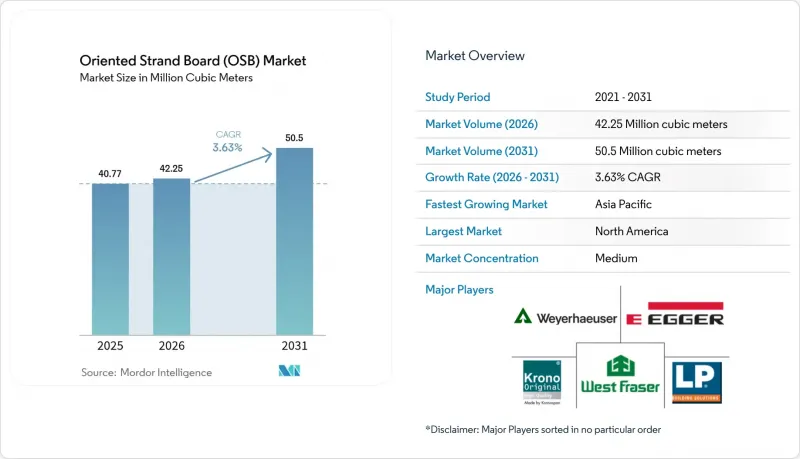
Mordor Intelligence에 의하면, 배향성 스트랜드 보드(OSB) 시장 규모는 2025년 4,077만 입방미터로 평가되었습니다. 2026년 4,225만 입방미터로부터, 2031년까지 5,050만 입방미터로 확대될 것으로 예측되며 2026-2031년에 걸쳐 CAGR 3.63%를 기록할 전망입니다.

본 보고서는 등급별(OSB/1, OSB/2, OSB/3, OSB/4), 최종 사용자용도별(건설, 가구, 포장), 지역별(아시아태평양, 북미, 유럽, 남미, 중동 및 아프리카)로 분류되어 있습니다. 시장 전망은 수량(입방미터) 기준으로 제시되어 있습니다.
세계의 배향성 스트랜드 보드(OSB) 시장 동향 및 인사이트
합판에 비해 비용 효율이 뛰어난 대체재
OSB는 합판에 비해 가격 면에서 일관되게 우위를 점하고 있습니다. 이러한 가격 우위 덕분에 단독 주택 및 소규모 상업 프로젝트에서 사양 변경이 꾸준히 진행되고 있습니다. 미국 남동부 및 캐나다 프레리 지역의 건설업체들은 지붕 밑판이나 벽 보강재로 OSB를 채택하는 경향이 강해지고 있습니다. OSB의 균일한 스트랜드 배향은 신뢰할 수 있는 전단 저항력을 제공합니다. 또한, OSB의 사전 절단된 트림 포장은 현장에서 발생하는 잔여 재료를 줄여주며, 특히 최저 임금이 높은 지역에서 인건비를 대폭 절감하는 데 기여합니다. 합판은 우수한 가장자리 밀봉이 요구되는 외장 용도에서 여전히 틈새 시장을 차지하고 있지만, 이로 인해 구조용 피복재 수요에서 OSB의 실질적인 점유율은 제한되고 있습니다. 그러나 베니어용 원목 공급이 감소 추세에 있고, 합판 공장도 원목 가격 급등으로 어려움을 겪고 있는 만큼, 중기적으로는 OSB를 지지하는 추세가 지속될 것으로 예측됩니다.
전 세계 건설 활동의 확대
2025년, 전체 건설 생산액은 완만한 성장세를 보였습니다. 그러나 OSB(지향성 스트랜드 보드)에 대한 의존도가 높은 주택 및 인프라 등의 부문에서는 더욱 견실한 실적을 기록했습니다. 인도의 주택 정책에 따라 집성재를 지정된 주택이 도입되면서 주택 건설이 급증했습니다. 한편, 베트남에서는 고속도로 확충이 진행되었고, 인도네시아에서는 신수도 건설 프로젝트가 시작되었으나, 두 사업 모두 가설 거푸집을 많이 사용했습니다. 이러한 상황에서 건설사들은 기존 합판보다 재사용형 OSB 패널을 명확히 선호하여 채택했습니다. 중국의 부동산 시장 침체로 인해 연간 OSB 수요는 감소했으나, 그 영향은 어느 정도 완화되었습니다. 이는 주로 북미와 유럽에서의 OSB 수출이 인도 및 아세안 시장으로 전환되었기 때문입니다. 따라서 OSB 시장 동향은 더 이상 특정 단일 국가에 의해 좌우되는 것이 아니라, 신흥 아시아 국가들의 건설 활동과 점점 더 밀접하게 연결되어 있습니다.
포름알데히드 및 VOC 관련 규제 강화
캘리포니아주의 CARB 2단계 규제로 인해 OSB 제조업체들은 초저휘발성 수지로의 전환을 강요받고 있습니다. 현행 규정에서는 패널이 적용 대상에서 제외되어 있음에도 불구하고, 대형 소매업체들이 모든 제품에 걸쳐 일관된 규정 준수를 요구하고 있기 때문에 이러한 전환이 진행되고 있습니다. 페놀·포름알데히드 계열에서 MDI로의 전환은 수지 비용 증가를 초래하여, 소규모 제조업체에게는 감당하기 어려운 부담이 되고 있습니다. 2025년 1월부터 의무화된 EU의 E1 기준 상한치로 인해, 많은 튀르키예 및 러시아 수출업체들은 설비 개조나 시장 철수를 강요받고 있으며, 그 결과 해외 공급량이 감소했습니다. 또한, 일본의 엄격한 실내 공기질 기준으로 인해 밀봉되지 않은 OSB의 사용은 더욱 제한받고 있습니다. 자사 수지 공장을 보유한 대형 제조업체는 이러한 변화에 쉽게 대응하고 있지만, 규제 변동은 산업 재편을 가속화하여 단기적으로는 OSB 시장의 성장을 저해하고 있습니다.
부문별 분석
OSB/3는 2025년 물량의 46.89%를 차지했으며, 2031년까지 연평균 성장률(CAGR) 4.61%로 배향성 스트랜드 보드 시장을 주도할 것으로 예측됩니다. 내하중성과 내습성 인증을 획득한 OSB/3는 북미와 유럽의 피복재 수요 대부분을 충족시키고 있습니다. 이러한 특성 덕분에 건조용과 고습도용을 구분하여 재고를 관리할 필요가 없어집니다. 한편, 고습도 환경의 구조용도로 설계된 OSB/4는 시장 점유율은 작지만, 허리케인과 태풍이 빈번하게 발생하는 연안 지역의 건축 기준 요건에 힘입어 성장을 거듭하고 있습니다. 상당한 시장 점유율을 차지하는 OSB/1과 OSB/2는 성장세가 주춤하고 있습니다. 이는 건설업체들이 더 고성능 등급으로 전환함에 따라, 이러한 등급들이 단계적으로 폐지될 가능성이 있음을 시사합니다.
비용 상승에도 불구하고, OSB/3 및 OSB/4에서 MDI 수지의 사용 확대는 LEED 및 BREEAM 크레딧 획득을 보장할 뿐만 아니라 평균 판매 가격 상승으로도 이어지고 있습니다. 대조적으로, 수지 제조 설비를 갖추지 않은 소규모 공장에서는 OSB/1이나 OSB/2에 치중하는 경향이 보입니다. 이러한 동향은 배향성 스트랜드보드 시장의 양극화 추세를 여실히 보여주며, 등급의 주도권은 환경 규제 준수 여부와 점점 더 밀접하게 연결되고 있습니다.
지역별 분석
북미는 다수의 제재소 운영과 견고하게 통합된 목재 공급망에 힘입어 2025년 생산량의 60.12%를 차지했습니다. 그러나 그 성장률은 세계 평균보다 낮습니다. 이러한 성장 부진은 미국의 주택 담보 대출 금리 상승이 단독 주택 건축 허가 건수를 억제하고 있는 점과 캐나다의 입목 가격 상승에 기인합니다. 그 결과, 북미의 배향성 스트랜드 보드(OSB) 시장 규모는 안정적이지만, 지리적 우위 덕분에 높은 이익률을 계속 유지하고 있습니다.
큰 시장 점유율을 차지하는 아시아태평양은 2031년까지 연평균 6.28%의 성장 궤도에 올라 있습니다. 인도의 이러한 성장세는 주로 ‘프라단 만트리 아와스 요자나(Pradhan Mantri Awas Yojana)’에 기인하며, 이 계획이 OSB 소비를 크게 끌어올리고 있습니다. 한편, 베트남과 인도네시아 양국은 고속도로 및 신도시에 대한 대규모 인프라 투자를 진행하고 있으며, 거푸집을 많이 사용하는 건설 공법에 중점을 두고 있습니다. 중국은 부동산 시장이 조정 국면에 접어들었으나, 서부 여러 성에서 진행 중인 인프라 프로젝트가 기초적인 수요를 뒷받침하고 있습니다. 그러나 남아시아와 동남아시아는 수입 의존도가 높아 선적 비용에 상당한 프리미엄이 발생하고 있습니다. 이러한 상황은 그린필드에서의 생산 능력 확대를 검토 중인 현지 투자자들에게 수익성 높은 기회가 되고 있습니다.
안정적인 시장 점유율을 유지하고 있는 유럽에서는 꾸준한 성장이 나타나고 있습니다. ‘제로 에너지 건축’에 대한 노력이 목조 건축의 급증을 이끌고 있습니다. 그러나 엄격한 수지 규제와 펄프 재료공급 부족과 같은 과제가 남아 있어, 이 모두 이익률을 압박하고 있습니다. 시장 점유율은 다소 낮지만, 남미는 성장 궤도에 올라 있습니다. 특히 브라질은 자국의 유칼립투스 조림지를 활용하여 OSB를 수익성 높은 수출품으로 전환하고 있습니다. 중동 및 아프리카는 시장 점유율이 다소 낮지만, 특히 야심 찬 기가 프로젝트의 대규모 거푸집에 대해서는 수입 의존도가 높습니다. 높은 운송 비용이 과제로 대두되고 있는 반면, 지속적인 석유 수입에 따른 호조가 장기적인 건설 사업을 위한 탄탄한 프로젝트 파이프라인을 보장하고 있습니다.
기타 혜택
- 엑셀 형식 시장 예측(ME) 시트
- 3개월간의 애널리스트 지원
자주 묻는 질문
목차
제1장 서론
제2장 조사 방법
제3장 주요 요약
제4장 시장 구도
제5장 시장 규모 및 성장 예측
제6장 경쟁 구도
제7장 시장 기회 및 향후 전망
KTH 26.09.08According to Mordor Intelligence, the oriented strand board market size is projected to expand from 40.77 million cubic meters in 2025 and 42.25 million cubic meters in 2026 to 50.50 million cubic meters by 2031, registering a CAGR of 3.63% between 2026 to 2031.
This report is Segmented by Grade (OSB/1, OSB/2, OSB/3, and OSB/4), End-User Application (Construction, Furniture, and Packaging), and Geography (Asia-Pacific, North America, Europe, South America, and Middle-East and Africa). The Market Forecasts are Provided in Terms of Volume (Cubic Meters).
Global Oriented Strand Board (OSB) Market Trends and Insights
Cost-Effective Substitution for Plywood
OSB enjoys a consistent price discount compared to plywood. This price advantage is driving a steady shift in specifications for single-family homes and light-commercial projects. Builders in the U.S. Southeast and Canadian Prairies are increasingly opting for OSB in roof decking and wall bracing. OSB's uniform strand orientation provides reliable shear resistance. Additionally, OSB's pre-cut trim packages reduce on-site scrap, translating to significant labor savings, especially in areas where minimum wages are high. While plywood still holds a niche for exterior uses demanding superior edge sealing, this limits OSB's practical share of the structural sheathing demand. However, with veneer-quality logs becoming scarcer and plywood mills grappling with rising raw-wood costs, the momentum favoring OSB is expected to continue in the medium term.
Expansion of Global Construction Activity
In 2025, overall construction output saw a modest growth. However, segments like residential and infrastructure, which have a heavy reliance on Oriented Strand Board (OSB), showcased stronger performance. Thanks to India's housing initiatives, which rolled out engineered wood-specified dwellings, residential construction surged. Meanwhile, as Vietnam expanded its expressways and Indonesia embarked on its new capital project, both undertakings leaned heavily on temporary formwork. Contractors, in these instances, showed a clear preference for reusable OSB panels over traditional plywood. Although China's property market slump led to a dip in annual OSB demand, the impact was somewhat mitigated. This was largely due to the redirection of North American and European OSB exports towards India and ASEAN markets. Thus, the trajectory of the OSB market is increasingly tied to the construction activities in emerging Asia, rather than being dominated by any single nation.
Formaldehyde and VOC Regulations Tightening
California's CARB Phase 2 limits are steering OSB mills towards ultra-low-emitting resins. This shift comes despite current rules exempting panels, as major retailers demand consistent compliance across all products. Transitioning from phenol-formaldehyde to MDI increases resin costs, a squeeze that smaller mills find hard to absorb. The EU's E1 ceiling, mandated since January 2025, has compelled numerous Turkish and Russian exporters to either retrofit or exit, leading to a reduction in external supply. Japan's stringent indoor-air standards further curtail the use of unsealed OSB. While major producers with their own resin plants navigate these changes with ease, the evolving regulations are hastening consolidation and, in the short term, stunting the growth of the Oriented Strand Board market.
Other drivers and restraints analyzed in the detailed report include:
- Sustainability-Driven Demand for Engineered Wood
- Modular and Prefab Housing Boom
- Wood-Fiber Price Volatility
For complete list of drivers and restraints, kindly check the Table Of Contents.
Segment Analysis
OSB/3 held 46.89% of 2025 volume and is forecast to lead the Oriented Strand Board market at a 4.61% CAGR through 2031. With a load-bearing, moisture-resistant certification, OSB/3 caters to a significant portion of North American and European sheathing demands. This capability negates the need for separate dry- and humid-grade inventories. While OSB/4, tailored for high-moisture structural applications, captures a smaller market share, it is witnessing growth driven by code requirements in coastal regions prone to hurricanes and typhoons. OSB/1 and OSB/2, holding a notable market share, are lagging behind, indicating a potential phase-out as builders gravitate towards higher-performing grades.
Even with a cost increase, the rising use of MDI resins in OSB/3 and OSB/4 not only secures LEED and BREEAM credits but also boosts average selling prices. In contrast, smaller mills without resin integration are leaning towards OSB/1 and OSB/2. This trend underscores a two-tier dynamic in the Oriented Strand Board market, where grade leadership increasingly aligns with environmental compliance.
Complete Report Scope:
- By Grade
- OSB/1
- OSB/2
- OSB/3
- OSB/4
- By End-user Application
- Construction
- Floor and Roof
- Wall
- Door
- Column and Beam (Shuttering)
- Staircase
- Other Constructions
- Furniture
- Residential
- Commercial
- Packaging
- Food and Beverage
- Industrial
- Pharmaceutical
- Cosmetics
- Other Packaging
- Construction
- By Geography
- Asia-Pacific
- China
- India
- Japan
- South Korea
- Malaysia
- Thailand
- Indonesia
- Vietnam
- Rest of Asia-Pacific
- North America
- United States
- Canada
- Mexico
- Europe
- Germany
- United Kingdom
- France
- Italy
- Spain
- NORDIC Countries
- Turkey
- Russia
- Rest of Europe
- South America
- Brazil
- Argentina
- Colombia
- Rest of South America
- Middle-East and Africa
- Saudi Arabia
- Qatar
- United Arab Emirates
- Nigeria
- Egypt
- South Africa
- Rest of Middle-East and Africa
- Asia-Pacific
Geography Analysis
North America controlled 60.12% of the 2025 volume, buoyed by the operations of numerous mills and a robustly integrated timber supply chain. However, its growth trails behind global averages. This sluggish growth is attributed to rising mortgage rates in the U.S., which dampen single-family permits, and increasing stumpage fees in Canada. Consequently, while the market size for Oriented Strand Board (OSB) in North America stabilizes, it continues to enjoy high margins, thanks to its geographical advantages.
Asia-Pacific, holding a significant market share, is on a growth trajectory with a 6.28% growth rate through 2031. The momentum in India can be largely credited to the Pradhan Mantri Awas Yojana, which has significantly boosted OSB consumption. Meanwhile, both Vietnam and Indonesia are channeling substantial infrastructure investments into expressways and new cities, emphasizing formwork-heavy constructions. Even amidst a property correction in China, infrastructure projects in the western provinces are sustaining a baseline demand. However, with South and Southeast Asia's reliance on imports, there's a notable landed-cost premium. This scenario presents a lucrative opportunity for local investors considering green-field capacities.
Europe, with a steady market share, is witnessing consistent growth. The push for near-zero-energy buildings is driving a surge in timber-frame constructions. Yet, challenges loom with stringent resin regulations and a tight pulpwood supply, both of which are pressuring profit margins. South America, capturing a modest market share, is on a growth path. Brazil, in particular, is capitalizing on its plantation eucalyptus, turning it into a lucrative export for OSB. In the Middle East and Africa, holding a modest share, there's a heavy reliance on imports, especially for large-scale formwork in ambitious giga-projects. While high freight costs pose challenges, the buoyancy from sustained oil revenues promises a robust pipeline for long-term construction endeavors.
- Arbec Forest Products Inc.
- Besgrade Plywood Sdn. Bhd.
- Coillte
- EGGER
- J.M. Huber Corporation
- Koch IP Holdings, LLC
- Koyuncuoglu Group of Companies
- Kronoplus Limited
- Louisiana-Pacific Corporation
- RoyOMartin
- Sonae Arauco
- STRANDPLYOSB
- Swiss Krono Group
- Tolko Industries Ltd.
- West Fraser
- Weyerhaeuser Company
- Yalong Wood
Additional Benefits:
- The market estimate (ME) sheet in Excel format
- 3 months of analyst support
TABLE OF CONTENTS
1 Introduction
- 1.1 Study Assumptions and Market Definition
- 1.2 Scope of the Study
2 Research Methodology
3 Executive Summary
4 Market Landscape
- 4.1 Market Overview
- 4.2 Market Drivers
- 4.2.1 Cost-effective substitution for plywood
- 4.2.2 Expansion of global construction activity
- 4.2.3 Sustainability-driven demand for engineered wood
- 4.2.4 Modular and prefab housing boom
- 4.2.5 Carbon-credit incentives for wood-based materials
- 4.3 Market Restraints
- 4.3.1 Formaldehyde and VOC regulations tightening
- 4.3.2 Wood-fibre price volatility
- 4.3.3 CLT adoption stealing structural share
- 4.4 Value Chain Analysis
- 4.5 Porter's Five Forces
- 4.5.1 Bargaining Power of Suppliers
- 4.5.2 Bargaining Power of Buyers
- 4.5.3 Threat of New Entrants
- 4.5.4 Threat of Substitutes
- 4.5.5 Degree of Competition
5 Market Size and Growth Forecasts (Volume)
- 5.1 By Grade
- 5.1.1 OSB/1
- 5.1.2 OSB/2
- 5.1.3 OSB/3
- 5.1.4 OSB/4
- 5.2 By End-user Application
- 5.2.1 Construction
- 5.2.1.1 Floor and Roof
- 5.2.1.2 Wall
- 5.2.1.3 Door
- 5.2.1.4 Column and Beam (Shuttering)
- 5.2.1.5 Staircase
- 5.2.1.6 Other Constructions
- 5.2.2 Furniture
- 5.2.2.1 Residential
- 5.2.2.2 Commercial
- 5.2.3 Packaging
- 5.2.3.1 Food and Beverage
- 5.2.3.2 Industrial
- 5.2.3.3 Pharmaceutical
- 5.2.3.4 Cosmetics
- 5.2.3.5 Other Packaging
- 5.2.1 Construction
- 5.3 By Geography
- 5.3.1 Asia-Pacific
- 5.3.1.1 China
- 5.3.1.2 India
- 5.3.1.3 Japan
- 5.3.1.4 South Korea
- 5.3.1.5 Malaysia
- 5.3.1.6 Thailand
- 5.3.1.7 Indonesia
- 5.3.1.8 Vietnam
- 5.3.1.9 Rest of Asia-Pacific
- 5.3.2 North America
- 5.3.2.1 United States
- 5.3.2.2 Canada
- 5.3.2.3 Mexico
- 5.3.3 Europe
- 5.3.3.1 Germany
- 5.3.3.2 United Kingdom
- 5.3.3.3 France
- 5.3.3.4 Italy
- 5.3.3.5 Spain
- 5.3.3.6 NORDIC Countries
- 5.3.3.7 Turkey
- 5.3.3.8 Russia
- 5.3.3.9 Rest of Europe
- 5.3.4 South America
- 5.3.4.1 Brazil
- 5.3.4.2 Argentina
- 5.3.4.3 Colombia
- 5.3.4.4 Rest of South America
- 5.3.5 Middle-East and Africa
- 5.3.5.1 Saudi Arabia
- 5.3.5.2 Qatar
- 5.3.5.3 United Arab Emirates
- 5.3.5.4 Nigeria
- 5.3.5.5 Egypt
- 5.3.5.6 South Africa
- 5.3.5.7 Rest of Middle-East and Africa
- 5.3.1 Asia-Pacific
6 Competitive Landscape
- 6.1 Market Concentration
- 6.2 Strategic Moves
- 6.3 Market Share (%) / Ranking Analysis
- 6.4 Company Profiles (includes Global-level overview, Market-level overview, Core Segments, Financials, Strategic Information, Products and Services, Recent Developments)
- 6.4.1 Arbec Forest Products Inc.
- 6.4.2 Besgrade Plywood Sdn. Bhd.
- 6.4.3 Coillte
- 6.4.4 EGGER
- 6.4.5 J.M. Huber Corporation
- 6.4.6 Koch IP Holdings, LLC
- 6.4.7 Koyuncuoglu Group of Companies
- 6.4.8 Kronoplus Limited
- 6.4.9 Louisiana-Pacific Corporation
- 6.4.10 RoyOMartin
- 6.4.11 Sonae Arauco
- 6.4.12 STRANDPLYOSB
- 6.4.13 Swiss Krono Group
- 6.4.14 Tolko Industries Ltd.
- 6.4.15 West Fraser
- 6.4.16 Weyerhaeuser Company
- 6.4.17 Yalong Wood
7 Market Opportunities and Future Outlook
- 7.1 White-space and Unmet-need Assessment


