|
시장보고서
상품코드
2122496
혈관 조영 카테터 : 시장 점유율 분석, 업계 동향과 통계, 성장 예측(2026-2031년)Global Angiographic Catheters - Market Share Analysis, Industry Trends & Statistics, Growth Forecasts (2026 - 2031) |
||||||
 Mordor Intelligence
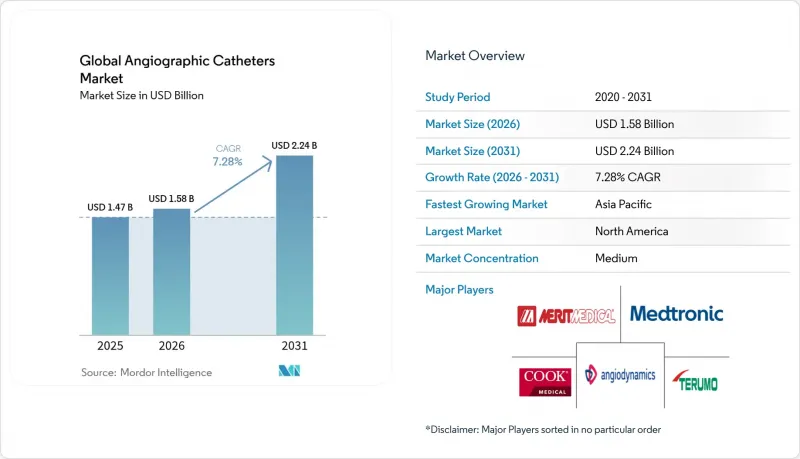
Mordor Intelligence에 의하면, 혈관 조영 카테터 시장 규모는 2025년에 14억 7,000만 달러로 평가되었고, 2026년15억 8,000만 달러에서 2031년까지 22억 4,000만 달러에 이를 것으로 예측되며, 예측 기간(2026년-2031년) CAGR은 7.28%를 기록할 전망입니다.
본 보고서는 용도별(관상동맥, 혈관내/말초, 기타), 최종 사용자별(병원, 외래수술센터(ASC), 기타),소재별(폴리우레탄, 폴리염화비닐, 기타), 코팅 유형별(친수성, 무코팅), 지역별(북미, 유럽, 아시아태평양, 중동 및 아프리카, 남미)로 분류되어 있습니다. 시장 예측은 금액(달러) 기준으로 제시되어 있습니다.
전 세계 혈관 조영 카테터 시장 동향 및 인사이트
심혈관 질환 유병률 증가
2024년에도 허혈성 심장 질환은 심혈관 질환(CVD)으로 인한 사망의 주요 원인으로 남아 2,050만 명의 목숨을 앗아갔으며, 치료의 초점은 조기 진단과 최소 침습 치료로 전환되었습니다. 신흥 경제국에서는 식생활 및 생활 습관에 기인한 위험 요인이 도시화와 맞물려 환자 수가 급증하고 있습니다. 그 결과, 특히 정부가 카테터 검사 체계에 투자하고 있는 지역에서 시술 건수도 이에 따라 증가하고 있습니다. 사모펀드 그룹은 이러한 수요를 지속 가능한 것으로 판단하여, 2021년부터 2023년에 걸쳐 342개 거점으로 구성된 41개의 심혈관 클리닉을 인수하고, 안정적인 환자 유입을 확보할 수 있는 지역 네트워크를 구축했습니다. 이러한 동향들이 맞물려 혈관 조영 카테터 시장의 견실한 성장을 뒷받침하고 있습니다.
심혈관 질환(CVD)에 걸리기 쉬운 고령 인구 증가
고령자는 다발성 협착, 석회화 병변, 허약증의 발생률이 높으며, 각각에 대해 추진력과 혈관 안전성의 균형이 잡힌 특수한 카테터 플랫폼이 필요합니다. 혈관 경화는 기기의 내비게이션을 어렵게 하므로, 제조업체들은 샤프트의 강성 구배와 선단의 유연성을 개선하고 있습니다. 저침습적 접근은 회복 기간 단축으로 이어지며, 이는 여러 가지 동반 질환을 앓고 있는 고령 환자를 관리하는 의사들에게 중요한 요소로 작용하고 있습니다. 전 세계 심장외과 벤치마크 조사에 따르면, 저·중소득 국가에서는 인구 10만 명당 61.6건의 카테터 기반 심장 치료 또는 외과적 심장 수술에 대한 미충족 수요가 존재하며, 평균 수명의 연장에 따라 카테터 시장의 확대 여지가 크다는 것이 시사되고 있습니다.
혈관조영 검사의 높은 비용
기기 가격, 시설 이용료, 급성기 후 치료 비용이 합쳐져 혈관조영술은 가장 비용이 많이 드는 일상적인 병원 시술 중 하나가 되었으며, 이러한 현실은 본인 부담제나 공적 자금을 통한 의료 제도에서 더욱 두드러집니다. 1,560억 달러 규모의 미국 의료기기 시장은 복잡한 환급 절차를 처리하는 것이 제조업체에게 여전히 막대한 자원을 요하는 작업임을 보여줍니다. 비용 대비 효과에 관한 연구에서는 경계부 병변에 대해 약물 요법이나 예방적 치료가 점점 더 권장되고 있으며, 보험사가 적용 기준을 엄격하게 할 경우 카테터 사용이 억제될 가능성이 있습니다. 사전 승인을 의무화하는 이용 관리 프로그램은 현재 미국의 대부분의 보험사로 확산되어 있으며, 비응급 사례의 시술을 지연시킬 수 있는 행정적 지연이 발생하고 있습니다.
부문 분석
2025년, 관상동맥 부문은 혈관 조영 카테터 시장 점유율의 49.32%를 차지하며, 계속해서 공급업체 수익의 기반이 되고 있습니다. 프로토콜이 성숙 단계에 접어들었고, 소재 및 코팅 개선이 지속적으로 이루어지고 있어 수요는 견조한 추세를 보이고 있으며, 관상동맥 혈관 조영 카테터 시장 규모는 7% 이상의 안정적인 연평균 성장률(CAGR)에 맞추어 확대될 것으로 예측됩니다. 대조적으로, 신경혈관 카테터는 대혈관 뇌졸중에서 기계적 혈전 제거술이 1순위 치료법으로 자리 잡음에 따라 7.96%의 연평균 성장률(CAGR)을 보이고 있습니다. SOFIA Flow 88과 같은 초고추적성 원위 접근 카테터 및 흡입 플랫폼은 혈전 제거 성공률을 최적화하여 신경혈관 분야에서의 보급률을 높이고 있습니다.
혈관 내 치료 및 말초 혈관 중재술은 상당한 규모의 중견 부문을 형성하고 있으며, 혈관 내 결석 분쇄 카테터와 같은 기기가 중증 석회화 병변을 치료하고 있습니다. ‘기타’ 범주(신장 신경 절제술, 구조적 심장 질환, 하이브리드 플랫폼)는 규모는 작지만 수익성이 높은 분야입니다. 메드트로닉(Medtronic)의 ‘Symplicity Spyral’은 2025년에 과도기적 패스스루(pass-through) 승인을 획득하여 추가 보험 환급이 가능해짐에 따라, 고혈압 치료가 혈관 조영 카테터 시장에서 확고한 입지를 다지게 되었습니다.
2025년 매출액 중 병원이 64.78%를 차지했는데, 이는 주로 외과적 지원이나 중환자실(ICU) 치료가 필요한 복잡하고 긴급한 사례를 병원이 관리하고 있기 때문입니다. 병원에 기인한 혈관 조영 카테터 시장 규모는 앞으로도 확대될 전망이지만, 그 속도는 ASC(외래수술센터(ASC))만큼 빠르지는 않을 것입니다. 외래수술센터(ASC)는 효율적인 인력 배치 모델과 전용실을 갖추고 있어, 이를 통해 처리 시간 단축과 환자 처리 능력 향상으로 이어지고 있습니다. 또한, 하류 의료기기 마진을 확보하기 위해 병원 내 ASC를 설립하는 심혈관 그룹에 대한 사모펀드(PE)의 인수가 성장세를 더욱 뒷받침하고 있습니다.
전문 클리닉이나 진료소 내 검사실은 진단용 혈관조영술 및 간단한 중재 시술이라는 틈새 시장을 차지하고 있으며, 인근 병원과 인력을 공유하고 있습니다. 그 매력은 시설 이용료가 저렴하고 지역 밀착형이라는 점에 있지만, 자본 요건이 확장 속도를 제한하고 있습니다. 이동식 카테터실과 하이브리드 수술실이 시장을 보완하며, 의료 서비스가 미치지 못하는 지역이나 외과 수술과 중재 시술을 병행하는 사례에 대해 유연한 솔루션을 제공합니다.
지역별 분석
북미는 2025년에 매출의 42.18%를 차지할 것으로 예상되며, 이는 광범위한 보험 적용 범위, 전국적인 임상 지침, 그리고 높은 시술 밀도에 힘입은 것입니다. 혁신적인 의료기기에 대한 과도기적인 패스스루 지불은 투자 회수 기간을 단축하고, 병원이 장비를 갱신하도록 유도하는 인센티브가 되고 있습니다. 미국만으로도 전 세계 의료기기 매출의 40%를 차지하고 있으며, 재료 및 코팅 기준에 지대한 영향을 미치고 있습니다. 심혈관 진료소 간의 통합이 가속화되고 있으며, 이로 인해 도시 지역과 의료 서비스가 부족한 지방 카운티 모두에서 ASC(외래수술센터(ASC))가 발전하고 있어 혈관 조영 카테터 시장의 매출 성장이 유지되고 있습니다.
아시아태평양은 8.62%라는 가장 높은 연평균 성장률(CAGR)을 기록하고 있습니다. 중국은 의료기기 심사 절차를 간소화하여 2023년에 1만 2,213건의 신규 등록을 승인했습니다. 이 중 61건은 ‘혁신적’으로 분류되어 시장 출시까지의 기간을 대폭 단축시켰습니다. ‘건강 중국 2030’에 기반한 정부의 추진책과 심혈관 질환(CVD) 발생률 상승이 수요와 정책 양면에서 호재로 작용하고 있습니다. 일본과 한국은 수출 지향형 제조를 통해 기여하고 있는 반면, 인도의 2025년 마케팅 코드는 윤리적인 판촉 기준을 강화하여 다국적 브랜드에 대해 보다 명확한 규정 준수 지침을 제공합니다.
유럽에서는 꾸준한 성장세를 보이고 있으나, 성장률은 완만합니다. ‘의료기기 규정(MDR)’에 따라 시장 진입 요건이 통일되었으며, 독일에서는 갱신된 OPS 코딩을 통해 새로운 시술에 대한 보험 급여의 일관성이 확보되고 있습니다. 프랑스에서는 2025년 추가 지급 정책에 따라 우위성이 입증되면 특수 카테터에 대한 접근성이 확대될 것입니다. 브렉시트 이후에도 영국은 독자적이면서도 조화로운 절차를 유지하고 있으며, 유럽 대륙의 임상 증거 파일 대부분을 계속 승인하고 있어 중복 임상시험이 억제되고 있습니다.
중동 및 아프리카 및 남미는 합쳐서 한 자릿수 후반대의 높은 성장 잠재력을 지니고 있으나, 구조적인 과제에 직면해 있습니다. 북아프리카에서는 허혈성 심장 질환이 DALY(장애 조정 생명년)의 주요 원인 중 하나이지만, 공공 자금 부족과 인재 유출이 카테터실 확충을 저해하고 있습니다. 기회로는 민관 파트너십과 기본 등급 카테터의 지역 내 생산을 들 수 있습니다. 라틴아메리카에서는 브라질이 3차 의료기관의 하이브리드 심장 센터를 통해 도입을 주도하고 있는 반면, 아르헨티나와 콜롬비아는 환율 변동 위험이 있음에도 불구하고 상환 목록을 꾸준히 갱신하고 있습니다.
기타 혜택:
- 엑셀 형식 시장 예측(ME) 시트
- 3개월간의 애널리스트 지원
목차
제1장 서론
제2장 조사 방법
제3장 주요 요약
제4장 시장 구도
제5장 시장 규모와 성장 예측
제6장 경쟁 구도
제7장 시장 기회와 향후 전망
LSHAccording to Mordor Intelligence, the angiographic catheter market size was valued at USD 1.47 billion in 2025 and estimated to grow from USD 1.58 billion in 2026 to reach USD 2.24 billion by 2031, at a CAGR of 7.28% during the forecast period (2026-2031).
This report is Segmented by Application (Coronary, Endovascular/Peripheral, and More), End-User (Hospitals, Ambulatory Surgical Centrs and More), Material (Polyurethane, Polyvinyl Chloride, and More), Coating Type (Hydrophilic, Non-Coated), and Geography (North America, Europe, Asia-Pacific, Middle East & Africa, South America). The Market Forecasts are Provided in Terms of Value (USD).
Global Angiographic Catheters Market Trends and Insights
Rising Incidence Of Cardiovascular Diseases
Ischemic heart disease remained the leading cause of CVD deaths in 2024, claiming 20.5 million lives and shifting therapeutic focus toward earlier diagnosis and less-invasive care . Emerging economies experience the steepest climb as dietary and lifestyle risk factors converge with urbanization. Procedural volumes therefore rise in tandem, especially where governments invest in catheterization capacity. Private-equity groups viewed this demand as durable, acquiring 41 cardiology practices comprising 342 sites between 2021 and 2023 to build regional networks that capture steady referral streams. These trends collectively sustain healthy growth in the angiographic catheter market.
Growing Geriatric Population Prone To CVD
Older adults present higher rates of multivessel stenosis, calcified lesions, and frailty, each necessitating specialized catheter platforms that balance pushability with vessel safety. Vascular stiffening complicates device navigation, prompting manufacturers to refine shaft stiffness gradients and tip flexibility. Minimally invasive access translates to shorter recovery times-an outcome prized by physicians managing elderly patients with multiple comorbidities. Global cardiac surgery benchmarking suggests an unmet need of 61.6 catheter-based or surgical cardiac procedures per 100,000 population in low- and middle-income countries, implying vast room for catheter expansion as life expectancy rises .
High Cost Of Angiographic Procedures
Device prices, facility fees, and post-acute care combine to make angiography among the costliest routine hospital procedures, a reality magnified in cash-pay and publicly funded systems. The USD 156 billion U.S. device market demonstrates that navigating complex reimbursement channels remains resource-intensive for manufacturers . Cost-effectiveness studies increasingly favor pharmacologic or preventive options for borderline lesions, potentially dampening catheter usage when payers tighten thresholds. Utilization-management programs that mandate prior authorization now span most U.S. insurers, adding administrative lag that can defer non-urgent cases.
Other drivers and restraints analyzed in the detailed report include:
- Demand For Minimally-Invasive Procedures
- Expansion Of Ambulatory Cath-Labs In EMS
- Intravascular Imaging Reducing Stand-Alone Angiography Usage
For complete list of drivers and restraints, kindly check the Table Of Contents.
Segment Analysis
The coronary segment accounted for 49.32% of the angiographic catheter market share in 2025 and remains the bedrock of vendor revenue. Despite mature protocols, ongoing material and coating enhancements keep demand steady, with the angiographic catheter market size for coronary work projected to rise in parallel with stable 7%-plus CAGR. Neurovascular catheters, by contrast, show an 7.96% CAGR as mechanical thrombectomy becomes front-line for large-vessel stroke. Ultra-trackable distal access catheters and aspiration platforms such as SOFIA Flow 88 optimize clot retrieval success rates, pushing neurovascular penetration higher.
Endovascular and peripheral interventions form a sizable mid-tier, where devices like intravascular lithotripsy catheters treat heavily calcified lesions. The "Others" category, renal denervation, structural heart, and hybrid platforms, remains small yet lucrative. Medtronic's Symplicity Spyral won transitional pass-through status in 2025, unlocking incremental reimbursement and placing hypertension therapy firmly within the angiographic catheter market.
Hospitals retained 64.78% of 2025 revenue, largely because they manage complex and emergent cases requiring surgical back-up or ICU care. The angiographic catheter market size attributable to hospitals should still climb but at a slower rate than ASCs. Outpatient centers enjoy lean staffing models and dedicated rooms, translating to shorter turnaround and improved patient throughput. Growth momentum is further reinforced by private-equity consolidation of cardiology groups that establish in-house ASCs to capture downstream device margins.
Specialty clinics and office-based labs occupy a niche for diagnostic angiography and simple interventions, relying on shared staff with nearby hospitals. Their appeal lies in lower facility fees and community proximity, though capital requirements limit expansion pace. Mobile cath-lab units and hybrid ORs round out the landscape, offering flexible solutions for underserved regions or combined surgical-interventional cases.
Complete Report Scope:
- By Application
- Coronary
- Endovascular / Peripheral
- Neurovascular
- Others
- By End-user
- Hospitals
- Ambulatory Surgical Centres
- Specialty Clinics
- Others
- By Material
- Polyurethane
- Polyvinyl Chloride
- Nylon & Pebax Blends
- Others
- By Coating Type
- Hydrophilic
- Non-coated
- By Geography
- North America
- United States
- Canada
- Mexico
- Europe
- Germany
- United Kingdom
- France
- Italy
- Spain
- Rest of Europe
- Asia-Pacific
- China
- Japan
- India
- Australia
- South Korea
- Rest of Asia-Pacific
- Middle East & Africa
- GCC
- South Africa
- Rest of Middle East & Africa
- South America
- Brazil
- Argentina
- Rest of South America
- North America
Geography Analysis
North America captured 42.18% revenue in 2025, underpinned by broad insurance coverage, national clinical guidelines, and high procedural density. Transitional pass-through payments for break-through devices shorten payback cycles, incentivizing hospitals to upgrade inventories. The U.S. alone holds 40% of global device sales and exerts outsized influence on material and coating standards. Consolidation among cardiology practices has accelerated, bringing ASC development to both urban and underserved rural counties, thereby preserving volume growth in the angiographic catheter market.
Asia-Pacific logs the highest CAGR at 8.62%. China streamlined device reviews, approving 12,213 new registrations in 2023, including 61 classified as innovative, which sharply cuts time-to-market. Government push under Healthy China 2030 and rising CVD incidence create dual demand and policy tailwinds. Japan and South Korea contribute through export-oriented manufacturing, while India's 2025 marketing code elevates ethical promotion standards, giving multinational brands clearer compliance guidance.
Europe offers steady but slower gains. The Medical Device Regulation unifies market entry, and Germany's updated OPS coding ensures reimbursement alignment for novel procedures. France's 2025 add-on payment policy widens access to specialty catheters once superiority is proven. Post-Brexit, the UK maintains a distinct yet harmonized pathway that still recognizes much of the Continental clinical evidence file, limiting duplicative trials.
The Middle East & Africa and South America collectively present high-single-digit growth potential but face structural hurdles. In North Africa, ischemic heart disease ranks among leading DALY drivers, yet public funding gaps and brain drain hinder cath-lab expansion. Opportunities lie in public-private partnerships and regional manufacturing of base-grade catheters. In Latin America, Brazil spearheads adoption through hybrid cardiac centers in tertiary hospitals, while Argentina and Colombia steadily update reimbursement lists, albeit with currency volatility risks.
- Boston Scientific
- Cardinal Health
- Terumo
- Medtronic
- Merit Medical Systems
- AngioDynamics
- Cook Group
- Oscor
- B. Braun
- Abbott Laboratories
- Asahi Intecc Co., Ltd.
- Teleflex
- Lepu Medical
- Tokai Medical Products
- Nipro
- Lepu Medical
- Penumbra
- iVascular S.L.U.
- Acandis
- Medinol Ltd.
Additional Benefits:
- The market estimate (ME) sheet in Excel format
- 3 months of analyst support
TABLE OF CONTENTS
1 Introduction
- 1.1 Study Assumptions & Market Definition
- 1.2 Scope of the Study
2 Research Methodology
3 Executive Summary
4 Market Landscape
- 4.1 Market Overview
- 4.2 Market Drivers
- 4.2.1 Rising Incidence Of Cardiovascular Diseases
- 4.2.2 Growing Geriatric Population Prone To CVD
- 4.2.3 Demand For Minimally-Invasive Procedures
- 4.2.4 Expansion Of Ambulatory Cath-Labs In EMS
- 4.2.5 Ai-Enabled 3-D Road-Mapping Integration
- 4.2.6 Ultra-Low-Profile Polymer Blends For Radial Access
- 4.3 Market Restraints
- 4.3.1 High Cost Of Angiographic Procedures
- 4.3.2 Catheter-Related Complications & Recalls
- 4.3.3 Reimbursement Uncertainties In Emerging Markets
- 4.3.4 Intravascular Imaging Reducing Stand-Alone Angiography Usage
- 4.4 Value / Supply-Chain Analysis
- 4.5 Regulatory Landscape
- 4.6 Technological Outlook
- 4.7 Porter's Five Forces Analysis
- 4.7.1 Threat of New Entrants
- 4.7.2 Bargaining Power of Buyers
- 4.7.3 Bargaining Power of Suppliers
- 4.7.4 Threat of Substitutes
- 4.7.5 Competitive Rivalry
5 Market Size & Growth Forecasts (Value, USD)
- 5.1 By Application
- 5.1.1 Coronary
- 5.1.2 Endovascular / Peripheral
- 5.1.3 Neurovascular
- 5.1.4 Others
- 5.2 By End-user
- 5.2.1 Hospitals
- 5.2.2 Ambulatory Surgical Centres
- 5.2.3 Specialty Clinics
- 5.2.4 Others
- 5.3 By Material
- 5.3.1 Polyurethane
- 5.3.2 Polyvinyl Chloride
- 5.3.3 Nylon & Pebax Blends
- 5.3.4 Others
- 5.4 By Coating Type
- 5.4.1 Hydrophilic
- 5.4.2 Non-coated
- 5.5 By Geography
- 5.5.1 North America
- 5.5.1.1 United States
- 5.5.1.2 Canada
- 5.5.1.3 Mexico
- 5.5.2 Europe
- 5.5.2.1 Germany
- 5.5.2.2 United Kingdom
- 5.5.2.3 France
- 5.5.2.4 Italy
- 5.5.2.5 Spain
- 5.5.2.6 Rest of Europe
- 5.5.3 Asia-Pacific
- 5.5.3.1 China
- 5.5.3.2 Japan
- 5.5.3.3 India
- 5.5.3.4 Australia
- 5.5.3.5 South Korea
- 5.5.3.6 Rest of Asia-Pacific
- 5.5.4 Middle East & Africa
- 5.5.4.1 GCC
- 5.5.4.2 South Africa
- 5.5.4.3 Rest of Middle East & Africa
- 5.5.5 South America
- 5.5.5.1 Brazil
- 5.5.5.2 Argentina
- 5.5.5.3 Rest of South America
- 5.5.1 North America
6 Competitive Landscape
- 6.1 Market Concentration
- 6.2 Market Share Analysis
- 6.3 Company Profiles (includes Global level Overview, Market level overview, Core Segments, Financials as available, Strategic Information, Market Rank/Share for key companies, Products & Services, Recent Developments)
- 6.3.1 Boston Scientific Corporation
- 6.3.2 Cordis (Cardinal Health)
- 6.3.3 Terumo Corporation
- 6.3.4 Medtronic plc
- 6.3.5 Merit Medical Systems, Inc.
- 6.3.6 AngioDynamics, Inc.
- 6.3.7 Cook Medical
- 6.3.8 Oscor Inc.
- 6.3.9 B. Braun Melsungen AG
- 6.3.10 Abbott Laboratories
- 6.3.11 Asahi Intecc Co., Ltd.
- 6.3.12 Teleflex Incorporated
- 6.3.13 Lepu Medical Technology
- 6.3.14 Tokai Medical Products
- 6.3.15 Nipro Corporation
- 6.3.16 Lepu Medical Technology
- 6.3.17 Penumbra, Inc.
- 6.3.18 iVascular S.L.U.
- 6.3.19 Acandis GmbH
- 6.3.20 Medinol Ltd.
7 Market Opportunities & Future Outlook
- 7.1 White-space & Unmet-Need Assessment