

|
시장보고서
상품코드
2122502
인터넷 프로토콜 TV(IPTV) : 시장 점유율 분석, 업계 동향 및 통계, 성장 예측(2026-2031년)Internet Protocol Television (IPTV) - Market Share Analysis, Industry Trends & Statistics, Growth Forecasts (2026 - 2031) |
||||||
 Mordor Intelligence
Mordor Intelligence에 의하면, 인터넷 프로토콜 TV(IPTV) 시장 규모는 2025년 557억 1,000만 달러로 평가되었습니다. 2026년에는 666억 3,000만 달러로 확대되어 2026년부터 2031년에 걸쳐 CAGR 15.55%로 성장을 지속하여, 2031년에는 1,372억 2,000만 달러에 이를 것으로 예측됩니다.

본 보고서는 구성 요소(하드웨어 및 서비스), 수익 모델(구독형 등), 스트리밍 유형(라이브/선형 TV, 타임시프트/리플레이 TV, 주문형 비디오),기기/접속 플랫폼(스마트 TV, 모바일 및 태블릿, PC/노트북, 기타), 제공 방식(멀티캐스트 IPTV, 유니캐스트 IPTV), 지역별로 분류되어 있습니다. 시장 예측은 금액(달러)으로 표시되어 있습니다.
세계의 인터넷 프로토콜 TV(IPTV) 시장 동향 및 인사이트
FTTH 확산이 4K 및 8K 수요를 충족
2025년 말까지 전 세계 광섬유 회선 수는 6억 회선을 돌파하여, 25 Mbps 및 100 Mbps의 대역폭을 소비하는 데이터 통신량이 많은 4K 및 8K 스트리밍에 필요한 처리 용량의 여유를 확보했습니다. 통신 사업자들은 현재 초고해상도 요금제를 30%-50%의 할증 요금으로 제공하며, 이에 상응하는 마케팅 비용을 들이지 않고도 매출 증대를 도모하고 있습니다. 사우디아라비아의 STC는 500만 가구를 대상으로 한 광회선망 구축을 활용하여 2024년에 8K 스포츠 패키지 제공을 시작했습니다. 또한, 프랑스의 Orange는 신규 광회선 가입자에게 추가 요금 없이 4K 지원 셋톱박스를 제공하여 해지율을 낮추고자 했습니다. 2025년 중반까지 NTT 동일본 및 서일본의 광회선 가입자 중 68%가 매주 4K IPTV를 시청하게 되었습니다. 교외나 지방에서는 여전히 회선 구축이 진행 중이므로, 이 요인은 중기적으로 계속해서 강력한 원동력이 될 것입니다.
슈퍼 어그리게이션 플랫폼이 기세를 더하고 있습니다.
지상파 채널과 넷플릭스, 디즈니+, 광고가 포함된 무료 스트리밍 서비스를 통합한 통합 가이드를 통해 ‘앱 피로감’이 해소되고 있습니다. Viaccess-Orca의 플랫폼은 2025년 말까지 유럽의 15개 통신사에 도입되었으며, 도입 후 월평균 해지율이 18% 감소했습니다. Comcast와 Rogers는 셋톱박스 펌웨어에 타사 앱을 통합하여 네트워크 사업자가 제공하는 콘텐츠 검색 기능을 되찾았습니다. Deloitte의 조사에 따르면, 미국 시청자의 42%가 단일 인터페이스에서 콘텐츠를 관리하기를 원하며, 이를 제공하는 통신 사업자들은 구독 비즈니스의 수익성을 회복하고 있습니다. 자본 지출(CAPEX)의 필요성이 최소화되고 소프트웨어 배포가 신속하기 때문에 단기적인 영향은 크다고 할 수 있습니다.
순수 OTT 서비스를 향한 지속적인 ‘코드 커팅’
미국의 유료 TV 사업자는 2024년에 590만 명의 가입자를 잃었으며, 가입자 수는 수십년만에 7,000만 명 아래로 떨어졌습니다. 영국 통신규제청(Ofcom)의 보고서에 따르면, 같은 해 영국의 기존 TV 가입 가구 수는 140만 가구 감소했으며, 스트리밍만 이용하는 가구의 비율은 62%에 달했습니다. Ampere Analysis의 조사에 따르면, 유럽의 유료 TV 가입자 수는 3.2% 감소했으며, 특히 스페인과 이탈리아에서 타격이 심각했습니다. IPTV 사업자들은 현재 케이블 사업자뿐만 아니라, 오리지널 콘텐츠 투자 규모에서 그들을 앞지르는 기동력 있는 DTC(Direct-to-Consumer) 서비스와도 경쟁하고 있습니다. 이러한 제약은 성숙한 시장에서 단기적으로 가장 심각한 영향을 미치고 있으며, 사업자들은 독점적인 스포츠 중계, 통합형 번들, 그리고 우수한 고객 지원에 중점을 둘 수밖에 없는 상황입니다.
부문별 분석
2025년에는 셋톱박스, 미들웨어 서버, 인코더, 조건부 접근 하드웨어에 힘입어 하드웨어가 매출의 63.20%를 차지했습니다. 반면, 서비스 매출은 연평균 성장률(CAGR) 15.80%로 증가했는데, 이는 사업자들이 운영 비용(OPEX)을 절감할 수 있는 관리형 플랫폼을 선호하는 경향을 반영한 것입니다. 통신 사업자들이 에릭슨, 시스코, 화웨이로부터 클라우드 미들웨어 라이선스를 취득하여 현장 출장 없이도 매주 기능을 배포할 수 있게 됨에 따라, 인터넷 프로토콜 TV(IPTV) 시장 규모는 확대될 것으로 예측됩니다. 관리형 서비스에는 24시간 모니터링, 장애 복구, 분석도 포함되어 있어 소규모 통신 사업자를 기술 인력 부족으로부터 보호하고 있습니다.
삼성 및 LG의 스마트 TV OS가 IPTV 앱을 네이티브로 실행할 수 있게 됨에 따라 셋톱박스 출하량은 감소 추세를 보이고 있습니다. 한편, 통신 사업자가 영구 라이선스 계약에서 구독 계약으로 전환함에 따라 미들웨어 라이선스 비용은 상승하고 있습니다. 전송 장비를 HEVC 및 AV1으로 업그레이드함으로써 4K 대역폭을 40% 절감할 수 있어, 통신 사업자는 기존 CDN 예산 내에서 채널을 추가할 수 있게 됩니다. 조건부 액세스는 USB 동글에서 모든 기기의 스트림을 보호하는 클라우드 키 서버로 전환되고 있습니다. IP 멀티캐스트와 유니캐스트의 공존을 둘러싼 통합 프로젝트로 인해 컨설팅 사업은 계속해서 호조를 보이고 있으며, 예측 기간 동안 서비스가 인터넷 프로토콜 TV(IPTV) 시장 점유율을 더 많이 차지하도록 추진되고 있습니다.
2025년에는 라이브 스포츠 및 OTT 번들 요금제의 견인에 힘입어 구독 패키지가 매출의 71.40%를 차지했습니다. 광고 지원형 주문형 비디오(AVoD)는 연평균 성장률(CAGR) 16.3%로 성장하고 있으며, 비용에 민감한 가구가 시간당 4-6분의 광고가 포함된 무료 요금제를 선택함에 따라 시장 규모는 확실히 확대될 전망입니다. AVoD 인터넷 프로토콜 TV 시장 규모는 평균 소득이 낮은 지역, 특히 인도, 브라질, 인도네시아에서 확대되고 있습니다. 사업자들은 가구 인구 통계 정보를 타겟으로 한 주소 지정형 광고를 전달하고 있으며, 이로 인해 TV 방송에 비해 CPM이 3배로 높아졌습니다.
격투기나 콘서트가 구독형 및 AVoD 번들 서비스로 전환됨에 따라, 페이-퍼-뷰(PPV)는 감소 추세를 보이고 있습니다. 미국 시청자 대다수는 가계 형편이 어려워진 것을 이유로 지난 1년 동안 적어도 하나의 유료 서비스를 해지했으며, 그 결과 소액의 요금과 광고 노출 횟수가 적은 하이브리드 모델이 지지를 얻고 있습니다. 아카마이(Akamai)와 브로드피크(Broadpeak)의 통합 광고 플랫폼은 프로그래매틱 수요를 라이브 및 온디맨드 전송에 통합하여 판매율을 향상시키는 동시에, 인터넷 프로토콜 TV(IPTV) 시장의 디지털 광고 밸류체인에서 사업자의 입지를 유지하고 있습니다.
지역별 분석
아시아태평양은 2025년에 전 세계 매출의 45.89%를 차지했으며, 2026년부터 2031년까지 연평균 성장률(CAGR) 16.3%로 성장할 것으로 전망됩니다. 이는 중국의 IPTV 가입자 수 3억 8,000만 명과 인도 및 일본에서의 광섬유 보급 확대에 힘입은 결과입니다. 중국의 인터넷 프로토콜 TV(IPTV) 시장 규모는 차이나 텔레콤의 1억 9,500만 가입자, 차이나 모바일의 1억 1,000만 가입자, 차이나 유니콤의 7,500만 가입자에 의해 계속해서 뒷받침되고 있습니다. 인도의 광섬유 회선 수는 2025년 중반까지 3,500만 회선을 돌파하여 매달 200만 명의 신규 IPTV 가입자를 뒷받침하고 있습니다.
유럽에서는 ‘코드 커팅’ 현상이 진행되고 있지만, MagentaTV와 같은 플랫폼은 Netflix와 Disney+를 단일 인터페이스로 통합함으로써 가입자 수를 안정화시켰습니다. 도이치 텔레콤은 오랜 기간 감소세를 보이다가 2024년에 40만 명의 가입자를 늘렸습니다. 북미에서는 AT&T와 버라이즌이 가입자 수 감소를 보고함에 따라 전체적으로 가입자 수가 감소했으나, 광대역 인터넷의 보급 범위가 확대되면서 통신 사업자들은 스트리밍 전용 요금제로의 업셀링 기회를 얻게 되었습니다.
아프리카에서는 나이지리아, 이집트, 남아프리카공화국에서 이동통신 사업자들이 고정 무선 기반의 가정용 광대역과 IPTV를 결합하여 구리선 부족 문제를 해결하고 있습니다. 나이지리아 통신위원회(NCC)의 집계에 따르면, 2025년 중반 시점에서 광대역 회선 수는 820만 회선에 달하고, 2년 전의 510만 회선에서 증가했습니다. 남미는 브라질에 의존하고 있으며, 2024년 말 기준으로 2,800만 가구가 광섬유를 이용할 수 있게 되었고, Claro와 Vivo가 4K IPTV 제공을 시작했습니다. 중동에서는 사우디아라비아의 STC와 UAE의 에티살라트가 IPTV와 5G를 결합하여, 2024년부터 2025년에 걸쳐 350만 명의 가입자를 확보했습니다.
기타 혜택 :
- 엑셀 형식 시장 예측(ME) 시트
- 3개월간의 애널리스트 지원
자주 묻는 질문
목차
제1장 서론
제2장 조사 방법
제3장 주요 요약
제4장 시장 구도
제5장 시장 규모 및 성장 예측
제6장 경쟁 구도
제7장 시장 기회 및 향후 전망
KTH 26.09.08According to Mordor Intelligence, the internet protocol television market size is expected to grow from USD 55.71 billion in 2025 to USD 66.63 billion in 2026 and is forecast to reach USD 137.22 billion by 2031 at 15.55% CAGR over 2026-2031.
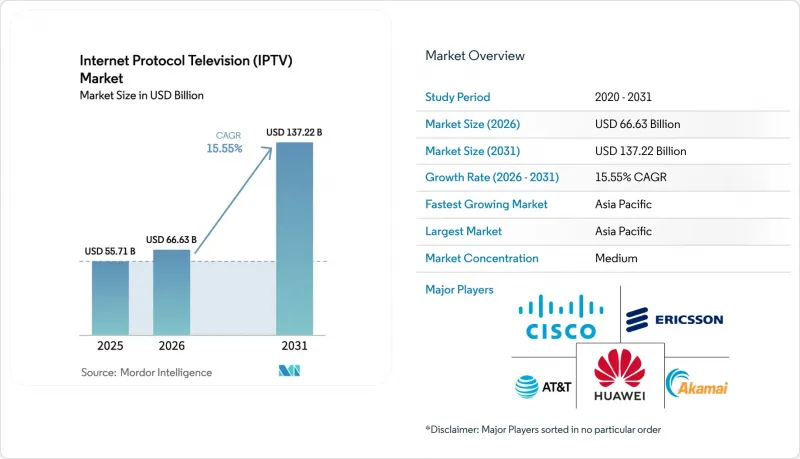
This report is Segmented by Component (Hardware, and Services), Revenue Model (Subscription-Based, and More), Streaming Type (Live/Linear TV, Time-Shifted/Replay TV, and Video-On-Demand), Device/Access Platform (Smart TV, Mobile and Tablet, PC/Laptop, and More), Delivery Method (Multicast IPTV, and Unicast IPTV), and Geography. The Market Forecasts are Provided in Terms of Value (USD).
Global Internet Protocol Television (IPTV) Market Trends and Insights
Fiber-to-Home Rollouts Meet 4K and 8K Demand
Global fiber lines surpassed 600 million by late 2025, creating the throughput headroom needed for data-hungry 4K and 8K streams that consume 25 Mbps and 100 Mbps. Operators now price ultra-high-definition tiers at 30%-50% premiums, adding incremental revenue without proportional marketing spend. Saudi Arabia's STC used its five-million-home fiber build to launch an 8K sports pack in 2024, and France's Orange gave new fiber customers 4K boxes at no surcharge, cutting churn. By mid-2025, 68% of NTT East and West fiber customers were watching 4K IPTV weekly. Construction is still underway in suburbs and rural areas, so this driver will remain potent in the medium term.
Super-Aggregation Platforms Gain Traction
Unified guides that merge linear channels with Netflix, Disney+, and free ad-supported streams are reversing app fatigue. Viaccess-Orca's platform served 15 European operators by late 2025, dropping average monthly churn by 18% after rollout. Comcast and Rogers embedded third-party apps in set-top firmware, restoring the discovery layer to the network operator. Deloitte found 42% of U.S. viewers would rather manage content from a single interface, so telcos that offer one are reclaiming subscription economics. Minimal capex needs and rapid software rollout drive its high short-term impact.
Persistent Cord-Cutting Toward Pure OTT Services
U.S. pay-TV providers lost 5.9 million subscribers in 2024, dropping the base below 70 million for the first time in decades[2]. Ofcom reported 1.4 million fewer traditional TV homes in the United Kingdom that year, while streaming-only households hit 62%. Ampere Analysis showed a 3.2% decline in European pay-TV subscribers, with Spain and Italy hardest hit. IPTV operators now fight not just cable but also agile direct-to-consumer services that outspend them on original content. The restraint bites hardest in the short term in mature regions, pushing operators to emphasize exclusive sports, convergent bundles, and superior customer support.
Other drivers and restraints analyzed in the detailed report include:
- Telco Bundles of IPTV With Convergent Plans
- AVoD Monetization Accelerates
- Unicast Bandwidth Bottlenecks During Peak Sporting Events
For complete list of drivers and restraints, kindly check the Table Of Contents.
Segment Analysis
Hardware generated 63.20% of revenue in 2025, driven by set-top boxes, middleware servers, encoders, and conditional-access hardware. Services revenue, however, is climbing at 15.80% CAGR, reflecting operator preference for opex-friendly managed platforms. The Internet Protocol Television market size for services is projected to expand as operators license cloud middleware from Ericsson, Cisco, and Huawei, enabling weekly feature rollouts without truck rolls. Managed services also cover 24-hour monitoring, fault remediation, and analytics, shielding smaller telcos from skill shortages.
Set-top shipments are sliding because Samsung and LG smart-TV operating systems run IPTV apps natively, while middleware license fees rise as operators shift from perpetual to subscription contracts. Transmission equipment upgrades to HEVC and AV1 cut 4K bandwidth by 40%, letting operators add channels inside existing CDN budgets. Conditional access is moving from USB dongles to cloud key servers that secure streams on any device. Integration projects around IP multicast and unicast coexistence keep consulting pipelines full, pushing services toward a larger slice of the Internet Protocol Television market share over the forecast horizon.
Subscription packages accounted for 71.40% of revenue in 2025, driven by live sports and bundled OTT offers. Advertising-supported video-on-demand is growing at 16.3% CAGR and will add clear scale because cost-sensitive households opt for free tiers with four to six minutes of ads per hour. The internet protocol television market size for AVoD is widening in regions where average incomes lag, notably India, Brazil, and Indonesia. Operators overlay addressable ads that target household demographics, tripling CPMs relative to broadcast television.
Pay-per-view is slipping as combat sports and concerts migrate to subscription or AVoD bundles. A significant number of U.S. viewers canceled at least one paid service in the past year due to wallet strain, so hybrid models that pair small fees with lighter ad loads are gaining favor. Unified ad platforms from Akamai and Broadpeak stitch programmatic demand into live and on-demand feeds, boosting sell-through rates and keeping operators active in the internet protocol television market's digital ad value chain.
Complete Report Scope:
- By Component
- Hardware
- Set-Top Box (STB)
- Middleware
- Transmission and Encoding Equipment
- Conditional Access Systems
- Services
- Managed IPTV Services
- Integration and Consulting
- Support and Maintenance
- Hardware
- By Revenue Model
- Subscription-Based
- Pay-Per-View
- Advertising-Supported (AVoD)
- By Streaming Type
- Live/Linear TV
- Time-Shifted/Replay TV
- Video-on-Demand
- By Device/Access Platform
- Smart TV
- Mobile and Tablet
- PC/Laptop
- Set-Top Box and Media Streamer
- By Delivery Method
- Multicast IPTV
- Unicast IPTV
- By Geography
- North America
- United States
- Canada
- Mexico
- South America
- Brazil
- Argentina
- Rest of South America
- Europe
- Germany
- United Kingdom
- France
- Italy
- Spain
- Rest of Europe
- Asia-Pacific
- China
- India
- Japan
- South Korea
- Australia and New Zealand
- Rest of Asia-Pacific
- Middle East
- Saudi Arabia
- United Arab Emirates
- Turkey
- Rest of Middle East
- Africa
- South Africa
- Nigeria
- Egypt
- Rest of Africa
- North America
Geography Analysis
Asia-Pacific accounted for 45.89% of global revenue in 2025 and is expected to grow at a 16.3% CAGR from 2026 to 2031, led by 380 million Chinese IPTV subscriptions and rapid fiber rollouts in India and Japan. The internet protocol television market size in China remains anchored by China Telecom's 195 million subscribers, China Mobile's 110 million, and China Unicom's 75 million. India's fiber base crossed 35 million lines by mid-2025, supporting 2 million new IPTV additions each month.
Europe faces cord-cutting, yet platforms such as MagentaTV stabilized counts by bundling Netflix and Disney+ under one interface. Deutsche Telekom added 400,000 subscribers in 2024 after years of decline. North America saw total subscriber losses, as AT&T and Verizon reported declines, but fiber broadband footprints grew, giving operators headroom to upsell streaming-only bundles.
In Africa, Nigeria, Egypt, and South Africa see mobile operators pair fixed-wireless home broadband with IPTV, bypassing the scarcity of copper. The Nigerian Communications Commission tallied 8.2 million broadband lines by mid-2025, up from 5.1 million two years earlier. South America relies on Brazil, where 28 million homes had fiber by late 2024, enabling Claro and Vivo to launch 4K IPTV. The Middle East follows with Saudi Arabia's STC and UAE's Etisalat bundling IPTV and 5G to secure 3.5 million subs across 2024-2025.
- AT&T Inc.
- Verizon Communications Inc.
- Deutsche Telekom AG
- China Telecom Corp. Ltd.
- Orange S.A.
- British Telecom plc
- Telefonica S.A.
- DISH Network Corp.
- Comcast Corp.
- Vodafone Group plc
- Akamai Technologies Inc.
- Cisco Systems Inc.
- Huawei Technologies Co. Ltd.
- Ericsson AB
- ARRIS (CommScope Holding Co.)
- Sagemcom Broadband SAS
- ZTE Corp.
- Imagine Communications Corp.
- Broadpeak S.A.
- Amino Technologies plc
- Tripleplay Services Ltd.
- Sterlite Technologies Ltd.
- Moftak Solutions
Additional Benefits:
- The market estimate (ME) sheet in Excel format
- 3 months of analyst support
TABLE OF CONTENTS
1 INTRODUCTION
- 1.1 Study Assumptions and Market Definition
- 1.2 Scope of the Study
2 RESEARCH METHODOLOGY
3 EXECUTIVE SUMMARY
4 MARKET LANDSCAPE
- 4.1 Market Overview
- 4.2 Market Drivers
- 4.2.1 Convergence of Fiber-to-Home Roll-outs With 4K/8K Content Demand
- 4.2.2 Emergence of Super-Aggregation Platforms in Europe and North America
- 4.2.3 Telco Bundling of IPTV With Fixed-Mobile Convergent Plans in Asia
- 4.2.4 Advertising-Supported Video-on-Demand (AVoD) Monetization Gains
- 4.2.5 Broadband Penetration Growth in Emerging Markets
- 4.2.6 Migration of Broadcasters to IP-based Delivery Infrastructure
- 4.3 Market Restraints
- 4.3.1 Persistent Cord-Cutting Toward Pure-OTT Services in Mature Markets
- 4.3.2 Unicast Bandwidth Bottlenecks During Peak Sporting Events
- 4.3.3 Regulatory Fragmentation in Multinational Content Rights
- 4.3.4 Piracy and Illegal IPTV Distribution Networks
- 4.4 Industry Value Chain Analysis
- 4.5 Regulatory Landscape
- 4.6 Technological Outlook
- 4.7 Impact of Macroeconomic Factors
- 4.8 Porter's Five Forces Analysis
- 4.8.1 Threat of New Entrants
- 4.8.2 Bargaining Power of Suppliers
- 4.8.3 Bargaining Power of Buyers
- 4.8.4 Threat of Substitutes
- 4.8.5 Competitive Rivalry
5 MARKET SIZE AND GROWTH FORECASTS (VALUE)
- 5.1 By Component
- 5.1.1 Hardware
- 5.1.1.1 Set-Top Box (STB)
- 5.1.1.2 Middleware
- 5.1.1.3 Transmission and Encoding Equipment
- 5.1.1.4 Conditional Access Systems
- 5.1.2 Services
- 5.1.2.1 Managed IPTV Services
- 5.1.2.2 Integration and Consulting
- 5.1.2.3 Support and Maintenance
- 5.1.1 Hardware
- 5.2 By Revenue Model
- 5.2.1 Subscription-Based
- 5.2.2 Pay-Per-View
- 5.2.3 Advertising-Supported (AVoD)
- 5.3 By Streaming Type
- 5.3.1 Live/Linear TV
- 5.3.2 Time-Shifted/Replay TV
- 5.3.3 Video-on-Demand
- 5.4 By Device/Access Platform
- 5.4.1 Smart TV
- 5.4.2 Mobile and Tablet
- 5.4.3 PC/Laptop
- 5.4.4 Set-Top Box and Media Streamer
- 5.5 By Delivery Method
- 5.5.1 Multicast IPTV
- 5.5.2 Unicast IPTV
- 5.6 By Geography
- 5.6.1 North America
- 5.6.1.1 United States
- 5.6.1.2 Canada
- 5.6.1.3 Mexico
- 5.6.2 South America
- 5.6.2.1 Brazil
- 5.6.2.2 Argentina
- 5.6.2.3 Rest of South America
- 5.6.3 Europe
- 5.6.3.1 Germany
- 5.6.3.2 United Kingdom
- 5.6.3.3 France
- 5.6.3.4 Italy
- 5.6.3.5 Spain
- 5.6.3.6 Rest of Europe
- 5.6.4 Asia-Pacific
- 5.6.4.1 China
- 5.6.4.2 India
- 5.6.4.3 Japan
- 5.6.4.4 South Korea
- 5.6.4.5 Australia and New Zealand
- 5.6.4.6 Rest of Asia-Pacific
- 5.6.5 Middle East
- 5.6.5.1 Saudi Arabia
- 5.6.5.2 United Arab Emirates
- 5.6.5.3 Turkey
- 5.6.5.4 Rest of Middle East
- 5.6.6 Africa
- 5.6.6.1 South Africa
- 5.6.6.2 Nigeria
- 5.6.6.3 Egypt
- 5.6.6.4 Rest of Africa
- 5.6.1 North America
6 COMPETITIVE LANDSCAPE
- 6.1 Market Concentration
- 6.2 Strategic Moves
- 6.3 Market Share Analysis
- 6.4 Company Profiles (includes Global level Overview, Market level overview, Core Segments, Financials as available, Strategic Information, Market Rank/Share for key companies, Products and Services, and Recent Developments)
- 6.4.1 AT&T Inc.
- 6.4.2 Verizon Communications Inc.
- 6.4.3 Deutsche Telekom AG
- 6.4.4 China Telecom Corp. Ltd.
- 6.4.5 Orange S.A.
- 6.4.6 British Telecom plc
- 6.4.7 Telefonica S.A.
- 6.4.8 DISH Network Corp.
- 6.4.9 Comcast Corp.
- 6.4.10 Vodafone Group plc
- 6.4.11 Akamai Technologies Inc.
- 6.4.12 Cisco Systems Inc.
- 6.4.13 Huawei Technologies Co. Ltd.
- 6.4.14 Ericsson AB
- 6.4.15 ARRIS (CommScope Holding Co.)
- 6.4.16 Sagemcom Broadband SAS
- 6.4.17 ZTE Corp.
- 6.4.18 Imagine Communications Corp.
- 6.4.19 Broadpeak S.A.
- 6.4.20 Amino Technologies plc
- 6.4.21 Tripleplay Services Ltd.
- 6.4.22 Sterlite Technologies Ltd.
- 6.4.23 Moftak Solutions
7 MARKET OPPORTUNITIES AND FUTURE OUTLOOK
- 7.1 White-Space and Unmet-Need Assessment


