

|
시장보고서
상품코드
2122509
클라우드 AI : 시장 점유율 분석, 업계 동향 및 통계, 성장 예측(2026-2031년)Cloud AI - Market Share Analysis, Industry Trends & Statistics, Growth Forecasts (2026 - 2031) |
||||||
 Mordor Intelligence
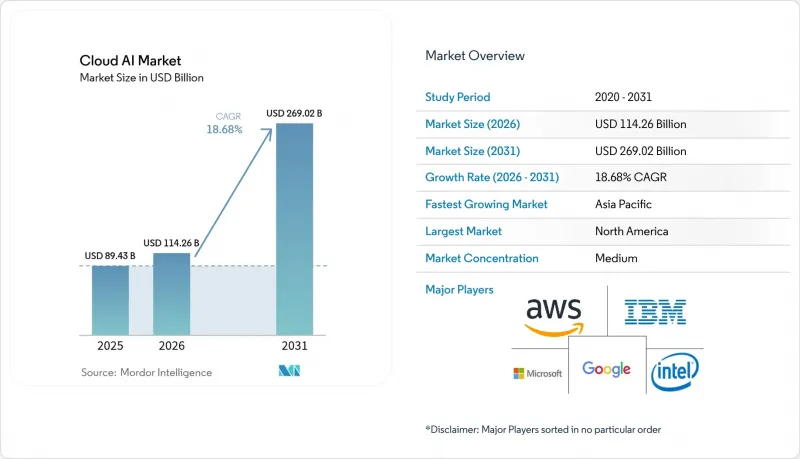
Mordor Intelligence에 의하면, 클라우드 AI 시장 규모는 2025년에 894억 3,000만 달러로 평가되었습니다. 2026년에 1,142억 6,000만 달러에 달하고, 2031년까지 2,690억 2,000만 달러에 이를 것으로 예측되며, 2026년부터 2031년에 걸쳐 CAGR 18.68%로 성장할 전망입니다.

본 보고서는 유형(솔루션 및 서비스), 최종 사용자 산업(은행, 금융서비스 및 보험(BFSI), 헬스케어,자동차·모빌리티 등), 배포 모델(퍼블릭 클라우드, 프라이빗 클라우드, 하이브리드 및 멀티 클라우드), 용도(고객 서비스 및 컨택 센터 AI 등), 기술(머신러닝, 컴퓨터 비전 등), 그리고 지역별로 분류되어 있습니다. 시장 예측은 금액(달러) 기준으로 제시되어 있습니다.
세계의 클라우드 AI 시장 동향 및 인사이트
증가하는 빅데이터 양
2025년에는 조직이 120제타바이트의 데이터를 생성했으나, 이 규모의 멀티모달 데이터 세트를 비용 효율적인 방식으로 수집, 라벨링 및 분석할 수 있는 것은 확장 가능한 클라우드 AI 플랫폼뿐입니다. 퍼블릭 클라우드의 오브젝트 스토리지를 활용함으로써 제조업체는 몇 주 전에 발생한 열 이상을 감지하는 예측 유지보수 알고리즘에 사용되는 머신 비전 영상을 저렴한 비용으로 장기간 저장할 수 있습니다. 금융 기관은 거래 로그와 콜센터 대화 기록을 클라우드 데이터 레이크에 통합하고 NLP를 적용함으로써, 규칙 기반 엔진으로는 놓치기 쉬운 새로운 부정 행위를 파악하고 있습니다. ‘11의 9’에 해당하는 내구성 보증과 기가바이트당 0.02달러 미만의 가격 정책으로 인해, AI 이용 사례를 위한 On-Premise형 스토리지 확장에 대한 관심은 사실상 줄어들고 있습니다. 그 결과, 데이터 파이프라인 자동화, 피처 스토어, 그리고 확장 가능한 어노테이션 서비스에 대한 수요가 클라우드 AI 시장의 성장을 더욱 가속화하고 있습니다.
AI-as-a-Service(AIaaS) 도입 확대
ML 전문 지식이 부족한 기업들이 턴키형 모델 API를 채택함에 따라, 2025년 AIaaS 매출은 280억 달러에 달했습니다. Databricks의 ‘Model Serving’은월140억 건의 추론 호출을 처리하며, 원클릭 배포를 통해 프로덕션 환경 도입까지 걸리는 기간을 몇 분기에서 몇 주로 단축할 수 있음을 입증했습니다. Snowflake Cortex를 통해 SQL 분석가는 익숙한 쿼리 내에서 감정 분석이나 번역 모델을 실행할 수 있게 되어, 데이터 사이언스 팀 이외의 분야로도 활용 범위가 확대되었습니다. 2025년 조사에 따르면, 유럽 중소기업의 42%가 이미 클라우드 NLP 또는 비전 API를 이용하고 있으며, 이는 종량제 요금제로 인해 초기 라이선스 비용의 위험이 제거되었기 때문입니다. 이러한 동향으로 인해 AIaaS는 기업 규모에 관계없이 클라우드 AI의 보급을 단기적으로 가속화하는 요인이 되고 있습니다.
숙련된 인력 부족과 데이터 보안에 대한 우려
2025년에는 전 세계적으로 140만 명의 머신러닝(ML) 전문가가 부족하고, 실리콘밸리의 연봉 중앙값이 38만 5,000달러에 달함에 따라 많은 중견 기업들이 인재를 확보하지 못하게 되었습니다. 대학에서 배출한 AI 분야 박사 학위 취득자는 고작 8만 7,000명에 불과하여 수요 증가세를 크게 밑돌고 있습니다. 설정 오류가 발생한 클라우드 버킷으로 인해 23억 건의 기록이 유출되었습니다. 이로 인해 CIO의 34%가 제로 트러스트 및 암호화 대책이 성숙해질 때까지 전환을 연기하게 되었습니다. GDPR(EU 개인정보보호규정) 및 CCPA에 따른 벌금은 20억 3,000만 달러에 달했으며, 기밀성이 높은 개인 데이터를 다루는 업계에서 규정 준수의 중요성이 더욱 커지고 있습니다. 교육 체계의 개선과 보안 도구의 자동화가 진전되지 않는다면, 인력 부족과 정보 유출에 대한 우려는 여전히 큰 장애물이 될 것입니다.
부문별 분석
2025년, 솔루션은 클라우드 AI 시장에서 62.39%의 점유율을 차지했습니다. 이는 기업들이 턴키형 인프라, PaaS 도구, 개발 주기를 단축하는 광범위한 마켓플레이스를 선호하는 경향을 반영합니다. 모든 하이퍼스케일러가 제공하는 GPU 최적화 인스턴스는 여전히 주요 구매 대상이며, 한편 Databricks Lakehouse AI와 Snowflake Cortex는 데이터 준비 및 버전 관리를 추상화하여 소매업체들이 연말 연시 추천 엔진을 기한 내에 배포할 수 있게 했습니다. Hugging Face와 같은 모델 허브에는 34만 개의 알고리즘이 호스팅되어 있어, 팀은 처음부터 훈련을 진행하는 대신 BERT나 Stable Diffusion을 미세 조정할 수 있게 되었습니다. 또한, 컴퓨터 비전 및 코드 생성 워크로드가 급증하는 가운데, 고객들은 예측 가능한 지연 시간과 내장형 거버넌스를 약속하는 솔루션 번들에 계속해서 예산을 투자하고 있습니다.
서비스 시장은 편향 완화에 대한 전문적인 지침과 프로덕션 환경에서의 추론에 대해 99.9%의 가동률을 보장하는 관리형 서비스에 힘입어 2031년까지 연평균 성장률(CAGR) 20.19%를 기록할 전망입니다. 2026년 EU AI법 시행에 따라 유럽 기업의 67%가 규정 준수 감사 및 모델 문서화를 외주화할 의향을 보이고 있으며, 이로 인해 예측 기간 동안 클라우드 AI 시장 전체에서 서비스 시장이 차지하는 비중이 증가할 전망입니다. 지속적인 훈련 계약에는 이미 드리프트 알림, 적대적 필터링, 제로데이 패치 적용이 포함되어 있어, 고객은 인건비를 늘리지 않고도 AI 인력 부족을 보완할 수 있습니다. 이러한 요인들이 복합적으로 작용함에 따라, 벤더는 핵심 인프라를 사내에서 계속 운영하는 조직 사이에서도 예산 점유율을 확대할 수 있는 입장에 있습니다.
2025년 지출 중 퍼블릭 클라우드가 70.24%를 차지했으며, 탄력적인 용량과 새로운 실리콘(H100, H200, MI300X)에 대한 신속한 접근이 여전히 결정적인 우위를 점하고 있습니다. 특히 디지털 네이티브 기업들은 데이터센터, 냉각, 고속 네트워크에 대한 자본 지출(CAPEX)을 피할 수 있는 종량제 요금제의 경제성을 높이 평가했습니다. 현재 퍼블릭 플랫폼에는 AutoML 및 기반 모델 API가 패키지화되어 있어, 비즈니스 분석가들은 분기 단위가 아닌 며칠 단위로 파일럿 운영을 시작할 수 있게 되었습니다. 그러나 규제 당국은 금융, 의료, 정부 기관 사용자에게 기밀 데이터를 국내에 보관할 것을 계속 요구하고 있어, 팀은 아키텍처를 이원화할 수밖에 없는 상황에 처해 있습니다.
하이브리드 및 멀티 클라우드 도입은 연평균 성장률(CAGR) 22.31%로 확대될 것으로 예측됩니다. 이는 현재 54%의 기업이 락인(lock-in)을 피하고 지연 시간 목표를 달성하기 위해 최소 두 곳공급업체에 걸쳐 AI 워크로드를 스케줄링하고 있기 때문입니다. 은행들은 GDPR(EU 개인정보보호규정) 준수를 위해 거래 원장을 프라이빗 클라우드로 되돌리고 있는 한편, 익명화된 특징량은 대규모 모델 훈련을 위해 퍼블릭 클러스터로 다시 전송되고 있습니다. 의료 네트워크도 유사한 패턴을 따르고 있으며, PHI(개인 건강 정보)를 On-Premise에 저장하고, 특징량을 추출한 텐서를 페더레이티드 러닝을 위해 GPU 팜으로 전송하고 있습니다. 따라서 공급자, 특징량 저장소, 가시성 대시보드, 정책 엔진 전반에 걸쳐 MLOps를 표준화하는 도구가 클라우드 AI 시장의 중요한 성장 동력으로 부상하고 있습니다.
지역별 분석
2025년, 북미는 클라우드 AI 시장 점유율의 40.59%를 차지했습니다. 이는 포춘 500대 기업의 풍부한 예산과, 같은 해 신규 데이터센터 건설에 2,000억 달러를 초과한 하이퍼스케일러의 설비 투자를 반영한 것입니다. ‘소버린 컴퓨팅’ 이니셔티브도 확대되고 있습니다. 캐나다의 ‘범캐나다 AI 전략’에서는 인재 확보와 현지 GPU 클러스터에 대한 자금 지원을 위해 24억 캐나다 달러(17억 7,000만 달러)를 배정했습니다. 멕시코는 니어쇼어링을 활용하여 자동차 및 전자제품 공급망에 클라우드 AI를 도입함으로써, 해당 지역의 클라우드 서비스 매출을 전년 대비 19% 끌어올렸습니다. 미국 전역에서 기업들은 생성형 AI 시범 도입을 통해 ROI 중앙값이 240%에 달했다고 보고하고 있으며, 이러한 성과가 해당 지역의 클라우드 AI 시장 지속적 확장을 뒷받침하고 있습니다. 이러한 요인들이 결합되어 북미는 대규모 파라미터 모델의 훈련 및 추론 활용 분야에서 선두를 유지하고 있습니다.
아시아태평양은 정부 주도 정책과 지역 밀착형 모델 생태계에 대한 민간 투자 증가에 힘입어, 2031년까지 22.74%라는 가장 높은 연평균 성장률(CAGR)을 나타낼 전망입니다. 중국은 ‘주권 AI’ 지침에 따라 연간 약 180억 달러의 기업 지출을 국내 AI 클라우드로 전환하여, 현지에서 훈련된 기반 모델의 채택을 가속화했습니다. 인도의 ‘국가 AI 미션’은 여러 도시에 걸친 GPU 클러스터 구축에 1,030억 루피(12억 4,000만 달러)를 배정하고, 1만 4,000개 스타트업에 연산 크레딧 보조금을 지원함으로써,개발자들이 첨단 반도체 칩을 활용할 수 있는 기회를 확대했습니다. 일본과 한국은 엣지 클라우드 인프라 및 국내 AI 칩 생산에 총 15억 달러를 투자하여, 스마트 시티 및 자율주행 프로젝트에서의 추론 지연 시간을 단축하기 위한 노력을 추진하고 있습니다.
유럽, 남미, 중동 및 아프리카를 합친 지역은 2025년 매출의 37%를 차지했으며, 현재 이 지역 전체에서 규제 동향이 조달 기준을 형성하고 있습니다. 곧 시행될 EU AI법에 따라, 조사 대상 기업의 62%가 2026년 시행 전에 설명 가능한 AI 도구를 도입하고 규정 준수 컨설턴트를 활용하고 있습니다. 독일의 ‘AI Made in Europe’ 프로그램은 주권 클라우드 노드에 30억 유로(33억 9,000만 달러)를 배정하여 첫해에 340개의 기업 테넌트를 유치했습니다. 브라질의 은행과 아르헨티나의 애그리테크 기업들은 사기 분석 및 정밀 농업 솔루션을 통해 2025년 남미 클라우드 AI 시장 규모를 18% 끌어올렸습니다. GCC 국가들은 AI 인프라에 120억 달러를 투자했으며, 사우디아라비아의 NEOM 프로젝트에서는 자율주행 차량의 시범 운영과 스마트 그리드 최적화가 진행되고 있습니다. 아프리카에서는 2025년에 통신 사업자가 AI 기반 신용 평가 시스템을 활용해 은행 계좌가 없는 성인 820만 명에게 소액 대출을 제공했습니다. 이는 해당 지역이 아직 초기 단계에 있지만, 막대한 영향력을 지닌 비즈니스 기회로 가득 차 있음을 보여줍니다.
기타 혜택 :
- 엑셀 형식 시장 예측(ME) 시트
- 3개월간의 애널리스트 지원
자주 묻는 질문
목차
제1장 서론
제2장 조사 방법
제3장 주요 요약
제4장 시장 구도
제5장 시장 규모 및 성장 예측
제6장 경쟁 구도
제7장 시장 기회 및 향후 전망
KTH 26.09.08According to Mordor Intelligence, the cloud AI market size is projected to be USD 89.43 billion in 2025, USD 114.26 billion in 2026, and reach USD 269.02 billion by 2031, growing at a CAGR of 18.68% from 2026 to 2031.
This report is Segmented by Type (Solutions, and Services), End-User Vertical (BFSI, Healthcare, Automotive and Mobility, and More), Deployment Model (Public Cloud, Private Cloud, and Hybrid and Multi-Cloud), Application (Customer Service and Contact-Center AI, and More), Technology (Machine Learning, Computer Vision, and More), and Geography. The Market Forecasts are Provided in Terms of Value (USD).
Global Cloud AI Market Trends and Insights
Rising Big-Data Volume
Organizations generated 120 zettabytes of data in 2025, and only scalable cloud AI platforms can cost-effectively ingest, label, and analyze multimodal datasets at that magnitude. Public-cloud object stores give manufacturers inexpensive retention of machine-vision footage used for predictive-maintenance algorithms that spot thermal anomalies weeks in advance. Financial institutions are funneling transaction logs and call-center transcripts into cloud data lakes, then applying NLP to surface emerging fraud behaviors that rule-based engines miss. Eleven-nines durability guarantees and sub-USD 0.02 per-gigabyte pricing have all but ended interest in on-premises storage expansions for AI use cases. As a result, demand for data-pipeline automation, feature stores, and scalable annotation services is amplifying the growth of the cloud AI market.
Growing Adoption of AI-as-a-Service (AIaaS)
AIaaS revenue reached USD 28 billion in 2025 as firms without deep ML talent embraced turnkey model APIs. Databricks' Model Serving processed 14 billion monthly inference calls, demonstrating how one-click deployment compresses time-to-production from quarters to weeks. Snowflake Cortex enabled SQL analysts to run sentiment and translation models inside familiar queries, widening access beyond data-science teams. A 2025 survey showed 42% of European SMEs already consume cloud NLP or vision APIs because consumption pricing removes up-front licensing risk. These dynamics position AIaaS as a near-term accelerator of cloud AI uptake across company sizes.
Lack of Skilled Workforce and Data-Security Concerns
The global shortage of 1.4 million ML professionals in 2025 pushed Silicon Valley median compensation to USD 385,000, pricing out many mid-market firms. Universities produced only 87,000 AI-focused doctorates, well below demand growth. Misconfigured cloud buckets exposed 2.3 billion records, triggering 34% of CIOs to postpone migrations until zero-trust and encryption controls mature. GDPR and CCPA fines reached USD 2.03 billion, raising the compliance stakes for sectors handling sensitive personal data. Without improved training pipelines and automated security tooling, talent scarcity and breach fears remain formidable obstacles.
Other drivers and restraints analyzed in the detailed report include:
- Increasing Demand for Virtual Assistants and Generative-AI Chatbots
- GenAI GPU-Fractionalization Expanding SME Access
- Persistent GPU and HBM Supply-Chain Shortages
For complete list of drivers and restraints, kindly check the Table Of Contents.
Segment Analysis
Solutions held a 62.39% cloud AI market share in 2025, reflecting enterprises' preference for turnkey infrastructure, PaaS tooling, and expansive model marketplaces that shorten development cycles. GPU-optimized instances from every hyperscaler remained the anchor purchase, while Databricks Lakehouse AI and Snowflake Cortex abstracted data prep and version control so retailers could roll out holiday recommendation engines on time. Model hubs such as Hugging Face hosted 340,000 algorithms, letting teams fine-tune BERT or Stable Diffusion instead of training from scratch, computer vision, and code-generation workloads proliferate, customers continue to funnel budget toward solution bundles that promise predictable latency and embedded governance.
Services are set to post a 20.19% CAGR through 2031, driven by professional guidance on bias mitigation and managed offerings that guarantee 99.9% uptime for production inference. As the EU AI Act starts enforcement in 2026, 67% of European firms intend to outsource compliance audits and model documentation, raising the services slice of overall cloud AI market size during the forecast window. Continuous-training contracts already cover drift alerts, adversarial filtering, and zero-day patching, helping clients bridge the AI-talent gap without ballooning payrolls. Collectively, these factors position service vendors to capture a growing share of budget even among organizations that keep core infrastructure in-house.
Public cloud accounted for 70.24% of 2025 spending, with elastic capacity and rapid access to new silicon, H100, H200, MI300X, remaining decisive advantages. Digital-native firms especially prize the pay-as-you-go economics that avoid capex on data centers, cooling, and high-speed networking. Public platforms now package AutoML and foundation-model APIs, letting business analysts stand up pilots in days rather than quarters. Yet regulators continue to push finance, healthcare, and government users to retain sensitive data within national borders, forcing teams to bifurcate architectures.
Hybrid and multi-cloud deployments are projected to expand at a 22.31% CAGR, as 54% of enterprises now schedule AI workloads across at least two providers to sidestep lock-in and meet latency goals. Banks repatriate transaction ledgers to private clouds for GDPR compliance, while anonymized features flow back to public clusters for large-scale model training. Healthcare networks follow a similar pattern by storing PHI on-premises and shipping stripped tensors to GPU farms for federated learning. Tooling that normalizes MLOps across providers, feature stores, observability dashboards, and policy engines, is therefore emerging as a pivotal growth vector for the cloud AI market.
Complete Report Scope:
- By Type
- Solution
- Infrastructure (Compute, Storage, Networking)
- Platform-as-a-Service for AI
- Model Marketplace
- Service
- Professional Services
- Managed Services
- Solution
- By End-User Vertical
- Banking, Financial Services, and Insurance (BFSI)
- Healthcare
- Automotive and Mobility
- Retail and E-Commerce
- Government and Public Sector
- Education
- Manufacturing
- By Deployment Model
- Public Cloud
- Private Cloud
- Hybrid and Multi-Cloud
- By Application
- Customer Service and Contact-Center AI
- Predictive Maintenance and Asset Operations
- Fraud and Risk Analytics
- Marketing and Personalization
- Computer-Vision-as-a-Service
- By Technology
- Machine Learning
- Natural Language Processing
- Computer Vision
- Generative AI
- Reinforcement and Edge AI
- By Geography
- North America
- United States
- Canada
- Mexico
- South America
- Brazil
- Argentina
- Chile
- Rest of South America
- Europe
- Germany
- United Kingdom
- France
- Italy
- Spain
- Netherlands
- Russia
- Rest of Europe
- Asia-Pacific
- China
- India
- Japan
- South Korea
- ASEAN
- Rest of Asia-Pacific
- Middle East
- GCC
- Turkey
- Rest of Middle East
- Africa
- South Africa
- Nigeria
- Kenya
- Rest of Africa
- North America
Geography Analysis
North America commanded a 40.59% cloud AI market share in 2025, reflecting deep Fortune 500 budgets and hyperscaler capital expenditure that topped USD 200 billion on new datacenter builds during the year. Sovereign-compute initiatives are also scaling: Canada's Pan-Canadian AI Strategy earmarked CAD 2.4 billion (USD 1.77 billion) to retain talent and fund local GPU clusters. Mexico leveraged near-shoring to infuse cloud AI into automotive and electronics supply chains, pushing regional cloud-services revenue up 19% year over year. Across the United States, enterprises report median 240% ROI on generative-AI pilots, an outcome that fuels continued expansion of the cloud AI market in the region. Taken together, these factors keep North America at the forefront of large-parameter model training and inference consumption.
Asia-Pacific is projected to record the fastest 22.74% CAGR through 2031, propelled by state-led mandates and rising private investment in localized model ecosystems. China redirected roughly USD 18 billion in annual enterprise spending toward domestic AI clouds under its sovereign-AI directive, accelerating adoption of locally trained foundation models. India's National AI Mission allocated INR 103 billion (USD 1.24 billion) for multi-city GPU clusters and subsidized compute credits for 14,000 startups, broadening developer access to advanced silicon. Japan and South Korea committed a combined USD 1.5 billion to edge-cloud infrastructure and domestic AI-chip production, actions that shorten inference latency for smart-city and autonomous-mobility projects.
Europe, South America, Middle East, and Africa together accounted for 37% of 2025 revenue, and regulatory dynamics now shape procurement criteria across these territories. The forthcoming EU AI Act is prompting 62% of surveyed enterprises to adopt explainable-AI tooling and engage compliance consultants before 2026 go-live. Germany's AI Made in Europe program set aside EUR 3 billion (USD 3.39 billion) for sovereign cloud nodes, attracting 340 enterprise tenants in its first year. Brazil's banks and Argentina's agritech firms pushed South American cloud AI market size upward by 18% in 2025 through fraud analytics and precision-farming solutions. GCC nations invested USD 12 billion in AI infrastructure, with Saudi Arabia's NEOM project piloting autonomous fleets and smart-grid optimization. In Africa, mobile carriers used AI-powered credit scoring to extend micro-loans to 8.2 million unbanked adults in 2025, underscoring the region's early-stage yet high-impact opportunity set.
- Amazon Web Services
- Microsoft Corp.
- Google LLC
- IBM Corp.
- Salesforce Inc.
- NVIDIA Corp.
- Oracle Corp.
- Alibaba Cloud
- SAP SE
- ServiceNow Inc.
- Databricks Inc.
- Snowflake Inc.
- Hugging Face Inc.
- OpenAI LP
- Anthropic PBC
- CoreWeave Inc.
- AMD Inc.
- Intel Corp.
- Wipro Ltd.
- Infosys Ltd.
- SoundHound AI Inc.
- Twilio Inc.
- Cohere Inc.
- Tencent Cloud
Additional Benefits:
- The market estimate (ME) sheet in Excel format
- 3 months of analyst support
TABLE OF CONTENTS
1 INTRODUCTION
- 1.1 Study Assumptions and Market Definition
- 1.2 Scope of the Study
2 RESEARCH METHODOLOGY
3 EXECUTIVE SUMMARY
4 MARKET LANDSCAPE
- 4.1 Market Overview
- 4.2 Industry Value Chain Analysis
- 4.3 Impact of Macroeconomic Factors on the Market
- 4.4 Market Drivers
- 4.4.1 Rising Big-Data Volume
- 4.4.2 Growing Adoption of AI-as-a-Service (AIaaS)
- 4.4.3 Increasing Demand for Virtual Assistants and Generative-AI Chatbots
- 4.4.4 GenAI GPU-Fractionalization Expanding SME Access
- 4.4.5 Edge-Cloud AI Interoperability Standards (e.g., ONNX, MEDAL)
- 4.4.6 Carbon-Aware Workload Orchestration Incentives
- 4.5 Market Restraints
- 4.5.1 Lack of Skilled Workforce and Data-Security Concerns
- 4.5.2 Persistent GPU and HBM Supply-Chain Shortages
- 4.5.3 AI Datacenter Energy Constraints and Carbon Regulations
- 4.5.4 Geopolitical GPU Export-Control Frameworks
- 4.6 Regulatory Landscape
- 4.7 Technological Outlook
- 4.8 Porter's Five Forces Analysis
- 4.8.1 Threat of New Entrants
- 4.8.2 Bargaining Power of Suppliers
- 4.8.3 Bargaining Power of Buyers
- 4.8.4 Threat of Substitutes
- 4.8.5 Intensity of Competitive Rivalry
5 MARKET SIZE AND GROWTH FORECASTS (VALUE)
- 5.1 By Type
- 5.1.1 Solution
- 5.1.1.1 Infrastructure (Compute, Storage, Networking)
- 5.1.1.2 Platform-as-a-Service for AI
- 5.1.1.3 Model Marketplace
- 5.1.2 Service
- 5.1.2.1 Professional Services
- 5.1.2.2 Managed Services
- 5.1.1 Solution
- 5.2 By End-User Vertical
- 5.2.1 Banking, Financial Services, and Insurance (BFSI)
- 5.2.2 Healthcare
- 5.2.3 Automotive and Mobility
- 5.2.4 Retail and E-Commerce
- 5.2.5 Government and Public Sector
- 5.2.6 Education
- 5.2.7 Manufacturing
- 5.3 By Deployment Model
- 5.3.1 Public Cloud
- 5.3.2 Private Cloud
- 5.3.3 Hybrid and Multi-Cloud
- 5.4 By Application
- 5.4.1 Customer Service and Contact-Center AI
- 5.4.2 Predictive Maintenance and Asset Operations
- 5.4.3 Fraud and Risk Analytics
- 5.4.4 Marketing and Personalization
- 5.4.5 Computer-Vision-as-a-Service
- 5.5 By Technology
- 5.5.1 Machine Learning
- 5.5.2 Natural Language Processing
- 5.5.3 Computer Vision
- 5.5.4 Generative AI
- 5.5.5 Reinforcement and Edge AI
- 5.6 By Geography
- 5.6.1 North America
- 5.6.1.1 United States
- 5.6.1.2 Canada
- 5.6.1.3 Mexico
- 5.6.2 South America
- 5.6.2.1 Brazil
- 5.6.2.2 Argentina
- 5.6.2.3 Chile
- 5.6.2.4 Rest of South America
- 5.6.3 Europe
- 5.6.3.1 Germany
- 5.6.3.2 United Kingdom
- 5.6.3.3 France
- 5.6.3.4 Italy
- 5.6.3.5 Spain
- 5.6.3.6 Netherlands
- 5.6.3.7 Russia
- 5.6.3.8 Rest of Europe
- 5.6.4 Asia-Pacific
- 5.6.4.1 China
- 5.6.4.2 India
- 5.6.4.3 Japan
- 5.6.4.4 South Korea
- 5.6.4.5 ASEAN
- 5.6.4.6 Rest of Asia-Pacific
- 5.6.5 Middle East
- 5.6.5.1 GCC
- 5.6.5.2 Turkey
- 5.6.5.3 Rest of Middle East
- 5.6.6 Africa
- 5.6.6.1 South Africa
- 5.6.6.2 Nigeria
- 5.6.6.3 Kenya
- 5.6.6.4 Rest of Africa
- 5.6.1 North America
6 COMPETITIVE LANDSCAPE
- 6.1 Market Concentration
- 6.2 Strategic Moves
- 6.3 Market Share Analysis
- 6.4 Company Profiles (includes Global Level Overview, Market Level Overview, Core Segments, Financials as available, Strategic Information, Market Rank/Share, Products and Services, Recent Developments)
- 6.4.1 Amazon Web Services
- 6.4.2 Microsoft Corp.
- 6.4.3 Google LLC
- 6.4.4 IBM Corp.
- 6.4.5 Salesforce Inc.
- 6.4.6 NVIDIA Corp.
- 6.4.7 Oracle Corp.
- 6.4.8 Alibaba Cloud
- 6.4.9 SAP SE
- 6.4.10 ServiceNow Inc.
- 6.4.11 Databricks Inc.
- 6.4.12 Snowflake Inc.
- 6.4.13 Hugging Face Inc.
- 6.4.14 OpenAI LP
- 6.4.15 Anthropic PBC
- 6.4.16 CoreWeave Inc.
- 6.4.17 AMD Inc.
- 6.4.18 Intel Corp.
- 6.4.19 Wipro Ltd.
- 6.4.20 Infosys Ltd.
- 6.4.21 SoundHound AI Inc.
- 6.4.22 Twilio Inc.
- 6.4.23 Cohere Inc.
- 6.4.24 Tencent Cloud
7 MARKET OPPORTUNITIES AND FUTURE OUTLOOK
- 7.1 White-Space and Unmet-Need Assessment


