|
시장보고서
상품코드
2122521
토큰화 솔루션 : 시장 점유율 분석, 업계 동향 및 통계, 성장 예측(2026-2031년)Tokenization Solution - Market Share Analysis, Industry Trends & Statistics, Growth Forecasts (2026 - 2031) |
||||||
 Mordor Intelligence
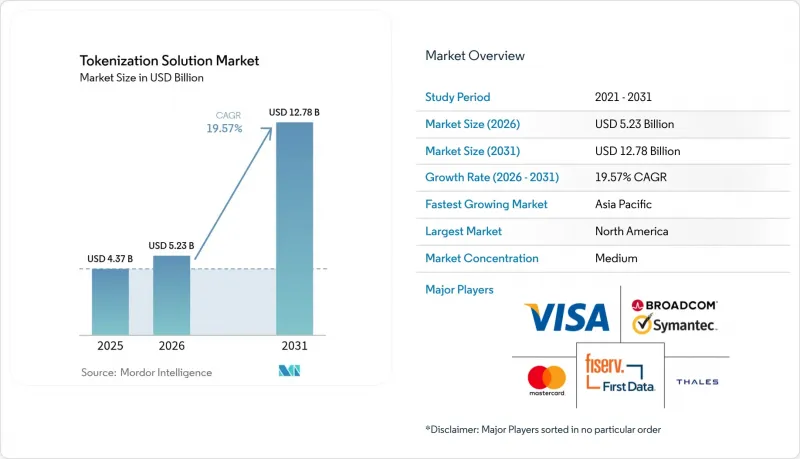
Mordor Intelligence에 의하면, 토큰화 솔루션 시장 규모는 2025년 43억 7,000만 달러로 평가되었습니다. 2026년에는 52억 3,000만 달러로 확대되어 2026년부터 2031년에 걸쳐 CAGR 19.57%로 성장을 지속하여, 2031년에는 127억 8,000만 달러에 이를 것으로 예측됩니다.

본 보고서는 구성 요소(솔루션, 서비스), 배포 방식(On-Premise, 클라우드), 토큰화 기법(볼트형 토큰화 등), 용도 분야(결제 보안, 고객 인증 등), 최종 사용자 산업(은행, 금융서비스 및 보험(BFSI), 소매 및 전자상거래 등), 지역별로 분류되어 있습니다. 시장 예측은 금액(달러) 기준으로 제시되어 있습니다.
세계의 토큰화 솔루션 시장 동향 및 인사이트
아시아에서 비접촉식 및 모바일 지갑 결제에 토큰화 도입이 급증
2024년 초, 아시아태평양의 모바일 결제 거래 건수는 전년 대비 2배 이상 증가했으며, 토큰화는 이 지역의 결제 인프라의 핵심으로 자리 잡아가고 있습니다. 일본이 2025년까지 국내 200만 개 매장을 아우르는 아세안(ASEAN) 공동 QR 네트워크 구축을 계획하고 있다는 사실은 현재 지갑 간 상호 운용성이 네트워크 토큰에 얼마나 의존하고 있는지를 여실히 보여줍니다. 2029년까지 1,100조 위안 이상에 달할 것으로 예상되는 중국의 모바일 결제 처리액은 슈퍼앱 생태계를 보호하기 위해 토큰화된 인증 정보에 의존하고 있습니다. 2024년 일본의 무현금 결제 비율이 39.3%를 넘어섬에 따라, 지역 정책 목표에 따라 가맹점은 보조금 수령의 전제조건으로 토큰화를 추진해야 합니다. 이러한 네트워크 효과로 인해 전 세계 결제 처리 업체들은 대상 거래량을 유지하기 위해 아시아에서의 파트너십을 강화할 수밖에 없게 되었습니다.
PCI DSS 4.0 준수 의무화 시한이 북미의 토큰화 투자를 촉진
PCI DSS 4.0에서는 카드 회원 데이터 취급에 관한 의무가 강화되었으며, 토큰화가 바로 대상 범위를 축소하고 감사 비용을 절감하기 위한 가장 빠른 길입니다. 기밀성이 높은 필드를 토큰화하는 기업은 연례 평가 대상 시스템을 줄일 수 있으므로, 보안 예산을 예방적 위협 감지 및 제로 트러스트 이니셔티브에 재할당할 수 있게 됩니다. 새로운 표준의 지속적인 모니터링 조항은 최신 토큰 플랫폼에 내장된 실시간 분석 기능과 일치하므로, 이사회는 필요에 따라 규정 준수 증거를 제시할 수 있게 됩니다. 클라우드를 통해 제공되는 토큰화 서비스는 도입 기간을 더욱 단축하여, 옴니채널 소매업체와 핀테크 발행사에게 가치 실현까지의 시간을 단축시켜 줍니다.
독자적인 사양을 가진 토큰 서비스 제공업체 간의 상호 운용성 격차
서로 다른 토큰 형식과 독자적인 사양의 API는 멀티 레일 결제 수용을 방해하고, 통합 비용 및 벤더 종속의 위험을 높입니다. 공급업체의 다양화를 의무화하고 있는 정부 기관은 많은 경우, 병행하여 여러 토큰 인프라를 유지할 수밖에 없어 자본 지출(CapEx)에 부담을 주고 거버넌스를 복잡하게 만들고 있습니다. 또한, 보편적인 토큰 교환 프로토콜이 존재하지 않는 것은 국경을 넘는 상거래의 장벽이 되고 있습니다. 스킴의 불일치로 인해 복잡한 변환 게이트웨이가 필요하게 되어 처리 수수료가 증가하기 때문입니다.
부문별 분석
솔루션은 2025년 매출의 71.35%를 차지했으며, 이는 토큰화 솔루션 시장에서 플랫폼 소프트웨어가 기반적인 역할을 하고 있음을 보여줍니다. 전문 서비스 및 관리형 서비스는 사내 전문 지식의 부족과 아웃소싱을 촉진하는 지속적인 규정 준수 의무에 힘입어 연평균 성장률(CAGR) 20.35%를 나타낼 것으로 예측됩니다. 기업들은 자문 계약을 활용하여 데이터 흐름을 가시화하고 PCI 위험을 저감한 후, 토큰의 유지 관리를 위해 지속적인 서비스 계약으로 전환하고 있습니다. ‘Tokenization-as-a-Service(ToA-S)’ 프레임워크는 제품 및 서비스의 경계를 모호하게 만들어 중견 기업의 도입 진입 장벽을 낮추고 있습니다. Marqeta Docs AI와 같은 AI 기반 문서 작성 도구는 코드 개요 생성을 자동화함으로써 도입 과정을 더욱 가속화합니다.
솔루션 분야는 독자적인 결제 흐름으로의 확장성이나 하이브리드 On-Premise 구축을 원하는 기업에게 여전히 매우 중요합니다. 기능 로드맵에는 토큰 스트림 내의 부정 패턴을 시각화하는 인공지능(AI) 분석이 점점 더 많이 통합되어, 수동적인 제어를 능동적인 의사결정 엔진으로 전환하고 있습니다. 확장성이 뛰어난 API와 규정 준수 증명을 결합한 벤더는 장기적인 엔터프라이즈 고객을 확실히 확보할 수 있는 입장에 있습니다.
클라우드는 2025년 매출의 63.10%를 차지했으며, 연평균 성장률(CAGR) 20.65%로 주도적인 위치를 유지할 전망입니다. 이는 전 세계 거점망을 통한 커버리지와 탄력적인 확장성이라는 구조적 우위를 반영한 것입니다. 기존 ID 및 액세스 관리(IAM) 스택과의 통합을 통해 보안 팀은 정책 적용을 통일하고, 감사 및 침해 대비를 신속하게 수행할 수 있습니다. 엣지 컴퓨팅의 확대로 네트워크 홉이 감소하여, 과거 On-Premise 배포에 유리했던 지연 시간 차이가 해소됩니다. 하이퍼스케일러가 제공하는 포스트 양자암호화 로드맵은 향후 알고리즘 전환에 따른 위험을 완화함으로써 경쟁 우위를 더욱 강화하고 있습니다.
엄격한 데이터 상주 요건이나 메인프레임에 대한 의존도가 높은 산업에서는 여전히 On-Premise 도입이 지속되고 있습니다. 하이브리드 아키텍처는 로컬에서의 키 관리를 유지하면서, 계절적 수요 피크 시에는 토큰화 워크로드를 클라우드로 버스트함으로써 중간적인 경로를 제공합니다. 제로 트러스트 프레임워크가 성숙해짐에 따라, 보수적인 업계조차 비핵심 워크로드를 오프로드하게 될 것이며, 예측 기간 동안 On-Premise 점유율은 점차 축소될 것입니다.
지역별 분석
북미는 클라우드의 조기 도입과 엄격한 결제 보안 규정 준수 체제를 배경으로, 2025년 토큰화 솔루션 시장 매출의 38.60%를 차지했습니다. PCI DSS 4.0 적용 기한으로 인해 업그레이드 주기가 단축되면서, 많은 후발 도입 기업들이 관리형 토큰화 서비스로 전환하고 있습니다. 주요 신용카드 분야는 시장 포화 상태에 가까워지고 있어, 공급업체들은 의료 결제 및 정부 급여 지급과 같은 인접 이용 사례로 사업을 전환하고 있습니다.
아시아태평양은 모바일 지갑의 보급과 공공 부문의 디지털화 자금 지원에 힘입어 2031년까지 연평균 성장률(CAGR) 19.95%로 시장을 주도하고 있습니다. 일본의 ASEAN QR 프로젝트와 Alipay+의 가맹점 확대는 국경을 초월한 지갑이 네트워크 토큰을 활용해 통화에 의존하지 않는 결제를 실현하고 있는 좋은 사례입니다. 중국의 슈퍼앱 생태계는 계속 확대되고 있으며, 쇼핑 페스티벌의 피크 시간대에도 대응할 수 있는 초고처리량 토큰 엔진이 요구되고 있습니다. 인도의 통합 결제 인프라는 현지 Aadhaar(아다르) 신분증 기준에 맞추어 맞춤 설정할 수 있는 토큰화 제공업체에게 유망한 시장이 되고 있습니다.
유럽에서는 GDPR(EU 개인정보보호규정)의 제약과 강력한 부정방지 인센티브 간의 균형을 맞추면서 착실한 도입이 진행되고 있습니다. 중앙 집중형 데이터 저장소에 경계심을 품고 있는 규제 당국에게는 저장소가 필요 없는 구현 방식이 지지를 받고 있으며, 각국의 디지털 ID 프로그램은 시민 대상 서비스의 토큰화에 새로운 기회를 제공합니다. 규제의 파편화로 인해 유럽 전역에서의 확산은 여전히 복잡하지만, 제도적 조화가 진행됨에 따라 기술적 장벽은 점차 낮아지고 있습니다.
기타 혜택 :
- 엑셀 형식 시장 예측(ME) 시트
- 3개월간의 애널리스트 지원
자주 묻는 질문
목차
제1장 서론
제2장 조사 방법
제3장 주요 요약
제4장 시장 구도
제5장 시장 규모 및 성장 예측
제6장 경쟁 구도
제7장 시장 기회 및 향후 전망
KTH 26.09.08According to Mordor Intelligence, the tokenization solution market size is expected to grow from USD 4.37 billion in 2025 to USD 5.23 billion in 2026 and is forecast to reach USD 12.78 billion by 2031 at 19.57% CAGR over 2026-2031.
This report is Segmented by Component (Solutions, Services), Deployment Mode (On-Premise, Cloud), Tokenization Technique (Vaulted Tokenization, and More), Application Area (Payment Security, Customer Authentication, and More), End-User Industry (BFSI, Retail and E-Commerce, and More), and by Geography. The Market Forecasts are Provided in Terms of Value (USD).
Global Tokenization Solution Market Trends and Insights
Surge in Tokenisation Adoption for Contactless & Mobile Wallet Payments in Asia
Mobile payment transactions in Asia Pacific more than doubled year-on-year in early 2024, drawing tokenisation into the region's core payments stack. Japan's plan for a joint ASEAN QR network by fiscal 2025, covering 2 million domestic merchants, showcases the scale at which cross-wallet interoperability now depends on network tokens. China's mobile payment throughput, projected above CNY 1,100 trillion by 2029, relies on tokenised credentials to secure super-app ecosystems. With Japan's cashless ratio topping 39.3% in 2024, regional policy targets drive merchants toward tokenisation as a precondition for subsidy eligibility. This network effect compels global processors to deepen Asian partnerships to retain addressable volume.
Mandatory PCI DSS 4.0 Compliance Deadlines Boosting Tokenisation Investments in North America
PCI DSS 4.0 elevates cardholder-data obligations, making tokenisation the quickest path to scope reduction and audit-cost containment. Enterprises that tokenise sensitive fields can quarantine fewer systems under annual assessment, freeing security budgets for proactive threat-hunting and zero-trust initiatives. Continuous-monitoring clauses in the new standard align with real-time analytics embedded in modern token platforms, allowing boards to evidence compliance on demand. Cloud-delivered tokenisation services further compress deployment timelines, accelerating time-to-value for omnichannel retailers and fintech issuers.
Interoperability Gaps Among Proprietary Token Service Providers
Disparate token formats and proprietary APIs hinder multi-rail payment acceptance, elevating integration cost and vendor-lock-in risk. Government agencies mandated to diversify suppliers must often maintain parallel token infrastructures, draining CapEx and complicating governance. Absence of a universal token exchange protocol also impedes cross-border commerce, where mismatched schemes require complex translation gateways that inflate processing fees.
Other drivers and restraints analyzed in the detailed report include:
- Rising Fraud Losses in Card-Not-Present Transactions Driving Vaultless Tokenisation Uptake in Europe
- Expansion of BNPL Platforms Demanding Tokenised Credentials Integration
- High Latency Concerns in Token Vault Architectures for High-Frequency Trading Firms
For complete list of drivers and restraints, kindly check the Table Of Contents.
Segment Analysis
Solutions accounted for 71.35% of 2025 revenue, testifying to the foundational role of platform software in the tokenization solution market. Professional and managed services are forecast to grow at a 20.35% CAGR, aided by scarce in-house expertise and continuous compliance obligations that favour outsourcing. Enterprises leverage advisory engagements to map data flows and reduce PCI exposure, then transition to ongoing service contracts for token maintenance. Tokenization-as-a-Service frameworks blur the boundary between product and service, lowering entry barriers for mid-market adopters. AI-enabled documentation tools, such as Marqeta Docs AI, further accelerate onboarding by automating code-snippet generation.
The solutions segment remains critical for enterprises demanding extensibility into proprietary payment flows or hybrid on-premise deployments. Feature roadmaps increasingly embed artificial-intelligence analytics that surface fraud patterns within the token stream, turning passive controls into active decision engines. Vendors that pair extensible APIs with compliance attestation are best placed to lock in long-cycle enterprise accounts.
Cloud held 63.10% of 2025 revenue and will sustain leadership with a 20.65% CAGR, reflecting the structural advantage of global point-of-presence coverage and elastic scaling. Integrations with existing identity-and-access-management stacks allow security teams to unify policy enforcement, speeding audits and breach preparation. Edge compute extensions reduce network hops, closing the latency gap that once favoured on-premise deployments. Post-quantum cryptography roadmaps hosted by hyperscalers further tip the balance by de-risking future algorithmic transitions.
On-premise installations persist in industries with strict residency mandates or mainframe dependencies. Hybrid architectures offer a middle path, retaining local key custody while bursting tokenisation workloads to the cloud during seasonal spikes. As zero-trust frameworks mature, even conservative sectors may offload non-core workloads, shrinking the on-premise footprint over the forecast horizon.
Complete Report Scope:
- By Component
- Solutions
- Services
- By Deployment Mode
- On-Premise
- Cloud
- By Tokenization Technique
- Vaulted Tokenization
- Vaultless Tokenization
- By Application Area
- Payment Security
- Customer Authentication
- Fraud Prevention and Risk Management
- Compliance and Audit Management
- Others
- By End-User Industry
- BFSI
- Retail and E-commerce
- IT and Telecommunications
- Healthcare and Life Sciences
- Transportation and Logistics
- Government and Public Sector
- Energy and Utilities
- Media and Entertainment
- Others
- By Geography
- North America
- United States
- Canada
- Mexico
- South America
- Brazil
- Argentina
- Rest of South America
- Europe
- United Kingdom
- Germany
- France
- Nordics
- Rest of Europe
- Asia Pacific
- China
- Japan
- India
- South Korea
- ASEAN
- Australia
- New Zealand
- Rest of Asia Pacific
- Middle East and Africa
- Middle East
- United Arab Emirates
- Saudi Arabia
- Turkey
- Rest of Middle East
- Africa
- South Africa
- Nigeria
- Rest of Africa
- Middle East
- North America
Geography Analysis
North America generated 38.60% of 2025 revenue for the tokenization solution market, anchored by early cloud adoption and a strict payment-security compliance regime. PCI DSS 4.0 deadlines have compressed upgrade cycles, tipping many late adopters toward managed tokenisation services. Market saturation is approaching in core credit-card verticals, so providers are pivoting to adjacent use cases such as healthcare payments and government disbursements.
Asia Pacific is pacing the field with a 19.95% CAGR through 2031, catalysed by mobile-wallet penetration and public-sector digitalisation funds. Japan's ASEAN QR project and Alipay+ merchant expansion exemplify how cross-border wallets leverage network tokens for currency-agnostic settlement. China's super-app ecosystems continue to scale, demanding ultra-high-throughput token engines capable of handling peak shopping festivals. India's unified payments infrastructure offers fertile ground for tokenisation providers that can tailor to local Aadhaar identity norms.
Europe remains a steady adopter, balancing GDPR constraints with strong fraud-prevention incentives. Vaultless implementations resonate with regulators wary of centralised data stores, while national digital-ID programmes open fresh opportunities for citizen-service tokenisation.Fragmented rule sets still complicate pan-European roll-outs, but scheme-level harmonisation is gradually lowering technical barriers.
- Thales Group
- Broadcom Inc. (Symantec Enterprise)
- Visa Inc.
- Mastercard Inc.
- Fiserv Inc. (First Data)
- Worldpay LLC (FIS)
- PayPal Holdings Inc. (Braintree)
- American Express Company
- Protegrity USA Inc.
- TokenEx LLC
- Entrust Corporation
- Rambus Inc. (Bell ID)
- Sequent Software Inc.
- CardConnect Corporation
- Bluefin Payment Systems
- Marqeta Inc.
- Adyen N.V.
Additional Benefits:
- The market estimate (ME) sheet in Excel format
- 3 months of analyst support
TABLE OF CONTENTS
1 INTRODUCTION
- 1.1 Study Assumptions
- 1.2 Scope of the Study
2 RESEARCH METHODOLOGY
3 EXECUTIVE SUMMARY
4 MARKET LANDSCAPE
- 4.1 Market Overview
- 4.2 Market Drivers
- 4.2.1 Surge in Tokenization Adoption for Contactless and Mobile Wallet Payments in Asia
- 4.2.2 Mandatory PCI DSS 4.0 Compliance Deadlines Boosting Tokenization Investments in North America
- 4.2.3 Rising Fraud Losses in Card-Not-Present Transactions Driving Vaultless Tokenization Uptake in Europe
- 4.2.4 Expansion of "Buy Now Pay Later" Platforms Demanding Tokenized Credentials Integration
- 4.2.5 Emergence of Network Tokenization Programs by Card Schemes Accelerating Merchant Enrolment
- 4.3 Market Restraints
- 4.3.1 Interoperability Gaps among Proprietary Token Service Providers
- 4.3.2 High Latency Concerns in Token Vault Architectures for High-Frequency Trading Firms
- 4.3.3 Limited Awareness of Non-Payment Tokenization Use-Cases in Mid-Tier Healthcare Providers
- 4.3.4 Vendor Lock-in Risk Restricting Adoption by Government Agencies
- 4.4 Value / Supply-Chain Analysis
- 4.5 Regulatory or Technological Outlook
- 4.5.1 Regulatory Landscape
- 4.5.2 Technological Innovations (Tokenization-as-a-Service, Cloud HSM)
- 4.6 Porter's Five Forces Analysis
- 4.6.1 Threat of New Entrants
- 4.6.2 Bargaining Power of Buyers
- 4.6.3 Bargaining Power of Suppliers
- 4.6.4 Threat of Substitute Products
- 4.6.5 Intensity of Competitive Rivalry
5 MARKET SIZE AND GROWTH FORECASTS (VALUE)
- 5.1 By Component
- 5.1.1 Solutions
- 5.1.2 Services
- 5.2 By Deployment Mode
- 5.2.1 On-Premise
- 5.2.2 Cloud
- 5.3 By Tokenization Technique
- 5.3.1 Vaulted Tokenization
- 5.3.2 Vaultless Tokenization
- 5.4 By Application Area
- 5.4.1 Payment Security
- 5.4.2 Customer Authentication
- 5.4.3 Fraud Prevention and Risk Management
- 5.4.4 Compliance and Audit Management
- 5.4.5 Others
- 5.5 By End-User Industry
- 5.5.1 BFSI
- 5.5.2 Retail and E-commerce
- 5.5.3 IT and Telecommunications
- 5.5.4 Healthcare and Life Sciences
- 5.5.5 Transportation and Logistics
- 5.5.6 Government and Public Sector
- 5.5.7 Energy and Utilities
- 5.5.8 Media and Entertainment
- 5.5.9 Others
- 5.6 By Geography
- 5.6.1 North America
- 5.6.1.1 United States
- 5.6.1.2 Canada
- 5.6.1.3 Mexico
- 5.6.2 South America
- 5.6.2.1 Brazil
- 5.6.2.2 Argentina
- 5.6.2.3 Rest of South America
- 5.6.3 Europe
- 5.6.3.1 United Kingdom
- 5.6.3.2 Germany
- 5.6.3.3 France
- 5.6.3.4 Nordics
- 5.6.3.5 Rest of Europe
- 5.6.4 Asia Pacific
- 5.6.4.1 China
- 5.6.4.2 Japan
- 5.6.4.3 India
- 5.6.4.4 South Korea
- 5.6.4.5 ASEAN
- 5.6.4.6 Australia
- 5.6.4.7 New Zealand
- 5.6.4.8 Rest of Asia Pacific
- 5.6.5 Middle East and Africa
- 5.6.5.1 Middle East
- 5.6.5.1.1 United Arab Emirates
- 5.6.5.1.2 Saudi Arabia
- 5.6.5.1.3 Turkey
- 5.6.5.1.4 Rest of Middle East
- 5.6.5.2 Africa
- 5.6.5.2.1 South Africa
- 5.6.5.2.2 Nigeria
- 5.6.5.2.3 Rest of Africa
- 5.6.5.1 Middle East
- 5.6.1 North America
6 COMPETITIVE LANDSCAPE
- 6.1 Market Concentration
- 6.2 Strategic Moves and Funding
- 6.3 Market Share Analysis
- 6.4 Company Profiles (includes Global level Overview, Market level overview, Core Segments, Financials as available, Strategic Information, Market Rank/Share for key companies, Products and Services, and Recent Developments)
- 6.4.1 Thales Group
- 6.4.2 Broadcom Inc. (Symantec Enterprise)
- 6.4.3 Visa Inc.
- 6.4.4 Mastercard Inc.
- 6.4.5 Fiserv Inc. (First Data)
- 6.4.6 Worldpay LLC (FIS)
- 6.4.7 PayPal Holdings Inc. (Braintree)
- 6.4.8 American Express Company
- 6.4.9 Protegrity USA Inc.
- 6.4.10 TokenEx LLC
- 6.4.11 Entrust Corporation
- 6.4.12 Rambus Inc. (Bell ID)
- 6.4.13 Sequent Software Inc.
- 6.4.14 CardConnect Corporation
- 6.4.15 Bluefin Payment Systems
- 6.4.16 Marqeta Inc.
- 6.4.17 Adyen N.V.
7 MARKET OPPORTUNITIES AND FUTURE OUTLOOK
- 7.1 White-Space and Unmet-Need Assessment
- 7.2 Emerging Use-Cases Beyond Payments (Healthcare Records, Digital Twins)
- 7.3 Tokenization in IoT Edge Devices