

|
시장보고서
상품코드
2122542
G 단백질 결합 수용체(GPCR) 시장 : 시장 점유율 분석, 업계 동향 및 통계, 성장 예측(2026-2031년)Global G-Protein Coupled Receptors (GPCR) - Market Share Analysis, Industry Trends & Statistics, Growth Forecasts (2026 - 2031) |
||||||
 Mordor Intelligence
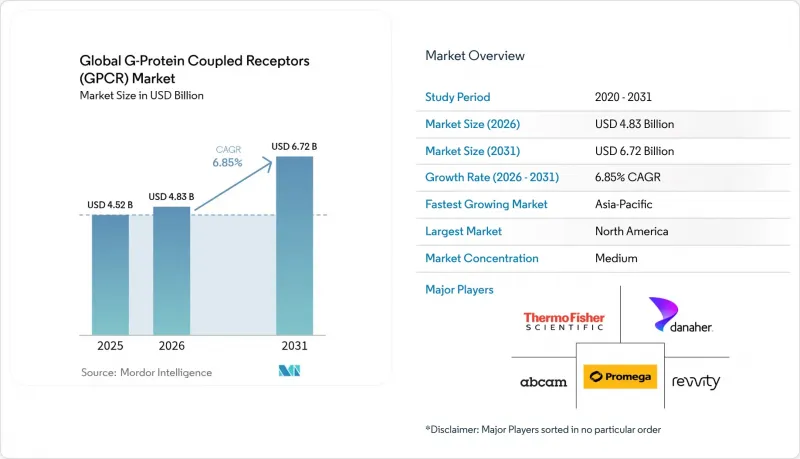
Mordor Intelligence에 의하면, 2026년 G 단백질 결합 수용체(GPCR) 시장 규모는 48억 3,000만 달러로 추정되고, 2025년 45억 2,000만 달러에서 확대해, 2031년에는 67억 2,000만 달러에 이를 것으로 예측됩니다.
2026-2031년 연평균 성장률(CAGR)은 6.85%가 될 것으로 전망됩니다.
본 보고서는 구성 요소별(시약 및 키트 등), 분석법 유형별(칼슘 농도 검출 분석법 등), 치료 분야별(심혈관계 등), 최종 사용자별(제약·바이오기술 기업 등), 지역별(북미, 유럽, 아시아태평양 등)로 분류되어 있습니다. 시장 전망은 금액(달러) 기준으로 제시되어 있습니다.
세계의 G 단백질 결합 수용체(GPCR) 시장 동향 및 인사이트
GPCR 분석에서 HTS 플랫폼 채택이 급증
스폰서 기업들이 동위원소 취급을 배제하고 더 신속하며 라벨이 필요 없는 측정 결과를 요구하는 가운데, 하이 스루풋 스크리닝(HTS) 장비가 수동 방식의 방사성 리간드법을 대체하고 있습니다. 생물발광 공명 에너지 전달(BRET) 센서는 구조적 변화를 실시간으로 포착함으로써 감도를 더욱 향상시키고 있으며, 임피던스 기반 마이크로 전극 어레이는 패치 클램프 데이터와 0.85의 상관 계수를 보이는 전기생리학적 반응에 대한 비침습적 대안을 제공합니다. 벤더의 로드맵에는 미세 분주를 위한 로봇 기술과 리간드 히트를 자동으로 순위 매기는 클라우드 분석이 통합되어 있습니다. 이러한 발전이 결합되면서, G 단백질 결합 수용체(GPCR) 시장은 정밀 약리학 프로젝트를 위한 유망한 분야로서 확고한 입지를 다지고 있습니다.
GPCR을 표적으로 한 신약 개발 투자 확대
G 단백질 결합 수용체(GPCR)는 승인된 의약품의 36%를 차지하지만, 수용체 아형의 4분의 3에는 여전히 시판 의약품이 없어 지속적인 연구 개발 투자를 촉진하고 있습니다. 당뇨병 및 비만 치료제만으로도 2024년 매출이 300억 달러에 육박할 것으로 예상되며, 상업적 성장 가능성이 입증됨에 따라 경구용 저분자 GLP-1, 아밀린 및 이중 작용제 후보 화합물에 대한 예산 배분이 진행되고 있습니다. Structure Therapeutics는 그 규모를 여실히 보여주고 있으며, 2b상 GLP-1 및 GIPR 프로그램을 위해 8억 8,350만 달러의 현금을 확보하고 있습니다. 라이선스 계약 역시 투자자들의 신뢰를 반영하고 있으며, 노보노르디스크(Novo Nordisk) 및 세프텔나(Septerna)와의 제휴를 통한 경구용 비만 치료제 계약 규모는 최대 22억 달러로 평가됩니다. 이러한 자금 흐름은 단기적인 파이프라인을 뒷받침할 뿐만 아니라, G 단백질 결합 수용체(GPCR) 시장을 대형 제약사들의 전략적 우선순위로 확고히 자리매김하고 있습니다.
GPCR의 정제 및 안정성과 관련된 과제
막 단백질은 지질 이중층에서 추출되면 천연의 입체 구조를 잃게 되므로, 결정 구조 분석 및 생물물리학적 분석이 복잡해집니다. 계면활성제를 이용한 가용화 처리에서는 안정화에 도움이 되는 지질이 제거되는 경우가 많기 때문에 천연 나노디스크 구조를 유지하는 스티렌-말레산 공중합체의 채택이 증가하고 있습니다. 최근의 기술 혁신으로 Ga 모방 펩타이드가 크로마토그래피 수지에 결합되게 되어, 분취 규모에서 활성 수용체의 태그 프리 분리가 가능해졌습니다. 그러나 GPCR의 각 아형에는 개별적인 열 안정화 사이클이 필요하며, 이로 인해 플랫폼의 표준화가 지연되고 G 단백질 결합 수용체 시장에서 단기적인 효율 향상이 저해되고 있습니다.
부문 분석
시약 및 키트는 GPCR 신약 개발 워크플로우의 핵심을 이루며, 2025년에는 G 단백질 결합 수용체 시장의 35.86%를 차지했습니다. 이는 완충액, 리간드 및 검출용 시약에 대한 보편적인 수요를 반영합니다. 자동 액체 핸들러, 포토닉 리더, 임피던스 모듈은 플랫폼 카테고리를 구성하며, 소형화와 클라우드 연동형 분석 기술 덕분에 연평균 성장률(CAGR) 8.58%로 성장하고 있습니다. AI 알고리즘과 광학 센서의 융합을 통해 단일 워크스테이션 내에서 종단 간 히트 선별이 가능해졌으며, 리드 선정까지의 시간을 단축함과 동시에 중견 기업으로의 접근성도 확대되고 있습니다.
제약 개발 기업이 독자적인 세포 은행 및 어세이 라이브러리를 보유한 CRO에 하이컨텐츠 스크리닝을 위탁하는 움직임이 확산되면서, 서비스 계약도 확대되고 있습니다. 예를 들어, Eurofins CEREP사는 20년에 걸친 수용체 약리학 노하우와 고밀도 스크리닝 라인을 결합하여 고객의 프로그램 일정을 단축하고 있습니다. 하이브리드형 서비스에서는 시약, 플레이트, 분석 라이선스를 구독 모델로 묶어 제공하므로, 연구소는 프로젝트의 마일스톤에 맞추어 자본 지출을 조정할 수 있습니다. 그 결과, 플랫폼과 서비스 생태계가 G 단백질 공액 수용체 시장에서 가치의 이동을 뒷받침하고 있습니다.
2025년에는 세포 내 칼슘 동원 키트가 매출의 28.45%를 차지했으며, A급 수용체 프로그램에서 지금까지의 역할을 반영했습니다. 그러나 cAMP 검출 형식은 생세포 내의 사이클릭 AMP를 서브나노몰 수준의 감도로 정량화하는 NanoLuc 바이너리 기술에 힘입어 연평균 성장률(CAGR) 8.85%를 나타낼 것으로 예측됩니다. 방사성 리간드법 및 GTPYS법은 여전히 직교적인 확인 기법으로 자리 잡고 있지만, 방사성 동위원소 폐기물에 대한 규제 압력으로 인해 그 보급은 억제되고 있습니다.
B-알레스타인 바이오센서는 심장 대사 안전성 프로파일링과 관련된 경로에서 계속해서 보급이 확대되고 있으며, 라벨이 없는 임피던스 분석 플레이트는 형광 태그를 사용하지 않고도 형태학적 변화를 기록할 수 있게 되었습니다. ThermoBRET 프로토콜은 표지된 리간드를 배제함으로써 열 안정성 평가를 더욱 효율화하고, 선도 화합물 최적화에 드는 소모품 비용을 절감합니다. 전반적으로, 이러한 기술들은 G 단백질 결합 수용체(GPCR) 시장에서 이용 가능한 기능적 레퍼토리를 확대되고 있습니다.
지역별 분석
북미는 2025년 매출의 37.10%를 차지했습니다. 이는 보스턴, 샌프란시스코, 샌디에이고의 각 클러스터가 벤처 캐피털, AI 인재, 그리고 머신러닝에 대한 증거 패키지를 명확히 하는 FDA 지침을 결합한 결과입니다. 국내 기존 기업들은 매년 장비를 단계적으로 업그레이드하여 출시하고 있으며, 사용자는 자본 주기의 혼란을 초래하지 않고도 기존 실험실을 개조할 수 있게 되었습니다. 구조 생물학에 대한 NIH의 오랜 기간에 걸친 자금 지원은 G 단백질 결합 수용체 시장에서 이 지역의 우위를 더욱 공고히 하고 있습니다.
유럽은 학문적 탁월성과 규제 측면의 실용주의가 균형 있게 조화를 이루고 있습니다. 2024년, 유럽의약품청(EMA)이 폐동맥 고혈압 치료제 ‘Winrevair’ 및 과활동성 방광 치료제 ‘Obgemsa’를 승인함으로써, 새로운 GPCR 치료법의 승인 절차가 확립되었습니다. 바젤 대학교 등 유럽 대륙의 연구 기관들은 GPS-NMR과 같은 최첨단 기술을 활용하여 수용체의 움직임을 원자 수준에서 추적하고 있으며, 그 연구 결과는 리간드 설계 주기에 직접 활용되고 있습니다. 이러한 요인들이 맞물려, G 단백질 결합 수용체(GPCR) 시장의 유럽에서 견고하고 꾸준한 성장 추세가 형성되고 있습니다.
2031년까지 연평균 성장률(CAGR) 8.69%가 예상되는 아시아태평양은 생명공학 분야의 자립성을 강화하고 승인 일정을 통일하기 위한 정부의 협력적인 노력의 혜택을 받고 있습니다. 일본이 PCO371과 같은 세포 내 활성화제를 발견한 것은 이 지역의 독창성을 보여주는 좋은 예이며, 전신성 부작용을 줄인 경구 투여 가능한 약물의 실현을 약속하고 있습니다. 중국과 한국에서는 펩타이드 치료제의 제조 능력을 확대하는 한편, 벤처 펀드가 다국적 기업과 공동 출자하여 지역 내 임상시험 거점 확충을 가속화하고 있습니다. 라틴아메리카, 중동 및 아프리카의 신흥 경제국들은 여전히 시장 규모는 작지만, 기술 이전 협정을 통해 임상 인프라를 확충하고 있으며, G 단백질 결합 수용체 시장의 향후 성장을 견인하는 주역으로서의 입지를 확립해 가고 있습니다.
기타 장점 :
- Excel 형식 시장 예측(ME) 시트
- 3개월간의 애널리스트 지원
자주 묻는 질문
목차
제1장 서론
제2장 조사 방법
제3장 주요 요약
제4장 시장 구도
제5장 시장 규모 및 성장 예측
제6장 경쟁 구도
제7장 시장 기회 및 향후 전망
AJY 26.09.09According to Mordor Intelligence, g-protein coupled receptors market size in 2026 is estimated at USD 4.83 billion, growing from 2025 value of USD 4.52 billion with 2031 projections showing USD 6.72 billion, growing at 6.85% CAGR over 2026-2031.
This report is Segmented by Component(Reagents & Kits and More), Assay Type (Calcium Level Detection Assays and More), Therapeutic Area (Cardiovascular System and More), End-User (Pharmaceutical & Biotech Companies and More), and Geography (North America, Europe, Asia-Pacific, and More). The Market Forecasts are Provided in Terms of Value (USD).
Global G-Protein Coupled Receptors (GPCR) Market Trends and Insights
Surging Adoption of HTS Platforms for GPCR Assays
High-throughput screening instruments are replacing manual radioligand methods as sponsors demand faster, label-free read-outs that eliminate isotope handling. Bioluminescence resonance energy transfer sensors further improve sensitivity by capturing conformational shifts in real time, and impedance-based microelectrode arrays provide a non-invasive proxy for electrophysiological responses with 0.85 correlation to patch-clamp data. Vendor roadmaps integrate robotics for micro-volume dispensing and cloud analytics that rank ligand hits automatically. Together, these advances reinforce the G-protein coupled receptors market as a fertile ground for precision pharmacology projects.
Growing Drug-Discovery Spend Targeting GPCRs
G protein-coupled receptors (GPCRs) underpin 36% of approved medicines, yet three-quarters of receptor subtypes still lack marketed drugs, prompting sustained R&D allocations. Diabetes and obesity agents alone delivered nearly USD 30 billion in 2024 sales, validating the commercial upside and steering budgets toward oral small-molecule GLP-1, amylin and dual-agonist candidates. Structure Therapeutics illustrates the scale, carrying USD 883.5 million in cash earmarked for Phase 2b GLP-1 and GIPR programs. Licensing deals echo investor confidence, with Novo Nordisk's collaboration with Septerna valued at up to USD 2.2 billion for oral obesity pills. Such capital flows underpin the near-term pipeline and solidify the G-protein coupled receptors market as a strategic priority for big pharma.
Purification & Stability Challenges of GPCRs
Membrane proteins lose native conformation once removed from lipid bilayers, complicating crystallography and biophysical assays. Detergent solubilization often strips stabilizing lipids, prompting adoption of styrene-maleic-acid copolymers that preserve native nanodiscs. Recent innovations attach Ga-mimetic peptides to chromatography resin, enabling tag-free isolation of active receptors at preparative scale. Nevertheless, each GPCR subtype demands bespoke thermostabilization cycles, delaying platform standardization and tempering near-term efficiency gains in the G-protein coupled receptors market.
Other drivers and restraints analyzed in the detailed report include:
- Rising Burden of Chronic & Metabolic Diseases
- Expansion of Biologics & Allosteric Modulators
- Signal-Bias Complexity Hampers Assay Design
For complete list of drivers and restraints, kindly check the Table Of Contents.
Segment Analysis
Reagents and kits provided the backbone of GPCR discovery workflows and represented 35.86% of G-protein coupled receptors market share in 2025, reflecting universal demand for buffers, ligands and detection chemistries. Automated liquid handlers, photonic readers and impedance modules constitute the platform category, which is climbing at an 8.58% CAGR thanks to miniaturization and cloud-linked analytics. The convergence of AI algorithms with optical sensors now supports end-to-end hit triaging inside a single workstation, accelerating time-to-lead and widening access for mid-tier firms.
Service contracts are expanding as drug sponsors outsource high-content screens to CROs that maintain proprietary cell banks and assay libraries. Eurofins CEREP, for example, couples 20 years of receptor pharmacology know-how with high-density screening lines to shorten client program timelines. Hybrid offerings bundle reagents, plates and analytics licences under subscription models, allowing labs to align capital outlay with project milestones. Consequently, platforms and service ecosystems anchor the value shift within the G-protein coupled receptors market.
Intracellular calcium mobilization kits led revenues at 28.45% in 2025, mirroring their historic role in class-A receptor programs. Yet cAMP detection formats are projected to register a 8.85% CAGR, underpinned by NanoLuc binary technologies that quantify cyclic-AMP in live cells with sub-nanomolar sensitivity. Radioligand and GTPYS methods endure for orthogonal confirmation, although regulatory pressure on radioisotope waste curbs broader uptake.
B-arrestin biosensors continue to gain currency for pathways implicated in cardiometabolic safety profiling, and label-free impedance plates now record morphological changes without fluorescent tags. ThermoBRET protocols further streamline thermostability assessments by eliminating labelled ligands, trimming consumable costs during lead optimization. Collectively, these technologies extend the functional repertoire available to the G-protein coupled receptors market.
Complete Report Scope:
- By Component
- Reagents & Kits
- Cell Lines
- Assay Platforms
- Detection Instruments
- Services
- By Assay Type
- Calcium Level Detection Assays
- Radioligand Binding & GTPyS Assays
- cAMP & cGMP Assays
- B-Arrestin Functional Assays
- Reporter Gene Assays
- Label-free Impedance Assays
- Other Assay Types
- By Therapeutic Area
- Cardiovascular System
- Central Nervous System
- Oncology
- Metabolic Disorders
- Respiratory Diseases
- Other Therapeutic Areas
- By End-User
- Pharmaceutical & Biotech Companies
- Contract Research Organizations (CROs)
- Academic & Research Institutes
- Diagnostic Laboratories
- By Geography
- North America
- United States
- Canada
- Mexico
- Europe
- Germany
- United Kingdom
- France
- Italy
- Spain
- Rest of Europe
- Asia-Pacific
- China
- India
- Japan
- Australia
- South Korea
- Rest of Asia-Pacific
- Middle East and Africa
- GCC
- South Africa
- Rest of Middle East and Africa
- South America
- Brazil
- Argentina
- Rest of South America
- North America
Geography Analysis
North America commanded 37.10% of 2025 sales as Boston, San Francisco and San Diego clusters combined venture capital, AI talent and FDA guidance that clarifies machine-learning evidence packages. Domestic incumbents release iterative instrumentation upgrades annually, enabling users to retrofit established laboratories without disruptive capital cycles. Long-standing NIH funding streams for structural biology further solidify the region's dominance within the G-protein coupled receptors market.
Europe contributes a balanced mix of academic excellence and regulatory pragmatism. EMA endorsements of Winrevair for pulmonary arterial hypertension and Obgemsa for overactive bladder verified the approval pathway for novel GPCR therapies in 2024. Continental institutes such as the University of Basel are pushing envelope techniques like GPS-NMR to trace receptor motions at atomic resolution, insights that feed directly into ligand engineering cycles. Combined, these factors nurture a robust albeit steady growth profile across the European slice of the G-protein coupled receptors market.
Asia-Pacific, projected at an 8.69% CAGR through 2031, benefits from concerted governmental drives to bolster biotech self-reliance and harmonize approval timelines. Japan's discovery of intracellular-side activators such as PCO371 exemplifies the region's ingenuity, promising orally available agents with reduced systemic side-effects. China and South Korea are expanding manufacturing capacity for peptide therapeutics, while venture funds co-invest with multinationals to accelerate regional trial sites. Emerging economies in Latin America, the Middle East and Africa remain smaller but are ramping clinical infrastructure via technology-transfer agreements, positioning themselves as future contributors to the G-protein coupled receptors market.
- Abcam
- Addex Therapeutics
- Beckton Dickinson
- BioInvenu
- Bio-Rad Laboratories
- BMG Labtech GmbH
- Charles River
- Cisbio
- Corning
- Danaher
- Enzo Biochem
- Eurofins Scientific SE (DiscoverX)
- Evotec
- HD Biosciences
- ION Biosciences
- Luminex
- Merck
- Promega
- Reaction Biology Corp.
- Revvity Inc
- Structure Therapeutics Inc.
- Thermo Fisher Scientific
Additional Benefits:
- The market estimate (ME) sheet in Excel format
- 3 months of analyst support
TABLE OF CONTENTS
1 Introduction
- 1.1 Study Assumptions & Market Definition
- 1.2 Scope of the Study
2 Research Methodology
3 Executive Summary
4 Market Landscape
- 4.1 Market Overview
- 4.2 Market Drivers
- 4.2.1 Surging adoption of HTS platforms for GPCR assays
- 4.2.2 Growing drug-discovery spend targeting GPCRs
- 4.2.3 Rising burden of chronic & metabolic diseases
- 4.2.4 Expansion of biologics & allosteric modulators
- 4.2.5 AI-enabled structure-guided GPCR modeling
- 4.2.6 VC boom in oral small-molecule GLP-1 agonists
- 4.3 Market Restraints
- 4.3.1 Purification & stability challenges of GPCRs
- 4.3.2 Signal-bias complexity hampers assay design
- 4.3.3 High cost of advanced assay platforms
- 4.3.4 IP clustering limits freedom-to-operate
- 4.4 Value Chain Analysis
- 4.5 Regulatory Landscape
- 4.6 Technological Outlook
- 4.7 Porter's Five Forces Analysis
- 4.7.1 Threat of New Entrants
- 4.7.2 Bargaining Power of Buyers
- 4.7.3 Bargaining Power of Suppliers
- 4.7.4 Threat of Substitutes
- 4.7.5 Intensity of Rivalry
5 Market Size & Growth Forecasts (Value)
- 5.1 By Component
- 5.1.1 Reagents & Kits
- 5.1.2 Cell Lines
- 5.1.3 Assay Platforms
- 5.1.4 Detection Instruments
- 5.1.5 Services
- 5.2 By Assay Type
- 5.2.1 Calcium Level Detection Assays
- 5.2.2 Radioligand Binding & GTPyS Assays
- 5.2.3 cAMP & cGMP Assays
- 5.2.4 B-Arrestin Functional Assays
- 5.2.5 Reporter Gene Assays
- 5.2.6 Label-free Impedance Assays
- 5.2.7 Other Assay Types
- 5.3 By Therapeutic Area
- 5.3.1 Cardiovascular System
- 5.3.2 Central Nervous System
- 5.3.3 Oncology
- 5.3.4 Metabolic Disorders
- 5.3.5 Respiratory Diseases
- 5.3.6 Other Therapeutic Areas
- 5.4 By End-User
- 5.4.1 Pharmaceutical & Biotech Companies
- 5.4.2 Contract Research Organizations (CROs)
- 5.4.3 Academic & Research Institutes
- 5.4.4 Diagnostic Laboratories
- 5.5 By Geography
- 5.5.1 North America
- 5.5.1.1 United States
- 5.5.1.2 Canada
- 5.5.1.3 Mexico
- 5.5.2 Europe
- 5.5.2.1 Germany
- 5.5.2.2 United Kingdom
- 5.5.2.3 France
- 5.5.2.4 Italy
- 5.5.2.5 Spain
- 5.5.2.6 Rest of Europe
- 5.5.3 Asia-Pacific
- 5.5.3.1 China
- 5.5.3.2 India
- 5.5.3.3 Japan
- 5.5.3.4 Australia
- 5.5.3.5 South Korea
- 5.5.3.6 Rest of Asia-Pacific
- 5.5.4 Middle East and Africa
- 5.5.4.1 GCC
- 5.5.4.2 South Africa
- 5.5.4.3 Rest of Middle East and Africa
- 5.5.5 South America
- 5.5.5.1 Brazil
- 5.5.5.2 Argentina
- 5.5.5.3 Rest of South America
- 5.5.1 North America
6 Competitive Landscape
- 6.1 Market Concentration
- 6.2 Competitive Benchmarking
- 6.3 Market Share Analysis
- 6.4 Company Profiles (includes Global level Overview, Market level overview, Core Segments, Financials as available, Strategic Information, Market Rank/Share for key companies, Products & Services, and Recent Developments)
- 6.4.1 Abcam plc
- 6.4.2 Addex Therapeutics Ltd.
- 6.4.3 Becton, Dickinson and Company
- 6.4.4 BioInvenu Inc.
- 6.4.5 Bio-Rad Laboratories Inc.
- 6.4.6 BMG Labtech GmbH
- 6.4.7 Charles River Laboratories
- 6.4.8 Cisbio
- 6.4.9 Corning Incorporated
- 6.4.10 Danaher Corporation
- 6.4.11 Enzo Biochem Inc.
- 6.4.12 Eurofins Scientific SE (DiscoverX)
- 6.4.13 Evotec SE
- 6.4.14 HD Biosciences Co., Ltd.
- 6.4.15 ION Biosciences
- 6.4.16 Luminex Corporation
- 6.4.17 Merck KGaA
- 6.4.18 Promega Corporation
- 6.4.19 Reaction Biology Corp.
- 6.4.20 Revvity Inc
- 6.4.21 Structure Therapeutics Inc.
- 6.4.22 Thermo Fisher Scientific Inc.
7 Market Opportunities & Future Outlook
- 7.1 White-space & Unmet-need Assessment


