

|
시장보고서
상품코드
2122557
샌드위치 패널 : 시장 점유율 분석, 업계 동향 및 통계, 성장 예측(2026-2031년)Sandwich Panels - Market Share Analysis, Industry Trends & Statistics, Growth Forecasts (2026 - 2031) |
||||||
 Mordor Intelligence
Mordor Intelligence에 의하면, 샌드위치 패널 시장 규모는 2025년에 157억 2,000만 달러로 평가되었습니다. 2026년에 165억 2,000만 달러에 달하고, 2031년까지 212억 1,000만 달러에 이를 것으로 예측되며, 2026년부터 2031년에 걸쳐 CAGR 5.12%로 성장할 전망입니다.

본 보고서는 주요 소재(폴리우레탄 등), 표면 소재(CFRT, FRP, 알루미늄, 강철, 기타 표면재), 기술(연속식 및 불연속식), 용도(벽 패널, 지붕 패널,단열 패널, 기타 용도), 최종 용도 분야(주택, 상업시설 등), 지역(아시아태평양 등)별로 분류되어 있습니다. 시장 예측은 금액(달러) 기준으로 제시되어 있습니다.
세계의 샌드위치 패널 시장 동향 및 인사이트
PVDF 계열 알루미늄 복합 패널에 대한 수요 증가
설계자들은 PVDF 코팅의 이점을 누리고 있습니다. 이 코팅은 장기적인 색상 유지력을 보장하고, 외장재의 경량화를 가능하게 함으로써 고층 건축물의 지진 하중을 경감시킵니다. 자카르타와 마닐라에서는 개발업자들이 프리캐스트 콘크리트 대신 PVDF 코팅 샌드위치 패널을 채택함으로써, 내풍 하중 기준을 충족하면서도 구조용 강재 사용량을 줄이는 데 성공했습니다. 한편, 걸프 지역에서는 PVDF의 높은 일사 반사율 덕분에 폭염 시 냉방비 절감으로 이어지고 있습니다. 해안 지역에서는 이 수지의 내염수 분무성이 중시되어, 파사드의 수명을 연장하고 부동산 소유주에게 순현재가치를 높여주고 있습니다. 수지 공급 부족으로 인해 PVDF 가격이 급등함에 따라, 건축가들은 현재 햇빛이 잘 드는 파사드에만 PVDF를 사용하고, 그늘이 지는 측면에는 보다 저렴한 마감재를 선택하고 있습니다. 이는 초기 비용을 절감하면서도 단열상의 이점을 유지하기 위한 전략입니다.
조립식 및 모듈식 건축의 급속한 성장
공장에서 조립된 유닛은 기존의 현장 조립 공법에 비해 공사 기간을 단축하고 비용을 절감할 수 있습니다. 또한 모듈식 구성 요소를 사용함으로써 현장에서 발생하는 폐기물이 줄어들며, 이는 ESG 평가 기준에서도 긍정적으로 평가받고 있습니다. 조립식 건축은 주로 노동력 부족으로 인해 공장 작업의 가치가 높아지고 있는 것을 배경으로, 2026년까지 상당한 성장이 예상됩니다. 엄격한 공차를 실현하는 샌드위치 패널은 현장에서의 심(shim) 조정을 불필요하게 하며, 공기 누출을 패시브 하우스 기준치 이하로 억제할 수 있습니다. 인도의 인센티브 제도 덕분에 모듈식 공장에서는 클린룸 공간에 맞추어 조정된 R-30 코어를 채택하는 사례가 늘고 있습니다. 중국에서는 개발업자에게 조립식 건축 비율을 50% 이상으로 높일 경우 연면적 보너스라는 인센티브를 제공하고 있어, 특히 2급 도시에서 샌드위치 패널 수요가 급증하고 있습니다. 공사 기간이 단축됨에 따라 데이터센터나 냉장 시설 소유주는 샌드위치 패널이 기본 외장재보다 비싸더라도 일정 지연으로 인한 수익 손실을 피할 수 있습니다.
OSB의 VOC 배출량
2025년, 요소-포름알데히드계 접착제로 결합된 OSB는 CARB 2단계 포름알데히드 기준치에 근접했습니다. 이로 인해 페놀계 또는 VOC 제로 접착제로의 전환이 진행되면서 패널 비용이 상승했습니다. EU에서는 더 엄격한 실내 포름알데히드 상한치가 설정되어 있습니다. 이로 인해 제조업체가 최대 18개월이 소요되는 배합 변경 및 재인증 절차를 거치지 않는 한, EU 시장에서 기존의 OSB는 사실상 사용할 수 없게 됩니다. 북미에서는 각 제조업체들이 요소 수지를 MDI 바인더로 대체함으로써 배출량 문제를 해결했습니다. 그러나 이러한 전환으로 인해 원자재 비용이 상승하여 매출 총이익률에 압박이 가해지는 결과가 되었습니다. 한국에서는 실시간 VOC 모니터링을 실시하고 막대한 벌금을 부과함으로써 저배출 코어로의 전환이 가속화되고 있습니다. 한편, 주로 수출 지향적인 동남아시아의 가공업체들은 다국적 개발사들이 전 세계적으로 CARB 기준을 적용하게 됨에 따라 새로운 과제에 직면하고 있습니다.
부문별 분석
폴리우레탄(PUR)은 2025년 매출의 41.36%를 차지했으며, 5.38%의 성장률이 전망되고 있어, 샌드위치 패널 시장이 성능과 초기 비용의 균형을 얼마나 중시하고 있는지를 보여줍니다. PUR은 경량이기 때문에 기존 창고(브라운필드)에서 고가의 기초 개보수를 피할 수 있으며, 그 단열 성능 덕분에 따뜻한 기후에서는 패널 두께를 100mm 이하로 줄일 수 있어 내부 공간을 절약할 수 있습니다. 폴리이소시아누레이트(PIU)는 1인치당 R값이 높고 지붕 위의 고온에 내성이 있어, 지붕 표면 온도가 상승하기 쉬운 중동에서 인기를 끌고 있습니다. 화제가 되었던 파사드 화재 사고를 계기로 건축 기준이 개정됨에 따라, 예산이 제한적인 경우에도 학교나 병원에서는 미네랄 울의 채택이 확대되고 있습니다.
미네랄 울 코어는 A1 등급의 내화 등급과 방음 성능 덕분에 적용 범위가 확대되고 있습니다. 보험사들이 가연성 코어에 대한 규제를 강화하는 가운데, 데이터센터 및 생산 시설에서 미네랄 울 샌드위치 패널 시장 규모는 확대되고 있습니다. 농업 분야는 이익률이 낮아 PUR의 가격 프리미엄을 회수할 수 없기 때문에 EPS는 농장용 건물에서 여전히 필수적인 소재로 남아 있습니다. 페놀 폼이나 진공 단열 패널과 같은 틈새 소재는 극히 낮은 발연량이나 탁월한 R값이 의무화되어 있는 분야에서 완만하지만 꾸준히 침투하고 있습니다.
2025년에는 알루미늄이 시장 점유율의 45.31%를 차지하며, 그 내식성, 가공성, 경량성이 높이 평가되었습니다. 또한, 오두막이나 헛간 등 비용을 중시하는 용도에서 선호되는 강재도 뚜렷한 점유율을 유지했습니다. CFRT는 2025년 매출에서 차지하는 비중은 미미했으나, 연평균 성장률(CAGR)은 5.27%로 시장에서 가장 높은 성장률을 기록했습니다. 이러한 급성장은 생명주기 평가(LCA)를 통해 CFRT가 알루미늄에 비해 내재 탄소량이 적다는 사실이 밝혀진 데 기인합니다. 도장 강판보다 가격이 비싸지만, 넷제로 인증을 목표로 하는 고객들 사이에서 CFRT를 선택하는 경향이 강해지고 있습니다.
유리섬유 외장재는 식품 및 제약 분야에서 중요한 역할을 하고 있으며, 비다공성 표면 덕분에 위생 관리가 용이합니다. 한편, 구리나 아연과 같은 특수 금속은 뛰어난 내식성 덕분에 고급 파사드나 가혹한 화학 물질에 노출되는 환경에 적합합니다. 2025년부터 스코프 3 공시를 의무화하는 개정된 EU CSRD의 시행에 따라, 개발사들은 보고 대상 배출량을 대폭 감축할 수 있을 것이라는 기대를 품고 CFRT에 주목하고 있습니다. 이러한 전략적 움직임으로 인해 향후 몇 년간 알루미늄 시장 점유율이 하락할 것으로 예측됩니다.
지역별 분석
아시아태평양은 2025년에 전 세계 매출의 49.90%를 차지했으며, 연평균 성장률(CAGR) 5.81%로 성장할 전망입니다. 이러한 성장은 2030년까지 신축 건축물의 일부를 조립식으로 건설하겠다는 중국의 목표와 인도의 전자기기 공장 확충 추진에 크게 힘입은 것입니다. 2025년, 중국 각 성의 신규 산업용 바닥 면적 중 상당 비율이 샌드위치 패널로 채택되어, 정책이 신속하게 도입되고 있음을 보여줍니다. 인도에서는 2025년에 다수의 A급 창고가 건설되었으며, 그 상당수가 세계 콜드체인 얼라이언스(GCCA) 기준을 준수하는 단열 박스를 채택했습니다. 일본과 한국은 해당 지역의 매출에서 상당한 점유율을 차지하고 있었으나, 양국의 노동력 고령화로 인해 노동력 절감 솔루션에 대한 수요가 증가하고 있습니다. 동남아시아에서는 제조업체들이 중국에서 생산 거점을 이전함에 따라 성장이 나타났으나, 아세안(ASEAN)의 철강 및 알루미늄 수입 관세로 인해 리드타임이 길어지고 있습니다.
북미는 2025년에 전 세계 매출에서 상당한 점유율을 차지하며 꾸준한 성장을 이루었습니다. 미국의 전자상거래 물류창고는 대폭 확대되었으며, 일정 규모 이상의 하이베이 시설 중 상당 비율이 건설에 패널을 채택했습니다. 캐나다에서는 2025년에 시행된 더욱 엄격한 건축 기준에 따라 프레리 지역의 냉장실에서의 이러한 패널 채택이 가속화되었습니다. 멕시코의 성장은 니어쇼어링을 촉진하는 USMCA(미국·멕시코·캐나다 협정)의 규제에 기인하며, 신설 자동차 공장에서는 LEED 인증 취득이 가능한 설계가 채택되고 있습니다.
세계 매출의 상당 부분을 차지하는 유럽에서는 꾸준한 성장세를 보이고 있습니다. 천연가스 가격 변동에 따라 공장에서는 더 두꺼운 패널로 개조하는 작업이 진행되어 난방 부하를 현저히 줄이고 있습니다. 독일과 폴란드는 현재 건설 중인 배터리 셀 공장의 지원에 힘입어 유럽 수요의 상당 부분을 담당하고 있습니다. 성장을 거듭하고 있는 북유럽 국가들에서는 극한의 추위로 인해 기밀성이 요구되는 수소 관련 프로젝트가 급증하고 있습니다.
세계 매출의 상당 부분을 차지하는 남미에서는 꾸준한 성장이 관찰됩니다. 브라질에서는 단백질 수출용 냉장 시설이 다수 건설되고 있으며, 그 중 상당수가 180mm 두께의 PIR 코어를 채택하고 있습니다. 한편, 아르헨티나에서는 광업의 급속한 확장에 따라 신속한 시공이 가능한 외피를 우선시한 건설이 빠르게 진행되고 있습니다. 중동 및 아프리카도 상당한 시장 점유율을 차지하고 있으며, 사우디아라비아의 NEOM과 UAE의 산업 단지를 필두로, 건조한 환경에서 LEED 골드 기준 획득을 목표로 하는 프로젝트가 견인차 역할을 하여 눈부신 성장을 이루고 있습니다.
기타 혜택 :
- 엑셀 형식 시장 예측(ME) 시트
- 3개월간의 애널리스트 지원
자주 묻는 질문
목차
제1장 서론
제2장 조사 방법
제3장 주요 요약
제4장 시장 구도
제5장 시장 규모 및 성장 예측
제6장 경쟁 구도
제7장 시장 기회 및 향후 전망
KTH 26.09.08According to Mordor Intelligence, the sandwich panels market size is projected to be USD 15.72 billion in 2025, USD 16.52 billion in 2026, and reach USD 21.21 billion by 2031, growing at a CAGR of 5.12% from 2026 to 2031.
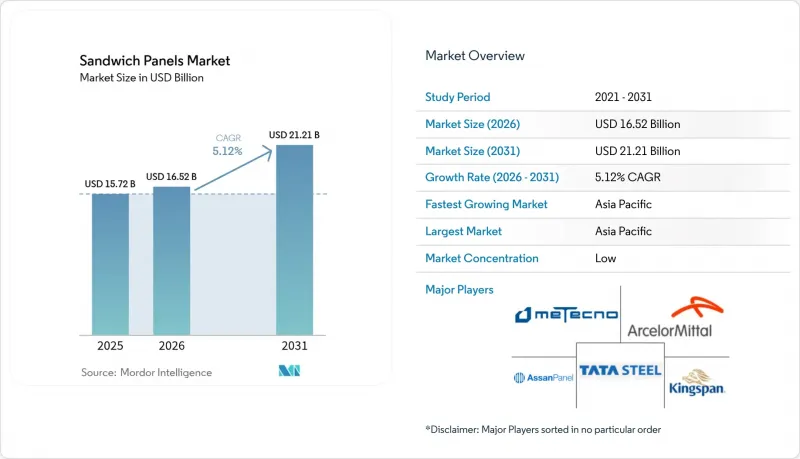
This report is Segmented by Core Material (Polyurethane, and More), Skin Material (CFRT, FRP, Aluminum, Steel, and Other Skin Materials), Technology (Continuous and Discontinuous), Application (Wall Panels, Roof Panels, Insulated Panels, and Other Applications), End-Use Sector (Residential, Commercial, and More), and Geography (Asia-Pacific, and More). The Market Forecasts are Provided in Terms of Value (USD).
Global Sandwich Panels Market Trends and Insights
Increasing Demand for PVDF-Based Aluminum Composite Panels
Designers benefit from PVDF coatings, which promise long-term color retention and enable a reduction in cladding weight, subsequently lessening seismic loads in towering structures. In Jakarta and Manila, developers achieved a reduction in structural steel by opting for PVDF-clad sandwich panels over precast concrete, all while meeting wind-load standards. Meanwhile, in the Gulf, a high solar-reflectance index for PVDF translates to cooling bill savings during peak heat. Marine locations value the resin's resistance to salt spray, boosting facade lifespans and enhancing net present value for property owners. Due to resin shortages causing a price surge for PVDF, architects now reserve its use for sunlit facades, opting for more affordable finishes on shaded sides, a strategy that maintains thermal advantages at a reduced initial expense.
Rapid Growth of Prefabricated and Modular Construction
Volumetric units, when factory-assembled, can reduce schedules and offer cost savings compared to traditional stick-built methods. Additionally, the use of modular components reduces site waste, a move that resonates well with ESG scorecards. Prefabrication is expected to grow significantly by 2026, driven primarily by labor shortages that have heightened the value of factory work. Sandwich panels, achieving tight tolerances, eliminate the need for on-site shimming and ensure air leakage remains below Passive House limits. Thanks to incentive schemes in India, modular factories are increasingly opting for R-30 cores tailored for cleanroom spaces. In China, developers are incentivized with floor-area bonuses to push beyond 50% prefabrication, leading to a surge in demand for sandwich panels, especially in tier-2 cities. With cycle times reduced, owners of data centers and cold storage facilities can sidestep revenue losses from scheduling delays, even when sandwich panels come at a premium over basic cladding.
Oriented-Strand-Board VOC Emissions
In 2025, OSB bonded with urea-formaldehyde neared CARB Phase 2's formaldehyde limit. This led to a shift towards phenolic or zero-VOC adhesives, increasing panel costs. The EU has set a stricter indoor formaldehyde cap. This effectively sidelines conventional OSB in the EU unless manufacturers undertake a reformulation and recertification process, which can extend up to 18 months. In North America, producers tackled the emissions challenge by substituting urea resins with MDI binders. However, this switch resulted in a hike in raw material costs, putting pressure on gross margins. South Korea, implementing real-time VOC monitoring and imposing hefty fines, has hastened the transition to low-emission cores. Meanwhile, Southeast Asian fabricators, primarily export-oriented, encounter fresh hurdles as multinational developers enforce CARB standards on a global scale.
Other drivers and restraints analyzed in the detailed report include:
- Energy-Efficiency Regulations for Building Envelopes
- Data-Center Boom Requiring High-Performance Envelopes
- Moisture Ingress and Long-Term Degradation in PUR/PIR Cores
For complete list of drivers and restraints, kindly check the Table Of Contents.
Segment Analysis
Polyurethane delivered 41.36% of 2025 revenue and is forecast to expand at 5.38%, illustrating how the sandwich panels market balances performance with first cost. PUR's lower mass helps brownfield warehouses avoid expensive foundation upgrades, and its thermal efficiency keeps panel thickness to 100 mm or less in moderate climates, saving interior space. Polyisocyanurate enjoys a better R-value per inch and resists rooftop temperatures, making it popular in the Middle-East, where roof surfaces reach high temperatures. Code changes after high-profile facade fires push schools and hospitals toward mineral wool even when budgets are tight.
Mineral-wool cores are expanding due to their A1 fire rating and acoustic attenuation. The sandwich panels market size for mineral wool in data centers and production halls is rising as insurers tighten rules around combustible cores. EPS remains critical for farm buildings because the price premium of PUR cannot be recovered in low-margin agriculture. Niche materials such as phenolic foam and vacuum-insulated panels suggest slow but steady penetration where extremely low smoke or extraordinary R-values are mandatory.
In 2025, aluminum commanded a 45.31% market share, lauded for its corrosion resistance, workability, and lightweight nature. Steel, favored for cost-sensitive applications like sheds and barns, also held a notable share. While CFRT accounted for a modest portion of the 2025 revenue, it boasted a 5.27% CAGR, the market's fastest growth rate. This surge is attributed to lifecycle assessments highlighting CFRT's lower embodied carbon compared to aluminum. Even with a higher price tag than coated steel, clients pursuing net-zero certifications are increasingly opting for CFRT.
Fiberglass skins play a crucial role in the food and pharmaceutical sectors, where their non-porous surface simplifies sanitation. Meanwhile, exotic metals like copper and zinc cater to luxury facades and environments with extreme chemical exposure due to their heightened corrosion resistance. With the updated EU CSRD mandating Scope 3 disclosures starting in 2025, developers are turning to CFRT to potentially slash reported emissions. This strategic move is anticipated to dent aluminum's market share in the coming years.
Complete Report Scope:
- By Core Material
- Polyurethane (PUR)
- Polyisocyanurate (PIR)
- Mineral Wool
- Expanded Polystyrene (EPS)
- Other Core Materials
- By Skin Material
- Continuous Fiber Reinforced Thermoplastics (CFRT)
- Fiberglass Reinforced Panel (FRP)
- Aluminum
- Steel
- Other Skin Materials
- By Technology
- Continuous
- Discontinuous
- By Application
- Wall Panels
- Roof Panels
- Insulated Panels
- Other Applications
- By End-use Sector
- Residential
- Commercial
- Industrial
- Institutional and Infrastructure
- By Geography
- Asia-Pacific
- China
- India
- Japan
- South Korea
- Rest of Asia-Pacific
- North America
- United States
- Canada
- Mexico
- Europe
- Germany
- United Kingdom
- Italy
- France
- Spain
- Poland
- NORDIC Countries
- Hungary
- Rest of Europe
- South America
- Brazil
- Argentina
- Rest of South America
- Middle-East and Africa
- Saudi Arabia
- South Africa
- Rest of Middle-East and Africa
- Asia-Pacific
Geography Analysis
Asia-Pacific delivered 49.90% of global revenue in 2025 and will climb at a 5.81% CAGR. This growth is largely driven by China's goal to prefabricate a portion of its new constructions by 2030 and India's push for electronics factories. In 2025, a notable percentage of the new industrial floor area in Chinese provinces utilized sandwich panels, indicating swift policy adoption. India constructed a substantial amount of Grade A warehouses in 2025, with a significant portion featuring insulated boxes that align with Global Cold Chain Alliance standards. Japan and South Korea made up a considerable share of the region's revenue, while aging workforces in these nations are pushing for more labor-saving solutions. Southeast Asia experienced growth as manufacturers shifted operations from China, though ASEAN's import tariffs on steel and aluminum have extended lead times.
North America accounted for a notable share of global sales in 2025, with steady growth. U.S. e-commerce warehouses expanded significantly, and a considerable percentage of high bay facilities over a certain size opted for panels in their construction. In Canada, a stricter code in 2025 has hastened the adoption of these panels in prairie cold rooms. Mexico's growth can be attributed to USMCA regulations promoting nearshoring, with new automotive plants opting for LEED-eligible designs.
Europe, contributing a significant share to global sales, is on a steady rise. Volatility in natural gas prices has led factories to retrofit with thicker panels, achieving a notable reduction in heating loads. Germany and Poland, bolstered by battery cell plants currently under construction, cater to a considerable portion of Europe's demand. The Nordic states, witnessing growth, are seeing a surge in hydrogen projects that necessitate airtightness due to extreme cold.
South America, with a notable share of global revenue, is growing steadily. Brazil established numerous cold storage facilities for protein exports, with a significant portion utilizing 180 mm PIR cores. Meanwhile, Argentina's mining surge is prompting rapid constructions that prioritize quick-install envelopes. The Middle-East and Africa, holding a notable share, are experiencing significant growth, spearheaded by Saudi NEOM and the UAE's industrial zones, both aiming for LEED Gold standards in arid conditions.
- Alubel
- ArcelorMittal
- Areco
- Assan Panel A.S.
- Building Component Solutions LLC
- Cornerstone Building Brands, Inc.
- DANA Group of Companies
- EPACK Prefab
- Isopan
- Jiangsu Jingxue Energy Saving Technology Co., Ltd.
- Kingspan Group
- Lattonedil
- Marcegaglia Steel S.p.A.
- Metecno Group
- NAV SYSTEM
- Rautaruukki Corporation
- Romakowski GmbH and Co. KG
- Sintex
- Structural Panels
- Tata Steel
- Teknopanel
- Tonmat Group
Additional Benefits:
- The market estimate (ME) sheet in Excel format
- 3 months of analyst support
TABLE OF CONTENTS
1 Introduction
- 1.1 Study Assumptions and Market Definition
- 1.2 Scope of the Study
2 Research Methodology
3 Executive Summary
4 Market Landscape
- 4.1 Market Overview
- 4.2 Market Drivers
- 4.2.1 Increasing demand for PVDF-based aluminium composite panels
- 4.2.2 Rapid growth of prefabricated and modular construction
- 4.2.3 Energy-efficiency regulations for building envelopes
- 4.2.4 Data-centre boom requiring high-performance envelopes
- 4.2.5 Green-hydrogen gigafactories driving demand for climate-controlled production halls
- 4.3 Market Restraints
- 4.3.1 Oriented-strand-board VOC emissions
- 4.3.2 Moisture ingress and long-term degradation in PUR/PIR cores
- 4.3.3 Volatility in MDI, steel and aluminium prices squeezing panel margins
- 4.4 Value Chain Analysis
- 4.5 Porter's Five Forces
- 4.5.1 Bargaining Power of Suppliers
- 4.5.2 Bargaining Power of Buyers
- 4.5.3 Threat of New Entrants
- 4.5.4 Threat of Substitute Products and Services
- 4.5.5 Degree of Competition
5 Market Size and Growth Forecasts (Value)
- 5.1 By Core Material
- 5.1.1 Polyurethane (PUR)
- 5.1.2 Polyisocyanurate (PIR)
- 5.1.3 Mineral Wool
- 5.1.4 Expanded Polystyrene (EPS)
- 5.1.5 Other Core Materials
- 5.2 By Skin Material
- 5.2.1 Continuous Fiber Reinforced Thermoplastics (CFRT)
- 5.2.2 Fiberglass Reinforced Panel (FRP)
- 5.2.3 Aluminum
- 5.2.4 Steel
- 5.2.5 Other Skin Materials
- 5.3 By Technology
- 5.3.1 Continuous
- 5.3.2 Discontinuous
- 5.4 By Application
- 5.4.1 Wall Panels
- 5.4.2 Roof Panels
- 5.4.3 Insulated Panels
- 5.4.4 Other Applications
- 5.5 By End-use Sector
- 5.5.1 Residential
- 5.5.2 Commercial
- 5.5.3 Industrial
- 5.5.4 Institutional and Infrastructure
- 5.6 By Geography
- 5.6.1 Asia-Pacific
- 5.6.1.1 China
- 5.6.1.2 India
- 5.6.1.3 Japan
- 5.6.1.4 South Korea
- 5.6.1.5 Rest of Asia-Pacific
- 5.6.2 North America
- 5.6.2.1 United States
- 5.6.2.2 Canada
- 5.6.2.3 Mexico
- 5.6.3 Europe
- 5.6.3.1 Germany
- 5.6.3.2 United Kingdom
- 5.6.3.3 Italy
- 5.6.3.4 France
- 5.6.3.5 Spain
- 5.6.3.6 Poland
- 5.6.3.7 NORDIC Countries
- 5.6.3.8 Hungary
- 5.6.3.9 Rest of Europe
- 5.6.4 South America
- 5.6.4.1 Brazil
- 5.6.4.2 Argentina
- 5.6.4.3 Rest of South America
- 5.6.5 Middle-East and Africa
- 5.6.5.1 Saudi Arabia
- 5.6.5.2 South Africa
- 5.6.5.3 Rest of Middle-East and Africa
- 5.6.1 Asia-Pacific
6 Competitive Landscape
- 6.1 Market Concentration
- 6.2 Strategic Moves
- 6.3 Market Share(%)/Ranking Analysis
- 6.4 Company Profiles (includes Global Overview, Market Overview, Core Segments, Financials, Strategic Information, Products and Services, Recent Developments)
- 6.4.1 Alubel
- 6.4.2 ArcelorMittal
- 6.4.3 Areco
- 6.4.4 Assan Panel A.S.
- 6.4.5 Building Component Solutions LLC
- 6.4.6 Cornerstone Building Brands, Inc.
- 6.4.7 DANA Group of Companies
- 6.4.8 EPACK Prefab
- 6.4.9 Isopan
- 6.4.10 Jiangsu Jingxue Energy Saving Technology Co., Ltd.
- 6.4.11 Kingspan Group
- 6.4.12 Lattonedil
- 6.4.13 Marcegaglia Steel S.p.A.
- 6.4.14 Metecno Group
- 6.4.15 NAV SYSTEM
- 6.4.16 Rautaruukki Corporation
- 6.4.17 Romakowski GmbH and Co. KG
- 6.4.18 Sintex
- 6.4.19 Structural Panels
- 6.4.20 Tata Steel
- 6.4.21 Teknopanel
- 6.4.22 Tonmat Group
7 Market Opportunities and Future Outlook
- 7.1 White-space and Unmet-Need Assessment


