

|
시장보고서
상품코드
2122560
스프레이 접착제 : 시장 점유율 분석, 업계 동향과 통계, 성장 예측(2026-2031년)Spray Adhesive - Market Share Analysis, Industry Trends & Statistics, Growth Forecasts (2026 - 2031) |
||||||
 Mordor Intelligence
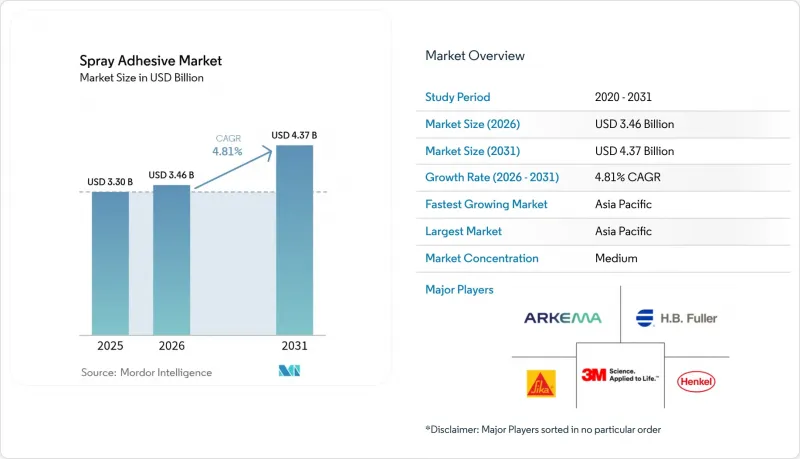
에 의하면, 스프레이 접착제 시장 규모는 2025년에 33억 달러로 평가되었고, 2026년 34억 6,000만 달러에서 2031년까지 43억 7,000만 달러에 이를 것으로 예측되며, 예측 기간(2026년-2031년) CAGR은 4.81%를 기록할 전망입니다.
본 보고서에서는 시장을 유형별(용제형, 수성, 핫멜트), 수지 유형별(에폭시, 폴리우레탄, 합성고무 등), 용도별(건축 및 건설, 포장, 가구, 운송 등), 지역별(아시아태평양, 북미, 유럽, 남미, 중동 및 아프리카)로 분류하고 있습니다. 시장 예측은 금액(백만 달러) 기준으로 제시되어 있습니다.
세계 스프레이 접착제 시장 동향 및 인사이트
신흥 경제국 건설 업계의 급속한 성장
중국, 인도, 인도네시아 및 걸프 국가들의 공공·민간 인프라 투자가 급증하면서, 스프레이 접착제를 포함한 건설용 화학제품의 판매량이 지속적으로 증가하고 있습니다. 조립식 벽 패널, 흡음판, 단열 피복재는 모두 온도 변화와 지진 하중을 견디기 위해 고성능 접착 성능이 필요합니다. 일부 지방 자치 단체의 주택 프로그램에서는 친환경 건축 기준을 충족하기 위해 저VOC 접착제 사용을 지정하고 있어, 이에 따라 건설업체들은 수성 스프레이 시스템으로의 전환을 강요받고 있습니다. 모듈식 건축 업체들은 오버스프레이와 작업 시간을 줄이고 대규모 프로젝트에서 처리 능력을 높이는 휴대용 캐니스터식 장비를 선호하고 있습니다. 도시화가 가속화되는 가운데, 현지 기업들은 순식간에 경화되는 핫멜트 스프레이 라인을 도입하여 고층 개발 프로젝트 내에서 주방 캐비닛 및 내부 설비의 신속한 조립을 가능하게 하고 있습니다. 이러한 요인들이 결합되어 스프레이 접착제 시장은 특히 아시아태평양의 급성장하는 메가시티에서 건축 활동과 깊이 연계된 상태를 유지하고 있습니다.
수성·저VOC 배합 접착제로의 전환
3개 대륙의 규제 당국이 배출 상한선 인하를 시행함에 따라, 접착제 제조업체들은 용제형 제품과 동등한 접착력과 내열성을 갖춘 수성 시스템을 시장에 출시하고 있습니다. 텍사스주 환경품질위원회는 휴스턴 주변의 VOC 배출량을 하루 3.12톤 감축하는 규정 개정을 단행했습니다. 한편, 캘리포니아주 유해물질관리국은 스프레이 접착제를 2024년부터 2026년까지의 우선 제품 작업 계획에 포함시켰습니다. 다우(Dow)사의 ‘PRIMAL CA 750’과 3M사의 ‘Fastbond 1049’는 고가의 환기 설비를 업그레이드하지 않고도 수성 폴리머가 산업용 처리 능력 목표를 달성할 수 있음을 입증하고 있습니다. 주요 구매업체, 특히 EU로 수출하는 가구 제조업체들은 현재 구매 계약에 저VOC 요건을 포함하고 있으며, 이로 인해 수성 화학제품의 보급이 가속화되고 있습니다. 이러한 배합을 사용하면 경화 오븐의 에너지 소비량이 감소하므로, 사용자는 에너지 비용과 Scope 2 배출량 감축이라는 직접적인 이점을 얻을 수 있습니다.
VOC 배출에 따른 우려
대기질 규제 당국은 제품 카테고리별 상한치를 더욱 엄격하게 적용하여, 여전히 강력한 용제 기반 캐리어에 의존하고 있는 브랜드에 즉각적인 규정 준수 부담을 부과하고 있습니다. 캘리포니아주 대기 자원국(CARB)은 웹 스프레이용 및 특수 용도 배합물에 대한 제한치를 하향 조정했습니다. 뉴저지주의 규정안은 건설용 접착제에 포함된 VOC 허용치를 절반 이상 줄이는 것을 목표로 하고 있습니다. 새로운 제한이 설정될 때마다 라벨 교체 및 재인증이 필요하며, 경우에 따라서는 폭발성 대기 구역 내 지게차의 업그레이드도 요구됩니다. 전 세계 제조업체들은 여러 관할 구역의 기준치를 모두 충족해야 하므로 생산 로트가 세분화되어 규모의 경제가 훼손되고 있습니다. 신속한 배합 변경에 필요한 자금을 조달하지 못하는 기업은 매장 진열 공간을 잃을 위험이 있으며, 이로 인해 스프레이 접착제 시장의 성장이 일시적으로 억제될 가능성이 있습니다.
부문 분석
2025년 매출에서 수성 등급이 42.38%라는 최대 점유율을 차지하여, 저배출 화학 기술에 대한 업계의 노력이 입증되었습니다. 이 부문은 규제 측면의 지원에 더해, 폴리머 설계 개선을 통해 수성 분산액의 내열성이 120°C 이상으로 향상되어 적용 범위가 확대된 혜택을 누리고 있습니다. 아시아태평양의 가공 업체들은 세척으로 인한 가동 중단 시간을 최소화하는 캐니스터식 스프레이 시스템을 채택하여 합판 라미네이팅 라인 전반에 걸쳐 보급을 촉진하고 있습니다. 이와 동시에, 핫멜트 부문은 즉각적인 접착 강도와 건조로 불필요성을 중시하는 자동화 가구 생산 라인의 견인 덕분에 4.95%라는 가장 높은 연평균 성장률(CAGR)을 기록하고 있습니다. 용제형 제품은 여전히 항공우주용 복합재 보수와 같은 틈새 시장을 차지하고 있지만, 환경세 인상에 따라 스프레이 접착제 시장에서의 규모는 축소될 전망입니다.
수성 제품의 채택을 뒷받침하는 두 번째 요인은 포틀라이프를 연장하고 오버스프레이를 줄여주는 휴대용 장비의 개발입니다. 워싱턴 엔터프라이즈는 3M과 제휴하여, 전체 충전량에 걸쳐 균일한 스프레이 패턴을 유지하는 경량 가압 캐니스터를 제공함으로써 공장 내 이송 효율을 80%까지 향상시켰습니다. 이러한 개선을 통해 이 부문은 오랫동안 자리 잡은 용제형 제품 사용자에 대해 스프레이 접착제 시장에서의 점유율을 지킬 수 있게 되었으며, 2030년까지 수성 제품 라인이 지속적인 리더십을 유지할 수 있는 기반이 마련되었습니다.
지역별 분석
아시아태평양은 2025년에 매출의 46.30%를 차지하며 시장을 선도하고 있으며, 5.64%라는 가장 높은 연평균 성장률(CAGR)을 보일 것으로 예측됩니다. 중국의 저렴한 주택 건설 지원 정책과 인도의 고속도로 회랑 프로젝트 덕분에 패널 라미네이션용 스프레이 및 타일용 접착제에 대한 안정적인 수요가 확보되고 있습니다. 현지 가공업체들은 미국 및 유럽연합(EU)으로의 가구 수출 주문에 대응하기 위해 생산 능력을 확대하고 있으며, 수출 대상국의 규정을 준수하는 저VOC 기준을 제품에 반영하고 있습니다. 일본의 전자기기 조립 제조업체들은 인쇄 회로 기판상의 결로 위험을 줄여주는 고고형분 수성 스프레이를 적극적으로 채택하고 있으며, 이에 따라 현지 컴파운더들은 하청 파트너를 대상으로 배합을 확대되고 있습니다. 한국의 배터리 제조업체는 고밀도 전기차(EV) 팩의 진동 방지를 확보하기 위해 폴리우레탄 스프레이 라인을 수직 통합하고 있습니다.
북미에서는 견조한 주택 리모델링, 상업시설의 지붕 교체, 그리고 회복세를 보이는 국내 자동차 생산이 시장을 지탱하고 있습니다. 유타주 환경품질국은 소비자 제품에 대한 규제가 시행되면 연간 4,000톤의 VOC 감축이 가능할 것으로 추산하고 있습니다. 이에 따라 규정 준수 기한이 설정됨에 따라, 이미 수성 스프레이 캔으로의 구매 경향이 점차 전환되고 있습니다. 멕시코의 수출 지향형 가구 공장에서는 미국 수출용 극장 좌석 및 호텔·리조트용 가구의 생산량을 확대하기 위해 자동화된 핫멜트 스프레이 부스에 대한 투자가 진행되고 있습니다. 캐나다의 조립식 주택 공장에서는 엄격한 주 규제를 충족하는 난연성 스프레이가 지정되어 있으며, 이는 스프레이 접착제 시장의 지역적 다양화를 뒷받침하고 있습니다.
유럽에서는 시장이 성숙 단계에 접어들고 있지만, 여전히 혁신 주도적인 추세가 나타나고 있습니다. 독일의 고급 자동차 제조업체들은 무취의 조종석용 접착제를 요구하고 있으며, 이에 따라 공급업체들은 모노머를 포함하지 않는 폴리우레탄 분산액을 맞춤형으로 개발하고 있습니다. 영국에서는 기존 건물의 단열 개보수 추진에 따라, 건설용 등급의 수성 스프레이로 고정된 저배출형 스프레이 폼 패널이 채택되고 있습니다. 시카(Sika)사의 전 세계 매출은 118억 스위스 프랑에 달하며, EMEA 지역의 건설용 화학제품 부문에서는 7.3%의 성장을 기록하고 있어, 이는 접착제 수요의 견조함을 뒷받침하고 있습니다. 이탈리아와 폴란드의 가구 산업 클러스터에서는 온라인 소매업체의 빠른 납기 기대에 부응하기 위해 스프레이 라인의 자동화가 진행되고 있습니다. EU의 ‘그린 딜(Green Deal)’ 정책은 용제 대체를 가속화하고 있으며, 이를 통해 유럽은 스프레이 접착제 시장에서 지속가능성 기준 시장으로서의 위상을 유지하고 있습니다.
기타 혜택:
- 엑셀 형식 시장 예측(ME) 시트
- 3개월간의 애널리스트 지원
자주 묻는 질문
목차
제1장 서론
제2장 조사 방법
제3장 주요 요약
제4장 시장 구도
제5장 시장 규모와 성장 예측
제6장 경쟁 구도
제7장 시장 기회와 향후 전망
LSH 26.09.03According to Mordor Intelligence, the spray adhesive market size was valued at USD 3.30 billion in 2025 and estimated to grow from USD 3.46 billion in 2026 to reach USD 4.37 billion by 2031, at a CAGR of 4.81% during the forecast period (2026-2031).
This report Segments the Industry by Type (Solvent-Based, Water-Based, and Hot Melt), Resin Type (Epoxy, Polyurethane, Synthetic Rubber, and More), Application (Building and Construction, Packaging, Furniture, Transportation, and More), and Geography (Asia-Pacific, North America, Europe, South America, and Middle East and Africa). The Market Forecasts are Provided in Terms of Value (USD Million)
Global Spray Adhesive Market Trends and Insights
Rapid Growth of Construction in Emerging Economies
Surging public and private infrastructure investment across China, India, Indonesia, and the Gulf states is driving relentless volume growth for construction chemicals, including spray adhesives. Prefabricated wall panels, acoustic boards, and insulation sheathing all rely on high-performance bonding to withstand temperature swings and seismic loading. Several municipal housing programs specify low-VOC adhesives to meet green-building codes, nudging contractors toward water-based spray systems. Modular builders favor portable canister rigs that reduce overspray and labor time, increasing throughput on large projects. As urbanization accelerates, local firms adopt hot-melt spray lines that cure instantly, allowing rapid assembly of kitchen cabinets and interior fixtures inside high-rise developments. These combined forces keep the spray adhesive market deeply tied to building activity, particularly in Asia-Pacific's fast-growing megacities.
Transition to Water-Based, Low-VOC Formulations Adhesives
Regulators on three continents have enacted lower emission ceilings, prompting adhesive formulators to launch waterborne systems with comparable tack and heat resistance to solvent grades. The Texas Commission on Environmental Quality amended rules that will eliminate 3.12 tons per day of VOCs around Houston, while California's Department of Toxic Substances Control placed spray adhesives on its 2024-2026 priority product work plan. Dow's PRIMAL CA 750 and 3M's Fastbond 1049 demonstrate that water-based polymers can meet industrial throughput targets without costly ventilation upgrades. Large buyers, especially furniture exporters shipping into the EU, now embed low-VOC requirements in purchase contracts, accelerating penetration of waterborne chemistries. As curing ovens consume less energy with these formulations, users realize direct savings on utility expenses and scope-2 emissions.
Concerns Due to VOC Emissions
Air-quality agencies have tightened product-category caps, placing immediate compliance burdens on brands that still rely on strong-solvent carriers. The California Air Resources Board lowered limits on web-spray and special-purpose formulations. New Jersey's draft rule aims to cut allowable VOCs in construction adhesives by more than half. Every new limit triggers relabeling, re-qualification, and sometimes forklift upgrades for explosive-atmosphere zones. Global producers must juggle multiple jurisdictional thresholds, fragmenting volume runs and trimming economies of scale. Firms unable to finance rapid reformulation risk losing shelf space, temporarily suppressing growth in the spray adhesive market.
Other drivers and restraints analyzed in the detailed report include:
- Increasing Utilization from the Automotive Industry
- Increasing Demand for Hygienic Food Packaging
- Competition from Alternative Products
For complete list of drivers and restraints, kindly check the Table Of Contents.
Segment Analysis
Water-based grades held the largest 42.38% portion of 2025 revenue, confirming industry commitment to low-emission chemistries. The segment benefits from regulatory support and from upgrades in polymer design that give water dispersions heat resistance above 120 °C, widening their application window. Asia-Pacific converters adopted canister spray systems that minimize cleaning downtime, advancing penetration across plywood lamination lines. In parallel, the hot-melt category is charting the quickest 4.95% CAGR, driven by automated furniture lines that value instant handling strength and zero drying ovens. Solvent products still occupy niche spaces such as aerospace composite repair, but their spray adhesive market size is set to shrink as environmental levies rise.
A second boost to water-based adoption comes from portable equipment developments that extend pot life and reduce overspray. Worthington Enterprises collaborated with 3M to deliver lightweight pressurized canisters that maintain uniform spray patterns for the full charge, lifting in-plant transfer efficiency to 80%. These improvements help the category defend its spray adhesive market share against entrenched solvent users, positioning water-based lines for sustained leadership through 2030.
Complete Report Scope:
- By Type
- Solvent-based
- Water-based
- Hot-Melt
- By Resin Type
- Epoxy
- Polyurethane
- Synthetic Rubber
- Vinyl Acetate-Ethylene
- By Application
- Building and Construction
- Packaging
- Furniture
- Transportation
- Textile
- Other Applications
- By Geography
- Asia-Pacific
- China
- India
- Japan
- South Korea
- ASEAN Countries
- Rest of Asia-Pacific
- North America
- United States
- Canada
- Mexico
- Europe
- Germany
- United Kingdom
- Italy
- France
- Rest of Europe
- South America
- Brazil
- Argentina
- Rest of South America
- Middle East and Africa
- Saudi Arabia
- South Africa
- Rest of Middle-East and Africa
- Asia-Pacific
Geography Analysis
Asia-Pacific dominates with 46.30% revenue in 2025 and exhibits the fastest 5.64% CAGR outlook. China's stimulus for affordable housing and India's highway corridor projects ensure consistent demand for panel lamination sprays and tile adhesives. Local converters boost capacity to satisfy furniture export orders to the United States and the European Union, embedding low-VOC metrics that align with destination regulations. Japan's electronics assemblers champion high-solids water-based sprays that reduce condensation risk on printed-circuit boards, spurring local compounders to scale formulations for subcontract partners. South Korea's battery vertical integrates polyurethane spray lines to secure vibration isolation in high-density EV packs.
North America relies on strong residential remodeling, commercial reroofing, and resurgent domestic auto production. The Utah Department of Environmental Quality estimates a potential 4,000-ton annual VOC cuts once its consumer-product rule takes effect. This sets a compliance clock that already shifts purchase preference toward water-based canisters. Mexico's export-oriented upholstery factories invest in automated hot-melt spray booths that boost throughput for theater seating and hospitality furniture destined for the United States. Canadian prefab home plants specify flame-retardant sprays that meet stringent provincial codes, underpinning regional diversification within the spray adhesive market.
Europe shows a mature yet innovation-driven profile. Germany's premium auto OEMs require odor-free cockpit adhesives, steering suppliers to tailor monomer-free polyurethane dispersions. The United Kingdom's retrofit insulation drive deploys low-emission spray foam panels secured with construction-grade water-based sprays. Sika's CHF 11.8 billion global sales, with 7.3% growth in EMEA construction chemicals, evidence adhesive demand resilience. Italian and Polish furniture clusters automate spray lines to meet shorter lead-time expectations from online retailers. EU Green Deal policies accelerate solvent replacement, ensuring that Europe remains a reference market for sustainability in the spray adhesive market.
- 3M
- AFT Aerosols
- Arkema Group (Bostik)
- Avery Dennison Corporation
- BASF SE
- Blu-Sky UK Ltd
- Casa Adhesive Inc.
- Chemique Adhesives & Sealants Ltd
- Dow Inc.
- Gemini Adhesives Ltd
- H.B. Fuller Company
- Henkel AG & Co. KGaA
- Illinois Tool Works Inc.
- Kissel + Wolf GmbH
- Philips Manufacturing
- Powerbond
- Quin Global
- Sika AG
- Soudal NV
- Spray-Lock Inc.
- The Kroger Co.
- Westech Aerosol Corporation
- Worthen Industries
Additional Benefits:
- The market estimate (ME) sheet in Excel format
- 3 months of analyst support
TABLE OF CONTENTS
1 Introduction
- 1.1 Study Assumptions and Market Definition
- 1.2 Scope of the Study
2 Research Methodology
3 Executive Summary
4 Market Landscape
- 4.1 Market Overview
- 4.2 Market Drivers
- 4.2.1 Rapidly Growth of Construction Sector in Emerging Economies
- 4.2.2 Transition to Water-based, Low-VOC Formulations Adhesives
- 4.2.3 Increasing Utilization from the Automotive Industry
- 4.2.4 Increasing Demand for Hygienic Food Packaging
- 4.2.5 Growth of E-Commerce Fulfilment Centers Requiring Fast-Tack Packaging Adhesives
- 4.3 Market Restraints
- 4.3.1 Concerns due to VOC Emissions
- 4.3.2 High Production Costs of Advanced Formulations
- 4.3.3 Competitions from Alternative Products
- 4.4 Value Chain Analysis
- 4.5 Porter's Five Forces Analysis
- 4.5.1 Bargaining Power of Suppliers
- 4.5.2 Bargaining Power of Buyers
- 4.5.3 Threat of New Entrants
- 4.5.4 Threat of Substitutes
- 4.5.5 Degree of Competition
5 Market Size and Growth Forecasts (Value)
- 5.1 By Type
- 5.1.1 Solvent-based
- 5.1.2 Water-based
- 5.1.3 Hot-Melt
- 5.2 By Resin Type
- 5.2.1 Epoxy
- 5.2.2 Polyurethane
- 5.2.3 Synthetic Rubber
- 5.2.4 Vinyl Acetate-Ethylene
- 5.3 By Application
- 5.3.1 Building and Construction
- 5.3.2 Packaging
- 5.3.3 Furniture
- 5.3.4 Transportation
- 5.3.5 Textile
- 5.3.6 Other Applications
- 5.4 By Geography
- 5.4.1 Asia-Pacific
- 5.4.1.1 China
- 5.4.1.2 India
- 5.4.1.3 Japan
- 5.4.1.4 South Korea
- 5.4.1.5 ASEAN Countries
- 5.4.1.6 Rest of Asia-Pacific
- 5.4.2 North America
- 5.4.2.1 United States
- 5.4.2.2 Canada
- 5.4.2.3 Mexico
- 5.4.3 Europe
- 5.4.3.1 Germany
- 5.4.3.2 United Kingdom
- 5.4.3.3 Italy
- 5.4.3.4 France
- 5.4.3.5 Rest of Europe
- 5.4.4 South America
- 5.4.4.1 Brazil
- 5.4.4.2 Argentina
- 5.4.4.3 Rest of South America
- 5.4.5 Middle East and Africa
- 5.4.5.1 Saudi Arabia
- 5.4.5.2 South Africa
- 5.4.5.3 Rest of Middle-East and Africa
- 5.4.1 Asia-Pacific
6 Competitive Landscape
- 6.1 Market Concentration
- 6.2 Strategic Moves
- 6.3 Market Share(%)/Ranking Analysis
- 6.4 Company Profiles (includes Global-level Overview, Market-level Overview, Core Segments, Financials as available, Strategic Information, Market Rank/Share, Products and Services, Recent Developments)
- 6.4.1 3M
- 6.4.2 AFT Aerosols
- 6.4.3 Arkema Group (Bostik)
- 6.4.4 Avery Dennison Corporation
- 6.4.5 BASF SE
- 6.4.6 Blu-Sky UK Ltd
- 6.4.7 Casa Adhesive Inc.
- 6.4.8 Chemique Adhesives & Sealants Ltd
- 6.4.9 Dow Inc.
- 6.4.10 Gemini Adhesives Ltd
- 6.4.11 H.B. Fuller Company
- 6.4.12 Henkel AG & Co. KGaA
- 6.4.13 Illinois Tool Works Inc.
- 6.4.14 Kissel + Wolf GmbH
- 6.4.15 Philips Manufacturing
- 6.4.16 Powerbond
- 6.4.17 Quin Global
- 6.4.18 Sika AG
- 6.4.19 Soudal NV
- 6.4.20 Spray-Lock Inc.
- 6.4.21 The Kroger Co.
- 6.4.22 Westech Aerosol Corporation
- 6.4.23 Worthen Industries
7 Market Opportunities and Future Outlook
- 7.1 White-space and Unmet-need Assessment


