

|
시장보고서
상품코드
2122570
바이오 가소제 : 시장 점유율 분석, 업계 동향 및 통계, 성장 예측(2026-2031년)Bio-plasticizers - Market Share Analysis, Industry Trends & Statistics, Growth Forecasts (2026 - 2031) |
||||||
 Mordor Intelligence
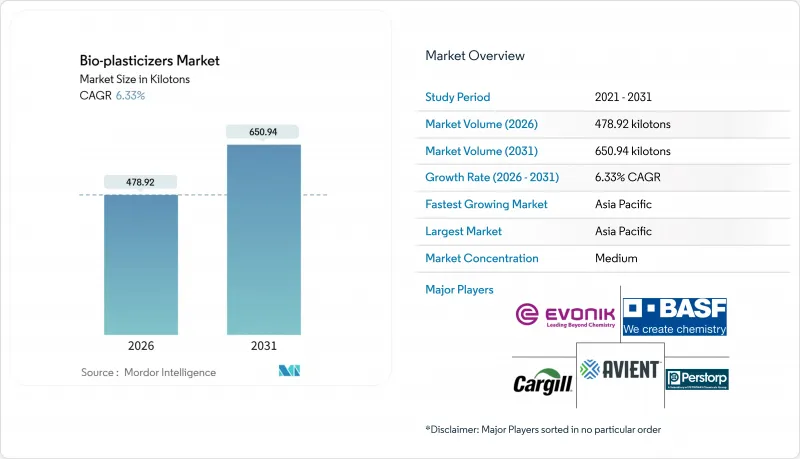
Mordor Intelligence에 의하면, 바이오 가소제 시장 규모는 2026년에 478.92 킬로톤으로 추정되고 예측 기간(2026-2031년) CAGR 6.33%로 확대되어 2031년에는 650.94 킬로톤에 이를 전망입니다.

본 보고서는 제품 유형(피마자유 등), 원료원(식물성 기름, 유기산 및 무수물, 글리세롤 에스테르 등), 용도(전선 및 케이블,필름 및 시트, 바닥재 등), 최종 사용자 산업(포장, 건축 및 건설 등), 지역(아시아태평양, 북미 등)별로 분류되어 있습니다. 시장 예측은 수량(톤) 단위로 표시되어 있습니다.
세계의 바이오 가소제 시장 동향 및 인사이트
전선 및 케이블 절연재 분야의 유연 PVC 수요 급증
2025년에는 아시아태평양의 전력 사업자들이 저발연·무할로겐 기준을 준수하기 위해 송전망 현대화를 추진한 것을 배경으로, 전선 및 케이블 절연재가 바이오 가소제 출하량의 큰 비중을 차지했습니다. 인도의 ‘국가 인프라 계획’에서는 IEC 60502를 준수하는 케이블의 사용을 의무화하고 있어, 난연성을 높이는 에폭시기를 가진 에폭시화 대두유 수요를 뒷받침하고 있습니다. 동남아시아의 프로젝트에는 바이오 함유율 공개 조항이 마련되어 있어, 구연산염과 ESBO가 선호되고 있음을 보여줍니다. 중국에서는 입찰 주기에 따라 매년 수요가 앞당겨 발생하고 있으며, 베트남과 인도네시아도 유사한 송전망 확장 전략을 채택하고 있습니다. 이러한 동향들이 맞물려 바이오 가소제 시장은 지속적인 성장 궤도에 올라섰습니다.
엄격한 프탈레이트 규제가 바이오 대체재 도입을 가속화
규제 당국이 노출 한도를 강화함에 따라, 프탈레이트류 금지 조치가 예측 연평균 성장률(CAGR)을 끌어올릴 것으로 전망됩니다. 2027년부터 미국 환경보호청(EPA)이 소비재에 포함된 8유형의 프탈레이트류를 금지함에 따라, 연질 PVC의 배합 변경이 매년 의무화됩니다. 한편, 유럽화학물질청(ECHA)은 4종의 프탈레이트를 REACH 후보 목록에 추가했으며, 이에 따라 소매업체들은 자사 브랜드 제품에 대해 바이오 함유량 인증을 요구하고 있습니다. 캘리포니아주에서는 프로포지션 65에 근거한 소송으로 인해 업계의 구연산 에스테르로의 전환이 더욱 가속화되고 있습니다. 일본에서는 식품 접촉용 필름의 프탈레이트 이온 이동량에 제한이 설정되어, 슈퍼마켓 포장재에서 기존의 가소제가 사실상 배제되고 있습니다. 이러한 전 세계적인 협력적 노력은 기존의 선택지를 배제할 뿐만 아니라, 바이오 대체재에 대한 신속한 시장 기회를 창출하고 있습니다.
식물성 기름의 가격 변동
아르헨티나의 가뭄과 브라질의 B15 바이오디젤 혼합 연료 도입을 배경으로, 2024년 1월부터 2025년 12월에 걸쳐 대두유 가격은 대폭 상승했습니다. 인도가 수출을 제한함에 따라 피마자유 가격도 급등하여 유럽 및 북미의 배합 제조업체에 압박을 가했습니다. 인도네시아의 수출 부과금 변경으로 인해 팜유 가격이 변동하면서 글리세롤 에스테르 가격 상승으로 이어졌습니다. 단기 현물 계약으로 사업을 영위하는 소규모 생산자들은 이익률 압박에 직면하여 이러한 비용 상승분을 가격에 전가함에 따라, 바이오 대체품의 가격은 프탈산 에스테르류보다 높아졌습니다. 원료의 헤지 상황이 개선되지 않는 한, 이러한 비용 급등은 예측 연평균 성장률(CAGR)에 부정적인 영향을 미칠 것으로 예측됩니다.
부문별 분석
에폭시화 대두유는 2025년 판매량의 40.31%를 차지하며, 플렉서블 필름 분야에서 비용 대비 성능 면에서 우위를 보였습니다. ‘기타’ 바이오 가소제 시장 규모는 숙신산 디에스테르 및 리그닌계 화합물이 내열성이 높은 자동차 부품에 점차 보급됨에 따라 연평균 성장률(CAGR) 8.12%로 확대될 것으로 전망됩니다. OEM 수요에 부응하기 위해 BASF의 북미 바이오 숙신산 제품 라인에서는 200°C까지의 내열성을 갖춘 가소제를 생산하고 있습니다. 피마자유 유도체는 의료기기용 ISO 10993 생체적합성 기준을 충족합니다. 구연산염은 식품 접촉용 및 의약품용 필름 분야에서 선도적인 위치를 차지하고 있지만, 유럽에서는 조달의 집중화에 따른 과제에 직면해 있습니다. 이타코닉스(Itaconix)사가 시장에 출시한 이타콘산과 같은 새로운 화학 물질은 항균성을 자랑하며, 의료용 포장 분야에서 경쟁 우위를 제공합니다. 식용유에서 원료 전환을 배경으로, 벤처 캐피털은 비용이 마이너스가 되는 펄프 부산물을 활용하는 리그닌 유래 제조 방식에 대한 지원을 점점 더 늘리고 있습니다.
Matrica와 같은 전문 기업들은 중간체의 이익률을 극대화하기 위해 바이오부탄디올과 숙신산의 생산 거점을 전략적으로 한곳에 집약하고 있습니다. 발효 기술 선도 기업은 디옥틸숙신산을 제조하여 아지페이트의 유연성을 유지하면서 탄소 발자국을 줄이고 있습니다. 에보닉(Evonik)의 ‘VESTINOL’ 시리즈는 제약 업계 고객을 위한 적합성 평가 프로세스를 효율화합니다. 에폭시화 아마인유와 아린산염 안정제를 조합함으로써, 하이브리드 배합은 150°C를 넘는 열안정성을 실현하고 있습니다. 이러한 발전은 전반적으로 성능 중심의 가소제로의 전환을 나타내며, 바이오 가소제 시장 전망을 넓히고 있습니다.
2025년에는 식물성 오일이 50.22%의 점유율을 차지했으나, ‘기타 원료원’에서 유래한 바이오 가소제 시장 규모는 2031년까지 연평균 성장률(CAGR) 7.59%로 확대될 것으로 예측됩니다. 카길(Cargill)사의 비유전자변형 대두유를 활용한 노력은 의약품 등급공급을 확보함과 동시에 높은 이익률을 실현하고 있습니다. PVC에서 pH 안정제로 이중 역할을 하는 구연산 무수물 및 말레산 무수물은 큰 점유율을 차지했습니다. 융분츠라우어사는 자사의 입지를 공고히 하기 위해 스위스에서 생산되는 구연산의 일부를 가소제 등급으로 배정하고 있습니다.
글리세롤 에스테르의 경우, EU의 RED-III가 작물 유래 바이오디젤을 제한하고 있어 원료 공급 제약에 직면해 있습니다. 이 제한으로 인해 글리세롤 공급이 억제되어 가격 상승으로 이어지고 있습니다. 이에 대응하여 에머리 올레오케미칼(Emery Oleochemicals)은 의약품 용도로 사용하기 위해 원료 글리세롤을 고순도로 정제했습니다. UPM은 크라프트 리그닌계 가소제에 대한 시험을 진행하고 있으며, 펄프 폐기물을 수익원으로 전환함으로써 식량 대 연료 논쟁을 피하고 있습니다. 비식용 원료로의 이러한 전략적 전환은 가격 충격을 완화할 뿐만 아니라, 산림 벌채가 수반되지 않는 공급망을 요구하는 브랜드 소유자들의 요구에도 부합하여 바이오 가소제 시장의 회복력을 높이고 있습니다.
지역별 분석
아시아태평양은 2025년 시장 규모의 35.22%를 차지했으며, 송전망 인프라 확충 및 새로운 포장 규제 도입을 배경으로 연평균 성장률(CAGR) 7.81%로 성장할 전망입니다. 중국에서는 초고압 계약에 있어, 특히 ESBO와 호환되는 난연성 PVC의 사용이 의무화되어 있습니다. 인도에서는 야심 찬 인프라 계획이 추진되고 있어 저독성 케이블로의 전환이 진행되고 있습니다. 일본은 ‘그린 트랜스포메이션’ 보조금을 통해 제조업체를 지원하고, 바이오 유래 화학 물질의 채택을 촉진하는 동시에 국내 컴파운더를 강화하고 있습니다. 한국의 K-REACH 등록에 따라 프탈레이트 에스테르 수입에 제한이 부과되면서 수요가 국내 바이오 유래 대체품으로 전환되고 있습니다. 한편, 동남아시아에서는 재생에너지에 대한 자금 투자가 진행되고 있으며, 조달 과정에서 바이오 함유율에 관한 조항이 중요시되고 있습니다.
2025년, 북미는 두드러진 시장 점유율을 확보했습니다. EPA의 프탈레이트류 금지 조치가 발효될 예정인 만큼, 업계는 대폭적인 배합 변경에 대비하고 있습니다. 캐나다의 ‘화학물질 관리 계획’은 미국의 일정에 밀접하게 연계되어 있습니다. 멕시코에서는 자동차 공장이 미국의 OEM 사양을 준수하기 위해 구연산염 화합물로 전환을 추진하고 있습니다. 또한, USDA의 ‘BioPreferred’ 프로그램은 인증된 가소제에 대해 막대한 연방 예산을 투입하고 있습니다.
유럽 역시 주목할 만한 시장 점유율을 확보했습니다. ‘포장 및 포장 폐기물 규정’에서는 필름에 대한 바이오 함유율 요건이 정해져 있습니다. 독일 연방환경청(Umweltbundesamt)은 보조금 수령 자격을 얻기 위해 건축자재에 바이오 가소제를 배합할 것을 권장하고 있습니다. 영국에서는 브렉시트 이후 규제를 REACH와 조화시켜 프탈레이트 제한이 유지되도록 보장하고 있습니다. 프랑스의 AGEC법은 일회용 플라스틱에 대해 단호한 입장을 보이고 있으며, 각 변환업체에 PVC 재활용 공정에 원활하게 통합될 수 있는 ESBO로의 전환을 촉구하고 있습니다. 남미에서는 현지산 대두유가 ESBO 생산에 활용되고 있으며, 사우디아라비아의 ‘비전 2030’ 인프라 구상이 중동에서 새로운 수요의 싹을 틔우는 데 힘을 실어주고 있습니다.
기타 혜택 :
- 엑셀 형식 시장 예측(ME) 시트
- 3개월간 애널리스트 지원
자주 묻는 질문
목차
제1장 서론
제2장 조사 방법
제3장 주요 요약
제4장 시장 구도
제5장 시장 규모 및 성장 예측
제6장 경쟁 구도
제7장 시장 기회 및 향후 전망
KTH 26.09.08According to Mordor Intelligence, the bio-plasticizers market size is estimated at 478.92 kilotons in 2026, and is expected to reach 650.94 kilotons by 2031, at a CAGR of 6.33% during the forecast period (2026-2031).
This report is Segmented by Product Type (Castor Oil, and More), Raw-Material Source (Plant Oils, Organic Acids and Anhydrides, Glycerol Esters, and Others), Application (Wire and Cable, Film and Sheet, Flooring, and More), End-User Industry (Packaging, Building and Construction, and More), and Geography (Asia-Pacific, North America, and More). The Market Forecasts are Provided in Terms of Volume (Tons).
Global Bio-plasticizers Market Trends and Insights
Surging Flexible-PVC Demand from Wire and Cable Insulation
In 2025, wire and cable insulation accounted for a significant share of the bio-plasticizer volume, driven by Asia-Pacific utilities modernizing grids to adhere to low-smoke, halogen-free standards. India's National Infrastructure Pipeline mandates IEC 60502-compliant cables, bolstering demand for epoxidized soybean oil due to its epoxy groups that enhance flame retardancy. Projects in Southeast Asia come with bio-content disclosure clauses, showing a preference for citrates and ESBO. China's tender cycle has front-loaded demand annually, with Vietnam and Indonesia mirroring this grid-expansion strategy. Collectively, these developments provide a sustained growth trajectory for the bio-plasticizers market.
Stringent Phthalate Regulations Accelerating Bio-options Adoption
As regulators tighten exposure limits, phthalate bans are projected to boost the forecast CAGR. Starting in 2027, the U.S. EPA's ban on eight phthalates in consumer goods mandates the annual reformulation of flexible PVC. Meanwhile, the European Chemicals Agency has added four phthalates to the REACH Candidate List, leading retailers to insist on bio-content certification for their private-label products. In California, Proposition 65 lawsuits have further accelerated the industry's shift towards citrate esters. Japan has set a limit on phthalate migration in food-contact films, effectively sidelining traditional plasticizers from supermarket packaging. These coordinated global actions not only eliminate established options but also create a swift market opportunity for bio-alternatives.
Price Volatility of Vegetable Oils
Soybean oil prices increased significantly from January 2024 to December 2025, driven by a drought in Argentina and Brazil's adoption of B15 biodiesel blends. Castor oil prices rose sharply after India restricted exports, putting pressure on formulators in Europe and North America. Palm oil prices experienced fluctuations due to changes in export levies by Indonesia, making glycerol esters more expensive. Small producers operating on short-term spot contracts faced margin compressions and passed on these increased costs, resulting in bio-alternatives being priced higher than phthalates. Unless there's an improvement in feedstock hedging, these cost surges are projected to impact the forecast CAGR negatively.
Other drivers and restraints analyzed in the detailed report include:
- Rapid Capacity Additions of Bio-refineries in Asia-Pacific
- Growth of the Sustainable Packaging Industry
- Performance Gap in High-temperature Applications
For complete list of drivers and restraints, kindly check the Table Of Contents.
Segment Analysis
Epoxidized soybean oil held 40.31% of the 2025 volume, demonstrating cost-performance leadership in flexible films. The bio-plasticizers market size for "Other Types" is set to accelerate at an 8.12% CAGR as succinic acid diesters and lignin-based compounds penetrate high-temperature automotive parts. Addressing OEM demands, BASF's North American bio-succinic line produces plasticizers resilient up to 200 °C. Castor oil derivatives meet ISO 10993 biocompatibility standards for medical devices. While citrates lead in food-contact and pharmaceutical films, they grapple with procurement consolidation challenges in Europe. New chemistries, like itaconic acid-brought to market by Itaconix-boast antimicrobial properties, giving them a competitive advantage in healthcare packaging. Highlighting a shift from edible oils, venture capital is increasingly backing lignin-derived methods that utilize cost-negative pulp by-products.
Specialty firms, such as Matrica, are strategically co-locating bio-butanediol and succinic acid production to maximize intermediary margins. Fermentation leaders are producing dioctyl succinate, achieving the flexibility of adipate while reducing carbon footprints. Evonik's VESTINOL range streamlines the qualification process for pharmaceutical clients. By combining epoxidized linseed oil with phosphite stabilizers, hybrid formulations achieve thermal stability exceeding 150 °C. Collectively, these advancements signal a shift towards performance-centric plasticizers, broadening the horizons of the bio-plasticizers market.
Plant oils held a 50.22% share in 2025, yet the bio-plasticizers market size derived from "Other Raw Material Sources" is forecast to grow at a 7.59% CAGR through 2031. Cargill's initiative with non-GMO soybean oil ensures a pharmaceutical-grade supply and secures premium margins. Citric and maleic anhydrides, playing dual roles as pH stabilizers in PVC, captured a significant share. Jungbunzlauer, solidifying its position, allocates a portion of its Swiss citric output to the plasticizer grade.
Glycerol esters grapple with a constrained feedstock as the EU RED-III caps crop-based biodiesel. This limitation curtails glycerol supply, leading to price increases. In response, Emery Oleochemicals has refined crude glycerol to a high purity for pharmaceutical applications. UPM is testing kraft lignin plasticizers, turning pulp waste into profit and avoiding the food-versus-fuel controversy. This strategic shift towards non-food inputs not only mitigates price shocks but also aligns with brand-owner demands for deforestation-free supply chains, enhancing resilience in the bio-plasticizers market.
Complete Report Scope:
- By Product Type
- Epoxidized Soybean Oil (ESBO)
- Castor oil
- Citrates
- Succinic acid
- Other Types (Itaconic acid, etc.)
- By Raw-Material Source
- Plant Oils
- Organic Acids and Anhydrides
- Glycerol Esters
- Others (Lignin-based Compounds, etc.)
- By Application
- Wire and Cable
- Film and Sheet
- Flooring, Roofing and Wall-covering
- Medical Devices
- Consumer Goods
- Other Applications (Automotive Interior Parts, etc.)
- By End-User Industry
- Packaging
- Building and Construction
- Healthcare
- Electrical and Electronics
- Automotive
- Consumer Products
- Others (Textile, Footwear, etc.)
- By Geography
- Asia-Pacific
- China
- India
- Japan
- South Korea
- Rest of Asia-Pacific
- North America
- United States
- Canada
- Mexico
- Europe
- Germany
- United Kingdom
- France
- Italy
- Rest of Europe
- South America
- Brazil
- Argentina
- Rest of South America
- Middle-East and Africa
- Saudi Arabia
- South Africa
- Rest of Middle-East and Africa
- Asia-Pacific
Geography Analysis
Asia-Pacific held 35.22% of the 2025 volume and is primed for a 7.81% CAGR, fueled by grid infrastructure and emerging packaging mandates. In China, ultra-high-voltage contracts mandate the use of flame-retardant PVC, specifically compatible with ESBO. India's ambitious infrastructure pipeline is leaning towards low-toxicity cables. Japan is incentivizing its manufacturers through Green Transformation subsidies, promoting the adoption of bio-based chemicals, and bolstering domestic compounders. South Korea's K-REACH registration is imposing restrictions on phthalate imports, creating a shift in demand towards local bio-alternatives. Meanwhile, Southeast Asia is channeling funding towards renewables, with an emphasis on bio-content clauses in their procurement processes.
In 2025, North America secured a notable share. With the EPA's phthalate ban set to take effect, the industry is bracing for significant reformulation. Canada's Chemicals Management Plan is closely aligned with U.S. timelines. In Mexico, automotive plants are turning to citrate compounds to ensure compliance with U.S. OEM specifications. Additionally, the USDA BioPreferred program is directing substantial federal spending towards certified plasticizers.
Europe managed to capture a notable share. The Packaging and Packaging Waste Regulation mandates a bio-content requirement for films. Germany's Umweltbundesamt is advocating for bio-plasticizer inclusion in construction products to qualify for subsidies. The UK, post-Brexit, is harmonizing its regulations with REACH, ensuring phthalate limits remain intact. France's AGEC law is taking a firm stance against single-use plastics, nudging converters towards ESBO, which seamlessly integrates into PVC recycling streams. In South America, local soybean oil is being harnessed for ESBO production, and Saudi Arabia's Vision 2030 infrastructure initiative is sparking a budding demand in the Middle East.
- Avient Corporation
- Baerlocher GmbH
- BASF SE
- Cargill, Incorporated.
- ChemPoint
- Danimer Scientific
- DIC Corporation
- Dow
- Emery Oleochemicals
- Evonik Industries AG
- Hebei Jingu Plasticizer Co. Ltd.
- JIAAO ENPROTECH
- Jungbunzlauer Suisse AG, Basel
- KLJ Group
- LANXESS
- Matrica SpA
- OXEA GmbH
- Perstorp
- PTT Global Chemical Public Company Limited
- Roquette Freres
- Teknor Apex
Additional Benefits:
- The market estimate (ME) sheet in Excel format
- 3 months of analyst support
TABLE OF CONTENTS
1 Introduction
- 1.1 Study Assumptions and Market Definition
- 1.2 Scope of the Study
2 Research Methodology
3 Executive Summary
4 Market Landscape
- 4.1 Market Overview
- 4.2 Market Drivers
- 4.2.1 Surging flexible-PVC demand from wire and cable insulation
- 4.2.2 Stringent phthalate regulations accelerating bio-options adoption
- 4.2.3 Rapid capacity additions of bio-refineries in Asia-Pacific
- 4.2.4 Growth of the sustainable packaging industry
- 4.2.5 OEM push for non-migratory plasticizers in medical tubing
- 4.3 Market Restraints
- 4.3.1 Price volatility of vegetable oils
- 4.3.2 Performance gap in high-temperature applications
- 4.3.3 Limited global glycerol surplus after biodiesel blend-rate cuts
- 4.4 Value Chain Analysis
- 4.5 Porter's Five Forces
- 4.5.1 Bargaining Power of Suppliers
- 4.5.2 Bargaining Power of Buyers
- 4.5.3 Threat of New Entrants
- 4.5.4 Threat of Substitutes
- 4.5.5 Degree of Competition
5 Market Size and Growth Forecasts (Volume)
- 5.1 By Product Type
- 5.1.1 Epoxidized Soybean Oil (ESBO)
- 5.1.2 Castor oil
- 5.1.3 Citrates
- 5.1.4 Succinic acid
- 5.1.5 Other Types (Itaconic acid, etc.)
- 5.2 By Raw-Material Source
- 5.2.1 Plant Oils
- 5.2.2 Organic Acids and Anhydrides
- 5.2.3 Glycerol Esters
- 5.2.4 Others (Lignin-based Compounds, etc.)
- 5.3 By Application
- 5.3.1 Wire and Cable
- 5.3.2 Film and Sheet
- 5.3.3 Flooring, Roofing and Wall-covering
- 5.3.4 Medical Devices
- 5.3.5 Consumer Goods
- 5.3.6 Other Applications (Automotive Interior Parts, etc.)
- 5.4 By End-User Industry
- 5.4.1 Packaging
- 5.4.2 Building and Construction
- 5.4.3 Healthcare
- 5.4.4 Electrical and Electronics
- 5.4.5 Automotive
- 5.4.6 Consumer Products
- 5.4.7 Others (Textile, Footwear, etc.)
- 5.5 By Geography
- 5.5.1 Asia-Pacific
- 5.5.1.1 China
- 5.5.1.2 India
- 5.5.1.3 Japan
- 5.5.1.4 South Korea
- 5.5.1.5 Rest of Asia-Pacific
- 5.5.2 North America
- 5.5.2.1 United States
- 5.5.2.2 Canada
- 5.5.2.3 Mexico
- 5.5.3 Europe
- 5.5.3.1 Germany
- 5.5.3.2 United Kingdom
- 5.5.3.3 France
- 5.5.3.4 Italy
- 5.5.3.5 Rest of Europe
- 5.5.4 South America
- 5.5.4.1 Brazil
- 5.5.4.2 Argentina
- 5.5.4.3 Rest of South America
- 5.5.5 Middle-East and Africa
- 5.5.5.1 Saudi Arabia
- 5.5.5.2 South Africa
- 5.5.5.3 Rest of Middle-East and Africa
- 5.5.1 Asia-Pacific
6 Competitive Landscape
- 6.1 Market Concentration
- 6.2 Strategic Moves
- 6.3 Market Share(%)/Ranking Analysis
- 6.4 Company Profiles (includes Global level Overview, Market level overview, Core Segments, Financials, Strategic Information, Products and Services, Recent Developments)
- 6.4.1 Avient Corporation
- 6.4.2 Baerlocher GmbH
- 6.4.3 BASF SE
- 6.4.4 Cargill, Incorporated.
- 6.4.5 ChemPoint
- 6.4.6 Danimer Scientific
- 6.4.7 DIC Corporation
- 6.4.8 Dow
- 6.4.9 Emery Oleochemicals
- 6.4.10 Evonik Industries AG
- 6.4.11 Hebei Jingu Plasticizer Co. Ltd.
- 6.4.12 JIAAO ENPROTECH
- 6.4.13 Jungbunzlauer Suisse AG, Basel
- 6.4.14 KLJ Group
- 6.4.15 LANXESS
- 6.4.16 Matrica SpA
- 6.4.17 OXEA GmbH
- 6.4.18 Perstorp
- 6.4.19 PTT Global Chemical Public Company Limited
- 6.4.20 Roquette Freres
- 6.4.21 Teknor Apex
7 Market Opportunities and Future Outlook
- 7.1 White-space and Unmet-Need Assessment


