

|
시장보고서
상품코드
2122572
아스타잔틴 : 시장 점유율 분석, 업계 동향 및 통계, 성장 예측(2026-2031년)Astaxanthin - Market Share Analysis, Industry Trends & Statistics, Growth Forecasts (2026 - 2031) |
||||||
 Mordor Intelligence
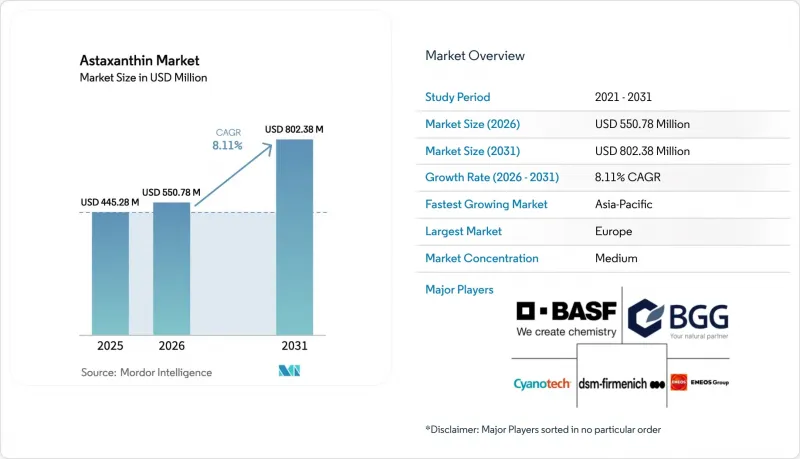
Mordor Intelligence에 의하면, 아스타잔틴 시장 규모는 2026년에 5억 5,078만 달러로 평가되고 2025년 4억 4,528만 달러에서 확대해, 2031년까지 8억 238만 달러에 이를 것으로 예측됩니다.
연평균 성장률(CAGR)은 8.11%를 나타낼 전망입니다.

본 보고서는 유형(천연 및 합성), 형태(분말 및 액체), 제조 방법(미세조류 배양, 화학 합성, 발효), 용도(식품 및 음료, 영양 보조제, 동물사료 등), 지역(북미, 유럽, 아시아태평양, 남미, 중동 및 아프리카)별로 분류되어 있습니다. 시장 전망은 금액(달러) 기준으로 제시되어 있습니다.
세계의 아스타잔틴 시장 동향 및 인사이트
예방 의료의 보급과 안티에이징 제품에 대한 수요 증가
인구 고령화와 건강에 대한 인식 제고에 따라, 소비자들은 아스타잔틴을 사후 대책으로서의 보충제가 아닌 예방책으로 점점 더 적극적으로 섭취하고 있습니다. 2025년 2월에 실시된 무작위 대조 시험에서 천연 아스타잔틴을 1일 4밀리그램, 9주간 섭취했을 때 자외선에 의한 피부 손상이 대폭 경감되고, 일광 화상이 발생하기까지의 시간이 연장된 것으로 밝혀져, 이 화합물은 외용 제품을 보완하는 ‘체내용 자외선 차단제’로서의 입지를 확립했습니다. 이러한 임상적 근거가 ‘내면에서 아름다움을 가꾸는’ 제품 개발을 뒷받침하고 있습니다. 아스타잔틴은 세포막을 투과하는 능력 덕분에 미토콘드리아 수준에서 산화 스트레스로부터 보호하는 작용이 있으며, 이것이 표면에서 작용하는 항산화 물질과의 차이점입니다. 또한, 안티에이징 시장에서는 노화에 따른 기억력 저하가 나타나는 중장년층을 대상으로, 1일 12밀리그램을 12주간 섭취했을 때 인지 기능이 개선되었습니다는 조사 결과가 제시되어, 그 응용 범위는 피부과 영역을 넘어 확대되고 있습니다. 규제 측면에서의 지원으로는 1999년 FDA가 아스타잔틴을 영양보조식품으로 승인한 점, 또한 2010년에 헤마토코쿠스 풀비아리스 유래 아스타잔틴이 GRAS(일반적으로 안전하다고 인정되는 물질)로 지정된 점을 들 수 있으며,이러한 조치들이 예방 의학을 목적으로 한 기능성 식품 및 음료로의 채택을 촉진하고 있습니다.
피부, 눈, 심장 건강에 대한 아스타잔틴의 항산화 작용에 대한 소비자의 인식 제고
소비자 대상 계몽 캠페인에서는 아스타잔틴의 다기관계에 미치는 효과가 소개되고 있어, 화장품, 뉴트라슈티컬, 기능성 식품 각 분야에서 수요를 뒷받침하고 있습니다. 10세에서 14세 사이의 아동 64명을 대상으로 한 이중 맹검 위약 대조 시험에서는 하루 4시간 이상 화면을 보는 모든 아동에게 84일 동안 하루 4밀리그램의 ‘AstaReal’ 아스타잔틴을 투여했습니다. 그 결과, 위약군에 비해 컴퓨터 시각 증후군 점수가 20% 개선되었고, 시각 피로가 27% 완화된 것으로 나타났습니다. 또한, 입체시 및 동공의 빛 반사에서도 유의미한 개선이 확인되었습니다. 전 세계적으로 디지털 기기 사용이 증가하는 가운데, 이 소아 대상 유효성 데이터는 가치 있는 새로운 타겟층을 부각시키고 있습니다. 심혈관계에 대한 유익성은 메타분석을 통해 입증되었습니다. 전당뇨 및 고콜레스테롤혈증 피험자에게 1일 12밀리그램을 24주간 섭취하게 한 결과, 피브리노겐 수치가 감소했습니다. 또한, 폐경 후 여성을 대상으로 동일한 용량을 8주간 섭취하게 한 결과, 혈압이 낮아지고 혈관 마커가 개선되었습니다. 아스타잔틴의 항산화력은 특정 시험법에서 α-토코페롤의 100배 이상으로 보고되었으며, 지질 이중층을 가로질러 친수성 및 친유성 세포 구획을 모두 보호하는 독보적인 능력과 결합되어 기존의 항산화 물질과는 차별화됩니다. 이러한 차별화는 그 효능을 강조할 뿐만 아니라, 건강 의식이 높은 소비자층을 대상으로 한 프리미엄 가격 책정의 정당성도 뒷받침하고 있습니다.
기후 요인에 따른 조류 배양 공급망의 취약성
헤마토코쿠스 풀비아리스의 배양은 온도, 광도, 수질의 영향을 받기 쉬우므로 기후 변화의 영향을 쉽게 받아 생산 일정과 수확량의 안정성을 저해할 우려가 있습니다. 조류 배양에 관한 유럽연합(EU) 보고서에 따르면, 실외 개방형 연못 시스템에서는 경쟁 미생물에 의한 오염 위험이 있다고 지적되고 있습니다. 대조적으로, 광바이오리액터 시스템은 제어하기가 더 쉽지만, 온도 조절과 교반을 위해 다량의 에너지가 필요합니다. 유럽집행위원회에 따르면, 규모나 시스템의 유형에 따라 다르지만, 이러한 시스템의 생산 비용은 건조 바이오매스 1Kg당 약 38달러에서 111달러에 이르는 것으로 나타났습니다. 기후로 인한 조류 배양에 대한 장애 요인은 다양합니다. 극단적인 기온은 조류의 성장을 저해하며, 이스라엘의 알라바 사막이나 중국 광둥성 같은 지역에서는 물 부족에 직면해 있고, 제철이 아닌 따뜻한 기간에는 오염 사고가 급증합니다. 배양 공정은 먼저 녹색 영양 성장 단계를 거친 후, 아스타잔틴 축적을 촉진하기 위해 영양분을 차단하고 강한 광 스트레스를 가하는 2단계 프로토콜을 채택하고 있어 생산 주기가 수 주간에 이릅니다. 이러한 장기적인 주기는 기상 변동에 대한 취약성을 높이고, 배치 실패 위험을 증가시킵니다. 공급의 집중화는 이러한 취약성을 더욱 증폭시키고 있습니다. 2025년 5월 생산 능력을 두 배로 늘린 BGG World의 광남성에 위치한 시설은 현재 천연 아스타잔틴 생산 분야에서 세계 최대의 거점이 되었습니다. 이러한 집중화는 전 세계 공급의 상당 부분에 있어 단일 장애 지점이 되기 때문에 중대한 위험을 내포하고 있습니다. 이러한 과제를 해결하기 위해 업계 관계자들은 몇 가지 위험 완화 방안을 모색하고 있습니다. 여기에는 생산 거점의 지리적 다각화, 기후 제어 기능을 갖춘 밀폐형 광바이오리액터 시스템으로의 전환, 그리고 기존의 광합성이 아닌 유기 탄소원에 의존하는 종속 영양 배양법의 개척 등이 포함됩니다. 다만, 종속영양 배양법은 유망하지만 여전히 시험 단계에 있으며, 상업적인 비용 경쟁력을 아직 확보하지 못했다는 점에 유의해야 합니다.
부문별 분석
2025년, 합성 등급은 아스타잔틴 시장 점유율의 83.18%를 차지했습니다. 이는 양식 사료 업계가 비용 효율이 뛰어난 색소를 대량으로 요구하는 수요에 힘입은 결과입니다. 그러나 건강 보조 식품, 화장품 및 프리미엄 기능성 식품 분야에서 미세 조류 유래 원료의 채택이 확대됨에 따라, 천연 등급은 2031년까지 연평균 성장률(CAGR) 9.24%로 성장하여 합성 등급을 추월할 것으로 예측됩니다. 천연 등급의 가격은 1kg당 1,650-7,220달러인 반면, 합성 등급은 950달러입니다. 하지만 유럽 식품의 합성 물질 사용 규제와 미국의 GRAS(일반적으로 안전하다고 인정되는) 인증 부재가 천연 등급 생산자에게 경쟁 우위를 가져다주고 있습니다. 클린 라벨 트렌드에 힘입어 아시아태평양의 프리미엄 부문에서 천연 제품으로의 전환이 가속화되고 있습니다. 한편, 효모 유래 및 유전자 변형 미생물을 이용한 제조 방법은 기술적으로는 실현 가능하지만, 수율이 낮고 인간의 영양 섭취에 있어 GMO에 대한 규제상의 우려로 인해 상업적으로는 아직 초기 단계에 머물러 있습니다.
임상 연구와 소비자 인식 간의 피드백 루프가 천연 제품의 채택을 뒷받침하고 있습니다. 각 브랜드는 인간 혈장 연구 결과와 일치하는 ‘전체 E-3S, 3'S’ 구조를 강조하며, 뛰어난 생체 이용률과 산화 안정성에 대한 주장을 뒷받침하고 있습니다. 소매업체들은 천연 유래 SKU에 더 많은 진열 공간을 할당하고 있으며, 특히 알고리즘이 전환율이 높은 상품을 우선시하는 전자상거래 플랫폼에서 이러한 경향이 두드러집니다. 그 결과, 아스타잔틴 시장은 천연 유래 원료로 전환되고 있지만, 양식업의 착색 용도에서는 합성 제품이 여전히 중요한 역할을 하고 있습니다.
지역별 분석
유럽은 2025년 전 세계 매출의 35.24%를 차지했습니다. 이는 식품에 합성 아스타잔틴 사용을 금지하고, 천연 제품에 대해서는 ‘신규 식품(Novel Food)’ 승인을 의무화하는 규제 환경의 혜택을 받은 결과입니다. 독일, 영국, 프랑스, 네덜란드의 높은 건강 리터러시와 잘 갖춰진 건강기능식품 판매 채널이 판매량 증가를 뒷받침하고 있는 반면, 중복 인증 취득으로 인해 프리미엄 가격 책정이 주류를 이루고 있습니다. 규제상의 장벽은 두 가지 추출 방법에 대한 승인을 획득한 기존 기업들에게 방어적인 경쟁 우위(모트)를 구축해 주고 있습니다.
아시아태평양은 2026년부터 2031년까지 연평균 성장률(CAGR) 9.78%를 나타낼 것으로 예측되며, 이는 다른 모든 지역을 능가할 전망입니다. 중국이 공급을 주도하고 있으며, BGG사가 2025년 5월 구이난성(雲南省)의 광생물반응기 농장을 두 배로 확장함에 따라 세계 최대 천연 아스타잔틴 생산자로서의 입지를 공고히 했습니다. 일본은 여전히 소비의 선구자이며, 한편 인도에서는 가처분 소득 증가와 예방 의료에 대한 인식 제고에 따라 수요가 급속히 증가하고 있습니다. 동남아시아의 양식업에서는 합성 등급이 주류를 이루고 있지만, 프리미엄 건강기능식품의 보급은 향후 천연 원료로의 전환이 진행될 것임을 시사하고 있습니다.
북미에서는 조기에 획득한 GRAS 인증을 활용하여, 건강기능식품, 음료, 화장품 등 폭넓은 분야로의 적용을 확대되고 있습니다. 사이아노테크(CyanoTech)사의 하와이 사업부는 ‘BioAstin’을 공급하고 있으며, 이는 2025 회계연도 순매출 2,421만 5,000달러 중 65%를 차지하여 단일 제품에 대한 매출 의존도가 높다는 점이 두드러지게 나타나고 있습니다. 규제의 명확화와 소매 유통의 광범위한 확장이 안정적인 수요를 뒷받침하고 있지만, 대중을 대상으로 하는 유통 채널에서의 가격 민감도로 인해 그 성장세는 다소 둔화되고 있습니다. 남미, 중동 및 아프리카는 여전히 발전 단계에 있지만, 규제 체계가 성숙해지고 도시 중산층이 클린 라벨 영양 보충제를 찾게 됨에 따라 전망은 밝습니다.
기타 혜택 :
- 엑셀 형식 시장 예측(ME) 시트
- 3개월간의 애널리스트 지원
자주 묻는 질문
목차
제1장 서론
제2장 조사 방법
제3장 주요 요약
제4장 시장 구도
제5장 시장 규모 및 성장 예측
제6장 경쟁 구도
제7장 시장 기회 및 향후 전망
KTH 26.09.08According to Mordor Intelligence, the astaxanthin market size is valued at USD 550.78 million in 2026, growing from the 2025 value of USD 445.28 million, and is forecast to climb to USD 802.38 million by 2031, advancing at a 8.11% CAGR.
This report is Segmented by Nature (Natural and Synthetic), Form (Powder and Liquid), Production Method (Microalgae Cultivation, Chemical Synthesis, and Fermentation), Application (Food and Beverage, Dietary Supplement, Animal Feed, and More), and Geography (North America, Europe, Asia-Pacific, South America, and Middle East and Africa). The Market Forecasts are Provided in Terms of Value (USD).
Global Astaxanthin Market Trends and Insights
Rising Preventive Healthcare and Increasing Demand for Anti-Aging Products
With aging demographics and growing health awareness, consumers are increasingly adopting astaxanthin as a preventive solution rather than a reactive supplement. A randomized controlled trial conducted in February 2025 revealed that consuming 4 milligrams of natural astaxanthin daily for 9 weeks significantly reduced UV-induced skin damage and prolonged time-to-sunburn, establishing the compound as an "internal sunscreen" that complements topical products. This clinical evidence is driving advancements in beauty-from-within formulations. Astaxanthin's ability to penetrate cellular membranes provides oxidative protection at the mitochondrial level, distinguishing it from surface-acting antioxidants. Additionally, the anti-aging market benefits from research showing that a 12-week intake of 12 milligrams daily improved cognitive performance in middle-aged and elderly individuals experiencing age-related memory decline, broadening its applications beyond dermatology. Regulatory support includes the FDA's 1999 approval of astaxanthin as a dietary supplement and its 2010 GRAS designation for Haematococcus pluvialis-derived astaxanthin, which has facilitated its adoption in functional foods and beverages targeting preventive health.
Rising Consumer Awareness of Astaxanthin's Antioxidant Benefits for Skin, Eye, and Heart Health
Consumer education campaigns are showcasing astaxanthin's multi-system benefits, fueling demand across cosmetics, nutraceuticals, and functional foods. A double-blind, placebo-controlled trial involving 64 schoolchildren aged 10 to 14, each with over 4 hours of daily screen time, administered 4 milligrams of AstaReal astaxanthin daily for 84 days. The study revealed a 20 percent improvement in computer vision syndrome scores and a 27 percent reduction in visual fatigue compared to the placebo group. Additionally, significant improvements were observed in stereopsis and pupillary light reflex. With the global increase in digital device usage, this pediatric efficacy data highlights a valuable new demographic segment. Cardiovascular benefits are supported by meta-analyses: 12 milligrams daily for 24 weeks reduced fibrinogen levels in prediabetic and high-cholesterol individuals. Moreover, an 8-week supplementation at the same dosage lowered blood pressure and improved vascular markers in postmenopausal women. Astaxanthin's antioxidant potency, reported to be over 100 times that of alpha-tocopherol in specific assays, along with its unique ability to cross lipid bilayers and protect both hydrophilic and lipophilic cellular compartments, distinguishes it from conventional antioxidants. This differentiation not only emphasizes its effectiveness but also validates its premium pricing among health-conscious consumers.
Supply Chain Vulnerabilities in Algal Cultivation Due to Climate Factors
Haematococcus pluvialis cultivation is sensitive to temperature, light intensity, and water quality, making it vulnerable to climate variability that can disrupt production schedules and yield consistency. A European Union report on algae cultivation noted that outdoor open-pond systems are at risk of contamination from competing microorganisms. In contrast, photobioreactor systems, while more controlled, demand substantial energy for temperature regulation and mixing. Depending on the scale and system type, production costs for these systems can range from approximately USD 38 to USD 111 per kilogram of dry biomass, according to the European Commission. Climate-related disruptions to algal cultivation are manifold: extreme temperatures can stifle algal growth, regions like Israel's Arava desert and China's Yunnan province face water scarcity, and unseasonably warm periods see a spike in contamination events. The cultivation process, which involves a two-stage protocol first, green vegetative growth, followed by nutrient deprivation and high-light stress to boost astaxanthin accumulation, extends production cycles over several weeks. This prolonged cycle heightens vulnerability to weather variability and increases the risk of batch failures. The concentration of supply further amplifies this vulnerability. BGG World's facility in Yunnan, which doubled its capacity in May 2025, has now become the world's largest site for natural astaxanthin production. This centralization poses a significant risk, as it stands as a single point of failure for a large portion of the global supply. To counter these challenges, industry players are exploring several mitigation strategies. These include diversifying production geographically, transitioning to closed photobioreactor systems equipped with climate control, and pioneering heterotrophic cultivation methods that rely on organic carbon sources instead of traditional photosynthesis. However, it's worth noting that while heterotrophic methods show promise, they remain in the pilot stage and have yet to reach commercial cost-competitiveness.
Other drivers and restraints analyzed in the detailed report include:
- Preference for Natural Microalgae-Derived Astaxanthin Over Synthetics
- Technological Advances in Extraction Improving Bioavailability and Yields
- Stringent Regulations on Purity, Labeling, and Novel Food Approvals
For complete list of drivers and restraints, kindly check the Table Of Contents.
Segment Analysis
In 2025, synthetic grades held 83.18% of the astaxanthin market share, driven by the aquaculture feed industry's demand for cost-efficient pigments in bulk quantities. However, natural grades are expected to surpass the overall category with a projected 9.24% CAGR through 2031, as dietary supplements, cosmetics, and premium functional foods increasingly adopt microalgae sourcing. Natural batches are priced between USD 1,650 and 7,220 per kilogram, compared to USD 950 for synthetic materials. Nonetheless, regulatory bans on synthetic use in European foods and the absence of GRAS status in the U.S. provide a competitive edge for natural producers. Clean-label trends are accelerating the shift toward natural products in the Asia-Pacific's premium segments. At the same time, yeast-derived and genetically engineered microbial methods remain technically viable but are still in the early stages commercially, limited by low yields and regulatory concerns regarding GMOs in human nutrition.
A feedback loop between clinical research and consumer perception is driving the adoption of natural products. Brands emphasize the all-E-3S,3'S configuration, which aligns with human plasma studies, to support claims of superior bioavailability and oxidative stability. Retailers are allocating more shelf space to natural SKUs, particularly in e-commerce platforms where algorithms prioritize products with high conversion rates. Consequently, the astaxanthin market is transitioning toward natural sources, even as synthetic variants retain their role in aquaculture pigmentation.
Complete Report Scope:
- Nature
- Natural
- Synthetic
- Form
- Powder
- Liquid
- Application
- Food and Beverages
- Dietary Supplements
- Animal Feed
- Personal Care and Cosmetics
- Pharmaceuticals
- By Geography
- North America
- United States
- Canada
- Mexico
- Rest of North America
- Europe
- Germany
- United Kingdom
- Italy
- France
- Spain
- Netherlands
- Rest of Europe
- Asia-Pacific
- China
- India
- Japan
- Australia
- Rest of Asia-Pacific
- South America
- Brazil
- Argentina
- Rest of South America
- Middle East and Africa
- South Africa
- Saudi Arabia
- Rest of Middle East and Africa
- North America
Geography Analysis
Europe secured 35.24% of global revenue in 2025, benefiting from a regulatory environment that bans synthetic astaxanthin in food and enforces Novel Food approval for natural variants. High health literacy and robust supplement channels in Germany, the United Kingdom, France, and the Netherlands strengthen volume growth, while premium pricing prevails due to certification stacking. Regulatory hurdles create defensive moats for incumbents that have secured dual extraction-method approvals.
Asia-Pacific is projected to record a 9.78% CAGR between 2026 and 2031, outpacing all other regions. China drives supply, with BGG's May 2025 doubling of its Yunnan photobioreactor farm cementing its status as the largest natural producer globally. Japan remains a consumption pioneer, while India posts rapid demand gains aligned with rising disposable income and growing preventive-health awareness. Although synthetic grades dominate aquaculture in Southeast Asia, premium supplement uptake signals future migration toward natural inputs.
North America leverages early GRAS status to broaden application breadth across supplements, beverages, and cosmetics. Cyanotech's Hawaiian operation supplies BioAstin, which contributed 65% of its USD 24.215 million net sales in fiscal 2025, underscoring single-product revenue reliance. Regulatory clarity and widespread retail distribution support consistent demand, albeit tempered by cost sensitivity in mass channels. South America and Middle East and Africa remain nascent but promising as regulatory frameworks mature and urban middle-class populations seek clean-label nutraceuticals.
- dsm-firmenich
- BASF SE
- Fuji Chemical Industry / AstaReal
- Cyanotech Corporation
- Beijing Gingko Group (BGG)
- Algatech Ltd.
- Algalif Iceland ehf.
- Divi's Laboratories Ltd.
- ENEOS Holdings Inc.
- Biogenic Co. Ltd.
- Otsuka Holdings Co. Ltd.
- INNOBIO Ltd.
- Yunnan Alphy Biotech Co.
- NOW Health Group Inc.
- Archer Daniels Midland Company
- Givaudan SA
- Kemin Industries
- Evonik Nutrition and Care
- Valensa International
- Atacama Bio
Additional Benefits:
- The market estimate (ME) sheet in Excel format
- 3 months of analyst support
TABLE OF CONTENTS
1 INTRODUCTION
- 1.1 Study Assumptions and Market Definition
- 1.2 Scope of the Study
2 RESEARCH METHODOLOGY
3 EXECUTIVE SUMMARY
4 MARKET LANDSCAPE
- 4.1 Market Overview
- 4.2 Market Drivers
- 4.2.1 Rising Preventive Healthcare and Increasing Demand for Anti-Aging Products
- 4.2.2 Rising Consumer Awareness of Astaxanthin's Antioxidant Benefits for Skin, Eye, and Heart Health
- 4.2.3 Preference for Natural Microalgae-Derived Astaxanthin Over Synthetics
- 4.2.4 Technological Advances in Extraction Improving Bioavailability and Yields
- 4.2.5 Rising Sports Nutrition Use for Recovery and Inflammation Reduction
- 4.2.6 Consumer Shift Towards Clean-Label, Non-GMO Ingredients
- 4.3 Market Restraints
- 4.3.1 Supply Chain Vulnerabilities in Algal Cultivation Due to Climate Factors
- 4.3.2 Stringent Regulations on Purity, Labeling, and Novel Food Approvals
- 4.3.3 High Production Costs of Natural Astaxanthin
- 4.3.4 Raw Material Price Fluctuations for Algae Feedstocks
- 4.4 Supply Chain Analysis
- 4.5 Regulatory Outlook
- 4.6 Porter's Five Forces
- 4.6.1 Threat of New Entrants
- 4.6.2 Bargaining Power of Buyers/Consumers
- 4.6.3 Bargaining Power of Suppliers
- 4.6.4 Threat of Substitute Products
- 4.6.5 Intensity of Competitive Rivalry
5 MARKET SIZE AND GROWTH FORECASTS (VALUE)
- 5.1 Nature
- 5.1.1 Natural
- 5.1.2 Synthetic
- 5.2 Form
- 5.2.1 Powder
- 5.2.2 Liquid
- 5.3 Application
- 5.3.1 Food and Beverages
- 5.3.2 Dietary Supplements
- 5.3.3 Animal Feed
- 5.3.4 Personal Care and Cosmetics
- 5.3.5 Pharmaceuticals
- 5.4 By Geography
- 5.4.1 North America
- 5.4.1.1 United States
- 5.4.1.2 Canada
- 5.4.1.3 Mexico
- 5.4.1.4 Rest of North America
- 5.4.2 Europe
- 5.4.2.1 Germany
- 5.4.2.2 United Kingdom
- 5.4.2.3 Italy
- 5.4.2.4 France
- 5.4.2.5 Spain
- 5.4.2.6 Netherlands
- 5.4.2.7 Rest of Europe
- 5.4.3 Asia-Pacific
- 5.4.3.1 China
- 5.4.3.2 India
- 5.4.3.3 Japan
- 5.4.3.4 Australia
- 5.4.3.5 Rest of Asia-Pacific
- 5.4.4 South America
- 5.4.4.1 Brazil
- 5.4.4.2 Argentina
- 5.4.4.3 Rest of South America
- 5.4.5 Middle East and Africa
- 5.4.5.1 South Africa
- 5.4.5.2 Saudi Arabia
- 5.4.5.3 Rest of Middle East and Africa
- 5.4.1 North America
6 COMPETITIVE LANDSCAPE
- 6.1 Market Concentration
- 6.2 Strategic Moves
- 6.3 Market Ranking Analysis
- 6.4 Company Profiles (includes Global-level Overview, Market-level Overview, Core Segments, Financials (if available), Strategic Information, Market Rank/Share, Products and Services, Recent Developments)
- 6.4.1 dsm-firmenich
- 6.4.2 BASF SE
- 6.4.3 Fuji Chemical Industry / AstaReal
- 6.4.4 Cyanotech Corporation
- 6.4.5 Beijing Gingko Group (BGG)
- 6.4.6 Algatech Ltd.
- 6.4.7 Algalif Iceland ehf.
- 6.4.8 Divi's Laboratories Ltd.
- 6.4.9 ENEOS Holdings Inc.
- 6.4.10 Biogenic Co. Ltd.
- 6.4.11 Otsuka Holdings Co. Ltd.
- 6.4.12 INNOBIO Ltd.
- 6.4.13 Yunnan Alphy Biotech Co.
- 6.4.14 NOW Health Group Inc.
- 6.4.15 Archer Daniels Midland Company
- 6.4.16 Givaudan SA
- 6.4.17 Kemin Industries
- 6.4.18 Evonik Nutrition and Care
- 6.4.19 Valensa International
- 6.4.20 Atacama Bio


