

|
시장보고서
상품코드
2122585
헬스케어 모빌리티 솔루션 : 시장 점유율 분석, 업계 동향 및 통계, 성장 예측(2026-2031년)Global Healthcare Mobility Solutions - Market Share Analysis, Industry Trends & Statistics, Growth Forecasts (2026 - 2031) |
||||||
 Mordor Intelligence
Mordor Intelligence에 의하면, 2026년 헬스케어 모빌리티 솔루션 시장 규모는 1,867억 2,000만 달러로 추정되고 2025년 1,643억 1,000만 달러에서 성장하여 2031년에는 3,538억 6,000만 달러에 이를 것으로 예측됩니다.
2026년부터 2031년까지의 연평균 성장률(CAGR)은 13.64%를 나타낼 전망입니다.

본 보고서에서는 업계를 제품 및 서비스별(모바일 애플리케이션(앱), 모바일 기기 등), 용도별(엔터프라이즈 솔루션, m헬스 용도), 최종 사용자별(보험사, 의료 제공업체, 환자),케어 환경(병원 및 진료소, 재택 간호 등), 배포 방식(클라우드 기반 및 On-Premise), 지역(북미, 유럽, 아시아태평양 등)별로 분류하고 있습니다.
세계의 헬스케어 모빌리티 솔루션 시장 동향 및 인사이트
원격의료 및 RPM 프로그램의 확대
미국 내 원격 환자 모니터링(RPM)에 참여하는 환자 수는 2020년 2,900만 명에서 2025년에는 7,060만 명에 달했습니다. 메이요 클리닉의 ‘Advanced Care at Home’ 모델은 2,000명 이상의 환자를 치료하고 있으며, 이 모델의 감염률은 입원 환자의 기준치보다 낮고 재입원율도 낮은 것으로 나타났습니다. CMS(미국 의료보험서비스센터)의 면제 조치에 따라 현재 320개 이상의 병원이 재택 급성기 의료 서비스를 제공할 수 있게 되었으며, 병원 수준의 서비스가 환자의 자택으로 이전되고 있습니다. 클리블랜드 클리닉의 AI 기반 가상 분류 시스템은 94%의 진단 정확도를 달성하여 응급실 혼잡 완화에 기여하고 있습니다. 화상 통화, 메시징, 대면 후속 관리를 결합한 하이브리드형 ‘클릭 앤 브릭(Click-and-Brick)’ 모델은 제한된 자원을 최대한 활용하여 환자 만족도 향상으로 이어지고 있습니다.
스마트폰 및 웨어러블 기기의 보급 확대
현재 아시아태평양 성인의 80% 이상이 스마트폰을 보유하고 있으며, 이를 통해 병원은 환자에게 직접 건강 지도, 복약 알림, 생체 측정 데이터를 제공할 수 있게 되었습니다. 홍콩대학교 연구진은 유연한 마이크로일렉트로닉스를 피부 위에서 분석이 가능한 독립형 AI 웨어러블로 변환하는 유기 전기화학 트랜지스터의 실증에 성공했습니다. FDA가 2025년에 ‘Stelo’ 연속 혈당 모니터의 소매 판매를 승인한 것은 처방전이 필요한 의료기기에서 일반 소비자용 채널로의 전환을 의미합니다. 소비자용 기기의 임상적 정확도가 향상됨에 따라 데이터는 전자 건강 기록에 원활하게 유입되어, 임상의는 유해 사건이 발생하기 전에 동향을 파악할 수 있게 됩니다. 기기에서 생성되는 예측적 인사이트력을 통해 응급실 방문이 감소하고, 만성 질환 관리의 경제적 지속가능성이 높아집니다.
사이버 보안 및 HIPAA/GDPR(EU 개인정보보호규정) 관련 위험
사이버 범죄자들이 모바일 단말기를 표적으로 삼는 사례가 증가함에 따라, 의료 제공업체들은 인증, 암호화, 패치 관리를 강화해야만 합니다. 많은 병원 네트워크에서는 최신 제로 트러스트 전략을 지원하지 못하는 구형 운영 체제가 가동되고 있어, 완전한 규정 준수를 달성하기 어렵습니다. EU 규제 당국은 암호화되지 않은 모바일 데이터 전송과 관련된 GDPR(EU 개인정보보호규정) 위반에 대해 막대한 벌금을 부과하기 시작했습니다. 지방 의료시설에서는 2025년에 지급될 새로운 원격의료 보조금의 전제조건으로 모바일 보안이 제시되고 있습니다. 엄격한 보안과 임상의의 편의성 사이의 균형을 맞추는 것은 향후 2년 동안 도입의 주요 장벽으로 남아 있을 것입니다.
부문별 분석
모바일 애플리케이션는 2031년까지 연평균 성장률(CAGR) 14.22%로 가장 높은 성장률을 보이고 있지만, 2025년 매출의 42.73%를 차지한 것은 모바일 기기였습니다. FDA가 2024년에 ADHD용 디지털 치료제를 클래스 II 의료기기로 분류하기로 결정함에 따라, 보험 적용의 길이 넓어졌으며 소프트웨어 전용 제품도 상업적으로 성공할 수 있게 되었습니다. Epic, Oracle, Cerner의 엔터프라이즈 플랫폼은 현재 보안 메시징, 싱글 사인온(SSO), 기기 추적 기능을 통합하여 도입을 간소화하고 있습니다. 헬스케어 모빌리티 솔루션 시장에서는 전용 하드웨어가 아닌 기존의 일반용 스마트폰을 활용하는 벤더들이 지속적으로 높은 평가를 받고 있으며, 이를 통해 의료 제공업체의 자본 지출이 절감되고 있습니다.
모바일 기기는 감염 방지 케이스, 배터리 핫스왑, 바코드를 활용한 투약 관리 등의 측면에서 여전히 중요한 역할을 수행하고 있습니다. 그러나 견고한 일반용 태블릿의 가격 하락으로 그 격차가 좁혀지면서 하드웨어 시장의 성장세는 둔화되고 있습니다. 기기 독립성과 EHR(전자의무기록)과의 긴밀한 연동을 결합한 벤더들은 IT의 복잡성을 줄임으로써 시장 점유율을 확대되고 있습니다. AI가 통합된 용도는 생체 신호 대시보드에 그치지 않고, 투약량 조정, 오피오이드 관리, 재활 지도까지 확대되면서, 구매 결정에 있어 소프트웨어가 중심적인 역할을 수행하게 되었습니다.
엔터프라이즈 솔루션은 장기간에 걸친 조달 주기와 EHR 번들 계약으로 인해 2025년 지출의 61.88%를 차지했습니다. 가스리 클리닉의 가상 진료 허브는 인건비를 700만 달러 절감하고 간호사 이직률을 절반으로 줄임으로써, 대규모 모빌리티 도입을 통한 경제적 이점을 입증했습니다. 자동 차트 작성, 앰비언트 딕테이션, 실시간 분석은 현재 북미 및 유럽의 엔터프라이즈 로드맵에서 필수적인 요소로 자리 잡고 있습니다.
m헬스 용도는 연평균 14.28%의 성장률을 기록하며, 걸음 수, 수면, 혈당 수치를 매일 기록하는 젊고 기술에 정통한 사용자층을 확보하고 있습니다. 소비자 직접 판매 채널은 보험 코드를 거치지 않고 제공되므로, 스타트업 기업은 보다 신속한 피드백 루프와 반복적인 제품 개발 프로세스를 확보할 수 있습니다. 고용주가 웰니스 앱을 복리후생 계획에 통합하고, 보험사가 디지털 우선 보험 적용을 확대함에 따라 m헬스 분야의 헬스케어 모빌리티 솔루션 시장 규모는 더욱 확대될 것으로 예측됩니다.
지역별 분석
북미는 성숙한 상환 모델, 명확한 규제 환경, 그리고 모바일 확장에 대응할 수 있는 전자 건강 기록(EHR)의 도입 기반 덕분에 2025년 매출의 42.11%를 차지했습니다. 현재 320개 이상의 미국 병원이 재택 급성기 의료에 관한 CMS(미국 의료보험 및 의료보조 서비스 센터)의 면제를 획득했으며, 이는 물류 앱, 대시보드, 5G 라우터에 대한 광범위한 투자의 기반이 되고 있습니다. 캐나다의 각 주에서는 외딴 지역 사회에 의료 서비스를 제공하기 위해 온라인 진료에 보조금을 지급하고 있는 반면, 멕시코의 민간 병원에서는 의료 인력 부족을 보완하기 위해 모바일 트리아지를 도입하고 있습니다.
유럽에서는 국경을 초월한 기준이 성숙해짐에 따라 꾸준한 도입이 진행되고 있습니다. ‘유럽 헬스 데이터 스페이스(European Health Data Space)’ 이니셔티브는 웨어러블 기기, 영상 진단, 검사 데이터를 통합하는 상호 운용 가능한 API를 추진하고 있습니다. 독일은 6G 의료 연구에 자금을 지원하고 있으며, 영국은 미국 파트너와 공동으로 머신러닝 진단을 위한 투명성 프레임워크를 수립하고 있습니다. 이러한 프로그램들은 헬스케어 모빌리티 솔루션 시장이 지역 전반에 걸쳐 AI를 활용한 예후 진단에 대한 신뢰를 구축하는 데 기여하고 있습니다.
아시아태평양은 14.37%라는 가장 높은 연평균 성장률(CAGR)을 기록하고 있습니다. 18억 명의 모바일 가입자를 보유한 이 지역의 5G 보급률은 북미에 이어 두 번째로 높은 수준입니다. 중국의 외과의사들은 독립형 5G를 활용해 원격 위절제술을 시행하며 전 세계의 주목을 받는 동시에 규제 측면에서의 분위기를 고조시키고 있습니다. 인도의 ‘디지털 퍼스트’ 의료를 위한 새로운 보험 환급 규정과 일본의 AI를 활용한 당뇨성 망막병증 선별 검사가 시장 규모 확대에 기여하고 있습니다. 동남아시아에서는 2024년에 스타트업 기업들이 원격의료 분야에서 15억 달러를 조달했으며, 이는 헬스케어 모빌리티 솔루션 시장에 대한 벤처 기업들의 신뢰가 높음을 보여줍니다.
기타 혜택 :
- 엑셀 형식 시장 예측(ME) 시트
- 3개월간의 애널리스트 지원
자주 묻는 질문
목차
제1장 서론
제2장 조사 방법
제3장 주요 요약
제4장 시장 구도
제5장 시장 규모 및 성장 예측
제6장 경쟁 구도
제7장 시장 기회 및 향후 전망
KTH 26.09.08According to Mordor Intelligence, healthcare mobility solutions market size in 2026 is estimated at USD 186.72 billion, growing from 2025 value of USD 164.31 billion with 2031 projections showing USD 353.86 billion, growing at 13.64% CAGR over 2026-2031.
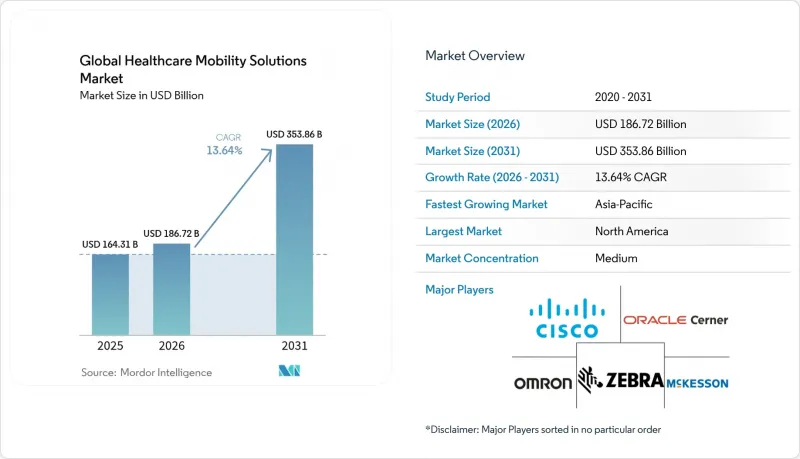
This report Segments the Industry Into by Products and Services (Mobile Applications (Apps), Mobile Devices, and More), by Application (Enterprise Solutions, Mhealth Applications), by End User (Payers, Providers, Patients), Care Setting (Hospitals & Clinics, Home-Care, and More), Deployment Mode (Cloud-Based and On-Premise), and Geography (North America, Europe, Asia-Pacific, and More).
Global Healthcare Mobility Solutions Market Trends and Insights
Expansion of Tele-medicine & RPM Programs
US patient participation in remote patient monitoring (RPM) is projected to reach 70.6 million in 2025, up from 29 million in 2020. Mayo Clinic's Advanced Care at Home model has treated more than 2,000 patients with infection rates below inpatient norms and lower readmissions. CMS waivers now let 320-plus hospitals deliver acute care at home, moving hospital-level services into living rooms . Cleveland Clinic's AI-based virtual triage system has reached 94% diagnostic accuracy and eased emergency department congestion. Hybrid, "click-and-brick" models that blend video, messaging, and in-person follow-ups stretch fixed resources and raise patient satisfaction.
Rising Adoption of Smartphones & Wearables
More than 80% of adults in Asia-Pacific now own a smartphone, enabling hospitals to deliver coaching, medication reminders, and biometrics directly to patients. Researchers at the University of Hong Kong have demonstrated organic electrochemical transistors that turn soft microelectronics into standalone AI wearables capable of on-skin analytics. The FDA's 2025 clearance of the Stelo continuous glucose monitor for retail purchase illustrates the shift from prescription-only devices to consumer channels. As consumer devices gain clinical accuracy, data flows seamlessly into electronic records, allowing clinicians to spot trends before adverse events occur. Predictive insights generated on-device reduce emergency visits and make chronic-care economics more sustainable.
Cyber-security & HIPAA/GDPR Risks
Cybercriminals increasingly target mobile endpoints, forcing providers to harden authentication, encryption, and patch management. Many hospital networks run legacy operating systems that cannot support modern zero-trust strategies, making full compliance difficult. EU regulators have begun levying sizeable fines for GDPR violations involving unencrypted mobile data transfers. Rural facilities flagged mobile security as a prerequisite for new telehealth grants awarded in 2025. Balancing tight security with clinician usability remains a central adoption barrier during the next two years.
Other drivers and restraints analyzed in the detailed report include:
- Need to Cut Clinical Workflow Costs
- Hospital-at-home Roll-outs
- Shortage of Digital-health Talent
For complete list of drivers and restraints, kindly check the Table Of Contents.
Segment Analysis
Mobile Applications post the fastest 14.22% CAGR through 2031, even though Mobile Devices commanded 42.73% of 2025 revenue. The FDA's 2024 decision to classify digital therapeutics for ADHD as Class II devices widened reimbursement pathways, making software-only products commercially viable. Enterprise platforms from Epic and Oracle Cerner now bundle secure messaging, single-sign-on, and device tracking, simplifying rollouts. The healthcare mobility solutions market repeatedly rewards vendors that leverage existing consumer smartphones instead of specialized hardware, reducing capital expenditure for providers.
Mobile Devices stay relevant for infection-resistant casings, battery hot-swap, and barcode medication administration. Yet the declining price of rugged consumer tablets narrows the gap, slowing hardware growth. Platform vendors that combine device agnosticism with tight EHR integration gain share by limiting IT complexity. AI-infused applications extend beyond vital-sign dashboards into medication titration, opioid stewardship, and rehabilitation coaching, pushing software front and center in purchasing decisions.
Enterprise Solutions represented 61.88% of 2025 spending thanks to long-standing procurement cycles and bundled EHR contracts. Guthrie Clinic's virtual care hub saved USD 7 million in wages and cut nurse turnover by half, proving the financial upside of mobility at scale. Automated note capture, ambient dictation, and real-time analytics are now staples of enterprise roadmaps across North America and Europe.
mHealth Applications, advancing 14.28% annually, tap a younger, tech-savvy audience that tracks steps, sleep, and blood glucose daily. Direct-to-consumer channels bypass insurance codes, giving start-ups quicker feedback loops and iterative product pathways. The healthcare mobility solutions market size for mHealth is expected to widen further as employers integrate wellness apps into benefit plans and payers roll out digital-first coverage.
Complete Report Scope:
- By Products & Services
- Mobile Devices
- Mobile Applications
- Enterprise Mobility Platforms
- By Application
- Enterprise Solutions
- mHealth Applications
- By End User
- Providers
- Payers
- Patients
- By Care Setting
- Hospitals & Clinics
- Home-Care / Hospital-at-Home
- Emergency & Ambulatory Services
- By Deployment Mode
- Cloud-based
- On-premise
- Geography
- North America
- United States
- Canada
- Mexico
- Europe
- Germany
- United Kingdom
- France
- Italy
- Spain
- Rest of Europe
- Asia-Pacific
- China
- Japan
- India
- South Korea
- Australia
- Rest of Asia-Pacific
- Middle East and Africa
- GCC
- South Africa
- Rest of Middle East and Africa
- South America
- Brazil
- Argentina
- Rest of South America
- North America
Geography Analysis
North America commanded 42.11% of 2025 revenue because of mature reimbursement models, regulatory clarity, and an installed base of EHRs ready for mobile extensions. More than 320 US hospitals now hold CMS waivers for acute care at home, anchoring broad investment in logistics apps, dashboards, and 5G routers. Canadian provinces subsidize virtual consults to reach remote communities, while Mexico's private hospitals adopt mobile triage to offset clinician shortages.
Europe delivers steady adoption as cross-border standards mature. The European Health Data Space initiative promotes interoperable APIs that integrate wearables, imaging, and lab feeds. Germany funds 6G medicine research, and the UK co-authors transparency frameworks for machine-learning diagnostics with US partners. These programs help the healthcare mobility solutions market build trust in AI prognostics across the region.
Asia-Pacific records the highest 14.37% CAGR. With 1.8 billion mobile subscribers, the region trails only North America in 5G penetration. Chinese surgeons have performed remote gastrectomies over standalone 5G, creating global headlines and regulatory momentum. India's new reimbursement codes for digital-first care, plus Japan's AI diabetic retinopathy screening, add scale. In Southeast Asia, start-ups raised USD 1.5 billion for telehealth in 2024, illustrating venture confidence in the healthcare mobility solutions market.
- AirStrip Technologies Inc.
- AT&T
- Cisco Systems
- Oracle
- Mckesson
- OMRON
- Koninklijke Philips
- SAP
- Zebra Technologies
- Epic Systems Corp.
- IBM Corp.
- Apple
- Samsung Group
- GE Healthcare
- Teladoc Health
- Stryker
- Honeywell International
- Medtronic
- Microsoft Corp.
- Qualcomm
Additional Benefits:
- The market estimate (ME) sheet in Excel format
- 3 months of analyst support
TABLE OF CONTENTS
1 Introduction
- 1.1 Study Assumptions & Market Definition
- 1.2 Scope of the Study
2 Research Methodology
3 Executive Summary
4 Market Landscape
- 4.1 Market Overview
- 4.2 Market Drivers
- 4.2.1 Rising Adoption of Smartphones & Wearables
- 4.2.2 Expansion of Tele-medicine & RPM Programs
- 4.2.3 Need to Cut Clinical Workflow Costs
- 4.2.4 Hospital-at-home Roll-outs
- 4.2.5 5G Private Networks Enable Low-latency Mobility
- 4.2.6 Spatial-computing/AR Surgical Support Apps
- 4.3 Market Restraints
- 4.3.1 Cyber-security & HIPAA/GDPR Risks
- 4.3.2 Shortage of Digital-health Talent
- 4.3.3 Legacy EMR Vendor Lock-in to Mobile APIs
- 4.3.4 Battery & Ruggedisation Costs for Medical Devices
- 4.4 Value / Supply-Chain Analysis
- 4.5 Regulatory Landscape
- 4.6 Technological Outlook
- 4.7 Porter's Five Forces Analysis
- 4.7.1 Threat of New Entrants
- 4.7.2 Bargaining Power of Buyers
- 4.7.3 Bargaining Power of Suppliers
- 4.7.4 Threat of Substitutes
- 4.7.5 Competitive Rivalry
5 Market Size & Growth Forecasts (Value)
- 5.1 By Products & Services
- 5.1.1 Mobile Devices
- 5.1.2 Mobile Applications
- 5.1.3 Enterprise Mobility Platforms
- 5.2 By Application
- 5.2.1 Enterprise Solutions
- 5.2.2 mHealth Applications
- 5.3 By End User
- 5.3.1 Providers
- 5.3.2 Payers
- 5.3.3 Patients
- 5.4 By Care Setting
- 5.4.1 Hospitals & Clinics
- 5.4.2 Home-Care / Hospital-at-Home
- 5.4.3 Emergency & Ambulatory Services
- 5.5 By Deployment Mode
- 5.5.1 Cloud-based
- 5.5.2 On-premise
- 5.6 Geography
- 5.6.1 North America
- 5.6.1.1 United States
- 5.6.1.2 Canada
- 5.6.1.3 Mexico
- 5.6.2 Europe
- 5.6.2.1 Germany
- 5.6.2.2 United Kingdom
- 5.6.2.3 France
- 5.6.2.4 Italy
- 5.6.2.5 Spain
- 5.6.2.6 Rest of Europe
- 5.6.3 Asia-Pacific
- 5.6.3.1 China
- 5.6.3.2 Japan
- 5.6.3.3 India
- 5.6.3.4 South Korea
- 5.6.3.5 Australia
- 5.6.3.6 Rest of Asia-Pacific
- 5.6.4 Middle East and Africa
- 5.6.4.1 GCC
- 5.6.4.2 South Africa
- 5.6.4.3 Rest of Middle East and Africa
- 5.6.5 South America
- 5.6.5.1 Brazil
- 5.6.5.2 Argentina
- 5.6.5.3 Rest of South America
- 5.6.1 North America
6 Competitive Landscape
- 6.1 Market Concentration
- 6.2 Market Share Analysis
- 6.3 Company Profiles
- 6.3.1 AirStrip Technologies Inc.
- 6.3.2 AT&T Inc.
- 6.3.3 Cisco Systems Inc.
- 6.3.4 Oracle Cerner
- 6.3.5 McKesson Corporation
- 6.3.6 Omron Corporation
- 6.3.7 Koninklijke Philips N.V.
- 6.3.8 SAP SE
- 6.3.9 Zebra Technologies Corp.
- 6.3.10 Epic Systems Corp.
- 6.3.11 IBM Corp.
- 6.3.12 Apple Inc.
- 6.3.13 Samsung Electronics Co. Ltd.
- 6.3.14 GE Healthcare
- 6.3.15 Teladoc Health Inc.
- 6.3.16 Stryker
- 6.3.17 Honeywell International Inc.
- 6.3.18 Medtronic plc
- 6.3.19 Microsoft Corp.
- 6.3.20 Qualcomm Life
7 Market Opportunities & Future Outlook
- 7.1 White-space & Unmet Need Assessment


