|
시장보고서
상품코드
2122586
레이저 캡처 미세 절제술(LCM) : 시장 점유율 분석, 업계 동향과 통계, 성장 예측(2026-2031년)Laser Capture Microdissection - Market Share Analysis, Industry Trends & Statistics, Growth Forecasts (2026 - 2031) |
||||||
 Mordor Intelligence
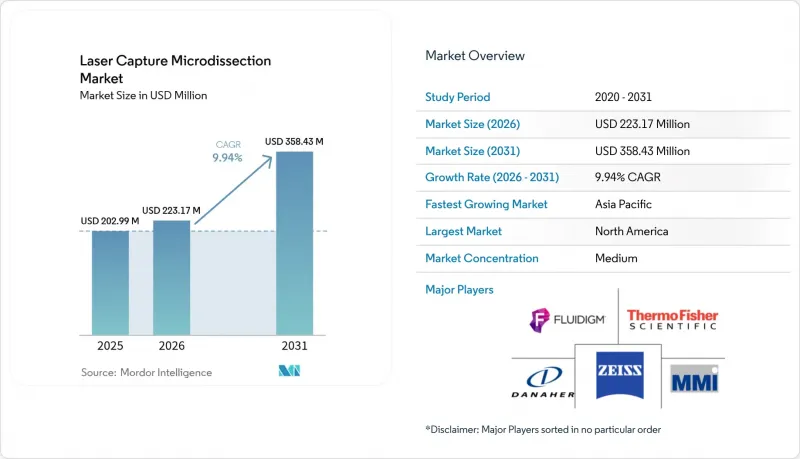
Mordor Intelligence에 의하면, 레이저 캡쳐 미세 절제술(LCM) 시장 규모는 2025년 2억 299만 달러에서 2026년에는 2억 2,317만 달러로 성장하고, 2026-2031년 CAGR 9.94%로 성장을 지속하여 2031년에는 3억 5,843만 달러에 달할 것으로 예측됩니다.
본 보고서는 제품별(장비 등), 시스템 유형별(자외선 LCM 등),용도별(연구개발(유전체학, 단백질체학) 등), 최종 사용자별(학술·정부 연구 기관 등), 지역별(북미, 유럽, 아시아태평양, 중동 및 아프리카, 남미)로 분류되어 있습니다. 시장 예측은 금액(달러) 기준으로 제시되어 있습니다.
전 세계 레이저 캡처 마이크로디섹션 시장 동향 및 인사이트
종양학 및 신경학 분야의 공공·민간 부문 연구개발비 증가
암 및 신경퇴행성 질환으로 인한 사회적 부담의 증대가 자금 유입을 촉진하고 있으며, 레이저 캡처 마이크로디섹션은 학술 기관 및 민간 연구소에서 필수적인 기술이 되고 있습니다. 중국과 일본의 보조금은 단일 세포 유전체학 분야에서 이 기술에 의존하는 국가 수준의 공간 오믹스 허브에 자금을 지원하고 있습니다. 각 종양학 프로젝트에서는 일반적으로 종양 미세환경 매핑에서 치료 모니터링에 이르기까지 여러 단계에 레이저 캡처 마이크로디섹션이 통합되어 있습니다. 현재 이는 경쟁적인 의약품 파이프라인에 있어 필수 요건이 되었으며, 제약 기업 후원사들은 연구 계약에 레이저 캡처 미세 절제술을 명시하고 있습니다. 이러한 안정적인 자금 유입이 모든 주요 지역에서 장기적인 성장 전망을 뒷받침하고 있습니다.
수동 미세 절제술에 대한 기술적 우위
레이저 캡처 미세 절개술은 인접한 세포 간의 크로스톡 위험이 있는 수동 메스 방식과 달리, 일관되게 오염 없는 절편을 생성합니다. 손상되지 않은 분자가 필요한 단일 세포 전사체학으로 연구실이 전환됨에 따라, RNA의 무결성 유지가 중요합니다. 자동화를 통해 조작자의 편향을 배제하고 재현성을 향상시키며, 비용이 많이 드는 재실험을 줄일 수 있습니다. 이미징 모듈을 통해 과학자는 세포 내 수준의 해상도로 형태나 형광을 기반으로 세포 클러스터를 식별할 수 있게 되어, 수동 추출로는 이전에는 불가능했던 발생 생물학 및 질병 진행에 관한 연구가 가능해집니다. 이러한 이점들이 결합되어 워크플로우 소요 시간이 단축되고, 하류 분석에 대한 신뢰성이 높아집니다.
통합 시스템의 높은 도입 및 유지 비용
본격적인 레이저 캡처 미세 절단 워크스테이션의 가격은 종종 50만 달러를 초과하기 때문에 많은 중규모 연구소에게는 감당하기 어려운 수준입니다. 연간 유지보수 계약비는 구매 가격의 15-20%에 달하며, 여기에는 레이저 교정 및 광학계 교체가 포함됩니다. 예산 제약으로 인해 각 기관은 공동 시설을 공유할 수밖에 없어 예약 일정이 포화 상태에 이르러 처리 능력이 저하되고 있습니다. 신흥 시장의 대학에서는 조달 주기가 길어지고 있어, 연구 보조금 확보 경쟁력을 뒷받침해야 할 장비 도입이 지연되고 있습니다. 경제적으로 여유가 있는 지역이라 하더라도 소모품이나 데이터 분석에 대한 예산 배분이 우선시되기 때문에 신규 장비 발주가 늦어지는 경우가 있습니다.
부문 분석
소모품은 가장 빠르게 성장하는 카테고리이며, 고처리량 파이프라인에서는 캡처 필름, 슬라이드, 시약의 지속적인 공급이 필요하기 때문에 2031년까지 연평균 성장률(CAGR) 13.03%로 확대될 것으로 예측됩니다. 장비는 2025년 시점에서 레이저 캡처 마이크로디섹션 시장의 44.05% 점유율을 유지했으나, 구독형 주문 모델로의 전환은 장기적인 워크플로우의 일관성을 중시하는 구매자층이 성숙해졌음을 시사합니다. 소프트웨어 및 서비스는 매출 규모는 작지만, 마이크로디섹션용 하드웨어와 하류 시퀀싱 및 바이오인포매틱스를 연계하는 턴키형 생태계를 요구하는 구매자가 늘어남에 따라 그 중요성이 높아지고 있습니다.
이러한 전환을 통해 공급업체는 소모품에 대한 안정적인 수요를 바탕으로 기존 고객 기반에 자리매김하고, 수익원을 확대할 수 있게 됩니다. 새로운 폴리머 막은 특정 조직 유형에 맞추어 접착력과 두께를 조절할 수 있게 되어 포집 효율이 향상되었습니다. 공급업체는 소모품에 RFID 태그를 부착함으로써 연구소가 로트별 사용 현황을 추적하고 재주문을 자동화할 수 있도록 하고 있습니다. 마이크로플루이딕스와 LCM을 결합한 하이브리드 제품이 시장에 등장함에 따라, 분리 및 용해 기능을 모두 갖춘 완전히 새로운 카트리지 형태가 실현되어, 하드웨어와 소모품의 경계를 모호하게 만드는 통합적인 수익원이 창출될 가능성이 있습니다.
2025년에는 자외선(UV) 시스템이 매출의 51.51%를 차지했지만, 적외선 플랫폼은 하류 오믹스 분석을 위한 DNA 및 단백질을 보호하는 더 온화한 열 특성 덕분에 연평균 15.17%의 성장이 예상됩니다. 또한, 적외선 장치는 세포를 더 깨끗하게 포착할 수 있으므로 오류 없는 라이브러리를 요구하는 단일 세포 분석 파이프라인에 적합합니다. 반면, UV 시스템은 형태 보존이 필수적인 상황, 예를 들어 미세 절개와 기존 조직학을 병행하는 교육 병원 등에서는 여전히 인기가 있습니다.
각 공급업체는 자동화 수준, 시료 이동 속도, 하이컨텐츠 이미지 분석과의 호환성을 통해 차별화를 꾀하고 있습니다. 적외선 플랫폼은 더 낮은 출력 임계값에서 작동하므로 가장자리의 탄화를 억제하고 포획 수율을 향상시킵니다. 반면, 레이저 미세 절제술의 압력 캐터펄트 방식 시스템은 법과학 분야에서 틈새 수요가 있습니다. 이 방식은 비접촉식 배출을 통해 미량 DNA 분석 시 발생할 수 있는 오염 위험을 제거합니다. 이러한 발전들이 결합되어 레이저 캡처 미세 절단 시장은 변화하는 연구 우선순위에 유연하게 대응하고 있습니다.
지역별 분석
북미는 미국 국립보건원(NIH)의 지속적인 자금 지원과 성숙한 제약 연구개발 클러스터에 힘입어 2025년에도 레이저 캡처 마이크로디섹션 시장의 42.42% 점유율을 유지했습니다. 디지털 병리학의 광범위한 도입으로 워크플로우 통합이 간소화되었으며, AI를 활용한 마이크로디섹션 덕분에 인력 부족으로 인한 병목 현상이 완화되고 있습니다. 다만, 인력 부족과 보험 급여 압박이 단기적인 성장을 저해하는 요인으로 작용하고 있습니다.
유럽은 정밀 의학 연구를 지원하는 민관 협력 프로그램을 통해 2위 규모 시장을 자랑하는 지역이 되었습니다. 독일, 영국, 프랑스에는 공유 허브 역할을 하는 여러 레이저 캡처 마이크로디섹션 핵심 시설이 있어 장비 이용 효율을 높이고 있습니다. 동반 진단에 관한 규제 조화를 통해 의료기기 제조업체들은 현지 바이오의약품 기업과의 제휴를 촉진하고 있습니다. 그러나 EU 회원국 간의 자금 조달 격차와 브렉시트 이후 연구 환경의 불확실성으로 인해 유럽 대륙 전체에서 도입률에 편차가 발생하고 있습니다.
아시아태평양은 2031년까지 13.19%라는 가장 높은 연평균 성장률(CAGR)을 보일 것으로 전망됩니다. 중국의 5개년 계획에서는 공간 생물학이 우선 과제로 지정되어, 대규모 실험실 건설 및 일괄 구매 계약이 촉진되고 있습니다. 일본의 연구 기관은 고정밀 적외선 미세 절제술에 의존하는 종양학 및 신경퇴행성 질환 연구에 주력하고 있습니다. 인도의 계약 연구 기관(CRO)은 전 세계 제약 스폰서를 대상으로 서비스 메뉴에 레이저 캡처 미세 절제술을 추가하고 있으나, 인프라 격차와 인력 부족으로 인해 주요 도시 이외 지역에서의 확산이 지연될 가능성이 있습니다. 해당 지역 전체의 공동 투자를 통해 평균을 상회하는 지속적인 성장이 예상됩니다.
기타 혜택:
- 엑셀 형식 시장 예측(ME) 시트
- 3개월간의 애널리스트 지원
자주 묻는 질문
목차
제1장 서론
제2장 조사 방법
제3장 주요 요약
제4장 시장 구도
제5장 시장 규모와 성장 예측
제6장 경쟁 구도
제7장 시장 기회와 향후 전망
LSH 26.09.03According to Mordor Intelligence, the laser capture microdissection market size is expected to grow from USD 202.99 million in 2025 to USD 223.17 million in 2026 and is forecast to reach USD 358.43 million by 2031 at 9.94% CAGR over 2026-2031.
This report is Segmented by Product (Instruments, and More), System Type (Ultraviolet LCM, and More), Application (Research & Development [Genomics, Proteomics], and More), End User (Academic & Government Research Institutes, and More), and Geography (North America, Europe, Asia-Pacific, Middle East and Africa, South America). The Market Forecasts are Provided in Terms of Value (USD).
Global Laser Capture Microdissection Market Trends and Insights
Rising Public & Private-Sector R&D Outlays in Oncology & Neurology
Cancer and neurodegenerative disease burdens spur funding streams that make laser capture microdissection a staple in academic and commercial labs. Chinese and Japanese grants bankroll national spatial-omics hubs that rely on the technique for single-cell genomics. Each oncology project typically loops laser capture microdissection into several stages, from tumor microenvironment mapping to therapy monitoring. The requirement now reads as table stakes for competitive drug pipelines, causing pharmaceutical sponsors to specify laser capture microdissection in research contracts. This steady cash flow underpins long-term growth prospects in every major region.
Technical Advantages Vs. Manual Microdissection
Laser capture microdissection produces contamination-free sections with consistent success, unlike manual scalpel methods that risk cross-talk between adjacent cells. Preservation of RNA integrity matters when labs shift toward single-cell transcriptomics requiring intact molecules. Automation removes operator bias and improves reproducibility, reducing costly re-runs. Imaging modules help scientists identify cell clusters by morphology or fluorescence at sub-cellular resolution, enabling studies in developmental biology and disease progression once impossible with manual extraction. These combined benefits shorten workflow times and raise confidence in downstream analytics.
High Capital & Maintenance Cost of Integrated Systems
Full laser capture microdissection workstations often top USD 500,000, placing them beyond reach for many mid-tier labs. Annual service contracts reach 15-20% of purchase value, covering laser calibration and optics replacement. Limited budgets force institutions to share core facilities, stretching booking schedules and lowering throughput. Emerging-market universities find procurement cycles lengthy, delaying installations that could support grant competitiveness. Even in wealthier regions, budget reallocations toward consumables and data analysis sometimes slow new equipment orders.
Other drivers and restraints analyzed in the detailed report include:
- Surge in Spatial-Omics & Single-Cell Multi-Omics Workflows
- Growth in Precision-Medicine Biomarker Discovery Programs
- Shortage of Pathologists & Trained Technologists in Histology Labs
For complete list of drivers and restraints, kindly check the Table Of Contents.
Segment Analysis
Consumables are the fastest rising category, projected to climb at a 13.03% CAGR through 2031 as high-throughput pipelines require continuous supplies of capture films, slides, and reagents. Instruments retained a 44.05% laser capture microdissection market share in 2025, yet the shift to subscription-style ordering models signals a maturing buyer base focused on long-term workflow consistency. Software & services, though smaller in sales, gain relevance as buyers seek turnkey ecosystems that link microdissection hardware to downstream sequencing and bioinformatics.
This transition widens profit pools by anchoring vendors to installed bases through steady consumable demand. Novel polymer membranes now tailor adhesion and thickness to specific tissue classes, improving capture efficiency. Suppliers add RFID tags to consumables so laboratories can track batch usage and automate re-ordering. As microfluidic-LCM hybrids reach market, entirely new cartridge formats could deliver combined isolation and lysis, enabling bundled revenue streams that blur the boundary between hardware and consumables.
Ultraviolet systems owned 51.51% revenue in 2025, yet infrared platforms are forecast to expand 15.17% yearly thanks to milder thermal signatures that protect DNA and proteins for downstream omics. Infrared devices also capture cells more cleanly, which suits single-cell pipelines seeking error-free libraries. UV systems remain popular where morphological preservation is essential, such as teaching hospitals that pair microdissection with conventional histology.
Vendors differentiate through automation depth, sample navigation speed, and compatibility with high-content image analysis. Infrared platforms operate at lower power thresholds that cut edge carbonization, enhancing capture yield. Meanwhile, laser microdissection pressure-catapulting systems find niche demand in forensic science, where non-contact ejection eliminates contamination risk in trace DNA work. Together these advances keep the laser capture microdissection market responsive to shifting research priorities.
Complete Report Scope:
- By Product
- Instruments
- Consumables
- Software & Services
- By System Type
- Ultraviolet LCM
- Infrared LCM
- Immunofluorescence-guided LCM
- LMPC (Laser Microdissection Pressure-Catapulting)
- By Application
- Research & Development
- Genomics
- Proteomics
- Diagnostics
- Oncology
- Pathology and Cytopathology
- Forensics & Others
- Research & Development
- By End User
- Academic & Government Research Institutes
- Hospitals
- Pharmaceutical, Biotechology Companies & CROs
- Forensic Science Laboratories
- By Geography
- North America
- United States
- Canada
- Mexico
- Europe
- Germany
- United Kingdom
- France
- Italy
- Spain
- Rest of Europe
- Asia-Pacific
- China
- Japan
- India
- Australia
- South Korea
- Rest of Asia-Pacific
- Middle East & Africa
- GCC
- South Africa
- Rest of Middle East & Africa
- South America
- Brazil
- Argentina
- Rest of South America
- North America
Geography Analysis
North America retained 42.42% of laser capture microdissection market share in 2025, supported by sustained National Institutes of Health funding and mature pharmaceutical R&D clusters. Widespread adoption of digital pathology simplifies workflow integration, while AI-assisted microdissection reduces labor bottlenecks. Nevertheless, staffing shortages and reimbursement pressures temper near-term growth.
Europe follows as the second-largest region through concerted public-private programs that back precision-medicine research. Germany, the United Kingdom, and France house multiple laser capture microdissection core facilities that operate as shared hubs, improving equipment utilization. Harmonized companion diagnostic regulations encourage device makers to partner with local biopharma companies. Still, funding variability among EU states and post-Brexit research uncertainties create uneven adoption rates across the continent.
Asia-Pacific posts the fastest 13.19% CAGR to 2031. China's Five-Year Plan prioritizes spatial biology, prompting large-scale laboratory construction and bulk purchasing agreements. Japanese institutes pursue oncology and neurodegeneration studies that depend on high-fidelity infrared microdissection. India's contract research organizations add laser capture microdissection to service menus for global drug sponsors, yet infrastructure gaps and talent shortages may slow rollout outside tier-one cities. Collective investment across the region points to sustained, above-average expansion.
- Carl Zeiss
- Danaher Corp (Leica Microsystems)
- Thermo Fisher Scientific
- Molecular Machines & Industries
- Fluidigm Corp.
- LLS Rowiak LaserLabSolutions GmbH
- Molecular Devices
- Hamilton Thorne
- Motic Instruments Inc.
- MicroSupport Co. Ltd.
- Epistem Ltd.
- VitroVivo Biotech LLC
- Caresbio Laboratory
- GnomeDX LLC
- Biogenity Ltd.
- PALM MicroBeam
- Tecan Group
- Omnit Labs
- AvanSci Bio
- NIKON Instruments Inc.
Additional Benefits:
- The market estimate (ME) sheet in Excel format
- 3 months of analyst support
TABLE OF CONTENTS
1 Introduction
- 1.1 Study Assumptions & Market Definition
- 1.2 Scope of the Study
2 Research Methodology
3 Executive Summary
4 Market Landscape
- 4.1 Market Overview
- 4.2 Market Drivers
- 4.2.1 Rising Public & Private-Sector R&D Outlays in Oncology & Neurology
- 4.2.2 Technical Advantages Vs. Manual Microdissection
- 4.2.3 Surge in Spatial-Omics & Single-Cell Multi-Omics Workflows
- 4.2.4 Growth in Precision-Medicine Biomarker Discovery Programs
- 4.2.5 AI-Guided Image Recognition Enabling Fully Automated LCM
- 4.2.6 Emergence of Microfluidic-LCM Hybrids for High-Throughput Sample Prep
- 4.3 Market Restraints
- 4.3.1 High Capital & Maintenance Cost of Integrated Systems
- 4.3.2 Shortage of Pathologists & Trained Technologists in Histology Labs
- 4.3.3 Thermal / UV-Induced Nucleic-Acid Damage Risk in Delicate Samples
- 4.3.4 Competition From Droplet-Based Single-Cell Isolation Platforms
- 4.4 Porter's Five Forces Analysis
- 4.4.1 Threat of New Entrants
- 4.4.2 Bargaining Power of Buyers
- 4.4.3 Bargaining Power of Suppliers
- 4.4.4 Threat of Substitutes
- 4.4.5 Competitive Rivalry
5 Market Size & Growth Forecasts (Value in USD)
- 5.1 By Product
- 5.1.1 Instruments
- 5.1.2 Consumables
- 5.1.3 Software & Services
- 5.2 By System Type
- 5.2.1 Ultraviolet LCM
- 5.2.2 Infrared LCM
- 5.2.3 Immunofluorescence-guided LCM
- 5.2.4 LMPC (Laser Microdissection Pressure-Catapulting)
- 5.3 By Application
- 5.3.1 Research & Development
- 5.3.1.1 Genomics
- 5.3.1.2 Proteomics
- 5.3.2 Diagnostics
- 5.3.2.1 Oncology
- 5.3.2.2 Pathology and Cytopathology
- 5.3.3 Forensics & Others
- 5.3.1 Research & Development
- 5.4 By End User
- 5.4.1 Academic & Government Research Institutes
- 5.4.2 Hospitals
- 5.4.3 Pharmaceutical, Biotechology Companies & CROs
- 5.4.4 Forensic Science Laboratories
- 5.5 By Geography
- 5.5.1 North America
- 5.5.1.1 United States
- 5.5.1.2 Canada
- 5.5.1.3 Mexico
- 5.5.2 Europe
- 5.5.2.1 Germany
- 5.5.2.2 United Kingdom
- 5.5.2.3 France
- 5.5.2.4 Italy
- 5.5.2.5 Spain
- 5.5.2.6 Rest of Europe
- 5.5.3 Asia-Pacific
- 5.5.3.1 China
- 5.5.3.2 Japan
- 5.5.3.3 India
- 5.5.3.4 Australia
- 5.5.3.5 South Korea
- 5.5.3.6 Rest of Asia-Pacific
- 5.5.4 Middle East & Africa
- 5.5.4.1 GCC
- 5.5.4.2 South Africa
- 5.5.4.3 Rest of Middle East & Africa
- 5.5.5 South America
- 5.5.5.1 Brazil
- 5.5.5.2 Argentina
- 5.5.5.3 Rest of South America
- 5.5.1 North America
6 Competitive Landscape
- 6.1 Market Concentration
- 6.2 Market Share Analysis
- 6.3 Company Profiles (includes Global level Overview, Market level overview, Core Segments, Financials as available, Strategic Information, Market Rank/Share for key companies, Products & Services, and Recent Developments)
- 6.3.1 Carl Zeiss Meditec AG
- 6.3.2 Danaher Corp (Leica Microsystems)
- 6.3.3 Thermo Fisher Scientific Inc.
- 6.3.4 Molecular Machines & Industries GmbH
- 6.3.5 Fluidigm Corp.
- 6.3.6 LLS Rowiak LaserLabSolutions GmbH
- 6.3.7 Molecular Devices LLC
- 6.3.8 Hamilton Thorne Inc.
- 6.3.9 Motic Instruments Inc.
- 6.3.10 MicroSupport Co. Ltd.
- 6.3.11 Epistem Ltd.
- 6.3.12 VitroVivo Biotech LLC
- 6.3.13 Caresbio Laboratory LLC
- 6.3.14 GnomeDX LLC
- 6.3.15 Biogenity Ltd.
- 6.3.16 PALM MicroBeam
- 6.3.17 Tecan Group Ltd.
- 6.3.18 Omnit Labs
- 6.3.19 AvanSci Bio
- 6.3.20 NIKON Instruments Inc.
7 Market Opportunities & Future Outlook
- 7.1 White-space & Unmet-need Assessment