|
시장보고서
상품코드
2122590
정형외과용 소프트웨어 : 시장 점유율 분석, 업계 동향 및 통계, 성장 예측(2026-2031년)Orthopedic Software - Market Share Analysis, Industry Trends & Statistics, Growth Forecasts (2026 - 2031) |
||||||
 Mordor Intelligence
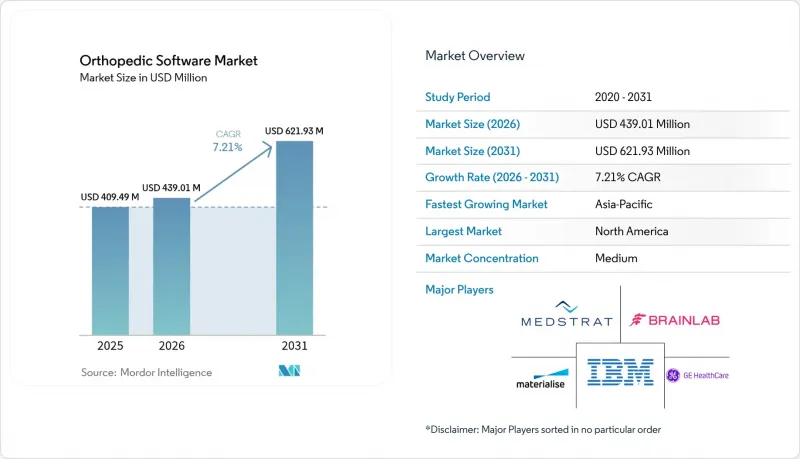
Mordor Intelligence에 의하면, 정형외과용 소프트웨어 시장 규모는 2025년 4억 949만 달러로 평가되었습니다. 2026년에는 4억 3,901만 달러로 확대되어 2026년부터 2031년에 걸쳐 CAGR 7.21%로 성장을 지속하여, 2031년에는 6억 2,193만 달러에 이를 것으로 예측됩니다.

본 보고서에서는 업계를 제품 유형(디지털 템플릿/수술 전 계획, 정형외과용 전자 차트 등), 제공 형태(클라우드/웹 기반 등), 용도(정형외과 수술 등), 최종 사용자(병원 등), 지역(북미, 유럽, 아시아태평양, 중동 및 아프리카, 남미)별로 분류하고 있습니다. 시장 전망은 금액(달러) 기준으로 제시되어 있습니다.
세계의 정형외과용 소프트웨어 시장 동향 및 인사이트
고령화로 인한 퇴행성 관절염 및 골절 사례 증가
세계적으로 65세 이상 인구가 계속 증가함에 따라 퇴행성 관절 질환 및 골절 발생률이 높아지고 있으며, 이는 수작업에 의존하는 업무 흐름에 부담을 주고 있습니다. 디지털 템플릿 기술을 통해 수술 시간을 15-20% 단축하고 임플란트 배치 정확도를 향상시킴으로써, 외과의사는 치료 성과를 저해하지 않으면서 더 많은 사례를 처리할 수 있게 됩니다. AI를 활용한 영상 진단은 골 병변의 조기 발견에서 90% 이상의 진단 정확도를 달성하고 있어, 장기적인 비용 부담을 완화하는 예방적 개입을 가능하게 합니다. 통합된 수익 사이클 모듈은 복잡한 고령자 대상 청구 업무를 효율화하여, 보험사의 면밀한 심사에 직면한 의료기관의 이익 확보를 지원합니다.
외래 및 최소 침습 정형외과 수술로의 급속한 전환
ASC(외래수술센터(ASC))의 시술 건수는 연평균 6.9%로 증가하고 있으며, 정형외과 외래 수술 건수는 향후 10년 동안 13% 증가할 것으로 예측됩니다. 이러한 환경에서는 신속한 환자 회전, 소규모 수술실, 엄격한 자본 예산에 대응할 수 있는 클라우드 네이티브 소프트웨어가 요구됩니다. CMS(미국 의료보험센터)의 어깨 관절 치환술 외래 진료비 승인은 첨단 계획 도구의 도입을 가속화하고 있습니다. 현재 인증된 EHR(전자 건강 기록)을 도입한 ASC는 54.6%에 그치고 있어, 이는 전문 벤더에게 상당한 잠재 시장이 존재함을 시사합니다.
정형외과 정보학 및 영상진단 IT 전문가 부족
고급 EHR 도입에는 전 세계적으로 최대 15만 3,114명 분의 IT 정규직 상당 인력이 추가로 필요하지만, 인재 양성 체계가 수요를 따라가지 못하고 있습니다. 지방에 위치한 전문 클리닉은 벤더의 서비스에 의존하고 있어 도입 비용이 높아지고, 도입 기간도 장기화되고 있습니다. 따라서 도입, 교육, 매니지드 서비스를 패키지로 묶은 벤더는 전략적 우위를 확보할 수 있습니다.
부문별 분석
2025년, 디지털 템플릿은 정형외과용 소프트웨어 시장에서 35.12%의 점유율을 차지했으며, 이는 재수술률 감소 및 수술 시간 단축에 효과적인 것으로 입증된 사실을 반영합니다. 이 하위 부문은 과거 사례로부터 학습하는 AI 이미지 분할 모듈의 혜택을 받아 표준화된 임플란트 계획을 수립하고, 외과의사 간의 편차를 줄이고 있습니다. 정형외과용 PACS는 MRI 및 CT 검사 건수 증가와 필름 폐지를 향한 규제 움직임에 힘입어 연평균 성장률(CAGR) 9.52%를 나타낼 것으로 예측됩니다. 가치 기반 계약이 증가하는 가운데, 수익 주기 관리 도구는 여전히 필수적이며, 한편 통합형 전자 건강 기록(EHR)에는 근골격계 워크플로우에 맞춘 전문적인 의사 결정 지원 기능이 통합되어 있습니다. 재활 진행 상황을 임상 기록과 동기화하는 환자 참여 앱은 피드백 루프를 완성하고 종합적 지불 제도 준수를 지원합니다.
보완적인 모듈은 스케줄링, 영상 진단, 수술실 재고 관리를 통합하는 개방형 API 백본을 중심으로 집약되어 있습니다. 각 벤더는 현재 3D 렌더링을 위한 클라우드 기능을 도입하여 로컬 서버의 계산 부하를 경감하고 있습니다. 디지털 템플릿이 구조화된 데이터를 로봇 제어 콘솔로 내보냄으로써 수술 중 조정이 줄어들고, 수술 후 정렬 점수가 향상되고 있습니다. 템플릿 제작 및 PACS와 관련된 정형외과용 소프트웨어 시장 규모는 팬데믹 기간 동안 연기된 선택적 수술의 미처리 건수에 힘입어 연평균 8-9%의 안정적인 속도로 확대될 것으로 예측됩니다.
2025년에는 정형외과용 소프트웨어 시장의 58.74%를 클라우드 도입이 차지했으며, 2031년까지 연평균 성장률(CAGR) 11.42%를 나타낼 것으로 전망됩니다. 구독형 가격 정책은 외래수술센터(ASC)의 현금 흐름에 부합하며, 소규모 클리닉이 막대한 설비 투자 부담을 덜 수 있게 해줍니다. 각 벤더는 다운타임이 없는 업그레이드와 엣지에서 클라우드로의 암호화된 동기화를 강조하고 있으며, 이를 통해 이전에 우려되었던 지연 및 데이터 주권 문제를 극복하고 있습니다. 기밀성이 높은 연구용 이미지를 시설 내에 보관하면서 AI 모델 훈련에는 클라우드 분석을 활용하는 학술 기관의 경우, 하이브리드 모델이 여전히 유효합니다.
광대역 대역폭이 제한적이거나 데이터 관리 규정에 따라 오프사이트 저장이 금지된 경우에는 On-Premise형 시스템이 계속 사용됩니다. 이러한 경우에도 벤더는 데이터 세트를 재해 복구용 클라우드로 미러링하는 모듈식 게이트웨이를 제공합니다. 퍼블릭 클라우드 제공업체들이 HIPAA 및 GDPR(EU 개인정보보호규정) 인증을 획득함에 따라, 도입을 주저하던 기관들도 점차 전환해 나갈 것으로 예측됩니다. 현재의 도입 추세가 유지된다면, 클라우드 소프트웨어에 기인한 정형외과용 소프트웨어 시장 규모는 2031년까지 4억 780만 달러를 넘어설 전망입니다.
지역별 분석
북미는 확립된 환급 경로와 성숙한 클라우드 인프라 덕분에 2025년 총 수익의 39.33%를 차지했습니다. 미국의 메디케어 정책은 품질 지표를 뒷받침하는 전자 문서화를 장려하여 의료 기관이 통합 솔루션을 채택하도록 유도하고 있습니다. 캐나다 각 주에서 전자 데이터 공유를 의무화함으로써 수요가 더욱 공고해졌으며, 국경을 초월한 벤더와의 관계가 기술 이전을 용이하게 하고 있습니다.
아시아태평양은 12.79%라는 가장 높은 연평균 성장률(CAGR)을 기록하고 있습니다. 중국의 ‘건강 중국’ 구상은 디지털 헬스 시범 사업에 자금을 지원하고 있으며, 성립 병원이 조기 도입자로서의 입지를 확고히 하고 있습니다. 일본은 외과 의사 인력 부족을 보완하기 위해 로봇 공학과 AI를 활용하고 있는 반면, 인도에서는 민관 파트너십을 통해 3차 외상 센터에 클라우드 기반 전자건강기록(EHR)을 도입하기 위한 자금이 조달되고 있습니다. 지역별 이질성으로 인해, 서로 다른 개인정보 보호 법규를 준수하는 모듈식이며 언어 지원이 완료된 플랫폼이 선호되고 있습니다.
유럽에서 꾸준한 도입을 주도하고 있는 것은 독일이며, 이 나라에서는 연방 정부의 보조금을 통해 엄격한 GDPR(EU 개인정보보호규정) 규정을 준수하는 진료소의 정형외과 분야 디지털화가 지원되고 있습니다. 영국의 NHS 상호운용성 프로그램에서는 정형외과 의뢰서에 FHIR 메시징 사용이 규정되어 있으며, 검증된 데이터 교환 워크플로우를 보유한 벤더들이 앞서 나가고 있습니다. 프랑스에서는 외래 방사선과에서 정형외과 병동으로의 실시간 영상 전송이 필요한 연계 진료 네트워크에 혁신 예산이 투입되고 있습니다. EU 전역에서 재수술률 감소를 입증하는 증거는 투자 승인의 핵심 요소이며, 풍부한 데이터를 보유한 공급업체가 유리한 입지에 있습니다.
기타 혜택 :
- 엑셀 형식 시장 예측(ME) 시트
- 3개월간의 애널리스트 지원
자주 묻는 질문
목차
제1장 서론
제2장 조사 방법
제3장 주요 요약
제4장 시장 구도
제5장 시장 규모 및 성장 예측
제6장 경쟁 구도
제7장 시장 기회 및 향후 전망
KTH 26.09.08According to Mordor Intelligence, the orthopedic software market size is expected to grow from USD 409.49 million in 2025 to USD 439.01 million in 2026 and is forecast to reach USD 621.93 million by 2031 at 7.21% CAGR over 2026-2031.
This report Segments the Industry Into by Product Type (Digital Templating / Pre-Operative Planning, Orthopedic EHR, and More), Mode of Delivery (Cloud/Web Based, and More), Application (Orthopedic Surgery, and More), End User (Hospitals, and More), and Geography (North America, Europe, Asia-Pacific, Middle East and Africa, South America). The Market Forecasts are Provided in Terms of Value (USD).
Global Orthopedic Software Market Trends and Insights
Aging Population Boosting Osteoarthritis & Fracture Case-Load
Global populations aged 65+ continue to expand, driving up degenerative joint disease and fracture incidence that strain manual workflows. Digital templating decreases surgical time by 15-20% and improves implant placement accuracy, helping surgeons handle higher caseloads without compromising outcomes. AI-driven imaging reaches over 90% diagnostic accuracy for early bone pathology detection, enabling proactive interventions that ease long-term cost pressures. Integrated revenue-cycle modules streamline complex geriatric billing, improving margin security for practices facing payer scrutiny.
Rapid Shift to Ambulatory & Minimally-Invasive Orthopedic Surgery
ASC volumes are climbing at 6.9% annually, with orthopedic outpatient procedures projected to grow 13% this decade. These settings require cloud-native software that supports rapid turnover, small operating suites, and tight capital budgets. CMS approval of shoulder replacements for outpatient reimbursement accelerates adoption of advanced planning tools. Only 54.6% of ASCs presently operate certified EHRs, signaling a sizable addressable market for specialty vendors.
Shortage of Orthopedic Informatics & Imaging IT Specialists
Advanced EHR rollouts require up to 153,114 additional IT full-time equivalents worldwide, yet training pipelines lag demand. Specialty clinics in rural settings depend on vendor services, elevating deployment cost and elongating timelines. Vendors that bundle implementation, training, and managed services thus gain a strategic edge.
Other drivers and restraints analyzed in the detailed report include:
- Mandatory EHR / PACS Interoperability
- 3-D Digital Templating Proven to Cut Implant Revision Rates
- Soaring Cyber-Insurance Premiums after Ransomware Incidents
For complete list of drivers and restraints, kindly check the Table Of Contents.
Segment Analysis
Digital templating held a 35.12% orthopedic software market share in 2025, reflecting its proven ability to lower revision rates and trim operating-room minutes. The sub-segment benefits from AI image-segmentation modules that learn from prior cases, yielding standardized implant plans and reducing inter-surgeon variability. Orthopedic PACS is projected to post a 9.52% CAGR, fueled by climbing MRI and CT volumes and regulatory moves to eliminate film. Revenue-cycle tools remain essential as value-based contracts rise, while integrated EHRs embed specialty decision support tailored to musculoskeletal workflows. Patient-engagement apps that sync rehab milestones into the clinical record close the feedback loop, supporting bundled-payment compliance.
Complementary modules converge around an open-API backbone that unifies scheduling, imaging, and OR inventory control. Vendors now deploy cloud functions for 3-D rendering, offloading compute workload from local servers. As digital templating exports structured data to robotics consoles, intra-operative adjustments shrink and post-operative alignment scores improve. The Orthopedic software market size tied to templating and PACS is forecast to expand at a steady 8-9% pace, underpinned by a backlog of elective cases deferred during pandemic years.
Cloud deployments comprised 58.74% of the orthopedic software market in 2025 and are tracking an 11.42% CAGR to 2031. Subscription pricing aligns with ASC cashflows and shields smaller clinics from large capital outlays. Vendors emphasize zero-downtime upgrades and encrypted edge-to-cloud sync, overcoming earlier fears of latency and data sovereignty. Hybrid models remain relevant for academic centers that house sensitive research images onsite while using cloud analytics for AI model-training.
On-premise systems persist where wide-area bandwidth is limited or data guardianship rules forbid offsite storage. Even here, suppliers offer modular gateways that mirror datasets to disaster-recovery clouds. As public cloud providers win HIPAA and GDPR attestations, holdouts are expected to convert. The Orthopedic software market size attributed to cloud software will likely exceed USD 407.8 million by 2031 if current adoption curves hold.
Complete Report Scope:
- By Product Type
- Digital Templating / Pre-operative Planning
- Orthopedic EHR
- Orthopedic Practice Management
- Orthopedic PACS
- Revenue Cycle Management
- Other Software
- By Mode of Delivery
- Cloud / Web-based
- On-premise
- By Application
- Orthopedic Surgery
- Fracture Management
- Joint Replacement
- Pediatric Assessment
- Other Applications
- By End User
- Hospitals
- Ambulatory Surgical Centers
- Orthopedic Clinics
- Academic & Research Institutes
- By Geography
- North America
- United States
- Canada
- Mexico
- Europe
- Germany
- United Kingdom
- France
- Italy
- Spain
- Rest of Europe
- Asia-Pacific
- China
- Japan
- India
- Australia
- South Korea
- Rest of Asia-Pacific
- Middle East & Africa
- GCC
- South Africa
- Rest of Middle East & Africa
- South America
- Brazil
- Argentina
- Rest of South America
- North America
Geography Analysis
North America accounted for 39.33% of total revenue in 2025 thanks to established reimbursement pathways and mature cloud infrastructure. U.S. Medicare policies reward digital documentation that supports quality metrics, encouraging practices to adopt integrated solutions. Canada's provincial mandates for electronic data sharing further entrench demand, and cross-border vendor relationships ease technology transfers.
Asia-Pacific is registering the strongest 12.79% CAGR. China's Healthy China blueprint funds digital health pilots, positioning provincial hospitals as early adopters. Japan utilizes robotics and AI to offset surgical labor shortages, while India's public-private partnerships finance cloud EHRs in tertiary trauma centers. Regional heterogeneity favors modular, language-localised platforms that comply with divergent privacy statutes.
Europe's steady adoption is led by Germany, where federal grants subsidize orthopedic digitization in clinics complying with stringent GDPR controls. The U.K.'s NHS Interoperability program specifies FHIR messaging for orthopedic referrals, giving vendors with proven data-exchange workflows a head start. France channels innovation budgets toward coordinated care networks that require real-time image routing from outpatient radiology to orthopedic wards. Across the bloc, evidence of lower revision rates is pivotal to investment sign-off, placing data-rich suppliers in an advantageous position.
- Athenahealth
- Brain Lab
- CureMD Healthcare
- GE Healthcare
- Greenway Health
- IBM (Merge Healthcare)
- Materialise
- Medstrat
- NextGen Healthcare
- Breg
- mediCAD Hectec
- Rayence
- Stryker
- Zimmer Biomet
- Smiths Group
- Mckesson
- HealthFusion
- Allscripts
- Medhost
- Touch Surgery
Additional Benefits:
- The market estimate (ME) sheet in Excel format
- 3 months of analyst support
TABLE OF CONTENTS
1 Introduction
- 1.1 Study Assumptions & Market Definition
- 1.2 Scope of the Study
2 Research Methodology
3 Executive Summary
4 Market Landscape
- 4.1 Market Overview
- 4.2 Market Drivers
- 4.2.1 Aging Population Boosting Osteoarthritis & Fracture Case-Load
- 4.2.2 Rapid Shift to Ambulatory & Minimally-Invasive Orthopedic Surgery
- 4.2.3 Mandatory EHR / PACS Interoperability
- 4.2.4 3-D Digital Templating Proven to Cut Implant Revision Rates
- 4.2.5 AI Auto-Templating Reduces Sterile Tray Inventory
- 4.2.6 Ortho-Software API Marketplaces Unlocking New Saas Revenue for Clinics
- 4.3 Market Restraints
- 4.3.1 Shortage of Orthopedic Informatics & Imaging IT Specialists
- 4.3.2 High Capital Cost and Workflow Disruption During System Migration
- 4.3.3 Complex HIPAA / GDPR Compliance for Cloud Data Hosting
- 4.3.4 Soaring Cyber-Insurance Premiums after Ransomware Incidents
- 4.4 Porter's Five Forces Analysis
- 4.4.1 Threat of New Entrants
- 4.4.2 Bargaining Power of Buyers
- 4.4.3 Bargaining Power of Suppliers
- 4.4.4 Threat of Substitutes
- 4.4.5 Intensity of Competitive Rivalry
5 Market Size & Growth Forecasts (Value in USD)
- 5.1 By Product Type
- 5.1.1 Digital Templating / Pre-operative Planning
- 5.1.2 Orthopedic EHR
- 5.1.3 Orthopedic Practice Management
- 5.1.4 Orthopedic PACS
- 5.1.5 Revenue Cycle Management
- 5.1.6 Other Software
- 5.2 By Mode of Delivery
- 5.2.1 Cloud / Web-based
- 5.2.2 On-premise
- 5.3 By Application
- 5.3.1 Orthopedic Surgery
- 5.3.2 Fracture Management
- 5.3.3 Joint Replacement
- 5.3.4 Pediatric Assessment
- 5.3.5 Other Applications
- 5.4 By End User
- 5.4.1 Hospitals
- 5.4.2 Ambulatory Surgical Centers
- 5.4.3 Orthopedic Clinics
- 5.4.4 Academic & Research Institutes
- 5.5 By Geography
- 5.5.1 North America
- 5.5.1.1 United States
- 5.5.1.2 Canada
- 5.5.1.3 Mexico
- 5.5.2 Europe
- 5.5.2.1 Germany
- 5.5.2.2 United Kingdom
- 5.5.2.3 France
- 5.5.2.4 Italy
- 5.5.2.5 Spain
- 5.5.2.6 Rest of Europe
- 5.5.3 Asia-Pacific
- 5.5.3.1 China
- 5.5.3.2 Japan
- 5.5.3.3 India
- 5.5.3.4 Australia
- 5.5.3.5 South Korea
- 5.5.3.6 Rest of Asia-Pacific
- 5.5.4 Middle East & Africa
- 5.5.4.1 GCC
- 5.5.4.2 South Africa
- 5.5.4.3 Rest of Middle East & Africa
- 5.5.5 South America
- 5.5.5.1 Brazil
- 5.5.5.2 Argentina
- 5.5.5.3 Rest of South America
- 5.5.1 North America
6 Competitive Landscape
- 6.1 Market Concentration
- 6.2 Market Share Analysis
- 6.3 Company Profiles (includes Global-level Overview, Market-level Overview, Core Segments, Financials as available, Strategic Information, Market Rank/Share for key companies, Products & Services, Recent Developments)
- 6.3.1 Athenahealth
- 6.3.2 Brainlab
- 6.3.3 CureMD Healthcare
- 6.3.4 GE Healthcare
- 6.3.5 Greenway Health
- 6.3.6 IBM (Merge Healthcare)
- 6.3.7 Materialise
- 6.3.8 Medstrat
- 6.3.9 NextGen Healthcare
- 6.3.10 Breg
- 6.3.11 mediCAD Hectec
- 6.3.12 Rayence
- 6.3.13 Stryker
- 6.3.14 Zimmer Biomet
- 6.3.15 Smith & Nephew
- 6.3.16 McKesson
- 6.3.17 HealthFusion
- 6.3.18 Allscripts
- 6.3.19 Medhost
- 6.3.20 Touch Surgery
7 Market Opportunities & Future Outlook
- 7.1 White-space & Unmet-need Assessment