

|
시장보고서
상품코드
2122592
세포 분리 : 시장 점유율 분석, 업계 동향 및 통계, 성장 예측(2026-2031년)Cell Dissociation - Market Share Analysis, Industry Trends & Statistics, Growth Forecasts (2026 - 2031) |
||||||
 Mordor Intelligence
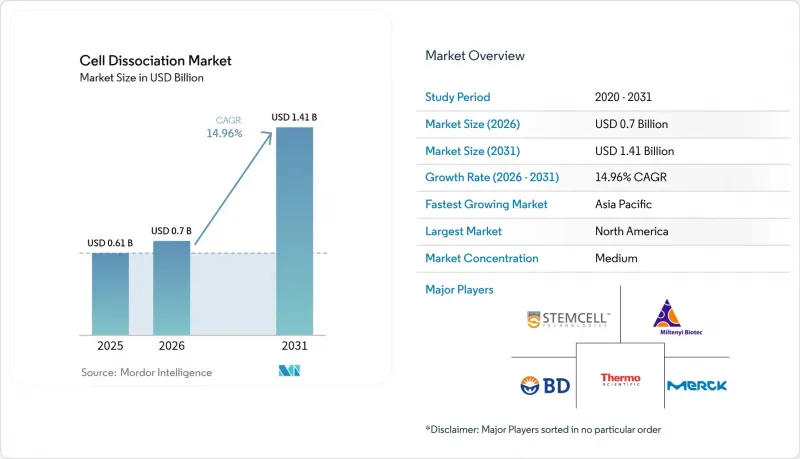
Mordor Intelligence에 의하면, 세포 분리 시장 규모는 2025년에 6억 1,000만 달러로 평가되었습니다. 2026년 7억 달러에서 2031년까지 14억 1,000만 달러에 이를 것으로 추정되고 예측 기간(2026-2031년) CAGR은 14.96%를 나타낼 전망입니다.

본 보고서는 제품별(효소를 이용한 세포 분산 제품 등), 조직별(결합 조직, 상피 조직, 근육 조직 등), 최종 사용자별(제약·바이오기술 기업, 연구·학술 기관 등), 지역별(북미, 유럽, 아시아태평양, 중동 및 아프리카, 남미)로 분류되어 있습니다. 시장 예측은 금액(달러) 기준으로 제시되어 있습니다.
세계의 세포 분리 시장 동향 및 인사이트
세포 및 유전자 치료 파이프라인의 확대
2024년에는 7개의 세포 및 유전자 치료제가 FDA 승인을 획득했으며, FDA는 2025년까지 매년 10-20건의 승인이 이루어졌습니다. 각 제품에는 고도의 세포 분리 프로토콜이 필요하며, 로트 릴리스 비용을 50% 절감할 수 있는 자동 세포 분산 플랫폼에 대한 수요가 증가하고 있습니다. 고형암 및 자가면역 질환을 대상으로 하는 프로그램에서는 사용되는 조직의 유형가 다양해지고 있어, 시약의 품질 및 확장성에 대한 요구 사항이 더욱 엄격해지고 있습니다. 동종 이식 형태에서는 기증자 1인당 배치량이 더욱 증가하므로, 표준화된 GMP 등급 워크플로우의 필요성이 강조되고 있습니다.
단일 세포 오믹스 기술의 보급 확대
현재 마이크로유체 칩은 1회 실행으로 10만 개 이상의 세포를 처리할 수 있어, 기존 처리 능력에 비해 비약적인 향상을 이루었습니다. RNA의 무결성을 유지하기 위해 새로운 FixNCut 프로토콜을 통해 분산 전 가역적인 조직 고정이 가능해졌으며, 데이터 유출 없이 검체를 쉽게 운반할 수 있게 되었습니다. 불균일성 연구에서는 생존율이 높은 단일 세포 현탁액이 필수적이기 때문에 종양학 분야에서 수요가 주류를 이루고 있습니다. AI를 활용한 파이프라인의 보급으로 인해, 편차를 최소화하는 표준화된 프로토콜의 도입이 더욱 가속화되고 있습니다.
첨단 세포 분산 기술의 높은 비용
밀폐형 완전 자동화 시스템은 100만 달러를 초과하는 경우가 많아, 소규모 연구실에서의 도입을 저해하고 있습니다. 전 세계적인 췌장 효소 공급 부족으로 인해 원자재 비용과 납기 기간이 더욱 증가하고 있습니다. 중국의 CAR-T 치료 현황은 높은 생산 비용으로 인해 치료비의 대부분을 환자 본인 부담으로 전가할 가능성이 있음을 시사하고 있습니다.
부문별 분석
2025년에는 효소계 시약이 58.21%의 점유율을 유지했으며, Clostridium histolyticum 유래의 세균성 콜라게나제는 그 특이성으로 인해 높은 평가를 받았습니다. 트립신은 일상적인 계대 배양에서 주류를 이루는 반면, 디스퍼스와 엘라스타제는 틈새 용도로 사용되고 있습니다. 비효소계 제제는 단일 세포 워크플로우에서 프로테아제에 대한 노출을 피하려는 경향이 강해지고 있어 17.08%라는 가장 높은 연평균 성장률(CAGR)을 기록하고 있습니다. ATCC의 킬레이트제 기반 솔루션과 재조합 TrypLE는 규제 준수를 고려한 이러한 변화를 상징하는 사례입니다. 자동 조직 분산 장치에는 조작자에 의한 편차를 최소화하기 위해 현재 시약 카트리지가 동봉되어 있습니다.
지역별 분석
북미는 첨단 치료법에 대한 FDA의 패스트 트랙 제도의 뒷받침을 받아 2025년에는 시장 점유율의 38.32%를 차지했습니다. 뉴욕에 위치한 4억 3,000만 달러 규모의 ‘BioGenesis Park’는 1,530개의 일자리를 창출하고 새로운 GMP 대응 시설을 구축하고 있습니다. 캐나다가 STEMCELL Technologies사에 2,250만 달러를 투자함으로써 국내 시약 생산 능력이 확보되었습니다. Sartorius와 Siemens는 로트 릴리스 시간을 단축하는 디지털 트윈을 활용한 자동화 기술 분야에서 제휴하고 있습니다.
아시아태평양은 중국의 41억 7,000만 달러 규모의 바이오파크 프로그램을 견인력으로 연평균 성장률(CAGR) 16.21%를 기록하며 성장하고 있습니다. 일본의 ‘스타트업 육성 5개년 계획’과 고령화 사회 수요에 힘입어, 생명공학 시장은 2030년까지 15조 엔 규모로 성장할 전망입니다. 인도의 ‘BioE3’ 정책은 미국의 ‘바이오시큐어법’ 준수에 따른 공급망 다각화를 전망하며, 현지 CDMO를 세계 공급업체로 자리매김하는 것을 목표로 하고 있습니다.
유럽은 7,200억 유로 규모 세계 시장 진출 확대를 목표로 하는 EU의 생명공학 전략의 혜택을 받고 있습니다. 세포 유래 제품에 관한 EMA의 지침과 유럽 약전(European Pharmacopoeia)의 새로운 품질 관리(QC) 장이 규제 측면의 명확화를 가져오고 있습니다. 론자(Lonza)의 네덜란드 공장에서는 버텍스(Vertex)사를 위한 ‘CASGEVY’를 생산하고 있으며, 이는 유럽이 대량 생산의 수탁 제조 거점으로서 중요한 역할을 하고 있음을 보여줍니다.
기타 혜택 :
- 엑셀 형식 시장 예측(ME) 시트
- 3개월간의 애널리스트 지원
자주 묻는 질문
목차
제1장 서론
제2장 조사 방법
제3장 주요 요약
제4장 시장 구도
제5장 시장 규모 및 성장 예측
제6장 경쟁 구도
제7장 시장 기회 및 향후 전망
KTH 26.09.08According to Mordor Intelligence, the cell dissociation market size was valued at USD 0.61 billion in 2025 and estimated to grow from USD 0.7 billion in 2026 to reach USD 1.41 billion by 2031, at a CAGR of 14.96% during the forecast period (2026-2031).
This report is Segmented by Product (Enzymatic Dissociation Products, and More), Tissue (Connective Tissue, Epithelial Tissue, Muscular Tissue, and More), End-User (Pharmaceutical & Biotechnology Companies, Research & Academic Institutes, and More), Geography (North America, Europe, Asia-Pacific, The Middle East and Africa, and South America). The Market Forecasts are Provided in Terms of Value (USD).
Global Cell Dissociation Market Trends and Insights
Expansion of Cell and Gene Therapy Pipelines
Seven cell and gene therapies secured FDA approval in 2024, and the agency expects 10-20 clearances annually through 2025. Each product requires sophisticated cell-isolation protocols, elevating demand for automated dissociation platforms that can cut lot-release costs by 50%. Solid-tumor and autoimmune programs diversify tissue inputs, intensifying reagent-quality and scalability requirements. Allogeneic formats further raise batch volumes per donor, underscoring the need for standardized, GMP-grade workflow.
Rising Adoption of Single-Cell Omics Technologies
Microfluidic chips now process upward of 100,000 cells per run, a step-change from prior capacities. To preserve RNA integrity, new FixNCut protocols enable reversible tissue fixation before dissociation, easing sample transport without data loss. Oncology applications dominate demand as heterogeneity studies rely on high-viability single-cell suspensions. AI-augmented pipelines intensify the push for standardized protocols that minimize variability.
High Cost of Advanced Dissociation Technologies
Closed, fully automated suites frequently exceed USD 1 million, limiting adoption among smaller labs. The global pancreatic-enzyme shortage further inflates raw-material costs and delivery times. China's CAR-T landscape shows how high production costs can shift most payments out-of-pocket.
Other drivers and restraints analyzed in the detailed report include:
- Surge in Biomanufacturing for Personalized Medicine
- Increasing Demand for High-Throughput Automation
- Variability and Standardization Challenges
For complete list of drivers and restraints, kindly check the Table Of Contents.
Segment Analysis
Enzymatic reagents retained 58.21% share in 2025, with bacterial collagenase from Clostridium histolyticum prized for specificity. Trypsin dominates routine passaging, while dispase and elastase service niche applications. Non-enzymatic formulations post the fastest 17.08% CAGR as single-cell workflows shy away from protease exposure. ATCC's chelator-based solution and recombinant TrypLE exemplify this regulatory-friendly shift. Automated tissue dissociators now come bundled with reagent cartridges to minimize operator variability.
Complete Report Scope:
- By Product
- Enzymatic Dissociation Products
- Collagenase
- Trypsin
- Papain
- Dispase
- Elastase & Hyaluronidase
- Non-Enzymatic Dissociation Products
- Chelating Agents
- Recombinant Enzyme-Free Solutions (Accutase, TrypLE)
- Mechanical Dissociation Kits & Filters
- Instruments & Accessories
- Automated Tissue Dissociators
- Microfluidic Dissociation Devices
- Cell Strainers & Filtration Units
- Consumable Accessories (Tubes, Rotors)
- Enzymatic Dissociation Products
- By Tissue
- Connective Tissue
- Epithelial Tissue
- Muscular Tissue
- Nervous Tissue
- Tumor & Organoid Samples
- By End-User
- Pharmaceutical & Biotechnology Companies
- Research & Academic Institutes
- Contract Research Organizations
- Hospitals & Diagnostic Laboratories
- Other End-Users
- Geography
- North America
- United States
- Canada
- Mexico
- Europe
- Germany
- United Kingdom
- France
- Italy
- Spain
- Rest of Europe
- Asia-Pacific
- China
- Japan
- India
- Australia
- South Korea
- Rest of Asia-Pacific
- Middle East & Africa
- GCC
- South Africa
- Rest of Middle East & Africa
- South America
- Brazil
- Argentina
- Rest of South America
- North America
Geography Analysis
North America held 38.32% of market share in 2025, buoyed by FDA fast-track pathways for advanced therapies. New York's USD 430 million BioGenesis Park adds 1,530 jobs and new GMP suites. Canada's USD 22.5 million investment in STEMCELL Technologies ensures domestic reagent capacity. Sartorius and Siemens collaborate on digital-twin automation that trims lot-release time.
Asia-Pacific advances at 16.21% CAGR, led by China's USD 4.17 billion biopark program. Japan's Startup Development Five-Year Plan and aging-society needs push biotech growth toward ¥15 trillion by 2030. India's BioE3 policy aims to position local CDMOs as global suppliers in anticipation of supply-chain diversification from U.S. Biosecure Act compliance.
Europe benefits from the EU biotechnology strategy targeting greater participation in the EUR 720 billion global market. EMA guidelines for cell-based products and new European Pharmacopoeia QC chapters provide regulatory clarity. Lonza's Dutch plant produces CASGEVY for Vertex, underscoring Europe's relevance as a high-volume contract-manufacturing hub.
- Thermo Fisher Scientific
- Beckton Dickinson
- Merck
- Miltenyi Biotec
- Roche
- GE Healthcare
- American Type Culture Collection
- Stem Cell Technologies
- HiMedia Laboratories
- PAN-Biotech
- Worthington Biochemical Corporation
- Danaher
- Corning
- Lonza Group
- Sartorius
- Takara Bio
- Bio-Rad Laboratories
- Advanced Cell Diagnostics (Bio-Techne)
- TissueGnostics
- CellData Sciences
Additional Benefits:
- The market estimate (ME) sheet in Excel format
- 3 months of analyst support
TABLE OF CONTENTS
1 Introduction
- 1.1 Study Assumptions & Market Definition
- 1.2 Scope of the Study
2 Research Methodology
3 Executive Summary
4 Market Landscape
- 4.1 Market Overview
- 4.2 Market Drivers
- 4.2.1 Expansion of Cell and Gene Therapy Pipelines
- 4.2.2 Rising Adoption of Single-Cell Omics Technologies
- 4.2.3 Surge In Biomanufacturing for Personalized Medicine
- 4.2.4 Growing Investments in Regenerative Medicine Research
- 4.2.5 Increasing Demand For High-Throughput Automation
- 4.2.6 Government Initiatives to Strengthen Biotechnology Infrastructure
- 4.3 Market Restraints
- 4.3.1 High Cost of Advanced Dissociation Technologies
- 4.3.2 Variability and Standardization Challenges
- 4.3.3 Stringent Regulatory and Validation Requirements
- 4.3.4 Limited Availability of GMP-Grade Enzymes
- 4.4 Regulatory Landscape
- 4.5 Porter's Five Forces Analysis
- 4.5.1 Bargaining Power Of Buyers/Consumers
- 4.5.2 Bargaining Power Of Suppliers
- 4.5.3 Threat Of New Entrants
- 4.5.4 Threat Of Substitute Products
- 4.5.5 Intensity Of Competitive Rivalry
5 Market Size & Growth Forecasts (Value, USD)
- 5.1 By Product
- 5.1.1 Enzymatic Dissociation Products
- 5.1.1.1 Collagenase
- 5.1.1.2 Trypsin
- 5.1.1.3 Papain
- 5.1.1.4 Dispase
- 5.1.1.5 Elastase & Hyaluronidase
- 5.1.2 Non-Enzymatic Dissociation Products
- 5.1.2.1 Chelating Agents
- 5.1.2.2 Recombinant Enzyme-Free Solutions (Accutase, TrypLE)
- 5.1.2.3 Mechanical Dissociation Kits & Filters
- 5.1.3 Instruments & Accessories
- 5.1.3.1 Automated Tissue Dissociators
- 5.1.3.2 Microfluidic Dissociation Devices
- 5.1.3.3 Cell Strainers & Filtration Units
- 5.1.3.4 Consumable Accessories (Tubes, Rotors)
- 5.1.1 Enzymatic Dissociation Products
- 5.2 By Tissue
- 5.2.1 Connective Tissue
- 5.2.2 Epithelial Tissue
- 5.2.3 Muscular Tissue
- 5.2.4 Nervous Tissue
- 5.2.5 Tumor & Organoid Samples
- 5.3 By End-User
- 5.3.1 Pharmaceutical & Biotechnology Companies
- 5.3.2 Research & Academic Institutes
- 5.3.3 Contract Research Organizations
- 5.3.4 Hospitals & Diagnostic Laboratories
- 5.3.5 Other End-Users
- 5.4 Geography
- 5.4.1 North America
- 5.4.1.1 United States
- 5.4.1.2 Canada
- 5.4.1.3 Mexico
- 5.4.2 Europe
- 5.4.2.1 Germany
- 5.4.2.2 United Kingdom
- 5.4.2.3 France
- 5.4.2.4 Italy
- 5.4.2.5 Spain
- 5.4.2.6 Rest of Europe
- 5.4.3 Asia-Pacific
- 5.4.3.1 China
- 5.4.3.2 Japan
- 5.4.3.3 India
- 5.4.3.4 Australia
- 5.4.3.5 South Korea
- 5.4.3.6 Rest of Asia-Pacific
- 5.4.4 Middle East & Africa
- 5.4.4.1 GCC
- 5.4.4.2 South Africa
- 5.4.4.3 Rest of Middle East & Africa
- 5.4.5 South America
- 5.4.5.1 Brazil
- 5.4.5.2 Argentina
- 5.4.5.3 Rest of South America
- 5.4.1 North America
6 Competitive Landscape
- 6.1 Market Concentration
- 6.2 Market Share Analysis
- 6.3 Company Profiles (includes Global level Overview, Market level overview, Core Business Segments, Financials, Headcount, Key Information, Market Rank, Market Share, Products and Services, and analysis of Recent Developments)
- 6.3.1 Thermo Fisher Scientific, Inc.
- 6.3.2 Becton, Dickinson And Company
- 6.3.3 Merck KGaA
- 6.3.4 Miltenyi Biotec
- 6.3.5 F. Hoffmann-La Roche Ltd
- 6.3.6 GE Healthcare
- 6.3.7 American Type Culture Collection (ATCC)
- 6.3.8 STEMCELL Technologies
- 6.3.9 HiMedia Laboratories
- 6.3.10 Pan-Biotech
- 6.3.11 Worthington Biochemical Corporation
- 6.3.12 Danaher Corporation
- 6.3.13 Corning Incorporated
- 6.3.14 Lonza Group
- 6.3.15 Sartorius AG
- 6.3.16 Takara Bio Inc.
- 6.3.17 Bio-Rad Laboratories
- 6.3.18 Advanced Cell Diagnostics (Bio-Techne)
- 6.3.19 TissueGnostics
- 6.3.20 CellData Sciences
7 Market Opportunities & Future Outlook
- 7.1 White-Space & Unmet-Need Assessment


