

|
시장보고서
상품코드
2122597
항공기 제빙 : 시장 점유율 분석, 업계 동향 및 통계, 성장 예측(2026-2031년)Aircraft De-Icing - Market Share Analysis, Industry Trends & Statistics, Growth Forecasts (2026 - 2031) |
||||||
 Mordor Intelligence
Mordor Intelligence에 의하면, 2026년 항공기 제빙 시장 규모는 17억 달러로 추정되고 2025년 16억 2,000만 달러에서 확대해, 2031년에는 21억 3,000만 달러에 이를 것으로 예측됩니다.
2026년부터 2031년까지 연평균 성장률(CAGR) 4.66%로 성장할 것으로 전망됩니다.

본 보고서는 최종 사용자별(민간 항공사 등), 장비 유형별(제빙 트럭(이동식) 등), 제빙액 유형별(유형 I(글리콜·물) 등),방법별(액제식, 적외선/전기 펄스식 등), 지역별(북미, 유럽, 아시아태평양 등)로 분류되어 있습니다. 시장 전망은 금액(달러) 기준으로 제시되어 있습니다.
세계의 항공기 제빙 시장 동향 및 인사이트
고위도 지역의 지방 공항에서 겨울철 운항 일정이 급증
한랭 지역의 지방 공항에서는 항공기가 연중 운항할 수 있도록 겨울철 노선이 추가되고 있습니다. 스카이웨스트(SkyWest)와 같은 지역 항공사는 2024년에 미국에서 4,200만 명의 승객을 수송했습니다. 이는 겨울철 이용률 증가로 인해 상설 갠트리가 아직 설치될 수 없는 장소에 배치할 수 있는 이동식 제빙 장치 수요가 증가하고 있음을 보여줍니다. 과거에는 시즌 중 일부 기간 동안 폐쇄되곤 했던 소규모 공항에서도 현재는 교통량이 급증하고 있어, 제한된 에이프런 레이아웃에 적합한 다목적 트럭 및 모듈식 액체 탱크의 도입이 촉진되고 있습니다. 장비 제조업체들은 콤팩트한 섀시, 더 빠른 붐 구동 장치, 디지털식 분사량 제어 기능 등을 도입하여 이에 대응하고 있습니다. 안전 규제 당국 역시 지방 공항에 주목하고 있으며, 주요 허브 공항과 동등한 수준의 엄격한 절차를 운항 사업자에게 요구하고 있습니다. 이러한 요인들로 인해 항공기 제빙 시장 전체에서 장비 판매 대수 및 애프터서비스 분야의 비즈니스 기회가 증가하고 있습니다.
EU 및 미국 내 결빙 관련 사고에 대한 안전 규정 위반 처벌 강화
미국 연방항공청(FAA)이 2024-2025년 겨울철을 위해 갱신한 지상 제빙 지침에서는 잔류 시간표와 살포 절차가 엄격해졌으며, 항공사 및 서비스 기업들은 벌금을 피하기 위해 장비 현대화 및 승무원 훈련을 서둘러야 하는 상황에 놓여 있습니다. 유럽연합 항공안전청(EASA)의 유사한 움직임도 이러한 방침을 뒷받침하고 있으며, 결빙의 심각도를 분류하고 문서화된 완화 조치를 의무화하고 있습니다. 규정 준수 압박으로 인해 센서를 통한 검증, 제빙액 로트의 바코드를 통한 추적성 확보, 그리고 기상 정보와 연동된 실시간 의사결정 도구의 도입이 가속화되고 있습니다. 그 결과, 항공기 제빙 시장에서는 분사 패턴을 검증하기 위한 소프트웨어 라이선스, 휴대용 리더기, 기내 카메라에 대한 수요가 증가하고 있으며, 하드웨어 이외의 수익원도 확대되고 있습니다.
에틸렌글리콜 및 프로파일렌글리콜 원료 가격 변동
에틸렌글리콜 및 프로파일렌글리콜의 가격은 업스트림 석유화학 시장의 변동에 연동되어 있으며, 이로 인해 액체 블렌딩 업체 및 서비스 제공업체의 이익률이 압박받고 있습니다. 비용 급등으로 인해 공항에서는 사용 후 유체의 재활용이 촉진되고 있으며, 항공사에서는 주변 기상 조건에 따라 농도를 조정하는 움직임이 나타나고 있습니다. 세인트루이스 램버트 국제공항의 2024/2025년도 계획에서는 따뜻한 조건에서의 소비량을 줄이는 ‘기온에 따른 배합’이 강조되고 있습니다. 일부 항공사는 다년간공급량 계약을 체결하여 비용을 헤지하고 있지만, 소규모 사업자는 위험에 노출되기 쉬우며, 그 결과 설비 업그레이드가 지연되어 단기적으로는 시장 성장이 제한되고 있습니다.
부문별 분석
2025년, 민간 항공사는 항공기 제빙 시장 점유율의 45.88%를 차지했습니다. 이는 겨울 성수기에도 정시 출발을 유지해야 하는 전 세계 노선망에 힘입은 결과입니다. 이러한 항공사들은 턴어라운드 시간을 단축하기 위해 처리 능력이 높은 트럭 차량군과 자동 혼합 설비를 선호하여 도입하고 있습니다. 현재 규모는 작지만, 화물 항공사는 전자상거래가 온도에 영향을 받지 않는 물류에 대한 연중 수요를 견인하고 있기 때문에 2031년까지 연평균 성장률(CAGR) 6.34%라는 가장 빠른 속도로 항공기 제빙 시장 규모를 확대되고 있습니다. 이 항공사들은 야간이나 2차 허브 공항에서 운항하는 경우가 많기 때문에 공항 간 이동이 가능한 자립형 제빙 장치에 대한 투자가 진행되고 있습니다. 군용 항공은 틈새 시장이지만, 북극권 기지를 위한 견고한 장비와 극한의 추위에서도 작동하는 신속 전개 키트가 요구되고 있습니다. 일반 항공 및 비즈니스 제트기는 난방 시설이 갖춰진 격납고나 이동식 살포 장치 등 유연한 서비스 모델에 의존하고 있어, 공급업체에게는 점진적이긴 하지만 꾸준한 수요를 창출하고 있습니다.
민간 항공사도 유체 규격에 영향을 미치고 있습니다. 이들 기업이 체류 시간 연장을 요구함에 따라, 유형 IV 배합으로의 전환이 가속화되고 있습니다. 화물 항공사도 이러한 추세를 뒷받침하고 있습니다. 택싱이나 적재 대기 시간이 길어지면 제빙액의 전단 및 재동결 위험이 높아지기 때문입니다. 군사 사용자들은 휴대용 전기 가열 담요 및 소형 전원 시스템의 연구 개발에 자금을 지원하고 있으며, 이러한 기술들은 이후 지방 공항에서의 용도로 확대됨에 따라 민간 운항에 파급 효과를 가져오고 있습니다. 이러한 요구 사항들의 상호 작용으로 인해, 표면상의 성장률은 완만함에도 불구하고 항공기 제빙 시장은 활기를 유지하고 있습니다.
제빙 트럭은 그 범용성과 고정식 갠트리에 비해 초기 비용이 낮다는 장점 덕분에 2025년에도 항공기 제빙 시장의 53.95%를 계속 차지했습니다. 최신 설계에는 단일 엔진 구동 시스템, 에너지 효율이 높은 히터, 터치스크린 방식의 진단 기능이 통합되어 있어 연료 소비량과 유지보수로 인한 가동 중단 시간을 줄이고 있습니다. 그러나 겨울철 스케줄이 과밀한 공항에서는 여러 대의 와이드바디 항공기를 동시에 처리할 수 있는 고정 붐식이나 갠트리식 시스템으로의 전환이 진행되고 있습니다. 이 하위 부문은 2031년까지 연평균 성장률(CAGR) 6.55%로 확대되어 항공기 제빙 시장 규모에 대한 기여도를 높일 뿐만 아니라, 폭설이 가장 심할 때 발생하는 인력 부족 문제 완화에도 기여할 것입니다. 견인식 스프레이어는 소규모 비행장에서 여전히 중요한 역할을 하고 있는 반면, 격납고 내 솔루션은 MRO(유지보수, 수리 및 오버홀) 업무 및 기업 소유 항공기 군을 지원합니다.
전동화는 모든 범주에 걸쳐 진행되고 있습니다. 베스터가드, 오슈코시, 텍스트론 GSE는 현재 공항의 탄소 배출 감축 공약을 이행하기 위해 2035년까지 납품 기체의 대부분을 전기식 또는 하이브리드식으로 전환한다는 목표를 담은 로드맵을 발표했습니다. 이러한 변화로 인해 수명 주기 비용 산정 기준이 재검토되고 있으며, 에너지 가격 변동과 지속가능성에 대한 인센티브로 인해 구매 결정은 배터리식 전기 또는 하이브리드 유압 플랫폼으로 기울고 있습니다. 고전압 시스템 통합 및 한랭 지역에서의 배터리 관리 기술을 확보한 공급업체들은 고객들이 디젤 기계를 단계적으로 폐지함에 따라 장기적인 서비스 수익을 확보하게 될 것입니다.
지역별 분석
북미는 2025년 매출의 62.20%를 차지했으며, 고밀도 허브 네트워크, 혹독한 겨울, 그리고 FAA의 엄격한 감독 체제가 항공기 제빙 시장을 뒷받침하고 있습니다. 시러큐스-핸콕 국제공항에 1,940만 달러 규모의 글리콜 재활용 플랜트를 건설하는 등 최근의 투자는 이 지역의 지속 가능한 운영과 비용 관리에 대한 노력을 여실히 보여주고 있습니다. 이 시설은 글리콜 농도가 0.25%로 낮은 액체도 회수할 수 있도록 설계되었으며, 연간 최대 55만 갤런의 유형 I 용액을 생산합니다. EPA의 폐수 규제는 회수 시스템 및 패드식 처리 방식의 도입을 더욱 촉진하고 있으며, 북미 수요가 규제 준수 및 기술 갱신 주기에 의해 지속적으로 뒷받침될 것임을 보장합니다.
유럽은 두 번째로 큰 시장 규모를 자랑하며, EASA(유럽항공안전청)의 결빙 위험 분류 및 ‘유럽 그린딜’에 의해 그 동향이 형성되고 있습니다. ‘클린 항공(Clean Aviation)’ 이니셔티브는 에너지 소비를 30% 이상 절감할 수 있는 차세대 날개 결빙 방지 기술을 뒷받침하고 있으며, 내장형 전기 가열 소자 및 첨단 코팅 공급업체에게 호재가 되고 있습니다. 스칸디나비아 및 알프스 지역 공항에서는 안전 및 환경 요건을 충족하기 위해 원격 패드 및 글리콜 회수 설비에 대한 투자가 진행되고 있어, 비교적 성숙한 시장에서도 장비 수주가 지속되고 있습니다.
아시아태평양은 중국, 한국, 일본의 공항 인프라 확장을 배경으로 연평균 성장률(CAGR) 6.63%가 예상되는 명실상부한 고성장 신흥 시장입니다. 이러한 시설의 대부분은 겨울철에만 한정적으로 운영되던 것에서 연중 운영으로 규모를 확대하고 있으며, 트럭,저장 탱크, 유체 벌크 플랜트에 대한 초기 구매 수요를 창출하고 있습니다. 중국과 한국의 일부 지역은 산악 지대인 관계로 고고도 대응 시스템이 필요한 반면, 중국 북부의 허브 공항에서는 영하 기온이 장기간 지속되어 장비의 가열 능력에 부담이 가해지고 있습니다. 모듈식이며 신속하게 배치 가능한 차량군과 현지 서비스 파트너십을 제공하는 공급업체들이 조기에 계약을 확보하고 있으며, 이 지역은 항공기 제빙 시장 규모에서 점유율 확대의 견인차로 자리매김하고 있습니다.
기타 혜택 :
- 엑셀 형식 시장 예측(ME) 시트
- 3개월간의 애널리스트 지원
자주 묻는 질문
목차
제1장 서론
제2장 조사 방법
제3장 주요 요약
제4장 시장 구도
제5장 시장 규모 및 성장 예측
제6장 경쟁 구도
제7장 시장 기회 및 향후 전망
KTH 26.09.08According to Mordor Intelligence, aircraft de-icing market size in 2026 is estimated at USD 1.7 billion, growing from 2025 value of USD 1.62 billion with 2031 projections showing USD 2.13 billion, growing at 4.66% CAGR over 2026-2031.
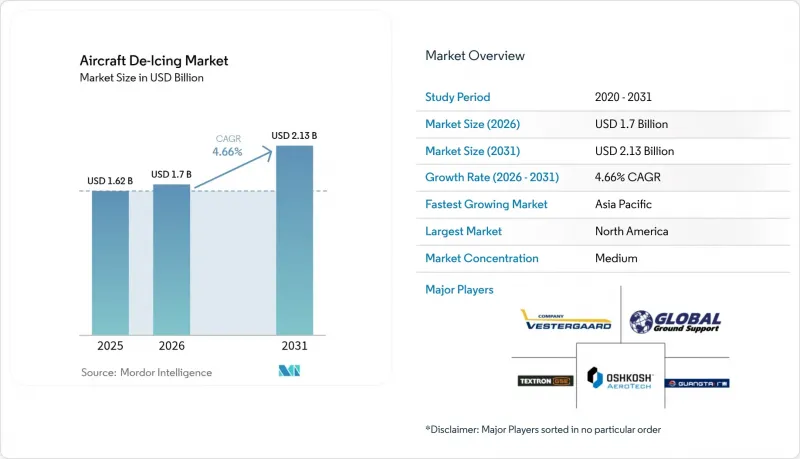
This report is Segmented by End-User (Commercial Airlines, and More), Equipment Type (De-Icing Trucks (Mobile), and More), Fluid Type (Type I (Glycol-Water), and More), Method (Fluid-Based, Infrared/Electro-Impulse, and More), and Geography (North America, Europe, Asia-Pacific, and More). The Market Forecasts are Provided in Terms of Value (USD).
Global Aircraft De-Icing Market Trends and Insights
Surge in Winter Flight Schedules Across Secondary Airports in Northern Latitudes
Secondary airports in cold regions add winter routes that keep aircraft flying year-round. Regional carriers such as SkyWest carried 42 million passengers in the US in 2024. This illustrates how stronger winter utilization lifts demand for mobile de-icing units that can be stationed where permanent gantries are not yet viable. Smaller fields that once closed for part of the season now see traffic spikes, encouraging procurement of multi-purpose trucks and modular fluid tanks that fit constrained apron layouts. Equipment makers are responding with compact chassis, faster boom articulation, and digital spray-rate controls. Safety regulators are likewise paying closer attention to secondary airports, pushing operators to match the procedural rigor of major hubs. These factors raise unit volumes and after-market service opportunities across the aircraft de-icing market.
Heightened Safety-Compliance Penalties for Ice-Related Incidents in the EU and US
The Federal Aviation Administration's updated ground-deicing guidance for winter 2024-2025 tightened holdover tables and application procedures, prompting airlines and service companies to modernize fleets and train crews to avoid fines. Parallel moves by the European Union Aviation Safety Agency reinforce the same message, classifying icing severity and mandating documented mitigation steps. Compliance pressure is accelerating the adoption of sensor-based verification, barcode traceability of fluid batches, and real-time weather-linked decision tools. The aircraft de-icing market, therefore, sees rising demand for software licenses, handheld readers, and on-board cameras that validate spray patterns, expanding revenue streams beyond hardware.
Volatility in Ethylene and Propylene Glycol Feedstock Prices
Ethylene and propylene glycol prices follow upstream petrochemical swings, squeezing margins for fluid blenders and service providers. Cost spikes encourage airports to recycle spent fluid and airlines to vary concentration based on ambient conditions. St. Louis Lambert International's 2024/2025 plan highlights blend-to-temperature dosing that reduces consumption in milder conditions. Some carriers hedge costs by contracting multi-year supply volumes, but smaller operators are more exposed, delaying equipment upgrades and limiting market growth in the short term.
Other drivers and restraints analyzed in the detailed report include:
- Fleet Growth of Next-Generation Narrow-Body Jets With Larger Wing Surface Areas
- Expansion of Remote De-Icing Pads to Reduce Gate-Hold Times
- Stringent Waste-Glycol Run-Off Regulations Elevating Operating Expenses
For complete list of drivers and restraints, kindly check the Table Of Contents.
Segment Analysis
Commercial airlines held 45.88% of the aircraft de-icing market share in 2025, supported by global route networks that must maintain on-time departures during winter peaks. These carriers favor high-throughput truck fleets and automated mixing plants to tighten turnaround times. Though smaller today, Cargo airlines are expanding the aircraft de-icing market size fastest at a 6.34% CAGR through 2031 as e-commerce drives year-round demand for temperature-insensitive logistics. They often operate at night and in secondary hubs, prompting investments in self-contained de-icing rigs that can travel between airports. Military aviation, while niche, specifies ruggedized equipment for Arctic bases and rapid-deployment kits that perform in extreme cold. General aviation and business jets rely on flexible service models, including heated hangars and portable applicators, representing incremental but steady volume for suppliers.
Commercial carriers also influence fluid standards; their push for longer holdover times speeds the shift toward Type IV formulations. Cargo operators reinforce this trend because extended taxi and loading intervals increase the risk of fluid shear or re-freeze. Military users create spill-over benefits for civil operations by funding R&D in portable electro-thermal blankets and compact power systems that later migrate to regional airport applications. The cross-pollination of requirements keeps the aircraft de-icing market dynamic despite moderate headline growth.
De-icing trucks retained 53.95% of the aircraft de-icing market in 2025, thanks to their versatility and lower initial cost relative to permanent gantries. Modern designs integrate single-engine drivetrains, energy-efficient heaters, and touch-screen diagnostics, cutting fuel burn and maintenance downtime. However, airports with congested winter schedules are pivoting to fixed-boom or gantry systems that process multiple wide-body aircraft simultaneously. This sub-segment will advance at a 6.55% CAGR to 2031, raising its contribution to the aircraft de-icing market size and easing workforce constraints during peak storms. Tow-behind sprayers remain relevant for small airfields, while in-hangar solutions cater to MRO operations and corporate fleets.
Electrification overlays all categories. Vestergaard, Oshkosh, and Textron GSE now publish roadmaps targeting majority electric or hybrid deliveries before 2035, responding to airport carbon-reduction pledges. The shift redefines lifetime cost-of-ownership calculations, with energy price volatility and sustainability incentives tilting purchasing decisions toward battery-electric or hybrid hydraulic platforms. Suppliers that master high-voltage integration and cold-weather battery management will lock in long-term service revenue as customers phase out diesel units.
Complete Report Scope:
- By End User
- Commercial Airlines
- Cargo Airlines
- Military Aviation
- General Aviation and Business Jets
- By Equipment Type
- De-icing Trucks (Mobile)
- Fixed-Boom/Gantry Systems
- Tow-Behind Sprayers
- In-Hangar De-icing Systems
- By Fluid Type
- Type I (Glycol-Water)
- Type II
- Type III
- Type IV
- By Method
- De-icing with Fluids
- Infra-red/Electro-Impulse
- Forced-Air/Hot-Air
- Hybrid Systems
- By Geography
- North America
- United States
- Canada
- Mexico
- Europe
- United Kingdom
- Russia
- France
- Germany
- Spain
- Rest of Europe
- Asia-Pacific
- China
- Japan
- South Korea
- Australia
- India
- Rest of Asia-Pacific
- Middle East and Africa
- Middle East
- Saudi Arabia
- United Arab Emirates
- Israel
- Rest of Middle East
- Africa
- South Africa
- Rest of Africa
- Middle East
- South America
- Brazil
- Rest of South America
- North America
Geography Analysis
North America generated 62.20% of 2025 revenue, underpinning the aircraft de-icing market with its dense hub network, severe winters, and rigorous FAA oversight. Recent investments, such as Syracuse Hancock International Airport's USD 19.4 million glycol-recycling plant, demonstrate regional commitment to sustainable operations and cost control. The facility is designed to reclaim fluid with glycol concentrations as low as 0.25%, generating up to 550,000 gallons of Type I solution annually. EPA effluent rules further drive adoption of collection systems and pad-based treatments, ensuring that North American demand remains anchored in regulatory compliance and technology refresh cycles.
Europe is the second-largest territory, shaped by EASA's icing risk classification and the European Green Deal. Clean Aviation initiatives back next-generation wing-ice protection that can cut energy draw by 30% or more, creating fertile ground for suppliers of embedded electro-thermal elements and advanced coatings. Airports across Scandinavia and the Alps invest in remote pads and glycol capture to meet safety and environmental requirements, sustaining equipment orders even in a comparatively mature market.
Asia-Pacific is the clear high-growth frontier, posting a forecast 6.63% CAGR on the strength of expanding airport infrastructure in China, South Korea, and Japan. Many of these facilities are scaling from minimal winter activity to full-season operations, generating first-time purchases of trucks, storage tanks, and fluid bulk plants. Mountainous terrain in parts of China and Korea requires altitude-tolerant systems, while northern Chinese hubs face prolonged sub-zero periods that strain equipment heating capacity. Suppliers that offer modular, quickly deployable fleets and local service partnerships are winning early contracts, positioning the region as a rising share contributor to the aircraft de-icing market size.
- Oshkosh Corporation
- Vestergaard Company
- Global Ground Support LLC
- TUG TECHNOLOGIES CORPORATION (Textron Inc.)
- Ground Support Specialists
- Tronair Inc.
- Safran SA
- Weihai Guangtai Airport Equipment Co., Ltd.
- Mallaghan Group
- Hubei Donghan Airport Equipment Technology Co., Ltd.
Additional Benefits:
- The market estimate (ME) sheet in Excel format
- 3 months of analyst support
TABLE OF CONTENTS
1 INTRODUCTION
- 1.1 Study Assumptions and Market Definition
- 1.2 Scope of the Study
2 RESEARCH METHODOLOGY
3 EXECUTIVE SUMMARY
4 MARKET LANDSCAPE
- 4.1 Market Overview
- 4.2 Market Drivers
- 4.2.1 Surge in winter flight schedules across secondary airports in Northern Latitudes
- 4.2.2 Heightened safety-compliance penalties for ice-related incidents in EU and US
- 4.2.3 Fleet growth of next-gen narrow-body jets with larger wing surface area
- 4.2.4 Expansion of remote de-icing pads to reduce gate-hold times in Canada and Nordics
- 4.2.5 Electrification initiatives and sustainable ground support equipment adoption
- 4.2.6 Military Arctic operations modernization in NATO and Russian far-north bases
- 4.3 Market Restraints
- 4.3.1 Volatility in Ethylene and Propylene Glycol feedstock prices
- 4.3.2 Stringent waste-glycol run-off regulations elevating OPEX at US Class-B airports
- 4.3.3 Airline cost-cutting leading to outsourcing price compression in Asia
- 4.3.4 Infrastructure limitations for electric de-icing equipment deployment
- 4.4 Value Chain Analysis
- 4.5 Regulatory Outlook
- 4.6 Technological Outlook
- 4.7 Porter's Five Forces Analysis
- 4.7.1 Bargaining Power of Buyers/Consumers
- 4.7.2 Bargaining Power of Suppliers
- 4.7.3 Threat of New Entrants
- 4.7.4 Threat of Substitute Products
- 4.7.5 Intensity of Competitive Rivalry
5 MARKET SIZE AND GROWTH FORECASTS (VALUE)
- 5.1 By End User
- 5.1.1 Commercial Airlines
- 5.1.2 Cargo Airlines
- 5.1.3 Military Aviation
- 5.1.4 General Aviation and Business Jets
- 5.2 By Equipment Type
- 5.2.1 De-icing Trucks (Mobile)
- 5.2.2 Fixed-Boom/Gantry Systems
- 5.2.3 Tow-Behind Sprayers
- 5.2.4 In-Hangar De-icing Systems
- 5.3 By Fluid Type
- 5.3.1 Type I (Glycol-Water)
- 5.3.2 Type II
- 5.3.3 Type III
- 5.3.4 Type IV
- 5.4 By Method
- 5.4.1 De-icing with Fluids
- 5.4.2 Infra-red/Electro-Impulse
- 5.4.3 Forced-Air/Hot-Air
- 5.4.4 Hybrid Systems
- 5.5 By Geography
- 5.5.1 North America
- 5.5.1.1 United States
- 5.5.1.2 Canada
- 5.5.1.3 Mexico
- 5.5.2 Europe
- 5.5.2.1 United Kingdom
- 5.5.2.2 Russia
- 5.5.2.3 France
- 5.5.2.4 Germany
- 5.5.2.5 Spain
- 5.5.2.6 Rest of Europe
- 5.5.3 Asia-Pacific
- 5.5.3.1 China
- 5.5.3.2 Japan
- 5.5.3.3 South Korea
- 5.5.3.4 Australia
- 5.5.3.5 India
- 5.5.3.6 Rest of Asia-Pacific
- 5.5.4 Middle East and Africa
- 5.5.4.1 Middle East
- 5.5.4.1.1 Saudi Arabia
- 5.5.4.1.2 United Arab Emirates
- 5.5.4.1.3 Israel
- 5.5.4.1.4 Rest of Middle East
- 5.5.4.2 Africa
- 5.5.4.2.1 South Africa
- 5.5.4.2.2 Rest of Africa
- 5.5.4.1 Middle East
- 5.5.5 South America
- 5.5.5.1 Brazil
- 5.5.5.2 Rest of South America
- 5.5.1 North America
6 COMPETITIVE LANDSCAPE
- 6.1 Market Concentration
- 6.2 Strategic Moves
- 6.3 Market Share Analysis
- 6.4 Company Profiles (includes Global level Overview, Market level overview, Core Segments, Financials as available, Strategic Information, Market Rank/Share for key companies, Products and Services, and Recent Developments)
- 6.4.1 Oshkosh Corporation
- 6.4.2 Vestergaard Company
- 6.4.3 Global Ground Support LLC
- 6.4.4 TUG TECHNOLOGIES CORPORATION (Textron Inc.)
- 6.4.5 Ground Support Specialists
- 6.4.6 Tronair Inc.
- 6.4.7 Safran SA
- 6.4.8 Weihai Guangtai Airport Equipment Co., Ltd.
- 6.4.9 Mallaghan Group
- 6.4.10 Hubei Donghan Airport Equipment Technology Co., Ltd.
7 Market Opportunities and Future Outlook
- 7.1 White-space and Unmet-Need Assessment


