

|
시장보고서
상품코드
2122599
냉동요법 시장 : 시장 점유율 분석, 업계 동향 및 통계, 성장 예측(2026-2031년)Cryotherapy - Market Share Analysis, Industry Trends & Statistics, Growth Forecasts (2026 - 2031) |
||||||
 Mordor Intelligence
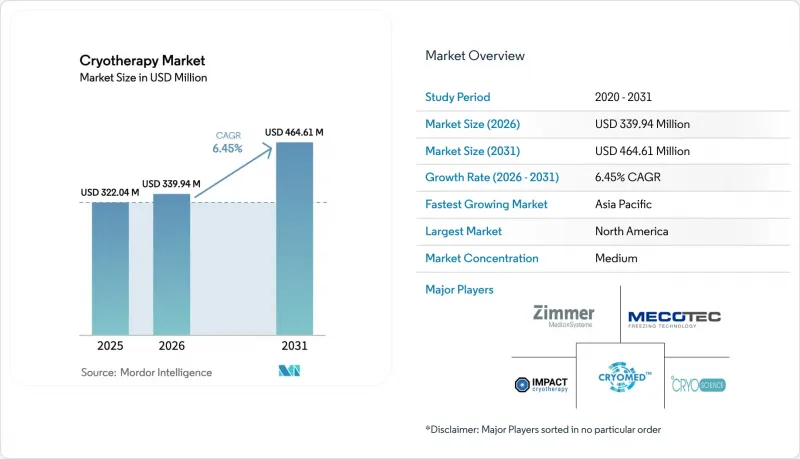
Mordor Intelligence에 의하면, 냉동요법 시장 규모는 2025년 3억 2,204만 달러로 평가되었고, 2026년에는 3억 3,994만 달러로 추정되고, 2031년까지 4억 6,461만 달러에 이를 것으로 예상되며, 2026-2031년 CAGR 6.45%로 성장할 전망입니다.
본 보고서는 제품 및 서비스별(전신용 크라이오 챔버, 국소용 기기, 냉동 수술 시스템, 하이브리드/모바일 유닛 등), 용도별(스포츠 회복 등), 최종 사용자별(병원 및 전문 클리닉 등), 기술별(액체 질소 시스템 등), 지역별(북미 등)로 분류되어 있습니다. 시장 예측은 금액(달러) 기준으로 제시되어 있습니다.
세계의 냉동요법 시장 동향 및 인사이트
액체 질소에서 완전 전동식 크라이오 시스템으로의 급속한 전환이 비용 절감으로 이어지고 있습니다.
전기식 챔버로 전환하는 클리닉에서는 매주 듀어 용기 배송이 필요 없어지고, 가압 가스 저장과 관련된 보험료가 절감되며, 유럽연합(EU) 및 캘리포니아주의 넷 제로 규제 요건을 충족할 수 있습니다. CryoBuilt사의 전기식 챔버 ‘Polaris’는 질소 모델에 비해 5년간의 운영 비용을 60% 절감한 것으로 입증되었습니다. 이러한 전환은 가스 물류가 불안정한 지역에서 가속화되고 있으며, 동남아시아와 라틴아메리카의 신규 사업자들이 전문적인 공급망을 갖추지 않고도 냉동요법 시장에 진입할 수 있게 하고 있습니다. 시설 관리자들도 OSHA(미국 산업안전보건청)의 산소 모니터링 요건을 피할 수 있다는 점에서 전기식 장치를 선호하고 있습니다. 이러한 변화들이 맞물려 서비스를 제공할 수 있는 시설 기반이 확대되고, 교체 수요가 증가함에 따라 예측 연평균 성장률(CAGR)에 1.2포인트가 추가될 것으로 전망됩니다.
주요 지역의 보험 적용 범위 확대
미국 의학협회(AMA)는 2024년에 CPT 코드 64624를 도입하여 크라이오뉴로리시스 청구를 공식적으로 인정하고, 통증 클리닉의 장비 구매를 촉진했습니다. 독일의 보험사는 2025년, 시범 프로그램의 일환으로 류마티스 관절염에 대한 전신 냉동요법의 보험 적용을 시작하여 유럽 내 선례를 보여주었습니다. 미국 메디케어·메디케이드 서비스 센터(CMS)는 여전히 전신 냉동요법을 ‘연구 단계’로 분류하고 있지만, 부분적인 보험 적용을 통해 시술비가 인정되는 국소용 의료기기에 대한 투자가 촉진되고 있습니다. 장기적으로는 보험사의 일관된 승인이 진행되고, 특히 만성 통증 적응증에 대해 더 많은 보험사가 합의에 도달할 경우, 전 세계 연평균 성장률(CAGR)에 1% 가까운 추가 효과가 발생할 가능성이 있습니다.
가스 가격 급등이 리스크를 가중시킵니다.
2025년 하반기, 유럽의 질소 현물 가격은 1MWh당 50유로를 넘어서는 급등세를 보이며, 대량 시술을 수행하는 스포츠 클리닉의 이익률을 압박하고 질소 공급 시스템 구매를 연기하는 결과를 초래했습니다. 사업자들은 손익분기점을 재계산하고, 전기식 대체품이 합리적인 가격대가 될 때까지 장비 교체 주기를 연기하고 있습니다. 아시아태평양의 LNG 시장에서도 유사한 가격 변동이 관찰되었으며, 일본과 한국에서는 예산 압박을 받고 있습니다. 이러한 상황으로 인해 단기 성장률은 0.8포인트 하락했습니다.
부문별 분석
2025년 매출의 거의 절반은 전신용 크라이오 챔버가 차지했으나, 렌탈 사업자들이 이벤트나 기업 캠퍼스에 트레일러 탑재형 시스템을 파견함에 따라 하이브리드형 및 이동식 유닛의 성장률이 연평균 성장률(CAGR) 10.63%로 이를 앞지를 전망입니다. 이러한 변화로 인해 자본 예산이 없는 고객도 온디맨드 방식으로 세션을 이용할 수 있게 되어, 크라이오테라피 시장의 다양화가 진행될 것입니다.
업계가 전동화로 전환됨에 따라 소모품 매출은 감소하고 있지만, 사업자들이 클라우드 대시보드를 활용해 세션 일정 관리, 이용 현황 추적, 안전 규정 준수 기록을 수행함에 따라 소프트웨어 구독 수익은 증가하고 있습니다. 미용 목적의 국소 치료에 피부과에서 도입이 주도하면서, 지역 밀착형 기기는 약 18%의 점유율을 차지하고 있습니다. 주로 종양학 분야에서 활용되고 있는 냉동 수술 시스템은 중재적 방사선학 진료실 내에서 꾸준히 보급되고 있습니다. 질소 듀어나 방한 장갑 등의 부속품은 전동화의 진전에 발맞추어 감소 추세를 보이고 있으므로, 각 벤더사는 유지보수 계약이나 분석 플랫폼을 번들로 제공함으로써 리스크를 헤지하고 있습니다. 이러한 구성의 변화로 인해 경쟁 우위를 결정짓는 요소는 온도가 아닌 챔버의 형태가 되었으며, 크라이오테라피 시장 전체에서 플랫폼 경쟁이 격화되고 있습니다.
스포츠 회복 분야는 최상위 팀과 대학 스포츠 프로그램 덕분에 2025년 저온 요법 시장 규모의 33.45%를 계속 차지했습니다. 한편, 피부과 및 미용 분야는 소셜 미디어 노출과 자금 조달 계획을 배경으로 시술 횟수가 더욱 빠르게 증가하고 있으며, 2031년까지 연평균 9.24%의 성장률이 예상됩니다.
통증 관리 클리닉에서는 CPT 64624에 따라 크라이오뉴로리시스용 프로브를 도입하고 있지만, 보험 환급의 격차가 주 전체로의 확산을 저해하고 있습니다. 영상 유도 하의 냉동 절제술로 인해 주변 조직에 대한 손상이 경감됨에 따라 종양학 분야에서의 활용이 확대되고 있으며, 3차 의료 기관 내에서 꾸준한 도입이 진행되고 있습니다. 웰니스 및 체중 관리용 키오스크는 여전히 분산된 상태이지만, 크라이오테라피를 대사 촉진법으로 자리매김하는 고급 리조트에서는 두드러지게 나타나고 있습니다. 응용 분야의 동향으로는 프로 스포츠계에서 회복 목적으로의 이용이 포화 상태에 이르렀기 때문에 사업자들은 아마추어 운동선수, 미용을 추구하는 사람들, 만성 통증 환자를 타겟으로 크라이오테라피 시장의 확대를 도모하고 있습니다.
지역별 분석
2025년, 북미는 전 세계 매출의 37.83%를 차지했으며, 그중 미국은 프로 스포츠계 수요와 조기 의료 보험 환급을 배경으로 그 85%를 차지했습니다. 캐나다와 멕시코는 규모는 작지만 안정적이며, 토론토, 밴쿠버, 몬테레이, 멕시코시티에서는 본인 부담 모델이 정착되어 있습니다. IceCure사의 ProSense 시스템이 양성 유방 종양에 대해 FDA 승인을 획득한 것은 저침습 냉동 절제술에 대한 규제 측면에서의 호재를 시사합니다.
아시아태평양에서는 중국의 국내 제조업체들이 유럽산 수입품보다 30-40% 저렴한 가격으로 제품을 공급하고 있어, 2031년까지 동결 요법 시장은 연평균 7.74% 성장할 것으로 전망됩니다. 일본에서는 보험 적용이 없음에도 불구하고, 고령화에 따른 비약물 요법을 통한 통증 완화 수요가 시장을 견인하고 있습니다. 인도에서는 뭄바이와 방갈로르의 크리켓 아카데미 및 사립 병원이 프로 선수와 경제적으로 여유가 있는 아마추어 운동선수를 대상으로 크라이오 챔버를 도입하고 있습니다. 한국에서는 서울 강남 지역을 중심으로 미용 목적으로 이용이 활발하며, 호주에서는 시드니와 멜버른에서 운동 후 회복에 중점을 두고 있습니다. 규제의 차이와 전통적인 치료법에 대한 문화적 선호로 인해 보급이 더딘 편이지만, 중산층의 소득 증가와 스포츠 참여 확대에 힘입어 사용자층은 점차 넓어지고 있습니다.
유럽에서는 독일이 주도적인 역할을 하고 있으며, 류마티스 관절염에 대한 크라이오테라피의 보험 적용을 시범적으로 도입하고 있는 공적 보험 기관의 지원을 받고 있습니다. 프랑스의 탈라소테라피 스파와 영국 프리미어리그 클리닉에서는 꾸준한 수요가 유지되고 있습니다. 이탈리아와 스페인에서는 각각 미용 목적과 스포츠 재활 목적을 위한 이용자가 증가하고 있습니다. 중동 및 아프리카은 총 약 6%의 점유율을 차지하고 있으며, UAE와 사우디아라비아의 고급 웰니스 센터가 시장을 주도하고 있습니다. 남미의 5% 점유율은 브라질과 아르헨티나에 집중되어 있으며, 이들 국가에서는 사립 병원에 정형외과 병동이 갖춰져 있습니다. 이러한 지역별 동향을 종합해 보면, 도입 곡선에는 차이가 보이지만, 크라이오테라피 시장 전체적으로는 디지털화가 진행되면서 풍부한 데이터를 처리할 수 있는 하드웨어에 대한 선호도가 공통적으로 높아지고 있다는 점이 두드러지게 나타납니다.
기타 혜택 :
- 엑셀 형식 시장 예측(ME) 시트
- 3개월간의 애널리스트 지원
자주 묻는 질문
목차
제1장 서론
제2장 조사 방법
제3장 주요 요약
제4장 시장 구도
제5장 시장 규모 및 성장 예측
제6장 경쟁 구도
제7장 시장 기회 및 향후 전망
AJY 26.09.09According to Mordor Intelligence, the cryotherapy market size is expected to increase from USD 322.04 million in 2025 to USD 339.94 million in 2026 and reach USD 464.61 million by 2031, growing at a CAGR of 6.45% over 2026-2031.
This report is Segmented by Product and Services (Whole-Body Cryochambers, Localised Devices, Cryosurgery Systems, Hybrid/Mobile Units, and More), Application (Sports Recovery, and More), End User (Hospitals & Specialty Clinics, and More), Technology (Liquid-Nitrogen Systems and More), and Geography (North America, and More). The Market Forecasts are Provided in Terms of Value (USD).
Global Cryotherapy Market Trends and Insights
Rapid Shift From Liquid-Nitrogen to Fully-Electric Cryo-Systems Cut Costs
Clinics switching to electric chambers remove weekly dewar deliveries, lower insurance premiums linked to pressurized-gas storage, and meet net-zero mandates in the European Union and California. CryoBuilt's Polaris electric chamber demonstrated a 60% reduction in five-year operating cost compared with nitrogen models. The transition accelerates in regions with unstable gas logistics, enabling new operators in Southeast Asia and Latin America to enter the cryotherapy market without specialized supply chains. Facility managers also favor electric units because they bypass OSHA oxygen-monitor requirements. Collectively, these shifts add 1.2 percentage points to forecast CAGR by broadening the serviceable venue base and raising replacement demand.
Reimbursement Expansion in Key Regions
The American Medical Association introduced CPT 64624 in 2024, legitimizing cryoneurolysis billing and prompting capital purchases in pain clinics. Germany's insurers began reimbursing whole-body cryotherapy for rheumatoid arthritis under pilot programs in 2025, signaling a European precedent. Although the U.S. Centers for Medicare & Medicaid Services still classifies whole-body cryo as investigational, partial reimbursement steers investment toward localized medical devices that enjoy procedural fees. Over the long term, consistent payer recognition could inject nearly 1 percentage point into the global CAGR, especially if more Payors align on chronic-pain indications.
Rising Gas Prices Increase Risks
European nitrogen spot prices spiked above EUR 50 per MWh in late 2025, eroding margins at high-volume sports clinics and prompting deferred purchases of nitrogen-fed systems. Operators recalculated break-even analyses, delaying replacement cycles until electric alternatives become affordable. Similar volatility in Asia-Pacific LNG markets compresses budgets in Japan and South Korea. These conditions shave 0.8 percentage points off short-term growth.
Other drivers and restraints analyzed in the detailed report include:
- Increased Cryo Access in Fitness Clubs
- AI-Driven Chambers Enhance Throughput
- Insurer Pushback Due to Lack of Standards Benchmarking Study
For complete list of drivers and restraints, kindly check the Table Of Contents.
Segment Analysis
Whole-body cryochambers generated almost half of 2025 revenue, yet hybrid and mobile units will outpace at a 10.63% CAGR as rental operators send trailer-mounted systems to events and corporate campuses. The shift diversifies the cryotherapy market because customers with no capital budget can still provision sessions on demand.
Consumables revenue shrinks as the sector turns electric, but software subscriptions grow when operators use cloud dashboards to schedule sessions, track utilization, and document safety compliance. Localized devices hold roughly 18% share, driven by dermatology uptake for aesthetic spot treatments. Cryosurgery systems, vested mainly in oncology, maintain steady adoption inside interventional radiology suites. Accessories, including nitrogen dewars and thermal gloves, taper in lock-step with the electric transition, so vendors hedge by bundling maintenance contracts and analytics platforms. The evolving mix means chamber form-factors, not temperatures, define competitive advantage, intensifying a platform race across the cryotherapy market.
Sports recovery retained 33.45% of the cryotherapy market size in 2025 thanks to elite teams and collegiate programs. Dermatology and aesthetics, however, add sessions faster, climbing 9.24% annually through 2031 on social-media visibility and financing plans.
Pain-management clinics deploy cryoneurolysis probes under CPT 64624, but reimbursement gaps cap statewide rollouts. Oncology usage broadens as imaging-guided cryoablation lowers collateral tissue damage, supporting steady unit placements inside tertiary hospitals. Wellness and weight-management kiosks remain fragmented yet visible in luxury resorts that position cryo as a metabolism booster. The application landscape shows recovery saturation in professional sports, so operators court amateur athletes, beauty seekers, and chronic-pain patients to enlarge the cryotherapy market.
Complete Report Scope:
- By Product and Services
- Whole-Body Cryochambers
- Localised Devices
- Cryosurgery Systems
- Hybrid / Mobile Units
- Accessories and Conusmables
- Software and Services
- By Application
- Sports Recovery
- Pain Management
- Oncology (Cryo-ablation)
- Dermatology & Aesthetics
- Wellness & Weight-Management
- By End User
- Hospitals & Specialty Clinics
- Sports & Fitness Centers
- Wellness & Spa Facilities
- Home-Use / Direct-to-Consumer
- By Technology
- Liquid-Nitrogen Systems
- Fully-Electric Systems
- CO2 Spot-Therapy Devices
- By Geography
- North America
- United States
- Canada
- Mexico
- Europe
- Germany
- France
- United Kingdom
- Italy
- Spain
- Rest of Europe
- Asia-Pacific
- China
- Japan
- India
- South Korea
- Australia
- Rest of Asia-Pacific
- Middle East & Africa
- GCC
- South Africa
- Rest of Middle East & Africa
- South America
- Brazil
- Argentina
- Rest of South America
- North America
Geography Analysis
North America generated 37.83% of global revenue in 2025, with the United States comprising 85% of that figure on the back of pro-sports demand and early medical reimbursement. Canada and Mexico remain smaller but stable, supporting cash-pay models in Toronto, Vancouver, Monterrey, and Mexico City. FDA clearance of IceCure's ProSense system for benign breast tumors signals regulatory momentum for minimally invasive cryoablation.
Asia-Pacific will expand the cryotherapy market at 7.74% through 2031 as China's domestic builders undercut European imports by 30-40%. Japan rides aging-population demand for non-pharmacological pain relief despite absent reimbursement. India's cricket academies and private hospitals in Mumbai and Bangalore buy chambers to serve professional and affluent amateur athletes. South Korea gravitates toward aesthetics in Seoul's Gangnam district, while Australia focuses on sports recovery in Sydney and Melbourne. Fragmented rules and cultural preferences for traditional remedies slow uptake, but growing middle-class income and sports participation widen the user base.
In Europe, Germany led, aided by statutory insurers piloting cryo coverage for rheumatoid arthritis. France's thalassotherapy spas and the United Kingdom's Premier League clinics maintain robust demand. Italy and Spain add aesthetic and sports-rehab users respectively. Middle East and Africa collectively held about 6% share, dominated by UAE and Saudi Arabia luxury wellness centers. South America's 5% share is concentrated in Brazil and Argentina, where private hospitals equip orthopedic wards. Together, these regional profiles underline differing adoption curves yet a converging preference for electric, data-rich hardware across the cryotherapy market.
- Art of Cryo
- Boston Scientific
- Brymill Cryogenic Systems
- The Cooper Companies
- Cryo Innovations
- CRYO Science
- CryoAction
- CryoBuilt Inc.
- Cryomed s.r.o.
- CRYONiQ
- Grand Cryo
- IceCure Medical
- Impact Cryotherapy Inc.
- JUKA
- KRION
- MECOTEC GmbH
- Medtronic plc (Cryoablation)
- Metrum CryoFlex
- Vacuactivus
- Zimmer MedizinSysteme
Additional Benefits:
- The market estimate (ME) sheet in Excel format
- 3 months of analyst support
TABLE OF CONTENTS
1 Introduction
- 1.1 Study Assumptions & Market Definition
- 1.2 Scope of the Study
2 Research Methodology
3 Executive Summary
4 Market Landscape
- 4.1 Market Overview
- 4.2 Market Drivers
- 4.2.1 Rapid Shift from Liquid Nitrogen to Fully-Electric Cryo-Systems Cut Costs
- 4.2.2 Reimbursement Expansion in Key Regions
- 4.2.3 Increased Cryo Access in Fitness Clubs
- 4.2.4 AI-Driven Chambers Enhance Throughput
- 4.2.5 Rental Market Growth with Mobile Cryo-Vans
- 4.2.6 Fat-Reduction Demand Spurs Cryo Adoption
- 4.3 Market Restraints
- 4.3.1 Rising Gas Prices Increase Risks
- 4.3.2 Insurer Pushback Due to Lack of Standards Benchmarking Study
- 4.3.3 Tariffs Impact Mobile Chamber Costs
- 4.3.4 High Costs Limit Adoption in Small Clinics
- 4.4 Value / Supply-Chain Analysis
- 4.5 Regulatory Landscape
- 4.6 Technological Outlook
- 4.7 Porter's Five Forces Analysis
- 4.7.1 Threat of New Entrants
- 4.7.2 Bargaining Power of Suppliers
- 4.7.3 Bargaining Power of Buyers
- 4.7.4 Threat of Substitutes
- 4.7.5 Intensity of Competitive Rivalry
5 Market Size & Growth Forecasts (Value in USD)
- 5.1 By Product and Services
- 5.1.1 Whole-Body Cryochambers
- 5.1.2 Localised Devices
- 5.1.3 Cryosurgery Systems
- 5.1.4 Hybrid / Mobile Units
- 5.1.5 Accessories and Conusmables
- 5.1.6 Software and Services
- 5.2 By Application
- 5.2.1 Sports Recovery
- 5.2.2 Pain Management
- 5.2.3 Oncology (Cryo-ablation)
- 5.2.4 Dermatology & Aesthetics
- 5.2.5 Wellness & Weight-Management
- 5.3 By End User
- 5.3.1 Hospitals & Specialty Clinics
- 5.3.2 Sports & Fitness Centers
- 5.3.3 Wellness & Spa Facilities
- 5.3.4 Home-Use / Direct-to-Consumer
- 5.4 By Technology
- 5.4.1 Liquid-Nitrogen Systems
- 5.4.2 Fully-Electric Systems
- 5.4.3 CO2 Spot-Therapy Devices
- 5.5 By Geography
- 5.5.1 North America
- 5.5.1.1 United States
- 5.5.1.2 Canada
- 5.5.1.3 Mexico
- 5.5.2 Europe
- 5.5.2.1 Germany
- 5.5.2.2 France
- 5.5.2.3 United Kingdom
- 5.5.2.4 Italy
- 5.5.2.5 Spain
- 5.5.2.6 Rest of Europe
- 5.5.3 Asia-Pacific
- 5.5.3.1 China
- 5.5.3.2 Japan
- 5.5.3.3 India
- 5.5.3.4 South Korea
- 5.5.3.5 Australia
- 5.5.3.6 Rest of Asia-Pacific
- 5.5.4 Middle East & Africa
- 5.5.4.1 GCC
- 5.5.4.2 South Africa
- 5.5.4.3 Rest of Middle East & Africa
- 5.5.5 South America
- 5.5.5.1 Brazil
- 5.5.5.2 Argentina
- 5.5.5.3 Rest of South America
- 5.5.1 North America
6 Competitive Landscape
- 6.1 Market Concentration
- 6.2 Market Share Analysis
- 6.3 Company Profiles (includes Global level Overview, Market level overview, Core Segments, Financials as available, Strategic Information, Market Rank/Share for key companies, Products and Services, and Recent Developments)
- 6.3.1 Art of Cryo
- 6.3.2 Boston Scientific
- 6.3.3 Brymill Cryogenic Systems
- 6.3.4 CooperSurgical
- 6.3.5 Cryo Innovations
- 6.3.6 CRYO Science
- 6.3.7 CryoAction
- 6.3.8 CryoBuilt Inc.
- 6.3.9 Cryomed s.r.o.
- 6.3.10 CRYONiQ
- 6.3.11 Grand Cryo
- 6.3.12 IceCure Medical
- 6.3.13 Impact Cryotherapy Inc.
- 6.3.14 JUKA
- 6.3.15 KRION
- 6.3.16 MECOTEC GmbH
- 6.3.17 Medtronic plc (Cryoablation)
- 6.3.18 Metrum CryoFlex
- 6.3.19 Vacuactivus
- 6.3.20 Zimmer MedizinSysteme GmbH
7 Market Opportunities & Future Outlook
- 7.1 White-space & Unmet-Need Assessment


