|
시장보고서
상품코드
2122602
발기부전 치료제 : 시장 점유율 분석, 업계 동향과 통계, 성장 예측(2026-2031년)Erectile Dysfunction Drugs - Market Share Analysis, Industry Trends & Statistics, Growth Forecasts (2026 - 2031) |
||||||
 Mordor Intelligence
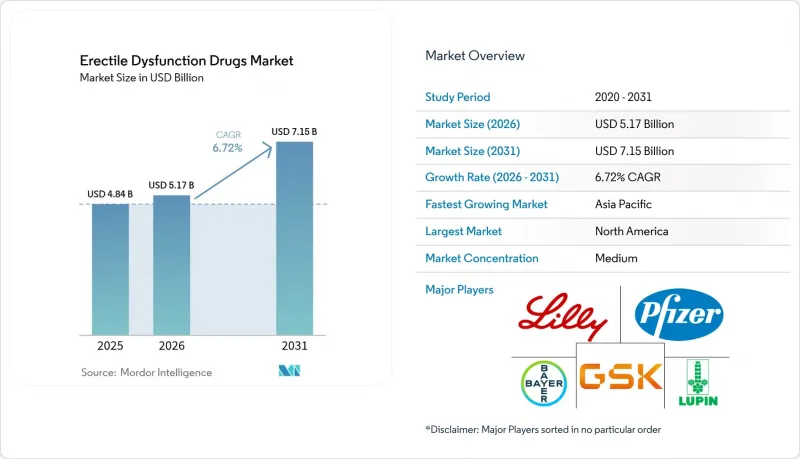
Mordor Intelligence에 의하면, 발기부전 치료제 시장 규모는 2025년에 48억 4,000만 달러로 평가되었고, 2026년51억 7,000만 달러에서 2031년까지 71억 5,000만 달러에 이를 것으로 예측되며, 예측 기간(2026년-2031년) CAGR은 6.72%를 기록할 전망입니다.
본 보고서는 제품별(비아그라(실데나필), 시알리스(타다라필), 레비트라/스타크신(발데나필) 등), 약물 분류별(PDE5 억제제, 프로스타글란딘 유사체 등),투여 경로(경구 정제/캡슐 등), 유통 채널(병원 약국 등), 지역(북미, 유럽 등)별로 분류되어 있습니다. 시장 예측은 금액(달러) 기준으로 제시되어 있습니다.
전 세계 발기부전 치료제 시장 동향 및 인사이트
원격의료 및 온라인 약국의 보급 확대
디지털 플랫폼은 지리적 및 심리적 장벽을 제거하여, 하나의 워크플로우 내에서 눈에 띄지 않는 상담과 통신 판매를 실현하고 있습니다. Hims &Hers는 비동기식 의료 평가와 저가 제네릭 실데나필(hims.com)을 통합함으로써 2025년 1분기에 가입자 수를 240만 명으로 확대하고 매출을 2배 이상 늘렸습니다. Lemonaid Health의 유사한 모델에서는 실데나필을 1정당 2달러에 판매하고 있으며, 이는 오프라인 약국보다 저렴한 가격으로 가격에 민감한 사용자들을 발기부전 치료제 시장으로 끌어들이고 있습니다. GoodRx는 2025년 6월에 발기부전 치료제 정기 구독 서비스를 시작하여, 예측 가능한 월별 비용을 원하는 소비자 수요를 뒷받침했습니다. 플랫폼의 데이터 분석을 바탕으로 개인 맞춤형 복약 순응도 유도를 통해 처방전 갱신율을 향상시키고, 환자 1인당 평생 가치를 높이고 있습니다. 특히 아시아태평양에서 각국 정부가 원격의료 보험 적용에 관한 규제를 완화하는 가운데, 디지털 분야의 기존 기업들은 후발 주자들이 재현하기 어려운 ‘선구자로서의 신뢰’라는 우위를 누리고 있습니다.
승인 임박한 비강용 및 외용 속효성 제제
발효 시간을 1시간 가까이에서 15분 미만으로 단축하는 제제는 경구용 PDE5 억제제에 반응이 없는 환자를 대상으로 한 추적 조사에서 지적된 주요 불만 사항을 해소합니다. LTR Pharma사의 SPONTAN 비강 스프레이는 경구 투여량의 절반으로 12분 이내에 혈장 농도 정점에 도달하며, 승인될 경우 프리미엄 가격으로 판매될 수 있습니다. FDA의 2024년 ‘Eroxon’ 젤에 대한 데 노보(de novo) 승인으로 최초의 OTC용 외용제 카테고리가 탄생했으며, 사용자의 60%가 10분 이내에 발기를 경험했다고 보고하고 있습니다. Futura Medical사는 남성과 여성의 성기능 장애를 모두 대상으로 한 개선된 버전을 개발 중이며, 이에 따라 잠재적 수익원을 확대되고 있습니다. 외용제는 전신 요법이 금기인 환자도 사용할 수 있으므로, 기존의 경구용 브랜드와 경쟁을 유발하지 않으면서 시장 범위를 확대할 수 있습니다. 각 제약사는 실제 임상에서 안전성 데이터가 축적되는 대로 전 세계적인 진출이 가속화될 것으로 전망하고 있습니다.
뿌리 깊은 사회적 편견과 진단 부족
문화적 금기로 인해 의사와 환자 간의 대화가 제한되고 있습니다. 특히 지방에서는 비뇨기과 전문의 수가 검색 키워드에 대한 관심도를 크게 밑돌고 있어 이러한 경향이 두드러집니다. 익명의 원격의료 채팅은 부끄러움을 덜어주지만, 심리적 요인이나 대인관계적 요인이 평가를 복잡하게 만드는 경우, 대면 선별 검사를 완전히 대체할 수는 없습니다. 젊은 남성들은 온라인 포럼을 통해 자가 진단을 하는 경우가 많으며, 동반 질환이 나타날 때까지 전문의의 평가를 미루는 경향이 있습니다. 일반의약품(OTC) 출시와 맞물려 진행되는 인식 제고 캠페인은 발기부전을 단순한 성적 문제가 아닌, 심혈관 및 대사 질환의 초기 징후로 재인식하는 것을 목표로 하고 있습니다. 하지만 적어도 향후 10년 동안은 사회적 편견이 치료 보급률에 큰 걸림돌이 될 것으로 예측됩니다.
부문 분석
2025년, 바이아그라 프랜차이즈는 발기부전 치료제 시장에서 44.78%라는 최고 점유율을 유지했습니다. 이는 수십 년에 걸친 브랜드 자산과 처방 의사의 친근감을 반영한 결과입니다. 그러나 테바(Teva)사의 AB 등급 실데나필 정제가 대폭 할인된 가격으로 판매되면서 2025년 한 해 동안 브랜드 충성도가 훼손되었습니다. 스텐드라는 작용 발현이 빠르고 식사와의 상호작용이 적다는 특징 덕분에, 특허 유효 기간 중인 의약품 중 가장 높은 연평균 성장률(CAGR) 9.72%를 기록했습니다. 시알리스는 전립선 비대증을 포함하는 이중 적응증 라벨의 혜택을 받아, 일부 시장에서 제네릭 타다라필이 진입했음에도 불구하고 현금 흐름을 유지했습니다. 레비트라는 지불 주체가 저비용의 치료 동등품을 선호함에 따라 매장 내 판매 공간을 잃었습니다. 외용제인 ‘에록슨’은 전신성 부작용을 우려하는 환자들에게 어필하는 정제 외의 대안이 되어, 발기부전 치료제 시장에서 구조적인 전환점이 되었습니다. ‘자이데나’와 같은 지역 브랜드는 한국 및 일부 아시아 국가에 국한된 채로 남아 있어, 세계적 영향력은 제한적이었습니다. 전반적으로 제네릭 의약품이 판매량 증가분을 차지할 것으로 예상되지만, 혁신적인 투여 형태가 프리미엄 틈새 시장을 지켜낼 것으로 보입니다. 기존 브랜드 의약품 제조업체들은 시장 점유율을 지키기 위해 구강 내 용해 필름 등의 수명 연장 전략으로 대응하고 있습니다.
2세대 브랜드 제품 역시 약동학의 미세 조정을 활용해 차별화를 꾀하며, 초속효성이나 반감기 연장을 실현하고 있습니다. ENTADFI와 같은 고정 용량 복합제는 전립선 비대증과 발기부전에 공통된 병태생리학이 여러 증상에 대한 위치를 어떻게 뒷받침하고 있는지를 보여줍니다. 이러한 동향은 OTC(일반의약품) 규제 완화를 향한 광범위한 노력과 부합하며, 발기부전 치료제 시장에서 세분화되고 있지만 기회가 가득한 경쟁 환경이 형성될 것임을 시사합니다.
PDE5 억제제는 2025년 매출의 85.12%를 차지하며, 1차 선택 약제로서의 입지를 확고히 했습니다. 그러나 일산화질소 공급제, Rho 키나제 억제제, 중추 작용제 등의 파이프라인이 2상 및 3상 임상시험 단계로 진행되고 있습니다. 새로운 작용기전을 가진 제품군은 전체적으로 연평균 성장률(CAGR) 11.1%로 성장을 지속하고, 있으며, 이는 유효성 및 내약성 측면에서 차별화를 꾀할 여지가 있음을 시사합니다. 프로스타글란딘 유사체는 질산염 제제의 사용이 금기인 환자에게서 틈새 시장 역할을 유지하고 있지만, 국소 투여에 따른 불편함으로 인해 복약 순응도 문제에 직면해 있습니다. MDPI 저널에 게재된 데이터가 당뇨병 환자의 해면체 조직에서 일산화질소 신호 전달이 회복되었음을 보여준 데 따라, 단백질 키나아제 C 억제에 대한 임상적 관심이 높아졌습니다. 저용량 PDE5 억제제와 말초 혈관 확장제를 병용하는 병용 요법은 효능을 유지하면서 전신 노출을 줄이는 것을 목표로 하며, 이 전략은 위험을 회피하려는 처방 의사들의 관심을 끌 것으로 기대됩니다.
피라졸로피리미디논 유도체에 관한 특허는 선발 제약사가 차세대 독점권을 확보하려는 시도가 이어지는 가운데, 현재 진행 중인 혁신 경쟁을 상징하고 있습니다(drugpatentwatch.com). 중추 작용형 분자가 안전성 장벽을 극복할 수 있다면, 심인성 병인을 직접적으로 해결함으로써 발기부전 치료제 업계의 치료 순서를 재정의할 가능성이 있습니다. 현재로서는 PDE5 억제제가 치료 알고리즘을 지배하고 있지만, 약리학적 다양화가 탄력을 받고 있습니다.
지역별 분석
북미는 2025년에 전 세계 매출의 38.44%를 차지할 것으로 예상되며, 이는 높은 가처분 소득, 선진적인 원격 의료의 보급, 그리고 초기 OTC 규제 시범 사업에 힘입은 결과입니다. FDA의 에록손(Eroxon)에 대한 획기적인 승인은 현재 다른 규제 당국이 참고하고 있는 모델을 확립하고, 자가 관리 모델에서 이 지역의 리더십을 강화했습니다. 그러나 제네릭 의약품 시장의 포화 상태와 지불 주체의 비용 관리가 절대적인 성장을 억제하고 있어, 북미의 연평균 성장률(CAGR)은 세계 평균인 6.72%에 가까운 수준에 머물고 있습니다. 유럽도 비슷한 성숙도를 보이고 있지만, 디지털 헬스 분야 확장의 주목을 계속 받고 있습니다. Hims와 Hers-ZAVA의 제휴를 통해, 장기간의 라이선스 등록 절차를 거치지 않고도 즉시 여러 국가로 사업을 확장할 수 있게 되었습니다.
아시아태평양은 중국, 일본, 한국의 인구 고령화와 규제 현대화에 힘입어 10.04%라는 가장 높은 연평균 성장률(CAGR)을 기록했습니다. 2025년 중국의 지침 전면 개정에 따라 신약 심사가 가속화되고 승인까지의 기간이 200일 미만으로 단축됨에 따라, 국경을 초월한 라이선스 신청이 유입되고 있습니다. 일본의 의약품 산업 활성화 방안에는 디지털을 통한 임상시험 신청 수수료 면제가 포함되어 있어, 이를 통해 전 세계 스폰서들이 현지에서 후기 임상시험을 실시하도록 장려되고 있습니다. 즈렐리그 파마(Zuellig Pharma)와 같은 지역 유통업체들은 아세안(ASEAN) 시장에서 시알리스의 권리를 확보하고, 공급망 통합과 마케팅 현지화를 추진하고 있습니다. 남미 및 중동 및 아프리카는 절대 규모 면에서는 뒤처져 있지만, 스마트폰 보급률 상승에 따라 온라인 약국 도입이 가속화되고 있습니다. 브라질과 사우디아라비아의 결제 게이트웨이 혁신으로 국경을 넘는 수입 장벽이 낮아지면서, 세계 브랜드는 공식 규제 당국의 승인을 받기 전에 인지도를 높일 수 있게 되었습니다. 그러나 파편화된 보험 급여 제도와 뿌리 깊은 문화적 편견은 여전히 구조적인 장벽으로 남아 있습니다. 장기적인 전망은 성 건강이 더 광범위한 비전염성 질환 관리와 밀접하게 연관되어 있다는 공중보건적 인식에 달려 있으며, 이러한 관점은 지역 정책 입안자들 사이에서 지지를 넓혀가고 있습니다.
기타 혜택:
- 엑셀 형식 시장 예측(ME) 시트
- 3개월간의 애널리스트 지원
자주 묻는 질문
목차
제1장 서론
제2장 조사 방법
제3장 주요 요약
제4장 시장 구도
제5장 시장 규모와 성장 예측
제6장 경쟁 구도
제7장 시장 기회와 향후 전망
LSH 26.09.03According to Mordor Intelligence, the erectile dysfunction drugs market size was valued at USD 4.84 billion in 2025 and estimated to grow from USD 5.17 billion in 2026 to reach USD 7.15 billion by 2031, at a CAGR of 6.72% during the forecast period (2026-2031).

This report is Segmented by Product (Viagra (Sildenafil), Cialis (Tadalafil), Levitra / Staxyn (Vardenafil), and More), Drug Class (PDE5 Inhibitors, Prostaglandin Analogues, and More), Mode of Administration (Oral Tablets / Capsules, and More), Distribution Channel (Hospital Pharmacies, and More), and Geography (North America, Europe, and More). The Market Forecasts are Provided in Terms of Value (USD).
Global Erectile Dysfunction Drugs Market Trends and Insights
Growing Telemedicine & E-Pharmacy Penetration
Digital platforms remove geographic and psychological barriers, allowing discreet consultations and mail-order fulfillment in a single workflow. Hims & Hers expanded to 2.4 million subscribers and more than doubled revenue in Q1 2025 by integrating asynchronous medical evaluations with low-cost generic sildenafil hims.com. Similar models from Lemonaid Health price sildenafil at USD 2 per pill, undercutting brick-and-mortar pharmacies and encouraging price-sensitive users to enter the erectile dysfunction drugs market. GoodRx launched a subscription service for erectile dysfunction therapies in June 2025, reinforcing consumer appetite for predictable monthly costs. Platform data analytics guide personalized adherence nudges that improve refill persistence, lifting lifetime value per patient. As governments relax telehealth reimbursement restrictions, particularly in Asia-Pacific, digital incumbents enjoy a first-mover trust advantage that is hard for late-stage entrants to replicate.
Nasal & Topical Fast-Onset Formulations Nearing Approval
Formulations that shorten onset time from nearly an hour to under 15 minutes solve a key dissatisfaction point cited in follow-up surveys of oral PDE5 non-responders. LTR Pharma's SPONTAN nasal spray peaks plasma levels in 12 minutes with half the oral dosage, positioning the drug for premium pricing when approved. The FDA's 2024 De Novo clearance for Eroxon gel created the first OTC topical category, with 60% of users reporting erection within 10 minutes. Futura Medical is pursuing enhanced versions that target both male and female sexual dysfunction, broadening addressable revenue pools. Topical agents also serve patients contraindicated for systemic therapy, extending market reach without cannibalizing established oral brands. Manufacturers expect accelerated global rollouts once real-world safety data accumulate.
Persisting Social Stigma & Under-Diagnosis
Cultural taboos limit physician-patient dialogue, especially in rural regions where urologist density tracks well below search-term interest levels. Anonymous telehealth chats mitigate embarrassment yet cannot fully replace in-person screening where psychological or relational factors complicate assessment. Younger men often self-diagnose via online forums, delaying professional evaluation until comorbidities surface. Education campaigns timed around OTC launches aim to reframe erectile dysfunction as an early cardiometabolic signal rather than a purely sexual issue. Nevertheless, stigma is expected to weigh on adoption rates for at least the next decade.
Other drivers and restraints analyzed in the detailed report include:
- Aging-Related Comorbidities Boost PDE5 Demand
- Increasing Lifestyle-Induced Stress & Obesity Prevalence
- High Out-of-Pocket Cost for Branded Therapies
For complete list of drivers and restraints, kindly check the Table Of Contents.
Segment Analysis
The Viagra franchise maintained a leading 44.78% slice of the erectile dysfunction drugs market in 2025, reflecting decades-long brand equity and prescriber familiarity. However, Teva's AB-rated sildenafil tablets priced at a deep discount eroded trademark loyalty throughout 2025. Stendra's rapid onset profile and limited food interaction helped the brand register a 9.72% CAGR, the highest among on-patent agents. Cialis benefited from its dual-indication label covering benign prostatic hyperplasia, sustaining cash flows despite generic tadalafil entries in several markets. Levitra lost shelf space as payers prioritized lower-cost therapeutic equivalents. Topical Eroxon created a non-pill alternative that appeals to patients wary of systemic side effects, marking a structural inflection in the erectile dysfunction drugs market. Regional brands such as Zydena remained confined to South Korea and select Asian countries, limiting global influence. Overall, generics are projected to capture incremental volume, but innovative delivery formats will protect premium niches. Branded incumbents respond with life-cycle extensions like oro-dispersible films to defend share.
Second-generation brands also exploit pharmacokinetic tweaks to differentiate, offering ultra-rapid uptake or longer half-lives. Fixed-dose combination products such as ENTADFI illustrate how shared pathophysiology between prostate enlargement and erectile dysfunction supports multi-symptom positioning. These dynamics align with broader OTC liberalization efforts, pointing to a fragmented yet opportunity-rich competitive canvas for the erectile dysfunction drugs market.
PDE5 inhibitors generated 85.12% of 2025 revenue, cementing their status as first-line pharmacotherapy. Nevertheless, a pipeline of nitric-oxide donors, Rho-kinase inhibitors, and centrally acting agents is moving through Phase II and III trials. Novel mechanisms collectively post an 11.1% CAGR, suggesting room for differentiated efficacy and tolerability profiles. Prostaglandin analogues preserved a niche role for patients with nitrate contraindications but face compliance challenges due to local administration discomfort. Clinical interest in protein kinase C inhibition rose after MDPI-published data showed restored nitric-oxide signaling in diabetic cavernosal tissue. Combination regimens mixing low-dose PDE5 with peripheral vasodilators seek to reduce systemic exposure while maintaining potency, a strategy expected to entice risk-averse prescribers.
Patents surrounding pyrazolopyrimidinone derivatives exemplify the ongoing innovation race as originators attempt to lock in next-generation exclusivity drugpatentwatch.com. Should centrally acting molecules overcome safety hurdles, they could redefine therapeutic sequencing in the erectile dysfunction drugs industry by addressing psychogenic etiology more directly. For now, PDE5s dominate treatment algorithms, but pharmacologic diversification is gathering momentum.
Complete Report Scope:
- By Product Type
- Viagra (Sildenafil)
- Cialis (Tadalafil)
- Levitra / Staxyn (Vardenafil)
- Stendra / Spedra (Avanafil)
- Zydena (Udenafil)
- Vitaros / Alprostadil
- Others
- By Drug Class
- PDE5 Inhibitors
- Prostaglandin Analogues
- Centrally-acting Agents
- NO Donors / Novel MOA
- By Mode of Administration
- Oral Tablets / Capsules
- Oro-dispersible Films & Sublingual
- Topical & Transdermal
- Nasal Sprays
- Injectable / Intra-urethral
- By Distribution Channel
- Hospital Pharmacies
- Retail Pharmacies
- Online Pharmacies & DTC Platforms
- Geography
- North America
- United States
- Canada
- Mexico
- Europe
- Germany
- United Kingdom
- France
- Italy
- Spain
- Rest of Europe
- Asia-Pacific
- China
- Japan
- India
- South Korea
- Australia
- Rest of Asia-Pacific
- Middle East and Africa
- GCC
- South Africa
- Rest of Middle East and Africa
- South America
- Brazil
- Argentina
- Rest of South America
- North America
Geography Analysis
North America generated 38.44% of global revenue in 2025, sustained by high discretionary income, advanced telehealth coverage, and early OTC regulatory pilots. The FDA's landmark green light for Eroxon established a template other regulators now study, reinforcing the region's leadership in self-care models. Still, generic saturation and payer cost controls temper absolute growth, bending the North American CAGR closer to the 6.72% global mean. Europe shares similar maturity, yet remains a focal point for digital health expansion; the Hims & Hers-ZAVA deal instantly unlocked multi-country reach without protracted license registrations.
Asia-Pacific posted the highest CAGR at 10.04%, driven by demographic aging in China, Japan, and South Korea, coupled with regulatory modernization. China's 2025 guideline overhaul accelerates new-drug reviews, slashing approval timelines to under 200 days and attracting cross-border license applications. Japan's pharmaceutical revitalization initiatives include fee waivers for digital trial submissions, encouraging global sponsors to site late-phase studies locally. Regional distributors such as Zuellig Pharma bought Cialis rights in ASEAN markets to consolidate supply chains and localize marketing. South America and the Middle East & Africa trail in absolute size but show accelerating online-pharmacy adoption as smartphone penetration climbs. Payment-gateway innovation in Brazil and Saudi Arabia lowers cross-border import frictions, allowing global brands to seed awareness ahead of formal regulatory approvals. However, fragmented reimbursement frameworks and lingering cultural stigma remain structural hurdles. Long-term prospects hinge on public-health recognition that sexual health intersects broader non-communicable disease management, a narrative gaining traction among regional policymakers.
- Pfizer
- Eli Lilly and Company
- Bayer
- Teva Pharmaceutical Industries
- Viatris
- Cipla
- Lupin
- Aurobindo Pharma
- Dr. Reddy's Laboratories
- Sun Pharmaceuticals Industries
- Futura Medical plc
- Petros Pharmaceuticals
- Apricus Biosciences
- Vivus
- S.K. Chemicals
- LTR Pharma Pty Ltd
- Endo International
- Sanofi
- Glenmark Pharmaceuticals
Additional Benefits:
- The market estimate (ME) sheet in Excel format
- 3 months of analyst support
TABLE OF CONTENTS
1 Introduction
- 1.1 Study Assumptions & Market Definition
- 1.2 Scope of the Study
2 Research Methodology
3 Executive Summary
4 Market Landscape
- 4.1 Market Overview
- 4.2 Market Drivers
- 4.2.1 Aging Related Comorbidities Boost PDE5 Demand
- 4.2.2 Increasing Lifestyle-Induced Stress & Obesity Prevalence
- 4.2.3 Growing Tele-Medicine & E-Pharmacy Penetration
- 4.2.4 Wider Off-Label Use In BPH & LUTS Management
- 4.2.5 Nasal & Topical Fast-Onset Formulations Nearing Approval
- 4.3 Market Restraints
- 4.3.1 Persisting Social Stigma & Under-Diagnosis
- 4.3.2 High Out-Of-Pocket Cost For Branded Therapies
- 4.3.3 Online Counterfeit Supply Hurting Safety & Trust
- 4.3.4 Sub-Optimal Long-Term Adherence In Cardio-Metabolic Patients
- 4.4 Porter's Five Forces Analysis
- 4.4.1 Threat of New Entrants
- 4.4.2 Bargaining Power of Buyers
- 4.4.3 Bargaining Power of Suppliers
- 4.4.4 Threat of Substitutes (devices, surgery, regenerative)
- 4.4.5 Intensity of Competitive Rivalry
5 Market Size & Growth Forecasts (Value, USD)
- 5.1 By Product Type
- 5.1.1 Viagra (Sildenafil)
- 5.1.2 Cialis (Tadalafil)
- 5.1.3 Levitra / Staxyn (Vardenafil)
- 5.1.4 Stendra / Spedra (Avanafil)
- 5.1.5 Zydena (Udenafil)
- 5.1.6 Vitaros / Alprostadil
- 5.1.7 Others
- 5.2 By Drug Class
- 5.2.1 PDE5 Inhibitors
- 5.2.2 Prostaglandin Analogues
- 5.2.3 Centrally-acting Agents
- 5.2.4 NO Donors / Novel MOA
- 5.3 By Mode of Administration
- 5.3.1 Oral Tablets / Capsules
- 5.3.2 Oro-dispersible Films & Sublingual
- 5.3.3 Topical & Transdermal
- 5.3.4 Nasal Sprays
- 5.3.5 Injectable / Intra-urethral
- 5.4 By Distribution Channel
- 5.4.1 Hospital Pharmacies
- 5.4.2 Retail Pharmacies
- 5.4.3 Online Pharmacies & DTC Platforms
- 5.5 Geography
- 5.5.1 North America
- 5.5.1.1 United States
- 5.5.1.2 Canada
- 5.5.1.3 Mexico
- 5.5.2 Europe
- 5.5.2.1 Germany
- 5.5.2.2 United Kingdom
- 5.5.2.3 France
- 5.5.2.4 Italy
- 5.5.2.5 Spain
- 5.5.2.6 Rest of Europe
- 5.5.3 Asia-Pacific
- 5.5.3.1 China
- 5.5.3.2 Japan
- 5.5.3.3 India
- 5.5.3.4 South Korea
- 5.5.3.5 Australia
- 5.5.3.6 Rest of Asia-Pacific
- 5.5.4 Middle East and Africa
- 5.5.4.1 GCC
- 5.5.4.2 South Africa
- 5.5.4.3 Rest of Middle East and Africa
- 5.5.5 South America
- 5.5.5.1 Brazil
- 5.5.5.2 Argentina
- 5.5.5.3 Rest of South America
- 5.5.1 North America
6 Competitive Landscape
- 6.1 Market Concentration
- 6.2 Market Share Analysis
- 6.3 Company Profiles (includes Global level Overview, Market level overview, Core Segments, Financials as available, Strategic Information, Market Rank/Share for key companies, Products & Services, and Recent Developments)
- 6.3.1 Pfizer Inc.
- 6.3.2 Eli Lilly and Company
- 6.3.3 Bayer AG
- 6.3.4 Teva Pharmaceutical Industries Ltd
- 6.3.5 Viatris Inc
- 6.3.6 Cipla Ltd
- 6.3.7 Lupin Limited
- 6.3.8 Aurobindo Pharma
- 6.3.9 Dr. Reddy's Laboratories
- 6.3.10 Sun Pharmaceutical Industries Ltd
- 6.3.11 Futura Medical plc
- 6.3.12 Petros Pharmaceuticals
- 6.3.13 Apricus Biosciences Inc.
- 6.3.14 VIVUS Inc.
- 6.3.15 S.K. Chemicals Co. Ltd
- 6.3.16 LTR Pharma Pty Ltd
- 6.3.17 Endo International plc
- 6.3.18 Sanofi SA
- 6.3.19 Glenmark Pharmaceuticals Ltd
7 Market Opportunities & Future Outlook
- 7.1 White-space & Unmet-need Assessment