

|
시장보고서
상품코드
2122606
광견병 백신 : 시장 점유율 분석, 업계 동향과 통계, 성장 예측(2026-2031년)Rabies Vaccine - Market Share Analysis, Industry Trends & Statistics, Growth Forecasts (2026 - 2031) |
||||||
 Mordor Intelligence
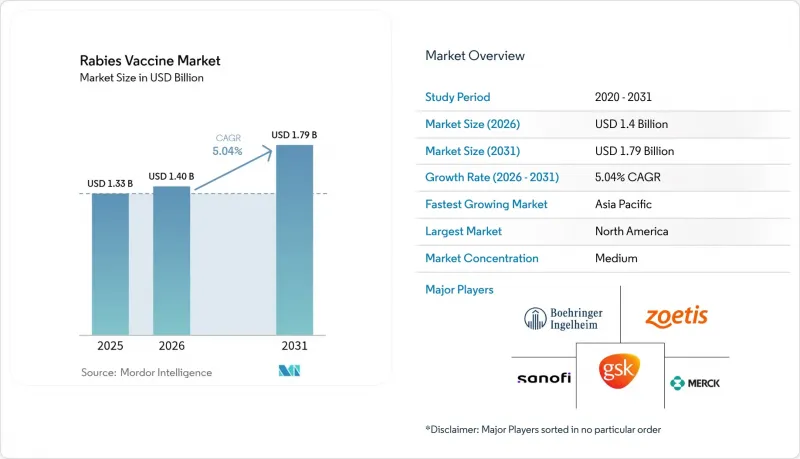
Mordor Intelligence에 의하면, 광견병 백신 시장 규모는 2025년 13억 3,000만 달러에서 2026년에는 14억 달러로 성장하고, 2026-2031년 CAGR 5.04%로 성장을 지속하여 2031년까지 17억 9,000만 달러에 달할 것으로 예측됩니다.
본 보고서는 제품 유형(아기 햄스터 신장(BHK) 백신 등), 예방접종 유형(노출 전 예방접종(PrEP/PEV) 및 노출 후 예방(PEP)), 최종 사용자(인간 및 동물), 유통 채널(공중보건 조달 및 집단 예방접종 프로그램 등),지역(북미, 유럽 등)별로 분류되어 있습니다. 시장 예측은 금액(달러) 기준으로 제시되어 있습니다.
전 세계 광견병 백신 시장 동향 및 인사이트
전 세계 ‘Zero by 30’ 광견병 근절 이니셔티브가 다자간 자금 조달을 촉진
2030년까지 개를 매개로 한 인간 광견병 사망을 근절하겠다는 WHO 주도의 목표에 따라, 장기적인 백신 수요를 보장하는 전례 없는 다자간 자금 흐름이 창출되었습니다. Gavi는 현재 50개국 이상의 대상국에서 노출 후 예방 조치에 자금을 지원함으로써 저소득 국가에서 가장 큰 경제적 장벽을 제거하고 있습니다. 이 체계 하에서 실시되는 일괄 입찰을 통해 제조업체는 향후 수요량을 보다 명확하게 파악할 수 있게 되어 생산 능력 확대가 촉진되고 있습니다. 이 프로그램과 함께 도입된 ‘물림 사례 통합 관리 도구’는 감시 체계를 강화하고 수요 예측의 정확도를 높이는 동시에 낭비를 줄여줍니다. 이러한 요소들이 결합되어, 이전에는 예측 불가능했던 인도적 지원 목적의 구매가 안정적인 상업적 공급 파이프라인으로 전환되고 있습니다.
신경 조직 유래 백신에서 첨단 세포 배양 및 mRNA 플랫폼으로의 전환을 통한 안전성 및 접종률 향상
각 제조업체는 신경 조직 유래 백신을 단계적으로 폐지하고, 더 높은 유효성과 뛰어난 안전 실적을 자랑하는 Vero, BHK 및 mRNA 기술로의 전환을 추진하고 있습니다. mRNA 후보 백신은 동물 모델에서 단 2회 접종만으로 완전한 예방 효과를 보여주고 있어, 이를 통해 환자의 복약 순응도가 향상되고 프로그램 비용이 절감됩니다. 중국에서 검토가 진행 중인 무혈청 생산은 동물 혈청에 수반되는 위험을 제거하여, 품질에 민감한 시장에서 프리미엄 가격 책정을 뒷받침합니다. 부유 배양을 통한 수율 향상으로 1회분당 비용이 절감되어, 공공 조달에서도 첨단 플랫폼이 매력적인 선택지로 부상하고 있습니다. 이러한 변화들이 결합되어 공급량 확대, 신뢰성 향상, 그리고 투여 횟수를 줄인 접종 일정 구현이 가능해집니다.
제한된 콜드체인 및 의료 인프라로 인해 풍토병 유행 지역의 농촌 지역으로의 배포가 제약을 받고 있습니다.
신뢰할 수 있는 전력 공급이 부족하기 때문에 아프리카와 남아시아의 몇몇 국가에서는 외딴 지역의 진료소에 도착하기 전에 최대 30%의 백신이 변질되어, 제한된 공중보건 예산을 낭비하고 있습니다. WHO의 ‘백신 혁신 우선 전략’에서는 내열성 광견병 백신 제제가 최우선 기술로 지정되어 있으며, 향후 40°C의 온도 변동을 최소 3일간 견딜 수 있는 제품이 조달 시 우선적으로 고려될 것임을 시사하고 있습니다. 2024년에 도입된 초저온 대응 붕규산 유리 바이알을 사용한 현장 시험에서는 비포장 도로를 오토바이로 이동하는 라스트 마일 운송 중 파손률이 70% 감소했습니다. 보관 시설이 있는 지역이라 하더라도 진료소에는 교정된 온도 모니터링 장치가 부족한 경우가 많아, 로트별 품질에 불확실성이 발생하고, 의료진의 신뢰를 저해하며, 수요를 감소시키고 있습니다. 현재 개발의 최종 단계에 있는 내열성 인간 광견병 면역글로불린(HRIG)은 2-8℃라는 엄격한 취급 요건을 없앰으로써 물류 부담을 더욱 경감시킬 가능성이 있지만, 2027년 이전에 시판될 전망은 없습니다.
부문 분석
2025년 현재, 베로 세포 부문은 광견병 백신 시장 점유율의 54.30%를 차지하고 있습니다. 견실한 항원 회수율과 99.99%의 숙주 DNA 제거율로 신뢰할 수 있는 안전 기준이 확보된 한편, 무혈청 현탁 배양을 통해 수율은 5.2×10^7 FFU/mL까지 향상되었습니다. 신흥 mRNA 및 BHK 제품이 연평균 성장률(CAGR) 9.4%로 성장하는 가운데, 각 제조업체는 경쟁력을 유지하기 위해 제품 포트폴리오 다각화를 모색하고 있습니다. 지속적인 공정 집약화를 통해 틈새 프리미엄 부문이 가속화되는 상황에서도 베로 세포 공장은 생산량을 유지할 수 있는 체제를 갖추고 있습니다.
그 밖의 제품 유형은 가장 빠르게 성장하는 분야를 형성하고 있습니다. mRNA 후보 제품은 2회 접종 일정, 소량 생산, 공급 부족 시 신속한 생산 확대를 가능하게 하며, 향후 입찰 기준에도 부합합니다. AIM Vaccine사는 2025년에 최초의 무혈청 인간 광견병 백신을 규제 당국에 신청할 예정이며, 이는 중·고소득 국가 시장에서 경쟁이 심화될 것임을 시사합니다. 이러한 혁신으로 인해 2031년까지 비베로 세포계 광견병 백신 시장 규모는 4억 1,800만 달러를 넘어설 것으로 예측됩니다.
2025년 현재, PEP(사후 예방)는 광견병 백신 시장의 77.20%를 차지하고 있습니다. WHO가 권장하는 1주간의 피내 접종 프로토콜로 인해 순응도가 향상되었으며, 접종자의 87%가 1년 후에도 보호 항체가를 유지하고 있습니다. 현재 상용화되고 있는 단일클론 항체 병용 요법은 부작용을 줄이고 효능을 표준화함으로써 PEP의 임상적 우위를 더욱 강화하고 있습니다.
PrEP는 여행 수요 회복 및 직업 관련 지침 변경에 따라 연평균 성장률(CAGR) 6.55%로 확대되고 있습니다. CDC는 현재 2회 접종 PrEP를 권장하고 있으며, 이를 통해 비용과 내원 횟수가 감소하고 있습니다. 부스터 접종 간격이 길어짐에 따라 광견병 백신 업계는 수의사, 검사실 직원, 어드벤처 여행객을 대상으로 한 고용주 부담 접종 프로그램에서 새로운 기회를 발견하고 있습니다.
지역별 분석
북미는 엄격한 규제 감독과 광범위한 보험 적용에 힘입어 2025년에도 광견병 백신 시장의 40.20% 점유율을 유지하고 있습니다. 캐나다의 ‘예방접종 가이드’에서는 수의사 및 검사실 종사자에게 위험 기반 접종 계획을 의무화하고 있어, 안정적인 기초 접종률 향상을 촉진하고 있습니다. 브라운즈빌에서 2025년에 실시된 무료 클리닉과 같은 지역 프로그램은 형평성 있는 접근성을 강화하고 있습니다.
아시아태평양은 6.32%라는 지역별 최고 연평균 성장률(CAGR)을 기록하고 있습니다. 인도와 중국은 현재 연간 10억 회분 이상의 백신을 공급하며, 지역 수요의 85% 이상을 자국에서 충당하고 있습니다. 중국의 광견병 백신 시장 규모는 도시 지역의 반려동물 사육 수 증가와 현지 혁신 파이프라인을 배경으로 2031년까지 155억 6,000만 위안(21억 7,000만 달러)을 넘어설 것으로 예측됩니다. 이러한 환경 속에서 혈청을 포함하지 않는 제제나 복합 제제가 조기에 채택될 것으로 전망됩니다. 유럽, 중동 및 아프리카, 그리고 남미는 다양한 비즈니스 기회를 형성하고 있습니다. 유럽에서는 바바리안 노르딕(Bavarian Nordic)사의 ‘라비풀/라바바트’가 2024년에 매출 예상을 상회하며, 프리미엄 제품에 대한 견조한 수요가 부각되었습니다. PAVM 등 아프리카 연합(AU)의 노력은 자금 지원 및 기술 이전을 통해 현지 생산 확대를 목표로 하고 있으며, 이는 장기적인 공급 측면의 변화를 시사합니다. 남미에서는 지속적인 진전이 나타나고 있습니다. 개를 매개로 한 인간 감염 사례는 1983년 이후 98% 감소했으나, 각국 정부는 여전히 80% 이상의 접종률을 유지하기 위해 개를 대상으로 한 예방접종 캠페인을 우선시하고 있습니다.
기타 혜택:
- 엑셀 형식 시장 예측(ME) 시트
- 3개월간의 애널리스트 지원
자주 묻는 질문
목차
제1장 서론
제2장 조사 방법
제3장 주요 요약
제4장 시장 구도
제5장 시장 규모와 성장 예측
제6장 경쟁 구도
제7장 시장 기회와 향후 전망
LSH 26.09.03According to Mordor Intelligence, the rabies vaccine market size is expected to grow from USD1.33 billion in 2025 to USD1.40 billion in 2026 and is forecast to reach USD1.79 billion by 2031 at 5.04% CAGR over 2026-2031.
This report is Segmented by Product Type (Baby Hamster Kidney (BHK) Vaccine, and More), Vaccination Type (Pre-Exposure Vaccination (PrEP/PEV) and Post-Exposure Prophylaxis (PEP)), End-User (Humans and Animals), Distribution Channel (Public Health Procurement & Mass Immunization Programs, and More), and Geography (North America, Europe, and More). The Market Forecasts are Provided in Terms of Value (USD).
Global Rabies Vaccine Market Trends and Insights
Global "Zero by 30" Rabies Elimination Initiative Boosting Multilateral Funding
The WHO-led goal of ending dog-mediated human rabies deaths by 2030 has unlocked unprecedented multilateral funding streams that guarantee long-term vaccine demand. Gavi now finances post-exposure prophylaxis in more than 50 eligible countries, removing the biggest affordability hurdle in low-income settings. Bulk tenders created under this framework give manufacturers better visibility into future volumes, encouraging capacity expansions. Integrated Bite Case Management tools rolled out with the program improve surveillance, which sharpens demand forecasts and cuts wastage. Together, these elements convert previously unpredictable humanitarian purchases into a stable commercial pipeline.
Shift from Nerve-Tissue to Advanced Cell-Culture & mRNA Platforms Enhancing Safety and Uptake
Manufacturers are phasing out nerve-tissue vaccines in favor of Vero, BHK, and mRNA technologies that deliver higher efficacy and better safety records. mRNA candidates show full protection in animal models with just two doses, which improves patient compliance and lowers program costs. Serum-free production under review in China eliminates animal serum risks and supports premium pricing in quality-sensitive markets. Higher yields from suspension cultures reduce per-dose cost, making advanced platforms attractive even for public tenders. These shifts collectively expand supply, enhance trust, and open doors to dose-sparing schedules.
Limited Cold-Chain & Healthcare Infrastructure Restricting Rural Distribution in Endemic Regions
The absence of reliable electricity means that up to 30% of vaccines spoil before reaching remote clinics in several African and South Asian countries, wiping out scarce public-health budgets. WHO's Vaccine Innovation Prioritisation Strategy now places thermostable rabies formulations in its top tier of needed technologies, signalling future tender preference for products that tolerate 40 °C excursions for at least three days. Pilot field studies with deep-cold borosilicate vials introduced in 2024 cut breakage rates by 70% during last-mile transport on motorcycles over unpaved roads. Even where storage exists, clinics often lack calibrated temperature monitoring, leading to batch-by-batch quality uncertainty that erodes clinician confidence and depresses demand. Thermostable human rabies immune globulin (HRIG) now in late-stage development could further ease logistics by eliminating strict 2-8 °C handling requirements, but commercial launch is not expected before 2027.
Other drivers and restraints analyzed in the detailed report include:
- Expanded Government Procurement & Donor Support Mechanisms Improving Vaccine Accessibility
- Robust R&D Pipeline in Novel Modalities (mRNA, Monoclonal Antibodies) Broadening Addressable Market
- High Total Cost of Full PEP Regimen Creating Affordability Barriers
For complete list of drivers and restraints, kindly check the Table Of Contents.
Segment Analysis
The Vero Cell segment holds 54.30% of the rabies vaccine market share in 2025. Robust antigen recovery and 99.99% host-DNA removal deliver reliable safety benchmarks, while serum-free suspension culture pushes yields to 5.2 X 10^7 FFU/mL. As emerging mRNA and BHK products grow at 9.4% CAGR, manufacturers hedge portfolios to retain relevance. Continuous process intensification positions Vero Cell plants to defend volumes even as niche premium segments accelerate.
Other product types form the quickest-growing cluster. mRNA candidates promise two-dose schedules, smaller batch sizes, and rapid scalability during shortages, aligning with future tender criteria. AIM Vaccine filed the first serum-free human rabies vaccine with regulators in 2025, signalling wider competition in upper-middle-income markets. These innovations are likely to lift the rabies vaccine market size for non-Vero formats above USD418 million by 2031.
PEP accounts for 77.20% of the rabies vaccine market in 2025. WHO's 1-week intradermal protocol lifts compliance: 87% of recipients maintain protective antibody titres after 1 year. Monoclonal antibody combinations now entering practice cut adverse reactions and standardize potency, strengthening PEP's clinical edge.
PrEP grows at 6.55% CAGR as travel rebounds and occupational guidelines shift. CDC now endorses a 2-dose PrEP series, lowering cost and clinic visits. With longer booster intervals, the rabies vaccine industry sees new opportunities in employer-funded schemes for veterinarians, laboratory staff, and adventure tourists.
Complete Report Scope:
- By Product Type
- Baby Hamster Kidney (BHK) Vaccine
- Purified Chick Embryo Cell Rabies Vaccine
- Vero Cell Rabies Vaccine
- Other Product Types
- By Vaccination Type
- Pre-Exposure Vaccination (PrEP/PEV)
- Post-Exposure Prophylaxis (PEP)
- By End-User
- Humans
- Animals
- By Distribution Channel
- Public Health Procurement & Mass Immunization Programs
- Hospitals & Travel Clinics
- Veterinary Clinics
- Retail & Online Pharmacies
- Geography
- North America
- United States
- Canada
- Mexico
- Europe
- Germany
- United Kingdom
- France
- Italy
- Spain
- Rest of Europe
- Asia Pacific
- China
- Japan
- India
- Australia
- South Korea
- Rest of Asia Pacific
- Middle East & Africa
- GCC
- South Africa
- Rest of Middle East & Africa
- South America
- Brazil
- Argentina
- Rest of South America
- North America
Geography Analysis
North America retains 40.20% share of the rabies vaccine market in 2025, propelled by airtight regulatory oversight and widespread insurance coverage. Canada's Immunization Guide mandates risk-based regimens for veterinarians and laboratory workers, promoting steady baseline uptake. Community programs such as Brownsville's free 2025 clinic reinforce equitable access.
Asia Pacific records the fastest regional CAGR at 6.32%. India and China now deliver more than 1 billion vaccine doses annually and self-supply over 85% of regional demand. China's rabies vaccine market size is forecast to surpass RMB15.56 billion (USD 2.17 billion) by 2031 on the back of rising urban pet ownership and local innovation pipelines. Serum-free and combination formulations are expected to be early adopters in this environment. Europe, Middle East & Africa, and South America form a diversified opportunity set. In Europe, Bavarian Nordic's Rabipur/RabAvert exceeded sales expectations in 2024, highlighting resilient premium demand. African Union initiatives such as PAVM aim to grow local manufacturing through finance and technology transfer, signalling long-run supply-side changes. South America showcases sustained progress: dog-transmitted human cases dropped 98% since 1983, yet governments still prioritize canine campaigns to maintain >=80% coverage.
- Sanofi
- GlaxoSmithKline
- Merck
- Zoetis
- Boehringer Ingelheim
- Pfizer
- Elanco
- Virbac
- Bharat Biotech
- AIM Vaccine Co., Ltd.
- Chengdu Institute of Biological Products
- Indian Immunologicals
- Kamada Ltd.
- Kedrion Biopharma
- CSL Behring
- Grifols
- Liaoning Cheng Da Co., Ltd.
- Shuanglin Bio-Pharmaceutical Co., Ltd.
Additional Benefits:
- The market estimate (ME) sheet in Excel format
- 3 months of analyst support
TABLE OF CONTENTS
1 Introduction
- 1.1 Study Assumptions & Market Definition
- 1.2 Scope of the Study
2 Research Methodology
3 Executive Summary
4 Market Landscape
- 4.1 Market Overview
- 4.2 Market Drivers
- 4.2.1 Global 'Zero by 30' Rabies Elimination Initiative Boosting Multilateral Funding
- 4.2.2 Shift from Nerve-Tissue to Advanced Cell-Culture & mRNA Platforms Enhancing Safety and Uptake
- 4.2.3 Escalating Animal-Bite Incidence & Stray-Dog Density in Emerging Economies Sustaining Demand
- 4.2.4 Rising Companion-Animal Ownership and Preventive Vet-Care Expenditure Worldwide
- 4.2.5 Expanded Government Procurement & Donor Support Mechanisms Improving Vaccine Accessibility
- 4.2.6 Robust R&D Pipeline in Novel Modalities (mRNA, Monoclonal Antibodies) Broadening Addressable Market
- 4.3 Market Restraints
- 4.3.1 Limited Cold-Chain & Healthcare Infrastructure Restricting Rural Distribution in Endemic Regions
- 4.3.2 High Total Cost of Full PEP Regimen Creating Affordability Barriers
- 4.3.3 Intermittent Supply Shortages & Manufacturing Capacity Constraints Impacting Global Availability
- 4.3.4 Complex, Price-Sensitive Tender and Regulatory Processes Delaying New Vaccine Market Entry
- 4.4 Value / Supply-Chain Analysis
- 4.5 Regulatory Outlook
- 4.6 Porter's Five Forces Analysis
- 4.6.1 Threat of New Entrants
- 4.6.2 Bargaining Power of Buyers/Consumers
- 4.6.3 Bargaining Power of Suppliers
- 4.6.4 Threat of Substitutes
- 4.6.5 Intensity of Competitive Rivalry
5 Market Size & Growth Forecasts (Value, USD)
- 5.1 By Product Type
- 5.1.1 Baby Hamster Kidney (BHK) Vaccine
- 5.1.2 Purified Chick Embryo Cell Rabies Vaccine
- 5.1.3 Vero Cell Rabies Vaccine
- 5.1.4 Other Product Types
- 5.2 By Vaccination Type
- 5.2.1 Pre-Exposure Vaccination (PrEP/PEV)
- 5.2.2 Post-Exposure Prophylaxis (PEP)
- 5.3 By End-User
- 5.3.1 Humans
- 5.3.2 Animals
- 5.4 By Distribution Channel
- 5.4.1 Public Health Procurement & Mass Immunization Programs
- 5.4.2 Hospitals & Travel Clinics
- 5.4.3 Veterinary Clinics
- 5.4.4 Retail & Online Pharmacies
- 5.5 Geography
- 5.5.1 North America
- 5.5.1.1 United States
- 5.5.1.2 Canada
- 5.5.1.3 Mexico
- 5.5.2 Europe
- 5.5.2.1 Germany
- 5.5.2.2 United Kingdom
- 5.5.2.3 France
- 5.5.2.4 Italy
- 5.5.2.5 Spain
- 5.5.2.6 Rest of Europe
- 5.5.3 Asia Pacific
- 5.5.3.1 China
- 5.5.3.2 Japan
- 5.5.3.3 India
- 5.5.3.4 Australia
- 5.5.3.5 South Korea
- 5.5.3.6 Rest of Asia Pacific
- 5.5.4 Middle East & Africa
- 5.5.4.1 GCC
- 5.5.4.2 South Africa
- 5.5.4.3 Rest of Middle East & Africa
- 5.5.5 South America
- 5.5.5.1 Brazil
- 5.5.5.2 Argentina
- 5.5.5.3 Rest of South America
- 5.5.1 North America
6 Competitive Landscape
- 6.1 Market Concentration
- 6.2 Strategic Moves
- 6.3 Market Share Analysis
- 6.4 Company Profiles (includes Global level Overview, Market level overview, Core Business Segments, Financials, Headcount, Key Information, Market Rank, Market Share, Products and Services, and analysis of Recent Developments)
- 6.4.1 Sanofi SA
- 6.4.2 GlaxoSmithKline plc
- 6.4.3 Merck & Co., Inc.
- 6.4.4 Zoetis Inc.
- 6.4.5 Boehringer Ingelheim International GmbH
- 6.4.6 Pfizer Inc.
- 6.4.7 Elanco Animal Health
- 6.4.8 Virbac SA
- 6.4.9 Bharat Biotech
- 6.4.10 AIM Vaccine Co., Ltd.
- 6.4.11 Chengdu Institute of Biological Products
- 6.4.12 Indian Immunologicals Ltd.
- 6.4.13 Kamada Ltd.
- 6.4.14 Kedrion Biopharma Inc.
- 6.4.15 CSL Behring
- 6.4.16 Grifols SA
- 6.4.17 Liaoning Cheng Da Co., Ltd.
- 6.4.18 Shuanglin Bio-Pharmaceutical Co., Ltd.
7 Market Opportunities & Future Outlook
- 7.1 White-Space & Unmet-Need Assessment


