|
시장보고서
상품코드
2122610
수의 내시경 : 시장 점유율 분석, 업계 동향과 통계, 성장 예측(2026-2031년)Veterinary Endoscopy - Market Share Analysis, Industry Trends & Statistics, Growth Forecasts (2026 - 2031) |
||||||
 Mordor Intelligence
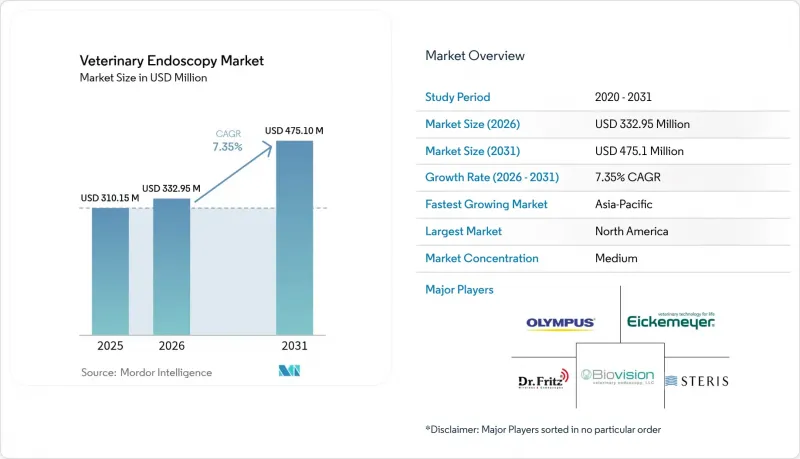
Mordor Intelligence에 의하면, 2026년 세계의 수의용 내시경 시장 규모는 3억 3,295만 달러로 추정되며, 2025년 3억 1,015만 달러에서 2031년에는 4억 7,510만 달러에 달할 것으로 예측됩니다.
또한 2026-2031년 연평균 성장률(CAGR) 7.35%를 기록할 전망입니다.
본 보고서는 제품 유형(내시경, 시각화·영상 진단 시스템 등), 시술(진단 및 치료), 용도(소화기계, 비뇨생식기계 등), 동물 종(반려동물 및 가축), 최종 사용자(동물병원 및 의뢰 클리닉 등),지역(북미, 유럽 등)별로 분류되어 있습니다. 시장 전망은 금액(달러) 기준으로 제시되어 있습니다.
전 세계 수의용 내시경 시장 동향 및 인사이트
증가하는 소화기계 및 호흡기계 질환
만성 장 질환, 염증성 장 질환, 하기도 질환의 발생률이 증가함에 따라 수의사들은 첫 번째 선택 진단법으로 내시경 검사를 채택하고 있습니다. 진료 현장의 보고에 따르면, X선 검사에 비해 진단 정확도가 현저히 높은 것으로 나타났으며, 한 연구에서는 내시경 검사를 도입한 결과 소화기 계통의 확정 진단률이 37% 상승한 것으로 기록되었습니다. 또한 반려동물의 수명이 연장되면서 노화에 따른 소화기 질환을 앓는 동물의 수가 늘어나고 있으며, 이로 인해 검사 건수는 더욱 증가하고 있습니다. 대형 동물 진료 현장에서는 경주마에 대한 상기도 내시경 검사나 젖소 군에 대한 기관지경 검사의 이용이 증가하고 있어, 수요는 반려동물 전문 클리닉의 범위를 넘어 확대되고 있습니다. 이러한 임상 동향이 맞물려 수의 내시경 시장 전체에서 검사 건수가 증가함에 따라, 장비에 대한 투자가 정당화되고 있습니다.
반려동물의 ‘인간화’와 프리미엄 케어에 대한 지출
자녀가 없는 가구는 가처분 소득을 반려동물의 고도의 의료 서비스에 지출하고 있으며, 내시경 진단이나 최소 침습 치료에 대한 지불 의향이 높아지고 있습니다. 모건 스탠리의 예측에 따르면, 2030년까지 가구당 연간 반려동물 관련 지출은 1,733달러에 달할 것으로 보이며, 그중에서도 수의학 서비스가 가장 빠르게 확대될 항목이 될 전망입니다. 고해상도 영상이나 캡슐 내시경과 같은 기법은 반려인이 원하는 ‘신체적 부담이 적고 흉터도 적은’ 시술이라는 요구와 부합합니다. 보험 적용 시술과 제3자 자금 조달 플랫폼의 영향이 맞물리면서 초기 비용에 대한 민감도가 낮아지고 있으며, 이에 따라 전문 시설은 종합적인 내시경 패키지를 판매할 수 있게 되었습니다. 그 결과, 반려동물의 ‘인간화’는 수의 내시경 시장 전체에서 시술 빈도와 수익을 지속적으로 끌어올리고 있습니다.
도입을 가로막는 고가의 장비 비용
엔트리 레벨 HD 시스템의 가격은 4만 5,000달러를 초과하기도 하여, 내원 환자 수 감소와 이익률 하락으로 어려움을 겪는 소규모 동물병원이나 지방 동물병원에게는 큰 장벽이 되고 있습니다. 서비스 계약, 내시경 수리, 전용 세척 장비 등의 비용이 수명 주기 비용에 더해져 투자 회수 기간이 길어지고 있습니다. 신흥 시장의 동물병원들은 더욱 높은 수입 관세와 자금 조달 제한에 직면해 있어, 이것이 수의학 내시경 시장의 확산을 방해하고 있습니다. ‘사용량 기반 과금’이나 리스 모델을 제공하는 업체들은 도입 장벽을 낮추기 위해 노력하고 있지만, 전반적인 예산 제약이 여전히 시장 성장의 큰 걸림돌이 되고 있습니다.
부문 분석
플렉서블 비디오 시스템은 2025년 매출의 45.30%를 차지하며, 소화기, 호흡기, 비뇨생식기 영역에서의 다용도성을 입증하고 있습니다. 끝단에 HD 칩을 탑재한 광학 시스템은 선명한 영상을 제공하며, 강성을 조절할 수 있는 삽입 튜브는 조작성을 향상시키고 있습니다. 이에 따라 이 부문은 수의학 내시경 시장에서 가장 큰 점유율을 차지했습니다. 캡슐 모듈은 절대적인 매출액은 낮지만, 고양이, 소형견, 이국적 동물을 대상으로 한 마취가 필요 없는 영상 진단이 진료소에서 보급되고 있어 연평균 성장률(CAGR) 11.2%로 성장을 지속하고, 있습니다. 캡슐형 기기의 수의학 내시경 시장 규모는 2030년까지 2배 이상으로 성장할 전망입니다. 경성 내시경은 내구성이 뛰어난 광학 시스템과 촉각적인 조작성 덕분에 관절경 검사 분야에서 여전히 인기를 유지하고 있습니다. 또한, 로봇 보조형 장치는 아직 발전 단계에 있지만, 원격 조이스틱 조작을 검토 중인 고급 말 의료 센터로부터 주목을 받고 있습니다.
보완적인 영상 표시 콘솔과 통합형 AI 분석은 새로운 검사실 건설보다는 시스템 업그레이드에 의해 주도되며, 매출액 기준으로 두 번째로 큰 분야를 차지하고 있습니다. 생검 집게, 스네어, 회수 바구니 등의 액세서리 판매는 OEM 제조업체에게 높은 이익률을 보장하는 지속적인 수익원이 되고 있습니다. 이 부문은 치료 시술 건수 증가에 힘입어 혜택을 보고 있으며, 각 시술마다 소모품 수요가 연동되어 발생하고 있습니다.
2025년에는 X선 검사보다 우수한 점막 평가가 가능하다는 점으로 인해, 진단용 내시경 검사가 전 세계 사례의 63.40%를 차지했습니다. 조직 채취의 정확도가 높아 탐색적 수술이 줄어들고, 표적 약물 치료가 가능해짐에 따라 수요가 뒷받침되고 있습니다. 그럼에도 불구하고 치료용 내시경 검사가 성장의 원동력이 되고 있으며, 내시경의 적용 범위가 확대되고 부속 기구의 라인업이 다양해짐에 따라 2031년까지 연평균 성장률(CAGR) 10.1%를 나타낼 것으로 예측됩니다. 현재, 한 번의 마취 시간 내에 협착부 확장술, 용종 절제술, 이물 제거술을 시행할 수 있게 된 점이 고객의 수용을 촉진하고 있습니다. 진단과 치료를 결합한 워크플로우를 통해 내원 횟수가 줄어들어 바쁜 반려동물 주인에게 매력적일 뿐만 아니라, 동물에게 가해지는 부담도 경감됩니다. 토크 안정성이 뛰어난 오버튜브나 레이저 대응 워킹 채널을 제공하는 제조업체는 수의학 내시경 시장에서 가장 급성장하는 분야를 주도할 전망입니다.
지역별 분석
북미는 2025년 전 세계 매출의 37.60%를 차지하며, 수의학 내시경 시장에서 확고한 지역적 우위를 점하고 있습니다. 반려동물 보험 가입률이 높고, 전 세계에서 가장 밀집된 인증 전문의가 상주하고 있어 고도의 시술에 대한 수요를 뒷받침하고 있습니다. 미국의 전문 소개 병원은 캡슐 내시경 및 4K 영상 진단 도입을 주도하고 있는 반면, 캐나다의 동물병원은 복잡한 증례 처리를 위해 대학과의 제휴에 의존하고 있습니다. 멕시코의 도시 지역에서는 중산층 가구가 서유럽의 반려동물 관리 기준을 도입함에 따라 두 자릿수 성장이 나타나고 있습니다.
유럽은 시장 규모에서 2위를 차지하고 있으며, 엄격한 동물 복지 규제와 오랜 기간 확립된 의뢰 네트워크에 힘입고 있습니다. 독일의 뛰어난 기술력 덕분에 현지 OEM 생산이 촉진되어 로봇식 관절 내시경의 조기 도입이 진행되고 있습니다. 영국에서는 뿌리 깊은 반려동물 사육 문화와 탄탄한 전문의 인증 제도가 맞물려 1인당 시술 건수가 많습니다. 지중해 국가들은 북유럽 국가들에 비해 뒤처져 있지만, 전문 병원이 급증함에 따라 그 격차는 빠르게 좁혀지고 있습니다.
아시아태평양은 세계 성장의 견인차이며, 2031년까지의 연평균 성장률(CAGR)은 9.1%로 전망됩니다. 중국에서는 확대되는 중산층으로 인해 반려동물 의료비가 증가하고 있어, 내시경 투자 비용을 상쇄할 수 있는 다점포 병원 체인의 확장을 뒷받침하고 있습니다. 일본은 높은 기술 성숙도를 자랑하는 반면, 인도의 성장은 낮은 수준에서 시작되었으나 도시 지역의 반려동물 수 증가와 서유럽 국가들과의 교육 협력의 혜택을 받고 있습니다. 호주와 한국은 높은 품질 기준을 유지하고 있으나, 지방 지역에서는 여전히 의료 서비스가 충분히 제공되지 않아 지역 내 격차가 지속되고 있습니다.
남미, 중동 및 아프리카는 시장 점유율은 작지만, 수의과 대학의 교육 과정 확충과 대도시권 시장으로의 기업 진출에 힘입어 견조한 성장을 보이고 있습니다. 의료기기 기증 프로그램과 원격 내시경 검사 제휴를 통해 전문의 부족 문제가 완화되면서 잠재 수요가 더욱 발굴되고 있습니다.
기타 혜택:
- 엑셀 형식 시장 예측(ME) 시트
- 3개월간의 애널리스트 지원
목차
제1장 서론
제2장 조사 방법
제3장 주요 요약
제4장 시장 구도
제5장 시장 규모와 성장 예측
제6장 경쟁 구도
제7장 시장 기회와 향후 전망
LSHAccording to Mordor Intelligence, the global veterinary endoscopy market size in 2026 is estimated at USD 332.95 million, growing from 2025 value of USD 310.15 million with 2031 projections showing USD 475.1 million, growing at 7.35% CAGR over 2026-2031.
This report is Segmented by Product Type (Endoscopes, Visualization & Imaging Systems, and More), Procedure (Diagnostic and Therapeutic), Application (Gastrointestinal, Urogenital, and More), Animal Type (Companion Animals and Livestock), End User (Veterinary Hospitals & Referral Clinics, and More), and Geography (North America, Europe, and More). The Market Forecasts are Provided in Terms of Value (USD).
Global Veterinary Endoscopy Market Trends and Insights
Rising Gastrointestinal and Respiratory Disorders
Growing incidence of chronic enteropathies, inflammatory bowel disease, and lower airway disease is prompting veterinarians to adopt endoscopy as first-line diagnostics. Practices report measurably higher diagnostic yields versus radiography; one study recorded a 37% uptick in definitive GI diagnoses when endoscopy was deployed. Prolonged companion-animal lifespans also expose more animals to age-related GI pathologies, further swelling procedure volumes. Large-animal practitioners increasingly use upper airway endoscopy for racehorses and bronchoscopy for dairy herds, broadening demand beyond companion clinics. Together, these clinical trends are raising throughput and justifying equipment investment across the veterinary endoscopy market.
Pet Humanization and Premium Care Spend
Households without children are channeling discretionary income toward advanced companion-animal healthcare, reinforcing willingness to pay for endoscopic diagnostics and minimally invasive therapy. Morgan Stanley projects annual household pet outlays to hit USD 1,733 by 2030, with veterinary services the fastest-expanding line item. High-definition video and capsule modalities align well with owner preferences for gentle, low-scarring interventions. The converging influence of insured procedures and third-party financing platforms is also reducing upfront cost sensitivity, allowing specialty centers to market comprehensive endoscopic packages. Consequently, pet humanization continues to boost procedure frequency and revenue across the veterinary endoscopy market.
High Equipment Costs Limiting Adoption
Entry-level HD systems can exceed USD 45,000, a hurdle for small or rural clinics battling declining foot traffic and thinning margins. Service contracts, scope repair, and specialty cleaning units add to lifecycle outlays, lengthening payback periods. Emerging-market practices face even steeper import duties and limited financing, stalling penetration of the veterinary endoscopy market. Vendors offering pay-per-use or leasing models are attempting to ease adoption, yet overall budget constraints remain a strong drag on market growth.
Other drivers and restraints analyzed in the detailed report include:
- Technological Miniaturization Expanding Accessibility
- Tele-Endoscopy and Cloud-Based Image Management
- Veterinary Endoscopist Shortage
For complete list of drivers and restraints, kindly check the Table Of Contents.
Segment Analysis
Flexible video systems delivered 45.30% of 2025 revenue, underscoring their versatility in GI, respiratory, and urogenital work. HD chip-on-tip optics provide crisp imagery, while variable stiffness insertion tubes improve maneuverability. Correspondingly, the segment captured the largest slice of the veterinary endoscopy market share. Capsule modules, although accounting for lower absolute revenue, post an 11.2% CAGR as clinics embrace anesthesia-free imaging for cats, small dogs, and exotics. The veterinary endoscopy market size for capsule devices is on track to more than double by 2030. Rigid scopes retain popularity in arthroscopy owing to durable optics and tactile control, and robot-assisted units, though nascent, attract premium equine centers exploring remote joystick manipulation.
Complementary visualization consoles and integrated AI analytics represent the second-largest revenue pool, driven by system upgrades rather than new room builds. Accessory sales-biopsy forceps, snares, retrieval baskets-generate high-margin recurring income for OEMs. The segment benefits as therapeutic procedure counts climb, knitting consumable pull-through to each intervention.
Diagnostic work comprised 63.40% of global cases in 2025, supported by superior mucosal assessment over radiography. High tissue-sampling accuracy reduces exploratory surgeries and informs targeted pharmacologic regimens, reinforcing demand. Still, therapeutic endoscopy is the momentum engine, projected to log a 10.1% CAGR through 2031 as scope channels widen and accessory toolkits diversify. Stricture dilations, polyp resections, and foreign-body retrievals now performable in a single anesthetic window drive client acceptance. Combined diagnostic-therapeutic workflows compress visit counts, appealing to busy pet owners and reducing stress on animals. Manufacturers responding with torque-stable overtubes and laser-compatible working channels stand to capture the fastest-growing pocket of the veterinary endoscopy market.
Complete Report Scope:
- By Product Type
- Endoscopes
- Capsule
- Flexible Video
- Rigid
- Robot-assisted
- Visualization & Imaging Systems
- Accessories & Consumables
- Endoscopes
- By Procedure
- Diagnostic
- Therapeutic / Interventional
- By Application
- Gastrointestinal
- Respiratory & ENT
- Urogenital
- Orthopedic / Arthroscopy
- Others
- By Animal Type
- Companion Animals
- Canine
- Feline
- Equine
- Livestock
- Bovine
- Porcine
- Poultry
- Ovine/Caprine
- Companion Animals
- By End User
- Veterinary Hospitals & Referral Clinics
- Ambulatory & Specialty Centers
- Academic & Research Institutes
- Geography
- North America
- United States
- Canada
- Mexico
- Europe
- Germany
- United Kingdom
- France
- Italy
- Spain
- Rest of Europe
- Asia-Pacific
- China
- Japan
- India
- South Korea
- Australia
- Rest of Asia-Pacific
- Middle East and Africa
- GCC
- South Africa
- Rest of Middle East and Africa
- South America
- Brazil
- Argentina
- Rest of South America
- North America
Geography Analysis
North America contributed 37.60% of 2025 global revenue, cementing regional supremacy for the veterinary endoscopy market. High pet insurance uptake and the world's densest population of diplomate-level specialists sustain premium procedure demand. U.S. referral hospitals spearhead adoption of capsule and 4K imaging, while Canadian clinics lean on university affiliations for complex case overflow. Mexico's urban corridors exhibit double-digit growth as middle-income households pivot toward Western pet-care norms.
Europe ranks second by value, buttressed by stringent welfare regulations and long-established referral networks. Germany's engineering pedigree supports local OEM production, driving early adoption of robotic articulating scopes. The United Kingdom combines strong pet-ownership culture with robust specialty certification, fostering high per-capita procedure volumes. Mediterranean countries lag Northern peers but close gaps swiftly as specialty hospitals proliferate.
Asia-Pacific is the locomotive of global growth, slated for a 9.1% CAGR through 2031. China's expanding middle class elevates pet medical spend, stimulating multi-site hospital chains that can amortize endoscope investments. Japan showcases advanced technique maturity, while India's growth stems from a low base but benefits from rising urban pet populations and Western educational collaborations. Australia and South Korea sustain high-quality benchmarks, but intra-regional disparity persists as rural sectors remain underserved.
South America and the Middle East & Africa represent smaller shares yet register healthy growth as veterinary colleges upgrade curricula and corporates enter metropolitan markets. Equipment donation programs and tele-endoscopy partnerships mitigate specialist shortages, further unlocking latent demand.
- Biovision Veterinary Endoscopy
- Karl Storz
- Olympus
- Medtronic
- STERIS
- Dr. Fritz Endoscopy
- Eickemeyer Veterinary Equipment
- Zhuhai Seesheen Medical Technology
- Fujifilm Holdings Corp.
- SonoScape Medical Corp.
- Cook Group
- Endoscopy Support Services Inc.
- VetOvation
- Arthrex Vet Systems
- Jorgensen Laboratories
- Hill-Rom Holdings (Welch Allyn Vet)
- iM3 Veterinary
- B. Braun
- TianSong Medical Instrument
- Medit Inc.
Additional Benefits:
- The market estimate (ME) sheet in Excel format
- 3 months of analyst support
TABLE OF CONTENTS
1 Introduction
- 1.1 Study Assumptions & Market Definition
- 1.2 Scope of the Study
2 Research Methodology
3 Executive Summary
4 Market Landscape
- 4.1 Market Overview
- 4.2 Market Drivers
- 4.2.1 Increasing Incidence of Gastrointestinal & Respiratory Disorders in Companion and Livestock Animals
- 4.2.2 Rising Pet Ownership and Humanization Boosting Spend on Advanced Veterinary Care
- 4.2.3 Continuous Technological Advancements in High-Definition & Miniaturized Veterinary Endoscopy Systems
- 4.2.4 Growing Adoption of Tele-Endoscopy and Cloud-Based Image Management Among Referral Networks
- 4.2.5 Consolidation of Veterinary Hospital Chains Driving Capital Investment in Endoscopic Equipment
- 4.3 Market Restraints
- 4.3.1 High Capital and Lifecycle Costs of Endoscopic Platforms for Small & Rural Clinics
- 4.3.2 Global Shortage of Skilled Veterinary Endoscopists and Specialized Support Staff
- 4.3.3 Sterilization, Reprocessing, and Cross-Species Infection Control Challenges
- 4.4 Supply-Chain Analysis
- 4.5 Porter's Five Forces
- 4.5.1 Threat of New Entrants
- 4.5.2 Bargaining Power of Buyers
- 4.5.3 Bargaining Power of Suppliers
- 4.5.4 Threat of Substitutes
- 4.5.5 Intensity of Competitive Rivalry
5 Market Size & Growth Forecasts (Value, USD)
- 5.1 By Product Type
- 5.1.1 Endoscopes
- 5.1.1.1 Capsule
- 5.1.1.2 Flexible Video
- 5.1.1.3 Rigid
- 5.1.1.4 Robot-assisted
- 5.1.2 Visualization & Imaging Systems
- 5.1.3 Accessories & Consumables
- 5.1.1 Endoscopes
- 5.2 By Procedure
- 5.2.1 Diagnostic
- 5.2.2 Therapeutic / Interventional
- 5.3 By Application
- 5.3.1 Gastrointestinal
- 5.3.2 Respiratory & ENT
- 5.3.3 Urogenital
- 5.3.4 Orthopedic / Arthroscopy
- 5.3.5 Others
- 5.4 By Animal Type
- 5.4.1 Companion Animals
- 5.4.1.1 Canine
- 5.4.1.2 Feline
- 5.4.1.3 Equine
- 5.4.2 Livestock
- 5.4.2.1 Bovine
- 5.4.2.2 Porcine
- 5.4.2.3 Poultry
- 5.4.2.4 Ovine/Caprine
- 5.4.1 Companion Animals
- 5.5 By End User
- 5.5.1 Veterinary Hospitals & Referral Clinics
- 5.5.2 Ambulatory & Specialty Centers
- 5.5.3 Academic & Research Institutes
- 5.6 Geography
- 5.6.1 North America
- 5.6.1.1 United States
- 5.6.1.2 Canada
- 5.6.1.3 Mexico
- 5.6.2 Europe
- 5.6.2.1 Germany
- 5.6.2.2 United Kingdom
- 5.6.2.3 France
- 5.6.2.4 Italy
- 5.6.2.5 Spain
- 5.6.2.6 Rest of Europe
- 5.6.3 Asia-Pacific
- 5.6.3.1 China
- 5.6.3.2 Japan
- 5.6.3.3 India
- 5.6.3.4 South Korea
- 5.6.3.5 Australia
- 5.6.3.6 Rest of Asia-Pacific
- 5.6.4 Middle East and Africa
- 5.6.4.1 GCC
- 5.6.4.2 South Africa
- 5.6.4.3 Rest of Middle East and Africa
- 5.6.5 South America
- 5.6.5.1 Brazil
- 5.6.5.2 Argentina
- 5.6.5.3 Rest of South America
- 5.6.1 North America
6 Competitive Landscape
- 6.1 Market Concentration
- 6.2 Market Share Analysis
- 6.3 Company Profiles (includes Global level Overview, Market level overview, Core Business Segments, Financials, Headcount, Key Information, Market Rank, Market Share, Products and Services, and analysis of Recent Developments)
- 6.3.1 Biovision Veterinary Endoscopy LLC
- 6.3.2 Karl Storz SE & Co. KG
- 6.3.3 Olympus Corporation
- 6.3.4 Medtronic PLC
- 6.3.5 Steris PLC
- 6.3.6 Dr. Fritz Endoscopy GmbH
- 6.3.7 Eickemeyer Veterinary Equipment
- 6.3.8 Zhuhai Seesheen Medical Technology
- 6.3.9 Fujifilm Holdings Corp.
- 6.3.10 SonoScape Medical Corp.
- 6.3.11 Cook Medical
- 6.3.12 Endoscopy Support Services Inc.
- 6.3.13 VetOvation
- 6.3.14 Arthrex Vet Systems
- 6.3.15 Jorgensen Laboratories
- 6.3.16 Hill-Rom Holdings (Welch Allyn Vet)
- 6.3.17 iM3 Veterinary
- 6.3.18 B. Braun Melsungen AG
- 6.3.19 TianSong Medical Instrument
- 6.3.20 Medit Inc.
7 Market Opportunities & Future Outlook
- 7.1 White-space & Unmet-Need Assessment