
|
시장보고서
상품코드
2122627
모바일 생체인식 시장 : 시장 점유율 분석, 업계 동향 및 통계, 성장 예측(2026-2031년)Mobile Biometrics - Market Share Analysis, Industry Trends & Statistics, Growth Forecasts (2026 - 2031) |
||||||
 Mordor Intelligence
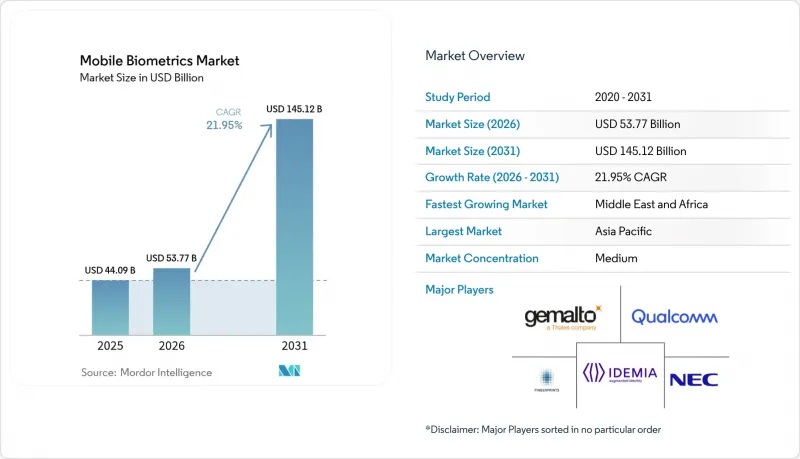
Mordor Intelligence에 의하면, 모바일 생체인식 시장 규모는 2025년에 440억 9,000만 달러로 평가되었고, 2026년 537억 7,000만 달러로 추정되고, 2031년까지 1,451억 2,000만 달러에 이를 것으로 예측됩니다.
예측 기간(2026-2031년) 동안 연평균 성장률(CAGR)은 21.95%를 나타낼 것으로 전망됩니다.
본 보고서는 구성 요소별(하드웨어, 소프트웨어 플랫폼, 서비스), 인증 방식별(단일 요소 인증 등), 기술 및 모달리티별(지문 인증, 얼굴 인증 등), 기기 유형별(스마트폰, 태블릿 등), 산업 분야별(은행, 금융서비스 및 보험(BFSI), 정부·공공 부문 등) 및 지역별로 분류되어 있습니다. 시장 전망은 금액(달러) 기준으로 제시되어 있습니다.
세계의 모바일 생체인식 시장 동향 및 인사이트
인도 UPI 생태계에서 바이모달 인증의 급증
인도의 통합 결제 인터페이스(UPI)는 PIN 대신 지문 인증 및 얼굴 인증을 가능하게 하여 부정 사용을 줄이는 동시에 소액 거래를 신속하게 처리하고 있습니다. 이 모델은 이미 동남아시아 전역의 전자지갑 제공업체에 영향을 미치고 있으며, 은행 계좌가 없는 소비자층에서 모바일 생체인식 시장의 보급을 촉진할 가능성이 있습니다. 은행은 차지백 비용 절감이라는 혜택을 누리고 있지만, 개인정보 보호 규제 당국은 Aadhaar와 연계된 데이터 보관 관행에 대해 계속해서 면밀히 조사했습니다.
중국 OEM 스마트폰, 5G 지원 온디바이스 AI로 신원 도용 감지 능력 향상
중국의 각 휴대폰 제조업체들은 단말기 내에서 딥페이크 시도를 감지하는 AI 모델을 탑재하고 있습니다. 이는 2024년에 생체 인증 사기가 40% 급증한 데 따른 시의적절한 대응이라고 할 수 있습니다. 이 하드웨어와 소프트웨어의 통합 솔루션은 전 세계 경쟁사들에 대한 진입 장벽을 높이며, 배터리 수명을 유지하면서도 프리미엄 제품 포지셔닝을 뒷받침하고 있습니다.
저가형 안드로이드 단말기에서 프레젠테이션 공격 발생률 높음
저가형 스마트폰은 견고한 생체 인증 검사 기능이 부족한 경우가 많아, 6번의 시도 중 99%의 확률로 딥페이크 음성이나 가면이 센서를 뚫고 지나가게 됩니다. 이러한 취약성은 사용자의 신뢰를 훼손하며, 아프리카의 은행들로 하여금 물리적 신분증 확인 절차를 추가하도록 강요하고 있어, 가격에 민감한 시장 부문에서의 보급을 저해하고 있습니다.
부문 분석
2025년 모바일 생체인식 시장의 하드웨어 시장 규모는 263억 5,000만 달러에 달하여 매출 점유율의 59.74%를 차지했습니다. 각 센서 제조업체들은 제품의 상품화가 진행되는 가운데, 이익률을 유지하기 위해 디스플레이 내장형 초음파 모듈에 대한 투자를 진행하고 있습니다. AI 최적화 칩을 통해 지연 시간이 줄어들어, 저조도 환경이나 손가락이 젖어 있는 상황에서도 확실하게 사용할 수 있게 되었습니다. 서비스 부문은 규모는 작지만, 은행이나 병원이 구매하는 ‘Identity-as-a-Service(IaaS)’ 구독을 바탕으로 연평균 성장률(CAGR) 22.8%로 성장하고 있습니다. 각 제공업체는 오케스트레이션 대시보드, 부정 위험 분석, 규정 준수 보고 기능을 묶어 제공함으로써 자본 지출을 운영비로 전환하고 있습니다.
매니지드 서비스 수요가 가장 두드러지는 분야는 의료 분야이며, 병원에서는 데이터센터 운영을 피하기 위해 환자의 생체 인증 등록 업무를 외부에 위탁하고 있습니다. 주요 IaaS 사업자들은 생체 인증 API에 대한 공동 마케팅을 진행하며 그 보급 범위를 확대되고 있습니다. 한편, 지문, 음성, 행동 신호를 통합하는 소프트웨어 플랫폼은 멀티 클라우드 배포의 주요 통합업체로서 전략적 지위를 확립하고 있습니다. 이러한 요인들이 맞물려 모바일 생체인식 시장 전체에서 더 높은 안정성을 지닌 연간 반복 수익(ARR)을 견인하는 서비스의 선순환을 강화하고 있습니다.
2025년에는 단일 요소 인증 기술에 의한 시장 규모가 312억 3,000만 달러에 달할 것으로 예상되며, iOS 및 Android에 기본적으로 내장된 원터치 잠금 해제 방식에 대한 사용자의 선호도가 두드러지게 나타났습니다. 그러나 규제 당국과 보험사는 현재 은행에 남아 있는 부정 사용을 줄이도록 압력을 가하고 있으며, 생체 인증과 기기 기반 암호화 키를 결합한 다중 요소 인증 도입을 위해 새로운 예산 항목이 배정되고 있습니다.
Android 15에서의 패스키 통합은 매우 중요합니다. 구글은 FIDO 인증 정보를 하드웨어 엔클레이브에 캐시함으로써, 사용자에게는 보이지 않는 형태로 얼굴 인식이나 지문 인식을 두 번째 인증 요소로 활용할 수 있게 하고 있습니다. 기업은 모바일 결제 흐름을 희생하지 않고도 다층 방어를 실현할 수 있습니다. 이사회 수준의 리스크 위원회는 생성형 AI를 악용한 피싱 키트 등에 대한 이러한 다층적인 통제를 우선시할 것으로 예측됩니다.
지역별 분석
아시아태평양은 2025년에 195억 5,000만 달러 시장 규모를 기록한 것으로 평가되었으며, 이는 전 세계 매출의 44.35%에 해당합니다. 스마트폰의 급속한 보급, 핀테크 앱의 급증, 그리고 정부 주도의 디지털 ID 프로그램이 이 지역의 성장을 견인하고 있습니다. 중국 OEM 업체들이 초음파 방식의 인디스플레이 센서를 채택한 것이 공급망 전반에 파급되어, BOM 비용 절감과 대규모 보급의 기반을 마련하고 있습니다. 인도에서는 Aadhaar(아다르)와 연계된 인프라 개선이 지속되고 있으며, 바이모달 UPI 거래를 통해 대도시권 이외의 지역에서도 가맹점에서의 이용이 확대되고 있습니다. 중동은 2025년에 30억 6,000만 달러에 달했으며, 연평균 성장률(CAGR) 23.6%로 가장 빠르게 성장하는 시장입니다. UAE가 물리적 에미레이트 ID를 모바일 인증 정보로 대체한 것은 전국적인 상호 운용성을 가속화하는 하향식 정책의 좋은 예입니다. 쿠웨이트의 ‘비전 2035’는 생체 인증 등록과 전자 정부 서비스 이용을 연계하여 멀티모달 키트에 대한 수요를 높이고 있습니다. 두바이에서는 교통 메가 프로젝트를 포함한 인프라 붐으로 인해 계약업체들이 생체 인증 기반 접근 제어 시스템을 도입할 수밖에 없게 되어, 지역 내 지출을 더욱 부추기고 있습니다.
북미에서는 기업들이 IAM 스택을 현대화하고 소비자 대상 은행 서비스가 비밀번호 없는 로그인으로 전환되는 가운데, 성장세는 견조하지만 성장 속도는 둔화되고 있습니다. JP모건 체이스의 생체 인증 결제 시범 사업은 카드 없는 소매 결제 분야에서 전환점이 다가오고 있음을 시사합니다. 유럽은 구조적으로 여전히 매력적이지만, 엄격한 GDPR(EU 개인정보보호규정) 및 AI 법의 요건을 준수해야 합니다. EU 디지털 ID 지갑은 10개국에 걸친 기준을 통일하여 공급업체의 인증 절차를 촉진하고 있습니다. 사하라 이남 아프리카는 금액 기준으로는 규모가 작지만, 모바일 유권자 등록 키트의 판매량을 주도하고 있어 휴대용 등록 하드웨어에 대한 잠재적 수요가 높음을 여실히 보여주고 있습니다.
기타 혜택 :
- 엑셀 형식 시장 예측(ME) 시트
- 3개월간의 애널리스트 지원
자주 묻는 질문
목차
제1장 서론
제2장 조사 방법
제3장 주요 요약
제4장 시장 구도
제5장 시장 규모 및 성장 예측
제6장 경쟁 구도
제7장 시장 기회 및 향후 전망
AJY 26.09.09According to Mordor Intelligence, the mobile biometric market size was valued at USD 44.09 billion in 2025 and estimated to grow from USD 53.77 billion in 2026 to reach USD 145.12 billion by 2031, at a CAGR of 21.95% during the forecast period (2026-2031).
This report is Segmented by Component (Hardware, Software Platforms, Services), Authentication Mode (Single-Factor Authentication, and More), Technology/Modality (Fingerprint Recognition, Facial Recognition, and More), Device Type (Smartphones, Tablets, and More), Industry Vertical (BFSI, Government and Public Sector, and More), and by Geography. The Market Forecasts are Provided in Terms of Value (USD).
Global Mobile Biometrics Market Trends and Insights
Bi-modal authentication surge in India's UPI ecosystem
India's Unified Payments Interface is enabling fingerprint or facial recognition in lieu of PINs, cutting fraud and speeding micro-transactions. The model is already influencing wallet providers across Southeast Asia and could lift mobile biometric market adoption among unbanked consumers. Banks benefit from reduced chargeback costs, yet privacy regulators continue to scrutinize Aadhaar-linked storage practices.
5G-enabled on-device AI improving spoof detection in Chinese OEM smartphones
Chinese handset makers have embedded AI models that detect deep-fake attempts locally, a timely response after a 40% jump in biometric fraud in 2024. The hardware-software bundle raises the bar for global competitors and underpins premium positioning while preserving battery life.
High presentation-attack rates on low-cost Android devices
Budget phones often lack robust liveness checks, allowing deep-fake audio or masks to bypass sensors 99% of the time in six attempts. The gap erodes user trust and forces banks in Africa to add physical ID reviews, dampening scale in price-sensitive segments.
Other drivers and restraints analyzed in the detailed report include:
- e-KYC mandates for mobile banking in Nigeria and Brazil
- European Digital Identity Wallet regulation accelerating biometric passports on phones
- Restrictive data-sovereignty laws limiting cloud voice biometrics in the EU
For complete list of drivers and restraints, kindly check the Table Of Contents.
Segment Analysis
The mobile biometric market size for hardware stood at USD 26.35 billion in 2025, equal to 59.74% revenue share. Sensor makers invested in under-display ultrasonic modules to defend margins as commoditization sets. AI-optimized chips compress latency, ensuring usability in low-light and wet-finger scenarios. Services, though smaller, are compounding at 22.8% CAGR on the back of identity-as-a-service subscriptions purchased by banks and hospitals. Providers bundle orchestration dashboards, fraud-risk analytics, and compliance reporting, shifting capital expense to operating outlays.
Demand for managed services is most pronounced in healthcare, where hospitals outsource biometric patient enrollment to avoid running data centers. Leading IaaS players co-market biometric APIs, broadening reach. Meanwhile, software platforms that unify fingerprint, voice, and behavioral signals hold strategic ground as integrators of record for multicloud deployments. Collectively, these forces reinforce a services flywheel that drives stickier annual recurring revenue across the mobile biometric market.
Single-factor techniques generated USD 31.23 billion in 2025, underscoring user preference for one-touch unlock flows embedded natively in iOS and Android. However, regulators and insurers now pressure banks to shrink residual fraud, steering new budget line items toward multi-factor deployments that mix biometrics with device-based cryptographic keys.
Android 15's passkey integration proves critical; by caching FIDO credentials in the hardware enclave, Google enables face or fingerprint to act as a second factor invisibly to users. Enterprises gain defense-in-depth without abandonment mobile checkout flows. Expect board-level risk committees to prioritize such layered controls as phishing kits that weaponize generative AI.
Complete Report Scope:
- By Component
- Hardware
- Software Platforms
- Services
- By Authentication Mode
- Single-Factor Authentication
- Multi-Factor Authentication
- By Technology / Modality
- Fingerprint Recognition
- Facial Recognition
- Voice Recognition
- Iris Recognition
- Vein and Vascular Pattern Recognition
- Behavioral Biometrics (Gait, Keystroke)
- Other Modalities
- By Device Type
- Smartphones
- Tablets
- Smart Wearables
- IoT / Edge Devices
- Rugged Handhelds and Scanners
- By Industry Vertical
- BFSI
- Government and Public Sector
- Healthcare
- Retail and E-commerce
- IT and Telecom
- Defense and Security
- Education
- Other Verticals
- By Geography
- North America
- United States
- Canada
- Mexico
- South America
- Brazil
- Argentina
- Rest of South America
- Europe
- United Kingdom
- Germany
- France
- Italy
- Spain
- Nordics
- Rest of Europe
- Asia Pacific
- China
- Japan
- South Korea
- India
- Australia
- New Zealand
- Rest of Asia Pacific
- Middle East and Africa
- Middle East
- GCC
- Turkey
- Rest of Middle East
- Africa
- South Africa
- Nigeria
- Kenya
- Rest of Africa
- Middle East
- North America
Geography Analysis
Asia-Pacific generated USD 19.55 billion in 2025, equating to 44.35% of global revenue. Rapid smartphone penetration, proliferating fintech apps, and government-backed digital ID programs sustain region-leading scale. Chinese OEMs' embrace of ultrasonic in-display sensors has rippled across supply chains, lowering BOM costs and seeding mass adoption. India continues to iterate on Aadhaar-linked rails, with bi-modal UPI transactions expanding merchant acceptance beyond metro centers. The Middle East, at USD 3.06 billion in 2025, is the fastest-growing pocket with a 23.6% CAGR. UAE's replacement of physical Emirates IDs with mobile credentials exemplifies a top-down policy play that accelerates nationwide interoperability. Kuwait's Vision 2035 ties biometric enrollment to e-government service access, lifting demand for multimodal kits. Dubai's infrastructure boom, including transit megaprojects, compels contractors to adopt biometric access control, further lifting regional outlays.
North America maintains steady but slower growth as enterprises modernize IAM stacks and consumer banking shifts toward password-free sign-in. JPMorgan Chase's biometric checkout pilots hint at a coming inflection in card-less retail payments. Europe remains structurally attractive but navigates stringent GDPR and AI Act requirements. The EU Digital Identity Wallet harmonizes standards across 10 nations, catalyzing vendor certification pipelines. Sub-Saharan Africa, while smaller in dollar terms, drives volume in mobile voter-registration kits, underscoring latent demand for portable enrollment hardware.
- Apple Inc.
- Samsung Electronics Co. Ltd.
- Qualcomm Technologies Inc.
- IDEMIA (Safran Identity and Security)
- NEC Corporation
- Thales Group (Gemalto)
- Fingerprint Cards AB
- Goodix Technology Co. Ltd.
- Synaptics Incorporated
- Precise Biometrics AB
- Nuance Communications Inc.
- Aware Inc.
- Daon Inc.
- M2SYS Technology
- Veridium Ltd.
- FaceTec Inc.
- Mobbeel Solutions SLL
- VoiceVault Inc.
- ValidSoft Ltd.
- Tech5 SA
- HYPR Corp.
- Suprema Inc.
- ID RandD Inc.
- ImageWare Systems Inc.
Additional Benefits:
- The market estimate (ME) sheet in Excel format
- 3 months of analyst support
TABLE OF CONTENTS
1 INTRODUCTION
- 1.1 Study Assumptions and Market Definition
- 1.2 Scope of the Study
2 RESEARCH METHODOLOGY
3 EXECUTIVE SUMMARY
4 MARKET LANDSCAPE
- 4.1 Market Overview
- 4.2 Market Drivers
- 4.2.1 Bi-modal authentication surge in India's Unified Payments Interface (UPI) ecosystem
- 4.2.2 5G-enabled on-device AI improving spoof detection in Chinese OEM smartphones
- 4.2.3 e-KYC mandates for mobile banking in Nigeria, Brazil and Indonesia
- 4.2.4 Deployment of mobile biometric voter enrolment kits across Sub-Saharan Africa
- 4.2.5 European Digital Identity Wallet regulation accelerating biometric passport use on phones
- 4.2.6 OEM shift toward under-display ultrasonic sensors in premium segment
- 4.3 Market Restraints
- 4.3.1 High presentation-attack rates on low-cost Android devices
- 4.3.2 Restrictive data-sovereignty laws limiting cloud-based voice biometrics in EU
- 4.3.3 Battery-drain concerns for continuous behavioral authentication
- 4.3.4 Absence of universal mobile biometric performance benchmarks
- 4.4 Value / Supply-Chain Analysis
- 4.5 Regulatory Outlook
- 4.6 Porter's Five Forces
- 4.6.1 Threat of New Entrants
- 4.6.2 Bargaining Power of Buyers
- 4.6.3 Bargaining Power of Suppliers
- 4.6.4 Threat of Substitutes
- 4.6.5 Intensity of Competitive Rivalry
5 MARKET SIZE AND GROWTH FORECASTS (VALUE)
- 5.1 By Component
- 5.1.1 Hardware
- 5.1.2 Software Platforms
- 5.1.3 Services
- 5.2 By Authentication Mode
- 5.2.1 Single-Factor Authentication
- 5.2.2 Multi-Factor Authentication
- 5.3 By Technology / Modality
- 5.3.1 Fingerprint Recognition
- 5.3.2 Facial Recognition
- 5.3.3 Voice Recognition
- 5.3.4 Iris Recognition
- 5.3.5 Vein and Vascular Pattern Recognition
- 5.3.6 Behavioral Biometrics (Gait, Keystroke)
- 5.3.7 Other Modalities
- 5.4 By Device Type
- 5.4.1 Smartphones
- 5.4.2 Tablets
- 5.4.3 Smart Wearables
- 5.4.4 IoT / Edge Devices
- 5.4.5 Rugged Handhelds and Scanners
- 5.5 By Industry Vertical
- 5.5.1 BFSI
- 5.5.2 Government and Public Sector
- 5.5.3 Healthcare
- 5.5.4 Retail and E-commerce
- 5.5.5 IT and Telecom
- 5.5.6 Defense and Security
- 5.5.7 Education
- 5.5.8 Other Verticals
- 5.6 By Geography
- 5.6.1 North America
- 5.6.1.1 United States
- 5.6.1.2 Canada
- 5.6.1.3 Mexico
- 5.6.2 South America
- 5.6.2.1 Brazil
- 5.6.2.2 Argentina
- 5.6.2.3 Rest of South America
- 5.6.3 Europe
- 5.6.3.1 United Kingdom
- 5.6.3.2 Germany
- 5.6.3.3 France
- 5.6.3.4 Italy
- 5.6.3.5 Spain
- 5.6.3.6 Nordics
- 5.6.3.7 Rest of Europe
- 5.6.4 Asia Pacific
- 5.6.4.1 China
- 5.6.4.2 Japan
- 5.6.4.3 South Korea
- 5.6.4.4 India
- 5.6.4.5 Australia
- 5.6.4.6 New Zealand
- 5.6.4.7 Rest of Asia Pacific
- 5.6.5 Middle East and Africa
- 5.6.5.1 Middle East
- 5.6.5.1.1 GCC
- 5.6.5.1.2 Turkey
- 5.6.5.1.3 Rest of Middle East
- 5.6.5.2 Africa
- 5.6.5.2.1 South Africa
- 5.6.5.2.2 Nigeria
- 5.6.5.2.3 Kenya
- 5.6.5.2.4 Rest of Africa
- 5.6.5.1 Middle East
- 5.6.1 North America
6 COMPETITIVE LANDSCAPE
- 6.1 Market Concentration
- 6.2 Strategic Moves
- 6.3 Market Share Analysis
- 6.4 Company Profiles {(includes Global level Overview, Market level overview, Core Segments, Financials as available, Strategic Information, Market Rank/Share for key companies, Products and Services, and Recent Developments)}
- 6.4.1 Apple Inc.
- 6.4.2 Samsung Electronics Co. Ltd.
- 6.4.3 Qualcomm Technologies Inc.
- 6.4.4 IDEMIA (Safran Identity and Security)
- 6.4.5 NEC Corporation
- 6.4.6 Thales Group (Gemalto)
- 6.4.7 Fingerprint Cards AB
- 6.4.8 Goodix Technology Co. Ltd.
- 6.4.9 Synaptics Incorporated
- 6.4.10 Precise Biometrics AB
- 6.4.11 Nuance Communications Inc.
- 6.4.12 Aware Inc.
- 6.4.13 Daon Inc.
- 6.4.14 M2SYS Technology
- 6.4.15 Veridium Ltd.
- 6.4.16 FaceTec Inc.
- 6.4.17 Mobbeel Solutions SLL
- 6.4.18 VoiceVault Inc.
- 6.4.19 ValidSoft Ltd.
- 6.4.20 Tech5 SA
- 6.4.21 HYPR Corp.
- 6.4.22 Suprema Inc.
- 6.4.23 ID RandD Inc.
- 6.4.24 ImageWare Systems Inc.
7 MARKET OPPORTUNITIES AND FUTURE OUTLOOK
- 7.1 White-space and Unmet-Need Assessment