

|
시장보고서
상품코드
2122636
GNSS 칩 시장 : 시장 점유율 분석, 업계 동향 및 통계, 성장 예측(2026-2031년)GNSS Chip - Market Share Analysis, Industry Trends & Statistics, Growth Forecasts (2026 - 2031) |
||||||
 Mordor Intelligence
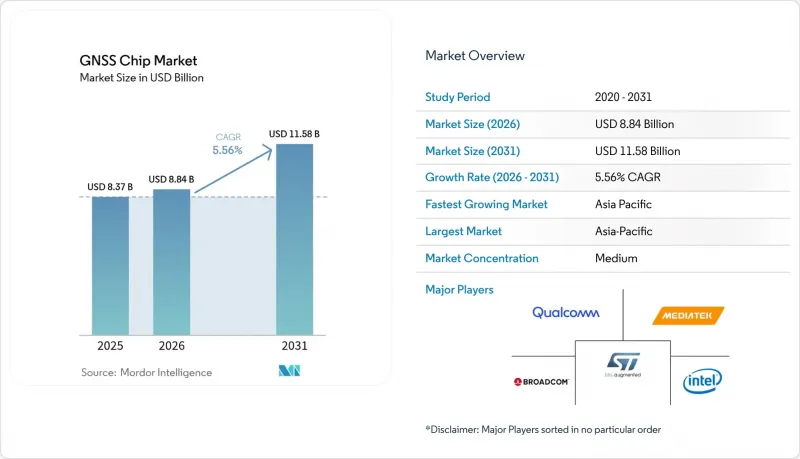
Mordor Intelligence에 의하면, GNSS 칩 시장 규모는 2025년에 83억 7,000만 달러로 평가되었고, 2026년 88억 4,000만 달러에서 2031년까지 115억 8,000만 달러에 이를 것으로 예측되며, 예측 기간(2026-2031년) CAGR은 5.56%를 나타낼 전망입니다.
본 보고서는 기기 유형별(스마트폰, 태블릿, 웨어러블 기기 등), 주파수 대역별(단일 주파수 L1 등), 최종 사용자 산업별(자동차, 농업 등), 용도별(내비게이션, 위치 파악·매핑 등), 지역별(북미, 남미, 유럽 등)로 분류되어 있습니다. 시장 전망은 금액(달러) 기준으로 제시되어 있습니다.
세계의 GNSS 칩 시장 동향 및 인사이트
다중 주파수 GNSS 탑재 스마트폰 출하 대수의 급증
현재, 하이엔드 단말기에는 듀얼 밴드(L1/L5) 및 트리플 밴드 수신기가 탑재되어 있어, 위치 측정 정밀도가 미터 단위에서 데시미터 단위로 향상되었으며, 밀집된 도시 지역에서도 신뢰성 높은 증강현실(AR) 내비게이션이 가능해졌습니다. 중국, 한국, 미국에서 플래그십 모델이 출시됨에 따라 기기 교체 주기가 가속화되고 있습니다. 이는 구형 단일 주파수 설계로는 새롭게 대두되고 있는 실내·실외를 원활하게 커버하는 기능을 지원할 수 없기 때문입니다. 개발자들은 이러한 정밀도 향상을 활용하여 게임, 소셜 미디어 태깅, 긴급 신고 시 위치 정보 서비스 등을 강화하고 있으며, 그 결과 GNSS 칩 시장에서 첨단 칩셋에 대한 막대한 수요가 지속되고 있습니다.
높아지는 ADAS 및 자율주행의 정밀도 요구 사항
레벨 3 이상의 자율주행에는 차선 수준에서의 일관된 위치 측정이 요구되며, 자동차 제조업체들은 다중 주파수 GNSS를 IMU 및 V2X 무선과 결합하고 있습니다. 측량급의 고정밀화로 인해 차량당 반도체 탑재량이 증가하여 프리미엄 평균 판매 가격(ASP)이 정당화되는 한편, 무선을 통한 소프트웨어 기능 제공은 펌웨어 업그레이드가 가능한 내비게이션 스택을 제공하는 칩 공급업체에게 지속적인 수익 가능성을 비약적으로 높이고 있습니다.
재밍 및 스푸핑에 대한 GNSS의 취약성
2024년에는 유럽 항공 당국에 의해 1,000건 이상의 간섭 사례가 보고되었으며, 이로 인해 경로 변경이나 비행 중 시스템 재설정이 발생했습니다. 현재 민간 기관은 다중 위성군 수신, 간섭 감지 및 암호화 서비스 도입을 의무화하고 있으며, 이로 인해 하드웨어 비용이 증가하고 GNSS 칩 시장 공급업체의 인증 일정이 복잡해지고 있습니다.
부문 분석
보고서에 따르면, 2025년 GNSS 칩 시장 규모의 54.62%를 스마트폰이 차지했으며, 이는 소비자용 기기에서 위치 정보 서비스의 보급이 원동력이 되고 있습니다. 출하 대수의 성장세는 성숙기에 접어들었지만, 듀얼 밴드 지원으로의 업그레이드를 통해 단말기 1대당 반도체 가치가 유지되어 공급업체들은 이익률을 유지하고 있습니다. 태블릿, 웨어러블 기기 및 개인용 트래커는 견조한 성장세를 보이고 있지만 평균 판매 가격(ASP)이 낮은 시장입니다. 차량용 시스템은 자동차 제조업체들이 ADAS를 위해 내비게이션의 이중화를 도입하고 있어 5% 중반대의 성장률을 보이고 있습니다.
현재 시장 규모는 작지만, 드론은 연평균 성장률(CAGR) 7.55%를 나타낼 것으로 예측되며, 기기 분류 중 가장 빠른 매출 증가를 가져올 것으로 전망됩니다. 상업용 점검, 배송 및 정밀 살포 농업 분야에서는 엄격한 중량 및 전력 제한 하에서 센티미터 단위의 정밀도가 요구되고 있어, 이에 따라 소형 다주파수 수신기에 대한 수요가 증가하고 있습니다. 저전력 자산 추적 장치 및 특수 산업용 기기는 견고성이 요구되는 틈새 수요를 보완하여 GNSS 칩 시장의 설계 다양성을 강화하고 있습니다.
비용 효율성을 중시하는 소비자용 전자 기기는 2025년에도 GNSS 칩 시장 점유율의 66.45%를 차지한 단일 주파수 L1 솔루션을 유지할 것으로 예상되며, 엔트리 레벨 제품으로서의 입지를 공고히 할 전망입니다. 그러나 도시 지역의 캐니언 효과로 인한 멀티패스 및 전리층으로 인한 오차가 L1의 성능을 제한하고 있기 때문에 자동차, 측량, 드론 분야의 고객들은 듀얼 밴드 또는 트리플 밴드 아키텍처를 채택하고 있습니다.
필터 가격 하락과 기판 설계를 효율화하는 새로운 쿼드밴드 싱글 다이 제품의 등장으로 인해, 다중 주파수 제품의 출하 대수는 연평균 성장률(CAGR) 7.86%로 증가하고 있습니다. 많은 Tier 1 자동차 플랫폼에서 듀얼 밴드 L1/L5는 현재 필수 요건이 된 반면, 항공 규제 당국은 안전상 중요한 항법 분야에서 L5 채택을 의무화하는 방향으로 나아가고 있습니다.
지역별 분석
아시아태평양은 중국의 북두(BeiDou) 시스템 구축, 스마트폰의 대량 생산, 그리고 정밀 농업 기기에 대한 현지 수요의 호조에 힘입어 2025년 GNSS 칩 시장 규모의 42.10%를 차지했습니다. 국산 반도체에 대한 정부의 지원책에 더해, 인도의 NavIC 및 일본의 QZSS를 둘러싼 생태계의 확대가 맞물리면서 해당 지역에서의 보급이 더욱 가속화되고 있습니다. 북두 및 NavIC에 대한 완전한 준수를 인증받은 공급업체는 우선 공급업체로서의 지위를 확보하여, 휴대전화 및 농업 기계 OEM 업체들과의 설계 채택을 확실시했습니다.
북미는 자동차용 ADAS, 방위 계약 및 대규모 5G 타이밍 구축을 기반으로 안정적인 시장 점유율을 차지하고 있습니다. 연방 정부 조달에서는 내결함성과 암호화된 M코드 기능이 중시되고 있어, 벤더들은 재밍 방지 프런트엔드 및 SAASM 호환성 채택을 요구받고 있습니다. 이 지역에서 활발히 진행되고 있는 드론 배송 시범 사업과 실리콘밸리의 웨어러블 브랜드는 기술적 리더십의 선순환을 유지하고 있으며, 출하 대수는 감소하고 있지만 평균 판매 가격(ASP)은 높은 수준을 유지하고 있습니다.
유럽에서는 항공 및 도로 운송 규제와 관련하여 갈릴레오의 듀얼 주파수 방식 채택이 우선시되고 있습니다. 2024년 동유럽에서 발생한 스푸핑 사건의 급증으로 인해, 항공사들의 다중 위성군 수신기 탑재를 위한 기체 개조가 가속화되었습니다. 한편, 남미, 중동 및 아프리카에서는 스마트시티 구축, 광업 자동화, 기후 변화를 고려한 농업 강화를 위해 GNSS가 도입되고 있습니다. 브라질은 대두의 정밀 재배를 활용하여 수출 경쟁력을 유지하고 있으며, 걸프 연안 국가들은 거대한 인프라 프로젝트에 GNSS를 통합하고 있습니다. 또한, 아프리카 전역의 이동통신 사업자들은 유선 통신망을 뛰어넘기 위해 5G 타이밍 기술에 투자하고 있으며, 이로 인해 GNSS 칩 시장은 누적적으로 확대되고 있습니다.
기타 혜택 :
- 엑셀 형식 시장 예측(ME) 시트
- 3개월간의 애널리스트 지원
자주 묻는 질문
목차
제1장 서론
제2장 조사 방법
제3장 주요 요약
제4장 시장 구도
제5장 시장 규모 및 성장 예측
제6장 경쟁 구도
제7장 시장 기회 및 향후 전망
AJY 26.09.07According to Mordor Intelligence, the GNSS chip market size was valued at USD 8.37 billion in 2025 and estimated to grow from USD 8.84 billion in 2026 to reach USD 11.58 billion by 2031, at a CAGR of 5.56% during the forecast period (2026-2031).
This report is Segmented by Device Type (Smartphones, Tablets and Wearables, and More), Frequency Band (Single-Frequency L1, and More), End-User Industry (Automotive, Agriculture, and More), Application (Navigation, Positioning and Mapping, and More), and Geography (North America, South America, Europe, and More). The Market Forecasts are Provided in Terms of Value (USD).
Global GNSS Chip Market Trends and Insights
Surge in Multi-frequency GNSS Smartphone Shipments
Premium handsets now integrate dual-band L1/L5 and even tri-band receivers, which enhance location accuracy from meters to decimeters, enabling reliable augmented-reality navigation in dense urban cores. Flagship launches across China, South Korea, and the United States accelerate the refresh cycle because older single-frequency designs cannot support emerging indoor-outdoor continuity. Developers leverage the improved accuracy to enrich gaming, social-media tagging, and emergency-caller location services, which in turn sustains a high-volume pull for advanced chipsets inside the GNSS chip market.
Rising ADAS and Autonomous-Driving Precision Needs
Level 3 and higher autonomy demands consistent lane-level positioning, prompting automakers to pair multi-frequency GNSS with IMUs and vehicle-to-everything radios. Survey-grade accuracy elevates silicon content per vehicle and justifies premium ASPs, while over-the-air software functions multiply recurring revenue potential for chip suppliers that offer firmware-upgradable navigation stacks.
GNSS Vulnerability to Jamming and Spoofing
More than 1,000 interference incidents were reported by European aviation authorities in 2024, resulting in rerouting and in-flight system resets. Civil agencies now mandate multi-constellation reception, interference detection, and encrypted services, which inflate hardware costs and complicate certification timelines for GNSS chip market vendors.
Other drivers and restraints analyzed in the detailed report include:
- Expansion of Precision Agriculture and Logistics Tracking
- Centimeter-Level Positioning for Drone Last-mile Delivery
- High Power Draw of Multi-constellation Chipsets
For complete list of drivers and restraints, kindly check the Table Of Contents.
Segment Analysis
Smartphones accounted for 54.62% of the GNSS chip market size in 2025, driven by the widespread adoption of location-based services in consumer devices, according to. Although shipment growth is maturing, dual-band upgrades sustain silicon value per handset, enabling suppliers to maintain their margins. Tablets, wearables, and personal trackers represent steady but lower-ASP outlets. In-vehicle systems post mid-single-digit growth as automakers embed navigation redundancy for ADAS.
Drones, with a modest base today, are forecasted to grow at a 7.55% CAGR and thus provide the fastest incremental revenue among device classes. Commercial inspection, delivery, and precision-spray agriculture collectively demand centimeter accuracy under strict weight and power budgets, creating a premium for compact multi-frequency receivers. Low-power asset trackers and specialty industrial devices round out niche demand with ruggedized requirements, reinforcing design diversity in the GNSS chip market.
Cost-sensitive consumer electronics are expected to maintain a single-frequency L1 solution at 66.45% of the GNSS chip market share in 2025, solidifying their role as the entry-level option. However, urban-canyon multipath and ionospheric errors limit L1 performance, prompting automotive, surveying, and drone clients to adopt dual- or tri-band architectures.
Multi-frequency shipments are rising at an 7.86% CAGR, helped by falling filter prices and new quad-band single-die offerings that streamline board design. For many tier-one automotive platforms, dual-band L1/L5 is now a hard requirement, while aviation regulators move toward mandatory L5 for safety-critical navigation.
Complete Report Scope:
- By Device Type
- Smartphones
- Tablets and Wearables
- Personal Tracking Devices
- Low-power Asset Trackers
- In-vehicle Systems
- Drones
- Other Device Types
- By Frequency Band
- Single-frequency L1
- Dual-frequency L1/L5
- Dual-frequency L1/L2
- Multi-frequency (Tri-band and above)
- By End-user Industry
- Automotive
- Consumer Electronics
- Aviation
- Agriculture
- Construction and Mining
- Defense and Public Safety
- Other End-users
- By Application
- Navigation
- Positioning and Mapping
- Timing and Synchronization
- Remote Sensing
- By Geography
- North America
- United States
- Canada
- Mexico
- South America
- Brazil
- Argentina
- Rest of South America
- Europe
- Germany
- United Kingdom
- France
- Italy
- Rest of Europe
- Asia-Pacific
- China
- Japan
- South Korea
- India
- Rest of Asia-Pacific
- Middle East
- Saudi Arabia
- United Arab Emirates
- Rest of Middle East
- Africa
- South Africa
- Rest of Africa
- North America
Geography Analysis
Asia-Pacific held 42.10% of the GNSS chip market size in 2025, supported by China's BeiDou build-out, high-volume smartphone assembly, and strong local demand for precision agriculture equipment. Government incentives for indigenous silicon, combined with the growing ecosystem around India's NavIC and Japan's QZSS, further accelerate regional uptake. Suppliers that certify full BeiDou and NavIC compliance gain preferred-vendor status, locking in design wins with OEMs across handsets and farm machinery.
North America contributes a stable share anchored in automotive ADAS, defense contracts, and large-scale 5G timing deployments. Federal procurement emphasizes resilience and encrypted M-code capability, prompting vendors to adopt anti-jam front-ends and SAASM compatibility. The region's thriving drone-delivery pilots and Silicon Valley wearable brands maintain a technology leadership loop that keeps ASPs elevated despite lower unit volumes.
Europe prioritizes the adoption of Galileo dual-frequency in both aviation and road transport regulations. The 2024 spike in spoofing incidents over Eastern Europe accelerated airline retrofits with multi-constellation receivers. Meanwhile, South America, the Middle East and Africa adopt GNSS to bolster smart-city builds, mining automation and climate-smart farming. Brazil leverages precision soybean planting to defend its export competitiveness; Gulf countries embed GNSS into mega infrastructure projects; and pan-African mobile operators invest in 5G timing to leapfrog fixed networks, cumulatively enlarging the GNSS chip market.
- Qualcomm Technologies, Inc.
- Broadcom Inc.
- MediaTek Inc.
- STMicroelectronics N.V.
- u-blox Holding AG
- Samsung Electronics Co., Ltd. (System LSI)
- Skyworks Solutions, Inc.
- Quectel Wireless Solutions Co., Ltd.
- Sony Semiconductor Solutions Corporation
- Intel Corporation
- Thales Group
- Trimble Inc.
- Hemisphere GNSS, Inc.
- Septentrio N.V.
- Furuno Electric Co., Ltd.
- Allystar Technology Co., Ltd.
- Hexagon AB (NovAtel Inc.)
- Orolia (Safran Electronics & Defense)
- HiSilicon (Shanghai) Technologies Co., Ltd.
- Topcon Positioning Systems, Inc.
Additional Benefits:
- The market estimate (ME) sheet in Excel format
- 3 months of analyst support
TABLE OF CONTENTS
1 INTRODUCTION
- 1.1 Study Assumptions and Market Definition
- 1.2 Scope of the Study
2 RESEARCH METHODOLOGY
3 EXECUTIVE SUMMARY
4 MARKET LANDSCAPE
- 4.1 Market Overview
- 4.2 Market Drivers
- 4.2.1 Surge in multi-frequency GNSS smartphone shipments
- 4.2.2 Rising ADAS and autonomous-driving precision needs
- 4.2.3 Expansion of precision agriculture and logistics tracking
- 4.2.4 Centimeter-level positioning for drone last-mile delivery
- 4.2.5 Miniaturized dual-band chips for medical wearables
- 4.2.6 Sovereign constellation investments spurring local demand
- 4.3 Market Restraints
- 4.3.1 GNSS vulnerability to jamming and spoofing
- 4.3.2 High power draw of multi-constellation chipsets
- 4.3.3 Advanced RF-front-end node supply constraints
- 4.3.4 Regulatory delays in L-band spectrum re-allocation
- 4.4 Industry Value Chain Analysis
- 4.5 Regulatory Landscape
- 4.6 Technological Outlook
- 4.7 Porter's Five Forces Analysis
- 4.7.1 Bargaining Power of Suppliers
- 4.7.2 Bargaining Power of Consumers
- 4.7.3 Threat of New Entrants
- 4.7.4 Threat of Substitute Products
- 4.7.5 Intensity of Competitive Rivalry
- 4.8 Impact of Macroeconomic and Geopolitical Shocks
5 MARKET SIZE AND GROWTH FORECASTS (VALUE)
- 5.1 By Device Type
- 5.1.1 Smartphones
- 5.1.2 Tablets and Wearables
- 5.1.3 Personal Tracking Devices
- 5.1.4 Low-power Asset Trackers
- 5.1.5 In-vehicle Systems
- 5.1.6 Drones
- 5.1.7 Other Device Types
- 5.2 By Frequency Band
- 5.2.1 Single-frequency L1
- 5.2.2 Dual-frequency L1/L5
- 5.2.3 Dual-frequency L1/L2
- 5.2.4 Multi-frequency (Tri-band and above)
- 5.3 By End-user Industry
- 5.3.1 Automotive
- 5.3.2 Consumer Electronics
- 5.3.3 Aviation
- 5.3.4 Agriculture
- 5.3.5 Construction and Mining
- 5.3.6 Defense and Public Safety
- 5.3.7 Other End-users
- 5.4 By Application
- 5.4.1 Navigation
- 5.4.2 Positioning and Mapping
- 5.4.3 Timing and Synchronization
- 5.4.4 Remote Sensing
- 5.5 By Geography
- 5.5.1 North America
- 5.5.1.1 United States
- 5.5.1.2 Canada
- 5.5.1.3 Mexico
- 5.5.2 South America
- 5.5.2.1 Brazil
- 5.5.2.2 Argentina
- 5.5.2.3 Rest of South America
- 5.5.3 Europe
- 5.5.3.1 Germany
- 5.5.3.2 United Kingdom
- 5.5.3.3 France
- 5.5.3.4 Italy
- 5.5.3.5 Rest of Europe
- 5.5.4 Asia-Pacific
- 5.5.4.1 China
- 5.5.4.2 Japan
- 5.5.4.3 South Korea
- 5.5.4.4 India
- 5.5.4.5 Rest of Asia-Pacific
- 5.5.5 Middle East
- 5.5.5.1 Saudi Arabia
- 5.5.5.2 United Arab Emirates
- 5.5.5.3 Rest of Middle East
- 5.5.6 Africa
- 5.5.6.1 South Africa
- 5.5.6.2 Rest of Africa
- 5.5.1 North America
6 COMPETITIVE LANDSCAPE
- 6.1 Market Concentration
- 6.2 Strategic Moves
- 6.3 Market Share Analysis
- 6.4 Company Profiles (includes Global level Overview, Market level overview, Core Segments, Financials as available, Strategic Information, Market Rank/Share for key companies, Products and Services, and Recent Developments)
- 6.4.1 Qualcomm Technologies, Inc.
- 6.4.2 Broadcom Inc.
- 6.4.3 MediaTek Inc.
- 6.4.4 STMicroelectronics N.V.
- 6.4.5 u-blox Holding AG
- 6.4.6 Samsung Electronics Co., Ltd. (System LSI)
- 6.4.7 Skyworks Solutions, Inc.
- 6.4.8 Quectel Wireless Solutions Co., Ltd.
- 6.4.9 Sony Semiconductor Solutions Corporation
- 6.4.10 Intel Corporation
- 6.4.11 Thales Group
- 6.4.12 Trimble Inc.
- 6.4.13 Hemisphere GNSS, Inc.
- 6.4.14 Septentrio N.V.
- 6.4.15 Furuno Electric Co., Ltd.
- 6.4.16 Allystar Technology Co., Ltd.
- 6.4.17 Hexagon AB (NovAtel Inc.)
- 6.4.18 Orolia (Safran Electronics & Defense)
- 6.4.19 HiSilicon (Shanghai) Technologies Co., Ltd.
- 6.4.20 Topcon Positioning Systems, Inc.
7 MARKET OPPORTUNITIES AND FUTURE OUTLOOK
- 7.1 White-space and Unmet-need Assessment


