
|
시장보고서
상품코드
2122638
상태 모니터링 장비 시장 : 시장 점유율 분석, 업계 동향 및 통계, 성장 예측(2026-2031년)Condition Monitoring Equipment - Market Share Analysis, Industry Trends & Statistics, Growth Forecasts (2026 - 2031) |
||||||
 Mordor Intelligence
Mordor Intelligence에 의하면, 상태 모니터링 장비 시장 규모는 2025년에 32억 9,000만 달러로 평가되었고, 2026년 35억 4,000만 달러에서 2031년까지 51억 1,000만 달러에 이를 것으로 예측되며, 예측 기간(2026-2031년) CAGR은 7.62%를 나타낼 전망입니다.
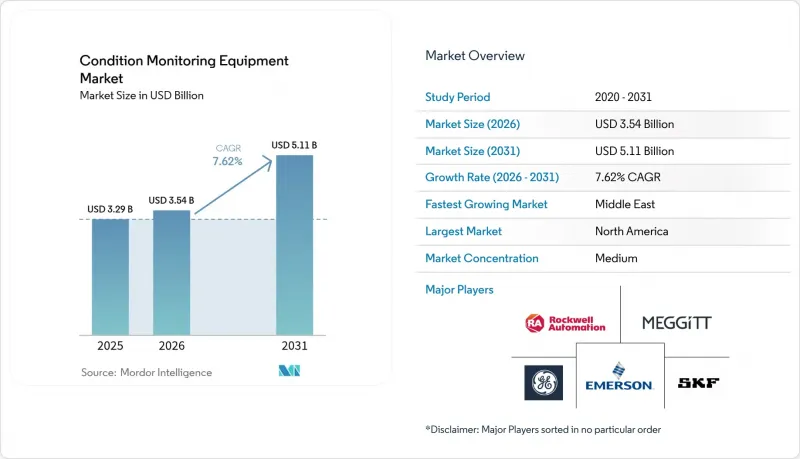
본 보고서는 유형별(하드웨어, 소프트웨어, 서비스), 최종 사용자 산업별(석유 및 가스, 발전, 공정·제조, 기타), 모니터링 방식별(휴대용/오프라인 모니터링, 온라인/연속 모니터링, 원격/무선 모니터링), 배포 모드별(온프레미스, 클라우드 기반) 및 지역별로 분류되어 있습니다. 시장 예측은 금액(달러) 기준으로 제시되어 있습니다.
세계의 상태 모니터링 장비 시장 동향 및 인사이트
스마트 팩토리에 대한 수요 증가
스마트 팩토리를 구축하는 제조업체들은 자산 건전성 데이터와 생산 지표를 통합하여 종합적인 최적화를 추진하고 있습니다. 상태 모니터링 플랫폼은 제조 실행 시스템(MES) 및 기업 자원 계획(ERP) 시스템과 연동되어야 하므로, 공급업체들은 개방형 프로토콜과 상호 운용 가능한 아키텍처를 중시하고 있습니다. 엣지 컴퓨팅을 통해 현장에서의 이상을 즉시 감지할 수 있게 되어, 클라우드 대역폭 비용과 응답 시간을 절감할 수 있습니다. 운영자는 진동이나 열 패턴을 구체적인 작업 지침으로 변환하는 직관적인 대시보드를 활용하고 있으며, 이러한 시스템이 완전히 도입될 경우 가동 중단 시간 감소율은 15%에서 25%에 달하는 것으로 보고되고 있습니다. 기업들이 신뢰성 성과를 종합 설비 효율(OEE) 목표와 연계함에 따라, 여러 공장 네트워크 전반에 걸쳐 확장 가능한 솔루션에 대한 수요가 증가하고 있습니다. 이처럼 스마트 운영에 대한 관심이 높아지고 있는 것이 상태 모니터링 장비 시장의 장기적인 성장을 뒷받침하고 있습니다.
예지보수 프로그램에 대한 관심 증가
현재 기업의 유지보수 정책에서는 획일적인 예방 유지보수 일정 대신 데이터에 기반한 개입이 우선시되고 있습니다. 예측 유지보수는 2차 손상이 발생하기 전에 고장을 감지할 수 있으므로 긴급 수리 비용과 생산 손실 시간을 줄일 수 있으며, 투자 수익률(ROI)이 3자리수에 달하는 경우도 드물지 않습니다. 머신러닝 모델은 진동, 온도, 윤활유 데이터를 통합하여 단일 자산 건전성 점수를 산출하며, 유지보수 계획 담당자는 이 점수를 신뢰하여 일정을 수립하고 있습니다. 통합된 클라우드 대시보드를 통해 팀은 관제 센터에서 분산된 공장을 모니터링할 수 있게 되었으며, 고장 모드에 대한 공유 데이터베이스 덕분에 진단 정확도는 지속적으로 향상되고 있습니다. 이러한 경제적 이점과 운영상의 높은 투명성이 계속해서 새로운 도입 기업들을 상태 모니터링 장비 시장으로 끌어들이고 있습니다.
연결형 모니터링 시스템의 사이버 보안 우려
운영 기술(OT)을 표적으로 한 주목할 만한 사이버 사고로 인해, 자산 소유자들은 기계를 외부 네트워크에 연결하는 데 신중을 기하고 있습니다. 2024년에 갱신된 NIST 지침에서는 센서 게이트웨이와 데이터 히스토리안이 잠재적인 공격 경로로 지목되었습니다. 많은 레거시 플랜트에는 부문화된 아키텍처가 부족하기 때문에 개보수에는 방화벽, 침입 감지 및 ID 관리에 대한 막대한 투자가 필요합니다. 중요 인프라를 규제하는 법규에서는 엄격한 규정 준수 감사가 요구되고 있으며, 이로 인해 프로젝트 일정이 장기화될 가능성이 있습니다. 그 결과, 일부 운영 사업자는 에어 갭 방식이나 온프레미스 도입을 선호하는 경향이 있어, 상태 모니터링 장비 시장에서 클라우드 중심 솔루션의 단기적인 성장을 억제하고 있습니다.
부문 분석
2025년, 하드웨어 부문은 상태 모니터링 장비 시장의 60.78%를 차지했습니다. 진동 프로브, 열화상 카메라, 오일 내 이물질 센서는 회전 기계, 전기 시스템, 유압 시스템 전반에서 여전히 핵심적인 진단 도구로 자리 잡고 있습니다. 각 벤더들은 가혹한 가동 환경에 대응하기 위해 센서의 대역폭과 내열 성능을 지속적으로 향상시키고 있으며, 이로 인해 하드웨어 교체 주기가 촉진되고 있습니다. 서비스 부문은 가장 빠르게 성장하는 카테고리로, 사용자가 데이터 분석 및 수리 계획 수립을 외부에 위탁함에 따라 연평균 성장률(CAGR) 8.99%로 확대되고 있습니다. 성과 기반 계약에 따라, 서비스 제공업체는 클라우드 분석을 활용하여 가동률 목표를 보장하고, 지불 금액을 장비 판매가 아닌 성능에 연동시키고 있습니다. 이 모델은 막대한 설비 투자가 필요 없이 예측 유지보수 프로그램의 도입을 촉진하여, 상태 모니터링 장비 시장 전체의 확대에 기여하고 있습니다.
소프트웨어의 발전은 원시 파형을 실행 가능한 인사이트로 변환함으로써 하드웨어와 서비스 간의 격차를 해소하고 있습니다. 벤더들은 엣지 게이트웨이에 인공지능을 통합하여 노이즈를 제거하고, 관련 이벤트를 압축하며, 우선순위가 지정된 경보를 유지보수 팀에 전송하고 있습니다. 구매자들이 통합된 스택을 선호함에 따라 독립형 소프트웨어 판매는 주춤하고 있지만, 소프트웨어는 여전히 범용 센서를 고부가가치 솔루션으로 전환하는 차별화 요소로 작용하고 있습니다. 따라서 ‘상태 모니터링 서비스(CMaaS)’는 하드웨어, 분석 기능, 전문가 검토를 하나의 구독 서비스로 통합하여, 상태 모니터링 장비 산업 전반에 걸쳐 지속적인 수익과 더욱 견고한 고객 충성도를 촉진하고 있습니다.
석유 및 가스 사업이 상태 모니터링 장비 시장을 주도하고 있으며, 2025년에는 시장 규모의 25.21%를 차지한 것으로 평가되었습니다. 가혹한 시추, 정제, 액화 환경에서는 펌프, 터빈,압축기가 심한 마모에 노출되기 때문에 진동 및 열화상 시스템은 오랫동안 필수 요건으로 자리 잡아 왔습니다. 풍력, 태양광 및 화력 발전소의 수명 연장 프로젝트가 주도하는 발전 부문은 2031년까지 연평균 성장률(CAGR) 8.05%를 나타낼 것으로 예측됩니다. 재생에너지 사업자들은 해상 설비의 점검 방문을 계획하고, 수요가 정점에 달했을 때 메가와트시의 손실을 방지하기 위해 지속적인 모니터링에 의존하고 있습니다. 또한, 전력 회사는 비용과 신뢰성의 균형을 맞추기 위해 자산 건전성 점수를 계통 운영 모델에 통합하고 있으며, 이로 인해 적용 범위가 확대되고 있습니다.
공정 및 이산형 제조 공장에서는 가동 시간이 최우선시되는 환경에서 린 재고 및 적시 생산을 지원하기 위해 예측 유지보수 프로그램이 도입되고 있습니다. 항공우주, 방위, 운송 부문에서는 전문적인 인증과 내환경성이 뛰어난 장치가 요구되어, 고수익률 제품의 수익성 높은 틈새 시장이 창출되고 있습니다. 한편, 광업, 해양, 토목 인프라 시장에서는 석유 및 가스 부문에서 검증된 조사 기법을 적용함으로써 수요가 서서히 확대되고 있습니다. 이러한 다각화로 인해 수요가 안정화되어, 상태 모니터링 장비 시장의 건전한 전망이 유지되고 있습니다.
지역별 분석
북미는 상태 모니터링 장비 시장을 주도하며, 2025년에는 33.21%의 점유율을 차지했습니다. 미국에서는 숙련된 인력 부족 문제를 해결하고 노후화된 공정 플랜트의 수명을 연장하기 위해 예측 유지보수가 활용되고 있습니다. 연방 안전 규정과 기업의 지속가능성 목표 또한 자산 건전성 모니터링을 더욱 의무화하고 있습니다. 캐나다에서는 오일샌드 사업 및 외딴 지역의 수력 발전 시설에서 유사한 기술이 적용되고 있는 반면, 멕시코에서는 계속 확장되고 있는 자동차 산업 회랑에서 린 생산 목표를 유지하기 위해 비용 효율적인 무선 솔루션이 요구되고 있습니다. 이러한 요인들이 복합적으로 작용하여 이 지역 전체에 걸쳐 강력한 갱신 및 업그레이드 주기가 유지되고 있습니다.
중동은 가장 빠르게 성장하는 지역으로, 2031년까지 연평균 성장률(CAGR) 7.88%를 나타낼 것으로 예측됩니다. 각국의 경제 다각화 정책은 대규모 프로그램을 통해 석유화학 단지의 현대화와 첨단 제조 거점 구축을 목표로 하고 있습니다. 새로운 스마트 시티 및 교통 프로젝트로 인해 자산의 건전성을 지속적으로 검증해야 할 필요성이 더욱 커지고 있습니다. 가혹한 주변 온도, 사막의 모래 먼지, 부식성 대기 환경으로 인해 특수 센서의 필요성이 높아지고 있으며, 진단 데이터를 현장에서 해석할 수 있도록 지원하는 지역 서비스 거점도 등장하고 있습니다.
아시아태평양은 거대한 산업 기반을 바탕으로 이를 근소한 차이로 뒤쫓고 있습니다. 중국은 산업용 인터넷(IIoT) 이니셔티브를 통해 국내 혁신을 추진하고 있으며, 상태 데이터를 공급망 플랫폼과 연계함으로써 품질 측면의 경쟁력을 높이고 있습니다. 일본에서는 성숙한 공장들이 자동차 및 전자기기 시설의 경쟁력을 유지하기 위해 대규모 개보수를 진행하고 있는 반면, 인도의 ‘메이크 인 인디아(Make in India)’ 이니셔티브는 중소규모 제조업체들의 도입을 촉진하고 있습니다. 이 지역 전체에서는 재생에너지 프로젝트의 급증에 따라 풍력 및 태양광 발전 자산에 대한 투자를 보호하기 위한 원격 모니터링이 요구되고 있습니다. 이러한 요인들이 복합적으로 작용하여 상태 모니터링 장비 시장의 범위가 확대되고 있습니다.
기타 혜택 :
- 엑셀 형식 시장 예측(ME) 시트
- 3개월간의 애널리스트 지원
자주 묻는 질문
목차
제1장 서론
제2장 조사 방법
제3장 주요 요약
제4장 시장 구도
제5장 시장 규모 및 성장 예측
제6장 경쟁 구도
제7장 시장 기회 및 향후 전망
AJY 26.09.09According to Mordor Intelligence, the condition monitoring equipment market size was valued at USD 3.29 billion in 2025 and estimated to grow from USD 3.54 billion in 2026 to reach USD 5.11 billion by 2031, at a CAGR of 7.62% during the forecast period (2026-2031).
This report is Segmented by Type (Hardware, Software, and Services), End-User Vertical (Oil and Gas, Power Generation, Process and Manufacturing, and More), Monitoring Technique (Portable/Offline Monitoring, Online/Continuous Monitoring, and Remote/Wireless Monitoring), Deployment Mode (On-Premise, and Cloud-Based), and Geography. The Market Forecasts are Provided in Terms of Value (USD).
Global Condition Monitoring Equipment Market Trends and Insights
Rise in Demand for Smart Factories
Manufacturers building smart factories integrate asset health data with production metrics to drive holistic optimization. Condition monitoring platforms must interface with manufacturing execution and enterprise resource planning systems, so vendors emphasize open protocols and interoperable architectures. Edge computing enables immediate anomaly detection on the shop floor, reducing cloud bandwidth costs and response times. Operators use intuitive dashboards that translate vibration and thermal patterns into actionable tasks, and reported downtime reductions range from 15% to 25% when such systems are fully deployed. As enterprises link reliability outcomes to overall equipment effectiveness targets, demand rises for solutions scalable across multi-plant networks. The heightened focus on smart operations thus feeds long-term growth for the condition monitoring equipment market.
Growing Emphasis on Predictive Maintenance Programs
Corporate maintenance policies now prioritize data-driven interventions instead of rigid preventive schedules. Predictive maintenance often yields triple-digit returns on investment because failures are detected before secondary damage occurs, thereby reducing emergency repair costs and lost production hours. Machine-learning models synthesize vibration, temperature, and lubricant data into a single asset health score that maintenance planners trust for scheduling. Centralized cloud dashboards enable teams to oversee distributed plants from command centers, while shared databases of failure modes continually refine diagnostic accuracy. The positive economics and operational clarity continue to draw new adopters into the condition monitoring equipment market.
Cybersecurity Concerns in Connected Monitoring Systems
High-profile cyber incidents targeting operational technology make asset owners cautious about connecting machines to external networks. Updated 2024 NIST guidelines highlight sensor gateways and data historians as potential attack vectors. Many legacy plants lack segmented architectures, so retrofits require significant investments in firewall, intrusion detection, and identity management. Regulations governing critical infrastructure require strict compliance audits, which can lengthen project timelines. As a result, some operators favor air-gapped or on-premise deployments, tempering the near-term growth of cloud-centric solutions within the condition monitoring equipment market.
Other drivers and restraints analyzed in the detailed report include:
- Increasing Focus on Renewable Energy Asset Reliability
- Integration of IIoT and Cloud Analytics in Condition Monitoring
- High Capital Outlay for Advanced Monitoring Equipment
For complete list of drivers and restraints, kindly check the Table Of Contents.
Segment Analysis
The hardware segment accounted for 60.78% of the condition monitoring equipment market in 2025. Vibration probes, thermal cameras, and oil debris sensors remain the core diagnostic tools across rotating machinery, electrical systems, and hydraulics. Vendors continually raise sensor bandwidth and temperature ratings to match harsher service environments, reinforcing hardware replacement cycles. The services segment is the fastest-growing category, progressing at a 8.99% CAGR as users outsource data interpretation and repair planning. Under outcome-based contracts, providers leverage cloud analytics to guarantee uptime targets, aligning payment with performance rather than equipment sales. This model encourages wider adoption of predictive programs without major capital outlays, expanding the total condition monitoring equipment market.
Software advances bridge the gap between hardware and services by converting raw waveforms into actionable insights. Vendors embed artificial intelligence inside edge gateways to filter noise, compress relevant events, and push prioritized alerts to maintenance teams. Stand-alone software sales have slowed because buyers prefer integrated stacks, but software remains the differentiator that turns generic sensors into high-value solutions. Condition monitoring as a service, therefore, bundles hardware, analytics, and expert review into one subscription, driving recurring revenue and deeper customer lock-in across the condition monitoring equipment industry.
Oil and gas operations dominated the condition monitoring equipment market, accounting for 25.21% of the market size in 2025. Harsh drilling, refining, and liquefaction environments expose pumps, turbines, and compressors to severe wear, so vibration and thermography systems are long-standing requirements. The power generation segment, led by wind, solar, and life-extension projects for thermal plants, is forecast to grow at an 8.05% CAGR through 2031. Renewable operators depend on continuous monitoring to plan offshore service visits and avoid lost megawatt-hours during peak demand periods. Utilities also integrate asset health scores into grid dispatch models to balance cost and reliability, broadening application scope.
Process and discrete manufacturing plants adopt predictive programs to support lean inventory and just-in-time production, where uptime is paramount. Aerospace, defense, and transportation sectors seek specialized certifications and ruggedized devices, creating profitable niches for high-margin products. Meanwhile, mining, marine, and civil infrastructure markets add incremental volume by applying proven methodologies from the oil and gas sector. This diversification stabilizes demand and sustains healthy prospects for the condition monitoring equipment market.
Complete Report Scope:
- By Type
- Hardware
- Vibration Monitoring Equipment
- Thermography Equipment
- Lubricating Oil Analysis Equipment
- Software
- Services
- Hardware
- By End-User vertical
- Oil and Gas
- Power Generation
- Process and Manufacturing
- Aerospace and Defence
- Automotive and Transportation
- Other End-user Verticals
- By Monitoring Technique
- Portable/Offline Monitoring
- Online/Continuous Monitoring
- Remote/Wireless Monitoring
- By Deployment Mode
- On-Premise
- Cloud-Based
- By Geography
- North America
- United States
- Canada
- Mexico
- Europe
- Germany
- United Kingdom
- France
- Russia
- Rest of Europe
- Asia-Pacific
- China
- Japan
- India
- South Korea
- Australia
- Rest of Asia-Pacific
- Middle East and Africa
- Middle East
- Saudi Arabia
- United Arab Emirates
- Rest of Middle East
- Africa
- South Africa
- Egypt
- Rest of Africa
- Middle East
- South America
- Brazil
- Argentina
- Rest of South America
- North America
Geography Analysis
North America led the condition monitoring equipment market, accounting for a 33.21% share in 2025. The United States relies on predictive maintenance to counter skilled-labor shortages and extend the life of aging process plants. Federal safety regulations and corporate sustainability goals further mandate the monitoring of asset integrity. Canada applies similar technologies in oil sands operations and remote hydroelectric facilities, whereas Mexico's expanding automotive corridor demands cost-effective wireless solutions to uphold lean production targets. Together, these factors sustain strong replacement and upgrade cycles across the region.
The Middle East is the fastest-growing region, projected to grow at a 7.88% CAGR through 2031. National diversification agendas aim to modernize petrochemical complexes and create advanced manufacturing hubs through large-scale programs. New smart city and transportation projects generate additional demand for continuous verification of asset health. Harsh ambient temperatures, desert dust, and corrosive atmospheres drive the need for specialized sensors, and regional service hubs are emerging to support the local interpretation of diagnostic data.
Asia-Pacific follows closely due to its massive industrial base. China pushes domestic innovation through industrial internet initiatives, linking condition data with supply-chain platforms to boost quality competitiveness. Japan's mature plants undertake large-scale retrofits to keep their automotive and electronics facilities competitive, while India's 'Make in India' initiative stimulates adoption among small and mid-sized manufacturers. Across the region, a surge in renewable power projects requires remote monitoring to protect investments in wind and solar assets. Collectively, these factors widen the scope of the condition monitoring equipment market.
- Rockwell Automation Inc.
- Emerson Electric Co.
- Meggitt PLC
- General Electric Company
- SKF AB
- Bruel and Kjaer Vibro GmbH
- Teledyne FLIR LLC
- Fluke Corporation
- Nippon Avionics Co., Ltd.
- Thermo Fisher Scientific Inc.
- PerkinElmer Inc.
- Spectro Scientific Inc. (AMETEK Inc.)
- Parker Hannifin Corporation
- Gastops Ltd.
- Siemens AG
- Honeywell International Inc.
- ABB Ltd.
- Baker Hughes Company
- National Instruments Corporation
- Schaeffler AG
- PRUFTECHNIK Dieter Busch AG
- Wilcoxon Sensing Technologies (ITT Inc.)
- Connection Technology Center Inc.
Additional Benefits:
- The market estimate (ME) sheet in Excel format
- 3 months of analyst support
TABLE OF CONTENTS
1 INTRODUCTION
- 1.1 Study Assumptions and Market Definition
- 1.2 Scope of the Study
2 RESEARCH METHODOLOGY
3 EXECUTIVE SUMMARY
4 MARKET LANDSCAPE
- 4.1 Market Drivers
- 4.1.1 Rise in Demand for Smart Factories
- 4.1.2 Growing Emphasis on Predictive Maintenance Programs
- 4.1.3 Increasing Focus on Renewable Energy Asset Reliability
- 4.1.4 Integration of IIoT and Cloud Analytics in Condition Monitoring
- 4.1.5 Miniaturisation of Wireless Sensor Nodes
- 4.1.6 Shift Toward Servitisation Business Models
- 4.2 Market Restraints
- 4.2.1 Unpredictable Maintenance Scheduling Windows
- 4.2.2 Shortage of Skilled Reliability Engineers
- 4.2.3 Cybersecurity Concerns in Connected Monitoring Systems
- 4.2.4 High Capital Outlay for Advanced Monitoring Equipment
- 4.3 Industry Value Chain Analysis
- 4.4 Regulatory Landscape
- 4.5 Technological Outlook
- 4.6 Porter's Five Forces Analysis
- 4.6.1 Bargaining Power of Suppliers
- 4.6.2 Bargaining Power of Buyers
- 4.6.3 Threat of New Entrants
- 4.6.4 Threat of Substitute Products
- 4.6.5 Intensity of Competitive Rivalry
- 4.7 Impact of Macroeconomic Factors
5 MARKET SIZE AND GROWTH FORECASTS (VALUE)
- 5.1 By Type
- 5.1.1 Hardware
- 5.1.1.1 Vibration Monitoring Equipment
- 5.1.1.2 Thermography Equipment
- 5.1.1.3 Lubricating Oil Analysis Equipment
- 5.1.2 Software
- 5.1.3 Services
- 5.1.1 Hardware
- 5.2 By End-User vertical
- 5.2.1 Oil and Gas
- 5.2.2 Power Generation
- 5.2.3 Process and Manufacturing
- 5.2.4 Aerospace and Defence
- 5.2.5 Automotive and Transportation
- 5.2.6 Other End-user Verticals
- 5.3 By Monitoring Technique
- 5.3.1 Portable/Offline Monitoring
- 5.3.2 Online/Continuous Monitoring
- 5.3.3 Remote/Wireless Monitoring
- 5.4 By Deployment Mode
- 5.4.1 On-Premise
- 5.4.2 Cloud-Based
- 5.5 By Geography
- 5.5.1 North America
- 5.5.1.1 United States
- 5.5.1.2 Canada
- 5.5.1.3 Mexico
- 5.5.2 Europe
- 5.5.2.1 Germany
- 5.5.2.2 United Kingdom
- 5.5.2.3 France
- 5.5.2.4 Russia
- 5.5.2.5 Rest of Europe
- 5.5.3 Asia-Pacific
- 5.5.3.1 China
- 5.5.3.2 Japan
- 5.5.3.3 India
- 5.5.3.4 South Korea
- 5.5.3.5 Australia
- 5.5.3.6 Rest of Asia-Pacific
- 5.5.4 Middle East and Africa
- 5.5.4.1 Middle East
- 5.5.4.1.1 Saudi Arabia
- 5.5.4.1.2 United Arab Emirates
- 5.5.4.1.3 Rest of Middle East
- 5.5.4.2 Africa
- 5.5.4.2.1 South Africa
- 5.5.4.2.2 Egypt
- 5.5.4.2.3 Rest of Africa
- 5.5.4.1 Middle East
- 5.5.5 South America
- 5.5.5.1 Brazil
- 5.5.5.2 Argentina
- 5.5.5.3 Rest of South America
- 5.5.1 North America
6 COMPETITIVE LANDSCAPE
- 6.1 Market Concentration
- 6.2 Strategic Moves
- 6.3 Market Share Analysis
- 6.4 Company Profiles (includes Global level Overview, Market level overview, Core Segments, Financials as available, Strategic Information, Market Rank/Share for key companies, Products and Services, and Recent Developments)
- 6.4.1 Rockwell Automation Inc.
- 6.4.2 Emerson Electric Co.
- 6.4.3 Meggitt PLC
- 6.4.4 General Electric Company
- 6.4.5 SKF AB
- 6.4.6 Bruel and Kjaer Vibro GmbH
- 6.4.7 Teledyne FLIR LLC
- 6.4.8 Fluke Corporation
- 6.4.9 Nippon Avionics Co., Ltd.
- 6.4.10 Thermo Fisher Scientific Inc.
- 6.4.11 PerkinElmer Inc.
- 6.4.12 Spectro Scientific Inc. (AMETEK Inc.)
- 6.4.13 Parker Hannifin Corporation
- 6.4.14 Gastops Ltd.
- 6.4.15 Siemens AG
- 6.4.16 Honeywell International Inc.
- 6.4.17 ABB Ltd.
- 6.4.18 Baker Hughes Company
- 6.4.19 National Instruments Corporation
- 6.4.20 Schaeffler AG
- 6.4.21 PRUFTECHNIK Dieter Busch AG
- 6.4.22 Wilcoxon Sensing Technologies (ITT Inc.)
- 6.4.23 Connection Technology Center Inc.
7 MARKET OPPORTUNITIES AND FUTURE OUTLOOK
- 7.1 White-Space and Unmet-Need Assessment