
|
시장보고서
상품코드
2122644
모바일 위성 서비스 시장 : 시장 점유율 분석, 업계 동향 및 통계, 성장 예측(2026-2031년)Mobile Satellite Services - Market Share Analysis, Industry Trends & Statistics, Growth Forecasts (2026 - 2031) |
||||||
 Mordor Intelligence
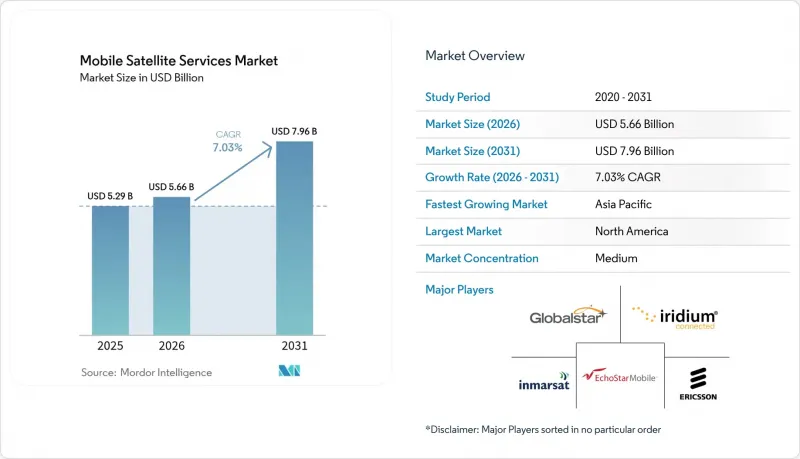
Mordor Intelligence에 의하면, 2026년 모바일 위성 서비스 시장 규모는 56억 6,000만 달러로 추정되고, 2025년 52억 9,000만 달러에서 확대해, 2031년에는 79억 6,000만 달러에 이를 것으로 예측됩니다.
2026-2031년 연평균 성장률(CAGR) 7.03%로 성장할 것으로 전망됩니다.
본 보고서는 서비스별(음성, 데이터, 광대역 등), 주파수 대역별(L대역, S대역 등), 최종 사용자 산업별(해운, 항공, 정부·국방 등)로 분류되어 있습니다.
세계의 모바일 위성 서비스 시장 동향 및 인사이트
위성 및 지상 모바일 통신 네트워크 통합의 진전
주요 하이라이트
- 2024년 연방통신위원회(FCC)가 ‘우주에서의 보완적 커버리지(Supplemental Coverage from Space)’ 프레임워크를 채택하고 지상 모바일통신 주파수 대역 내에서의 2차 위성 운영을 허용함에 따라, 우주 기반 네트워크와 지상 네트워크 간의 원활한 핸드오버가 구상에서 초기 상업적 현실로 전환되었습니다. 현재 모바일통신 사업자들은 광섬유 백홀, 마이크로파 또는 셀룰러 무선이 장애를 일으키더라도 가입자가 동일한 단말기로 서비스를 유지할 수 있도록 위성 용량을 자동화된 폴백 계층으로 통합하고 있습니다. AT&T와 Verizon은 기지국이 다운되었을 때 문자 메시지를 제공하기 위해 AST SpaceMobile의 L-밴드 및 S-밴드 페이로드를 활용하는 전국 규모의 로밍 시험의 길을 열었습니다. 위성 사업자는 도매 수익 증가를 얻는 한편, 통신 사업자는 설비 투자를 하지 않고도 커버리지 지도를 강화할 수 있습니다. 그 결과, 지상 네트워크와 비지상 네트워크 사이의 기존 경계를 모호하게 만들고, 모바일 위성 서비스 시장을 확대하는 선순환이 만들어지고 있습니다.
정부 및 국방 분야의 보안 통신 회선 수요 증가
일부 지정학적 긴장으로 인해 해외 사업자에 대한 의존도가 드러나자, 국가 차원의 연결 요구 사항이 급증했습니다. 유럽연합 집행위원회는 기관, 긴급 대응 요원, 중요 인프라에 암호화된 광대역 서비스를 제공하는 다궤도형 IRIS2 프로그램에 대해 106억 유로(113억 달러)의 예산을 승인했습니다. 미국, 일본, 인도의 유사한 조달 계획에는 양자 내성 암호화와 다궤도를 통한 중복성이 명시되어 있습니다. SES는 2025년 초, 정부용 포트폴리오를 강화하고 단일 창구 계약 하에 GEO·MEO·LEO의 다층적 통신 용량을 제공하기 위해 31억 달러에 인텔샛(Intelsat) 인수를 완료했습니다. 따라서 수익성이 높은 정부 계약은 위성 군의 업그레이드를 뒷받침하고, 모바일 위성 서비스 시장에서 잠재적인 수익원을 확대되고 있습니다.
기존 MSS 시스템 간의 상호 운용성 부족
대륙 횡단 함대를 보유한 기업들은 L-밴드, S-밴드, Ku-밴드 게이트웨이가 상호 운용되지 않기 때문에 여전히 여러 단말기를 번갈아 사용해야 하는 상황에 처해 있습니다. 2024년에 로밍 표준 추진을 목적으로 설립된 모바일 위성 서비스 협회(MSSA)가 있지만, 칩셋의 분할 현상은 여전히 지속되고 있으며, 많은 서비스 지역을 횡단하는 화주나 항공사에게 총 소유 비용(TCO) 증가 요인이 되고 있습니다. 원활한 로밍이 실현되지 않는 한, 모바일 위성 서비스 시장의 인식 가치는 하나의 SIM 카드로 전 세계에 접속할 수 있는 지상파 모바일통신 서비스보다 낮은 수준을 벗어나지 못할 것입니다. 멀티모드 단말기가 등장하고는 있지만, 인증 절차, 안테나 설계상의 타협, 그리고 생산 규모의 제한으로 인해 그 보급은 더딘 상황입니다.
부문 분석
2025년 매출 중 데이터 통신이 62.85%를 차지했으며, 모바일 위성 서비스 시장에서 광대역 및 스트리밍이 이제 고객 예산의 핵심을 이루고 있음을 여실히 보여주고 있습니다. 기업들은 비디오 감시, 승무원 복리후생 서비스 이용, 그리고 다른 방법으로는 불가능한 원격 소프트웨어 업데이트를 위한 백홀 용도로 높은 처리량의 회선을 계약하고 있습니다. 음성 통신은 해상 조난 및 조종실 안전 확보 분야에서 틈새 시장을 유지하고 있지만, 대역폭 기반 계약이 분 단위 과금을 앞지르고 있습니다. IoT/M2M 계약 건수는 가장 빠르게 증가하고 있으며, 농업, 광업, 유틸리티 분야에서 원격 센서 도입이 확대됨에 따라 2031년까지 연평균 성장률(CAGR) 12.05%를 나타낼 것으로 예측됩니다. 새로운 센서 모듈이 하나 추가될 때마다 위성 운영 비용은 미미한 수준에 그치면서도 수익이 증가하기 때문에 이 부문은 이익률 확대 측면에서 전략적으로 중요합니다. 따라서 IoT 엔드포인트용 모바일 위성 서비스 시장 규모는 기기당 평균 수익이 낮음에도 불구하고 크게 확대될 전망입니다.
동영상 및 데이터 증가로 인해 사업자들은 트래픽을 기내에서 처리할 수 있는 재생형 페이로드 도입을 서두르고 있으며, 이를 통해 지상 측의 병목 현상이 완화됩니다. 중국이 744 TOPS를 실행하는 AI 강화형 LEO 위성 12기를 발사한 것은 궤도상 엣지 컴퓨팅의 실제 사례를 보여줍니다. 이 기술은 스펙트럼 효율성을 향상시켜 추가 주파수 대역을 할당하지 않고도 판매 가능한 추가 처리량을 확보합니다. 유연한 소프트웨어 정의 허브를 통해 계절에 따른 해상 항로에서 허리케인 피해 지역으로 수 분 이내에 용량을 재배치할 수 있어 이용률이 향상됩니다. 또한, ‘용량 서비스(CaaS)’ 계약으로의 전환에 따라 통신 사업자들은 클라우드 컴퓨팅에서 도입된 ‘베스트 에포트(best-effort)’형 통신 링크가 아닌, 성능 보장을 제공하도록 유도되고 있습니다. 이러한 변화들은 종합적으로 데이터의 중요성을 더욱 강화하며, 2031년까지 모바일 위성 서비스 시장의 60% 이상을 데이터가 계속 차지할 것이라는 예측을 뒷받침하고 있습니다.
지역별 분석
북미는 국방부의 대규모 계약, 확립된 규제 체계, 그리고 초기 ‘Direct-to-Device(D2D)’ 시범 사업 덕분에 2025년 모바일 위성 서비스 시장에서 37.65%의 점유율을 유지했습니다. 미국은 에너지 파이프라인 및 응급 대응자 네트워크 전반에 걸친 플릿 브로드캐스트에 힘입어 지역 매출의 대부분을 차지했습니다. 캐나다는 북부 영토의 보편적 서비스 의무를 통해 수요를 확대했으며, 멕시코는 공유 위성 용량을 활용하여 산간 지역 사회를 연결했습니다. 지역 내 C-밴드의 재할당을 통해 추가적인 다운링크 대역폭이 확보됨에 따라, 사업자들은 새로운 위성을 발사하지 않고도 소비자용 광대역 서비스 제공 범위를 확대할 수 있게 되었습니다.
아시아태평양은 각국 정부가 디지털 주권을 추구하고 민간 대기업들이 물류 체인의 디지털화를 추진하는 가운데, 전 지역 중 가장 높은 연평균 성장률(CAGR) 9.95%를 기록할 전망입니다. 발사 속도는 여전히 활발하며, KDDI 등 지역 사업자들은 ‘au Starlink Direct’를 상용화하여 일본 산악 지대 전역에서 일반 스마트폰을 대상으로 메시징 서비스를 제공합니다. 중국은 ‘일대일로’ 해운 노선에 서비스를 제공하는 고처리량 Ka대역 위성을 추가하여 국내 통신 용량을 확대했습니다. 한편, 인도에서는 바티 에어텔과 스페이스X가 농촌 지역의 광대역 서비스를 확충하기 위한 협약을 체결했습니다. 동남아시아의 도서 국가들은 재난 구호, 어업 감시, 학교 인터넷 연결을 위한 통신 용량을 단일 국가 계약으로 통합하는 조달 프레임워크에 서명했습니다. 유럽에서는 IRIS2 보안 프로그램을 중심으로 견조한 기관 수요가 나타났습니다. 유럽 GNSS 청은 양자 내성 업링크 연구에 대한 보조금을 신속히 승인했으며, SpaceRISE 컨소시엄은 GEO, MEO, LEO 각 부문을 결합한 다궤도 네트워크 구축을 시작했습니다. 중동의 통신 사업자들은 유럽의 선단 소유주와 제휴하여 홍해의 새로운 항로를 따라 해상 통신 구역을 제공했습니다. 또한 아프리카의 통신 사업자들은 국내 광섬유 네트워크의 사각지대를 메우기 위해 유럽공급업체로부터 Ka 대역 통신 용량을 조달했습니다. 라틴아메리카에서는 허리케인이 빈번히 발생하는 지역에 재해에 강한 위성 오버레이 구축이 진행되고 있으며, 안데스 국가들에서는 마이크로파 링크를 이용할 수 없는 지형에서의 긴급 대응을 위해 L대역 휴대용 위성 전화가 도입되었습니다.
기타 혜택 :
- 엑셀 형식 시장 예측(ME) 시트
- 3개월간의 애널리스트 지원
자주 묻는 질문
목차
제1장 서론
제2장 조사 방법
제3장 주요 요약
제4장 시장 구도
제5장 시장 규모 및 성장 예측
제6장 경쟁 구도
제7장 시장 기회 및 향후 전망
AJY 26.09.07According to Mordor Intelligence, the mobile satellite services market size in 2026 is estimated at USD 5.66 billion, growing from 2025 value of USD 5.29 billion with 2031 projections showing USD 7.96 billion, growing at 7.03% CAGR over 2026-2031.
This report is Segmented by Service (Voice, Data, Broadband, and More), Frequency (L-Band, S-Band, and More), End-User Industry (Maritime, Aviation, Government and Defense, and More),
Global Mobile Satellite Services Market Trends and Insights
Rising Integration of Satellite-Terrestrial Mobile Networks
Key Highlights
- Seamless handover between space-based and ground networks moved from concept to early commercial reality after the Federal Communications Commission adopted its Supplemental Coverage from Space framework in 2024, allowing secondary satellite operations within terrestrial mobile spectrum.Mobile operators now embed satellite capacity as an automated fallback layer so subscribers retain service on the same handset when fibre backhaul, microwave, or cellular radios fail. AT&T and Verizon opened the door to nationwide roaming trials that use AST SpaceMobile's L- and S-Band payloads to provide texting when towers are down. Satellite operators gain incremental wholesale revenue, while telcos strengthen coverage maps without capital outlay. The result is a virtuous cycle that enlarges the mobile satellite services market by blurring the historical boundary between terrestrial and non-terrestrial networks.
Escalating Government and Defense Demand for Secure Links
Sovereign connectivity requirements surged after several geopolitical flashpoints exposed reliance on foreign operators. The European Commission approved EUR 10.6 billion (USD 11.3 billion) for the multi-orbit IRIS2 programme that will furnish encrypted broadband to institutions, first responders, and critical infrastructure.Similar procurement tracks in the United States, Japan, and India specify quantum-resistant encryption and multi-orbit redundancy. SES completed its USD 3.1 billion acquisition of Intelsat in early 2025 to strengthen its government portfolio and offer layered GEO-MEO-LEO capacity under single-throat contracts. High-margin government deals therefore underpin fleet upgrades and expand the reachable revenue pool for the mobile satellite services market.
Lack of Interoperability Among Legacy MSS Systems
Enterprises with transcontinental fleets still juggle multiple terminals because L-Band, S-Band, and Ku-Band gateways do not interoperate. The Mobile Satellite Services Association formed in 2024 to champion roaming standards, yet chipset fragmentation persists and drives higher total cost of ownership for shippers and airlines that traverse many footprints. Without seamless roaming, the perceived value of the mobile satellite services market remains lower than terrestrial cellular, where a single SIM offers worldwide access. Multimode terminals are emerging, but certification, antenna design compromises, and limited production scale have slowed adoption.
Other drivers and restraints analyzed in the detailed report include:
- Growing Connectivity Needs for Remote IoT/M2M Assets
- Surge in Disaster-Resilient Communications Programmes
- High User-Terminal Cost Due to Phased-Array Antennas
For complete list of drivers and restraints, kindly check the Table Of Contents.
Segment Analysis
Data connectivity accounted for 62.85% of 2025 revenue, underscoring how broadband and streaming now anchor customer budgets in the mobile satellite services market. Enterprises book high-throughput circuits to backhaul video surveillance, crew welfare access, and remote software updates that would otherwise be impossible. Voice retains a niche in maritime distress and cockpit safety, yet bandwidth-driven contracts are eclipsing per-minute billing. IoT/M2M subscriptions grew fastest and are forecast to post 12.05% CAGR to 2031 as agriculture, mining, and utilities scale remote sensor fleets. Each new sensor module adds incremental revenue at negligible satellite operating cost, making the segment strategically significant for margin expansion. The mobile satellite services market size for IoT endpoints is therefore poised to rise meaningfully despite lower average revenue per device.
Video and data growth pushes operators to adopt regenerative payloads so traffic can be processed onboard, reducing ground bottlenecks. China's launch of 12 AI-enhanced LEO satellites that execute 744 TOPS showcases orbital edge computing, where spectral efficiency gains free additional throughput for sale without extra spectrum allocation. Flexible software-defined hubs let capacity be redeployed from seasonal maritime lanes to hurricane recovery zones within minutes, improving utilisation. The transition to capacity-as-a-service contracts also incentivises operators to provide performance guarantees rather than best-effort links, a model imported from cloud computing. These shifts collectively reinforce data's primacy and validate the expectation that data will still exceed 60% of the mobile satellite services market by 2031.
Complete Report Scope:
- By Service
- Voice
- Data
- Broadband
- IoT / M2M
- By Frequency Band
- L-Band
- S-Band
- Ku-Band
- Ka-Band
- By End-User Industry
- Maritime
- Aviation
- Government and Defense
- Enterprise and Energy
- Land Mobile
- By Geography
- North America
- United States
- Canada
- Mexico
- South America
- Brazil
- Argentina
- Rest of South America
- Europe
- Germany
- United Kingdom
- France
- Russia
- Rest of Europe
- Asia Pacific
- China
- India
- Japan
- South Korea
- ASEAN
- Rest of Asia Pacific
- Middle East
- Saudi Arabia
- United Arab Emirates
- Turkey
- Rest of Middle East
- Africa
- South Africa
- Nigeria
- Rest of Africa
- North America
Geography Analysis
North America retained 37.65% share of the mobile satellite services market in 2025 because of large Department of Defense contracts, well-established regulatory pathways, and early direct-to-device pilots. The United States accounted for most regional revenue, buoyed by fleet broadcasts across energy pipelines and first-responder networks. Canada increased demand through universal service mandates in its northern territories, and Mexico leveraged shared satellite capacity to connect mountainous communities. Regional C-band refarming provided additional downlink bandwidth, allowing operators to widen consumer broadband offers without launching new spacecraft.
Asia Pacific is set to post a 9.95% CAGR, the fastest among all regions, as governments pursue digital sovereignty and private conglomerates digitise logistics chains. Launch rates remain brisk, and regional players such as KDDI commercialised "au Starlink Direct" to bring messaging to standard smartphones across Japan's mountainous topography. China expanded national capacity by adding high-throughput Ka-Band satellites that will serve Belt and Road shipping routes, while India welcomed agreements between Bharti Airtel and SpaceX to widen rural broadband. Southeast Asian archipelagos signed procurement frameworks that bundle capacity for disaster-relief, fisheries monitoring, and school connectivity into a single sovereign contract. Europe experienced robust institutional demand anchored by the IRIS2 security programme. The European GNSS Agency fast-tracked grants for quantum-safe uplink research, and the SpaceRISE consortium began constructing a multi-orbit network with combined GEO, MEO, and LEO segments. Middle East operators collaborated with European fleet owners to provide maritime coverage along new Red Sea shipping lanes, and African telcos sourced Ka-Band capacity from European providers to bridge national fibre gaps. Latin America pursued disaster-resilient satellite overlays in hurricane zones, and Andean nations adopted L-Band handheld satellite phones for emergency response in terrain where microwave links are infeasible.
- Inmarsat plc
- Iridium Communications Inc.
- Globalstar Inc.
- EchoStar Mobile Ltd
- Thuraya Telecommunications Co.
- Intelsat S.A.
- ORBCOMM Inc.
- ViaSat Inc. (Incl. ViaSat U.K.)
- Ericsson (Satellite IoT)
- SES S.A.
- Eutelsat Group
- Hughes Network Systems
- OneWeb
- AST SpaceMobile
- Ligado Networks
- Telesat Lightspeed
- Skylo Technologies
- Qualcomm Inc. (Snapdragon Satellite)
- SpaceX - Starlink Direct-to-Cell
- Thales Alenia Space
Additional Benefits:
- The market estimate (ME) sheet in Excel format
- 3 months of analyst support
TABLE OF CONTENTS
1 INTRODUCTION
- 1.1 Study Assumptions and Market Definition
- 1.2 Scope of the Study
2 RESEARCH METHODOLOGY
3 EXECUTIVE SUMMARY
4 MARKET LANDSCAPE
- 4.1 Market Overview
- 4.2 Market Drivers
- 4.2.1 Rising integration of satellite-terrestrial mobile networks
- 4.2.2 Escalating government and defense demand for secure links
- 4.2.3 Growing connectivity needs for remote IoT/M2M assets
- 4.2.4 Surge in disaster-resilient communications programs
- 4.2.5 3GPP-NTN standard enabling direct-to-device MSS
- 4.2.6 LEO narrow-band constellations lowering latency and cost
- 4.3 Market Restraints
- 4.3.1 Lack of interoperability among legacy MSS systems
- 4.3.2 Tightening spectrum and orbital slot regulations
- 4.3.3 High user-terminal cost due to phased-array antennas
- 4.3.4 Space-debris mitigation rules raising launch insurance
- 4.4 Value Chain Analysis
- 4.5 Regulatory Landscape
- 4.6 Technological Outlook
- 4.7 Porter's Five Forces Analysis
- 4.7.1 Bargaining Power of Buyers
- 4.7.2 Bargaining Power of Suppliers
- 4.7.3 Threat of New Entrants
- 4.7.4 Threat of Substitutes
- 4.7.5 Competitive Rivalry
5 MARKET SIZE AND GROWTH FORECASTS (VALUE)
- 5.1 By Service
- 5.1.1 Voice
- 5.1.2 Data
- 5.1.3 Broadband
- 5.1.4 IoT / M2M
- 5.2 By Frequency Band
- 5.2.1 L-Band
- 5.2.2 S-Band
- 5.2.3 Ku-Band
- 5.2.4 Ka-Band
- 5.3 By End-User Industry
- 5.3.1 Maritime
- 5.3.2 Aviation
- 5.3.3 Government and Defense
- 5.3.4 Enterprise and Energy
- 5.3.5 Land Mobile
- 5.4 By Geography
- 5.4.1 North America
- 5.4.1.1 United States
- 5.4.1.2 Canada
- 5.4.1.3 Mexico
- 5.4.2 South America
- 5.4.2.1 Brazil
- 5.4.2.2 Argentina
- 5.4.2.3 Rest of South America
- 5.4.3 Europe
- 5.4.3.1 Germany
- 5.4.3.2 United Kingdom
- 5.4.3.3 France
- 5.4.3.4 Russia
- 5.4.3.5 Rest of Europe
- 5.4.4 Asia Pacific
- 5.4.4.1 China
- 5.4.4.2 India
- 5.4.4.3 Japan
- 5.4.4.4 South Korea
- 5.4.4.5 ASEAN
- 5.4.4.6 Rest of Asia Pacific
- 5.4.5 Middle East
- 5.4.5.1 Saudi Arabia
- 5.4.5.2 United Arab Emirates
- 5.4.5.3 Turkey
- 5.4.5.4 Rest of Middle East
- 5.4.6 Africa
- 5.4.6.1 South Africa
- 5.4.6.2 Nigeria
- 5.4.6.3 Rest of Africa
- 5.4.1 North America
6 COMPETITIVE LANDSCAPE
- 6.1 Market Concentration
- 6.2 Strategic Moves
- 6.3 Market Share Analysis
- 6.4 Company Profiles (includes Global level Overview, Market level overview, Core Segments, Financials as available, Strategic Information, Market Rank/Share for key companies, Products and Services, and Recent Developments)
- 6.4.1 Inmarsat plc
- 6.4.2 Iridium Communications Inc.
- 6.4.3 Globalstar Inc.
- 6.4.4 EchoStar Mobile Ltd
- 6.4.5 Thuraya Telecommunications Co.
- 6.4.6 Intelsat S.A.
- 6.4.7 ORBCOMM Inc.
- 6.4.8 ViaSat Inc. (Incl. ViaSat U.K.)
- 6.4.9 Ericsson (Satellite IoT)
- 6.4.10 SES S.A.
- 6.4.11 Eutelsat Group
- 6.4.12 Hughes Network Systems
- 6.4.13 OneWeb
- 6.4.14 AST SpaceMobile
- 6.4.15 Ligado Networks
- 6.4.16 Telesat Lightspeed
- 6.4.17 Skylo Technologies
- 6.4.18 Qualcomm Inc. (Snapdragon Satellite)
- 6.4.19 SpaceX - Starlink Direct-to-Cell
- 6.4.20 Thales Alenia Space
7 MARKET OPPORTUNITIES AND FUTURE OUTLOOK
- 7.1 White-space and Unmet-need Assessment