

|
시장보고서
상품코드
2122652
전기자동차용 파워 인버터 시장 : 시장 점유율 분석, 업계 동향 및 통계, 성장 예측(2026-2031년)Electric Vehicle Power Inverter - Market Share Analysis, Industry Trends & Statistics, Growth Forecasts (2026 - 2031) |
||||||
 Mordor Intelligence
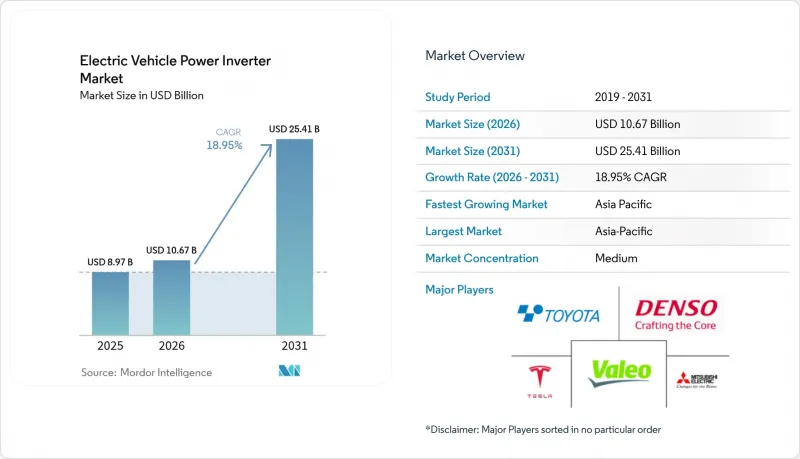
Mordor Intelligence에 의하면, 전기자동차용 파워 인버터 시장 규모는 2025년 89억 7,000만 달러로 평가되었고, 2026년 106억 7,000만 달러에서 2031년까지 254억 1,000만 달러로 확대될 전망이며, 2026-2031년 연평균 복합 성장률(CAGR)은 18.95%를 나타낼 전망입니다.
본 보고서는 추진 방식별(HEV, PHEV, BEV, FCEV), 차량 유형별(승용차, 소형 상용차 등), 전압 아키텍처별(400V 이하 및 그 이상), 반도체 소재별(실리콘 IGBT 등), 통합 수준별(스탠드얼론, E-액슬, CIDD), 그리고 지역별로 분류되어 있습니다. 시장 전망은 금액(달러) 기준으로 제시되어 있습니다.
세계의 전기차용 파워 인버터 시장 동향 및 인사이트
SiC 및 GaN 파워 반도체의 급속한 발전
실리콘 카바이드(SiC) MOSFET 및 갈륨 나이탈리아드(GaN) HEMT는 실리콘 IGBT의 150°C에 비해 최대 175°C까지의 접합 온도를 지원하므로, 이를 통해 방열판의 질량을 줄이고 전력 밀도를 높일 수 있습니다. Wolfspeed사의 65억 달러 규모의 모호크 밸리 생산 능력 증강과 인피니온사의 50억 유로(약 65억 달러) 규모의 드레스덴 공장 확장은 웨이퍼 공급이 자동차용 생산 규모로 확대되고 있음을 보여줍니다. 갈륨 질화물은 여전히 차량용 충전기에 편중되어 있지만, 인버터의 주류가 될 로드맵은 확실히 SiC를 중심으로 하고 있으며, 특히 800V 이상의 플랫폼에서는 스위칭 손실 감소 효과가 배가됩니다. 기존 IGBT가 시장 점유율을 유지하고 있는 것은 그 비용 구조가 가격에 민감한 400V급 자동차에 적합하기 때문이지만, 효율 격차는 모델 연도마다 확대되고 있어 와이드 밴드갭으로의 전환이 가속화되고 있습니다. ISO 26262에 기반한 기능 안전성 검증으로 인해 초기 단계의 시험 부담은 증가하지만, 선도 기업들이 수집한 장기 신뢰성 데이터 덕분에 후발 기업들의 진입 장벽은 낮아지고 있습니다.
OEM의 800V 차량 플랫폼으로의 전환
자동차 제조업체들은 DC 급속 충전 시간을 절반으로 줄이고, 구리 하네스의 무게를 3분의 1 가까이 줄이기 위해 800V 이상의 시스템을 채택하고 있습니다. 포르쉐 ‘타이칸’이나 현대 ‘이오닉 5’와 같은 초기 대표 사례들이 그 개념을 입증하고 있으며, BMW의 ‘노이에 클라세’ 플랫폼은 2027년에 프리미엄 양산 부문에 고전압 스택을 도입할 예정입니다. 인버터 설계는 더 높은 차단 전압과 더 빠른 dv/dt를 견딜 수 있어야 합니다. 이러한 사양 범위는 첨단 패키지 절연 기술과 낮은 인덕턴스 레이아웃을 갖춘 공급업체에게 유리하게 작용합니다. 공공 충전기의 경우, 기존 설치 장소의 대부분이 400V이기 때문에 듀얼 전압 지원이 요구되며, 인버터의 제어 루프가 복잡해지면서 전환이 지연되고 있습니다. 그럼에도 불구하고, 그 성능에 대한 설명은 구매자들에게 호응을 얻고 있으며, 각 OEM 업체들은 양산 시작 훨씬 전부터 800V 공급 계약을 확정하려고 하고 있습니다.
SiC 소자의 높은 비용과 공급 불안정성
실리콘 카바이드(SiC) 웨이퍼의 가격은 실리콘의 몇 배에 달하며, 생산 능력은 5개 파운드리 업체에 집중되어 있어 수요가 급증할 경우 OEM 각사는 현물 가격 변동에 노출될 수밖에 없습니다. 자동차 부품의 인증 절차에는 18-24개월이 소요되므로, 신규 공장의 가동으로 공급 부족이 완화되기까지는 상당한 시차가 발생합니다. 일부 자동차 제조업체는 SiC 부품과 기존 IGBT 부품을 이중 조달함으로써 리스크를 헤지하고, 효율성을 희생하더라도 공급 안정성을 확보하고 있습니다. 또한, 도가니나 결정 성장 장치공급처가 제한적이기 때문에 수출 규제의 불확실성이 추가적인 위험 요인으로 작용하고 있습니다. 임시방편적인 대책으로 일부 1차 공급업체들이 전략적 재고를 보유하고 있으나, 그 보관 비용이 이익률을 압박하고 있습니다.
부문별 분석
2025년에는 중국과 유럽의 고밀도 충전 네트워크에 힘입어 배터리 전기자동차(BEV)가 전기차용 파워 인버터 시장 점유율의 54.12%를 유지할 것으로 예측됩니다. 대조적으로, 플러그인 하이브리드차(PHEV)는 전력망 구축이 지연되고 있는 지역에서 과도기적 해결책으로서의 역할을 수행하고 있습니다. 연료전지 전기차(FCEV)는 일본, 한국 및 유럽 일부 지역의 수소 회랑 구축으로 인해 연료 보급 인프라의 위험이 감소함에 따라, 2031년까지 연평균 성장률(CAGR) 19.35%로 가장 높은 성장률을 보일 것으로 예측됩니다. 외부 충전 기능이 없는 하이브리드 전기차는 규제상 부분적인 전동화가 아닌 ‘배기가스 제로’가 평가받게 되면서 꾸준히 그 비중이 줄어들고 있습니다.
연료전지 스택은 리튬 이온 배터리 팩보다 낮은 직류 전압을 출력하기 때문에 그 인버터에는 강압형 DC-DC 컨버터와 저인덕턴스 버스바가 결합되어 있어, 운전자가 토크를 요구할 때 발생하는 급격한 전류 상승을 제어합니다. 배터리 온도 제한을 받지 않고 지속적인 전력 공급이 가능하기 때문에 배터리 무게가 화물 적재량을 초과하는 장거리 버스나 트럭에 적합합니다. 성장의 열쇠를 쥐고 있는 것은 그린 수소의 비용 추이와 충전소 밀도이지만, 재생에너지공급 잉여를 배경으로 전해조 도입이 진행되고 있어 이 두 가지 모두 동향이 호전되고 있습니다.
2025년에는 승용차가 전기차용 파워 인버터 시장 규모의 63.91%를 차지했으며, 주요 자동차 시장에서 소비자의 보급 현황을 반영하고 있습니다. 한편, 제로 에미션 구역 도입으로 디젤 차량이 도심에서 배제되는 가운데, 대형 상용차 및 버스는 19.42%라는 가장 높은 연평균 성장률(CAGR)을 기록했습니다. 소형 상용 밴도 차고에서 충전할 수 있는 이점을 누리고 있지만, 가격에 민감하기 때문에 배터리 비용 곡선이 정체될 때까지는 승용차에 비해 보급이 더디게 진행되고 있습니다.
40톤 트럭용 인버터는 300kW를 초과하는 연속 정격에 대응하며, 승용차를 훨씬 능가하는 진동 주기를 견뎌내야 합니다. 따라서 설계에 있어서는 강화된 버스바, 이중화된 전류 센서, 그리고 CharIN 사양을 준수하는 메가와트급 충전에 대한 대응이 중시되고 있습니다. 승용차용 유닛은 정숙성과 컴팩트한 외장에 중점을 둔 반면, 시내버스용 모델은 유지보수 용이성과 열적 여유를 확보하는 대신, 외장 내부의 공간을 더 넓게 확보할 수 있도록 설계되었습니다.
지역별 분석
아시아태평양은 2025년에 전기차용 파워 인버터 시장 점유율의 39.19%를 차지했으며, 2031년까지 연평균 성장률(CAGR) 19.36%로 확대될 것으로 예측됩니다. 중국은 SiC 웨이퍼 제조부터 최종 차량 조립까지를 단일 기업 산하에서 아우르는 수직 통합형 공급망을 통해 이 지역의 전기차용 파워 인버터 시장을 독점하고 있습니다. 일본은 수십 년에 걸친 전력 전자 기술 노하우를 활용하여, 덴소와 미쓰비시 전기가 국내 OEM 생태계에서 우선 공급업체로서의 지위를 차지하고 있습니다. 한국의 현대모비스는 LG에너지솔루션과 제휴하여, 시판 모델 중 최고 수준의 충전 속도를 자랑하는 800V 시스템을 전개하고 있습니다.
유럽은 절대적인 생산량 면에서는 뒤처져 있지만, 수요 전망이 확실한 엄격한 탄소 규제의 혜택을 받고 있습니다. 독일, 프랑스, 스칸디나비아의 자동차 제조업체들은 국내 조달 비율 기준을 충족하고 긴 공급망에 따른 위험을 줄이기 위해 인버터 조달을 현지화하고 있습니다. 드레스덴과 카타니아의 반도체 팹은 2035년 이후 내연기관 차량 판매 금지 조치가 발효될 때에도 SiC 공급량이 단일 시장 내에 머물 수 있도록 공공 자금 지원을 받고 있습니다.
북미의 성장은 ‘인플레이션 억제법’에 힘입고 있습니다. 이 법은 7,500달러의 소비자 세액 공제를 최종 조립 및 광물 원산지 규정에 연계하고 있으며, 이는 인버터 조달에도 파급되고 있습니다. 울프스피드(Wolfspeed)사의 노스캐롤라이나주에 위치한 거대 팹과 중서부 지역의 신흥 Tier 1 e-Axle 공장은 중요한 공정을 미국 국내로 가져오고 있지만, 충전 인프라의 구축은 해안 지역에서의 보급에 뒤처지고 있습니다. 따라서 이 지역공급업체들은 양극화된 시장 상황에 대응하기 위해, 기존의 400V 차량과 차세대 800V 차량을 모두 지원하는 모듈식 설계를 우선시하고 있습니다.
기타 혜택 :
- 엑셀 형식 시장 예측(ME) 시트
- 3개월간의 애널리스트 지원
자주 묻는 질문
목차
제1장 서론
제2장 조사 방법
제3장 주요 요약
제4장 시장 구도
제5장 시장 규모 및 성장 예측
제6장 경쟁 구도
제7장 시장 기회 및 향후 전망
AJY 26.09.09According to Mordor Intelligence, the electric vehicle power inverter market size is projected to expand from USD 8.97 billion in 2025 and USD 10.67 billion in 2026 to USD 25.41 billion by 2031, registering an 18.95% CAGR between 2026 and 2031.
This report is Segmented by Propulsion Type (HEV, PHEV, BEV, and FCEV), Vehicle Type (Passenger Cars, Light Commercial Vehicles, and More), Voltage Architecture (Less Than or Equal To 400V and More), Semiconductor Material (Silicon IGBT and More), Integration Level (Stand-Alone, E-Axle, and CIDD), and Geography. Market Forecasts are Provided in Terms of Value (USD).
Global Electric Vehicle Power Inverter Market Trends and Insights
Rapid Advances in SiC & GaN Power Semiconductors
Silicon-carbide MOSFETs and gallium-nitride HEMTs allow junction temperatures up to 175 °C, compared with 150 °C for silicon IGBTs, which reduces heat-sink mass and increases power density . Wolfspeed's USD 6.5 billion Mohawk Valley capacity build, and Infineon's EUR 5 billion (~USD 6.5 billion) Dresden expansion illustrate how wafer supply is scaling to automotive volumes. Gallium-nitride still skews toward onboard chargers, yet the mainstream inverter roadmap is firmly SiC, especially for >=800-V platforms where switching-loss savings are multiplied. Legacy IGBTs hold share because their cost profile suits price-sensitive 400-V cars, but the efficiency delta widens each model year, accelerating the migration to wide-bandgap. Functional-safety validation under ISO 26262 adds up-front testing, but the long-term reliability data collected by early movers lowers the barrier for fast followers.
OEM Transition to 800-V Vehicle Platforms
Automakers adopt >=800-V systems to halve DC-fast-charge times and trim copper harness mass by nearly one-third. Early showcases such as the Porsche Taycan and Hyundai Ioniq 5 proved the concept, and BMW's Neue Klasse platform will bring high-voltage stacks into the premium-volume segment in 2027. Inverter designs must now withstand higher blocking voltages and faster dv/dt, a specification window that plays to suppliers with advanced package insulation and low-inductance layouts. Public chargers lag because most existing sites are 400 V, forcing dual-voltage compatibility that complicates inverter control loops. Even so, the performance narrative resonates with buyers, prompting OEMs to lock in 800-V supply contracts well before mass production kicks off.
High SiC Device Cost & Supply Volatility
Silicon-carbide wafers cost multiples of silicon, and capacity is concentrated among five foundries, leaving OEMs exposed to spot-price swings when demand spikes. Automotive qualification runs 18-24 months, so new fabs only ease shortages with a significant lag. Some automakers hedge by dual-sourcing SiC and legacy IGBT parts, trading efficiency for supply security. Export-control uncertainty adds further risk because crucible and crystal-growth tools come from a narrow supplier base. As a stopgap, several tier-1s hold strategic inventory, but carrying costs erode margin.
Other drivers and restraints analyzed in the detailed report include:
- Rising Demand for Electric Vehicles
- Government Incentives & Emission Mandates
- Thermal-Management Complexity >=300 kW
For complete list of drivers and restraints, kindly check the Table Of Contents.
Segment Analysis
Battery-electric cars retain 54.12% of the electric-vehicle power inverter market share in 2025, driven by dense charging networks in China and Europe. In contrast, plug-in hybrids serve as transitional solutions in regions where grid upgrades lag. Fuel-cell electric vehicles are projected to post the fastest 19.35% CAGR through 2031, as hydrogen corridors in Japan, South Korea, and parts of Europe reduce the risk of refueling infrastructure. Hybrid electrics without external charging contracts steadily because regulatory rules now credit zero tailpipe emissions rather than partial electrification.
Fuel-cell stacks output lower DC voltages than lithium-ion packs, so their inverters pair with step-down DC-DC converters and low-inductance busbars that manage rapid current rise when drivers demand torque. Continuous power delivery without battery-temperature limits favors long-haul buses and trucks where battery mass would otherwise exceed freight payload. Growth hinges on green-hydrogen cost trajectories and station density, both of which are trending positively as electrolyzer deployments piggyback on renewable overcapacity.
Passenger cars commanded 63.91% of the electric vehicle power inverter market size in 2025, reflecting consumer uptake in the core auto markets, while heavy commercial vehicles and buses posted the strongest 19.42% CAGR as zero-emission zones lock diesel fleets out of cities. Light commercial vans also benefit from depot charging but are more price-sensitive, so adoption lags passenger cars until battery cost curves flatten.
Inverters for 40-ton trucks must handle continuous ratings above 300 kW and withstand vibration cycles far beyond those of passenger cars. Designs therefore emphasize reinforced busbars, redundant current sensors, and megawatt charging compatibility per CharIN's specification. Passenger-car units focus on acoustic comfort and compact housings, while city-bus variants allow more envelope space in exchange for serviceability and thermal headroom.
Complete Report Scope:
- By Propulsion Type
- Hybrid Electric Vehicle (HEV)
- Plug-in Hybrid Electric Vehicle (PHEV)
- Battery Electric Vehicle (BEV)
- Fuel Cell Electric Vehicle (FCEV)
- By Vehicle Type
- Passenger Cars
- Light Commercial Vehicles
- Heavy Commercial Vehicles & Buses
- By Voltage Architecture
- Less than or equal to 400 V Systems
- 401-799 V Systems
- More than or equal to 800 V Systems
- By Semiconductor Material
- Silicon IGBT
- Silicon-Carbide MOSFET
- Gallium-Nitride HEMT
- By Integration Level
- Stand-alone Inverter
- Integrated e-Axle (Motor + Inverter + Gearbox)
- Combined Inverter + DC/DC (CIDD)
- By Geography
- North America
- United States
- Canada
- Rest of North America
- South America
- Brazil
- Argentina
- Rest of South America
- Europe
- Germany
- United Kingdom
- France
- Italy
- Spain
- Russia
- Rest of Europe
- Asia Pacific
- China
- Japan
- India
- South Korea
- Rest of Asia Pacific
- Middle East and Africa
- Saudi Arabia
- United Arab Emirates
- Turkey
- South Africa
- Egypt
- Nigeria
- Rest of Middle East and Africa
- North America
Geography Analysis
Asia Pacific held a 39.19% of the electric-vehicle power inverter market share in 2025 and is forecasted to expand at a 19.36% CAGR through 2031. China dominates the regional electric-vehicle power-inverter market owing to vertically integrated supply chains that span from SiC wafer growth to final vehicle assembly under one corporate umbrella. Japan leverages decades of power-electronics know-how, with Denso and Mitsubishi Electric holding preferred-supplier status within local OEM ecosystems. South Korea's Hyundai Mobis partners with LG Energy Solution to roll out 800-V systems that rank among the highest-charging-speed models on sale.
Europe trails in absolute volume but benefits from tight carbon legislation that provides visibility into demand. German, French, and Scandinavian automakers localize inverter sourcing to meet domestic-content thresholds and de-risk long supply lines. Semiconductor fabs in Dresden and Catania receive public funding packages to ensure that SiC volumes remain within the single market once combustion bans take effect after 2035.
North America's growth rests on the Inflation Reduction Act, which ties a USD 7,500 consumer credit to final-assembly and mineral-origin rules that ripple through inverter sourcing. Wolfspeed's North Carolina mega-fab and emerging tier-1 e-Axle plants in the Midwest bring critical stages stateside, but the rollout of charging infrastructure lags coastal adoption. The region's suppliers, therefore, prioritize modular designs that support both 400-V legacy and 800-V next-gen vehicles to address a bifurcated market landscape.
- Robert Bosch GmbH
- DENSO Corporation
- Toyota Industries Corporation
- Hitachi Astemo Ltd
- Meidensha Corporation
- BorgWarner Inc.
- Mitsubishi Electric Corp.
- Tesla Inc.
- Marelli Holdings
- Valeo SA
- Lear Corporation
- Infineon Technologies AG
- Eaton Corporation
- STMicroelectronics N.V.
- ON Semiconductor Corp.
- Wolfspeed Inc.
- ROHM Semiconductor
- Continental AG
- ZF Friedrichshafen AG
- Dana Incorporated
Additional Benefits:
- The market estimate (ME) sheet in Excel format
- 3 months of analyst support
TABLE OF CONTENTS
1 Introduction
- 1.1 Study Assumptions & Market Definition
- 1.2 Scope of the Study
2 Research Methodology
3 Executive Summary
4 Market Landscape
- 4.1 Market Overview
- 4.2 Market Drivers
- 4.2.1 Rapid Advances in SiC & GaN Power Semiconductors
- 4.2.2 OEM Transition to 800V Vehicle Platforms
- 4.2.3 Rising Demand for Electric Vehicles
- 4.2.4 Government Incentives & Emission Mandates
- 4.2.5 Bidirectional V2G-Ready Inverter Architectures
- 4.2.6 Tier-1 Scale-Driven Cost Reductions
- 4.3 Market Restraints
- 4.3.1 High SiC Device Cost & Supply Volatility
- 4.3.2 Thermal-Management Complexity at More than 300 kW
- 4.3.3 Charging-Infrastructure Bottlenecks
- 4.3.4 Cyber-Security Risk in V2G-Enabled Inverters
- 4.4 Value / Supply-Chain Analysis
- 4.5 Regulatory Landscape
- 4.6 Technological Outlook
- 4.7 Porter's Five Forces
- 4.7.1 Bargaining Power of Suppliers
- 4.7.2 Bargaining Power of Buyers
- 4.7.3 Threat of New Entrants
- 4.7.4 Threat of Substitutes
- 4.7.5 Intensity of Rivalry
5 Market Size & Growth Forecasts (Value (USD))
- 5.1 By Propulsion Type
- 5.1.1 Hybrid Electric Vehicle (HEV)
- 5.1.2 Plug-in Hybrid Electric Vehicle (PHEV)
- 5.1.3 Battery Electric Vehicle (BEV)
- 5.1.4 Fuel Cell Electric Vehicle (FCEV)
- 5.2 By Vehicle Type
- 5.2.1 Passenger Cars
- 5.2.2 Light Commercial Vehicles
- 5.2.3 Heavy Commercial Vehicles & Buses
- 5.3 By Voltage Architecture
- 5.3.1 Less than or equal to 400 V Systems
- 5.3.2 401-799 V Systems
- 5.3.3 More than or equal to 800 V Systems
- 5.4 By Semiconductor Material
- 5.4.1 Silicon IGBT
- 5.4.2 Silicon-Carbide MOSFET
- 5.4.3 Gallium-Nitride HEMT
- 5.5 By Integration Level
- 5.5.1 Stand-alone Inverter
- 5.5.2 Integrated e-Axle (Motor + Inverter + Gearbox)
- 5.5.3 Combined Inverter + DC/DC (CIDD)
- 5.6 By Geography
- 5.6.1 North America
- 5.6.1.1 United States
- 5.6.1.2 Canada
- 5.6.1.3 Rest of North America
- 5.6.2 South America
- 5.6.2.1 Brazil
- 5.6.2.2 Argentina
- 5.6.2.3 Rest of South America
- 5.6.3 Europe
- 5.6.3.1 Germany
- 5.6.3.2 United Kingdom
- 5.6.3.3 France
- 5.6.3.4 Italy
- 5.6.3.5 Spain
- 5.6.3.6 Russia
- 5.6.3.7 Rest of Europe
- 5.6.4 Asia Pacific
- 5.6.4.1 China
- 5.6.4.2 Japan
- 5.6.4.3 India
- 5.6.4.4 South Korea
- 5.6.4.5 Rest of Asia Pacific
- 5.6.5 Middle East and Africa
- 5.6.5.1 Saudi Arabia
- 5.6.5.2 United Arab Emirates
- 5.6.5.3 Turkey
- 5.6.5.4 South Africa
- 5.6.5.5 Egypt
- 5.6.5.6 Nigeria
- 5.6.5.7 Rest of Middle East and Africa
- 5.6.1 North America
6 Competitive Landscape
- 6.1 Market Concentration
- 6.2 Strategic Moves
- 6.3 Market Share Analysis
- 6.4 Company Profiles (Includes Global Level Overview, Market Level Overview, Core Segments, Financials as Available, Strategic Information, Market Rank/Share for Key Companies, Products and Services, SWOT Analysis, and Recent Developments)
- 6.4.1 Robert Bosch GmbH
- 6.4.2 DENSO Corporation
- 6.4.3 Toyota Industries Corporation
- 6.4.4 Hitachi Astemo Ltd
- 6.4.5 Meidensha Corporation
- 6.4.6 BorgWarner Inc.
- 6.4.7 Mitsubishi Electric Corp.
- 6.4.8 Tesla Inc.
- 6.4.9 Marelli Holdings
- 6.4.10 Valeo SA
- 6.4.11 Lear Corporation
- 6.4.12 Infineon Technologies AG
- 6.4.13 Eaton Corporation
- 6.4.14 STMicroelectronics N.V.
- 6.4.15 ON Semiconductor Corp.
- 6.4.16 Wolfspeed Inc.
- 6.4.17 ROHM Semiconductor
- 6.4.18 Continental AG
- 6.4.19 ZF Friedrichshafen AG
- 6.4.20 Dana Incorporated
7 Market Opportunities & Future Outlook
- 7.1 White-space & Unmet-need Assessment


