
|
시장보고서
상품코드
2122655
제품 수명주기 관리(PLM) 소프트웨어 시장 : 시장 점유율 분석, 업계 동향 및 통계, 성장 예측(2026-2031년)Product Lifecycle Management (PLM) Software - Market Share Analysis, Industry Trends & Statistics, Growth Forecasts (2026 - 2031) |
||||||
 Mordor Intelligence
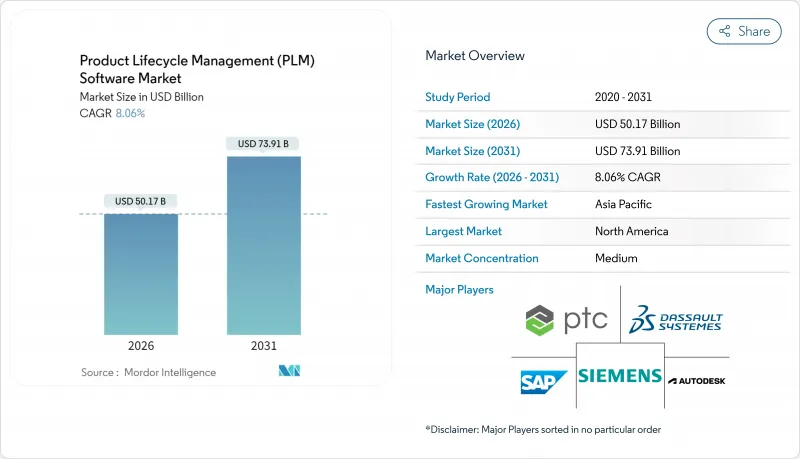
Mordor Intelligence에 의하면, 제품 수명주기 관리(PLM) 소프트웨어 시장 규모는 2026년에 501억 7,000만 달러로 추정되고, 2031년까지 739억 1,000만 달러로 확대될 것으로 예측되며, 2026-2031년 CAGR은 8.06%를 나타낼 전망입니다.
본 보고서는 배포 방식별(온프레미스, 클라우드), 솔루션 유형별(협업형 PDM/CPDM, MCAD 통합 PLM 등), 조직 규모별(대기업, 중소기업(SME)), 최종 사용자 산업별(자동차 및 운송, 항공우주 및 방위 등) 및 지역별로 분류되어 있습니다. 시장 전망은 금액(달러) 기준으로 제시되어 있습니다.
세계의 제품 수명주기 관리(PLM) 소프트웨어 시장 동향 및 인사이트
Tier 1 제조업체의 ‘클라우드 퍼스트’ 도입
클라우드 네이티브 PLM 아키텍처는 자체 데이터센터에 대한 의존도를 낮추고 전 세계적인 검토 주기를 단축합니다. 지멘스는 2025 회계연도 4분기 클라우드 연간 반복 수익(ARR)이 자사의 소프트웨어 ARR 53억 유로(56억 7,000만 달러)의 49%에 달했다고 보고하며, SaaS로의 전환이 빠르게 진행되고 있음을 보여주었습니다. PTC는 Windchill+SaaS 도입이 가속화됨에 따라 2026년 ARR이 7-9% 성장할 것으로 예측했습니다. 클라우드 도입이 확대되고 있는 배경에는 하드웨어의 과잉 프로비저닝 없이 생성형 설계 워크로드를 확장할 수 있는 온디맨드형 컴퓨팅이 있으며, 또한 공급업체가 실시간으로 접근할 수 있어 설계 변경 지시(ECO)의 지연이 대폭 단축된다는 점을 들 수 있습니다.
엔드투엔드 디지털 스레드에 대한 수요 증가
지속적인 디지털 스레드는 요구사항, CAD, 시뮬레이션, 제조 지시, 현장 데이터를 연결하여 폐쇄 루프 피드백을 가능하게 합니다. NIST는 2024년에 프레임워크를 발표하고, PLM, ERP, MES 데이터를 통합하기 위해 STEP AP242 및 관련 스키마의 채택을 권장하고 있습니다. 딜로이트와 지멘스는 ‘디지털 스레드 및 디지털 트윈 얼라이언스’를 결성하여 항공우주 및 자동차 업계 고객을 대상으로 이러한 프레임워크의 실용화에 힘쓰고 있습니다. 조기 도입 기업들로부터는 스크랩 감소, 설계 반복 과정의 신속화, 그리고 규제 당국이 요구하는 상세한 완제품 추적성에 대한 대응을 통한 감사 대응 능력 향상 등이 보고되고 있습니다.
레거시 CAD와 최신 PLM 간의 뿌리 깊은 상호 운용성 격차
CATIA, NX, SolidWorks, Creo에 걸쳐 있는 하이브리드 CAD 환경에서는 클라우드 저장소로 마이그레이션할 때 데이터 변환 오류가 발생합니다. ITI의 조사에 따르면, 마이그레이션 작업의 30-40%에서는 여전히 수작업에 의한 수정이 필요하며, 이로 인해 프로젝트 기간이 연장되고 있습니다. 지멘스가 2025년 1월에 알테아를 인수한 것은 HyperWorks 시뮬레이션과 Teamcenter의 보다 긴밀한 통합을 도모하기 위함이지만, STEP과 같은 중립 포맷의 채택 현황에는 여전히 편차가 나타납니다.
부문 분석
2025년에는 온프레미스 도입이 매출의 56.66%를 차지했으며, 관리된 기술 데이터와 기존 계약이 여전히 많은 프로그램의 기반이 되고 있음을 보여줍니다. PLM 소프트웨어 시장의 클라우드 부문은 시뮬레이션 처리 부하의 급증세를 흡수하고 전 세계 설계 검토를 지원하는 탄력적인 컴퓨팅에 힘입어 2031년까지 연평균 성장률(CAGR) 10.96%로 성장하고 있습니다. 클라우드 기반 PLM 소프트웨어 시장 규모는 2026년 217억 5,000만 달러에서 2031년에는 366억 1,000만 달러로 확대될 전망이며, 이는 SaaS로의 돌이킬 수 없는 전환을 여실히 보여주고 있습니다. 지멘스는 2025년 말 기준 클라우드 ARR이 자사 소프트웨어 구독의 49%를 차지했다고 지적하며, 이는 Tier 1 제조업체들 사이에서 클라우드가 주류로 받아들여지고 있음을 뒷받침합니다.
하이브리드형 토폴로지는 현실적인 타협안으로 부상하고 있습니다. 기밀성이 높은 지적 재산(IP)은 방화벽 내부에 보관되는 반면, 공급업체 포털, 디지털 트윈 분석 및 고성능 시뮬레이션은 클라우드로 이전되고 있습니다. 오토데스크는 중견 제조업체들이 종량제 라이선싱을 채택함에 따라 2025 회계연도 제조 부문 매출이 15-16% 증가한 요인으로 Fusion 360을 꼽고 있습니다. 방위 및 제약 업계에서는 온프레미스 도입이 지속될 전망이지만, 클라우드 벤더들이 FedRAMP 및 ISO 27001 인증을 획득함에 따라 성장은 SaaS 쪽으로 더욱 기울어질 것이며, 이는 제품 수명주기 관리(PLM) 소프트웨어 시장 전체의 지원 및 업그레이드 경제성을 재편하게 될 것입니다.
협업형 PDM은 버전 관리, 변경 거버넌스 및 BOM 계층 관리에서 핵심적인 역할을 수행한 덕분에 2025년에도 48.26%의 매출 점유율을 유지했습니다. 그러나 디지털 제조 및 MES-PLM 통합은 급성장 분야로, 연평균 성장률(CAGR) 9.32%로 확대되고 있습니다. 디지털 제조 솔루션에 기인한 제품 수명주기 관리(PLM) 소프트웨어 시장 규모는 2026년 81억 3,000만 달러에서 2031년에는 127억 5,000만 달러로 확대될 것으로 예측됩니다. 지멘스는 Opcenter MES를 Teamcenter에 통합하고, 설계 변경 사항을 현장의 일정에 반영함으로써 구식 작업 지시서로 인한 손실을 줄였습니다. 록웰 오토메이션도 FactoryTalk와 PTC Windchill을 연동하여 유사한 시너지 효과를 실현했습니다.
현재는 클라우드 마이크로서비스 형태로 제공되는 경우가 많은 시뮬레이션 및 해석 애드온은 통합 제품군의 매력을 한층 더 높이고 있습니다. Ansys는 Windchill 및 Teamcenter와 연동되는 클라우드 네이티브 솔버를 도입하여, 멀티피직스 검증에 소요되는 시간을 수주에서 수일로 단축했습니다. 자동차 섀시 설계에서는 여전히 MCAD 통합이 필수적인 반면, 펌웨어와 하드웨어의 공동 진화가 요구되는 전자 분야에서는 애플리케이션 수명주기 관리(ALM)의 중요성이 높아지고 있습니다. PDM, MES, 시뮬레이션을 하나의 계약으로 묶어 제공하는 벤더는 고객 유지율을 높이고, PLM 소프트웨어 시장 전체에서 플랫폼의 경쟁 우위를 공고히 하고 있습니다.
지역별 분석
북미는 2025년에도 35.28%의 매출 점유율을 유지했으며, 자동차, 항공우주, 산업기계 분야의 확고한 PLM 인프라가 이를 견인하고 있습니다. 이 지역의 PLM 소프트웨어 시장 점유율은 견조한 디지털 전환 예산과 새로운 사이버 보안 기준에 대한 조기 대응을 반영하고 있습니다. 미국의 제조업체들은 클라우드 연구개발비에 대한 세액 공제를 활용하여 SaaS로의 전환을 원활하게 진행하고 있습니다. 캐나다의 항공우주 클러스터에서는 민관 컨소시엄을 활용하여 PLM과 현장 센서 데이터를 통합하는 디지털 트윈 시범 프로젝트를 추진하고 있습니다.
아시아태평양은 계속해서 가장 빠르게 성장하는 지역으로, 2031년까지 연평균 성장률(CAGR) 10.44%로 성장을 지속하고 있습니다. 중국의 ‘제14차 5개년 계획’에서는 외국산 엔지니어링 툴에 대한 의존도를 낮추기 위해 국내 PLM 도입에 대해 적극적으로 보조금을 지원하고 있습니다. 인도의 디지털 제조 이니셔티브를 통해 국내 OEM 제조업체와 세계 1차 공급업체 모두 SaaS형 PLM을 통해 설계 데이터와 생산 데이터를 통합하도록 장려되고 있습니다. 베트남과 태국에 위치한 아세안(ASEAN)의 전자 산업 거점에서는 PLM 도입과 5G 공장 네트워크를 결합하여 대량 생산을 위한 PCB 설계의 반복을 촉진하고 있습니다.
유럽에서는 독일, 프랑스, 영국을 중심으로 상당한 수요가 예상됩니다. CSRD(기업 지속가능성 보고 지침)에 따른 환경 보고 의무화로 인해 PLM 제품군 전반에 걸쳐 수명 주기 평가(LCA) 플러그인 도입이 진행되고 있으며, 자동차 및 항공우주 분야의 주요 계약업체들은 수소 추진 시스템과 도심항공모빌리티(UAM)(UAM) 프로그램을 관리하기 위해 시스템을 업그레이드하고 있습니다. 동유럽의 수탁 제조업체들은 EU의 밸류체인에 진입하여 고객의 감사 요건을 준수하기 위해 경량 PLM을 도입하고 있습니다.
남미, 중동 및 아프리카에서는 아직 발전 단계에 있지만, 미래가 기대되고 있습니다. 브라질의 플렉스 연료 차량 제조업체는 에탄올과 가솔린의 다양한 설계를 동시에 지원하기 위해 PLM을 도입하고 있습니다. 사우디아라비아의 ‘비전 2030’은 PLM이 모듈식 설비 구축을 총괄하는 디지털 산업 회랑에 자금을 지원하고 있습니다. 아프리카의 통신 장비 재생 업체는 예비 부품의 물류를 최적화하기 위해 클라우드 기반 PLM 도입을 검토하고 있습니다. 절대적인 매출액은 여전히 낮은 수준이지만, 그린필드 투자 증가로 인해 제품 수명주기 관리(PLM) 소프트웨어 시장 전반에서 두 자릿수 성장을 보이는 분야가 나타나고 있습니다.
기타 혜택 :
- 엑셀 형식 시장 예측(ME) 시트
- 3개월간의 애널리스트 지원
목차
제1장 서론
제2장 조사 방법
제3장 주요 요약
제4장 시장 구도
제5장 시장 규모 및 성장 예측
제6장 경쟁 구도
제7장 시장 기회 및 향후 전망
AJYAccording to Mordor Intelligence, the product lifecycle management (PLM) software market size reached USD 50.17 billion in 2026 and is projected to advance to USD 73.91 billion by 2031, reflecting an 8.06% CAGR during 2026-2031.
This report is Segmented by Deployment Type (On-Premise, and Cloud), Solution Type (Collaborative PDM / CPDM, MCAD Integration PLM, and More), Organization Size (Large Enterprises, and Small and Medium Enterprises (SMEs)), End-User Industry (Automotive and Transportation, Aerospace and Defense, and More), and Geography. The Market Forecasts are Provided in Terms of Value (USD).
Global Product Lifecycle Management (PLM) Software Market Trends and Insights
Cloud-First Adoption Among Tier-1 Manufacturers
Cloud-native PLM architectures reduce reliance on proprietary data centers and shorten global review loops. Siemens reported that cloud annual recurring revenue reached 49% of its EUR 5.3 billion (USD 5.67 billion) software ARR in fiscal Q4 2025, illustrating the velocity of SaaS migrations. PTC forecasts 7-9% ARR growth for 2026 as Windchill+ SaaS deployments accelerate. Elevated cloud uptake stems from on-demand compute that scales generative-design workloads without hardware over-provisioning, while real-time access for suppliers slashes engineering change-order latency.
Growing Need for End-to-End Digital Thread
A continuous digital thread links requirements, CAD, simulation, manufacturing instructions, and field data, enabling closed-loop feedback. NIST published a 2024 framework urging adoption of STEP AP242 and related schemas to knit PLM, ERP, and MES data together. Deloitte and Siemens formed the Digital Thread and Twin Alliance to operationalize such frameworks for aerospace and automotive clients. Early adopters report lower scrap, faster design iterations, and audit readiness as regulators request granular as-built traceability.
Persistent Interoperability Gaps Between Legacy CAD and Modern PLM
Hybrid CAD estates spanning CATIA, NX, SolidWorks, and Creo introduce data-translation errors when ported into cloud repositories. ITI documented that 30-40% of migrations still need manual remediation, inflating project timelines. Siemens' acquisition of Altair in January 2025 targets tighter integration of HyperWorks simulation with Teamcenter, yet neutral formats such as STEP remain unevenly adopted.
Other drivers and restraints analyzed in the detailed report include:
- Regulatory Push for Product Traceability and Sustainability Reporting
- Generative-AI Copilots Trimming Engineering Change-Order Cycles
- Cyber-Security and IP Leakage Concerns in Multi-Tenant SaaS
For complete list of drivers and restraints, kindly check the Table Of Contents.
Segment Analysis
On-premise installations accounted for 56.66% revenue in 2025, a reminder that controlled technical data and legacy contracts still anchor many programs. The cloud segment of the PLM software market is growing at 10.96% CAGR to 2031, propelled by elastic compute that absorbs simulation spikes and supports global design reviews. The PLM software market size for cloud deployments is set to expand from USD 21.75 billion in 2026 to USD 36.61 billion in 2031, underscoring an irreversible shift toward SaaS. Siemens noted that cloud ARR equaled 49% of its software subscriptions by late 2025, confirming mainstream acceptance among Tier-1 manufacturers.
Hybrid topologies have emerged as a pragmatic compromise. Sensitive IP remains behind firewalls while supplier portals, digital twin analytics, and high-performance simulation burst to the cloud. Autodesk credits Fusion 360 for 15-16% manufacturing revenue growth in fiscal 2025 as mid-market fabricators adopted pay-as-you-go licensing. On-premise deployments will persist in defense and pharma, yet as cloud vendors attain FedRAMP and ISO 27001, growth will keep tilting to SaaS, reshaping support and upgrade economics across the Product Lifecycle Management (PLM) Software market.
Collaborative PDM maintained 48.26% revenue share in 2025 thanks to its core role in version control, change governance, and BOM hierarchy management. However, digital manufacturing and MES-PLM integration is the breakout segment, advancing at 9.32% CAGR. The Product Lifecycle Management (PLM) Software market size attributable to digital manufacturing solutions is anticipated to climb from USD 8.13 billion in 2026 to USD 12.75 billion in 2031. Siemens knitted Opcenter MES into Teamcenter to propagate engineering changes to shop-floor schedules, trimming scrap tied to outdated work instruction. Rockwell Automation achieved similar synergy by aligning FactoryTalk with PTC Windchill.
Simulation and analysis add-ons, now often delivered as cloud micro-services, reinforce the pull of integrated suites. Ansys introduced cloud-native solvers that handshake with Windchill and Teamcenter, compressing multi-physics validation from weeks to days. MCAD integration remains necessary for automotive chassis engineering, while application lifecycle management strengthens in electronics where firmware and hardware must co-evolve. Vendors bundling PDM, MES, and simulation under one contract gain stickiness, fortifying platform moats across the PLM software market.
Complete Report Scope:
- By Deployment Type
- On-Premise
- Cloud
- By Solution Type
- Collaborative PDM / cPDM
- MCAD Integration PLM
- Simulation and Analysis
- Digital Manufacturing and MES-PLM
- ALM / SLM
- By Organisation Size
- Large Enterprises
- Small and Medium Enterprises (SMEs)
- By End-user Industry
- Automotive and Transportation
- Aerospace and Defence
- Electronics and High-Tech
- Industrial Machinery and Heavy Equipment
- Architecture, Engineering and Construction
- Life Sciences and Medical Devices
- Consumer Packaged Goods / Retail
- Other End-user Industries
- By Geography
- North America
- United States
- Canada
- Mexico
- Europe
- Germany
- United Kingdom
- France
- Italy
- Spain
- Russia
- Rest of Europe
- Asia Pacific
- China
- Japan
- India
- South Korea
- Australia and New Zealand
- Rest of Asia Pacific
- South America
- Brazil
- Argentina
- Rest of South America
- Middle East
- Saudi Arabia
- United Arab Emirates
- Turkey
- Rest of Middle East
- Africa
- South Africa
- Nigeria
- Rest of Africa
- North America
Geography Analysis
North America maintained 35.28% revenue share in 2025, spearheaded by entrenched PLM infrastructures in automotive, aerospace, and industrial machinery. The PLM software market share of the region reflects robust digital transformation budgets and early compliance with emerging cyber-security norms. U.S. manufacturers leverage tax credits for cloud R&D spending, smoothing SaaS transitions. Canadian aerospace clusters tap public-private consortia to pilot digital twins that integrate PLM with field sensor data.
Asia Pacific remains the fastest-growing region, posting a 10.44% CAGR through 2031. China's 14th Five-Year Plan actively subsidizes domestic PLM deployment to cut reliance on foreign engineering tools. India's digital manufacturing mission is pushing both domestic OEMs and global tier-one suppliers to unify design and production data via SaaS PLM. ASEAN electronics hubs in Vietnam and Thailand pair PLM rollouts with 5G factory networks, facilitating high-volume PCB design iterations.
Europe contributes sizable demand, centered in Germany, France, and the United Kingdom. CSRD-driven environmental reporting is prompting lifecycle-assessment plug-ins across PLM suites, while automotive and aerospace primes upgrade to manage hydrogen propulsion and urban air-mobility programs. Eastern Europe's contract manufacturers join EU value chains, adopting lightweight PLM to comply with customer audit requirements.
South America, the Middle East, and Africa remain nascent yet promising. Brazil's flex-fuel vehicle producers deploy PLM to juggle ethanol and gasoline variant engineering. Saudi Arabia's Vision 2030 funds digital industrial corridors where PLM orchestrates modular equipment builds. African telecom equipment refurbishers evaluate cloud PLM to optimize spare-parts logistics. Although absolute revenue lags, rising green-field investments yield double-digit growth pockets across the Product Lifecycle Management (PLM) Software Market.
- Siemens AG
- Dassault Systems SE
- PTC Inc.
- SAP SE
- Autodesk Inc.
- Oracle Corporation
- IBM Corporation
- ANSYS Inc.
- Aras Corporation
- Arena (SaaS by PTC)
- Infor Inc.
- Hexagon AB
- Bentley Systems Inc.
- Altair Engineering Inc.
- Propel Software
- IFS AB
- HCLTech xLMCloud
- Accenture Industry X
- OpenBOM
- Propulsion-PLM
- Centric Software
- CONTACT Software
Additional Benefits:
- The market estimate (ME) sheet in Excel format
- 3 months of analyst support
TABLE OF CONTENTS
1 INTRODUCTION
- 1.1 Study Assumptions and Market Definition
- 1.2 Scope of the Study
2 RESEARCH METHODOLOGY
3 EXECUTIVE SUMMARY
4 MARKET LANDSCAPE
- 4.1 Market Overview
- 4.2 Market Drivers
- 4.2.1 Cloud-first Adoption among Tier-1 Manufacturers
- 4.2.2 Growing Need for End-to-End Digital Thread
- 4.2.3 Regulatory Push for Product Traceability and Sustainability Reporting
- 4.2.4 Generative-AI Copilots Trimming Engineering Change-Order Cycles
- 4.2.5 Micro-subscription PLM Bundles for SMB Value Chains
- 4.2.6 Low-Code PLM Platforms Democratising Custom Workflows (UNDER-REPORTED)
- 4.3 Market Restraints
- 4.3.1 Persistent Interoperability Gaps between Legacy CAD and Modern PLM
- 4.3.2 Cyber-security and IP Leakage Concerns in Multi-tenant SaaS
- 4.3.3 Growing Open-Source Digital-Twin Stacks Cannibalising Paid Licences
- 4.3.4 Trade-Policy-Driven Chip Export Controls Disrupting PLM Upgrade Cycles (UNDER-REPORTED)
- 4.4 Industry Value Chain Analysis
- 4.5 Regulatory Landscape
- 4.6 Technological Outlook
- 4.7 Porter's Five Forces Analysis
- 4.7.1 Bargaining Power of Suppliers
- 4.7.2 Bargaining Power of Buyers
- 4.7.3 Threat of New Entrants
- 4.7.4 Threat of Substitutes
- 4.7.5 Intensity of Competitive Rivalry
- 4.8 Impact of Macroeconomic Factors on the Market
5 MARKET SIZE AND GROWTH FORECASTS (VALUE)
- 5.1 By Deployment Type
- 5.1.1 On-Premise
- 5.1.2 Cloud
- 5.2 By Solution Type
- 5.2.1 Collaborative PDM / cPDM
- 5.2.2 MCAD Integration PLM
- 5.2.3 Simulation and Analysis
- 5.2.4 Digital Manufacturing and MES-PLM
- 5.2.5 ALM / SLM
- 5.3 By Organisation Size
- 5.3.1 Large Enterprises
- 5.3.2 Small and Medium Enterprises (SMEs)
- 5.4 By End-user Industry
- 5.4.1 Automotive and Transportation
- 5.4.2 Aerospace and Defence
- 5.4.3 Electronics and High-Tech
- 5.4.4 Industrial Machinery and Heavy Equipment
- 5.4.5 Architecture, Engineering and Construction
- 5.4.6 Life Sciences and Medical Devices
- 5.4.7 Consumer Packaged Goods / Retail
- 5.4.8 Other End-user Industries
- 5.5 By Geography
- 5.5.1 North America
- 5.5.1.1 United States
- 5.5.1.2 Canada
- 5.5.1.3 Mexico
- 5.5.2 Europe
- 5.5.2.1 Germany
- 5.5.2.2 United Kingdom
- 5.5.2.3 France
- 5.5.2.4 Italy
- 5.5.2.5 Spain
- 5.5.2.6 Russia
- 5.5.2.7 Rest of Europe
- 5.5.3 Asia Pacific
- 5.5.3.1 China
- 5.5.3.2 Japan
- 5.5.3.3 India
- 5.5.3.4 South Korea
- 5.5.3.5 Australia and New Zealand
- 5.5.3.6 Rest of Asia Pacific
- 5.5.4 South America
- 5.5.4.1 Brazil
- 5.5.4.2 Argentina
- 5.5.4.3 Rest of South America
- 5.5.5 Middle East
- 5.5.5.1 Saudi Arabia
- 5.5.5.2 United Arab Emirates
- 5.5.5.3 Turkey
- 5.5.5.4 Rest of Middle East
- 5.5.6 Africa
- 5.5.6.1 South Africa
- 5.5.6.2 Nigeria
- 5.5.6.3 Rest of Africa
- 5.5.1 North America
6 COMPETITIVE LANDSCAPE
- 6.1 Market Concentration
- 6.2 Strategic Moves
- 6.3 Market Share Analysis
- 6.4 Company Profiles (includes Global Level Overview, Market Level Overview, Core Segments, Financials as Available, Strategic Information, Market Rank/Share for Key Companies, Products and Services, Recent Developments)
- 6.4.1 Siemens AG
- 6.4.2 Dassault Systems SE
- 6.4.3 PTC Inc.
- 6.4.4 SAP SE
- 6.4.5 Autodesk Inc.
- 6.4.6 Oracle Corporation
- 6.4.7 IBM Corporation
- 6.4.8 ANSYS Inc.
- 6.4.9 Aras Corporation
- 6.4.10 Arena (SaaS by PTC)
- 6.4.11 Infor Inc.
- 6.4.12 Hexagon AB
- 6.4.13 Bentley Systems Inc.
- 6.4.14 Altair Engineering Inc.
- 6.4.15 Propel Software
- 6.4.16 IFS AB
- 6.4.17 HCLTech xLMCloud
- 6.4.18 Accenture Industry X
- 6.4.19 OpenBOM
- 6.4.20 Propulsion-PLM
- 6.4.21 Centric Software
- 6.4.22 CONTACT Software
7 MARKET OPPORTUNITIES AND FUTURE OUTLOOK
- 7.1 White-space and Unmet-need Assessment