|
시장보고서
상품코드
2122657
데이터 거버넌스 시장 : 시장 점유율 분석, 업계 동향 및 통계, 성장 예측(2026-2031년)Data Governance - Market Share Analysis, Industry Trends & Statistics, Growth Forecasts (2026 - 2031) |
||||||
 Mordor Intelligence
Mordor Intelligence에 의하면, 데이터 거버넌스 시장 규모는 2026년에 46억 달러로 추정되고, 2031년까지 96억 8,000만 달러에 이를 것으로 예측되며, 예측 기간 16.05%라고 하는 견고한 CAGR을 나타낼 전망입니다.
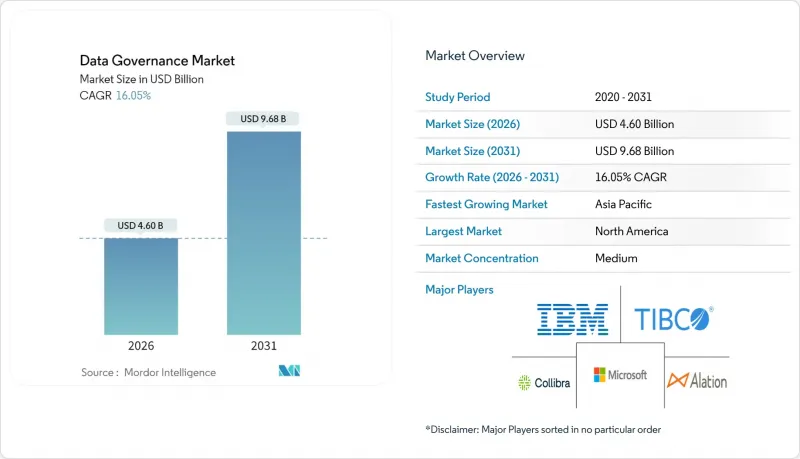
본 보고서는 구성 요소별(소프트웨어 및 서비스), 도입 형태별(클라우드 및 온프레미스), 조직 규모별(대기업 및 중소기업), 업무 기능별(IT·운영, 재무·리스크 등), 용도별(감사 관리 등), 최종 사용자 산업별(은행, 금융서비스 및 보험(BFSI), IT 및 통신 등), 지역별로 분류되어 있습니다. 시장 예측은 금액(달러) 기준으로 제시되어 있습니다.
세계의 데이터 거버넌스 시장 동향 및 인사이트
설명 가능한 데이터 계보(Data Lineage)를 의무화하는 EU AI법 및 전 세계 AI 규제
EU AI법은 2024년 8월부터 시행되고 있으며, 고위험 시스템을 분류하고 도입 사업자에게 데이터 출처, 편향 완화 조치, 재학습 트리거를 기록한 종단간 데이터 계보(end-to-end data lineage)를 유지할 것을 의무화하고 있습니다. 다국적 기업들은 현재 SQL, Python 및 ETL 워크플로우를 분석하여 관할 구역을 초월한 감사 대응을 가능하게 하는 자동화된 계보 플랫폼을 표준화하고 있으며, 이러한 동향은 캐나다의 ‘인공지능·데이터법’에도 이미 반영되어 있습니다. 금융 기관은 알고리즘 모델로 인해 AI 법의 의무와 엄격한 GDPR(EU 개인정보보호규정) 의무가 밀접하게 얽혀 있기 때문에 더 큰 위험에 직면해 있습니다. 전 세계 매출의 6%에 달하는 벌금으로 인해 거버넌스는 단순한 IT 문제에서 이사회 수준의 위험으로 격상되었으며, 데이터 거버넌스 시장에서 카탈로그 및 리니지 프로젝트에 대한 예산 승인이 신속하게 진행되고 있습니다.
FedNow 및 실시간 결제 네트워크가 북미 BFSI 업계에 서브밀리초 단위의 데이터 일관성을 요구함에 따라
2025년에 임계 질량에 도달한 FedNow는 10초 이내에 결제를 처리하고, 대조 주기를 단축하는 동시에 트랜잭션 에지에서 실시간 데이터 품질 검사가 필요합니다. 각 은행은 매일 밤 실행되던 프로파일링 작업을 폐지하고, Kafka 토픽 및 Flink 상태 저장소를 밀리초 단위로 검증하는 스트리밍 도구를 도입하고 있습니다. 브라질의 PIX 시스템이나 인도의 UPI에서 볼 수 있는 유사한 동향은 즉시 결제를 향한 전 세계적인 움직임을 여실히 보여주고 있으며, 단 한 건의 데이터 품질 결함만으로도 수백만 건의 잘못된 결제 거절이나 중복 계상으로 이어져 거버넌스 도구의 비용을 훨씬 상회하는 손실을 초래할 가능성이 있습니다.
Tier 1 은행에서 엔터프라이즈급 데이터 계보 도구의 높은 총 소유 비용
소프트웨어 라이선스, 전문 서비스, 맞춤형 커넥터를 합치면 풀스택 거버넌스 프로그램의 첫해 비용은 1,000만 달러를 초과할 수 있으며, 이후 연간 유지 비용도 500만 달러에 육박합니다. 따라서 예산 승인은 디지털 뱅킹과 같은 수익 창출을 우선시하는 이니셔티브와 경쟁하게 됩니다. 중견 은행은 복잡한 계보 엔진을 설정할 IT 인력이 부족하여 더욱 어려움을 겪고 있으며, 그 결과 데이터 자산 1건당 실질 비용이 더욱 치솟고 투자 회수 기간이 길어지고 있습니다.
부문 분석
기업들이 모놀리식 제품군보다 베스트 오브 브리드(best-of-breed) 카탈로그, 리니지, 마스터 데이터 플랫폼을 선호함에 따라, 2025년 매출의 65.66%를 소프트웨어가 차지했습니다. 데이터 보안 및 개인정보 보호 거버넌스 하위 부문은 EU AI법의 투명성 요건과 주권 클라우드 의무화에 힘입어 연평균 성장률(CAGR) 19.62%를 나타낼 것으로 예측됩니다. 서비스 부문은 34.34%를 차지하며, 온프레미스 환경에서 클라우드 아키텍처로의 전환에 따라 전문 서비스에 대한 수요가 확대되고 있습니다. 각 벤더는 현재 거버넌스와 가시성을 통합하고, 리니지 알림을 DevOps 대시보드에 통합하고 있지만, 순수한 전문 제공업체는 여전히 가장 진보된 카탈로그 기능을 보유하고 있습니다.
수요 동향을 보면 거버넌스와 사이버 보안 대책이 얼마나 융합되어 있는지를 알 수 있습니다. 보안 지향 플랫폼은 동의 추적 및 국경을 넘는 전송 로그 기록을 자동화하고 있으며, 품질 관리 및 프로파일링 도구는 머신러닝 파이프라인으로 그 범위를 넓히고 있습니다. 개인정보 보호 도구에 기인한 데이터 거버넌스 시장 규모는 2031년까지 두 배로 증가할 전망입니다. 또한, BFSI(은행 및 금융 및 보험) 및 의료 분야의 구매자들이 데이터 거버넌스 시장에서의 조달 요건으로 제3자 인증을 요구하고 있어, ISO 27001 인증 동향도 성장을 뒷받침하고 있습니다.
클라우드 배포는 2025년에 72.44%의 점유율을 차지했으며, 연평균 성장률(CAGR) 17.42%를 기록할 전망입니다. AWS Glue Data Catalog, Microsoft Purview, Google Dataplex와 같은 하이퍼스케일러 서비스는 파이프라인 수준에서 데이터 계보를 통합하고 있어 별도의 카탈로그를 도입할 필요가 없습니다. 디지털 네이티브 소매업체나 미디어 플레이어은 운영상의 오버헤드를 최소화하기 위해 이러한 매니지드 서비스를 선호하고 있습니다. 반면, 데이터를 방화벽 내부에 보관해야 하는 국방, 정부 기관 및 규제가 엄격한 은행의 경우, 온프레미스 도입이 여전히 중요하며 하이브리드 아키텍처가 계속해서 활용되고 있습니다.
비용 동향은 복잡합니다. 매일 수백만 개의 클라우드 오브젝트를 스캔하면 월간 카탈로그 이용료가 5만 달러를 초과할 가능성이 있습니다. 그 결과, 특히 GDPR(EU 개인정보보호규정)의 데이터 이전 영향 평가로 인해 표준 하이퍼스케일러와의 계약이 복잡해지는 경우, 일부 기업은 거버넌스 관련 워크로드를 자체 호스팅형 Kubernetes 클러스터로 되돌리고 있습니다. 예측 기간 동안 클라우드 도입 범위는 여전히 확대될 전망이지만, 하이브리드 환경 전반에 걸쳐 데이터를 추적할 수 있는 도구의 유연성이 벤더 선정의 결정 요인이 될 것입니다.
지역별 분석
북미는 2025년에 42.64%의 점유율을 차지했습니다. 이는 FedNow 도입, 주요 클라우드 하이퍼스케일러의 존재, 그리고 캐나다의 새로운 연방법 및 AI 규제가 뒷받침한 결과입니다. 실시간 결제 및 생성형 AI가 거버넌스의 시급성을 높이는 가운데, 과거 약 13%였던 연평균 성장률(CAGR)은 상승 추세를 보이고 있습니다. 니어쇼어링을 통해 미국공급망 투명성 프레임워크가 확대됨에 따라 멕시코는 추가적인 성장 여지를 제공합니다.
아시아태평양은 연평균 성장률(CAGR) 18.22%로 가장 빠르게 성장하는 지역입니다. 인도, 인도네시아, 베트남에서 소버린 클라우드 의무화로 인해 국내 카탈로그 구축이 요구되는 한편, 중국의 ‘개인정보 보호법’은 알리바바와 텐센트의 클라우드에 통합된 리니지 도구에 대한 국내 수요를 견인하고 있습니다. 일본과 한국은 디지털 제조 및 오픈 뱅킹을 지원하기 위해 꾸준히 투자하고 있는 반면, 성숙한 호주 시장에서는 다소 완만한 확장이 나타나고 있습니다.
유럽에서는 GDPR(EU 개인정보보호규정) 및 EU AI법에 따라 투자가 계속되고 있습니다. 북유럽 국가 정부들은 관리형 거버넌스 서비스를 중시하는 ‘클라우드 퍼스트’ 전략을 채택하고 있지만, 남유럽 및 동유럽에서는 예산 제약으로 인해 그 움직임이 더딘 임베디드니다. 중동 및 아프리카 및 남미는 여전히 소규모 시장이지만, UAE, 브라질, 남아프리카공화국의 정부계 투자 펀드와 개인정보 보호 관련 법규가 규정 준수를 주도하는 도입을 뒷받침하고 있습니다.
기타 혜택 :
- 엑셀 형식 시장 예측(ME) 시트
- 3개월간 애널리스트 지원
자주 묻는 질문
목차
제1장 서론
제2장 조사 방법
제3장 주요 요약
제4장 시장 구도
제5장 시장 규모 및 성장 예측
제6장 경쟁 구도
제7장 시장 기회 및 향후 전망
AJY 26.09.07According to Mordor Intelligence, the data governance market size stood at USD 4.60 billion in 2026 and is projected to reach USD 9.68 billion by 2031, translating into a robust 16.05% CAGR across the forecast window.
This report is Segmented by Component (Software, and Services), Deployment (Cloud, and On-Premise), Organization Size (Large Enterprises, and Small and Medium Enterprises), Business Function (IT and Operations, Finance and Risk, and More), Application (Audit Management, and More), End-User Industry (BFSI, IT and Telecom, and More), and Geography. The Market Forecasts are Provided in Terms of Value (USD).
Global Data Governance Market Trends and Insights
EU AI Act and Global AI-Regulation Requiring Explainable Data Lineage
The EU AI Act has been in force since August 2024 and classifies high-risk systems, compelling deployers to maintain end-to-end lineage that documents data provenance, bias-mitigation steps, and retraining triggers. Multinationals now standardize on automated lineage platforms that parse SQL, Python, and ETL workflows for cross-jurisdictional audit readiness, a trend already mirrored by Canada's Artificial Intelligence and Data Act. Financial institutions face heightened exposure because algorithmic models intertwine AI Act duties with stringent GDPR obligations. Penalties reaching 6% of global turnover elevate governance from an IT concern to a board-level risk, quickly unlocking budget approvals for catalog and lineage projects in the data governance market.
FedNow and Real-Time Payment Rails Forcing Sub-Millisecond Data Integrity in North American BFSI
FedNow, which attained critical mass in 2025, processes payments within 10 seconds, compressing reconciliation cycles and demanding real-time data-quality checks at the transaction edge. Banks have retired nightly profiling jobs in favor of streaming tools that validate Kafka topics or Flink state stores in milliseconds. Comparable dynamics in Brazil's PIX system and India's UPI underscore a global move toward instant payments, and a single data-quality lapse can cascade into millions of false declines or duplicate postings, far outweighing governance tool costs.
High Total Cost of Ownership for Enterprise-Scale Data Lineage Tooling in Tier-1 Banks
Full-stack governance programs can exceed USD 10 million during the first year when software licenses, professional services, and custom connectors are combined, with ongoing spend near USD 5 million annually. Budget approval therefore competes with revenue-generating priorities such as digital banking. Mid-tier banks struggle even more, lacking IT staff to configure complex lineage engines, which further inflates the effective cost per data asset and prolongs payback periods.
Other drivers and restraints analyzed in the detailed report include:
- Asia Pacific Sovereign-Cloud Mandates Accelerating In-Country Data Catalog Investments
- Generative AI Governance Use-Cases Elevating Automated Metadata Discovery Spend
- Talent Shortage of Certified Data Stewards and DCAM Practitioners
For complete list of drivers and restraints, kindly check the Table Of Contents.
Segment Analysis
Software generated 65.66% of 2025 revenue as enterprises preferred best-of-breed catalogs, lineage, and master-data platforms over monolithic suites. Data security and privacy governance sub-segments are forecast to grow at 19.62% CAGR, propelled by EU AI Act transparency requirements and sovereign-cloud mandates. Services captured 34.34%, with professional engagements expanding as on-premise estates migrate to cloud architectures. Vendors now overlap governance and observability, folding lineage alerts into DevOps dashboards, although pure-play providers still hold the deepest catalog capabilities.
Demand patterns illustrate how governance converges with cyber postures. Security-oriented platforms automate consent tracking and cross-border transfer logs, while quality and profiling tools extend into machine learning pipelines. The data governance market size attributable to privacy tools is poised to double by 2031. Growth also benefits from ISO 27001 certification trends, because BFSI and healthcare buyers request third-party attestations as procurement prerequisites in the data governance market.
Cloud deployment owned 72.44% share in 2025 and is on track for a 17.42% CAGR. Hyperscaler services such as AWS Glue Data Catalog, Microsoft Purview, and Google Dataplex integrate lineage at the pipeline level, sidestepping separate catalog rollouts. Digital-native retailers and media firms favor these managed services to minimize operational overhead. On-premise installations remain relevant for defense, government, and highly regulated banks where data must stay behind firewalls, keeping hybrid architectures in play.
Cost dynamics are nuanced. Scanning millions of cloud objects daily can push monthly catalog fees beyond USD 50,000. Consequently, some enterprises repatriate governance workloads to self-hosted Kubernetes clusters, especially when GDPR transfer-impact assessments complicate standard hyperscaler contracts. Over the forecast period, cloud footprints will still expand, but tooling flexibility to trace data across hybrid estates will dictate vendor selection.
Complete Report Scope:
- By Component
- Software
- Data Quality and Profiling Tools
- Metadata Management and Data Catalog
- Master Data Management
- Data Lineage and Impact Analysis
- Data Security and Privacy Governance
- Services
- Professional Services
- Managed Services
- Software
- By Deployment
- Cloud
- On-Premise
- By Organization Size
- Large Enterprises
- Small and Medium Enterprises (SMEs)
- By Business Function
- IT and Operations
- Legal and Compliance
- Finance and Risk
- Marketing and Sales
- Human Resources
- Other Business Functions
- By Application
- Compliance Management
- Risk Management
- Audit Management
- Incident Management
- Data Quality Management
- Other Applications
- By End-User Industry
- BFSI
- IT and Telecom
- Healthcare and Life Sciences
- Retail and E-Commerce
- Government and Defense
- Manufacturing
- Energy and Utilities
- Media and Entertainment
- Other End-User Industries
- By Geography
- North America
- United States
- Canada
- South America
- Brazil
- Argentina
- Chile
- Mexico
- Rest of South America
- Europe
- Germany
- United Kingdom
- France
- Italy
- Spain
- Sweden
- Norway
- Finland
- Denmark
- Russia
- Rest of Europe
- Asia Pacific
- China
- India
- Japan
- South Korea
- Southeast Asia
- Australia
- New Zealand
- Rest of Asia Pacific
- Middle East
- United Arab Emirates
- Saudi Arabia
- Qatar
- Turkey
- Israel
- Rest of Middle East
- Africa
- South Africa
- Nigeria
- Kenya
- Rest of Africa
- North America
Geography Analysis
North America held 42.64% share in 2025, underpinned by FedNow adoption, major cloud hyperscalers, and AI regulations converging with Canada's new federal act. Historical CAGR of roughly 13% has ticked upward as instant payments and generative AI elevate governance urgency. Mexico adds incremental upside as nearshoring extends U.S. supply-chain transparency frameworks.
Asia Pacific is the fastest-growing region at 18.22% CAGR. Sovereign-cloud mandates in India, Indonesia, and Vietnam oblige in-country catalogs, while China's Personal Information Protection Law drives domestic demand for lineage tools embedded in Alibaba and Tencent clouds. Japan and South Korea invest steadily to support digital manufacturing and open banking, whereas mature Australian markets expand more modestly.
Europe continues to invest due to GDPR and the EU AI Act. Nordic governments adopt cloud-first strategies that favor managed governance services, but Southern and Eastern Europe lag owing to constrained budgets. The Middle East and Africa and South America remain smaller markets, yet sovereign investment funds and privacy statutes in the UAE, Brazil, and South Africa are catalyzing compliance-driven rollouts.
- IBM Corporation
- Microsoft Corporation
- Oracle Corporation
- SAP SE
- Collibra NV
- Informatica Inc.
- Alation Inc.
- SAS Institute Inc.
- TIBCO Software Inc.
- Talend SA
- Varonis Systems Inc.
- Amazon Web Services
- Precisely LLC
- Ataccama Corp.
- Quest Software (erwin Data Intelligence)
- OneTrust LLC
- OpenText Corp. (incl. Micro Focus)
- ASG Technologies (Rocket Software)
- Snowflake Inc.
- Databricks Inc.
- Cloudera Inc.
- Alfresco Software Inc.
Additional Benefits:
- The market estimate (ME) sheet in Excel format
- 3 months of analyst support
TABLE OF CONTENTS
1 INTRODUCTION
- 1.1 Study Assumptions and Market Definition
- 1.2 Scope of the Study
2 RESEARCH METHODOLOGY
3 EXECUTIVE SUMMARY
4 MARKET LANDSCAPE
- 4.1 Market Overview
- 4.2 Market Drivers
- 4.2.1 EU AI Act and Global AI-Regulation Requiring Explainable Data Lineage
- 4.2.2 FedNow and Real-Time Payment Rails Forcing Sub-Millisecond Data Integrity in North-American BFSI
- 4.2.3 Asia Pacific Sovereign-Cloud Mandates (e.g., India DPDP Act) Accelerating In-Country Data Catalog Investments
- 4.2.4 Retail-Media Monetization Elevating Product-Master Data Quality Spend
- 4.2.5 Edge Analytics in Manufacturing 4.0 Demands Near-Edge Metadata Federation
- 4.2.6 Generative AI Governance Use-Cases Elevating Automated Metadata Discovery Spend
- 4.3 Market Restraints
- 4.3.1 High Total Cost of Ownership for Enterprise-Scale Data Lineage Tooling in Tier-1 Banks
- 4.3.2 Talent Shortage of Certified Data Stewards and DCAM Practitioners
- 4.3.3 Legacy Mainframe Interoperability Issues Limiting Real-Time Governance in Defense Agencies
- 4.3.4 Limited Inter-Catalog Interoperability Creating Metadata Silos in Multi-Cloud Environments
- 4.4 Industry Value Chain Analysis
- 4.5 Impact of Macroeconomic Factors on the Market
- 4.6 Regulatory Outlook
- 4.7 Technological Outlook
- 4.8 Porter's Five Forces Analysis
- 4.8.1 Bargaining Power of Suppliers
- 4.8.2 Bargaining Power of Buyers
- 4.8.3 Threat of New Entrants
- 4.8.4 Threat of Substitutes
- 4.8.5 Intensity of Competitive Rivalry
5 MARKET SIZE AND GROWTH FORECASTS (VALUE)
- 5.1 By Component
- 5.1.1 Software
- 5.1.1.1 Data Quality and Profiling Tools
- 5.1.1.2 Metadata Management and Data Catalog
- 5.1.1.3 Master Data Management
- 5.1.1.4 Data Lineage and Impact Analysis
- 5.1.1.5 Data Security and Privacy Governance
- 5.1.2 Services
- 5.1.2.1 Professional Services
- 5.1.2.2 Managed Services
- 5.1.1 Software
- 5.2 By Deployment
- 5.2.1 Cloud
- 5.2.2 On-Premise
- 5.3 By Organization Size
- 5.3.1 Large Enterprises
- 5.3.2 Small and Medium Enterprises (SMEs)
- 5.4 By Business Function
- 5.4.1 IT and Operations
- 5.4.2 Legal and Compliance
- 5.4.3 Finance and Risk
- 5.4.4 Marketing and Sales
- 5.4.5 Human Resources
- 5.4.6 Other Business Functions
- 5.5 By Application
- 5.5.1 Compliance Management
- 5.5.2 Risk Management
- 5.5.3 Audit Management
- 5.5.4 Incident Management
- 5.5.5 Data Quality Management
- 5.5.6 Other Applications
- 5.6 By End-User Industry
- 5.6.1 BFSI
- 5.6.2 IT and Telecom
- 5.6.3 Healthcare and Life Sciences
- 5.6.4 Retail and E-Commerce
- 5.6.5 Government and Defense
- 5.6.6 Manufacturing
- 5.6.7 Energy and Utilities
- 5.6.8 Media and Entertainment
- 5.6.9 Other End-User Industries
- 5.7 By Geography
- 5.7.1 North America
- 5.7.1.1 United States
- 5.7.1.2 Canada
- 5.7.2 South America
- 5.7.2.1 Brazil
- 5.7.2.2 Argentina
- 5.7.2.3 Chile
- 5.7.2.4 Mexico
- 5.7.2.5 Rest of South America
- 5.7.3 Europe
- 5.7.3.1 Germany
- 5.7.3.2 United Kingdom
- 5.7.3.3 France
- 5.7.3.4 Italy
- 5.7.3.5 Spain
- 5.7.3.6 Sweden
- 5.7.3.7 Norway
- 5.7.3.8 Finland
- 5.7.3.9 Denmark
- 5.7.3.10 Russia
- 5.7.3.11 Rest of Europe
- 5.7.4 Asia Pacific
- 5.7.4.1 China
- 5.7.4.2 India
- 5.7.4.3 Japan
- 5.7.4.4 South Korea
- 5.7.4.5 Southeast Asia
- 5.7.4.6 Australia
- 5.7.4.7 New Zealand
- 5.7.4.8 Rest of Asia Pacific
- 5.7.5 Middle East
- 5.7.5.1 United Arab Emirates
- 5.7.5.2 Saudi Arabia
- 5.7.5.3 Qatar
- 5.7.5.4 Turkey
- 5.7.5.5 Israel
- 5.7.5.6 Rest of Middle East
- 5.7.6 Africa
- 5.7.6.1 South Africa
- 5.7.6.2 Nigeria
- 5.7.6.3 Kenya
- 5.7.6.4 Rest of Africa
- 5.7.1 North America
6 COMPETITIVE LANDSCAPE
- 6.1 Market Concentration
- 6.2 Strategic Moves
- 6.3 Market Share Analysis
- 6.4 Company Profiles {(includes Global level Overview, Market level overview, Core Segments, Financials as available, Strategic Information, Market Rank/Share for key companies, Products and Services, and Recent Developments)}
- 6.4.1 IBM Corporation
- 6.4.2 Microsoft Corporation
- 6.4.3 Oracle Corporation
- 6.4.4 SAP SE
- 6.4.5 Collibra NV
- 6.4.6 Informatica Inc.
- 6.4.7 Alation Inc.
- 6.4.8 SAS Institute Inc.
- 6.4.9 TIBCO Software Inc.
- 6.4.10 Talend SA
- 6.4.11 Varonis Systems Inc.
- 6.4.12 Amazon Web Services
- 6.4.13 Precisely LLC
- 6.4.14 Ataccama Corp.
- 6.4.15 Quest Software (erwin Data Intelligence)
- 6.4.16 OneTrust LLC
- 6.4.17 OpenText Corp. (incl. Micro Focus)
- 6.4.18 ASG Technologies (Rocket Software)
- 6.4.19 Snowflake Inc.
- 6.4.20 Databricks Inc.
- 6.4.21 Cloudera Inc.
- 6.4.22 Alfresco Software Inc.
7 MARKET OPPORTUNITIES AND FUTURE OUTLOOK
- 7.1 White-Space and Unmet-Need Assessment