

|
시장보고서
상품코드
2122659
RRP(Retail Ready Packaging) 시장 : 시장 점유율 분석, 업계 동향 및 통계, 성장 예측(2026-2031년)Retail Ready Packaging - Market Share Analysis, Industry Trends & Statistics, Growth Forecasts (2026 - 2031) |
||||||
 Mordor Intelligence
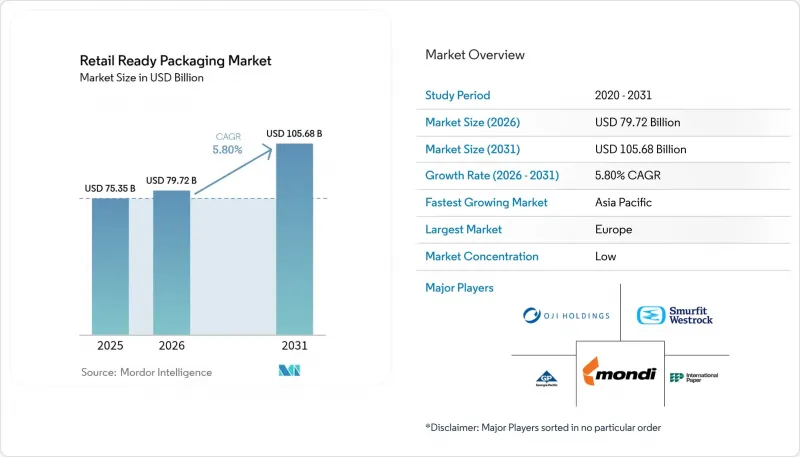
Mordor Intelligence에 의하면, 2026년 RRP(Retail Ready Packaging) 시장 규모는 797억 2,000만 달러로 추정되고, 2025년 753억 5,000만 달러에서 확대해, 2031년에는 1,056억 8,000만 달러에 이를 것으로 예측됩니다.
2026-2031년 연평균 성장률(CAGR) 5.8%로 성장할 것으로 전망됩니다.
본 보고서는 소재 유형별(종이 및 판지, 플라스틱, 하이브리드 소재, 기타), 포장 유형별(다이컷 디스플레이 용기, 골판지 상자, 수축 포장 트레이 등), 최종 사용자 용도별(식품, 음료, 가정용품·홈케어 제품, 퍼스널케어 및 화장품 등) 및 지역별로 분류되어 있습니다. 시장 전망은 금액(달러) 기준으로 제시되어 있습니다.
세계의 RRP(Retail Ready Packaging) 시장 동향 및 인사이트
순환 경제 관련 규제가 단일 소재 섬유 SRP의 채택을 가속화하고 있습니다.
2025년 1월에 시행될 유럽연합(EU)의 ‘포장 및 포장 폐기물 규정(PPWR)’에서는 재활용 가능성에 관한 기준이 도입되어, 다층 라미네이트 소재는 경제적으로 매력적이지 않게 될 것입니다. 규제 대상 조합에 대한 규정 준수 비용이 톤당 최대 739달러에 달하기 때문에 소매업체와 브랜드 소유주는 기존 쓰레기 수거 프로그램에 원활하게 통합될 수 있는 단일 섬유 구조로 전환해야 할 압박을 받고 있습니다. 전 세계 소비재 기업들은 중복되는 사양 관리를 피하기 위해 지역에 관계없이 이러한 형식을 표준화하고 있으며, 이로 인해 규정을 준수하는 가공업체에게는 선점 효과가 발생하고 있습니다. 미국에서도 유사한 움직임이 거세지고 있으며, 캘리포니아주의 SB 343 법에 따르면 대규모 재활용이 입증된 기판에만 재활용 마크 사용이 제한됩니다. 캐나다, 일본 및 주요 라틴아메리카 시장에서도 유사한 규정이 등장함에 따라, 단일 소재 설계는 지역적 선호에서 전 세계 입찰의 기본 요건으로 전환되고 있습니다.
전자상거래의 급속한 성장이 매장 진열용 포장에 대한 규정 준수 요구를 높이고 있습니다.
온라인 주문량의 급증으로 인해 주문 처리 센터에 부담이 가중됨에 따라, 대형 소매업체들은 엄격한 ‘진열대 진열 적합성’ 요건을 마련하고, 공급업체가 규격을 준수하지 않는 케이스를 출하할 경우 청구 금액의 3%를 초과할 수도 있는 차지백 벌금을 부과하고 있습니다. GS1의 ‘Sunrise 2027’ 로드맵에 부합하는 일련번호가 부여된 2차원 바코드와 확대되는 RFID 의무화로 인해 재고 정확성이 케이스에 직접 반영됨으로써, 자동 분류 및 실시간 재고 확인이 가능해집니다. 현재 패키지는 데이터 캐리어로서의 역할을 수행하고 있으며, 비용이 많이 드는 수동 스캔을 줄임으로써 고가의 스마트 포맷 도입을 정당화하고 있습니다. 또한, 통합된 NFC 태그를 통해 브랜드는 제품의 진위 여부를 검증하거나 개봉 시 앱 기반 프로모션을 전개할 수 있게 되어, RRP(Retail Ready Packaging) 시장 진출기업들에게 새로운 활용 사례가 창출되고 있습니다.
골판지 원지 가격 변동
라이너보드 가격은 1년 동안 15-25% 변동하며, 북미의 대형 제지 회사가 2025년 1월에 발표한 톤당 70달러의 가격 인상은 몇 주 이내에 가공업체의 청구서에 반영될 것입니다. 마감 공정에서 추가로 20-30%의 마진이 더해지기 때문에 브랜드 소유주는 케이스 단가의 급격한 변동에 직면하게 되며, 프로모션 예산 수립이 복잡해지고 있습니다. 수직 통합형 대기업은 제지 공장을 소유함으로써 위험을 완화하고 있지만, 소규모 독립 기업은 이익률 압박에 직면하거나 입찰 경쟁력을 저해하는 추가 비용을 전가할 수밖에 없습니다. 아시아태평양에서 추가 생산 능력이 가동되면 가격 변동이 완화될 가능성은 있지만, 유럽의 에너지 비용이 여전히 높은 수준을 유지하고 있어 원자재의 전망은 여전히 불투명합니다.
부문별 분석
2025년, 종이 및 판지는 RRP(Retail Ready Packaging) 시장 점유율의 54.86%를 차지했으며, 대량 생산되는 FMCG(일용소비재)의 표준 기재로 자리매김하고 있습니다. 골판지 원지는 내구성이 뛰어난 운송 보호 기능을 갖추고 있을 뿐만 아니라, 브랜딩 및 재활용 가능성을 강조하는 인쇄 가능한 크라프트지 표면을 제공합니다. 접이식 상자용 판지는 고품질 그래픽과 강성이 요구되는 분야, 특히 과자류 선물 포장 분야에서 점유율을 확대되고 있습니다. 고형 표백 황산 펄프는 내유성과 선명한 백색이 요구되는 냉장 유제품의 신제품 출시를 보호합니다. 흰색 뒷면 코팅 칩보드는 비용 효율성과 허용 범위 내의 진열용 마감을 추구하는 가성비 중심의 시리얼 및 가정용 일용품을 뒷받침하고 있습니다.
각 변환업체들이 바이오 폴리머, 배리어 코팅, 센서 층을 단일 구조로 융합함에 따라, 하이브리드 소재 및 기타 소재는 2031년까지 연평균 성장률(CAGR) 7.05%로 성장할 전망입니다. PLA 및 PHA 블렌드는 농산물을 위한 퇴비화 가능한 대안을 개척하고 있으며, 초기 상업 생산 단계에서 습도가 높은 공급망 내 진열 성능이 입증되었습니다. 전도성 잉크를 사용한 스마트 라벨은 PET 창에 매끄럽게 통합되어 2차 포장을 스캔이 가능한 상업 거점으로 변화시킵니다. 플라스틱은 방습성 및 내천자성이 요구되는 틈새 역할을 유지하고 있지만, 수성 분산 코팅 기술의 발전으로 인해 섬유계 기판은 냉동 환경에서도 기존의 다층 필름에 필적하는 성능을 발휘할 수 있게 되었습니다. 세계 브랜드들이 기능성을 저해하지 않으면서 지역별로 상이한 폐기물 감축 목표를 달성하기 위해 이러한 하이브리드 소재를 채택함에 따라, RRP(Retail Ready Packaging) 시장은 그 혜택을 누리고 있습니다.
지역별 분석
아시아태평양은 2031년까지 8.75%라는 가장 높은 연평균 성장률(CAGR)을 보일 것으로 전망됩니다. 중국, 인도, 동남아시아에서는 공급망 현대화가 진행되어 자동화된 주문 처리 시설이 도입되고 있습니다. 현지 골판지 제조업체들은 프리미엄 가전제품 출시에 대응하기 위해 다색 플렉소 인쇄기로의 업그레이드를 추진하고 있는 반면, 지역의 주요 펄프 및 제지 기업들은 급증하는 전자상거래용 케이스 수요를 충족하기 위해 컨테이너보드 공장의 병목 현상 해소에 주력하고 있습니다. 호주 및 뉴질랜드에서 특정 일회용 플라스틱을 금지하는 정부 정책에 따라, 유제품 및 농산물 수출업체들 사이에서 섬유 기반 SRP의 도입이 가속화되고 있습니다. 다국적 가공업체들은 싱가포르와 상하이의 디자인 센터를 확장하고, 지역의 문화적 뉘앙스에 맞추어 세계 브랜드 이미지를 현지화함으로써 RRP(Retail Ready Packaging) 시장의 수량 증가를 뒷받침하고 있습니다.
유럽은 2025년에도 35.12%의 점유율을 유지하며 최대의 단일 지역 블록이 되었습니다. PPWR(플라스틱 포장 재활용 지침)에 따른 엄격한 재활용 목표가 2025년에 발효되어, 독일, 프랑스, 북유럽 국가들에서 표준화된 단일 섬유 형식의 보급을 촉진할 것입니다. 영국의 ‘코트월드 커미트먼트(Courtauld Commitment)’ 등 소매 업계의 협력을 통해, 사용 후 제품에서 유래한 소재 사용률 목표가 상향 조정되었으며, 폐쇄형 컨테이너보드 공장에 대한 투자가 촉진되고 있습니다. 이탈리아에서는 전통적인 그래픽을 활용하여 고부가가치 와인 및 과자류의 수출을 포지셔닝하고, 뜯어 여는 방식의 SRP에 장식적인 엠보싱 가공을 도입하고 있습니다. 스페인의 온실 재배 농산물 부문에서는 안달루시아의 포장 거점에서 북유럽 유통 허브로 향하는 공기 흐름을 최적화하는 통기성 다이컷을 채택하고 있습니다.
북미에서는 옴니채널 소매가 매장 수령과 소비자 직접 배송의 흐름을 융합함에 따라, 수요는 성숙기에 접어들었음에도 불구하고 견조한 모습을 유지하고 있습니다. 미국의 대형 유통업체들은 RFID 도입을 일반 상품까지 확대하고, 2차 포장에 일련번호가 부여된 태그를 삽입함으로써 품절률을 낮추고 있습니다. 캐나다의 식료품점은 향후 시행될 연방 정부의 플라스틱 감축 규정을 준수하기 위해, 수성 코팅을 라미네이팅한 섬유 기반 육류용 트레이를 시범 도입하고 있습니다. 멕시코의 마키라도라(수출용 제조 공장)는 니어쇼어링의 혜택을 받고 있으며, 미국으로의 국경 간 운송용 골판지 케이스 수주를 촉진하고 있습니다. 전반적으로 노동 시장이 긴축되는 가운데, 서비스 수준을 유지하기 위한 중요한 수단으로서 자동화에 대한 투자가 계속해서 주목받고 있으며, 이는 RRP(Retail Ready Packaging) 시장에서의 견조한 출하량 증가를 뒷받침하고 있습니다.
기타 혜택 :
- 엑셀 형식 시장 예측(ME) 시트
- 3개월간의 애널리스트 지원
자주 묻는 질문
목차
제1장 서론
제2장 조사 방법
제3장 주요 요약
제4장 시장 구도
제5장 시장 규모 및 성장 예측
제6장 경쟁 구도
제7장 시장 기회 및 향후 전망
AJY 26.09.07According to Mordor Intelligence, retail ready packaging market size in 2026 is estimated at USD 79.72 billion, growing from 2025 value of USD 75.35 billion with 2031 projections showing USD 105.68 billion, growing at 5.8% CAGR over 2026-2031.
This report is Segmented by Material Type (Paper and Paperboard, Plastics, Hybrid and Other Materials), Package Type (Die-Cut Display Containers, Corrugated Cardboard Boxes, Shrink-Wrapped Trays, and More), End-User Application (Food, Beverage, Household and Home-Care Products, Personal Care and Cosmetics, and More), and by Geography. The Market Forecasts are Provided in Terms of Value (USD).
Global Retail Ready Packaging Market Trends and Insights
Circular-economy regulations accelerating single-material fiber SRP adoption
The European Union's Packaging and Packaging Waste Regulation (PPWR) effective January 2025 introduces recyclability thresholds that make multi-layer laminates financially unattractive. Compliance fees on restricted combinations run as high as USD 739 per tonne, encouraging retailers and brand owners to converge on mono-fiber structures that slide seamlessly into existing curbside programs. Global consumer-goods companies standardize these formats across regions to avoid managing duplicate specifications, giving compliant converters first-mover advantage. Similar momentum builds in the United States where California's SB 343 limits the use of recycling symbols to substrates proven recyclable at scale.As comparable rules emerge in Canada, Japan and key Latin American markets, single-material designs transition from regional preference to baseline requirement for global tenders.
E-commerce hyper-growth raising shelf-ready packaging compliance demand
Online order volumes strain fulfillment centers, so large retailers institute strict shelf-ready requirements and apply charge-back penalties that can exceed 3% of invoice value when suppliers ship non-compliant cases. Serialized 2D barcodes aligned with the GS1 Sunrise 2027 roadmap and expanding RFID mandates embed inventory accuracy directly into the case, allowing automated sortation and real-time stock checks. Packaging now acts as a data carrier that lowers costly manual scans, justifying higher-priced smart formats. Integrated NFC tags additionally let brands validate product authenticity and launch app-based promotions at the point of unboxing, creating an incremental marketing use-case for retail ready packaging market participants.
Corrugated containerboard price volatility
Linerboard prices moved 15-25% within a single year, and a USD 70 per-ton increase announced for January 2025 by a leading North American mill flows through converter invoices within weeks. Because finishing adds a further 20-30% mark-up, brand owners see case costs swing sharply, complicating promotion budgets.Vertically integrated majors smooth exposure by owning mills, yet small independents face margin compression or must pass on surcharges that hurt competitiveness in tenders. Volatility may ease once additional capacity comes online in Asia-Pacific, but elevated energy costs in Europe keep the input outlook uncertain.
Other drivers and restraints analyzed in the detailed report include:
- Retailer labor shortages driving SRP adoption for 40% man-hour reduction
- AI-enabled packaging line automation boosting changeover speed
- Lack of global SRP standardization inflating supply-chain costs
For complete list of drivers and restraints, kindly check the Table Of Contents.
Segment Analysis
Paper and paperboard controlled 54.86% of retail ready packaging market share in 2025 and remains the default substrate for high-volume FMCG goods. Corrugated containerboard supplies durable transit protection while presenting printable kraft surfaces that align with branding and recyclability claims. Folding boxboard gains ground where premium graphics and rigidity coexist, notably in confectionery gift packs. Solid bleached sulfate safeguards chilled dairy launches that need grease resistance and bright whiteness. White-lined chipboard supports value-tier cereals and household staples that seek cost efficiency with acceptable shelf finish.
Hybrid and other materials expand at a 7.05% CAGR through 2031 as converters fuse bio-polymers, barrier coatings and sensor layers into single structures. PLA and PHA blends open compostable options for produce, and early commercial runs demonstrate shelf performance in humid supply chains. Smart labels relying on conductive inks integrate seamlessly onto PET windows, turning secondary packs into scan-ready commerce nodes. Although plastics retain niche roles demanding moisture or puncture protection, advances in aqueous dispersion coatings allow fiber substrates to challenge incumbent multilayer films even in freezer environments. The retail ready packaging market benefits as global brands adopt these hybrids to meet diverging regional waste-reduction targets without sacrificing functionality.
Complete Report Scope:
- By Material Type
- Paper and Paperboard
- Corrugated Containerboard
- Folding Boxboard (FBB)
- Solid Bleached Sulfate (SBS)
- White-lined Chipboard (WLC)
- Plastics
- PET
- HDPE
- PP
- Bio-plastics (PLA, PHA)
- Hybrid and Other Materials
- Paper and Paperboard
- By Package Type
- Die-cut Display Containers
- Standard RSC Die-cuts
- High-graphic Pre-print Die-cuts
- Corrugated Cardboard Boxes
- Shelf-ready RSC
- Handle-integrated SRP
- Shrink-wrapped Trays
- PE Shrink
- Compostable Shrink
- Modified Cases
- High Wall Cases
- Retail-display Cases
- Plastic Containers
- Nestable Crates
- Rigid Plastic Trays
- Others (Stand-up Pouches, Re-usable Totes)
- Die-cut Display Containers
- By End-User Application
- Food
- Ready-to-eat Meals
- Fresh Produce
- Meat and Poultry
- Bakery and Confectionery
- Beverage
- Soft Drinks
- Alcoholic Beverages
- Dairy Drinks
- Household and Home-care Products
- Personal Care and Cosmetics
- Consumer Electronics and Appliances
- Others (DIY and Garden, Pet Food)
- Food
- By Geography
- North America
- United States
- Canada
- Mexico
- Europe
- Germany
- United Kingdom
- France
- Italy
- Spain
- Russia
- Rest of Europe
- Asia-Pacific
- China
- India
- Japan
- South Korea
- Australia and New Zealand
- Rest of Asia-Pacific
- Middle East and Africa
- Middle East
- United Arab Emirates
- Saudi Arabia
- Turkey
- Rest of Middle East
- Africa
- South Africa
- Nigeria
- Egypt
- Rest of Africa
- Middle East
- South America
- Brazil
- Argentina
- Rest of South America
- North America
Geography Analysis
Asia-Pacific delivers the highest 8.75% CAGR through 2031 with China, India and Southeast Asia modernizing supply chains and installing automated fulfillment facilities. Local corrugators upgrade to multi-color flexo machines to target premium consumer electronics launches, while regional pulp-and-paper majors debottleneck containerboard mills to satisfy surging e-commerce case demand. Government policies in Australia and New Zealand banning certain single-use plastics accelerate fiber SRP adoption across dairy and produce exporters. Multinational converters expand design centers in Singapore and Shanghai to localize global brand imagery for regional cultural nuances, underpinning volume growth for the retail ready packaging market.
Europe retains 35.12% 2025 share, the largest single regional block. Strict recycling targets under PPWR take effect in 2025, driving standardized mono-fiber formats in Germany, France and the Nordics. Retail alliances such as the United Kingdom's Courtauld Commitment elevate post-consumer content goals, spurring investment in closed-loop containerboard mills. Italy leverages heritage graphics to position high-value wine and confectionery exports, integrating embellished embossing into tear-open SRP. Spain's greenhouse produce sector adopts vented die-cuts that optimize airflow from Andalusia packing sites to Northern European distribution hubs.
North America exhibits mature but resilient demand as omnichannel retailing blends store pick-up and direct-to-consumer flows. US mass merchants broaden RFID rollouts to general merchandise, embedding serialized tags in secondary packs to cut out-of-stock rates. Canadian grocers pilot fiber-based meat trays laminated with aqueous coatings to comply with upcoming federal plastic reduction rules. Mexican maquiladoras benefit from nearshoring, stimulating corrugated case orders for cross-border shipments into the United States. Overall, automation investment remains the key lever for maintaining service levels in a tight labor market, sustaining healthy unit expansion for the retail ready packaging market.
- Mondi Group
- Smurfit Westrock
- International Paper Company
- Georgia-Pacific LLC
- Oji Holdings Corporation
- Rengo Co., Ltd.
- Klabin S.A.
- Pratt Industries
- Graphic Packaging International
- STI Group
- Cardboard Box Company
- Weedon Group
- Caps Cases Limited
- Vanguard Packaging Inc.
- TricorBraun
- Huhtamaki Oyj
- Orora Limited
- Sealed Air Corporation
- Amcor PLC
- Sonoco Products Company
- Visy Industries
- Packaging Corporation of America
Additional Benefits:
- The market estimate (ME) sheet in Excel format
- 3 months of analyst support
TABLE OF CONTENTS
1 INTRODUCTION
- 1.1 Study Assumptions and Market Definition
- 1.2 Scope of the Study
2 RESEARCH METHODOLOGY
3 EXECUTIVE SUMMARY
4 MARKET LANDSCAPE
- 4.1 Market Overview
- 4.2 Market Drivers
- 4.2.1 Circular-economy regulations accelerating single-material fibre SRP adoption
- 4.2.2 E-commerce hyper-growth raising shelf-ready packaging (SRP) compliance demand
- 4.2.3 Retailer labour shortages - SRP cuts in-store man-hours by 40 %
- 4.2.4 AI-enabled packaging line automation boosting change-over speed
- 4.2.5 Branded manufacturers using SRP to lift on-shelf conversion rates
- 4.2.6 Digital-printing economics enabling micro-batch promotions in SRP
- 4.3 Market Restraints
- 4.3.1 Corrugated containerboard price volatility
- 4.3.2 Lack of global SRP standardisation inflating supply-chain cost
- 4.3.3 RFID / smart-label integration costs in SRP formats
- 4.3.4 Supermarket non-compliance fines and charge-backs
- 4.4 Supply-Chain Analysis
- 4.5 Regulatory Landscape
- 4.6 Technological Outlook
- 4.7 Porter's Five Forces
- 4.7.1 Bargaining Power of Suppliers
- 4.7.2 Bargaining Power of Buyers
- 4.7.3 Threat of New Entrants
- 4.7.4 Threat of Substitutes
- 4.7.5 Intensity of Competitive Rivalry
5 MARKET SIZE AND GROWTH FORECASTS (VALUE)
- 5.1 By Material Type
- 5.1.1 Paper and Paperboard
- 5.1.1.1 Corrugated Containerboard
- 5.1.1.2 Folding Boxboard (FBB)
- 5.1.1.3 Solid Bleached Sulfate (SBS)
- 5.1.1.4 White-lined Chipboard (WLC)
- 5.1.2 Plastics
- 5.1.2.1 PET
- 5.1.2.2 HDPE
- 5.1.2.3 PP
- 5.1.2.4 Bio-plastics (PLA, PHA)
- 5.1.3 Hybrid and Other Materials
- 5.1.1 Paper and Paperboard
- 5.2 By Package Type
- 5.2.1 Die-cut Display Containers
- 5.2.1.1 Standard RSC Die-cuts
- 5.2.1.2 High-graphic Pre-print Die-cuts
- 5.2.2 Corrugated Cardboard Boxes
- 5.2.2.1 Shelf-ready RSC
- 5.2.2.2 Handle-integrated SRP
- 5.2.3 Shrink-wrapped Trays
- 5.2.3.1 PE Shrink
- 5.2.3.2 Compostable Shrink
- 5.2.4 Modified Cases
- 5.2.4.1 High Wall Cases
- 5.2.4.2 Retail-display Cases
- 5.2.5 Plastic Containers
- 5.2.5.1 Nestable Crates
- 5.2.5.2 Rigid Plastic Trays
- 5.2.6 Others (Stand-up Pouches, Re-usable Totes)
- 5.2.1 Die-cut Display Containers
- 5.3 By End-User Application
- 5.3.1 Food
- 5.3.1.1 Ready-to-eat Meals
- 5.3.1.2 Fresh Produce
- 5.3.1.3 Meat and Poultry
- 5.3.1.4 Bakery and Confectionery
- 5.3.2 Beverage
- 5.3.2.1 Soft Drinks
- 5.3.2.2 Alcoholic Beverages
- 5.3.2.3 Dairy Drinks
- 5.3.3 Household and Home-care Products
- 5.3.4 Personal Care and Cosmetics
- 5.3.5 Consumer Electronics and Appliances
- 5.3.6 Others (DIY and Garden, Pet Food)
- 5.3.1 Food
- 5.4 By Geography
- 5.4.1 North America
- 5.4.1.1 United States
- 5.4.1.2 Canada
- 5.4.1.3 Mexico
- 5.4.2 Europe
- 5.4.2.1 Germany
- 5.4.2.2 United Kingdom
- 5.4.2.3 France
- 5.4.2.4 Italy
- 5.4.2.5 Spain
- 5.4.2.6 Russia
- 5.4.2.7 Rest of Europe
- 5.4.3 Asia-Pacific
- 5.4.3.1 China
- 5.4.3.2 India
- 5.4.3.3 Japan
- 5.4.3.4 South Korea
- 5.4.3.5 Australia and New Zealand
- 5.4.3.6 Rest of Asia-Pacific
- 5.4.4 Middle East and Africa
- 5.4.4.1 Middle East
- 5.4.4.1.1 United Arab Emirates
- 5.4.4.1.2 Saudi Arabia
- 5.4.4.1.3 Turkey
- 5.4.4.1.4 Rest of Middle East
- 5.4.4.2 Africa
- 5.4.4.2.1 South Africa
- 5.4.4.2.2 Nigeria
- 5.4.4.2.3 Egypt
- 5.4.4.2.4 Rest of Africa
- 5.4.4.1 Middle East
- 5.4.5 South America
- 5.4.5.1 Brazil
- 5.4.5.2 Argentina
- 5.4.5.3 Rest of South America
- 5.4.1 North America
6 COMPETITIVE LANDSCAPE
- 6.1 Market Concentration
- 6.2 Strategic Moves
- 6.3 Market Share Analysis
- 6.4 Company Profiles (includes Global level Overview, Market level overview, Core Segments, Financials as available, Strategic Information, Market Rank/Share for key companies, Products and Services, and Recent Developments)
- 6.4.1 Mondi Group
- 6.4.2 Smurfit Westrock
- 6.4.3 International Paper Company
- 6.4.4 Georgia-Pacific LLC
- 6.4.5 Oji Holdings Corporation
- 6.4.6 Rengo Co., Ltd.
- 6.4.7 Klabin S.A.
- 6.4.8 Pratt Industries
- 6.4.9 Graphic Packaging International
- 6.4.10 STI Group
- 6.4.11 Cardboard Box Company
- 6.4.12 Weedon Group
- 6.4.13 Caps Cases Limited
- 6.4.14 Vanguard Packaging Inc.
- 6.4.15 TricorBraun
- 6.4.16 Huhtamaki Oyj
- 6.4.17 Orora Limited
- 6.4.18 Sealed Air Corporation
- 6.4.19 Amcor PLC
- 6.4.20 Sonoco Products Company
- 6.4.21 Visy Industries
- 6.4.22 Packaging Corporation of America
7 MARKET OPPORTUNITIES AND FUTURE OUTLOOK
- 7.1 White-space and Unmet-need Assessment


