

|
시장보고서
상품코드
2122681
퍼스널케어 물티슈 : 시장 점유율 분석, 업계 동향 및 통계, 성장 예측(2026-2031년)Personal Care Wipes - Market Share Analysis, Industry Trends & Statistics, Growth Forecasts (2026 - 2031) |
||||||
 Mordor Intelligence
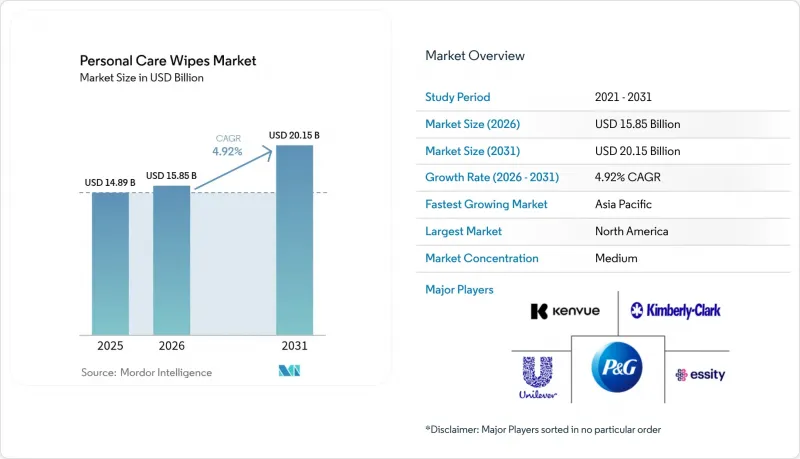
Mordor Intelligence에 의하면, 퍼스널케어 물티슈 시장 규모는 2025년 148억 9,000만 달러로 평가되었습니다. 2026년 158억 5,000만 달러에서 2031년까지 201억 5,000만 달러로 확대되어 2026-2031년에 걸쳐 CAGR 4.92%를 나타낼 것으로 예측됩니다.

본 보고서는 제품 유형(아기 물티슈, 화장품용 물티슈, 화장실용 물티슈, 범용 물티슈, 민감 부위용 물티슈), 성분(기존, 천연·유기농), 유통 채널(슈퍼마켓 및 하이퍼마켓, 편의점·식료품점, 온라인 소매점, 기타),지역별로 분류되어 있습니다. 시장 예측은 금액(달러) 기준으로 제시되어 있습니다.
세계의 퍼스널케어 물티슈 시장 동향 및 인사이트
건강 및 위생 의식의 고조
팬데믹 이후의 위생 대책이 일상생활에 정착하고, 감염에 대한 강한 우려가 누그러진 현재에도 일회용 물티슈에 대한 수요는 지속되고 있습니다. 미국 질병통제예방센터(CDC)는 사람의 왕래가 잦은 환경에서의 표면 소독을 계속해서 권장하고 있으며, 이에 따라 가정 및 상업시설에서의 항균 물티슈 사용이 일상화되고 있습니다. 이러한 행동 패턴의 정착은 특히 어린 자녀를 둔 부모들 사이에서 두드러지며, 아기 물티슈는 기저귀 갈기와 표면 신속 세척이라는 이중 목적을 수행하고 있기 때문에 수요의 가격 탄력성이 낮아지고 있습니다. 일본과 한국의 규제 당국은 유아용 물티슈에 대한 미생물학적 안전 기준을 강화하여, 제조업체에 녹농균(Pseudomonas aeruginosa)과 황색포도상구균(Staphylococcus aureus)에 대한 방부제의 유효성을 검증할 것을 의무화하고 있습니다. 이로 인해 배합의 복잡성이 증가하는 한편, 소규모 브랜드에게는 시장 진입 장벽이 되고 있습니다.
천연·유기농 청정 위생 제품에 대한 수요 증가
소비자들은 과거 식품 라벨에서만 볼 수 있었던 수준의 엄격함으로 성분표를 면밀히 검토하고 있으며, 이에 따라 각 브랜드는 식물 유래 계면활성제를 주성분으로 한 배합을 재검토하고, 파라벤, 프탈레이트, 합성 향료의 배제를 추진하고 있습니다. 2025년 1월 ‘더 오네스트 컴퍼니’가 출시한 ‘퓨어 아쿠아’ 물티슈 시리즈는 99%가 물로 구성되어 있으며, 기질로 유기농 면을 사용하고 있어 이러한 변화를 상징하는 제품입니다. 기존 제품보다 20-30% 높은 가격에도 불구하고, 고급 소매 채널에서 진열 공간을 확보하고 있습니다. 유럽 자연·유기농 화장품 협회(ENOC)가 운영하는 COSMOS 인증은 서유럽에서 밀레니얼 세대와 Z세대 소비자를 대상으로 하는 브랜드에게 사실상 필수 요건이 되었습니다. 이 지역에서는 퍼스널케어 제품 구매자의 42%가 유기농 인증 표시를 적극적으로 요구하고 있는 것으로 보고되고 있습니다. 이러한 추세는 현재 아시아태평양으로도 확산되고 있으며, 한국 식품의약품안전처는 2024년에 ‘그린 코스메’ 표시 제도를 도입하여 천연 성분이 함유된 제품에 대한 규제 측면에서 긍정적인 영향을 미치고 있습니다.
환경 문제 및 폐기물 관리 문제
북미와 유럽의 도시 하수 처리 시스템에 따르면, 분해되지 않는 물티슈가 하수관 막힘의 20-30%를 차지하고 있다고 합니다. 수환경연맹(Water Environment Federation)이 지적한 바와 같이, 이러한 막힘으로 인한 연간 수리 비용은 10억 달러를 초과하며, 상수도 유틸리티자가 이러한 비용을 회수하기 위해 제조업체를 상대로 소송을 제기하는 사태로까지 이어지고 있습니다. 2024년, 국제 수도 서비스 유수성 그룹(International Water Services Flushability Group)은 유수성 검사 프로토콜을 개정하여, 물티슈가 난류 조건에서 30분 이내에 분해되어야 한다고 의무화했습니다. 기존 제품의 대부분은 이 기준을 충족하지 못해 ‘물세척 가능’이라는 표기 사용이 제한되고 있으며, 이로 인해 습식 화장실용 물티슈 시장의 성장이 저해되고 있습니다. 캘리포니아주와 뉴욕주의 매립지 운영자들은 물티슈를 포함한 합성 섬유가 다량 포함된 폐기물 유입에 대해 추가 요금을 부과하고 있으며, 이로 인해 소매업체들은 생분해되지 않는 제품의 진열 공간을 재검토해야 하는 상황에 몰리고 있습니다. 소비자 단체들은 폴리프로필렌을 주성분으로 하는 물티슈에서 방출되는 미세 플라스틱에 대한 우려를 높이고 있습니다. 실험실 연구 결과, 채취한 폐수의 60%에서 섬유 조각이 검출되었습니다. 이 발견은 유럽 의회의 법안 초안에 영향을 미쳐, 물티슈를 ‘문제성 플라스틱’으로 분류하고 단계적 폐지 일정을 마련할 것을 제안하고 있습니다.
부문별 분석
2025년, 아기 물티슈는 퍼스널케어 물티슈 시장 규모의 53.48%를 차지했습니다. 이는 기저귀 교체 시의 확고한 사용 패턴에 더해, 가정 내 간편한 청소 수단으로서의 새로운 역할이 뒷받침된 결과입니다. 한편, 화장품용 물티슈는 한국식 스킨케어의 다단계 과정을 휴대용 소포장에 응축한 미셀 워터 기술을 활용하여 2031년까지 연평균 성장률(CAGR) 6.23%로 확대되고 있습니다. 습식 화장실용 물티슈는 대부분의 제품이 IWSFG의 30분 분해 기준을 충족하지 못해 물로 씻어낼 수 있는 제품으로서의 입지가 제한되고 있어 성장에 제약이 따르고 있습니다.
범용 물티슈는 카테고리를 넘나드는 편의성을 제공하지만, 이익률은 낮은 임베디드니다. 반면, 민감 부위용 물티슈는 시장 규모는 작지만, 약국에서의 추천으로 인해 구매에 대한 거부감이 줄어들면서 성장이 가속화되고 있습니다. 경쟁은 격화되고 있습니다. Harper Hygienics의 ‘Kindii Water Care’ 출시와 Procter & Gamble의 ‘Pampers Pure Aqua’ 라인업 확충은 모두 플라스틱을 사용하지 않은 기재와 99%가 물로 구성된 배합을 채택하여, 성분을 최소화하고자 하는 부모들의 요구에 부응하고 있습니다. 산업 전반에서는 프로바이오틱스, 발효 성분, 유효 성분이 함유된 물티슈가 연구 개발(R&D)을 통해 퍼스널케어 물티슈 시장의 가치 인식이 어떻게 재정의되고 있는지를 보여주고 있습니다. 방부제에 대한 규제 당국의 모니터링은 상황을 더욱 복잡하게 만들고 있습니다. 유럽 SCCS(과학안전위원회)의 포름알데히드 방출제에 대한 견해는 이미 배합 개발자들을 다시 연구실로 돌려보내고 있습니다.
지역별 분석
2025년, 북미는 1인당 사용량이 많고 규제 체계도 견고하여 매출의 40.28%를 차지했습니다. 2024년부터 의무화된 EPA(미국 환경보호청)의 ‘변기에 버리지 마십시오’ 아이콘은 소비자의 혼란을 줄이고 배수관 막힘을 방지함으로써 지자체에 연간 10억 달러의 비용 절감을 가져다주고 있습니다. 캐나다에서는 이민자 가구의 출산율 상승이 아기 물티슈 수요를 뒷받침하고 있습니다. 한편, 멕시코에서는 확대되는 중산층이 물티슈를 가끔 즐기는 사치품이 아닌 일상적인 필수품으로 인식하기 시작했습니다. 각 기업은 제품 포트폴리오 최적화를 추진하고 있으며, 예를 들어 프록터 앤 갬블(Procter & Gamble)은 2024년에 아르헨티나 사업에서 철수하고, 그 자원을 미국과 캐나다 시장에 재분배했습니다. 이러한 시장에서는 프리미엄화 추세가 매출 총이익률 유지에 기여하고 있습니다.
아시아태평양은 가장 두드러진 성장을 보이고 있으며, 2031년까지 연평균 6.88%의 성장이 예상됩니다. 인도와 인도네시아에서는 연간 3% 이상의 도시화율이 편의성이 높은 제품 형태에 대한 수요를 견인하고 있습니다. 유니참은 2025년 2월 아메다바드 공장을 개설하여 국내 생산 능력을 강화했습니다. 동시에, 회사의 ‘Sofy East Africa’ 이니셔티브를 통해 아시아의 노하우를 아프리카 신흥 시장으로 이전하고 있습니다. 중국에서는 소비자들이 천연 제품이나 수입 브랜드로 전환함에 따라 프리미엄 부문이 확대되고 있습니다. 한편, 국내 선도 기업인 헝안(Hengan)은 수직 통합을 활용하여 경쟁력 있는 가격을 유지하고 있습니다. 일본에서는 고령화가 진행됨에 따라 성인용 요실금 물티슈 수요가 증가하고 있으며, 특히 피부에 순한 성분과 탈취 기능이 중요시되고 있습니다.
유럽에서는 퍼스널케어 물티슈 시장에 대한 규제적 영향력이 매우 큽니다. 영국에서 플라스틱이 함유된 물티슈를 금지하는 조치는 퇴비화 가능한 대체품으로의 전환을 촉진하고 있습니다. EU의 ‘확대 생산자 책임(EPR)’ 제도는 생산 비용을 2-4% 상승시키고 있지만, 환경 의식이 높은 소비자층에서 브랜드 평판 향상에도 기여하고 있습니다. 남미에서는 환율 변동이 있음에도 불구하고 성장은 브라질과 아르헨티나에 집중되어 있습니다. 대조적으로, 중동 및 아프리카의 1인당 물티슈 소비량은 여전히 북미 수준의 10% 이하에 머물러 있습니다. 그러나 아랍에미리트(UAE)와 사우디아라비아의 물류 및 소매 인프라에 대한 지속적인 투자 덕분에, 2031년까지 고급 위생 제품의 보급이 점진적으로 확대될 전망입니다.
기타 혜택
- 엑셀 형식 시장 예측(ME) 시트
- 3개월간의 애널리스트 지원
자주 묻는 질문
목차
제1장 서론
제2장 조사 방법
제3장 주요 요약
제4장 시장 구도
제5장 시장 규모 및 성장 예측
제6장 경쟁 구도
제7장 시장 기회 및 향후 전망
KTH 26.09.08According to Mordor Intelligence, the personal care wipes market size is projected to expand from USD 14.89 billion in 2025 and USD 15.85 billion in 2026 to USD 20.15 billion by 2031, registering a CAGR of 4.92% between 2026 and 2031.
This report is Segmented by Product Type (Baby Wipes, Cosmetic Wipes, Moist Toilet Wipes, General Purpose Wipes, and Intimate Wipes), Ingredient (Conventional, and Natural/Organic), Distribution Channel (Supermarkets/Hypermarkets, Convenience/Grocery Stores, Online Retail Stores, and Other Distribution Channels), and Geography. The Market Forecasts are Provided in Terms of Value (USD).
Global Personal Care Wipes Market Trends and Insights
Heightened Health and Hygiene Awareness
Post-pandemic hygiene protocols have become embedded in daily routines, sustaining demand for single-use wipes even as acute infection fears recede. The U.S. Centers for Disease Control and Prevention continues to recommend surface disinfection in high-traffic environments, which has normalized the use of antimicrobial wipes in households and commercial settings. This behavioral stickiness is particularly pronounced among parents of young children, where baby wipes serve dual purposes, diaper changes and rapid surface cleaning, reducing the price elasticity of demand. Regulatory agencies in Japan and South Korea have tightened microbiological safety standards for wipes intended for infant use, requiring manufacturers to validate preservative efficacy against Pseudomonas aeruginosa and Staphylococcus aureus, which raises formulation complexity but also creates barriers to entry for smaller brands
Rising Demand for Natural, Organic, and Clean Hygiene Products
Consumers are scrutinizing ingredient lists with the rigor once reserved for food labels, driving brands to reformulate around plant-derived surfactants and eliminate parabens, phthalates, and synthetic fragrances. The Honest Company's January 2025 launch of its Pure Aqua wipes line, featuring 99% water and organic cotton substrate, exemplifies this shift and has captured shelf space in premium retail channels despite a 20-30% price premium over conventional alternatives. COSMOS certification, administered by the European Natural and Organic Cosmetics Association, has become a de facto requirement for brands targeting millennial and Gen Z consumers in Western Europe, where 42% of personal-care purchasers report actively seeking certified-organic claims. This trend is now diffusing into Asia-Pacific, where South Korea's Ministry of Food and Drug Safety introduced a "green cosmetics" labeling framework in 2024, creating regulatory tailwinds for natural formulations.
Environmental Concerns and Waste Management Issues
Municipal wastewater systems in North America and Europe report that non-dispersible wipes are responsible for 20-30% of sewer blockages. These blockages result in annual remediation costs exceeding USD 1 billion and have prompted utilities to file lawsuits against manufacturers to recover these expenses, as noted by the Water Environment Federation. In 2024, the International Water Services Flushability Group revised its flushability test protocols, requiring wipes to disintegrate within 30 minutes under turbulent flow conditions. Most existing products fail to meet this standard, restricting the use of the "flushable" label and hindering growth in the moist toilet wipes segment. Landfill operators in California and New York have introduced surcharges on waste streams with high levels of synthetic textiles, including wipes, leading retailers to reconsider shelf space for non-biodegradable options. Consumer advocacy groups have intensified concerns about microplastic shedding from polypropylene-based wipes. Laboratory studies have identified fiber fragments in 60% of sampled wastewater effluent. This finding has influenced draft legislation in the European Parliament, proposing that wipes be classified as "problematic plastics" subject to phase-out timelines.
Other drivers and restraints analyzed in the detailed report include:
- Growing Popularity of Sustainable and Biodegradable Wipes
- Product Innovation in Functionality and Fragrance
- Fluctuating Prices of Non-Woven Fabrics and Chemicals Impacting Margins
For complete list of drivers and restraints, kindly check the Table Of Contents.
Segment Analysis
Baby wipes captured 53.48% of the personal care wipes market size in 2025, supported by established usage for diaper changes and emergent roles in quick household cleaning. Cosmetic wipes, however, are expanding at a 6.23% CAGR through 2031, leveraging micellar-water technologies that compress multi-step Korean-inspired routines into portable sachets. Moist toilet wipes face growth constraints because most products cannot meet the IWSFG 30-minute disintegration standard, limiting their flushable positioning.
General-purpose wipes deliver cross-category utility yet suffer thinner margins, while intimate wipes remain small but are accelerating where pharmacy endorsement destigmatizes purchase. Competitive intensity is rising: Harper Hygienics' Kindii Water Care launch and Procter & Gamble's Pampers Pure Aqua extension both rely on plastic-free substrates and 99%-water formulas to resonate with ingredient-minimalist parents. Industry-wide, probiotic, fermented, and active-ingredient wipes illustrate how R&D is redefining value perception in the personal care wipes market. Regulatory scrutiny over preservatives injects further complexity; Europe's SCCS opinions on formaldehyde-releasing agents are already sending formulators back to the lab.
Complete Report Scope:
- By Product Type
- Baby Wipes
- Cosmetic Wipes
- Moist Toilet Wipes
- General Purpose Wipes
- Intimate Wipes
- By Ingredient
- Conventional
- Natural/Organic
- By Distribution Channel
- Supermarkets/Hypermarkets
- Convenience/Grocery Stores
- Online Retail Stores
- Other Distribution Channels
- By Geography
- North America
- United States
- Canada
- Mexico
- Rest of North America
- Europe
- Germany
- France
- United Kingdom
- Spain
- Netherlands
- Italy
- Sweden
- Norway
- Rest of Europe
- Asia-Pacific
- China
- India
- Japan
- Australia
- South Korea
- Vietnam
- Indonesia
- Rest of Asia-Pacific
- South America
- Brazil
- Argentina
- Chile
- Peru
- Colombia
- Rest of South America
- Middle East and Africa
- United Arab Emirates
- Saudi Arabia
- South Africa
- Nigeria
- Rest of Middle East and Africa
- North America
Geography Analysis
In 2025, North America contributed 40.28% of the revenue, driven by high per-capita usage and robust regulatory frameworks. The EPA's "Do Not Flush" icon, mandated since 2024, has reduced consumer confusion and saved municipalities USD 1 billion annually by preventing blockages. In Canada, the increasing birth rate among immigrant families supports the demand for baby wipes. Meanwhile, in Mexico, the expanding middle class now views wipes as everyday essentials rather than occasional luxuries. Companies are optimizing their portfolios; for example, Procter & Gamble divested in Argentina in 2024, reallocating resources to U.S. and Canadian markets, where premiumization trends help sustain gross margins.
Asia-Pacific is the fastest-growing region, with an annual growth rate of 6.88% projected through 2031. Urbanization rates exceeding 3% annually in India and Indonesia are driving demand for convenient product formats. Unicharm opened its Ahmedabad plant in February 2025, enhancing domestic production capacity. Concurrently, its Sofy East Africa initiative is transferring expertise from Asia to emerging African markets. In China, the premium segment is expanding as consumers shift to natural or imported brands, while domestic leader Hengan leverages vertical integration to maintain competitive pricing. In Japan, the aging population is fueling demand for adult-incontinence wipes, where gentle formulations and odour-control features are particularly valued.
Europe exerts significant regulatory influence on the personal care wipes market. The U.K.'s ban on plastic-containing wet wipes is driving a shift toward compostable alternatives. The EU's Extended Producer Responsibility increases production costs by 2-4%, but it also enhances brand reputation among environmentally-conscious consumers. In South America, growth is concentrated in Brazil and Argentina despite currency fluctuations. In contrast, per-capita wipes consumption in the Middle East and Africa remains below 10% of North American levels. However, ongoing investments in logistics and retail infrastructure in the United Arab Emirates and Saudi Arabia are paving the way for a gradual increase in the adoption of premium hygiene products by 2031.
- The Procter & Gamble Company
- Kimberly-Clark Corporation
- Kenvue Inc.
- Essity Hygiene and Health AB
- Unilever PLC
- Ecolab Inc.
- Edgewell Personal Care Company
- Unicharm Corporation
- Hengan International Group Company Limited
- Robanda International Inc.
- Albaad Massuot Yitzhak Ltd.
- WaterWipes Unlimited Company
- The Honest Company, Inc.
- 3M Company
- GAMA Healthcare Ltd
- Ontex Group NV
- Pigeon Corporation
- Reckitt Benckiser Group plc
- Bodyography Inc.
- A. M. HYGIENE
Additional Benefits:
- The market estimate (ME) sheet in Excel format
- 3 months of analyst support
TABLE OF CONTENTS
1 INTRODUCTION
- 1.1 Study Assumptions and Market Definition
- 1.2 Scope of the Study
2 RESEARCH METHODOLOGY
3 EXECUTIVE SUMMARY
4 MARKET LANDSCAPE
- 4.1 Market Overview
- 4.2 Market Drivers
- 4.2.1 Heightened Health And Hygiene Awareness
- 4.2.2 Rising Demand For Natural, Organic, And Clean Hygiene Products
- 4.2.3 Growing Popularity Of Sustainable And Biodegradable Wipes
- 4.2.4 Product Innovation In Functionality And Fragrance
- 4.2.5 Urbanization Driving Demand For Quick Solutions
- 4.2.6 Growth In E-Commerce Accessibility
- 4.3 Market Restraints
- 4.3.1 Environmental Concerns And Waste Management Issues
- 4.3.2 Regulatory And Safety Compliance Challenges
- 4.3.3 Stricter Regulations On Ingredients And Disposal Hindering Market Growth
- 4.3.4 Fluctuating Prices Of Non-Woven Fabrics And Chemicals Impacting Margins
- 4.4 Consumer Behaviour Analysis
- 4.5 Regulatory Landscape
- 4.6 Porter's Five Forces
- 4.6.1 Bargaining Power of Suppliers
- 4.6.2 Bargaining Power of Buyers
- 4.6.3 Threat of New Entrants
- 4.6.4 Threat of Substitutes
- 4.6.5 Competitive Rivalry
5 MARKET SIZE AND GROWTH FORECASTS (VALUE)
- 5.1 By Product Type
- 5.1.1 Baby Wipes
- 5.1.2 Cosmetic Wipes
- 5.1.3 Moist Toilet Wipes
- 5.1.4 General Purpose Wipes
- 5.1.5 Intimate Wipes
- 5.2 By Ingredient
- 5.2.1 Conventional
- 5.2.2 Natural/Organic
- 5.3 By Distribution Channel
- 5.3.1 Supermarkets/Hypermarkets
- 5.3.2 Convenience/Grocery Stores
- 5.3.3 Online Retail Stores
- 5.3.4 Other Distribution Channels
- 5.4 By Geography
- 5.4.1 North America
- 5.4.1.1 United States
- 5.4.1.2 Canada
- 5.4.1.3 Mexico
- 5.4.1.4 Rest of North America
- 5.4.2 Europe
- 5.4.2.1 Germany
- 5.4.2.2 France
- 5.4.2.3 United Kingdom
- 5.4.2.4 Spain
- 5.4.2.5 Netherlands
- 5.4.2.6 Italy
- 5.4.2.7 Sweden
- 5.4.2.8 Norway
- 5.4.2.9 Rest of Europe
- 5.4.3 Asia-Pacific
- 5.4.3.1 China
- 5.4.3.2 India
- 5.4.3.3 Japan
- 5.4.3.4 Australia
- 5.4.3.5 South Korea
- 5.4.3.6 Vietnam
- 5.4.3.7 Indonesia
- 5.4.3.8 Rest of Asia-Pacific
- 5.4.4 South America
- 5.4.4.1 Brazil
- 5.4.4.2 Argentina
- 5.4.4.3 Chile
- 5.4.4.4 Peru
- 5.4.4.5 Colombia
- 5.4.4.6 Rest of South America
- 5.4.5 Middle East and Africa
- 5.4.5.1 United Arab Emirates
- 5.4.5.2 Saudi Arabia
- 5.4.5.3 South Africa
- 5.4.5.4 Nigeria
- 5.4.5.5 Rest of Middle East and Africa
- 5.4.1 North America
6 COMPETITIVE LANDSCAPE
- 6.1 Market Concentration
- 6.2 Strategic Moves
- 6.3 Market Share Analysis
- 6.4 Company Profiles (Includes Global-level Overview, Market-level Overview, Core Segments, Financials, Strategic Info, Market Rank/Share, Products & Services, Recent Developments)
- 6.4.1 The Procter & Gamble Company
- 6.4.2 Kimberly-Clark Corporation
- 6.4.3 Kenvue Inc.
- 6.4.4 Essity Hygiene and Health AB
- 6.4.5 Unilever PLC
- 6.4.6 Ecolab Inc.
- 6.4.7 Edgewell Personal Care Company
- 6.4.8 Unicharm Corporation
- 6.4.9 Hengan International Group Company Limited
- 6.4.10 Robanda International Inc.
- 6.4.11 Albaad Massuot Yitzhak Ltd.
- 6.4.12 WaterWipes Unlimited Company
- 6.4.13 The Honest Company, Inc.
- 6.4.14 3M Company
- 6.4.15 GAMA Healthcare Ltd
- 6.4.16 Ontex Group NV
- 6.4.17 Pigeon Corporation
- 6.4.18 Reckitt Benckiser Group plc
- 6.4.19 Bodyography Inc.
- 6.4.20 A. M. HYGIENE


