
|
시장보고서
상품코드
2122696
비오피오이드 진통 패치 : 시장 점유율 분석, 업계 동향 및 통계, 성장 예측(2026-2031년)Non-opioid Pain Patch - Market Share Analysis, Industry Trends & Statistics, Growth Forecasts (2026 - 2031) |
||||||
 Mordor Intelligence
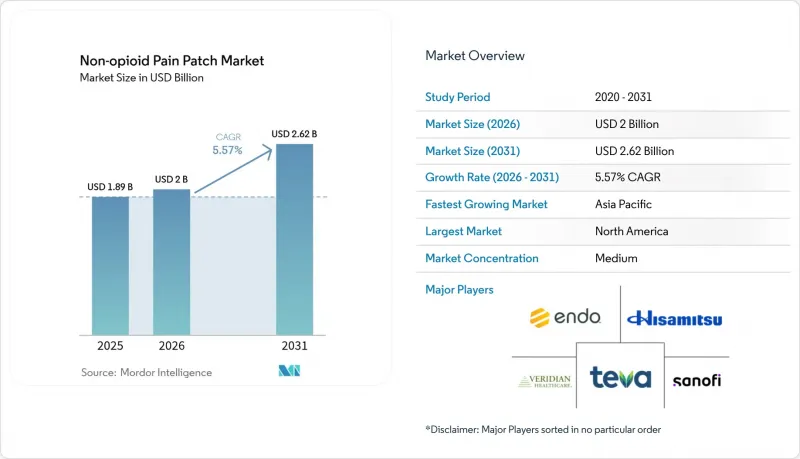
Mordor Intelligence에 의하면, 비오피오이드 진통 패치 시장 규모는 2025년 18억 9,000만 달러로 평가되었습니다. 2026년에는 20억 달러로 확대되어 2026-2031년에 걸쳐 CAGR 5.57%로 성장을 지속하여, 2031년에는 26억 2,000만 달러에 이를 것으로 예측됩니다.

본 보고서는 패치 유형(리도카인 패치, 디클로페낙 패치, 캡사이신 패치, 기타), 기술(매트릭스형 패치, 리저버형 패치, 기타), 적응증(통증 유형)(신경병성 통증, 기타), 유통 채널(병원 약국, 소매 약국, 기타),지역(북미, 기타)별로 분류되어 있습니다. 시장 예측은 금액(달러) 기준으로 제시되어 있습니다.
세계의 비오피오이드 진통 패치 시장 동향 및 분석
통증 관련 질환의 부담 증가
15억 명 이상이 만성 통증으로 고통받고 있으며, 고령화 사회가 진행됨에 따라 신경병증성 질환이 주목받고 있습니다. 2045년까지 당뇨병만으로도 7억 8,300만 명의 성인이 영향을 받을 것으로 예측되며, 당뇨병성 말초신경병증 환자 수는 더욱 증가할 전망입니다. 미국에서는 적절히 관리되지 않은 통증으로 인한 생산성 손실이 매년 3,000억 달러 이상에 달하고 있습니다. 이에 따라 보험사 및 임상의들은 환자의 활동성을 유지하고 전신 약물에 대한 의존도를 줄일 수 있는 국소적이고 위험이 낮은 치료법을 선호하고 있습니다.
경피 투여 기술의 발전
4세대 패치에는 단단한 표피층을 우회하여 진통제를 제어된 방식으로 방출하는 마이크로니들이 내장되어 있습니다. 다공성 코팅이 적용된 폴리머 기반 마이크로니들 어레이는 금속 재질에 비해 3배의 약물을 방출할 수 있으며, 진통 효과의 지속 시간도 연장합니다. 이러한 발전으로 인해 친수성 약물에 대한 기존의 한계가 해소되고, 부착 빈도가 감소함으로써 환자의 복약 순응도가 향상됩니다.
가격 민감도와 저비용 경구용 진통제
많은 신흥국에서 브랜드 패치는 제네릭 이부프로펜 정제에 비해 5배에서 10배나 비쌉니다. 보험 적용 범위가 제한적이기 때문에 환자들은 가장 저렴하고 즉효성이 있는 진통제를 선택하는 경향이 있습니다. 인도의 제약사들은 2030년까지 300개 이상의 제품 특허가 만료됨에 따라, 제네릭 패치를 출시하여 이러한 격차를 해소하고자 하고 있지만, 단기적으로는 여전히 합리적인 가격에 제품을 구할 수 있도록 하는 과제가 남아 있습니다.
부문별 분석
리도카인 제제는 수십 년에 걸친 임상 사용 실적과 폭넓은 제3자 결제 지원을 바탕으로, 2025년에는 비오피오이드 진통 패치 시장 규모의 34.78%라는 최대 점유율을 차지했습니다. 높은 안전성과 전신 흡수량이 최소한이라는 점 때문에 리도카인은 대상포진 후 신경통의 영향을 가장 많이 받는 고령층에게 인기가 있습니다. 그루넨탈(Gluenental)과 사이렉스(Silex)는 운동이나 샤워를 해도 잘 떨어지지 않는 더 얇고 점착력이 높은 제품을 제공함으로써 그 보급을 확대했습니다.
캡사이신 패치는 고농도 제제가 당뇨병성 신경병증이나 화학요법으로 인한 통증에 대해 수개월에 걸쳐 완화 효과를 가져다주기 때문에 패치 유형 중 가장 빠른 연평균 성장률(CAGR) 6.74%로 성장하고 있습니다. 2025년 연구에서 캡사이신과 표준 치료를 비교한 결과, 고령 환자에서 통계적으로 유의미한 통증 점수 감소가 확인되었습니다. 디클로페낙과 케토프로펜은 근골격계 손상 치료에서 틈새 시장 역할을 담당하고 있는 반면, 에노콘(Enocon)사의 천연 성분 패치는 화학 물질이 포함되지 않은 치료를 원하는 사람들에게 소규모이긴 하지만 주목할 만한 새로운 선택지가 되고 있습니다.
2025년, 매트릭스 구조는 비오피오이드 진통 패치 시장 점유율의 47.92%를 차지했습니다. 제조업체들이 이 형태를 선호하는 이유는 합리적인 제조 비용으로 광범위한 유효 성분(API)을 지원할 수 있기 때문입니다. 병원 측에서는 12-24시간에 걸쳐 안정적인 혈장 농도가 유지된다는 점을 높이 평가했습니다.
마이크로니들 강화형 패치는 6.88%의 연평균 성장률(CAGR)로 가장 높은 성장률을 보이고 있으며, 가바펜틴과 같은 친수성 분자의 침투성을 높이는 미세 채널을 형성하는 능력을 활용하고 있습니다. 2024년에 개발된 카본마스터사의 마이크로니들 프로토타입은 기존 금속 유닛에 비해 약물 전달 효율을 3배 높였습니다. 저장소 시스템은 장기간 착용이 필요한 만성 질환 치료에서 여전히 중요한 역할을 하고 있으며, 약물이 함유된 접착 시트는 초박형 설계로 미적 완성도를 확보하고 있습니다. pH에 반응하는 스마트 마이크로니들 어레이는 국소 염증 수준에 따라 투여량을 조절하는 차세대 기술로 주목받고 있습니다.
지역별 분석
북미는 2025년 매출의 39.02%를 차지했으며, 이는 오피오이드 의존증 위험에 대한 광범위한 인식과 외용 진통제에 대한 보험사의 관대한 급여를 반영한 것입니다. 2025년 ‘NOPAIN 법’은 오피오이드가 포함되지 않은 수술 후 치료 옵션에 자금을 지원하고 있으며, 이를 통해 병원에서 캡사이신 및 리도카인 제제의 채택이 촉진되고 있습니다. 또한, 미국 FDA의 새로운 비오피오이드 치료법 승인도 임상의들의 신뢰를 높이고 있습니다.
아시아태평양은 2031년까지 연평균 성장률(CAGR)이 7.55%로, 지역별로는 가장 높은 성장세를 보이고 있습니다. 초고령 사회인 일본에서는 대상포진 후 신경통의 유병률이 높으며, 보험급여위원회는 장기적인 통증 완화를 목적으로 한 8% 캡사이신 패치의 보험급여를 점점 더 많이 인정하고 있습니다. 중국과 인도에서는 성장이 가격 협상에 달려 있습니다. 국내 수탁 제조업체들은 전 세계 특허가 만료될 경우 시장 접근성을 확대할 가능성이 있는 저가 제네릭 의약품을 준비하고 있습니다.
유럽은 만성 통증 관리 체계가 잘 갖춰져 있어 견고한 시장 점유율을 유지하고 있으나, 유럽의약품청(EMA)이 추가적인 피부 감작성 검사를 요구함에 따라 성장 속도는 둔화되고 있습니다. 독일, 영국, 프랑스에서는 전자 처방이 장려되고 있어 디지털 약국 도입이 촉진되고 있습니다. 라틴아메리카와 중동에서는 주요 도시에서 민간 보험사가 브랜드 패치의 비용을 보상함에 따라 완만한 성장이 나타나고 있습니다. 아세안의 습도가 높은 기후는 높은 습도로 인해 보존 기간이 단축되기 때문에 공급망에 과제가 되고 있으며, 그 결과 알루미늄 포일 라미네이트 처리된 소포장이나 건조제가 포함된 라이너의 사용이 촉진되고 있습니다.
기타 혜택
- 엑셀 형식 시장 예측(ME) 시트
- 3개월간의 애널리스트 지원
자주 묻는 질문
목차
제1장 서론
제2장 조사 방법
제3장 주요 요약
제4장 시장 구도
제5장 시장 규모 및 성장 예측
제6장 경쟁 구도
제7장 시장 기회 및 향후 전망
KTH 26.09.08According to Mordor Intelligence, the non-opioid pain patch market size is expected to grow from USD 1.89 billion in 2025 to USD 2 billion in 2026 and is forecast to reach USD 2.62 billion by 2031 at 5.57% CAGR over 2026-2031.
This report is Segmented by Patch Type (Lidocaine Patches, Diclofenac Patches, Capsaicin Patches, and More), Technology (Matrix Patches, Reservoir Patches and More), Indication (Pain Type) (Neuropathic Pain, and More), Distribution Channel (Hospital Pharmacies, Retail Pharmacies, and More), and Geography (North America, and More). The Market Forecasts are Provided in Terms of Value (USD).
Global Non-opioid Pain Patch Market Trends and Insights
Rising burden of pain-related disorders
More than 1.5 billion people live with chronic pain, and aging societies push neuropathic conditions to the forefront. Diabetes alone is set to affect 783 million adults by 2045, swelling the pool of patients with diabetic peripheral neuropathy. Productivity losses tied to unmanaged pain top USD 300 billion each year in the United States. Payers and clinicians therefore favor localized, low-risk treatments that keep patients active and reduce reliance on systemic drugs.
Technological advances in transdermal delivery
Fourth-generation patches now integrate microneedles that bypass the tough outer skin layer and release analgesics in a controlled manner. Polymer-based microneedle arrays with porous coatings deliver three-times higher loads than metal designs and extend pain-relief duration. Such gains address prior limits for hydrophilic drugs and cut application frequency, raising patient adherence.
Price sensitivity versus low-cost oral analgesics
In many emerging countries a branded patch costs five-to-ten times more than generic ibuprofen tablets. Limited insurance coverage prompts patients to opt for the cheapest immediate relief. India's drug-makers hope to bridge this gap by launching generic patches as patents expire on over 300 products by 2030, yet near-term affordability hurdles stay in place.
Other drivers and restraints analyzed in the detailed report include:
- Growing consumer preference for OTC analgesics
- E-commerce and direct-to-consumer expansion
- Complex regional regulatory hurdles
For complete list of drivers and restraints, kindly check the Table Of Contents.
Segment Analysis
Lidocaine products held the largest slice of the non-opioid pain patch market size at 34.78% in 2025, supported by decades of clinical use and broad third-party payment. Strong safety and minimal systemic absorption make lidocaine popular in elderly populations, which are most affected by post-herpetic neuralgia. Grunenthal and Scilex broadened acceptance by delivering thinner, high-adhesion systems that permit exercise and showering without detachment.
Capsaicin patches expand at a 6.74% CAGR, the fastest among patch types, because high-concentration formulations produce multi-month relief from diabetic neuropathy and chemotherapy-induced pain. Older patients achieved statistically significant pain score reductions in a 2025 study that compared capsaicin to standard care. Diclofenac and ketoprofen hold niche roles in musculoskeletal injury management, while natural-ingredient patches from Enokon create a small but visible frontier for chemical-free therapy seekers.
Matrix construction accounted for 47.92% of the non-opioid pain patch market share in 2025. Manufacturers prefer the format because it supports a wide range of APIs at reasonable production cost. Hospitals value the steady plasma levels delivered over 12-24 hours.
Microneedle-enhanced patches post the highest growth at 6.88% CAGR, capitalizing on their ability to open microchannels that improve permeation of hydrophilic molecules like gabapentin. A 2024 carbon-master microneedle prototype raised delivery efficiency threefold compared with earlier metal units. Reservoir systems stay relevant in long-wear chronic treatment, and drug-in-adhesive sheets secure cosmetic appeal with ultra-thin designs. Smart pH-responsive microneedle arrays represent the next wave, adjusting dose to local inflammation levels.
Complete Report Scope:
- By Patch Type
- Lidocaine Patches
- Diclofenac Patches
- Capsaicin Patches
- Ketoprofen Patches
- Other Patch Types
- By Technology
- Matrix Patches
- Reservoir Patches
- Drug-in-Adhesive Patches
- Microneedle-Enhanced Patches
- By Indication (Pain Type)
- Neuropathic Pain
- Musculoskeletal Pain
- Cancer-Associated Pain
- Others (Headache, Dental, Post-op)
- By Distribution Channel
- Hospital Pharmacies
- Retail Pharmacies
- Online Pharmacies
- By Geography
- North America
- United States
- Canada
- Mexico
- Europe
- Germany
- United Kingdom
- France
- Italy
- Spain
- Rest of Europe
- Asia-Pacific
- China
- Japan
- India
- Australia
- South Korea
- Rest of Asia-Pacific
- Middle East and Africa
- GCC
- South Africa
- Rest of Middle East and Africa
- South America
- Brazil
- Argentina
- Rest of South America
- North America
Geography Analysis
North America contributed 39.02% of 2025 revenue, reflecting widespread awareness of opioid addiction risks and generous payer coverage for topical analgesics. The 2025 NOPAIN Act funds non-opioid postoperative options, driving hospital uptake of capsaicin and lidocaine systems. U.S. FDA approvals of novel non-opioid treatments also boost clinician confidence FDA.
Asia Pacific posts the fastest regional CAGR at 7.55% through 2031. Japan's super-aged society faces high rates of post-herpetic neuralgia, and reimbursement committees increasingly reimburse capsaicin 8% patches for long-term relief. In China and India growth hinges on price negotiation; domestic contract manufacturers prepare low-price generics that could widen access once global patents expire.
Europe holds a solid share with strong chronic-pain management frameworks but slower growth because the EMA demands extra skin-sensitization tests. Germany, the United Kingdom, and France incentivize e-prescriptions, easing digital pharmacy adoption. Latin America and the Middle East show moderate growth when private insurers reimburse branded patches in tier-one cities. Humid ASEAN climates challenge supply chains because high moisture shortens shelf life, prompting foil-laminated sachets and desiccant liners.
- Hisamitsu Pharmaceutical
- Endo International
- Scilex Pharmaceuticals (Sorrento Therapeutics)
- Teikoku Pharma USA / Teikoku Seiyaku Co.
- Teva Pharmaceutical Industries
- Averitas Pharma (Grunenthal)
- GlaxoSmithKline
- Sanofi
- Mylan (Viatris)
- IBSA Institut Biochimique
- Sparsha Pharma International Pvt. Ltd.
- Veridian Healthcare
- Amneal Pharmaceuticals
Additional Benefits:
- The market estimate (ME) sheet in Excel format
- 3 months of analyst support
TABLE OF CONTENTS
1 Introduction
- 1.1 Study Assumptions & Market Definition
- 1.2 Scope of the Study
2 Research Methodology
3 Executive Summary
4 Market Landscape
- 4.1 Market Overview
- 4.2 Market Drivers
- 4.2.1 Rising Burden of Pain-Related Disorders Worldwide
- 4.2.2 Technological Advancements in Transdermal Drug-Delivery Platforms
- 4.2.3 Growing Consumer Preference for OTC Topical Analgesics
- 4.2.4 Expansion of E-commerce & Direct-to-Consumer Channels Enhancing Accessibility
- 4.2.5 Regulatory & Payer Shift Toward Non-Opioid Analgesics Post-Opioid Crisis
- 4.2.6 Surge in the Volume of Sports Injuries
- 4.3 Market Restraints
- 4.3.1 Price Sensitivity Versus Low-Cost Oral Analgesics in Emerging Economies
- 4.3.2 Complex Regional Regulatory Hurdles for Transdermal Patch Safety & Skin Irritation
- 4.3.3 Competitive Threat from Alternative Topical & Device-Based Non-Opioid Pain Therapies
- 4.3.4 Humidity-Linked Shelf-life Issues Limiting ASEAN Distribution
- 4.4 Supply-Chain Analysis
- 4.5 Regulatory Outlook
- 4.6 Porter's Five Forces Analysis
- 4.6.1 Bargaining Power of Suppliers
- 4.6.2 Bargaining Power of Buyers
- 4.6.3 Threat of New Entrants
- 4.6.4 Threat of Substitute Products
- 4.6.5 Intensity of Competitive Rivalry
5 Market Size & Growth Forecasts (Value)
- 5.1 By Patch Type
- 5.1.1 Lidocaine Patches
- 5.1.2 Diclofenac Patches
- 5.1.3 Capsaicin Patches
- 5.1.4 Ketoprofen Patches
- 5.1.5 Other Patch Types
- 5.2 By Technology
- 5.2.1 Matrix Patches
- 5.2.2 Reservoir Patches
- 5.2.3 Drug-in-Adhesive Patches
- 5.2.4 Microneedle-Enhanced Patches
- 5.3 By Indication (Pain Type)
- 5.3.1 Neuropathic Pain
- 5.3.2 Musculoskeletal Pain
- 5.3.3 Cancer-Associated Pain
- 5.3.4 Others (Headache, Dental, Post-op)
- 5.4 By Distribution Channel
- 5.4.1 Hospital Pharmacies
- 5.4.2 Retail Pharmacies
- 5.4.3 Online Pharmacies
- 5.5 By Geography
- 5.5.1 North America
- 5.5.1.1 United States
- 5.5.1.2 Canada
- 5.5.1.3 Mexico
- 5.5.2 Europe
- 5.5.2.1 Germany
- 5.5.2.2 United Kingdom
- 5.5.2.3 France
- 5.5.2.4 Italy
- 5.5.2.5 Spain
- 5.5.2.6 Rest of Europe
- 5.5.3 Asia-Pacific
- 5.5.3.1 China
- 5.5.3.2 Japan
- 5.5.3.3 India
- 5.5.3.4 Australia
- 5.5.3.5 South Korea
- 5.5.3.6 Rest of Asia-Pacific
- 5.5.4 Middle East and Africa
- 5.5.4.1 GCC
- 5.5.4.2 South Africa
- 5.5.4.3 Rest of Middle East and Africa
- 5.5.5 South America
- 5.5.5.1 Brazil
- 5.5.5.2 Argentina
- 5.5.5.3 Rest of South America
- 5.5.1 North America
6 Competitive Landscape
- 6.1 Market Concentration
- 6.2 Market Share Analysis
- 6.3 Company Profiles (includes Global level Overview, Market level overview, Core Segments, Financials as available, Strategic Information, Market Rank/Share for key companies, Products & Services, and Recent Developments)
- 6.3.1 Hisamitsu Pharmaceutical Co. Inc.
- 6.3.2 Endo International plc
- 6.3.3 Scilex Pharmaceuticals (Sorrento Therapeutics)
- 6.3.4 Teikoku Pharma USA / Teikoku Seiyaku Co.
- 6.3.5 Teva Pharmaceutical Industries Ltd.
- 6.3.6 Averitas Pharma (Grunenthal)
- 6.3.7 GlaxoSmithKline plc
- 6.3.8 Sanofi
- 6.3.9 Mylan (Viatris)
- 6.3.10 IBSA Institut Biochimique
- 6.3.11 Sparsha Pharma International Pvt. Ltd.
- 6.3.12 Veridian Healthcare
- 6.3.13 Amneal Pharmaceuticals
7 Market Opportunities & Future Outlook
- 7.1 White-space & Unmet-need Assessment