

|
시장보고서
상품코드
2122697
혈전증 치료제 시장 : 시장 점유율 분석, 업계 동향 및 통계, 성장 예측(2026-2031년)Thrombosis Drugs - Market Share Analysis, Industry Trends & Statistics, Growth Forecasts (2026 - 2031) |
||||||
 Mordor Intelligence
Mordor Intelligence에 의하면, 혈전증 치료제 시장 규모는 2025년에 261억 4,000만 달러로 평가되었고, 2026년 282억 달러에서 2031년까지 412억 3,000만 달러에 이를 것으로 예측되며, 예측 기간(2026-2031년) CAGR은 7.89%를 나타낼 전망입니다.
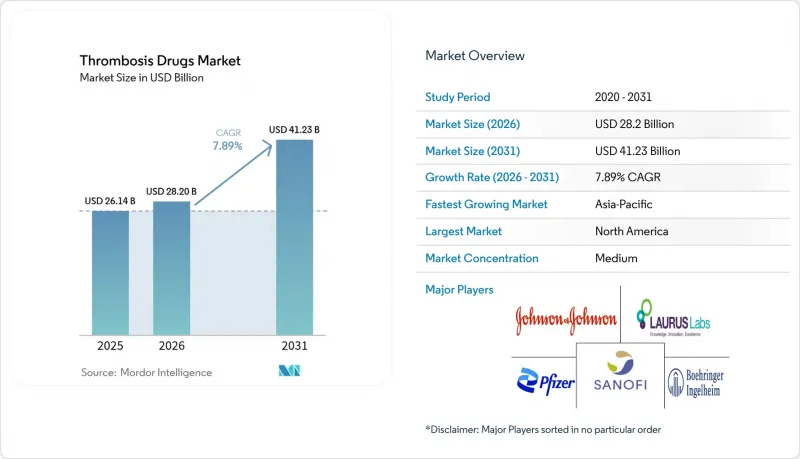
본 보고서는 약물 분류별(직접 경구용 항응고제, 헤파린 및 저분자량 헤파린 등), 질환별(심부정맥혈전증, 폐색전증 등), 투여 경로별(경구, 주사 등), 유통 채널별(병원 약국, 소매 약국 등), 지역별(북미 등)로 분류되어 있습니다. 시장 예측은 금액(달러)으로 제시되어 있습니다.
세계의 혈전증 치료제 시장 동향 및 인사이트
VTE(정맥혈전색전증) 유병률 증가
평균 수명의 연장 및 암 생존율의 급격한 상승으로 인해 VTE 발생률이 증가하고 있으며, 장기적인 항응고 요법은 만성 질환 관리에 있어 필수적인 요소가 되고 있습니다. 폐암 환자의 폐색전증 발병률은 일반 인구의 기준치보다 약 6배에 달하여, 보다 안전한 경구용 약물에 대한 지속적인 수요를 창출하고 있습니다. 이에 대응하여 병원 측은 종양학 치료 프로토콜에 혈전증 관리 프로토콜을 통합하여, 항응고 요법을 간헐적인 관리에서 지속적인 관리로 전환하고 있습니다.
DOAC의 급속한 보급
ROCKET-AF 및 ARISTOTLE 임상시험의 증거에 힘입어, 리바록사반 및 아피사반에 대한 처방 의사의 신뢰는 계속해서 높아지고 있습니다. 브리스톨-마이어스 스퀴브와 화이자는 2024년 4분기에 ‘엘리큐스’ 매출로 32억 달러를 기록했습니다. 2026년 1월부터 적용되는 메디케어의 가격 협상 결과, 환자의 본인 부담금이 경감되어 이익률을 훼손하지 않으면서도 적용 대상이 확대될 것입니다.
신규 항응고제의 높은 비용
정가는 와파린의 정가를 훨씬 상회하는 경우가 많아, 가격에 민감한 지역에서는 보급을 저해하고 있습니다. 브리스톨-마이어스 스퀴브사와 화이자는 현재 엘리큐스를 환자에게 직접 40% 할인된 가격으로 판매하여 월 비용을 346달러로 낮추고 있습니다. 메디케어의 가격 협상 등 정책 전환은 더 광범위한 가격 압박이 곧 닥칠 것임을 시사하고 있습니다.
부문 분석
2025년, DOAC(직접 작용형 항응고제)는 혈전증 치료제 시장에서 54.62%의 점유율을 차지했으며, 시장 규모 142억 8,000만 달러를 기록했습니다. 이는 투여 방법의 간소화와 모니터링 요건의 완화를 배경으로 확대되고 있습니다. 제11인자 억제제는 출혈 위험을 우려하는 임상의와 환자의 지지를 얻어 연평균 성장률(CAGR) 8.24%를 나타낼 것으로 예측됩니다.
헤파린 및 저분자량 헤파린(LMWH)은 입원 환자의 가교 요법 및 종양학 프로토콜에서 여전히 중요한 역할을 하고 있습니다. 비타민 K 길항제는 의료 자원이 제한된 환경으로 점차 국한되고 있는 반면, 혈전 용해제는 뇌졸중이나 중증 폐색전증의 응급 치료에서 틈새 시장을 유지하고 있습니다.월1회 투여하는 피하 투여형 제11인자 제제의 등장으로 기존 경구용 약물과 주사제의 경계가 모호해지면서, 혈전증 치료제 시장의 경쟁 구도가 재편될 가능성이 있습니다.
2025년에는 정형외과 수술 후 지침에 따른 항응고 요법의 확산에 힘입어, 심부정맥 혈전증이 혈전증 치료제 시장 규모의 31.22%를 차지했습니다. 폐색전증은 CT 혈관조영술을 통한 진단 기술의 발전에 힘입어 연평균 성장률(CAGR) 8.12%로 가장 빠르게 확대될 전망입니다.
폐색전증 대응팀(PERT)의 도입으로 신속한 치료가 표준화되는 한편, 생존율의 향상에 따라 암 관련 혈전증에 대한 관심이 높아지고 있습니다. 심방세동 환자의 뇌졸중 예방은 특히 제11인자에 대한 안전성 데이터에 힘입어 적응증 범위가 확대될 것으로 기대되므로, 계속해서 가치가 높은 적응증 영역으로 남아 있습니다.
지역별 분석
북미에서는 보험 환급 제도와 DOAC(직접 작용형 항응고제)의 조기 도입으로 인해, 2025년에는 혈전증 치료제 시장 점유율의 37.86%를 차지할 전망입니다. 연방 정부의 가격 협상은 합리적인 가격과 혁신의 균형을 도모하는 것을 목적으로 하고 있으며, 연구 개발(R&D) 투자를 저해하지 않으면서 의약품 접근성을 확대할 가능성이 있습니다.
유럽에서는 획기적인 약물의 도입을 가속화하는 통일된 임상 지침이 유지되고 있으며, 고령화를 배경으로 일관되게 한 자릿수 중반대의 성장률을 보이고 있습니다.
아시아태평양은 연평균 성장률(CAGR) 7.97%가 예상되며, 인프라 정비와 선택적 수술 건수 증가의 혜택을 받고 있습니다. 중국의 병원 계층화 개혁과 인도의 ‘아유슈만 바라트’ 제도로 인해 보험 가입자층이 확대되고 있는 반면, 일본의 초고령 사회에서는 1인당 항응고제 사용량이 높은 수준을 유지하고 있습니다. 라틴아메리카 및 중동 및 아프리카는 다른 지역에 비해 뒤처져 있지만, 인식 제고 캠페인의 활성화와 진입 장벽을 낮추는 수입 제네릭 의약품의 보급으로 인해 혈전증 치료제 시장에서 점차 입지를 넓혀가고 있습니다.
기타 혜택 :
- 엑셀 형식 시장 예측(ME) 시트
- 3개월간의 애널리스트 지원
자주 묻는 질문
목차
제1장 서론
제2장 조사 방법
제3장 주요 요약
제4장 시장 구도
제5장 시장 규모 및 성장 예측
제6장 경쟁 구도
제7장 시장 기회 및 향후 전망
AJY 26.09.07According to Mordor Intelligence, the thrombosis drugs market size was valued at USD 26.14 billion in 2025 and estimated to grow from USD 28.2 billion in 2026 to reach USD 41.23 billion by 2031, at a CAGR of 7.89% during the forecast period (2026-2031).
This report is Segmented by Drug Class (Direct Oral Anticoagulants, Heparin & Low-Molecular-Weight Heparin, and More), Disease Type (Deep Vein Thrombosis, Pulmonary Embolism, and More), Route of Administration (Oral, Injectable, and More), Distribution Channel (Hospital Pharmacies, Retail Pharmacies, and More), and Geography (North America, and More). The Market Forecasts are Provided in Terms of Value (USD).
Global Thrombosis Drugs Market Trends and Insights
Rising VTE prevalence
Higher life expectancy and a surge in cancer survival elevate VTE incidence, making long-term anticoagulation an essential component of chronic disease care. Lung-cancer patients face pulmonary-embolism rates roughly six times the population baseline, creating durable demand for safer oral agents. Hospitals respond by embedding thrombosis protocols within oncology pathways, shifting anticoagulation from episodic to continuous management.
Rapid adoption of DOACs
Evidence from ROCKET-AF and ARISTOTLE continues to drive prescriber confidence in rivaroxaban and apixaban. Bristol Myers Squibb and Pfizer recorded USD 3.2 billion in Eliquis sales in Q4 2024. Upcoming Medicare-negotiated prices effective January 2026 lower patient out-of-pocket costs, broadening eligibility without compromising margins.
High cost of novel anticoagulants
List prices often dwarf those of warfarin, curbing uptake in price-sensitive regions. Bristol Myers Squibb and Pfizer now sell Eliquis direct to patients at 40% discount, dropping monthly costs to USD 346. Policy shifts such as Medicare negotiations suggest broader price pressure is imminent.
Other drivers and restraints analyzed in the detailed report include:
- Growing surgical volumes & peri-operative prophylaxis
- Expanding pipeline of Factor XI inhibitors
- Patent expiries & generic erosion
For complete list of drivers and restraints, kindly check the Table Of Contents.
Segment Analysis
DOACs yielded 54.62% thrombosis drugs market share in 2025 and represent a USD 14.28 billion slice of the thrombosis drugs market size, expanding on the back of simplified dosing and fewer monitoring demands. Factor XI inhibitors are forecast to climb at an 8.24% CAGR, converting bleeding-averse clinicians and patients.
Heparin and LMWHs sustain relevance for in-patient bridging and oncology protocols. Vitamin K antagonists retreat to resource-limited settings, while thrombolytics retain niche roles in stroke and massive pulmonary-embolism emergencies. The arrival of once-monthly subcutaneous Factor XI agents could blur traditional oral-versus-injectable boundaries, recasting competitive alignment within the thrombosis drugs market.
Deep-vein thrombosis accounted for 31.22% of thrombosis drugs market size in 2025, driven by guideline-mandated anticoagulation post-orthopedic surgery. Pulmonary embolism is set to expand fastest at 8.12% CAGR, fueled by improved CT angiography diagnostics.
Adoption of Pulmonary Embolism Response Teams (PERTs) standardizes rapid treatment, while cancer-associated thrombosis gains visibility as survival rates rise. Stroke prevention in atrial-fibrillation patients remains a high-value application, especially with Factor XI safety data promising broader eligibility.
Complete Report Scope:
- By Drug Class (Value)
- Direct Oral Anticoagulants (DOACs)
- Heparin & Low-Molecular-Weight Heparin
- Vitamin K Antagonists
- Thrombolytics / Fibrinolytics
- P2Y12 Platelet Inhibitors
- Factor XI / XII Inhibitors (emerging)
- Others
- By Disease Type (Value)
- Deep Vein Thrombosis
- Pulmonary Embolism
- Atrial Fibrillation
- Peripheral Arterial Disease
- Stroke & Transient Ischemic Attack
- Others
- By Route of Administration (Value)
- Oral
- Injectable
- Topical
- By Distribution Channel (Value)
- Hospital Pharmacies
- Retail Pharmacies
- Online Pharmacies
- Mail-Order Pharmacies
- By Geography (Value)
- North America
- United States
- Canada
- Mexico
- Europe
- Germany
- United Kingdom
- France
- Italy
- Spain
- Rest of Europe
- Asia-Pacific
- China
- India
- Japan
- South Korea
- Australia
- Rest of Asia-Pacific
- South America
- Brazil
- Argentina
- Rest of South America
- Middle East and Africa
- GCC
- South Africa
- Rest of Middle East and Africa
- North America
Geography Analysis
North America's reimbursement systems and early DOAC adoption anchored 37.86% thrombosis drugs market share in 2025. Federal price negotiations aim to balance affordability with innovation, potentially widening drug access without hampering R&D investments.
Europe maintains harmonized clinical guidelines that speed incorporation of breakthrough agents; the region shows consistent mid-single-digit growth supported by aging demographics.
Asia-Pacific, projected at 7.97% CAGR, benefits from infrastructure upgrades and higher elective-surgery volumes. China's tiered hospital reform and India's Ayushman Bharat scheme expand insured cohorts, while Japan's super-aged society sustains high per-capita anticoagulant use. Latin America and the Middle East & Africa trail but show rising awareness campaigns and imported generics that lower entry barriers, gradually enlarging their footprint in the thrombosis drugs market.
- Bristol-Myers Squibb
- Pfizer
- Bayer
- Johnson & Johnson
- Boehringer Ingelheim
- Daiichi Sankyo
- Sanofi
- Aspen Pharmacare
- Leo Pharma
- CSL Behring
- Grifols
- Roche
- Fresenius
- Viatris
- Cipla
- NATCO Pharma
- Glenmark Pharmaceuticals
- Alkem Laboratories
- Dr. Reddy's Laboratories
- Hikma Pharmaceuticals
Additional Benefits:
- The market estimate (ME) sheet in Excel format
- 3 months of analyst support
TABLE OF CONTENTS
1 Introduction
- 1.1 Study Assumptions & Market Definition
- 1.2 Scope of the Study
2 Research Methodology
3 Executive Summary
4 Market Landscape
- 4.1 Market Overview
- 4.2 Market Drivers
- 4.2.1 Rising venous thrombo-embolism (VTE) prevalence
- 4.2.2 Rapid adoption of direct oral anticoagulants (DOACs)
- 4.2.3 Growing surgical volumes & peri-operative prophylaxis need
- 4.2.4 Pipeline of Factor XI inhibitors promising lower bleed risk
- 4.2.5 COVID-triggered protocols for inpatient thromboprophylaxis (under-reported)
- 4.2.6 Expansion of AI-based risk stratification enabling targeted therapy (under-reported)
- 4.3 Market Restraints
- 4.3.1 High cost of novel anticoagulants
- 4.3.2 Patent expiries & generic erosion
- 4.3.3 Safety concerns - major bleeding & limited reversal agents
- 4.4 Value / Supply-Chain Analysis
- 4.5 Regulatory Landscape
- 4.6 Technological Outlook
- 4.7 Porter's Five Forces
- 4.7.1 Threat of New Entrants
- 4.7.2 Bargaining Power of Suppliers
- 4.7.3 Bargaining Power of Buyers
- 4.7.4 Threat of Substitutes
- 4.7.5 Competitive Rivalry
5 Market Size & Growth Forecasts
- 5.1 By Drug Class (Value)
- 5.1.1 Direct Oral Anticoagulants (DOACs)
- 5.1.2 Heparin & Low-Molecular-Weight Heparin
- 5.1.3 Vitamin K Antagonists
- 5.1.4 Thrombolytics / Fibrinolytics
- 5.1.5 P2Y12 Platelet Inhibitors
- 5.1.6 Factor XI / XII Inhibitors (emerging)
- 5.1.7 Others
- 5.2 By Disease Type (Value)
- 5.2.1 Deep Vein Thrombosis
- 5.2.2 Pulmonary Embolism
- 5.2.3 Atrial Fibrillation
- 5.2.4 Peripheral Arterial Disease
- 5.2.5 Stroke & Transient Ischemic Attack
- 5.2.6 Others
- 5.3 By Route of Administration (Value)
- 5.3.1 Oral
- 5.3.2 Injectable
- 5.3.3 Topical
- 5.4 By Distribution Channel (Value)
- 5.4.1 Hospital Pharmacies
- 5.4.2 Retail Pharmacies
- 5.4.3 Online Pharmacies
- 5.4.4 Mail-Order Pharmacies
- 5.5 By Geography (Value)
- 5.5.1 North America
- 5.5.1.1 United States
- 5.5.1.2 Canada
- 5.5.1.3 Mexico
- 5.5.2 Europe
- 5.5.2.1 Germany
- 5.5.2.2 United Kingdom
- 5.5.2.3 France
- 5.5.2.4 Italy
- 5.5.2.5 Spain
- 5.5.2.6 Rest of Europe
- 5.5.3 Asia-Pacific
- 5.5.3.1 China
- 5.5.3.2 India
- 5.5.3.3 Japan
- 5.5.3.4 South Korea
- 5.5.3.5 Australia
- 5.5.3.6 Rest of Asia-Pacific
- 5.5.4 South America
- 5.5.4.1 Brazil
- 5.5.4.2 Argentina
- 5.5.4.3 Rest of South America
- 5.5.5 Middle East and Africa
- 5.5.5.1 GCC
- 5.5.5.2 South Africa
- 5.5.5.3 Rest of Middle East and Africa
- 5.5.1 North America
6 Competitive Landscape
- 6.1 Market Concentration
- 6.2 Market Share Analysis
- 6.3 Company Profiles (includes Global level Overview, Market level overview, Core Segments, Financials as available, Strategic Information, Market Rank/Share for key companies, Products & Services, Recent Developments)
- 6.3.1 Bristol Myers Squibb
- 6.3.2 Pfizer Inc.
- 6.3.3 Bayer AG
- 6.3.4 Johnson & Johnson (Janssen)
- 6.3.5 Boehringer Ingelheim
- 6.3.6 Daiichi Sankyo
- 6.3.7 Sanofi S.A.
- 6.3.8 Aspen Pharmacare
- 6.3.9 LEO Pharma
- 6.3.10 CSL Behring
- 6.3.11 Grifols S.A.
- 6.3.12 F. Hoffmann-La Roche
- 6.3.13 Fresenius Kabi
- 6.3.14 Viatris
- 6.3.15 Cipla Ltd.
- 6.3.16 Natco Pharma
- 6.3.17 Glenmark Pharmaceuticals
- 6.3.18 Alkem Laboratories
- 6.3.19 Dr. Reddy's Laboratories
- 6.3.20 Hikma Pharmaceuticals
7 Market Opportunities & Future Outlook
- 7.1 White-Space & Unmet-Need Assessment


