

|
시장보고서
상품코드
2122698
에틸렌초산비닐 시장 : 시장 점유율 분석, 업계 동향 및 통계, 성장 예측(2026-2031년)Ethylene Vinyl Acetate - Market Share Analysis, Industry Trends & Statistics, Growth Forecasts (2026 - 2031) |
||||||
 Mordor Intelligence
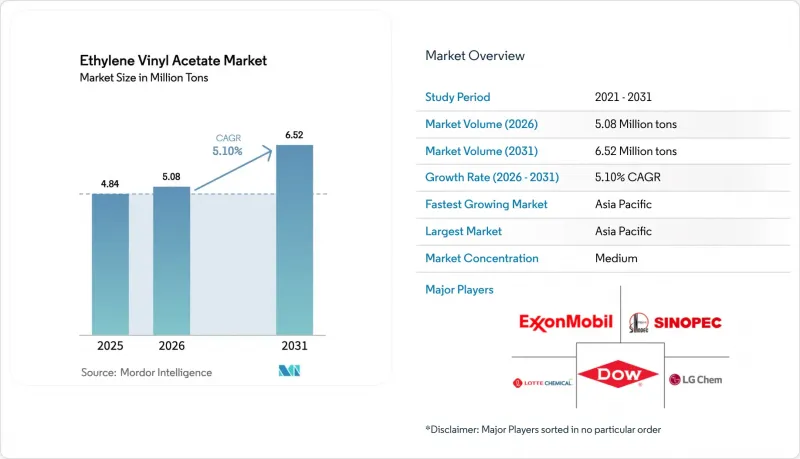
Mordor Intelligence에 의하면, 에틸렌초산비닐 시장 규모는 2025년에 484만 톤으로 평가되었고, 2026년 508만 톤에서 2031년까지 652만 톤에 이를 것으로 추정되며, 예측 기간(2026-2031년) CAGR은 5.10%를 나타낼 전망입니다.
본 보고서는 등급별(저밀도, 중밀도, 고밀도), 용도별(필름, 접착제, 발포체 등), 최종 이용 산업별(포장, 태양광 발전, 농업 등), 가공 기술별(압출 성형, 사출 성형 등) 및 지역별(아시아태평양, 북미, 유럽 등)로 분류되어 있습니다. 시장 전망은 수량(톤) 및 매출액(달러) 단위로 제시되어 있습니다.
세계의 에틸렌초산비닐(EVA) 시장 동향 및 인사이트
경량 EVA 폼을 기반으로 한 아시아 신발 생산량의 급증
인도의 신발 부문은 국내 EVA 소비량의 약 55%를 차지하고 있으며, 운송 비용을 절감하고 착용감을 향상시키는 사출 성형 밑창과 경량 샌들이 주류를 이루고 있습니다. 수탁 제조는 중국의 연안 거점에서 베트남 및 인도네시아로 이동하고 있으며, 이로 인해 압축 성형 EVA 폼에 대한 지역적 수요가 증가하고 있습니다. 2024년부터 2025년에 걸쳐 출원된 특허에는 수축률을 낮추고 자동 조립 라인에서 공차를 엄격하게 관리할 수 있는 다중 경도 배합에 대한 내용이 포함되어 있습니다. ISO 9001 인증을 획득한 공장에서는 로봇을 통한 신발 삽입에 필수적인 균일한 밀도 프로파일을 실현하고 있습니다. 그러나 TPU 미드솔은 더 높은 에너지 반환율을 제공하고 재분쇄가 가능하여 순환 경제의 요건에도 부합하므로, 프리미엄 러닝화 시장에 점차 침투하고 있습니다. 초경량이며 반발력이 뛰어난 EVA 등급을 경쟁력 있는 가격으로 제공할 수 있는 제조업체는 대중 시장 부문에서 점유율을 지킬 수 있을 것입니다.
북미의 포장재가 재활용 가능한 다층 EVA 필름으로의 전환
캘리포니아주, 콜로라도주, 메인주, 오리건주의 확대된 생산자 책임 법에 따라 재활용 불가능한 포장재에 수수료가 부과됨에 따라, 각 변환업체들은 EVA 타이층의 함유율을 5 wt% 미만으로 억제하면서 재활용 가능한 구조를 가진 다층 필름의 재설계를 추진하고 있습니다. 유럽연합(EU)의 ‘포장 및 포장 폐기물 규정(2025/40)’에 따르면, 재생 재료 함유율 요건이 2030년까지 35%, 2040년까지 65%로 상향 조정됩니다. 다우(Dow)사와 발로레겐(Valoregen)사의 순환형 원료 공급 계약을 통해 연간 1만 5,000톤의 인증된 원료가 공급되는 한편, 무라 테크놀로지(Mura Technology)사는 2030년까지 60만 톤의 고도 재활용 생산을 목표로 하고 있습니다. 세라니즈(Ceranies)는 재활용 가능 필름 수요에 부응하기 위해 2023년에 에드먼턴 공장의 생산 능력을 35% 증설했습니다. 친환경 조정 요금을 지불하는 브랜드 소유주들은 ISCC PLUS 인증을 취득한 수지를 선호하며, 이를 통해 순환형 원료의 추적성이 확보됩니다.
에틸렌 및 VAM 원자재 가격 변동
2025년 9월 에틸렌 현물 가격은 동남아시아 CFR 기준으로 평균 835-845달러/톤을 기록했으며, 중국과 중동에서 새로운 크래커가 가동을 시작함에 따라 전년 대비 15% 하락했습니다. VAM은 아세트산과 에틸렌의 가격 동향에 연동되므로, 비통합형 EVA 제조업체에게는 이중의 가격 변동 리스크가 되어 경영에 부담을 주고 있습니다. 한국의 대형 제조업체는 2025년 12월, 에틸렌 생산량을 366만 톤 이상 감축하여 가동률이 70% 미만으로 떨어졌습니다. 이로 인해 LG화학, 롯데케미칼, 한화솔루션에서는 크래커가 가동 중단 상태에 들어갔습니다. 유럽에서는 2026년에 도입될 탄소국경조정메커니즘(CBAM)으로 인해 화석 유래 원료에 부과되는 추가 비용에 직면하게 될 것입니다. 다우(Dow)의 포트 서스캐처원(Fort Saskatchewan) 넷제로 에틸렌 프로젝트는 2029년까지 마진을 화석 연료 가격 변동으로부터 분리하는 것을 목표로 하고 있습니다. 장기 에탄 또는 바이오나프타 계약의 유무가 비용 선도 기업과 현물 구매자 간의 차이를 결정짓게 될 것입니다.
부문별 분석
고밀도 EVA는 2031년까지 연평균 성장률(CAGR)이 6.46%를 나타낼 것으로 전망됩니다. 이는 양면형 및 헤테로접합형 태양전지 모듈에서 25년 동안의 광투과율과 접착력을 보장하기 위해 28%-33%의 VA 함량이 필요하기 때문이며, 이 부문은 에틸렌초산비닐 시장 전체의 성장률을 상회할 것으로 전망됩니다. 2025년에 48.25%의 점유율을 차지할 저밀도 수지는 짧은 사이클 타임을 실현하기 위해 20 g/10 min 이상의 용융 유동 지수를 중시하는 범용 필름 및 대중용 신발의 기반이 되고 있습니다. 관형 반응기는 이러한 등급의 제품을 낮은 설비 투자 비용으로 공급함으로써, 가격에 민감한 포장 분야에서 경쟁력을 유지하고 있습니다. 중밀도 EVA는 유동성과 응집 강도의 균형이 요구되는 핫멜트 접착제 및 전선 및 케이블 피복재의 가교 역할을 하고 있습니다. 2024년 9월에 출시된 다우·미쓰이의 ISCC PLUS 인증을 획득한 바이오매스 EVA는 스코프 3 배출량을 공개하는 브랜드 소유자에게 모든 밀도 등급에서 드롭인 대체재로 활용될 수 있습니다. 미국 FDA 21 CFR 177.1350 및 EU 규정 10/2011을 준수함에 따라 VA 함량은 50%로 제한되고 이온 이동 한계치가 설정되어 있어, 태양광 등급 공급업체는 낮은 잔류 모노머 수준을 검증해야 합니다.
중국에서는 현지화가 중요한 역할을 하고 있으며, 2023년에 태양광 등급 자급률이 70%에 도달했고, 2030년까지 85%를 목표로 하고 있습니다. 이를 통해 인도의 반덤핑 관세 대상이 되고 있는 한국 및 일본 제조업체에 대한 수입 의존도를 줄이고 있습니다. BASF-YPC는 리오넬 바셀의 관형 기술을 활용하여 국내 태양광 발전 시장 및 수출 고객 모두에 공급하기 위해 난징에서 30만 톤의 생산 능력 확장을 계획하고 있습니다. 저밀도 수지는 고성능 스포츠화의 TPU 미드솔 대체가 진행되고 있지만, 비용을 중시하는 시장에서는 여전히 주도적인 위치를 유지하고 있습니다. 농업용 온실 필름의 경우, 지중해성 기후에서 5시즌 이상의 내구 연한을 확보하기 위해 자외선 안정제가 배합된 중밀도 EVA가 계속해서 지정되고 있습니다.
태양광 발전용 봉지재 시장은 2031년까지 연평균 7.01%의 성장률을 기록하며, 전 세계 태양광 발전 설비 용량이 연간 400GW를 넘어섬에 따라 플랫 필름의 생산량을 추월할 것으로 전망됩니다. 필름용 에틸렌초산비닐(EVA) 시장 규모는 스낵 식품 포장, 온실용 커버, 접합 안전 유리 분야에서 2025년 기준 44.90%로 여전히 큰 비중을 차지하고 있지만, 일회용 플라스틱 규제 영향으로 그 성장 속도는 둔화되고 있습니다. 접착제는 전자상거래에 따른 물류 분야의 호재를 타고 있지만, 내열성이 필수적인 분야에서는 POE 계열 제품이 점유율을 확대되고 있습니다. 샌들, 요가 매트, 부력 보조 기구용 폼은 여전히 성숙한 분야이며, 현재 혁신은 다색 사출 성형 및 수축 방지 첨가제에 초점이 맞추어져 있습니다. 태양광 발전용 케이블 및 LCD 보호 시트를 포함한 기타 용도는 저VOC 수지를 권장하는 IEC 및 ISO 규격의 동향에 좌우됩니다.
EU 시장용 필름은 2030년까지 35%의 재활용 소재를 배합하고 재활용 설계 등급 A를 충족해야 하며, 이에 따라 가공업체들은 EVA 타이 레이어의 함유율을 중량비 5% 미만으로 억제한 단일 소재 폴리에틸렌 구조를 채택하도록 유도되고 있습니다. 핫멜트 배합 제조업체는 ZDHC 제한 물질 목록에 따라 프탈레이트를 배제하고 있으며, 이로 인해 EVA 제조업체는 저이동성 첨가제 패키지의 인증을 취득해야 하는 상황에 처해 있습니다. 현재 스포츠 신발용 폼 공급업체들은 TPU의 60%라는 반발 에너지 기준에 대응하기 위해 밀도 감소와 반발 에너지 간의 균형을 맞추려고 노력하고 있습니다.
지역별 분석
아시아태평양은 2025년 전 세계 에틸렌초산비닐(EVA) 시장 규모의 63.11%를 차지한 것으로 평가되었으며, 중국의 태양광 발전 분야에서의 우위와 인도의 신발 제조 산업의 성장에 힘입어 2031년까지 연평균 6.51%의 성장률을 보일 것으로 전망됩니다. 중국은 2023년 12월 기준으로 연간 245만 톤의 EVA 생산 능력을 가동하여 가동률이 90.66%에 달했으나, 여전히 고VA 등급 제품을 수입하고 있으며, 이로 인해 북서부 지역에서 석탄에서 올레핀으로의 전환에 대한 투자가 촉진되고 있습니다. 2024년에 예정된 젠하이(Zhenhai)의 에틸렌 생산 능력 150만 톤 증설과 2025년에 예정된 구레이(Gulei) 2단계 크래커 가동에 따라 업스트림 부문의 통합이 더욱 강화될 전망입니다. 한국 기업들은 공급 과잉으로 인해 2025년에 에틸렌 생산 능력을 366만 톤 감축하여 가동률에 압박을 가하고 있습니다. 다우 미쓰이(Dow Mitsui)와 도소(Tosoh) 등 일본 생산업체들은 동남아시아 수출용 고순도 태양광 수지를 전문으로 생산하고 있습니다. 인도의 반덤핑 관세는 국내 EVA 생산 능력을 보호하고 있지만, 모듈 생산 비용을 상승시키고 있어 현지 오토클레이브 프로젝트에 대한 관심이 높아지고 있습니다.
2025년, 북미는 15%대 중반의 점유율을 유지했습니다. 세라니즈(Ceranese)사의 에드먼턴 공장에서 35% 증산은 각 주의 새로운 EPR(생산자 책임 회수)법에 대응하는 재활용 가능 필름 제조업체에 대한 공급 체계를 구축했습니다. 탄소 중립을 목표로 하는 다우(Dow)사의 포트 서스캐처원 에틸렌 시설은 2029년 가동을 예정하고 있으며, 탄소세로 인한 이익률 하락을 방어하는 것을 목표로 하고 있습니다. 브라스켐(Braskem)사의 8억 달러 규모의 리우데자네이루 확장 계획은 2028년까지 에틸렌 생산 능력을 22만 톤 증강할 전망이지만, 자금 조달의 안정성이 관건이 될 것입니다. 멕시코는 미국 자동차 제조업체(OEM)와 지리적으로 가까워 자동차용 배선재 수요가 견조한 반면, 고부가가치 원예 분야에서는 온실용 필름 소비량이 증가하고 있습니다.
유럽 시장 점유율은 여전히 한 자릿수 후반에 머물러 있으며, 엄격한 폐기물 및 탄소 규제로 인해 제약을 받고 있습니다. ‘포장 및 포장 폐기물 규정’에서는 재활용 소재 35% 함유가 의무화되어 있으며, 재활용이 불가능한 필름은 C등급으로 분류되어 과태료 대상이 될 수 있습니다. VAM에 관한 REACH 등록 서류 작성은 규정 준수에 따른 부담을 가중시키고 있습니다. 독일과 이탈리아에서는 옥상 태양광 발전 및 농업 분야에서 여전히 EVA가 사용되고 있으나, 식품 포장용으로는 가공업체가 낮은 이주성을 입증해야 합니다. 중동에서는 ADNOC의 루와이스 확장 프로젝트나 사우디아람코의 자프라 유전이 대표하듯이 통합형 공급망이 구축되어 있으며, 아시아 수출용 원유 준비가 진행되고 있습니다. 남미에서는 간헐적인 성장이 관찰되며, 브라질의 농업용 필름이 경제 변동을 상쇄하고 있습니다. 한편, 아르헨티나에서는 온실용 필름에 대한 수요가 있음에도 불구하고인플레이션으로 인해 수입 능력이 제한되고 있습니다.
기타 혜택 :
- 엑셀 형식 시장 예측(ME) 시트
- 3개월간 애널리스트 지원
자주 묻는 질문
목차
제1장 서론
제2장 조사 방법
제3장 주요 요약
제4장 시장 구도
제5장 시장 규모 및 성장 예측
제6장 경쟁 구도
제7장 시장 기회 및 향후 전망
AJY 26.09.07According to Mordor Intelligence, the ethylene vinyl acetate market size was valued at 4.84 million tons in 2025 and is estimated to grow from 5.08 million tons in 2026 to reach 6.52 million tons by 2031, at a CAGR of 5.10% during the forecast period (2026-2031).
This report is Segmented by Grade (Low Density, Medium Density, and High Density), Application (Films, Adhesives, Foams, and More), End-Use Industry (Packaging, Photovoltaic, Agriculture, and More), Processing Technology (Extrusion, Injection Molding, and More), and Geography (Asia-Pacific, North America, Europe, and More). The Market Forecasts are Provided in Terms of Volume (Tons) and Revenue (USD).
Global Ethylene Vinyl Acetate Market Trends and Insights
Surge in Asian Footwear Output Based on Lightweight EVA Foams
India's footwear sector consumes roughly 55% of domestic EVA, dominated by injection-molded soles and lightweight sandals that reduce shipping costs and improve comfort. Contract manufacturing is shifting from China's coastal hubs to Vietnam and Indonesia, lifting regional demand for compression-molded EVA foams. Patent filings in 2024-2025 document multi-hardness formulations that lower shrinkage and enable tighter tolerances for automated assembly lines. ISO 9001-certified plants achieve consistent density profiles essential for robotic footwear insertion. Yet TPU midsoles are encroaching on premium running shoes because they deliver higher energy return and can be reground, aligning with circular-economy mandates. Producers able to deliver ultra-light, high-rebound EVA grades at competitive prices will protect their share in the mass-market segment.
Packaging Shift to Recyclable Multilayer EVA Films in North America
Extended producer responsibility laws in California, Colorado, Maine, and Oregon levy fees on non-recyclable packaging, prompting converters to redesign multilayer films around recyclable structures that retain EVA tie-layers below 5 wt%. The European Union's Packaging and Packaging Waste Regulation 2025/40 ramps recycled-content requirements to 35% by 2030 and 65% by 2040. Dow and Valoregen's circular-feedstock deal will supply 15,000 t per year of certified content, while Mura Technology targets 600,000 t of advanced-recycling output by 2030. Celanese lifted Edmonton capacity by 35% in 2023 to meet recyclable-film demand. Brand owners paying eco-modulated fees favor resins that carry ISCC PLUS certificates, ensuring traceable circular attribution.
Ethylene and VAM Feedstock Price Volatility
Spot ethylene averaged USD 835-845/t CFR Southeast Asia in September 2025, down 15% year-on-year as new crackers came online in China and the Middle East. VAM tracks acetic acid and ethylene, creating dual exposure that strains non-integrated EVA players. Korean majors cut more than 3.66 million t of ethylene output in December 2025, pushing operating rates below 70% and idling crackers at LG Chem, Lotte Chemical, and Hanwha Solutions. Europe faces added cost from the Carbon Border Adjustment Mechanism in 2026, punishing fossil-based feedstocks. Dow's Fort Saskatchewan net-zero ethylene project aims to decouple margins from fossil volatility by 2029. Long-term ethane or bio-naphtha contracts will differentiate cost leaders from spot buyers.
Other drivers and restraints analyzed in the detailed report include:
- Rapid Solar-PV Build-Out Boosting High-VA EVA Encapsulants
- APAC E-Commerce Explosion Driving Demand for EVA Hot-Melt Adhesives
- EU and US Single-Use-Plastic Crack-Downs
For complete list of drivers and restraints, kindly check the Table Of Contents.
Segment Analysis
High-density EVA achieved a 6.46% CAGR outlook through 2031 as bifacial and heterojunction solar modules require 28%-33% VA content to guarantee optical transmission and adhesion across 25 years, placing the segment ahead of overall ethylene vinyl acetate market growth. Low-density resin, dominant at 48.25% in 2025, underpins commodity films and mass-market footwear that value melt-flow indices above 20 g/10 min for fast cycle times. Tubular reactors supply these grades at lower capital cost, maintaining competitiveness in price-sensitive packaging. Medium-density EVA bridges hot-melt adhesives and wire-cable jacketing, where flow and cohesive strength must balance. ISCC PLUS-certified biomass EVA from Dow-Mitsui, launched in September 2024, offers a drop-in replacement across density tiers for brand owners disclosing Scope 3 emissions. Compliance with US FDA 21 CFR 177.1350 and EU Reg 10/2011 caps VA content at 50% and sets migration limits, forcing solar-grade suppliers to validate low residual monomer levels.
Localization plays heavily in China, which hit 70% solar-grade self-sufficiency in 2023 and pursues 85% by 2030, cutting import reliance on South Korean and Japanese producers subject to Indian antidumping duties. BASF-YPC plans a 300,000 ton expansion in Nanjing, leveraging LyondellBasell tubular technology to service both domestic solar and export customers. Low-density resin faces substitution from TPU midsoles in high-performance sports shoes but retains primacy in cost-driven markets. Agricultural greenhouse films continue to specify medium-density EVA with UV stabilizers to extend service life beyond five seasons in Mediterranean climates.
Solar encapsulation will accelerate at 7.01% through 2031, overtaking flat film volume as global photovoltaic installations surpass 400 GW annually. The ethylene vinyl acetate market size for films remains significant at 44.90% in 2025, serving snack packaging, greenhouse covers, and laminated safety glass, yet its trajectory slows under single-use-plastic restrictions. Adhesives capture logistics tailwinds from e-commerce, although POE systems are winning share where heat resistance is vital. Foams for sandals, yoga mats, and buoyancy aids remain a mature arena; innovation now focuses on multi-color injection molding and anti-shrinkage additives. Other uses, including photovoltaic cables and LCD protective sheets, depend on evolving IEC and ISO standards that favor low-VOC resins.
Films intended for EU markets must incorporate 35% recycled content by 2030 and meet design-for-recycling Grade A, motivating converters to adopt mono-material polyethylene structures with EVA tie-layers kept below 5 wt%. Hot-melt formulators are purging phthalates in line with the ZDHC Restricted Substances List, pushing EVA producers to certify low-migration additive packages. Foam suppliers in athletic footwear are now balancing density reduction against rebound energy to compete with TPU's 60% return benchmark.
Complete Report Scope:
- By Grade
- Low Density
- Medium Density
- High Density
- By Application
- Films
- Adhesives
- Foams
- Solar Cell Encapsulation
- Other Applications
- By End-use Industry
- Packaging
- Photovoltaic
- Agriculture
- Footwear and Sporting Goods
- Automotive and Transportation
- Electrical and Electronics
- Others
- By Processing Technology
- Extrusion
- Injection Molding
- Blow Molding
- Other Processes
- By Geography
- Asia-Pacific
- China
- India
- Japan
- South Korea
- Rest of Asia-Pacific
- North America
- United States
- Canada
- Mexico
- Europe
- Germany
- United Kingdom
- France
- Italy
- Rest of Europe
- South America
- Brazil
- Argentina
- Rest of South America
- Middle East and Africa
- Saudi Arabia
- United Arab Emirates
- South Africa
- Egypt
- Rest of Middle East and Africa
- Asia-Pacific
Geography Analysis
Asia-Pacific contributed 63.11% of global ethylene vinyl acetate market volume in 2025 and will grow at 6.51% through 2031, buoyed by Chinese solar dominance and Indian footwear manufacturing. China operated 2.45 million tons of annual EVA capacity at 90.66% utilization in December 2023, yet still imported high-VA grades, prompting northwest coal-to-olefins investments. Zhenhai's 1.5 million t ethylene expansion in 2024 and the Gulei Phase 2 cracker slated for 2025 reinforce upstream integration. South Korean players slashed 3.66 million t ethylene in 2025 due to oversupply, pressuring operating rates. Japanese producers such as Dow-Mitsui and Tosoh specialize in high-purity solar resin for export to Southeast Asia. India's antidumping tariffs protect domestic EVA capacity but raise module production costs, accelerating interest in local autoclave projects.
North America held a mid-teens share in 2025. Celanese's 35% Edmonton lift readied supply for recyclable film makers navigating new state EPR laws. Dow's net-zero Fort Saskatchewan ethylene facility, planned for 2029 start-up, aims to shield margins from carbon taxes. Braskem's USD 800 million Rio de Janeiro expansion will add 220,000 tons of ethylene by 2028 but hinges on financing stability. Mexico's proximity to U.S. OEMs anchors automotive wiring demand, while greenhouse film consumption rises in high-value horticulture.
Europe's share remains in the low double digits, constrained by strict waste and carbon rules. The Packaging and Packaging Waste Regulation demands 35% recycled content and could classify non-recyclable films as Grade C, triggering penalties. REACH dossiers for VAM drive compliance overhead. Germany and Italy still use EVA in rooftop solar and agriculture, but processors must certify low migration for food packaging. The Middle East is building integrated chains, exemplified by ADNOC's Ruwais expansion and Saudi Aramco's Jafurah field, preparing export barrels for Asia. South America experiences episodic growth, with Brazil's agriculture films offsetting economic volatility; Argentine inflation curbs import capability despite greenhouse demand.
- Asia Polymer Corporation
- BASF-YPC Company Limited
- Benson Polymers Pvt Ltd.
- Braskem
- Celanese Corporation
- China Petrochemical Corporation.
- Clariant
- Dow
- Exxon Mobil Corporation
- Formosa Plastics Corporation
- Hanwha Solutions
- Hyundai Chemical
- Innospec
- Jiangsu Sailboat Petrochemical Co., Ltd.
- Levima Group Co., Ltd.
- LG Chem
- LOTTE Chemical Corporation
- LyondellBasell Industries Holdings B.V.
- Repsol
- Saudi Arabian Oil Co.
- Sinochem Holdings Corporation Ltd
- Sinopec Yanshan Petrochemical Company
- Sipchem Company
- Sumitomo Chemical Co. Ltd
- Zhejiang Petroleum & Chemical
Additional Benefits:
- The market estimate (ME) sheet in Excel format
- 3 months of analyst support
TABLE OF CONTENTS
1 Introduction
- 1.1 Study Assumptions and Market Definition
- 1.2 Scope of the Study
2 Research Methodology
3 Executive Summary
4 Market Landscape
- 4.1 Market Overview
- 4.2 Market Drivers
- 4.2.1 Surge in Asian footwear output based on lightweight EVA foams
- 4.2.2 Packaging shift to recyclable multilayer EVA films in North America
- 4.2.3 Rapid solar-PV build-out boosting high-VA EVA encapsulants
- 4.2.4 APAC e-commerce explosion driving demand for EVA hot-melt adhesives
- 4.2.5 Autoclave-route EVA capacity expansions lowering unit costs
- 4.3 Market Restraints
- 4.3.1 Ethylene and VAM feedstock price volatility
- 4.3.2 EU and US single-use-plastic crack-downs
- 4.3.3 POE and TPU gaining share in solar and footwear
- 4.4 Value Chain Analysis
- 4.5 Porter's Five Forces
- 4.5.1 Bargaining Power of Suppliers
- 4.5.2 Bargaining Power of Buyers
- 4.5.3 Threat of New Entrants
- 4.5.4 Threat of Substitutes
- 4.5.5 Degree of Competition
5 Market Size and Growth Forecasts (Value and Volume)
- 5.1 By Grade
- 5.1.1 Low Density
- 5.1.2 Medium Density
- 5.1.3 High Density
- 5.2 By Application
- 5.2.1 Films
- 5.2.2 Adhesives
- 5.2.3 Foams
- 5.2.4 Solar Cell Encapsulation
- 5.2.5 Other Applications
- 5.3 By End-use Industry
- 5.3.1 Packaging
- 5.3.2 Photovoltaic
- 5.3.3 Agriculture
- 5.3.4 Footwear and Sporting Goods
- 5.3.5 Automotive and Transportation
- 5.3.6 Electrical and Electronics
- 5.3.7 Others
- 5.4 By Processing Technology
- 5.4.1 Extrusion
- 5.4.2 Injection Molding
- 5.4.3 Blow Molding
- 5.4.4 Other Processes
- 5.5 By Geography
- 5.5.1 Asia-Pacific
- 5.5.1.1 China
- 5.5.1.2 India
- 5.5.1.3 Japan
- 5.5.1.4 South Korea
- 5.5.1.5 Rest of Asia-Pacific
- 5.5.2 North America
- 5.5.2.1 United States
- 5.5.2.2 Canada
- 5.5.2.3 Mexico
- 5.5.3 Europe
- 5.5.3.1 Germany
- 5.5.3.2 United Kingdom
- 5.5.3.3 France
- 5.5.3.4 Italy
- 5.5.3.5 Rest of Europe
- 5.5.4 South America
- 5.5.4.1 Brazil
- 5.5.4.2 Argentina
- 5.5.4.3 Rest of South America
- 5.5.5 Middle East and Africa
- 5.5.5.1 Saudi Arabia
- 5.5.5.2 United Arab Emirates
- 5.5.5.3 South Africa
- 5.5.5.4 Egypt
- 5.5.5.5 Rest of Middle East and Africa
- 5.5.1 Asia-Pacific
6 Competitive Landscape
- 6.1 Market Concentration
- 6.2 Strategic Moves
- 6.3 Market Share Analysis
- 6.4 Company Profiles {(includes Global level Overview, Market level overview, Core Segments, Financials as available, Strategic Information, Market Rank/Share for key companies, Products and Services, Recent Developments)}
- 6.4.1 Asia Polymer Corporation
- 6.4.2 BASF-YPC Company Limited
- 6.4.3 Benson Polymers Pvt Ltd.
- 6.4.4 Braskem
- 6.4.5 Celanese Corporation
- 6.4.6 China Petrochemical Corporation.
- 6.4.7 Clariant
- 6.4.8 Dow
- 6.4.9 Exxon Mobil Corporation
- 6.4.10 Formosa Plastics Corporation
- 6.4.11 Hanwha Solutions
- 6.4.12 Hyundai Chemical
- 6.4.13 Innospec
- 6.4.14 Jiangsu Sailboat Petrochemical Co., Ltd.
- 6.4.15 Levima Group Co., Ltd.
- 6.4.16 LG Chem
- 6.4.17 LOTTE Chemical Corporation
- 6.4.18 LyondellBasell Industries Holdings B.V.
- 6.4.19 Repsol
- 6.4.20 Saudi Arabian Oil Co.
- 6.4.21 Sinochem Holdings Corporation Ltd
- 6.4.22 Sinopec Yanshan Petrochemical Company
- 6.4.23 Sipchem Company
- 6.4.24 Sumitomo Chemical Co. Ltd
- 6.4.25 Zhejiang Petroleum & Chemical
7 Market Opportunities and Future Outlook
- 7.1 White-space and Unmet-need Assessment


