|
시장보고서
상품코드
2122720
치과 임플란트 시장 : 시장 점유율 분석, 업계 동향 및 통계, 성장 예측(2026-2031년)Dental Implants - Market Share Analysis, Industry Trends & Statistics, Growth Forecasts (2026 - 2031) |
||||||
 Mordor Intelligence
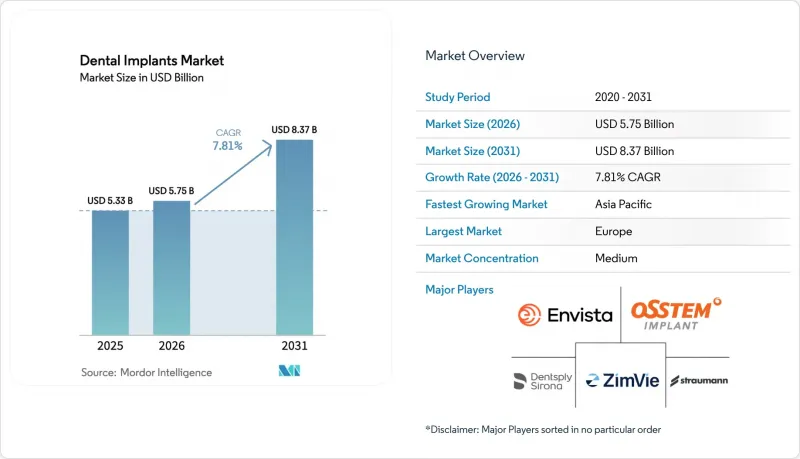
Mordor Intelligence에 의하면, 치과 임플란트 시장 규모는 2025년 53억 3,000만 달러로 평가되었고, 2026년에는 57억 5,000만 달러로 추정되고, 2026-2031년 CAGR 7.81%로 성장을 지속할 전망이며, 2031년에는 83억 7,000만 달러에 이를 것으로 예측됩니다.
본 보고서는 구성 부품별(픽처(골내 임플란트 등) 및 어버트먼트), 재질별(티타늄 임플란트 및 지르코늄 임플란트), 설계별(테이퍼형 임플란트 및 평행벽형 임플란트), 시술 유형별(즉시 하중형 임플란트 및 기존), 최종 사용자별(치과 병원 및 클리닉 등), 지역별(북미, 유럽, 기타)로 분류되어 있습니다. 시장 예측은 금액(달러) 기준으로 제시되어 있습니다.
세계의 치과 임플란트 시장 동향 및 인사이트
고령화에 따른 무치악 상태 증가와 가처분 소득의 향상
세계적으로 60세 이상 3억 4,900만 명이 심각한 치아 상실로 고통받고 있으며, 거의 모든 지역에서 평균 수명이 연장됨에 따라 그 절대 수는 증가 추세를 보이고 있습니다. 고소득 국가에서는 예방 치과 치료로 인해 자연치가 더 많이 보존되고 있지만, 인구 동향에 따라 무치악 노인의 총 수는 여전히 계속 증가하고 있습니다. 동시에, 2024년 중국의 실질 가처분 소득은 6.3% 증가했으며, IMF 통계에 따르면 인도의 1인당 GDP는 2,500달러를 넘어섰습니다. 이 모든 요인은 여러 치아에 걸친 수복 치료의 경제적 부담을 경감시키는 요인이 되고 있습니다. 독일과 프랑스의 보험 환급 제도 개혁으로 인해 전악 임플란트 비용의 60%가 보험 적용 대상이 되었고, 환자의 본인 부담금이 경감됨에 따라 치료의 보급이 가속화되고 있습니다. 한국에서는 고령자에 대한 임플란트 급여가 확대됨에 따라 2024년 시술 건수가 34% 급증했습니다. 이러한 요인들이 복합적으로 작용하여, 경제 변동의 영향을 비교적 덜 받는 지속적인 수요의 원동력이 되고 있습니다. 이는 치아 보철이 단순한 심미적 매력뿐만 아니라 기본적인 저작 기능과 발화 기능을 회복시켜 주기 때문입니다.
디지털 치과 워크플로우(CAD/CAM, 3D 프린팅)의 보급 확대
디지털 워크플로는 정확한 가상 계획 수립과 당일 보철을 가능하게 함으로써, 진단부터 최종 수복에 이르기까지의 임플란트 주기를 단축합니다. 구강 내 스캐너가 기존의 인상 채취를 대체하여 교차 오염의 위험을 줄이고 재제작 횟수를 감소시키는 한편, CAD 소프트웨어는 어버트먼트 설계 및 수술 가이드 제작을 몇 분 만에 자동화합니다. 덴츠프라이 시로나(Dentsply Sirona)는 2024 회계연도 디지털 기기 매출이 23% 증가했다고 보고했으며, 이러한 성장의 대부분은 임플란트를 주된 용도로 사용하는 사용자들에 기인한 것으로 분석됩니다. 2024년 10월에 발표된 FDA의 개정 지침에서는 3D 프린팅된 치과용 기기의 멸균 검증 기준이 명확해졌으며, 승인 절차가 간소화되었습니다. 이에 따라 일반 치과의사는 계획 단계를 외부에 위탁하지 않고도 임플란트 치료를 도입할 수 있게 되었으며, 치과 임플란트 시장은 1차 진료 현장으로 확대되고 있습니다. ISO 13485 및 ISO 20795-1 준수는 이제 기본 요건이 되었으며, 디지털 생산 전반에 걸친 추적성이 확보되고 있습니다. 점점 더 많은 치과 진료소 운영 조직(DSO)이 중앙 집중식 밀링 및 프린팅 방식을 도입함에 따라, 규모의 경제 효과로 단가가 하락하고 시장 침투가 더욱 촉진되고 있습니다.
OECD 비회원국에서의 높은 치료비와 좁은 보험 적용 범위
인도에서는 단일 치아 수복 비용이 1,500달러, 미국에서는 4,500달러이며, 브라질, 아르헨티나, 나이지리아에서는 전악 치료 비용이 가구 연소득을 초과합니다. 라틴아메리카 및 사하라 이남 아프리카에서는 치과 서비스에 대한 보험 보급률이 여전히 15% 미만에 머물러 있으며, 대부분의 보험 플랜에서는 임플란트를 심미 치과로 분류하고 있습니다. DSO 네트워크나 민간 금융 기관이 제공하는 대출 제도의 금리는 20%를 초과하여, 가격에 민감한 환자들의 이용을 저해하고 있습니다. 아르헨티나나 남아프리카공화국과 같은 보호무역주 시장에서는 티타늄 및 지르코늄에 대한 수입 관세로 인해 입고 비용이 10-15% 상승하고 있습니다. 그 결과, 인구 구조는 양호하지만 소득 수준이 낮은 지역에서는 경제적 부담이 치과 임플란트 시장의 성장을 제한하고 있습니다.
부문 분석
2025년에는 피처가 치과 임플란트 시장의 75.55%를 차지했으며, 골유합을 위한 앵커로서 필수적인 역할을 부각시켰으나, 집중형 밀링을 통한 대량 맞춤화의 진전에 따라, 어버트먼트는 2031년까지 연평균 성장률(CAGR) 9.25%로 시장 전체 성장률을 상회할 것으로 예측됩니다. 아바트먼트에 할당되는 치과 임플란트 시장 규모가 확대되고 있는 이유는 실험실에서 환자별로 최적화된 밀링 부품을 몇 시간 만에 제조할 수 있게 되어 기성 부품에 대한 의존도가 낮아진 데 더해, 시멘트와 관련된 임플란트 주위염을 최소화하는 나사 고정식 설계가 가능해졌기 때문입니다. 골내 이식형 피처는 여전히 표준적인 선택지인 반면, 골막하 이식형 구조는 틈새 시장에 머물러 있습니다. CAD/CAM 공정이 가격 면에서 동등해지고, 우수한 에머전시 프로파일을 실현함에 따라 기성 어버트먼트의 점유율은 계속 하락하고 있습니다.
디지털 랩에서는 5축 밀링 머신과 선택적 레이저 용융(SLM) 프린터를 활용하여 어버트먼트를 일괄 생산하고 있으며, 공차를 ±10µm 이내로 유지하면서 단위당 비용을 30% 절감하고 있습니다. 스트로만의 ‘Variobase’ 시리즈는 호환 가능한 플랫폼이 지원하는 아날로그 부품, 나사, 보철 부품의 재구매를 촉진함으로써 생태계의 안정성을 입증하고 있습니다. ISO 14801 피로 시험 및 ISO 10993 생체적합성은 여전히 필수 기준이지만, 대량 생산을 수행하는 실험실에서는 이를 일상적으로 상회하고 있어 산업 수준의 품질 관리가 철저히 이루어지고 있음을 알 수 있습니다. DSO(치과 서비스 조직)가 조달을 주도하는 가운데, 임플란트, 어버트먼트, 디지털 워크플로우를 세트로 제공하는 공급업체가 계약을 따내고 있어 수직 통합이 더욱 강화되고 있습니다.
2025년에도 티타늄은 85.53%의 점유율을 계속 유지하고 있으며, 이는 티타늄의 견고한 골유착 특성과 비용 효율성을 반영한 것입니다. 한편, 지르코늄 임플란트는 점유율은 작지만 2031년까지 연평균 성장률(CAGR) 10.85%를 나타낼 것으로 예측됩니다. 치과 임플란트 시장은 잇몸 생체형에 따른 세분화가 진행되고 있습니다. 조직이 얇은 경우 티타늄의 회색이 비쳐 보이지만, 지르코니아의 밝은 색조를 사용하면 심미적인 투명 현상을 피할 수 있습니다. 3년간의 데이터에 따르면, 스트라우만사의 ‘PURE’ 세라믹 임플란트는 96.7%의 생존율을 기록하며, 금속제 피처와의 역사적인 성능 격차를 좁혀가고 있습니다.
지르코늄은 열등방압 성형(HIP) 및 정밀한 기계 가공이 필요하기 때문에 제조상의 과제는 여전히 남아 있으며, 이로 인해 단위 비용은 티타늄보다 40-60% 더 높습니다. 그러나 심미성에 대한 환자의 지불 의향이 높은 상악 전치부 적응증의 경우, 가격에 대한 민감도는 그리 두드러지지 않습니다. ASTM F2393 및 ISO 13356 규격에 따라 상의 안정성과 기계적 강도가 보장되며, 이트리아 안정화 배합의 발전으로 취성도 감소되었습니다. 지르코늄 원자재 가격이 안정되고 3D 프린팅 기술이 성숙해지면, 그 적용 범위는 단스팬 브릿지나 특정 후치부 사례로 확대될 것입니다.
지역별 분석
2025년, 독일과 프랑스의 보험 적용 범위 확대에 따라 유럽은 치과 임플란트 시장의 35.13%를 차지했으나, 도시 지역의 보급이 성숙 단계에 접어들면서 성장은 정체되고 있습니다. 독일에서는 2024년 법 개정에 따라 적용 대상이 확대되었으나, 신규 사례의 대부분은 합병증을 안고 있는 고령 환자들로, 수술을 복잡하게 만들고 있습니다. 프랑스에서는 치과 병원의 소유 형태가 세분화되어 있어 DSO(치과 서비스 조직)의 확산이 더딘 편이며, 프리미엄 브랜드에 대한 충성도는 유지되고 있지만 수량 할인 기회는 제한적입니다. 스페인에서는 더 저렴한 임플란트를 찾는 영국 거주자들의 치과 관광 덕분에, 국내 임금 정체에도 불구하고 수요가 지지를 받고 있습니다. NHS(국민보건서비스)가 임플란트를 급여 대상에서 제외하고 있는 영국에서는 여전히 자비 치료가 주류를 이루며, 이용은 주로 부유층으로 한정되어 있습니다. 또한, 브렉시트 이후의 환율 변동으로 인해 수입 비용이 더욱 치솟고 있습니다. EU의 MDR(의료기기 규정) 준수 비용으로 인해 중소 공급업체들은 합병이나 시장 철수를 강요받고 있어, 경쟁의 폭이 미묘하게 좁아지고 있습니다.
아시아태평양은 연평균 성장률(CAGR) 9.91%로 성장하고 있으며, 예측 기간 후반에는 유럽을 추월할 전망입니다. 중국 시장은 수입 의존에서 국내 생산으로 전환되고 있으며, 항저우 지아세와 주하이 리브존은 유럽산 수입품보다 최대 50%나 저렴한 가격으로 제품을 제공합니다. 베이징이 첨단 의료기기를 ‘중국 제조 2025’의 우선 분야로 지정하고 세제 우대 조치를 부여하는 한편, 국가약품감독관리국(NMPA)의 심사를 신속화함에 따라 국내 시장 점유율이 급상승했습니다. 인도에서는 의료 관광과 클로브 덴탈(Clove Dental)과 같이 여러 도시에 진출한 그룹의 부상으로 연간 약 55만 개의 임플란트가 새로 추가되고 있습니다. 이러한 그룹들은 프로토콜을 표준화하고 디지털 마케팅을 활용하고 있습니다. 일본은 대체로 포화 상태이지만, 엄격한 승인 제도와 GC와 같은 국산 브랜드를 선호하는 문화적 경향 덕분에 프리미엄 가격을 유지하고 있습니다. 한국에서는 고령자 대상 보험 보조금으로 인해 2024년 시술 건수가 34% 증가했으며, 현지 대기업인 오스템(Osstem)과 덴티움(Dentium)은 생산 능력을 확대하여 현재 연간 1,200만 유닛을 초과하고 있습니다. 호주의 TGA는 2024년에 승인 절차를 간소화하여 새로운 코팅 및 디자인에 대한 승인을 신속하게 처리했습니다. 한편, 태국과 말레이시아는 서유럽 클리닉에 비해 60-70% 할인된 가격을 요구하는 지역 의료 관광객을 유치하고 있습니다.
북미는 여전히 1유닛당 가치가 가장 높은 지역으로, 수술 및 보철의 평균 비용은 4,500달러를 초과합니다. DSO(치과 서비스 조직)의 적극적인 확장이 조달 체계를 변화시키고 있습니다. 하트랜드 덴탈, 아스펜 덴탈, 퍼시픽 덴탈은 합쳐서 연간 12만 건 이상의 임플란트 보철물을 생산하는 실험실을 운영하고 있으며, 통합형 스캐너나 CAD/CAM 밀링 장비를 제공하지 못하는 제조업체의 이익률에 압박을 가하고 있습니다. FDA가 실세계 데이터와 시판 후 조사를 다시 중시하게 됨에 따라 문서화 비용은 증가하고 있지만, 한편으로는 서비스 수준이 낮은 신규 시장 진출기업에 대한 장벽도 형성되어 기존 기업의 입지가 지켜지고 있습니다. 캐나다에서는 자비 진료 체계가 유지되고 있으며, 멕시코 국경 도시로 향하는 국경 넘어 환자 증가 현상은 여전히 존재하는 비용 면에서의 격차를 여실히 드러내고 있습니다. 남미는 통화 변동과 보험 적용 범위가 좁은 탓에 여전히 뒤처져 있습니다. 브라질 헤알화 약세로 인해 현지 통화 기준 임플란트 수입이 18% 증가하여 수요가 둔화되고 있습니다. 중동 및 아프리카은 여전히 신흥 시장입니다. GCC 국가들은 치과 관광 복합 시설에 투자하고 있지만, 도시 외곽 지역의 보급률은 낮으며, 관세 제도로 인해 티타늄과 지르코늄의 비용이 상승하고 있습니다.
기타 혜택 :
- 엑셀 형식 시장 예측(ME) 시트
- 3개월간의 애널리스트 지원
자주 묻는 질문
목차
제1장 서론
제2장 조사 방법
제3장 주요 요약
제4장 시장 구도
제5장 시장 규모 및 성장 예측
제6장 경쟁 구도
제7장 시장 기회 및 향후 전망
AJY 26.09.07According to Mordor Intelligence, the dental implants market size is expected to grow from USD 5.33 billion in 2025 to USD 5.75 billion in 2026 and is forecast to reach USD 8.37 billion by 2031 at 7.81% CAGR over 2026-2031.
This report is Segmented by Component (Fixture [Endosteal Implants, and More] and Abutment), Material (Titanium Implants and Zirconium Implants), Design (Tapered Implants and Parallel-Walled Implants), Procedure Type (Immediate-Load Implant and Conventional), End User (Dental Hospitals & Clinics, and More), Geography (North America, Europe, and More). The Market Forecasts are Provided in Terms of Value (USD).
Global Dental Implants Market Trends and Insights
Aging-Driven Edentulism and Higher Disposable Incomes
Severe tooth loss affects 349 million individuals aged 60+ worldwide, and the absolute number is rising as longevity increases in almost every region. While preventive dentistry has preserved more natural dentition in high-income countries, demographic momentum means the total base of edentulous seniors is still expanding. Simultaneously, China's real disposable income grew 6.3% in 2024, and India's IMF-tracked per-capita GDP crossed USD 2,500, both developments that elevate affordability for multi-unit restorations. Reimbursement reforms in Germany and France now cover 60% of implant costs for full-arch cases, cutting patient co-pays and accelerating adoption. South Korea's extension of implant benefits to seniors drove a 34% procedure surge in 2024. The combined effect is a sustained demand driver that is relatively insulated from economic fluctuations because tooth replacement restores basic mastication and speech, not merely cosmetic appeal.
Growing Adoption of Digital Dentistry Workflows (CAD/CAM, 3-D Printing)
Digital workflows compress the implant cycle from diagnosis to definitive restoration by enabling accurate virtual planning and same-day prosthetics. Intraoral scanners replace conventional impressions, reducing cross-contamination risk and cutting remakes, while CAD software automates abutment design and surgical-guide fabrication in minutes. Dentsply Sirona reported a 23% jump in digital equipment sales during fiscal 2024, attributing most growth to implant-focused users. Updated FDA guidance published in October 2024 clarified sterility validation for 3-D-printed dental devices, streamlining approvals. General dentists can therefore adopt implants without outsourcing planning, expanding the dental implants market to primary care settings. Compliance with ISO 13485 and ISO 20795-1 is now a baseline, ensuring traceability across digital production. As more DSOs adopt centralized milling and printing, economies of scale drive down unit costs, further boosting penetration.
High Procedure Cost and Limited Insurance Outside OECD
Single-unit restorations cost USD 1,500 in India and USD 4,500 in the United States, with full-arch therapies exceeding annual household incomes in Brazil, Argentina, and Nigeria. Insurance penetration for dental services remains below 15% in Latin America and sub-Saharan Africa, and most plans classify implants as cosmetic. Financing schemes offered by DSO networks and private lenders carry interest rates above 20%, deterring uptake among price-sensitive patients. Import tariffs on titanium and zirconium raise landed costs 10-15% in protective markets such as Argentina and South Africa. Affordability thus caps the dental implants market in demographically favorable yet low-income geographies.
Other drivers and restraints analyzed in the detailed report include:
- Expansion of National Implant-Reimbursement Schemes
- Consolidation of Dental Service Organizations (DSOs) Enabling Bulk Procurement
- Shortage of Trained Implantologists in Tier-2 and Tier-3 Cities
For complete list of drivers and restraints, kindly check the Table Of Contents.
Segment Analysis
Fixtures dominated 75.55% of the dental implants market in 2025, underscoring their essential role as osseointegrating anchors, but abutments are projected to outpace overall growth at a 9.25% CAGR through 2031 as centralized milling drives mass customization. The dental implants market size allocated to abutments is expanding because labs now produce patient-specific milled components in hours, reducing reliance on stock parts and allowing screw-retained designs that minimize cement-related peri-implantitis. Endosteal fixtures remain the default choice, while sub-periosteal constructs stay niche. Stock abutment share keeps falling as CAD/CAM processes reach price parity and deliver superior emergence profiles.
Digital labs leverage five-axis mills and selective-laser-melting printers to batch abutment runs, achieving tolerances within +-10 µm while cutting per-unit cost by 30%. Straumann's Variobase line illustrates ecosystem stickiness because compatible platforms encourage repeat purchases of matching analogs, screws, and prosthetic components. ISO 14801 fatigue testing and ISO 10993 biocompatibility remain gating standards, yet high-volume labs routinely exceed them, underscoring industrial-grade quality control. As DSOs dictate procurement, suppliers that bundle implant, abutment, and digital workflows win contracts, reinforcing vertical integration.
Titanium continued to command 85.53% share in 2025, reflecting its robust osseointegration profile and cost efficiency, while zirconium implants, though smaller, are forecast to grow at a 10.85% CAGR through 2031. The dental implants market increasingly segments by gingival biotype; thin tissues reveal titanium's gray hue, but zirconium's light color avoids esthetic show-through. In three-year data, Straumann PURE ceramic implants posted a 96.7% survival rate, closing historical performance gaps with metal fixtures.
Manufacturing hurdles persist because zirconium requires hot-isostatic pressing and exacting machining, which raise unit cost 40-60% above titanium. Yet price sensitivity is less pronounced in maxillary anterior indications, where patient willingness to pay for esthetics is high. ASTM F2393 and ISO 13356 standards guarantee phase-stability and mechanical strength, and advances in yttria-stabilized formulations reduce brittleness. If zirconium feedstock pricing moderates and printing techniques mature, adoption will broaden into short-span bridges and select posterior cases.
Complete Report Scope:
- By Component
- Fixture
- Endosteal Implants
- Sub-periosteal Implants
- Trans-osteal Implants
- Intra-mucosal Implants
- Abutment
- Fixture
- By Material
- Titanium Implants
- Zirconium Implants
- By Design
- Tapered Implants
- Parallel-Walled Implants
- By Procedure Type
- Immediate-Load Procedure
- Conventional Procedure
- By End User
- Dental Hospitals & Clinics
- Dental Laboratories
- Academic & Research Institutes
- Geography
- North America
- United States
- Canada
- Mexico
- Europe
- Germany
- United Kingdom
- France
- Italy
- Spain
- Rest of Europe
- Asia-Pacific
- China
- Japan
- India
- Australia
- South Korea
- Rest of Asia-Pacific
- Middle East & Africa
- GCC
- South Africa
- Rest of Middle East & Africa
- South America
- Brazil
- Argentina
- Rest of South America
- North America
Geography Analysis
Europe retained 35.13% of the dental implants market in 2025 as reimbursement in Germany and France expanded coverage, yet growth is plateauing because urban penetration approaches maturity. Germany's 2024 statutory reforms enlarged eligibility, but most incremental cases involve elderly patients with comorbidities, complicating surgery. France's fragmented practice ownership slows DSO penetration, preserving loyalty to premium brands but limiting volume discounts. Spain benefits from dental tourism by U.K. residents who seek lower priced implants, cushioning demand despite domestic wage stagnation. The United Kingdom, where NHS omits implant coverage, remains heavily private-pay, restricting uptake mainly to affluent cohorts; currency fluctuations post-Brexit have further inflated import costs. EU MDR compliance costs have nudged smaller suppliers toward mergers or pull-out, subtly tightening competitive breadth.
Asia-Pacific is growing at a 9.91% CAGR and will surpass Europe late in the forecast. China's market is pivoting from import dependence to local production, with Hangzhou Jiace and Zhuhai Livzon undercutting European imports by as much as 50%. Domestic share rose sharply after Beijing's "Made in China 2025" priority designation for advanced medical devices granted tax incentives and accelerated NMPA reviews. India adds roughly 550,000 new implant units yearly, propelled by medical tourists and the rise of multi-city groups such as Clove Dental, which standardize protocols and leverage digital marketing. Japan is largely saturated but maintains premium pricing due to stringent Shonin approval and cultural preference for domestic brands like GC. South Korea's insurance subsidy for seniors triggered a 34% procedure spike in 2024, and local giants Osstem and Dentium added capacity that now exceeds 12 million units annually. Australia's TGA streamlined approvals in 2024, expediting novel coatings and designs, while Thailand and Malaysia serve regional medical tourists seeking 60-70% discounts compared with Western clinics.
North America remains the highest value per-unit region, with average surgical and prosthetic fees topping USD 4,500. Aggressive DSO expansion is transforming procurement; Heartland Dental, Aspen Dental, and Pacific Dental operate labs that collectively produce more than 120,000 implant restorations per year, pressuring margins for manufacturers unable to furnish integrated scanners and CAD/CAM mills. The FDA's renewed emphasis on real-world evidence and post-market surveillance raises documentation costs but also erects barriers against low-service entrants, defending incumbent positions. Canada maintains a private-pay structure, and rising cross-border traffic to Mexican border towns underscores persistent affordability gaps. South America continues to lag because of currency volatility and low insurance coverage; Brazil's real depreciation raised implant imports by 18% in local terms, dampening demand. Middle East & Africa remains emergent; GCC countries invest in dental tourism complexes, but penetration is low outside urban hubs and tariff regimes inflate titanium and zirconium costs.
- AlphaBio Tec.
- BEGO GmbH & Co. KG
- BioHorizons IPH Inc.
- Blue Sky Bio LLC
- Cortex Dental Implants Industries Ltd.
- Dentium Co., Ltd.
- Dentsply Sirona
- DIO
- Envista Holdings (Nobel Biocare)
- GC Corporation
- Straumann Group
- Kyocera Medical Corporation
- MegaGen Implant Co., Ltd.
- Osstem Implant Co., Ltd.
- Thommen Medical
- ZimVie
Additional Benefits:
- The market estimate (ME) sheet in Excel format
- 3 months of analyst support
TABLE OF CONTENTS
1 Introduction
- 1.1 Study Assumptions & Market Definition
- 1.2 Scope of the Study
2 Research Methodology
3 Executive Summary
4 Market Landscape
- 4.1 Market Overview
- 4.2 Market Drivers
- 4.2.1 Aging-driven edentulism and higher disposable incomes
- 4.2.2 Growing adoption of digital dentistry workflows (CAD/CAM, 3-D printing)
- 4.2.3 Expansion of national implant-reimbursement schemes
- 4.2.4 Consolidation of Dental Service Organisations enabling bulk procurement
- 4.2.5 AI-guided surgical planning cutting failure rates & chair-time
- 4.2.6 Sustainability mandates accelerating shift to recyclable & bio-sourced packaging
- 4.3 Market Restraints
- 4.3.1 High procedure cost & limited insurance outside OECD
- 4.3.2 Shortage of trained implantologists in tier-2/3 cities
- 4.3.3 Looming titanium supply constraints from aerospace super-cycle
- 4.3.4 Cyber-risk exposure of cloud-based implant workflow platforms
- 4.4 Value / Supply-Chain Analysis
- 4.5 Regulatory Landscape
- 4.6 Technological Outlook
- 4.7 Porter's Five Forces
- 4.7.1 Threat of New Entrants
- 4.7.2 Bargaining Power of Buyers
- 4.7.3 Bargaining Power of Suppliers
- 4.7.4 Threat of Substitutes
- 4.7.5 Competitive Rivalry
5 Market Size & Growth Forecasts (Value, USD)
- 5.1 By Component
- 5.1.1 Fixture
- 5.1.1.1 Endosteal Implants
- 5.1.1.2 Sub-periosteal Implants
- 5.1.1.3 Trans-osteal Implants
- 5.1.1.4 Intra-mucosal Implants
- 5.1.2 Abutment
- 5.1.1 Fixture
- 5.2 By Material
- 5.2.1 Titanium Implants
- 5.2.2 Zirconium Implants
- 5.3 By Design
- 5.3.1 Tapered Implants
- 5.3.2 Parallel-Walled Implants
- 5.4 By Procedure Type
- 5.4.1 Immediate-Load Procedure
- 5.4.2 Conventional Procedure
- 5.5 By End User
- 5.5.1 Dental Hospitals & Clinics
- 5.5.2 Dental Laboratories
- 5.5.3 Academic & Research Institutes
- 5.6 Geography
- 5.6.1 North America
- 5.6.1.1 United States
- 5.6.1.2 Canada
- 5.6.1.3 Mexico
- 5.6.2 Europe
- 5.6.2.1 Germany
- 5.6.2.2 United Kingdom
- 5.6.2.3 France
- 5.6.2.4 Italy
- 5.6.2.5 Spain
- 5.6.2.6 Rest of Europe
- 5.6.3 Asia-Pacific
- 5.6.3.1 China
- 5.6.3.2 Japan
- 5.6.3.3 India
- 5.6.3.4 Australia
- 5.6.3.5 South Korea
- 5.6.3.6 Rest of Asia-Pacific
- 5.6.4 Middle East & Africa
- 5.6.4.1 GCC
- 5.6.4.2 South Africa
- 5.6.4.3 Rest of Middle East & Africa
- 5.6.5 South America
- 5.6.5.1 Brazil
- 5.6.5.2 Argentina
- 5.6.5.3 Rest of South America
- 5.6.1 North America
6 Competitive Landscape
- 6.1 Market Concentration
- 6.2 Market Share Analysis
- 6.3 Company Profiles (includes Global level Overview, Market level Overview, Core Segments, Financials as available, Strategic Information, Market Rank/Share for key companies, Products & Services, and Recent Developments)
- 6.3.1 AlphaBio Tec.
- 6.3.2 BEGO GmbH & Co. KG
- 6.3.3 BioHorizons IPH Inc.
- 6.3.4 Blue Sky Bio LLC
- 6.3.5 Cortex Dental Implants Industries Ltd.
- 6.3.6 Dentium Co., Ltd.
- 6.3.7 Dentsply Sirona Inc.
- 6.3.8 DIO Corporation
- 6.3.9 Envista Holdings (Nobel Biocare)
- 6.3.10 GC Corporation
- 6.3.11 Institut Straumann AG
- 6.3.12 Kyocera Medical Corporation
- 6.3.13 MegaGen Implant Co., Ltd.
- 6.3.14 Osstem Implant Co., Ltd.
- 6.3.15 Thommen Medical AG
- 6.3.16 ZimVie Inc.
7 Market Opportunities & Future Outlook
- 7.1 White-space & Unmet-Need Assessment