

|
시장보고서
상품코드
2122733
어카운터블 케어 솔루션 : 시장 점유율 분석, 업계 동향 및 통계, 성장 예측(2026-2031년)Accountable Care Solutions - Market Share Analysis, Industry Trends & Statistics, Growth Forecasts (2026 - 2031) |
||||||
 Mordor Intelligence
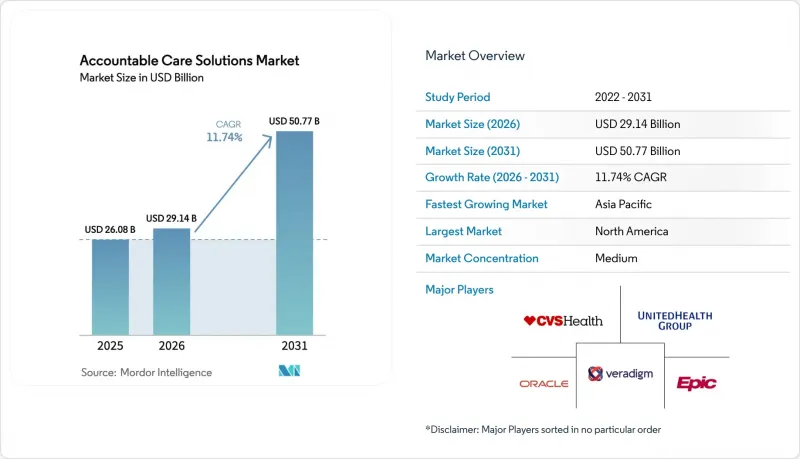
Mordor Intelligence에 의하면, 어카운터블 케어 솔루션 시장 규모는 2025년에 260억 8,000만 달러로 평가되었습니다. 2026년 291억 4,000만 달러에서 2031년까지 507억 7,000만 달러에 이를 것으로 예상되며, 예측 기간(2026-2031년) CAGR은 11.74%를 나타낼 전망입니다.

본 보고서는 구성 요소(솔루션, 서비스), 용도(전자 건강 기록, 헬스케어 분석, 기타), 배포 방식(On-Premise, 기타), 조직 규모(대기업, 중소기업), 최종 사용자(의료 제공자, 헬스케어 지불자), 지역(북미, 유럽, 아시아태평양, 기타)별로 분류되어 있습니다. 시장 예측은 금액(달러) 기준으로 제시되어 있습니다.
세계의 어카운터블 케어 솔루션 시장 동향 및 인사이트
의무화된 가치 기반 의료 및 보상 제도 개혁
CMS(미국 의료보험 및 의료보조 서비스 센터)는 현재 476개의 책임의료기구(ACO)를 인증하고 있으며, 이들 기관은 총 1,120만 명 이상의 기존 메디케어 수급자의 진료를 관리하고 있습니다. 이는 성과 연계형 지불 방식으로의 명확한 전환을 뒷받침하는 것입니다. ACO 1차 진료 플렉스 모델과 같은 새로운 프로그램은 의료 서비스가 부족한 지역의 1차 진료 현대화를 위한 선행 투자를 제공합니다. 민간 보험사 및 메디케이드 프로그램도 이러한 모델을 모방하고 있어, 책임의료 솔루션 시장은 메디케어의 범위를 넘어 확장되고 있습니다. ACO REACH 프레임워크는 비용 관리에 더해 형평성 요건도 포함하고 있어, 가치 기반 진료가 성숙 단계에 접어들었음을 보여줍니다. 종량제 진료에 집착하는 의료 제공업체들은 상환 방식이 공유 절감 또는 정액 지급으로 전환됨에 따라 이익률 감소에 직면하고 있습니다.
의료 빅데이터 분석의 확대
이미 많은 병원이 임상적 판단의 근거로 예측 모델을 활용하고 있으며, 의료 AI에 대한 투자액은 2024년에 110억 달러에 달했으며, 그 대부분은 관리 업무의 자동화에 사용되고 있습니다. 최신 분석 플랫폼은 청구 데이터, 임상 데이터, 사회적 결정 요인 데이터를 통합하여 위험을 예측함과 동시에 치료의 공백을 거의 실시간으로 해소합니다. 책임 의료 솔루션 제공 주체 입장에서는 고위험 환자를 조기에 식별함으로써 예방 가능한 입원을 줄이고, 품질 점수와 공유 이익 가능성을 모두 향상시킬 수 있습니다. 데이터 세트가 더욱 풍부해짐에 따라, 실시간 대시보드는 임상의의 아웃리치 활동 우선순위 설정을 지원하며, 책임 의료 솔루션 시장에서 통합 플랫폼의 가치 제안을 강화하고 있습니다.
데이터 개인정보 보호 및 사이버 보안 취약점
2024년, 의료 산업에서는 677건의 대규모 정보 유출 사고가 발생하여 1억 8,240만 건의 기록이 유출되었습니다. 이로 인해 클라우드의 광범위한 도입에 대한 우려가 커졌습니다. Change Healthcare의 랜섬웨어 공격 사건만으로도 1억 명 이상의 환자가 영향을 받았으며, 상호 연결된 플랫폼 전체에 걸친 체계적 위험이 부각되었습니다. 정보 유출로 인한 평균 비용은 488만 달러에 달하고, 법적 책임에 대한 우려를 더욱 가중시켰습니다. 이에 대응하여 규제 당국은 보안 조치의 미비에 대해 벌칙을 부과하는 새로운 상호운용성 및 사이버 보안 기준을 마련하고, 공급업체에 방어 체계 강화를 촉구했습니다.
부문별 분석
솔루션은 2025년 매출의 61.62%를 차지했으며, 조직들이 임상, 재무, 집단 건강 관리 기능을 연계하는 통합 플랫폼을 선호하는 경향이 나타나고 있습니다. 플랫폼 가동 후에는 전문가에 의한 교육, 워크플로우 재설계, 지속적인 최적화가 필수적이기 때문에 서비스 부문의 연평균 성장률(CAGR)은 12.76%로 소프트웨어 부문을 상회할 것으로 전망됩니다. ACO(Accountable Care Organization, 책임 의료 조직)가 위험 조정 알고리즘 및 규제 보고의 미세 조정을 위해 외부 지원을 요청함에 따라, 책임 의료 솔루션 시장의 서비스 부문 규모는 확대될 것으로 예측됩니다. 에픽 시스템즈가 2024년에 176개 시설을 추가한 것은 종합적인 플랫폼으로의 통합 추세를 여실히 보여줍니다.
서비스의 성장은 지속적인 변경 관리 없이는 소프트웨어만으로는 성과를 낼 수 없습니다는 인식을 반영합니다. 의료 시스템은 분석 서비스(Analytics-as-a-Service), 가상 지휘 센터, 관리형 집단 건강 운영 계약을 체결하고 있습니다. 이러한 계약을 통해 자본 예산을 최소화하고 성과 지표에 대한 책임성을 솔루션 파트너에게 이전함으로써, 책임 의료 솔루션 시장의 성장 궤도가 강화되고 있습니다.
전자 건강 기록(EHR)은 2025년 매출의 28.96%를 차지하며, 하류 모든 워크플로우에서 데이터 수집의 기반이 되었습니다. 그러나 집단건강관리는 2031년까지 연평균 성장률(CAGR) 13.08%로 확대되어, 책임 의료 솔루션 시장의 주요 성장 동력이 될 전망입니다. 카이저 퍼머넌트가 캘리포니아주 전역에 이노바커의 집단건강관리 플랫폼을 도입하기로 결정한 것은 이러한 예방적 협력으로의 전환을 뒷받침합니다.
또한, 조직들이 위험 및 자원 활용 상황에 대한 종단간 가시성을 우선시함에 따라 분석, 수익 주기 자동화, 환자 참여 각 모듈도 탄력을 받고 있습니다. AI 기반 수익 주기 관리 도구는 이미 많은 병원에 도입되어 사전 승인 절차의 효율화와 청구 거절 감축에 기여하고 있습니다. 이러한 상호 연동된 용도는 EHR을 기반으로 확고히 자리 잡는 한편, 책임 의료(Accountable Care) 솔루션 시장에서 가치 기반 보상 제도의 성공을 주도하는 영향력 있는 집단건강관리 워크플로우에 대한 새로운 투자를 촉진하고 있습니다.
지역별 분석
북미는 2025년에 전 세계 매출의 42.10%를 차지했으며, 이는 이미 기존 메디케어 가입자의 53.4%를 책임 의료(ACO) 계약 하에 두고 있는 CMS(미국 의료보험 및 의료보조국)의 규정에 힘입은 것입니다. 2031년까지 연평균 성장률(CAGR) 10.82%를 나타낼 것으로 예측되는 이 지역의 성장은 초기 구축 단계에서 최적화 단계로의 전환을 나타냅니다. 클라우드 전환, AI를 접목한 집단건강관리, ACO REACH와 같은 형평성에 중점을 둔 모델이 기존 플랫폼의 업데이트 주기를 촉진하고 있습니다. Highmark Health와 같은 대규모 의료 시스템에서는 현재 관리 및 임상 분석을 위해 Epic과 Google Cloud를 연동하고 있으며, 이는 생태계 차원의 협력을 보여줍니다.
아시아태평양은 각국의 디지털 헬스 전략과 스타트업에 대한 자금 조달에 힘입어 연평균 성장률(CAGR) 12.34%로 가장 빠르게 성장하고 있는 지역입니다. 동남아시아만 해도 인도네시아의 Halodoc이 1억 달러 규모의 자금 조달 라운드를 완료함에 따라, 2024년 디지털 헬스 부문 매출은 61억 달러에 달했습니다. 태국, 호주, 싱가포르 정부는 AI, 원격의료, IoT 모니터링에 자금을 투자하고 있어, 다양한 규제 환경에 맞추어 솔루션을 현지화하는 벤더들에게 호기가 마련되고 있습니다. 데이터 주권에 관한 규정은 지역마다 크게 다르기 때문에 클라우드의 유연성이 매우 중요합니다.
유럽에서는 통합 의료의 의무화와 GDPR(EU 개인정보보호규정)(일반 데이터 보호 규정) 준수가 조달 기준을 형성하는 가운데, 연평균 성장률(CAGR) 11.33%로 확대되고 있습니다. 독일의 의료 분야 국가 클라우드 전략은 공공 부문의 지침이 엄격한 데이터 주권 기준을 설정하면서도, 도입을 어떻게 가속화할지를 보여주고 있습니다. 한편, 중동 및 아프리카는 연평균 성장률(CAGR) 11.90%로 확대되고 있으며, 이는 병원의 디지털화와 국가 보건 정보 교환 시스템에 대한 정부 주도의 투자를 반영한 것입니다. 남미는 연평균 성장률(CAGR) 11.59%로 성장하고 있으며, 각국이 보험 제도의 현대화와 원격의료에 대한 지원을 추진하는 동시에, 책임 의료(Accountable Care) 원칙을 활용하여 만성 질환의 부담을 관리하고 있습니다. 이러한 지역적 확산은 규제 체계는 다르지만, 책임 의료 솔루션 시장이 ‘더 낮은 비용으로 더 나은 성과’라는 공통된 목표를 달성하고 있음을 입증합니다.
기타 혜택
- 엑셀 형식 시장 예측(ME) 시트
- 3개월간의 애널리스트 지원
자주 묻는 질문
목차
제1장 서론
제2장 조사 방법
제3장 주요 요약
제4장 시장 구도
제5장 시장 규모 및 성장 예측
제6장 경쟁 구도
제7장 시장 기회 및 향후 전망
KTH 26.09.08According to Mordor Intelligence, the accountable care solutions market size was valued at USD 26.08 billion in 2025 and estimated to grow from USD 29.14 billion in 2026 to reach USD 50.77 billion by 2031, at a CAGR of 11.74% during the forecast period (2026-2031).
This report is Segmented by Component (Solutions and Services), Application (Electronic Health Records, Healthcare Analytics, and More), Deployment (On-Premise and More), Organization Size (Large Enterprises and SMEs), End User (Healthcare Providers and Healthcare Payers), and Geography (North America, Europe, Asia-Pacific, and More). The Market Forecasts are Provided in Terms of Value (USD).
Global Accountable Care Solutions Market Trends and Insights
Mandatory value-based-care and reimbursement reforms
CMS now counts 476 accountable care organizations (ACOs) that collectively manage care for over 11.2 million Traditional Medicare beneficiaries, underscoring a clear shift to outcome-linked payment. New programs such as the ACO Primary Care Flex Model provide upfront investment for primary-care modernization in underserved communities. Commercial insurers and Medicaid programs replicate these models, broadening the accountable care solutions market beyond Medicare. The ACO REACH framework adds equity mandates alongside cost controls, signaling a mature stage for value-based care. Providers that cling to fee-for-service see shrinking margins as reimbursement pivots toward shared savings and capitated payments.
Growing volumes of healthcare big-data analytics
A large percent of hospitals already rely on predictive models to inform clinical decisions, and healthcare AI funding climbed to USD 11 billion in 2024 with most capital aimed at administrative automation. Modern analytics platforms ingest claims, clinical, and social-determinant data to forecast risk and close care gaps in near real time. For accountable entities, earlier identification of high-risk patients trims avoidable admissions, improving both quality scores and shared-savings potential. As datasets grow richer, real-time dashboards help clinicians prioritize outreach, reinforcing the value proposition of integrated platforms within the accountable care solutions market.
Data-privacy & cyber-security vulnerabilities
Healthcare experienced 677 large-scale breaches in 2024, exposing records of 182.4 million people and raising hesitation around expansive cloud deployments. The Change Healthcare ransomware incident alone affected more than 100 million patients and highlighted systemic risk across interconnected platforms. Average breach costs reached USD 4.88 million, amplifying liability concerns. Regulators responded by finalizing new interoperability and cybersecurity standards that impose penalties for lax security, forcing vendors to fortify defenses.
Other drivers and restraints analyzed in the detailed report include:
- Need to curb escalating healthcare expenditures
- Rapid migration toward scalable cloud-first IT stacks
- High CAPEX/OPEX for legacy-to-digital transformation
For complete list of drivers and restraints, kindly check the Table Of Contents.
Segment Analysis
Solutions generated 61.62% of 2025 revenue, showing that organizations favor unified platforms linking clinical, financial, and population-health functions. Services will outpace software with a 12.76% CAGR because expert training, workflow redesign, and ongoing optimization are indispensable once platforms go live. The accountable care solutions market size for services is projected to widen as ACOs seek external help to fine-tune risk-adjustment algorithms and regulatory reporting. Epic Systems' addition of 176 facilities in 2024 illustrates a consolidation wave toward comprehensive platforms.
Services growth reflects recognition that software alone cannot deliver outcomes without sustained change management. Health systems contract for analytics-as-a-service, virtual command centers, and managed population-health operations. These arrangements keep capital budgets lean and shift accountability for performance metrics to solution partners, reinforcing the trajectory of the accountable care solutions market
Electronic health records hold 28.96% of 2025 revenue, anchoring data capture for every downstream workflow. Yet population & care management will rise at a 13.08% CAGR to 2031, becoming the primary engine of the accountable care solutions market. Kaiser Permanente's decision to deploy Innovaccer's population-health platform across California underscores this pivot toward proactive coordination.
Analytics, revenue-cycle automation, and patient-engagement modules also gain momentum as organizations prioritize end-to-end visibility into risk and resource use. AI-based revenue-cycle tools are already live in a large number of hospitals, streamlining pre-authorization and reducing denials. These interconnected applications cement EHRs as a foundation but push new spending toward high-impact population-health workflows that drive value-based reimbursement success within the accountable care solutions market.
Complete Report Scope:
- By Component
- Solutions
- Services
- By Application
- Electronic Health Records
- Healthcare Analytics
- Population & Care Management
- Revenue Cycle & Claims Management
- Payment & Risk Adjustment
- Health Information Exchange (HIE)
- Patient Engagement & Portals
- Other Applications
- By Deployment Mode
- Cloud-Based
- On-Premise
- Hybrid
- By Organization Size
- Large Enterprises
- SMEs
- By End-User
- Healthcare Providers
- Healthcare Payers
- By Geography
- North America
- United States
- Canada
- Mexico
- Europe
- Germany
- United Kingdom
- France
- Italy
- Spain
- Rest of Europe
- Asia-Pacific
- China
- India
- Japan
- Australia
- South Korea
- Rest of Asia-Pacific
- Middle East and Africa
- GCC
- South Africa
- Rest of Middle East and Africa
- South America
- Brazil
- Argentina
- Rest of South America
- North America
Geography Analysis
North America generated 42.10% of global revenue in 2025, supported by CMS rules that already place 53.4% of Traditional Medicare members under accountable care contracts. Regional growth of 10.82% CAGR through 2031 represents a shift from initial build-out to optimization. Cloud migration, AI-embedded population health, and equity-focused models such as ACO REACH drive refresh cycles of existing platforms. Large systems like Highmark Health now link Epic and Google Cloud for administrative and clinical analytics, demonstrating ecosystem-level collaboration.
Asia-Pacific is the fastest-growing territory at 12.34% CAGR, propelled by national digital-health blueprints and startup funding. Southeast Asia alone projects USD 6.1 billion in digital-health revenue for 2024, aided by Indonesia's Halodoc closing a USD 100 million round. Governments in Thailand, Australia, and Singapore inject capital into AI, telemedicine, and IoT monitoring, creating fertile ground for vendors that localize solutions to diverse regulatory settings. Cloud flexibility is critical because data sovereignty rules vary widely across the region.
Europe expands at 11.33% CAGR as integrated-care mandates and GDPR compliance shape procurement criteria. Germany's national cloud strategy for healthcare shows how public-sector guidance accelerates adoption while setting strict data-sovereignty bars. Meanwhile, the Middle East & Africa advance at 11.90% CAGR, reflecting sovereign investments in hospital digitization and national health-information exchanges. South America grows at 11.59% CAGR as countries modernize insurance schemes and subsidize telehealth, using accountable care principles to manage chronic-disease burdens. The geographic spread proves that, while regulatory frameworks differ, the accountable care solutions market meets a common goal: better outcomes at lower cost.
- Aledade, Inc.
- Arcadia Solutions, LLC
- Athenahealth
- Conifer Health Solutions
- CVS Health
- eClinicalWorks
- Epic Systems
- Evolent Health LLC
- Exlservice Holdings, Inc.
- Health Catalyst, Inc.
- Lumeris, Inc.
- Mckesson
- Medecision, Inc.
- Merative L.P.
- Oracle
- Persivia, Inc.
- Signify Health, Inc.
- United Health Group
- Veradigm, Inc.
- ZeOmega, Inc.
Additional Benefits:
- The market estimate (ME) sheet in Excel format
- 3 months of analyst support
TABLE OF CONTENTS
1 Introduction
- 1.1 Study Assumptions & Market Definition
- 1.2 Scope of the Study
2 Research Methodology
3 Executive Summary
4 Market Landscape
- 4.1 Market Overview
- 4.2 Market Drivers
- 4.2.1 Mandatory value-based-care and reimbursement reforms
- 4.2.2 Growing volumes of healthcare big-data analytics
- 4.2.3 Need to curb escalating healthcare expenditures
- 4.2.4 Rapid migration toward scalable cloud-first IT stacks
- 4.2.5 AI-powered social-determinants risk-stratification use cases
- 4.2.6 Provider-enablement venture platforms integrating tech + MSO services
- 4.3 Market Restraints
- 4.3.1 Data-privacy & cyber-security vulnerabilities
- 4.3.2 High CAPEX/OPEX for legacy-to-digital transformation
- 4.3.3 Fragmented interoperability across disparate systems
- 4.3.4 Clinician burnout due to EHR workload & alert-fatigue
- 4.4 Technological Outlook
- 4.5 Porter's Five Forces Analysis
- 4.5.1 Bargaining Power of Suppliers
- 4.5.2 Bargaining Power of Buyers
- 4.5.3 Threat of New Entrants
- 4.5.4 Threat of Substitute Products
- 4.5.5 Intensity of Competitive Rivalry
5 Market Size & Growth Forecasts (Value)
- 5.1 By Component
- 5.1.1 Solutions
- 5.1.2 Services
- 5.2 By Application
- 5.2.1 Electronic Health Records
- 5.2.2 Healthcare Analytics
- 5.2.3 Population & Care Management
- 5.2.4 Revenue Cycle & Claims Management
- 5.2.5 Payment & Risk Adjustment
- 5.2.6 Health Information Exchange (HIE)
- 5.2.7 Patient Engagement & Portals
- 5.2.8 Other Applications
- 5.3 By Deployment Mode
- 5.3.1 Cloud-Based
- 5.3.2 On-Premise
- 5.3.3 Hybrid
- 5.4 By Organization Size
- 5.4.1 Large Enterprises
- 5.4.2 SMEs
- 5.5 By End-User
- 5.5.1 Healthcare Providers
- 5.5.2 Healthcare Payers
- 5.6 By Geography
- 5.6.1 North America
- 5.6.1.1 United States
- 5.6.1.2 Canada
- 5.6.1.3 Mexico
- 5.6.2 Europe
- 5.6.2.1 Germany
- 5.6.2.2 United Kingdom
- 5.6.2.3 France
- 5.6.2.4 Italy
- 5.6.2.5 Spain
- 5.6.2.6 Rest of Europe
- 5.6.3 Asia-Pacific
- 5.6.3.1 China
- 5.6.3.2 India
- 5.6.3.3 Japan
- 5.6.3.4 Australia
- 5.6.3.5 South Korea
- 5.6.3.6 Rest of Asia-Pacific
- 5.6.4 Middle East and Africa
- 5.6.4.1 GCC
- 5.6.4.2 South Africa
- 5.6.4.3 Rest of Middle East and Africa
- 5.6.5 South America
- 5.6.5.1 Brazil
- 5.6.5.2 Argentina
- 5.6.5.3 Rest of South America
- 5.6.1 North America
6 Competitive Landscape
- 6.1 Market Concentration
- 6.2 Competitive Benchmarking
- 6.3 Market Share Analysis
- 6.4 Company Profiles (includes Global level Overview, Market level overview, Core Segments, Financials as available, Strategic Information, Market Rank/Share for key companies, Products & Services, and Recent Developments)
- 6.4.1 Aledade, Inc.
- 6.4.2 Arcadia Solutions, LLC
- 6.4.3 athenahealth, Inc.
- 6.4.4 Conifer Health Solutions, LLC
- 6.4.5 CVS Health Corporation
- 6.4.6 eClinicalWorks, LLC
- 6.4.7 Epic Systems Corporation
- 6.4.8 Evolent Health LLC
- 6.4.9 Exlservice Holdings, Inc.
- 6.4.10 Health Catalyst, Inc.
- 6.4.11 Lumeris, Inc.
- 6.4.12 McKesson Corporation
- 6.4.13 Medecision, Inc.
- 6.4.14 Merative L.P.
- 6.4.15 Oracle Corporation
- 6.4.16 Persivia, Inc.
- 6.4.17 Signify Health, Inc.
- 6.4.18 UnitedHealth Group
- 6.4.19 Veradigm, Inc.
- 6.4.20 ZeOmega, Inc.
7 Market Opportunities & Future Outlook
- 7.1 White-space & Unmet-Need Assessment


