|
시장보고서
상품코드
2122736
장기 칩 : 시장 점유율 분석, 업계 동향 및 통계, 성장 예측(2026-2031년)Organ-on-chip - Market Share Analysis, Industry Trends & Statistics, Growth Forecasts (2026 - 2031) |
||||||
 Mordor Intelligence
Mordor Intelligence에 의하면, 장기 칩 시장 규모는 2025년 3억 9,000만 달러로 평가되었습니다. 2026년에는 5억 1,000만 달러로 확대되어 2026-2031년에 걸쳐 CAGR 29.63%로 성장을 지속하여, 2031년까지 18억 5,000만 달러에 이를 것으로 예측됩니다.

본 보고서에서는 산업을 장기 유형(간, 심장, 폐, 기타), 용도(신약 개발·리드 화합물 동정, 기타), 최종 사용자(제약·바이오기술 기업, 학술·연구 기관, 기타), 지역(북미, 유럽, 아시아태평양, 중동 및 아프리카, 남미)별로 분류하고 있습니다. 시장 전망은 금액(달러) 기준으로 제시됩니다.
세계의 장기 칩 시장 동향 및 인사이트
동물을 사용하지 않는 전임상시험으로의 전 세계적 전환이 의무화됩니다.
2025년 10월 FDA가 단일클론 항체에 대한 의무적인 동물 실험을 단계적으로 폐지하기로 결정한 데 더해, ‘FDA 현대화법 2.0’의 시행에 따라 인간과 유사한 실험 플랫폼의 도입이 가속화되고 있습니다. 개발자가 비동물 데이터를 제출할 수 있도록 하는 FDA의 시범 프로그램에 따라, 제약 기업들은 사내 프로토콜을 재검토하고 스크리닝 예산을 장기 칩에 할당하고 있습니다. 유럽에서도 규제 당국이 동물 실험에 대한 규제를 강화하는 가운데, 유사한 움직임이 관찰되고 있습니다. 이러한 정책적 움직임은 안정적인 수요를 뒷받침하고, 계약 연구 기관(CRO) 간의 조달 체계를 촉진하며, 플랫폼 공급업체의 판매 주기를 단축시키고 있습니다. 칩과 AI를 활용한 분석 기능을 결합한 기업들은 2025년 이후의 규정 준수 기한에 부합하는 턴키 솔루션을 제공할 수 있으므로 가장 큰 혜택을 볼 것으로 예측됩니다. 따라서 동물 비사용 검사의 의무화는 오가노-온-칩 시장의 중기적인 수익 전망을 확고히 하고 있습니다.
더 우수한 모델이 필요한 만성·복잡 질환의 큰 부담
대사증후군, 비알코올성 지방간 질환(NAFLD), 신경퇴행성 질환 등의 만성 질환은 전 세계 유병률에서 차지하는 비중을 확대되고 있습니다. 2024년 Hesperos의 다장기 칩을 활용한 연구에서는 NAFLD의 진행이 재현되었으며, 동물 모델에서는 간과되기 쉬운 치료 적기가 밝혀졌습니다. 이처럼 인간의 병태생리를 모방할 수 있는 능력은 연구 개발의 ‘계속할지 중단할지’에 대한 의사결정을 지원하고, 임상시험에서 발생하는 실패 비용을 절감합니다. 특히 고령화가 진행되고 대규모 공적 보험 제도를 갖춘 시장에서는 수요가 두드러지며, 이러한 시장에서는 현재 환자의 예후에 직접 기여하는 중개 연구가 우선시되고 있습니다. 이러한 의료 제도가 예측의 타당성 향상을 추진하는 가운데, 장기 칩은 필수적인 도구로 부상하고 있으며, 장기 온 칩 시장의 장기적인 성장세를 뒷받침하고 있습니다.
기술적 복잡성과 기술 격차가 보급을 저해
마이크로플루이딕스 플랫폼의 운영에는 세포 생물학, 공학, 센서 통합과 같은 여러 분야를 아우르는 전문 지식이 요구됩니다. 2024년 5월 『Frontiers in Lab-on-a-Chip Technology』지에 게재된 총설에서는 소규모 연구실을 대상으로 조사가 진행되었으며, 훈련된 인력과 표준화된 프로토콜에 대한 접근이 제한적이라는 사실이 밝혀졌습니다. 다기관 시스템의 경우, 각 모듈에서 정밀한 유량 제어와 동기화된 데이터 수집이 요구되므로 그 부담은 더욱 커집니다. 이러한 격차를 해소하기 위해 산업 단체들은 모듈식 장치, 배지 자동 교체, 클라우드 기반 분석을 제안하고 있습니다. 그러나 이러한 도구들이 주류가 되기 전까지는 특히 일류 연구 거점 이외의 곳에서는 그 복잡성 때문에 보급이 제한될 것으로 보입니다.
부문별 분석
2025년, 폐 칩은 호흡기 독성, 감염병 조사, 에어로졸 전달 연구에서의 유용성으로 인해 장기 온 칩 시장 점유율의 34.12%를 차지했습니다. POSTECH 연구진이 발표한 고충실도 3D 바이오 프린팅 폐포 구조체는 모델의 타당성을 높였으며, 백신 제조업체로부터의 자금 조달을 유도했습니다. 이러한 플랫폼은 기도의 생체역학을 모방하고, 섬모의 박동 빈도 등의 종점 측정을 가능하게 하며, 면역 세포층을 통합하고 있습니다. 코로나19 이후 규제 당국이 호흡기 의약품의 안전성을 우선시함에 따라 조달 수요는 견조한 추세를 보이고 있습니다. 이와 동시에, ‘하트 온 칩(Heart-on-a-chip)’ 장치는 부정맥 선별 검사 및 항암제의 심장 독성 검사에 힘입어 2031년까지 연평균 성장률(CAGR) 32.11%라는 가장 높은 성장률을 기록할 전망입니다. 힘 감지 마이크로 와이어를 이식하는 자동 제조 기술로 인해 수작업에 소요되는 시간이 단축되어, 학술 기관의 핵심 시설에서의 도입 확대가 촉진되고 있습니다.
신경퇴행성 질환 연구에서 연구자들이 설치류 모델을 대체할 방법을 모색하고 있어, 뇌 및 중추신경계 하위 부문이 성장세를 보이고 있습니다. 신장 및 간 기반 칩은 확고한 입지를 구축하고 있으며, 특히 간 칩은 ISTAND 검증을 거친 인간용 ‘Liver-Chip’의 혜택을 받아 대사계 후보 화합물의 안전성 평가 패키지의 핵심을 담당하고 있습니다. 혈관, 상피, 면역 각 구성 요소를 연결한 다기관 어레이는 다음 단계의 개척 분야가 될 것입니다. 후원자들이 전신 약리학 연구로 전환함에 따라, 즉시 사용 가능한 모듈식 플레이트를 제공하는 공급업체의 수주 증가가 예상됩니다.
지역별 분석
북미는 FDA의 ISTAND 프레임워크, 풍부한 벤처 자금, 아이비리그 대학과 대형 제약사의 협력에 힘입어 2025년 ‘오가노이드 온 칩’ 시장 매출의 42.15%를 차지했습니다. 미국에서는 초기 단계의 칩 검사의 대부분이 수행되는 반면, 캐나다는 수탁 제조업체에 공급되는 폴리머 미세 제조 전문 지식을 제공합니다. 메디케어의 ‘증거 기반 보장(coverage-with-evidence)’ 패러다임에 따른 환급 시범 사업은 병원 기반의 중개 연구를 더욱 촉진하고 있습니다.
아시아태평양은 2031년까지 34.21%라는 가장 높은 연평균 성장률(CAGR)을 나타낼 전망입니다. 중국은 마이크로플루이딕스학 도구 개발을 지원하는 국가 보조금을 활용하고 있으며, 그 위탁 연구 생태계는 다국적 기업의 아웃소싱 수요에 대응할 수 있도록 빠르게 확장되고 있습니다. 일본의 의약품 및 의료기기종합기구(PMDA)는 미세생리학적 데이터 제출에 관한 지침을 발표하여, 국내 개발자들에게 국내 승인을 위한 로드맵을 제시했습니다. 한국의 컨소시엄은 칩 생산을 세포 및 유전자 치료 관련 국가 이니셔티브와 연계하여 시너지 효과를 창출하고 있습니다.
유럽은 ‘호라이즌 유럽(Horizon Europe)’의 보조금과 견고한 학술 네트워크를 원동력으로 삼아 견고한 시장 점유율을 유지하고 있습니다. 2024년 7월에 공개된 CEN/CENELEC의 로드맵은 재료 적합성 평가, 멸균, 세포 무결성에 관한 로드맵을 제시하며, 실험실 간 비교 가능성을 촉진하고 있습니다. 프랑스와 독일은 나노 스케일 공학과 인간 1차 세포 은행을 결합한 산업 클러스터에 자금을 지원하고 있습니다. 이 지역의 엄격한 동물 복지 규제로 인해, 특히 안전성 약리학 및 화장품 부문에서 생체 내 시험에서 칩 모델로의 전환이 가속화되고 있습니다.
기타 혜택
- 엑셀 형식 시장 예측(ME) 시트
- 3개월간의 애널리스트 지원
자주 묻는 질문
목차
제1장 서론
제2장 조사 방법
제3장 주요 요약
제4장 시장 구도
제5장 시장 규모 및 성장 예측
제6장 경쟁 구도
제7장 시장 기회 및 향후 전망
KTH 26.09.08According to Mordor Intelligence, the organ-on-chip market size is expected to grow from USD 390 million in 2025 to USD 510 million in 2026 and is forecast to reach USD 1.85 billion by 2031 at 29.63% CAGR over 2026-2031.
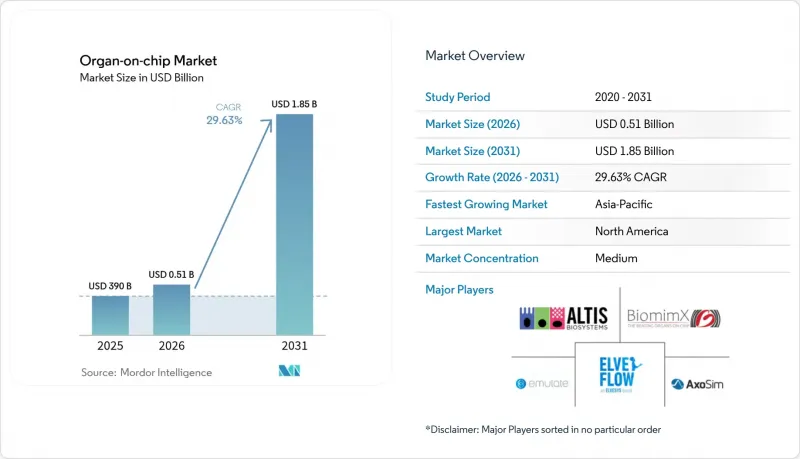
This report Segments the Industry Into by Organ Type (Liver, Heart, Lung, and More), Application (Drug Discovery and Lead Identification, and More), End User (Pharmaceutical and Biotechnology Companies, Academic and Research Institutes, and More) and Geography (North America, Europe, Asia-Pacific, Middle East and Africa, South America). The Market Forecasts are Provided in Terms of Value (USD).
Global Organ-on-chip Market Trends and Insights
Global Shift Toward Animal-Free Preclinical Testing Mandates
The FDA's decision in October 2025 to phase out compulsory animal studies for monoclonal antibodies, coupled with the FDA Modernization Act 2.0, is accelerating uptake of human-relevant test beds. The agency's pilot program that lets developers submit non-animal data has prompted pharmaceutical groups to revise internal protocols and divert screening budgets to organ chips. Europe is moving in parallel as regulators tighten restrictions on animal research. These policy moves create a stable demand floor, drive procurement frameworks among contract research organizations, and shorten sales cycles for platform vendors. Firms that combine chips with AI-enabled analytics stand to benefit most because they offer a turnkey path that aligns with post-2025 compliance deadlines. The animal-free mandate therefore anchors medium-term revenue visibility in the organ-on-chip market.
High Burden of Chronic & Complex Diseases Requiring Better Models
Chronic disorders such as metabolic syndrome, non-alcoholic fatty liver disease, and neurodegenerative conditions account for an expanding share of global morbidity. A 2024 study using Hesperos' multi-organ chip replicated NAFLD progression and highlighted therapeutic windows that animal models miss. This ability to mimic human pathophysiology supports go-no-go R&D decisions and lowers clinical attrition costs. Demand is especially pronounced in markets with aging populations and sizable public insurance schemes, which now prioritize translational research that directly benefits patient outcomes. As these health systems push for higher predictive validity, organ chips emerge as indispensable tools, sustaining long-term momentum in the organ-on-chip market.
Technical Complexity & Skill Gap Hindering Broad Adoption
Operating microfluidic platforms demands cross-disciplinary expertise in cell biology, engineering, and sensor integration. A May 2024 review in Frontiers in Lab-on-a-Chip Technology surveyed smaller laboratories and found limited access to trained personnel and standardized protocols. Multi-organ systems exacerbate the burden because each module requires tight flow control and synchronized data capture. To bridge the gap, industry groups advocate modular devices, automated media exchange, and cloud-based analytics. Yet, until these tools become mainstream, complexity will temper uptake, particularly outside tier-one research hubs.
Other drivers and restraints analyzed in the detailed report include:
- Rising Demand for Precision Medicine & Patient-Derived Chips
- Need for Early Detection of Drug Toxicity and New Product Launches
- High Capital & Operating Costs of Microfluidic Infrastructure
For complete list of drivers and restraints, kindly check the Table Of Contents.
Segment Analysis
Lung chips commanded 34.12% of the organ-on-chip market share in 2025 due to their utility in respiratory toxicity, infectious-disease research, and aerosol delivery studies. The launch of high-fidelity 3D-bioprinted alveolar constructs by POSTECH researchers has strengthened model relevance and drawn funding from vaccine makers. These platforms mimic airway biomechanics, enable endpoints such as ciliary beat frequency, and integrate immune cell layers. With regulatory agencies prioritizing respiratory-drug safety following COVID-19, procurement remains steady. In parallel, heart-on-chip devices are on track for the fastest 32.11% CAGR through 2031, driven by arrhythmia screening and cardiotoxicity testing for oncology compounds. Automated fabrication that embeds force-sensing microwires reduces hands-on time and encourages broader deployment across academic core facilities.
The brain and central-nervous-system subsegment is gaining momentum as researchers seek alternatives to rodent models in neurodegenerative research. Kidney- and liver-based chips hold strong positions; the latter benefits from the ISTAND-validated human Liver-Chip, which anchors safety packages for metabolic candidates. Multi-organ arrays linking vascular, epithelial, and immune components represent the next frontier. Vendors that offer ready-to-use, modular plates stand to capture incremental orders as sponsors move toward systemic pharmacology studies.
Complete Report Scope:
- By Organ Type
- Liver
- Heart
- Lung
- Kidney
- Intestine
- Brain & CNS
- Skin
- Multi-Organ & Other Complex Systems
- By Application
- Drug Discovery & Lead Identification
- ADME/Toxicology Screening
- Disease Modeling
- Precision Medicine & Personalized Therapy
- Other Applications
- By End User
- Pharmaceutical & Biotechnology Companies
- Contract Research Organizations
- Academic & Research Institutes
- Cosmetics & Personal Care Industry
- Other End Users
- By Geography
- North America
- United States
- Canada
- Mexico
- Europe
- Germany
- United Kingdom
- France
- Italy
- Spain
- Rest of Europe
- Asia-Pacific
- China
- Japan
- India
- Australia
- South Korea
- Rest of Asia-Pacific
- Middle East & Africa
- GCC
- South Africa
- Rest of Middle East & Africa
- South America
- Brazil
- Argentina
- Rest of South America
- North America
Geography Analysis
North America generated 42.15% of 2025 revenue for the organ-on-chip market, buoyed by the FDA's ISTAND framework, deep venture pools, and collaborations between Ivy League universities and big pharma. The United States hosts most early-stage chip trials, while Canada supplies polymer microfabrication expertise that feeds contract manufacturers. Reimbursement pilots under Medicare's coverage-with-evidence paradigm further encourage hospital-based translational studies.
Asia-Pacific is on course for the swiftest 34.21% CAGR through 2031. China leverages state grants that subsidize microfluidic tooling, and its contract research ecosystem scales at speed to handle multinational outsourcing. Japan's Pharmaceuticals and Medical Devices Agency has issued guidance on microphysiological data submissions, giving local developers a route to domestic approval. South Korean consortia align chip production with national initiatives in cell and gene therapy, creating synergistic demand.
Europe maintains a robust share powered by Horizon Europe grants and a consolidated academic network. The CEN/CENELEC roadmap published in July 2024 maps pathways for material qualification, sterilization, and cell integrity that foster cross-lab comparability. France and Germany finance industry clusters that pair nanoscale engineering with primary human-cell banks. The region's stringent animal-welfare rules accelerate substitution of in vivo assays with chip models, especially in safety pharmacology and cosmetics.
- Emulate
- Mimetas
- CN Bio Innovations
- TissUse
- Hesperos
- AxoSim Technologies
- Altis Biosystems
- InSphero
- Nortis
- Kirkstall Ltd
- Netri SAS
- BiomimX
- Bi/ond BV
- Organovo
- Allevi Inc. (3D Systems)
- Elveflow (Elvesys)
- Hurel
- Valo Health (Tara Biosystems)
- SynVivo (CFD Research)
- BioChip Technologies GmbH
Additional Benefits:
- The market estimate (ME) sheet in Excel format
- 3 months of analyst support
TABLE OF CONTENTS
1 Introduction
- 1.1 Study Assumptions & Market Definition
- 1.2 Scope of the Study
2 Research Methodology
3 Executive Summary
4 Market Landscape
- 4.1 Market Overview
- 4.2 Market Drivers
- 4.2.1 Global Shift Toward Animal-Free Preclinical Testing Mandates
- 4.2.2 High Burden of Chronic & Complex Diseases Requiring Better Models
- 4.2.3 Rising Demand for Precision Medicine & Patient-Derived Chips
- 4.2.4 Need for Early Detection of Drug Toxicity and New Products Launches
- 4.2.5 Strategic Investments & Partnerships Accelerating Commercialization
- 4.2.6 Technological Advances in Microfabrication & 3D Bioprinting
- 4.3 Market Restraints
- 4.3.1 Technical Complexity & Skill Gap Hindering Broad Adoption
- 4.3.2 High Capital & Operating Costs of Microfluidic Infrastructure
- 4.3.3 Limited Regulatory Validation & Harmonized Guidelines
- 4.3.4 High CapEx for Automated Microfluidic Tool-chains
- 4.4 Regulatory Landscape
- 4.5 Porter's Five Forces Analysis
- 4.5.1 Threat of New Entrants
- 4.5.2 Bargaining Power of Buyers
- 4.5.3 Bargaining Power of Suppliers
- 4.5.4 Threat of Substitutes
- 4.5.5 Intensity of Competitive Rivalry
5 Market Size & Growth Forecasts (Value in USD)
- 5.1 By Organ Type
- 5.1.1 Liver
- 5.1.2 Heart
- 5.1.3 Lung
- 5.1.4 Kidney
- 5.1.5 Intestine
- 5.1.6 Brain & CNS
- 5.1.7 Skin
- 5.1.8 Multi-Organ & Other Complex Systems
- 5.2 By Application
- 5.2.1 Drug Discovery & Lead Identification
- 5.2.2 ADME/Toxicology Screening
- 5.2.3 Disease Modeling
- 5.2.4 Precision Medicine & Personalized Therapy
- 5.2.5 Other Applications
- 5.3 By End User
- 5.3.1 Pharmaceutical & Biotechnology Companies
- 5.3.2 Contract Research Organizations
- 5.3.3 Academic & Research Institutes
- 5.3.4 Cosmetics & Personal Care Industry
- 5.3.5 Other End Users
- 5.4 By Geography
- 5.4.1 North America
- 5.4.1.1 United States
- 5.4.1.2 Canada
- 5.4.1.3 Mexico
- 5.4.2 Europe
- 5.4.2.1 Germany
- 5.4.2.2 United Kingdom
- 5.4.2.3 France
- 5.4.2.4 Italy
- 5.4.2.5 Spain
- 5.4.2.6 Rest of Europe
- 5.4.3 Asia-Pacific
- 5.4.3.1 China
- 5.4.3.2 Japan
- 5.4.3.3 India
- 5.4.3.4 Australia
- 5.4.3.5 South Korea
- 5.4.3.6 Rest of Asia-Pacific
- 5.4.4 Middle East & Africa
- 5.4.4.1 GCC
- 5.4.4.2 South Africa
- 5.4.4.3 Rest of Middle East & Africa
- 5.4.5 South America
- 5.4.5.1 Brazil
- 5.4.5.2 Argentina
- 5.4.5.3 Rest of South America
- 5.4.1 North America
6 Competitive Landscape
- 6.1 Market Concentration
- 6.2 Strategic Moves
- 6.3 Market Share Analysis
- 6.4 Company Profiles (includes Global level Overview, Market level overview, Core Segments, Financials as available, Strategic Information, Market Rank/Share for key companies, Products & Services, and Recent Developments)
- 6.4.1 Emulate Inc.
- 6.4.2 MIMETAS BV
- 6.4.3 CN Bio Innovations
- 6.4.4 TissUse GmbH
- 6.4.5 Hesperos Inc.
- 6.4.6 AxoSim Technologies
- 6.4.7 Altis Biosystems
- 6.4.8 InSphero AG
- 6.4.9 Nortis Inc.
- 6.4.10 Kirkstall Ltd
- 6.4.11 Netri SAS
- 6.4.12 BiomimX SRL
- 6.4.13 Bi/ond BV
- 6.4.14 Organovo Holdings Inc.
- 6.4.15 Allevi Inc. (3D Systems)
- 6.4.16 Elveflow (Elvesys)
- 6.4.17 Hurel Corporation
- 6.4.18 Valo Health (Tara Biosystems)
- 6.4.19 SynVivo (CFD Research)
- 6.4.20 BioChip Technologies GmbH
7 Market Opportunities & Future Outlook
- 7.1 White-space & Unmet-Need Assessment