|
시장보고서
상품코드
2122743
AaaS(Automation as a Service) 시장 : 시장 점유율 분석, 업계 동향 및 통계, 성장 예측(2026-2031년)Automation-as-a-Service - Market Share Analysis, Industry Trends & Statistics, Growth Forecasts (2026 - 2031) |
||||||
 Mordor Intelligence
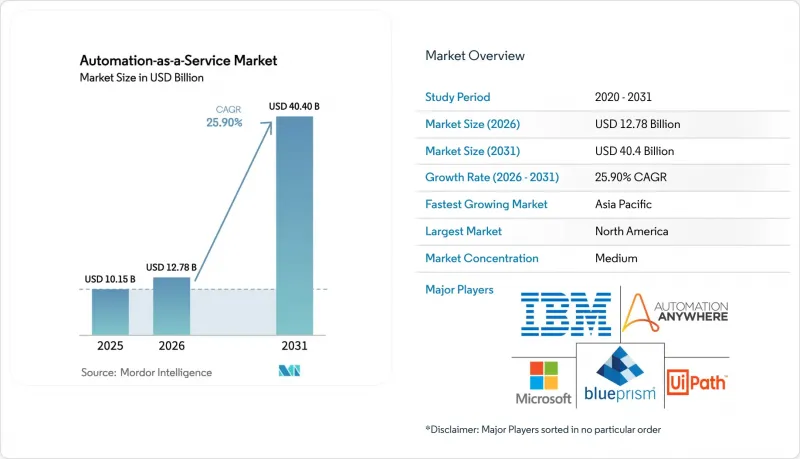
Mordor Intelligence에 의하면, AaaS(Automation as a Service) 시장 규모는 2025년 101억 5,000만 달러로 평가되었고, 2026년에는 127억 8,000만 달러로 추정되고, 2026-2031년 CAGR 25.9%로 성장을 지속할 전망이며, 2031년에는 404억 달러에 이를 것으로 예측됩니다.
본 보고서는 도입 형태별(온프레미스 및 클라우드), 구성 요소별(솔루션 및 서비스), 업무 기능별(정보 기술, 재무 및 회계 등), 기업 규모별(대기업 및 중소기업(SME)), 최종 사용자 업종별(은행, 금융서비스 및 보험(BFSI), 통신 및 IT, 소매 및 소비재 등), 그리고 지역별로 분류되어 있습니다.
세계의 AaaS(Automation as a Service) 시장 동향 및 인사이트
비즈니스 프로세스 자동화에 대한 수요 증가
현재, 새로 자동화된 워크플로우의 44%는 각 사업 부서에서 생성되고 있으며, 이는 시티즌 개발자가 중앙 IT 팀을 보완하고 있음을 보여줍니다. 수익 및 운영 관련 프로젝트가 가동 중인 자동화의 거의 절반을 차지하고 있어, 고객 중심 이용 사례로의 전환이 두드러지고 있습니다. 부서 간 팀이 업무 인계를 재설계함에 따라, 세밀한 권한 관리가 가능하면서도 로우코드 구성이 가능한 플랫폼에 대한 수요가 증가하고 있습니다. 또한 복잡성도 증가하고 있습니다. 가동 중인 봇의 61%는 단일 작업의 매크로가 아닌, 다단계 로직을 실행하고 있습니다. 고객 지원 프로세스는 세 자릿수의 성장을 기록하고 있으며, 비용 제약이 있는 경제 사이클에서 자동화가 고객 유지 전략과 밀접하게 연관되어 있음을 보여줍니다.
클라우드 우선 IT 전략이 AaaS 도입을 가속화
멀티테넌트 아키텍처를 통해 제공업체는 예정된 다운타임 없이 모든 클라이언트 인스턴스에 새로운 기능을 배포할 수 있어 혁신 주기를 단축할 수 있습니다. Infrastructure-as-Code(IaC) 템플릿은 테스트, 스테이징, 프로덕션 각 환경에서의 프로비저닝을 표준화함으로써 마찰을 더욱 줄여줍니다. 중소기업의 경우, 종량제 요금제를 활용함으로써 자동화 관련 지출이 운영 예산에 포함되고, 서버 유지보수 관련 간접비가 해소됩니다. 하이브리드 환경을 갖춘 기업은 지연 시간에 민감한 워크로드를 엣지에 배치하는 동시에, 클라우드상에서 정책을 중앙 집중식으로 조정함으로써 데이터 주권 관련 규정과 유연한 확장성 간의 균형을 맞추고 있습니다. 그 결과, 클라우드 중심 도입이 AaaS(Automation-as-a-Service) 시장 전체의 성장률을 상회하고 있습니다.
멀티테넌트형 클라우드에서의 데이터 보안 및 개인정보 보호에 대한 우려
공유 인프라 모델에서는 격리 제어가 제대로 작동하지 않을 경우, 횡방향 이동(lateral movement)의 위험이 높아집니다. 이는 금융 서비스 및 의료 분야의 구매자에게 가장 큰 우려 사항입니다. 이 문제는 AI 코파일럿이 광범위한 OAuth 범위를 상속받아 프롬프트 주입을 통해 기밀 컨텐츠가 유출될 가능성이 있는 경우 더욱 심각해집니다. 유럽 규제 당국은 엄격한 데이터 상주 요건 및 자동 의사 결정 공개 규정을 시행하고 있으며, 공급자에게 암호화 표준 인증 및 로그 분리를 의무화하고 있습니다. 벤더 측은 고객 관리형 키, 지역 제한 데이터 저장소, 지속적인 규정 준수 대시보드 등을 도입하여 이에 대응하고 있습니다. 도입 추세는 여전히 견조하지만, 규제가 엄격한 분야의 구매자들은 위험이 낮은 프로세스부터 시작하는 단계적 도입을 추진하고 있습니다.
부문 분석
2025년, 온프레미스 도입은 AaaS(Automation as a Service) 시장에서 67.62%의 점유율을 유지했습니다. 이는 금융 및 공공 부문의 엄격한 주권 요구 사항과 이미 투입된 하드웨어 투자를 반영한 것입니다. 그럼에도 불구하고, 조직들이 인프라 유지 관리 부담을 줄이기 위해 비핵심 워크플로우와 개발용 샌드박스를 이전함에 따라 클라우드 기반 솔루션은 연평균 성장률(CAGR) 27.3%로 확대되고 있습니다. 각 벤더는 현재 감사 요건을 충족하면서 탄력적인 확장성과 자동 패치 적용을 유지하는 싱글 테넌트형 VPC 옵션을 제공합니다. 엣지 배포에서는 지연 시간에 민감한 작업의 데이터를 로컬에서 처리한 후, 강화된 페이로드를 중앙 분석 시스템으로 전송함으로써 성능과 거버넌스의 균형을 맞춘 하이브리드 토폴로지를 구축하고 있습니다. 계약에서는 통합된 대시보드 아래에서 두 가지 운영 모드를 묶는 사례가 증가하고 있으며, 관리자는 비용이나 규정 준수 요건에 따라 워크로드를 동적으로 전환할 수 있게 되었습니다. 이러한 유연성 덕분에 클라우드 모델은 ‘AaaS(Automation as a Service)’ 시장의 장기적인 성장 동력으로서의 입지를 확고히 하고 있으며, 특히 데이터센터 자산을 한 번도 보유한 적이 없는 신규 디지털 비즈니스에서 이러한 경향이 두드러집니다.
2025년에는 플랫폼 라이선스와 봇 제작 스튜디오가 대부분의 구매자에게 진입점이 되었기 때문에 솔루션이 매출의 66.05%를 차지했습니다. 그러나 기업들이 디자인 사고, 변경 관리, 지속적인 개선에 대한 전문 지식을 추구함에 따라, 서비스 부문은 2031년까지 연평균 성장률(CAGR) 27.2%를 기록하며 소프트웨어 매출을 상회할 것으로 예측됩니다. 관리형 서비스 제공업체는 런북을 정비하고, 봇의 정상 작동을 모니터링하며, 보안 패치를 적용함으로써 고객이 핵심 혁신에 집중할 수 있도록 지원합니다. 벤더 생태계 내의 자문 기업들은 프로세스 마이닝을 통한 진단과 하이퍼 오토메이션 청사진을 결합한 패키지를 제공하여, 인력을 증원하지 않고도 가치 실현까지 걸리는 시간을 단축합니다. 복잡성이 증가함에 따라 서비스 품질이 중요한 차별화 요소가 되어 생태계에 대한 락인 효과를 강화하는 동시에, AaaS(Automation as a Service) 시장 전체의 계약 생애 가치를 끌어올립니다.
지역별 분석
북미는 성숙한 하이퍼스케일 데이터센터, 긴밀한 파트너 네트워크, 그리고 금융, 의료, 공공 서비스 분야에 걸친 플랫폼의 조기 도입에 힘입어 2025년에는 매출의 38.15%를 차지하며 주도적인 위치를 유지했습니다. 미국 기업들은 ERP, CRM 및 산업 특화형 클라우드 간의 데이터를 대조하는 인지 봇을 도입하여 플랫폼 이용률을 세계 평균을 상회하는 수준으로 끌어올리고 있습니다. 캐나다에서는 공공 부문에서의 이용이 가속화되고 있는 반면, 멕시코에서는 제조업 분야의 니어쇼어링 경쟁력을 높이기 위해 자동화를 활용하고 있습니다.
아시아태평양은 2031년까지 연평균 성장률(CAGR) 26.4%로 가장 빠른 성장세를 기록하고 있습니다. ‘아세안 디지털 마스터플랜 2025’는 국경을 초월한 디지털 서비스 기준 확립을 촉진하고 공공 부문의 자동화를 뒷받침함으로써 민간 기업으로의 급속한 확산을 이끌고 있습니다. 중국에서는 공장 현장의 로봇 도입과 도시 행정용 봇 활용을 확대하고 있으며, 인도에서는 IT 서비스의 워크플로우를 현대화하고, 일본에서는 고령자 돌봄을 위한 대화형 에이전트를 도입하여 인력 부족 문제에 대응하고 있습니다. 한국에서는 5G를 활용한 엣지 자동화의 시범 운영이 진행되고 있으며, 호주에서는 광업 부문의 공정 효율화에 주력하고 있습니다.
유럽은 혁신과 엄격한 데이터 보호 감독 간의 균형을 모색하는 신중한 자세를 취하고 있습니다. GDPR(EU 개인정보보호규정) 및 제안된 AI 거버넌스 관련 법안으로 인해 설명 가능한 워크플로우와 내장형 감사 로그에 대한 수요가 증가하고 있습니다. 스위스, 스웨덴, 독일에서는 보급률이 가장 높으며, 은행과 제조업체들이 핵심 업무에 AI 코파일럿을 통합하고 있습니다. 남유럽 국가들은 디지털화를 위해 EU의 자금 지원에 의존하고 있으며, 이로 인해 ‘서비스로서의 플랫폼(PaaS)’ 계약을 위한 새로운 입찰이 발생하고 있습니다. 이러한 동향으로 인해 다양한 거시경제적 상황 속에서도 ‘자동화 서비스(AaaS)’ 시장은 견조한 성장세를 유지하고 있습니다.
기타 혜택 :
- 엑셀 형식 시장 예측(ME) 시트
- 3개월간의 애널리스트 지원
자주 묻는 질문
목차
제1장 서론
제2장 조사 방법
제3장 주요 요약
제4장 시장 구도
제5장 시장 규모 및 성장 예측
제6장 경쟁 구도
제7장 시장 기회 및 향후 전망
AJY 26.09.07According to Mordor Intelligence, the automation-as-a-Service market size is expected to grow from USD 10.15 billion in 2025 to USD 12.78 billion in 2026 and is forecast to reach USD 40.4 billion by 2031 at 25.9% CAGR over 2026-2031.
This report is Segmented by Deployment Type (On-Premise and Cloud), Component (Solution and Services), Business Function (Information Technology, Finance and Accounting, and More), Enterprise Size (Large Enterprises and Small and Medium Enterprises (SMEs)), End-User Vertical (BFSI, Telecom and IT, Retail and Consumer Goods, and More), and Geography.
Global Automation-as-a-Service Market Trends and Insights
Rising Demand for Business-Process Automation
Business units now originate 44% of all newly automated workflows, signalling that citizen developers are complementing central IT teams. Revenue-operations projects account for nearly half of live automations, underscoring a pivot toward customer-facing use cases. As cross-functional teams re-engineer hand-offs, demand rises for platforms that can manage granular permissions while enabling low-code composition. Complexity is also increasing: 61% of active bots execute multistep logic rather than single-task macros. Customer support processes experienced triple-digit growth, showing that automation is firmly linked to retention strategies during cost-constrained economic cycles.
Cloud-First IT Strategies Accelerating AaaS Adoption
Multi-tenant architectures let providers roll out new capabilities to every client instance without scheduled downtime, shortening innovation cycles. Infrastructure-as-Code templates further reduce friction by standardising environment provisioning across testing, staging and production tiers. For SMEs, pay-as-you-go consumption shifts automation spending to operating budgets and removes server maintenance overhead. Enterprises with hybrid footprints place latency-sensitive workloads at the edge while orchestrating policies centrally in the cloud, balancing sovereignty rules with elastic scale. As a result, cloud-centric deployments are outpacing overall Automation-as-a-Service market growth.
Data-Security and Privacy Concerns in Multi-Tenant Clouds
Shared-infrastructure models increase lateral-movement risk if isolation controls fail, a top worry for financial-services and healthcare buyers. The issue is amplified when AI copilots inherit broad OAuth scopes, potentially exposing confidential content through prompt injections. European regulators enforce strict residency and automated-decision disclosure rules, forcing providers to certify encryption standards and segregate logs. Vendors respond with customer-managed keys, regionally pinned data stores and continuous compliance dashboards. Adoption momentum remains solid but buyers in highly regulated sectors proceed with staged rollouts that start with low-risk processes.
Other drivers and restraints analyzed in the detailed report include:
- Convergence of RPA with Generative AI for Hyper-Automation
- Subscription and Usage-Based Pricing Lowering SME Entry Barriers
- Integration Complexity with Legacy/On-Prem Systems
For complete list of drivers and restraints, kindly check the Table Of Contents.
Segment Analysis
On-premise installations retained 67.62% share of the Automation-as-a-Service market in 2025, reflecting strict sovereignty mandates and sunk hardware investments within finance and public-sector domains. Nevertheless, cloud variants are expanding at a 27.3% CAGR as organisations migrate non-critical workflows and development sandboxes to reduce infrastructure upkeep. Vendors now provide single-tenant VPC options that satisfy audit requirements while preserving elastic scale and automated patching. Edge deployments process data locally for latency-sensitive tasks before routing enriched payloads to central analytics, creating a hybrid topology that balances performance with governance. Contracts increasingly bundle both operating modes under unified dashboards, enabling administrators to shift workloads dynamically based on cost or compliance triggers. This flexibility positions cloud models as the long-run growth engine of the Automation-as-a-Service market, particularly for green-field digital businesses that never owned data-centre assets.
Solutions accounted for 66.05% revenue in 2025 as platform licences and bot-authoring studios formed the entry point for most buyers. The services segment, however, is forecast to outpace software sales at 27.2% CAGR through 2031 as enterprises seek design thinking, change management and continuous-improvement expertise. Managed-service providers curate runbooks, monitor bot health and apply security patches, letting customers focus on core innovation. Advisory firms within the vendor ecosystem package process-mining diagnostics with hyper-automation blueprints, accelerating time to value without ballooning headcount. As complexity rises, service quality becomes a key differentiator, reinforcing ecosystem lock-in and boosting lifetime contract values across the Automation-as-a-Service market.
Complete Report Scope:
- By Deployment Type
- On-premise
- Cloud
- By Component
- Solution
- Services
- By Business Function
- Information Technology
- Finance and Accounting
- Human Resources
- Sales and Marketing
- Operations / Supply-Chain
- By Enterprise Size
- Large Enterprises
- Small and Medium Enterprises (SMEs)
- By End-user Vertical
- BFSI
- Telecom and IT
- Retail and Consumer Goods
- Healthcare and Life Sciences
- Manufacturing
- Government and Public Sector
- Other End-user Verticals
- Geography
- North America
- United States
- Canada
- Mexico
- Europe
- Germany
- United Kingdom
- France
- Italy
- Spain
- Rest of Europe
- Asia-Pacific
- China
- Japan
- India
- South Korea
- Australia and New Zealand
- Rest of Asia-Pacific
- South America
- Brazil
- Argentina
- Rest of South America
- Middle East and Africa
- Middle East
- Saudi Arabia
- United Arab Emirates
- Turkey
- Rest of Middle East
- Africa
- South Africa
- Egypt
- Nigeria
- Rest of Africa
- Middle East
- North America
Geography Analysis
North America holds leadership with 38.15% revenue in 2025, supported by mature hyperscale data centres, a dense partner network and early platform adoption that spans finance, healthcare and public services. United States corporations deploy cognitive bots that reconcile data across ERP, CRM and vertical clouds, pushing platform utilisation rates above global averages. Canada accelerates public-sector use, while Mexico leverages automation to enhance near-shoring competitiveness in manufacturing.
Asia-Pacific registers the fastest growth at 26.4% CAGR through 2031. The ASEAN Digital Masterplan 2025 catalyses cross-border digital-service standards, spurring public-sector automation that quickly permeates private enterprises. China scales factory-floor robotics and city-administration bots, India modernises IT-service workflows, and Japan addresses labour shortages with conversational agents for elder-care. South Korea pilots 5G-enabled edge automations, while Australia focuses on mining-sector process efficiency.
Europe adopts a measured stance that balances innovation with rigorous data-protection oversight. GDPR and proposed AI-governance acts prompt demand for explainable workflows and built-in audit logs. Switzerland, Sweden and Germany exhibit the highest penetration rates, with banks and manufacturers integrating AI copilots into critical operations. Southern-European economies rely on EU funding for digitalisation, creating fresh bids for platform-as-a-service contracts. These dynamics keep the Automation-as-a-Service market resilient across varying macro-economic backdrops.
- Automation Anywhere
- UiPath
- Blue Prism
- IBM
- Microsoft
- HCLTech
- Hewlett Packard Enterprise
- Kofax
- NICE
- Pegasystems
- ServiceNow
- Appian
- SAP
- Oracle
- Salesforce (MuleSoft/RPA)
- WorkFusion
- Celonis
- Nintex
- Workato
- AutomationEdge
Additional Benefits:
- The market estimate (ME) sheet in Excel format
- 3 months of analyst support
TABLE OF CONTENTS
1 INTRODUCTION
- 1.1 Study Assumptions and Market Definition
- 1.2 Scope of the Study
2 RESEARCH METHODOLOGY
3 EXECUTIVE SUMMARY
4 MARKET LANDSCAPE
- 4.1 Market Overview
- 4.2 Market Drivers
- 4.2.1 Rising demand for business-process automation
- 4.2.2 Cloud-first IT strategies accelerating AaaS adoption
- 4.2.3 Convergence of RPA with Gen-AI for hyper-automation
- 4.2.4 Subscription and usage-based pricing lowering SME entry barriers
- 4.2.5 Emergence of domain-specific bot marketplaces
- 4.2.6 Integration of process-mining insights to drive end-to-end automation
- 4.3 Market Restraints
- 4.3.1 Data-security and privacy concerns in multi-tenant clouds
- 4.3.2 Integration complexity with legacy/on-prem systems
- 4.3.3 Regulatory scrutiny over algorithmic transparency and ethics
- 4.3.4 Scarcity of low-code automation governance talent
- 4.4 Value Chain Analysis
- 4.5 Regulatory Landscape
- 4.6 Technological Outlook
- 4.7 Porter's Five Forces Analysis
- 4.7.1 Bargaining Power of Suppliers
- 4.7.2 Bargaining Power of Consumers
- 4.7.3 Threat of New Entrants
- 4.7.4 Threat of Substitute Products
- 4.7.5 Intensity of Competitive Rivalry
- 4.8 Assessment of the Impact of Macroeconomic Trends on the Market
5 MARKET SIZE AND GROWTH FORECASTS (VALUE)
- 5.1 By Deployment Type
- 5.1.1 On-premise
- 5.1.2 Cloud
- 5.2 By Component
- 5.2.1 Solution
- 5.2.2 Services
- 5.3 By Business Function
- 5.3.1 Information Technology
- 5.3.2 Finance and Accounting
- 5.3.3 Human Resources
- 5.3.4 Sales and Marketing
- 5.3.5 Operations / Supply-Chain
- 5.4 By Enterprise Size
- 5.4.1 Large Enterprises
- 5.4.2 Small and Medium Enterprises (SMEs)
- 5.5 By End-user Vertical
- 5.5.1 BFSI
- 5.5.2 Telecom and IT
- 5.5.3 Retail and Consumer Goods
- 5.5.4 Healthcare and Life Sciences
- 5.5.5 Manufacturing
- 5.5.6 Government and Public Sector
- 5.5.7 Other End-user Verticals
- 5.6 Geography
- 5.6.1 North America
- 5.6.1.1 United States
- 5.6.1.2 Canada
- 5.6.1.3 Mexico
- 5.6.2 Europe
- 5.6.2.1 Germany
- 5.6.2.2 United Kingdom
- 5.6.2.3 France
- 5.6.2.4 Italy
- 5.6.2.5 Spain
- 5.6.2.6 Rest of Europe
- 5.6.3 Asia-Pacific
- 5.6.3.1 China
- 5.6.3.2 Japan
- 5.6.3.3 India
- 5.6.3.4 South Korea
- 5.6.3.5 Australia and New Zealand
- 5.6.3.6 Rest of Asia-Pacific
- 5.6.4 South America
- 5.6.4.1 Brazil
- 5.6.4.2 Argentina
- 5.6.4.3 Rest of South America
- 5.6.5 Middle East and Africa
- 5.6.5.1 Middle East
- 5.6.5.1.1 Saudi Arabia
- 5.6.5.1.2 United Arab Emirates
- 5.6.5.1.3 Turkey
- 5.6.5.1.4 Rest of Middle East
- 5.6.5.2 Africa
- 5.6.5.2.1 South Africa
- 5.6.5.2.2 Egypt
- 5.6.5.2.3 Nigeria
- 5.6.5.2.4 Rest of Africa
- 5.6.5.1 Middle East
- 5.6.1 North America
6 COMPETITIVE LANDSCAPE
- 6.1 Market Concentration
- 6.2 Strategic Moves
- 6.3 Market Share Analysis
- 6.4 Company Profiles (includes Global-level Overview, Market-level Overview, Core Segments, Financials as available, Strategic Information, Market Rank/Share, Products and Services, and Recent Developments)
- 6.4.1 Automation Anywhere
- 6.4.2 UiPath
- 6.4.3 Blue Prism
- 6.4.4 IBM
- 6.4.5 Microsoft
- 6.4.6 HCLTech
- 6.4.7 Hewlett Packard Enterprise
- 6.4.8 Kofax
- 6.4.9 NICE
- 6.4.10 Pegasystems
- 6.4.11 ServiceNow
- 6.4.12 Appian
- 6.4.13 SAP
- 6.4.14 Oracle
- 6.4.15 Salesforce (MuleSoft/RPA)
- 6.4.16 WorkFusion
- 6.4.17 Celonis
- 6.4.18 Nintex
- 6.4.19 Workato
- 6.4.20 AutomationEdge
7 MARKET OPPORTUNITIES AND FUTURE OUTLOOK
- 7.1 White-space and Unmet-Need Assessment