
|
시장보고서
상품코드
2122744
수의 서비스 : 시장 점유율 분석, 업계 동향 및 통계, 성장 예측(2026-2031년)Veterinary Services - Market Share Analysis, Industry Trends & Statistics, Growth Forecasts (2026 - 2031) |
||||||
 Mordor Intelligence
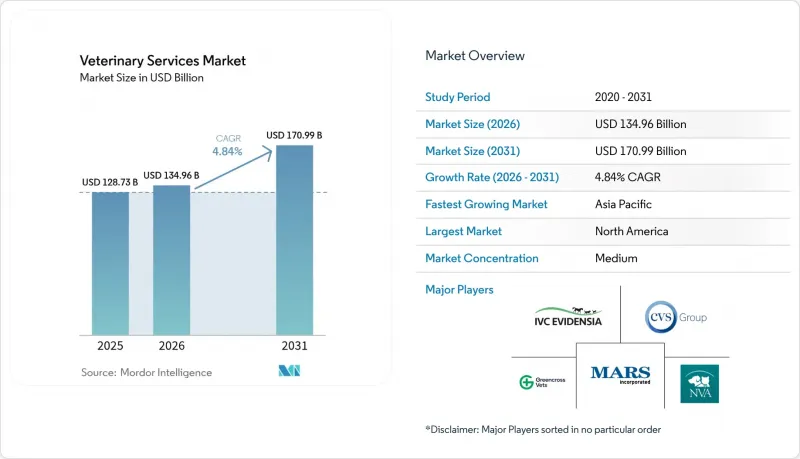
Mordor Intelligence에 의하면, 수의 서비스 시장 규모는 2025년에 1,287억 3,000만 달러로 평가되었습니다. 2026년 1,349억 6,000만 달러에서 2031년까지 1,709억 9,000만 달러에 이를 것으로 추정되고 예측 기간(2026-2031년) CAGR은 4.84%를 나타낼 전망입니다.

본 보고서는 서비스별(외과 수술, 영상 진단·임상 검사, 기타), 동물 유형별(반려동물, 생산동물·가축), 제공업체 소유 구조별(독립 클리닉, 기타), 제공 형태별(모바일·농장 내, 기타),지역별(북미, 유럽, 아시아태평양, 기타)로 분류되어 있습니다. 시장 예측은 금액(달러) 기준으로 제시되어 있습니다.
세계의 수의 서비스 시장 동향 및 인사이트
반려동물 사육 마릿수 증가와 동물의 ‘인간화’
반려동물을 기르는 미국 가구 수는 2011년 5,600만 가구에서 2025년에는 9,400만 가구에 달했으며, Z세대가 현재 신규 반려인 중 가장 빠르게 증가하는 계층입니다. 이 세대는 과거 인간 의료에 국한되었던 종양학, 심장학, 행동 치료 등을 기대하고 있습니다. 또한, 고소득층 고객들은 유전체 스크리닝, 영양 상담, 전문의와의 연중무휴 24시간 원격 상담을 결합한 컨시어지 플랜을 구매하고 있습니다. 이러한 프리미엄화는 수의 서비스 시장 전체의 현금 흐름 전망을 강화하는 동시에, 장비 업그레이드와 전문의 연수를 정당화하는 요인이 되고 있습니다.
인수공통감염병 및 동물 만성 질환 발생률 증가
2024년 H5N1형 인플루엔자 유행은 미국 내 800개 이상의 낙농 목장에 영향을 미쳤으며, 동물과의 접촉으로 인한 인간 감염 사례가 66건 확인되었습니다. 반려동물의 수명이 연장됨에 따라 만성 질환도 증가하고 있습니다. 2024년에는 개의 73%, 고양이의 64%가 치과 질환으로 진단받았습니다. 이러한 이중적인 압박으로 인해 수의 서비스 시장에서 검사, 영상 진단, 생물 보안에 대한 지출이 지속적으로 뒷받침되고 있습니다.
전 세계 수의사 부족과 번아웃
예측에 따르면, 2032년까지 수의사 부족 수는 7만 92명에 달할 것으로 예상되는 반면, 졸업생 수는 고작 5만 2,926명에 그칠 것으로 보이며, 평균 40만 달러에 달하는 학자금 대출 부담으로 인해 이 부족 현상은 더욱 심각해지고 있습니다. 번아웃 비율은 40%를 초과하고, 자살 위험도 여전히 높은 수준을 유지하며, 수의 서비스 산업의 동물병원 인력 배치에 압박을 가하고 있습니다. 특히 농촌 지역의 영향이 심각하여, 2025년에는 미국의 243개 카운티가 수의사 부족 지역으로 분류되었습니다.
부문별 분석
예방 의료 및 웰니스 케어는 2025년 매출의 31.02%를 차지하며, 수의 서비스 시장의 기반을 형성했습니다. 정기 구독형 웰니스 플랜과 연례 건강 검진은 예측 가능한 이익률을 창출하는 반면, 약국의 자동 재조제 서비스는 고객 유지율을 높이고 있습니다. 텔레헬스 부문의 수의 의료 서비스 시장 규모는 2026년 3억 9,298만 달러에서 2031년까지 5억 4,000만 달러로 확대될 전망이며, 연평균 성장률(CAGR)은 6.45%를 나타낼 것으로 예측됩니다. AI를 활용한 영상 진단은 진료 처리 능력을 높여, 수요가 급증할 때의 대응 능력을 뒷받침하고 있습니다. 최소 침습 수술 기술로 회복 기간이 단축됨에 따라 외과 수술 수요는 안정적인 추세를 보이고 있습니다. 치과 치료는 여전히 수익성이 높으며, 건당 평균 170-350달러에 달하며, 개의 73%가 일생에 적어도 한 번은 치료를 필요로 합니다.
진단 검사 기관은 동물병원과의 교차 판매 혜택을 누리고 있으며, 전자 조제 플랫폼은 약물 복용 순응도를 효율화하고 있습니다. 응급·중환자 치료 센터는 인력 부족에 직면해 있으며, 이에 따라 기업 그룹은 원격 ICU 대시보드를 통해 연계된 24시간 운영 거점을 개설하고 있습니다. 반려동물의 고령화에 따라 재활, 침술, 수중 치료가 보급되면서 수의 서비스 시장의 평생 지출을 확대시키고 있습니다.
2025년에는 반려동물이 매출의 62.68%를 차지했으며, 2031년까지 연평균 성장률(CAGR) 6.63%로 가장 높은 성장률을 보일 전망입니다. 개는 계속해서 가장 큰 하위 부문이며, 종양학 및 심장학 서비스는 인간 의료 프로토콜을 반영하고 있습니다. 밀레니얼 세대와 Z세대 사이에서 도시 지역의 고양이 사육이 증가하면서 고양이 전문 클리닉에 대한 수요가 높아지고 있습니다. 말 의료는 여전히 틈새 시장이지만, 파행 진단 및 스포츠 부상 재활 분야에서 높은 평균 거래액을 기록하고 있습니다.
H5N1형 조류 인플루엔자가 낙농 소 사육 군에서 발생하여 공중 보건상의 위험이 부각됨에 따라, 생산 동물용 서비스의 통합이 요구되고 있습니다. 현재 소 사육업자들은 실시간 모니터링 및 백신 접종 준수 현황 감사를 도입하고 있습니다. 돼지 및 가금류 생산자들은 종합적인 생물안전 대책을 확대하고 있으며, 양식업자들은 전문적인 건강 관리 계획을 요구하고 있어, 이 모든 요인이 수의 서비스 시장의 범위를 넓히고 있습니다. 소비자들이 단백질 공급원을 다양화함에 따라 소형 반추동물에 대한 관심이 높아지고 있어, 고객 기반은 더욱 확대되고 있습니다.
지역별 분석
2025년, 북미는 전 세계 매출의 42.01%를 차지했습니다. 보험 보급률이 높아지고 있으며, 견조한 전자상거래 약국 채널과 ‘원헬스(One Health)’ 정책의 통합으로 인해 보험료의 가격 탄력성이 유지되고 있습니다. 다국적 체인은 미국 도심에 집중되어 있으며, 캐나다의 사업자들도 유사한 통합 경향을 보이고 있지만, 공중보건 요건에 맞추어 서비스를 조정하고 있습니다. 멕시코에서는 중산층의 부상으로 반려동물사료 시장이 두 자릿수 성장을 기록하고 있으며, 이는 하류 서비스 분야의 비즈니스 기회로 이어질 전망입니다.
유럽에서는 꾸준한 확산세가 관찰됩니다. 영국의 왕립수의사협회(RCVS)는 인증 절차를 간소화하여 국경을 넘는 수의사의 이동을 촉진하고 있습니다. 독일과 프랑스는 동물과 인간의 역학 데이터를 연계하는 모니터링 플랫폼에 투자하고 있습니다. EQT의 VetPartners 인수는 회원국 전반에 걸친 동물병원 플랫폼 확장을 목표로 하는 자본 유입을 시사합니다. 원격 의료 및 데이터 상호 운용성에 관한 규제 조화는 동물병원 그룹이 수의 서비스 시장 전반에서 운영상의 시너지 효과를 누리는 데 기여하고 있습니다.
아시아태평양은 연평균 성장률(CAGR) 5.57%로 가장 빠르게 성장하고 있는 지역입니다. 중국의 반려동물 의료비는 2024년에 1조 620억 위안으로 증가했으며, 시장의 세분화에도 불구하고 계속 증가하고 있습니다. 인도의 반려동물사료 시장은 연평균 성장률(CAGR) 15.37%로 성장하고 있으며, 식이 요법 상담 및 피부과 등의 부가 서비스를 견인하고 있습니다. 일본에서는 고령화되는 개가 증가하여 노년기 돌봄 수요가 높아지고 있는 반면, 한국에서는 소동물 영상 진단을 위한 AI 알고리즘 개발이 진행되고 있습니다. 호주 내 동물병원 통합 및 인수는 규정 준수 수준이 높은 시장 진출을 목표로 하는 유럽의 인수자들을 끌어들이고 있습니다. 이러한 동향이 맞물리면서 해당 지역의 수의 서비스 시장 규모는 확대되고 있습니다.
기타 혜택
- 엑셀 형식 시장 예측(ME) 시트
- 3개월간의 애널리스트 지원
자주 묻는 질문
목차
제1장 서론
제2장 조사 방법
제3장 주요 요약
제4장 시장 구도
제5장 시장 규모 및 성장 예측
제6장 경쟁 구도
제7장 시장 기회 및 향후 전망
KTH 26.09.08According to Mordor Intelligence, the veterinary services market size was valued at USD 128.73 billion in 2025 and estimated to grow from USD 134.96 billion in 2026 to reach USD 170.99 billion by 2031, at a CAGR of 4.84% during the forecast period (2026-2031).
This report is Segmented by Service (Surgery, Diagnostic Imaging & Laboratory, and More), Animal Type (Companion Animals and Production/Farm Animals), Provider Ownership Structure (Independent Practices, and More), Delivery Mode (Mobile / On-Farm, and More), Geography (North America, Europe, Asia-Pacific, and More). The Market Forecasts are Provided in Terms of Value (USD).
Global Veterinary Services Market Trends and Insights
Rising Pet Ownership & Humanisation of Animals
Pet ownership reached 94 million U.S. households in 2025, up from 56 million in 2011, and Generation Z now represents the fastest-growing cohort of new owners. This demographic expects oncology, cardiology, and behavioural therapies once reserved for human medicine. High-net-worth clients also purchase concierge plans that bundle genomic screening, nutrition counselling, and 24/7 tele-access to specialists. Such premiumisation strengthens cash-flow visibility across the veterinary services market while justifying equipment upgrades and specialist training.
Increasing Incidence of Zoonotic & Chronic Animal Diseases
The 2024 H5N1 influenza episode affected more than 800 U.S. dairy herds, with 66 confirmed human infections traced to animal exposure. Companion pets live longer, which increases chronic conditions: 73% of dogs and 64% of cats were diagnosed with dental disease in 2024. These dual pressures support sustained laboratory, imaging, and bio-security spending within the veterinary services market.
Global Shortage & Burnout of Veterinarians
Forecasts show a deficit of 70,092 veterinarians by 2032 versus only 52,926 graduates, a shortfall aggravated by student debt that averages USD 400,000. Burnout exceeds 40%, and suicide risk remains elevated, pressuring clinic rosters in the veterinary services industry. Rural zones suffer most, with 243 U.S. counties classified as shortage areas in 2025.
Other drivers and restraints analyzed in the detailed report include:
- Growing Livestock Productivity & Food-Safety Requirements
- AI-Enabled Triage & Diagnostics Boosting Clinic Capacity
- Escalating Cost of Advanced Procedures & Equipment
For complete list of drivers and restraints, kindly check the Table Of Contents.
Segment Analysis
Preventive and wellness care captured 31.02% of 2025 revenue, anchoring the veterinary services market. Subscription wellness plans and annual health screens generate predictable margins, while pharmacy auto-refills deepen client stickiness. The veterinary services market size for tele-health is set to climb from USD 392.98 million in 2026 to USD 0.54 billion by 2031, a 6.45% CAGR. AI-enhanced imaging lifts throughput and supports surge capacity. Surgical demand stabilises as minimally-invasive techniques cut recovery time. Dental procedures remain lucrative, averaging USD 170-350 per case, and 73% of dogs need at least one intervention during their lifetime.
Diagnostic laboratories enjoy cross-selling with clinics, and e-prescribing platforms streamline drug compliance. Emergency and critical-care centres face labour constraints, prompting corporate groups to open 24-hour hubs linked by tele-ICU dashboards. Rehabilitation, acupuncture, and hydro-therapy gain traction as pets age, extending lifetime spending in the veterinary services market.
Companion animals constituted 62.68% of revenue in 2025 and will post the fastest 6.63% CAGR through 2031. Dogs continue as the largest sub-segment, with oncology and cardiology services mirroring human care protocols. Urban cat ownership rises among millennials and Generation Z, pushing demand for feline-only clinics. Equine medicine remains niche but commands high average transaction values for lameness diagnostics and sports-injury rehabilitation.
Production animals demand service integration after the H5N1 dairy-herd outbreak highlighted public-health risks. Cattle operators now purchase real-time monitoring and vaccine-compliance audits. Swine and poultry producers expand comprehensive bio-security packages, and aquaculture ventures request specialised health plans, both adding breadth to the veterinary services market. Small ruminants gain attention as consumers diversify protein sources, further widening the client base.
Complete Report Scope:
- By Service
- Surgery
- Diagnostic Imaging & Laboratory
- Preventive & Wellness Care
- Emergency & Critical Care
- Tele-health & Virtual Care
- Rehabilitation & Physiotherapy
- Dentistry
- Pharmacy & Prescription Management
- By Animal Type
- Companion Animals
- Dogs
- Cats
- Horses & Equine
- Production / Farm Animals
- Cattle & Buffalo
- Swine
- Poultry
- Small Ruminants
- Aquaculture Species
- Companion Animals
- By Provider Ownership Structure
- Independent Practices
- Corporate Clinic Chains
- Mobile / House-call Practices
- University & Referral Hospitals
- By Delivery Mode
- In-Clinic (Brick & Mortar)
- Mobile / On-farm
- Tele-consultation Platforms
- Geography
- North America
- United States
- Canada
- Mexico
- Europe
- Germany
- United Kingdom
- France
- Italy
- Spain
- Rest of Europe
- Asia-Pacific
- China
- Japan
- India
- Australia
- South Korea
- Rest of Asia-Pacific
- Middle East & Africa
- GCC
- South Africa
- Rest of Middle East & Africa
- South America
- Brazil
- Argentina
- Rest of South America
- North America
Geography Analysis
North America retained 42.01% of global revenue in 2025. Mature insurance penetration, robust e-commerce pharmacy channels, and One-Health policy integration sustain premium-price elasticity. Multinational chains cluster around U.S. urban centres, and Canadian operators observe similar consolidation but tailor offerings to public-health mandates. Mexico's rising middle class fuels double-digit pet-food growth, a signal of downstream service opportunity.
Europe shows steady uptake. The United Kingdom's Royal College of Veterinary Surgeons streamlines accreditation, facilitating cross-border clinician mobility. Germany and France invest in surveillance platforms that link animal and human epidemiological data. EQT's acquisition of VetPartners indicates capital inflows aiming at clinic platform scaling across member states. Regulatory harmonisation for tele-medicine and prescription data interoperability aids clinic groups in capturing operational synergies across the veterinary services market.
Asia-Pacific is the fastest-expanding zone at 5.57% CAGR. China's pet-medical spend hit 1,062 billion yuan in 2024 and keeps rising despite fragmentation. India's pet-food market is growing at 15.37% CAGR and pulls ancillary services such as dietetic consults and dermatology. Japan's super-aging dogs spur demand for geriatric care, while South Korea pioneers AI algorithms for small-animal imaging. Australia's clinic roll-ups attract European buyers hunting for exposure to a high-compliance market. Collectively, these dynamics enlarge the veterinary services market size for the region.
- Mars Inc. (VCA, Banfield, BluePearl)
- National Veterinary Associates (NVA)
- CVS Group
- IVC Evidensia
- Greencross Ltd
- Ethos Veterinary Health
- IDEXX
- Zoetis Services
- Elanco Animal Health Services
- Southern Veterinary Partners
- Thrive Pet Healthcare
- VetCor
- PetVet Care Centers
- Mission Veterinary Partners
- BlueRiver Pet Care
- FirstVet
- CityVet
- Armor Animal Health
- Kremer Veterinary Services
- I-Med Animal Referral Centers
Additional Benefits:
- The market estimate (ME) sheet in Excel format
- 3 months of analyst support
TABLE OF CONTENTS
1 Introduction
- 1.1 Study Assumptions & Market Definition
- 1.2 Scope of the Study
2 Research Methodology
3 Executive Summary
4 Market Landscape
- 4.1 Market Overview
- 4.2 Market Drivers
- 4.2.1 Rising Pet Ownership & Humanisation of Animals
- 4.2.2 Increasing Incidence of Zoonotic & Chronic Animal Diseases
- 4.2.3 Growing Livestock Productivity & Food-Safety Requirements
- 4.2.4 Expansion of Pet-Insurance Reimbursement Models
- 4.2.5 AI-Enabled Triage & Diagnostics Boosting Clinic Capacity
- 4.3 Market Restraints
- 4.3.1 Global Shortage & Burnout of Veterinarians
- 4.3.2 Escalating Cost of Advanced Procedures & Equipment
- 4.3.3 Regulatory Ambiguity on Cross-Border Tele-Veterinary Care
- 4.3.4 Consumer Price-Sensitivity Causing Deferred Care
- 4.4 Regulatory Landscape
- 4.5 Porter's Five Forces Analysis
- 4.5.1 Threat of New Entrants
- 4.5.2 Bargaining Power of Buyers
- 4.5.3 Bargaining Power of Suppliers
- 4.5.4 Threat of Substitutes
- 4.5.5 Intensity of Competitive Rivalry
5 Market Size & Growth Forecasts (Value, USD)
- 5.1 By Service
- 5.1.1 Surgery
- 5.1.2 Diagnostic Imaging & Laboratory
- 5.1.3 Preventive & Wellness Care
- 5.1.4 Emergency & Critical Care
- 5.1.5 Tele-health & Virtual Care
- 5.1.6 Rehabilitation & Physiotherapy
- 5.1.7 Dentistry
- 5.1.8 Pharmacy & Prescription Management
- 5.2 By Animal Type
- 5.2.1 Companion Animals
- 5.2.1.1 Dogs
- 5.2.1.2 Cats
- 5.2.1.3 Horses & Equine
- 5.2.2 Production / Farm Animals
- 5.2.2.1 Cattle & Buffalo
- 5.2.2.2 Swine
- 5.2.2.3 Poultry
- 5.2.2.4 Small Ruminants
- 5.2.2.5 Aquaculture Species
- 5.2.1 Companion Animals
- 5.3 By Provider Ownership Structure
- 5.3.1 Independent Practices
- 5.3.2 Corporate Clinic Chains
- 5.3.3 Mobile / House-call Practices
- 5.3.4 University & Referral Hospitals
- 5.4 By Delivery Mode
- 5.4.1 In-Clinic (Brick & Mortar)
- 5.4.2 Mobile / On-farm
- 5.4.3 Tele-consultation Platforms
- 5.5 Geography
- 5.5.1 North America
- 5.5.1.1 United States
- 5.5.1.2 Canada
- 5.5.1.3 Mexico
- 5.5.2 Europe
- 5.5.2.1 Germany
- 5.5.2.2 United Kingdom
- 5.5.2.3 France
- 5.5.2.4 Italy
- 5.5.2.5 Spain
- 5.5.2.6 Rest of Europe
- 5.5.3 Asia-Pacific
- 5.5.3.1 China
- 5.5.3.2 Japan
- 5.5.3.3 India
- 5.5.3.4 Australia
- 5.5.3.5 South Korea
- 5.5.3.6 Rest of Asia-Pacific
- 5.5.4 Middle East & Africa
- 5.5.4.1 GCC
- 5.5.4.2 South Africa
- 5.5.4.3 Rest of Middle East & Africa
- 5.5.5 South America
- 5.5.5.1 Brazil
- 5.5.5.2 Argentina
- 5.5.5.3 Rest of South America
- 5.5.1 North America
6 Competitive Landscape
- 6.1 Market Concentration
- 6.2 Market Share Analysis
- 6.3 Company Profiles (includes Global level Overview, Market level overview, Core Business Segments, Financials, Headcount, Key Information, Market Rank, Market Share, Products and Services, and analysis of Recent Developments)
- 6.3.1 Mars Inc. (VCA, Banfield, BluePearl)
- 6.3.2 National Veterinary Associates (NVA)
- 6.3.3 CVS Group PLC
- 6.3.4 IVC Evidensia
- 6.3.5 Greencross Ltd
- 6.3.6 Ethos Veterinary Health
- 6.3.7 Idexx Laboratories
- 6.3.8 Zoetis Services
- 6.3.9 Elanco Animal Health Services
- 6.3.10 Southern Veterinary Partners
- 6.3.11 Thrive Pet Healthcare
- 6.3.12 VetCor
- 6.3.13 PetVet Care Centers
- 6.3.14 Mission Veterinary Partners
- 6.3.15 BlueRiver Pet Care
- 6.3.16 FirstVet AB
- 6.3.17 CityVet Inc.
- 6.3.18 Armor Animal Health
- 6.3.19 Kremer Veterinary Services
- 6.3.20 I-Med Animal Referral Centers
7 Market Opportunities & Future Outlook
- 7.1 White-space & Unmet-need Assessment