

|
시장보고서
상품코드
2122771
카테터 고정 기기 : 시장 점유율 분석, 업계 동향 및 통계, 성장 예측(2026-2031년)Catheter Stabilization Devices - Market Share Analysis, Industry Trends & Statistics, Growth Forecasts (2026 - 2031) |
||||||
 Mordor Intelligence
Mordor Intelligence에 의하면, 카테터 고정 기기 시장 규모는 2025년 17억 9,000만 달러로 평가되었습니다. 2026년에는 18억 9,000만 달러로 확대되어 2026-2031년에 걸쳐 CAGR 5.34%로 성장을 지속하여, 2031년에는 24억 5,000만 달러에 이를 것으로 예측됩니다.

본 보고서는 제품별(말초정맥 카테터 고정 기기, 기타), 용도별(심혈관 시술, 기타), 최종 사용자별(병원, 외래수술센터(ASC), 기타), 지역별(북미, 유럽, 아시아태평양, 중동 및 아프리카, 남미)로 분류되어 있습니다. 시장 예측은 금액(달러) 기준으로 제시되어 있습니다.
세계의 카테터 고정 기기 시장 동향 및 인사이트
만성 생활습관병 유병률 증가
당뇨병, 심혈관 질환, 암의 전 세계적 증가로 인해, 장기간의 치료 기간 동안 카테터의 무결성을 유지하는 고정 솔루션에 대한 수요가 지속적으로 증가하고 있습니다. 종양학 치료 프로토콜에서는 말초 삽입형 중심정맥카테터(PICC)에 대한 의존도가 높아지고 있으며, 임상의들이 피부의 무결성을 해치지 않으면서 카테터의 이탈을 방지하는 장치를 선호함에 따라 이 부문의 연평균 성장률(CAGR)은 6.81%로 성장을 지속하고 있습니다. 현재 입원 환자 중 고령자의 비율이 증가하고 있으며, 이들의 취약한 혈관 구조로 인해 부드럽지만 견고한 고정 기기에 대한 수요가 높아지고 있습니다. 병원들은 감염 위험을 줄여주는 항균 드레싱에 투자함으로써 의료비 및 재입원에 따른 벌금 비용을 절감하고 있습니다. 이러한 인구 통계학적 변화로 인해 카테터 고정 기기 시장은 만성 질환 관리 전략의 핵심 요소로서의 위상을 강화하고 있습니다.
저침습 및 카테터 기반 시술의 확대
경카테터 대동맥판막 치환술이나 로봇 보조 혈관 치료와 같은 중재 플랫폼에서는 장시간에 걸친 시술 중 카테터의 정밀한 안정성이 요구됩니다. 당일 퇴원 프로토콜의 도입으로 환자는 더 빨리 퇴원하게 되며, 지속적인 모니터링 없이도 기능을 유지하는 고정 기기의 중요성이 더욱 높아지고 있습니다. 이에 대응하여 각 장치 제조업체들은 영상 촬영에 방해가 되지 않으면서도 우발적인 인장력을 견딜 수 있는 초박형 앵커 개발에 주력하고 있습니다. 고정 기기가 특정 중재 워크플로우에 맞게 전용으로 설계된 경우, 프리미엄 가격 책정이 가능해져 카테터 고정 기기 시장에서의 수익 다각화가 촉진됩니다.
피하 포트 및 무바늘 커넥터로의 전환
BD의 MaxPlus 시리즈와 같은 무바늘 커넥터는 미국 내 3,000개 이상의 병원에서 CLABSI 감소 효과를 보여주고 있으며, 임상의들의 선호도는 허브 수준의 감염 관리로 이동하고 있습니다. SecurAcath와 같은 피하 앵커는 CLABSI 위험을 288% 감소시켜 접착식 장치에 도전장을 내밀고 있습니다. UV-C 소독 장치는 커넥터 부위의 병원체를 관리함으로써 기존 고정 방식에 대한 의존도를 더욱 낮춥니다. 통합형 대체 제품이 보급됨에 따라, 단독형 표면용 접착제의 매출은 정체될 가능성이 있습니다.
부문별 분석
2025년, 말초정맥용 고정 기기는 카테터 고정 기기 시장 전체의 37.12%를 차지했습니다. 중심정맥용 솔루션은 규모는 작지만, 중환자 치료의 복잡화와 CLABSI 예방 의무화로 인해 연평균 성장률(CAGR) 6.05%로 확대될 것으로 예측됩니다. 이 두 범주가 카테터 고정 기기 시장 규모의 대부분을 차지하고 있으며, 동맥용, 요로용 및 기타 틈새 시장 형태는 투석이나 소아 의료와 같은 특수한 요구를 충족시키고 있습니다.
각 개발사는 항균 오버레이를 일체화하거나, 매일 삽입 부위를 육안으로 확인할 수 있는 투명하고 통기성 있는 필름을 채택하는 등 말초정맥용 제품의 기능 향상을 도모하고 있습니다. CVC(중심정맥카테터) 부문에서는 터널형 PICC 삽입이 비터널형 라인에 비해 감염 및 탈락 위험이 낮은 것으로 밝혀졌으며, 이에 따라 각 벤더들은 터널화 기술에 대응하는 고정 메커니즘 혁신에 주력하고 있습니다. 힘을 이용한 분리 장치에 대한 규제가 명확해질 것으로 예상에 따라, 제품 차별화가 더욱 촉진되어 카테터 고정 기기 시장의 성장 전망이 한층 더 강화될 것으로 예측됩니다.
지역별 분석
북미는 2025년 카테터 고정 기기 시장 점유율의 44.78%를 차지했습니다. 이는 엄격한 감염 관리 방침과 견실한 보험 환급 제도에 힘입은 결과입니다. 재택 수액 요법에 관한 메디케어의 2025년 규정에 따라, 기기의 사용이 주거 환경으로 더욱 확대되면서 이 지역의 급속한 성장을 뒷받침하고 있습니다.
유럽에서는 병원이 재활용 가능하거나 생분해성 고정 부품을 우선적으로 사용하는 지속가능성 규정에 적응함에 따라 시장이 꾸준히 확대되고 있으며, 제품의 재설계 및 조달 주기가 촉진되고 있습니다. 독일, 프랑스, 영국에 임상 연구가 집중됨에 따라, 감염 관리와 환경 목표를 모두 충족하는 혁신적인 접착제의 현지 채택이 가속화되고 있습니다.
아시아태평양은 2031년까지 연평균 성장률(CAGR) 6.88%로 세계 평균을 상회하는 성장이 예상됩니다. 중국과 인도의 의료 인프라 현대화와 더불어 일본 및 한국의 고령화가 진행됨에 따라 수요는 고도 혈관 접근 솔루션으로 이동하고 있습니다. 규제 조화를 위한 노력으로 승인 절차가 효율화되어, 다국적 제조업체들은 현지 의료 프로토콜을 준수하면서도 통일된 제품 라인을 전개할 수 있게 되었습니다.
기타 혜택
- 엑셀 형식 시장 예측(ME) 시트
- 3개월간의 애널리스트 지원
자주 묻는 질문
목차
제1장 서론
제2장 조사 방법
제3장 주요 요약
제4장 시장 구도
제5장 시장 규모 및 성장 예측
제6장 경쟁 구도
제7장 시장 기회 및 향후 전망
KTH 26.09.08According to Mordor Intelligence, the catheter securement devices market size is expected to grow from USD 1.79 billion in 2025 to USD 1.89 billion in 2026 and is forecast to reach USD 2.45 billion by 2031 at 5.34% CAGR over 2026-2031.
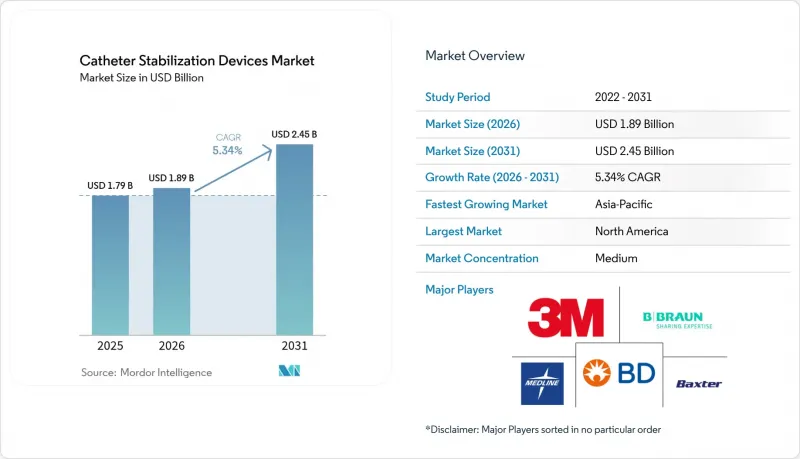
This report is Segmented by Product (Peripheral IV Catheter Securement Devices, and More), Application (Cardiovascular Procedures, and More), End-User (Hospitals, Ambulatory Surgical Centers, and More), and Geography (North America, Europe, APAC, Middle East & Africa, South America). The Market Forecasts are Provided in Terms of Value (USD).
Global Catheter Stabilization Devices Market Trends and Insights
Rising Prevalence of Chronic Lifestyle Diseases
The global rise in diabetes, cardiovascular disease, and cancer drives long-term demand for securement solutions that maintain catheter integrity over extended treatment cycles. Oncology protocols increasingly rely on peripherally inserted central catheters, resulting in a 6.81% CAGR for the segment as clinicians favor devices that cut dislodgement without compromising skin integrity. Seniors now constitute a larger share of hospitalized patients, and their fragile vasculature heightens the need for gentle yet robust securement. Hospitals invest in antimicrobial dressings that lower infection risk, thereby reducing cost of care and readmission penalties. This demographic shift positions the catheter securement devices market as a central component of chronic disease management strategies.
Expansion of Minimally Invasive & Catheter-Based Procedures
Interventional platforms such as transcatheter aortic valve replacement and robotic-assisted vascular therapies rely on precise catheter stability during lengthy procedures. Same-day discharge protocols mean patients leave the hospital sooner, placing a premium on securement devices that continue to perform without continuous monitoring. Device makers respond by engineering low-profile anchors that allow imaging access while resisting accidental pull forces. Premium pricing is achievable when a securement device is purpose-built for a specialized interventional workflow, enhancing revenue diversity within the catheter securement devices market.
Migration to Subcutaneous Ports / Needle-Free Connectors
Needle-free connectors such as BD's MaxPlus line show CLABSI reductions across more than 3,000 U.S. hospitals, shifting clinician preference toward hub-level infection control . Subcutaneous anchors like SecurAcath cut CLABSI risk by 288%, challenging adhesive devices. UV-C disinfection devices further decrease reliance on traditional securement by managing pathogens at the connector site. As integrated alternatives proliferate, sales of standalone surface adhesives may plateau.
Other drivers and restraints analyzed in the detailed report include:
- Stricter CLABSI & CAUTI Prevention Guidelines
- Greater Hospital Spend on Infection-Control Consumables
- Shift to Hospital-at-Home & Outpatient Infusion Programs
- Advanced Skin-Friendly Antimicrobial Adhesive Platforms
- Frequent Product Recalls & Adverse-Event Litigation
- Sustainability Mandates Curbing Single-Use Plastics
For complete list of drivers and restraints, kindly check the Table Of Contents.
Segment Analysis
Peripheral IV securement devices accounted for 37.12% of the catheter securement devices market in 2025. Central venous solutions, though smaller, are projected to expand at a 6.05% CAGR due to critical-care complexity and CLABSI prevention mandates. These two categories collectively define the bulk of catheter securement devices market size, with arterial, urinary, and other niche formats serving specialized needs such as dialysis and pediatric care.
Developers enhance peripheral IV products with integrated antimicrobial overlays and transparent, breathable films that allow daily site inspection. In the CVC space, tunneled PICC placements exhibit better infection and dislodgement profiles than non-tunneled lines, prompting vendors to innovate around anchoring mechanisms that accommodate tunneling techniques. Anticipated regulatory clarity for force-activated separation devices should foster additional product differentiation further reinforcing growth prospects for the catheter securement devices market.
Complete Report Scope:
- By Product
- Peripheral IV catheter securement devices
- Central venous catheter (CVC) securement devices
- Arterial catheter securement devices
- Urinary catheter securement devices
- Other niche securement devices
- By Application
- Cardiovascular procedures
- Oncology & chemotherapy
- Critical care & emergency medicine
- Gastro-urology & nephrology
- Pain management & anesthesia
- By End-User
- Hospitals
- Ambulatory Surgical Centers
- Home-Care & Hospital-at-Home Programs
- Long-term Care / Skilled Nursing Facilities
- Geography
- North America
- United States
- Canada
- Mexico
- Europe
- Germany
- France
- United Kingdom
- Italy
- Spain
- Rest of Europe
- APAC
- China
- Japan
- India
- Australia
- South Korea
- Rest of APAC
- Middle East & Africa
- GCC
- South Africa
- Rest of MEA
- South America
- Brazil
- Argentina
- Rest of South America
- North America
Geography Analysis
North America held 44.78% of catheter securement devices market share in 2025, underpinned by stringent infection-control policies and robust reimbursement pathways. Medicare's 2025 provisions for home infusion therapy further extend device use into residential settings, reinforcing the regional growth runaway.
Europe shows consistent expansion as hospitals adapt to sustainability regulations that favor recyclable or biodegradable securement components, propelling product redesign and procurement cycles. Clinical research concentration in Germany, France, and the United Kingdom accelerates local adoption of innovative adhesives that satisfy both infection-control and environmental objectives.
Asia-Pacific is set to outpace global averages at a 6.88% CAGR through 2031. Healthcare infrastructure modernization in China and India, combined with aging demographics in Japan and South Korea, steers demand toward advanced vascular access solutions. Regulatory harmonization initiatives streamline approvals, allowing multinational manufacturers to deploy uniform product lines while accommodating local care protocols.
- 3M
- Beckton Dickinson
- Baxter
- B. Braun
- ConvaTec Group plc
- Medline Industries
- Medtronic
- Merit Medical Systems
- TIDI Products
- Argon Medical Devices
- CATHETRIX
- Smiths Group
- Teleflex
- Avanos Medical (Halyard)
- Vygon
- Cardinal Health
- Centurion Medical Products
- SecurePort Medical
- Marpac Inc.
- Tractus Vascular
- Levity Products
Additional Benefits:
- The market estimate (ME) sheet in Excel format
- 3 months of analyst support
TABLE OF CONTENTS
1 Introduction
- 1.1 Study Assumptions & Market Definition
- 1.2 Scope of the Study
2 Research Methodology
3 Executive Summary
4 Market Landscape
- 4.1 Market Overview
- 4.2 Market Drivers
- 4.2.1 Rising Prevalence Of Chronic Lifestyle Diseases
- 4.2.2 Expansion Of Minimally Invasive & Catheter-Based Procedures
- 4.2.3 Stricter CLABSI & CAUTI Prevention Guidelines
- 4.2.4 Greater Hospital Spend On Infection-Control Consumables
- 4.2.5 Shift To Hospital-At-Home & Outpatient Infusion Programs
- 4.2.6 Advanced Skin-Friendly Antimicrobial Adhesive Platforms
- 4.3 Market Restraints
- 4.3.1 Migration To Subcutaneous Ports/Needle-Free Connectors
- 4.3.2 Frequent Product Recalls & Adverse-Event Litigation
- 4.3.3 Sustainability Mandates Curbing Single-Use Plastics
- 4.3.4 Hospital Reimbursement Squeeze On "Non-Revenue" Disposables
- 4.4 Value / Supply-Chain Analysis
- 4.5 Regulatory Landscape
- 4.6 Technological Outlook
- 4.7 Porter's Five Forces
- 4.7.1 Threat of New Entrants
- 4.7.2 Bargaining Power of Buyers
- 4.7.3 Bargaining Power of Suppliers
- 4.7.4 Threat of Substitutes
- 4.7.5 Competitive Rivalry
5 Market Size & Growth Forecasts (Value - USD Million)
- 5.1 By Product
- 5.1.1 Peripheral IV catheter securement devices
- 5.1.2 Central venous catheter (CVC) securement devices
- 5.1.3 Arterial catheter securement devices
- 5.1.4 Urinary catheter securement devices
- 5.1.5 Other niche securement devices
- 5.2 By Application
- 5.2.1 Cardiovascular procedures
- 5.2.2 Oncology & chemotherapy
- 5.2.3 Critical care & emergency medicine
- 5.2.4 Gastro-urology & nephrology
- 5.2.5 Pain management & anesthesia
- 5.3 By End-User
- 5.3.1 Hospitals
- 5.3.2 Ambulatory Surgical Centers
- 5.3.3 Home-Care & Hospital-at-Home Programs
- 5.3.4 Long-term Care / Skilled Nursing Facilities
- 5.4 Geography
- 5.4.1 North America
- 5.4.1.1 United States
- 5.4.1.2 Canada
- 5.4.1.3 Mexico
- 5.4.2 Europe
- 5.4.2.1 Germany
- 5.4.2.2 France
- 5.4.2.3 United Kingdom
- 5.4.2.4 Italy
- 5.4.2.5 Spain
- 5.4.2.6 Rest of Europe
- 5.4.3 APAC
- 5.4.3.1 China
- 5.4.3.2 Japan
- 5.4.3.3 India
- 5.4.3.4 Australia
- 5.4.3.5 South Korea
- 5.4.3.6 Rest of APAC
- 5.4.4 Middle East & Africa
- 5.4.4.1 GCC
- 5.4.4.2 South Africa
- 5.4.4.3 Rest of MEA
- 5.4.5 South America
- 5.4.5.1 Brazil
- 5.4.5.2 Argentina
- 5.4.5.3 Rest of South America
- 5.4.1 North America
6 Competitive Landscape
- 6.1 Market Concentration
- 6.2 Market Share Analysis
- 6.3 Company Profiles (includes Global level Overview, Market level overview, Core Segments, Financials as available, Strategic Information, Market Rank/Share, Products & Services, Recent Developments)
- 6.3.1 3M
- 6.3.2 Becton, Dickinson & Co.
- 6.3.3 Baxter International
- 6.3.4 B. Braun SE
- 6.3.5 ConvaTec Group plc
- 6.3.6 Medline Industries
- 6.3.7 Medtronic plc
- 6.3.8 Merit Medical Systems
- 6.3.9 TIDI Products
- 6.3.10 Argon Medical Devices
- 6.3.11 CATHETRIX
- 6.3.12 Smiths Medical (ICU Medical)
- 6.3.13 Teleflex Inc.
- 6.3.14 Avanos Medical (Halyard)
- 6.3.15 Vygon SA
- 6.3.16 Cardinal Health
- 6.3.17 Centurion Medical Products
- 6.3.18 SecurePort Medical
- 6.3.19 Marpac Inc.
- 6.3.20 Tractus Vascular
- 6.3.21 Levity Products
7 Market Opportunities & Future Outlook
- 7.1 White-space & Unmet-need Assessment


