

|
시장보고서
상품코드
2122772
관상동맥 스텐트 시장 : 시장 점유율 분석, 업계 동향 및 통계, 성장 예측(2026-2031년)Coronary Stent - Market Share Analysis, Industry Trends & Statistics, Growth Forecasts (2026 - 2031) |
||||||
 Mordor Intelligence
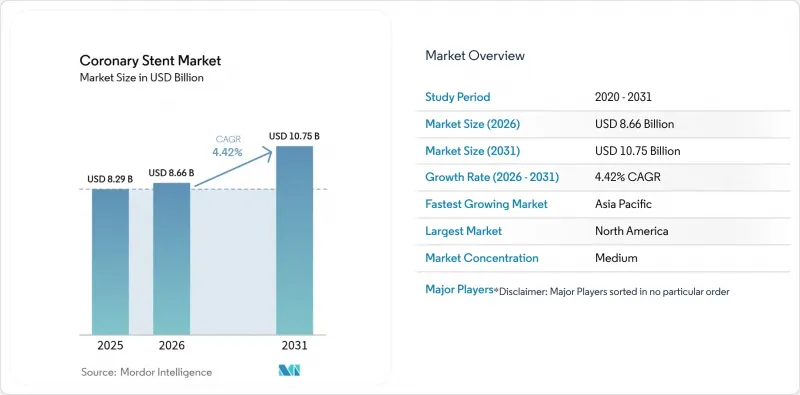
Mordor Intelligence에 의하면, 2026년 관상동맥 스텐트 시장 규모는 86억 6,000만 달러로 추정되고, 2025년 82억 9,000만 달러에서 성장하여 2031년에는 107억 5,000만 달러에 이를 것으로 예측됩니다.
2026-2031년 연평균 성장률(CAGR) 4.42%로 성장할 것으로 전망됩니다.
본 보고서는 제품 유형별(약물 방출형 스텐트, 베어 메탈 관상동맥 스텐트 등), 생체 재료별(금속, 폴리머 등), 삽입 방식별(풍선 확장형 스텐트, 자가 확장형 스텐트), 최종 사용자별(병원, 외래수술센터(ASC) 등), 지역별(북미, 유럽, 아시아태평양 등)로 분류되어 있습니다. 시장 예측은 금액(달러) 기준으로 제시되어 있습니다.
세계의 관상동맥 스텐트 시장 동향 및 인사이트
관상동맥질환(CAD) 유병률 증가 및 고령화
인구의 고령화와 대사증후군의 확산에 따라 심혈관 질환의 발생률은 지속적으로 증가하고 있으며, 이는 관상동맥 스텐트 시장에서 치료 개입에 대한 안정적인 수요를 뒷받침하고 있습니다. 현재 PCI(경피적 관상동맥 성형술) 사례의 약 4분의 1에서 당뇨병이 확인되고 있으며, 고혈당 환자를 위한 전용 스텐트 설계의 경우 재협착률이 낮은 것으로 나타났습니다. 평균 수명의 연장으로 인해, 과거에는 보존적 치료로 관리되던 다지 병변 사례가 증가하고 있습니다. 보험사들은 초기 단계의 스텐트 삽입을 재입원을 대체하는 비용 절감 방안으로 간주하고 있어, 정책적 지원이 추진되고 있습니다. 신흥국에서는 도시형 생활 방식으로 인해 질환 발병까지의 기간이 단축되고 있어, 이러한 변화를 더 빨리 실감하고 있습니다. 이 모든 요인이 복합적으로 작용하여 2030년까지 적격 환자의 꾸준한 공급원이 유지될 전망입니다.
급성 관상동맥 증후군 지침에서의 조기 PCI로의 전환
지침 위원회는 즉각적인 혈류 재건을 점점 더 지지하는 추세이며, 이는 약물 요법에 예방적 PCI를 병용했을 때 표적 혈관의 실패율이 0.4%였음을 보여준 PREVENT 연구 결과에도 반영되어 있습니다. 이러한 입장은 ISCHEMIA 임상시험에서 도출된 미묘한 뉘앙스를 포함하는 증거와 공존하고 있으므로, 임상의들은 사망률과 삶의 질(QOL) 간의 균형을 맞추기 위해 위험도 계층화 알고리즘에 의존하고 있습니다. 응급 사례는 대개 복잡하기 때문에 전달성이 향상된 고품질 기기가 선호됩니다. 안정형 관상동맥 질환의 환자 수는 정체될 가능성이 있지만, 급성기 중재는 증가하고 있어 예측 가능한 제품 구성이 형성되고 있습니다. 각 제조업체는 갑작스러운 수요에 신속하게 대응할 수 있도록 공급망을 미세 조정하고 있습니다.
가격 상한선 및 집중 조달에 따른 평균 판매 가격(ASP) 압박
인도 및 중국에서는 가격 규제로 인해 약물 방출형 스텐트의 정가가 85-90% 인하되었으며, 그 결과 유통업체이 유통망에서 배제되어 이익률이 압박받고 있습니다. 판매량 증가는 매출 감소분을 부분적으로만 상쇄할 수 있어, 공장에서는 자동화 및 이전이 진행되고 있습니다. 프리미엄 기술은 불균형할 정도의 압박에 시달리고 있어, 차세대 플랫폼의 투자 수익률(ROI) 산정이 어려워지고 있습니다. 현재 전 세계 구매자들이 협상 시 아시아의 가격 수준을 기준으로 삼고 있어, 이로 인해 관상동맥 스텐트 시장에서는 지속적인 디플레이션이 발생하고 있습니다.
부문 분석
2025년, 약물 방출형 스텐트는 매출의 75.64%를 차지했으며, 관상동맥 스텐트 시장에서 가장 큰 점유율을 확립했습니다. 이 부문은 스트럿이 점점 얇아지는 가운데, 재협착률과 혈전증 발생률이 낮다는 것을 뒷받침하는 데이터가 지속적으로 확보되고 있다는 이점을 누리고 있습니다. 현재 경쟁의 초점은 고분자 화학, 약물 동태 및 방사형 강도와 같은 분야에 집중되어 있으며, 이러한 분야는 가격 압박 속에서도 이익률을 확대할 수 있는 영역입니다. 생체 흡수성 혈관 스캐폴드는 현재 매출에서 차지하는 비중이 미미하지만, 안전성 프로파일의 개선에 힘입어 2031년까지 연평균 성장률(CAGR) 7.52%로 성장을 지속하고 있습니다. ‘INFINITY-SWEDEHEART’와 같은 최근 임상시험에서는 DynamX사의 바이오 어댑터에서 표적 혈관의 실패율이 0.6%인 것으로 나타나, 임상적 신뢰도가 다시 높아지고 있음을 뒷받침하고 있습니다.
차세대 생체 흡수성 혈관 스캐폴드(BVS)는 일시적인 스캐폴딩 기능과 금속의 방사형 성능을 융합하는 것을 목표로 하고 있습니다. 규제 당국의 승인으로 적응증이 관상동맥에서 말초 영역으로 확대되고 있으며, 예를 들어 애보트의 ‘에스프리트 BTK’는 무릎 아래 병변에 대한 FDA 승인을 획득했습니다. 이를 통해 플랫폼의 가능성이 넓어지고, 연구 개발이 더욱 촉진되고 있습니다. 한편, 베어 메탈 스텐트는 단기간의 항혈소판 요법이 필요한 상황에서 여전히 유용하며, 듀얼 테라피 스텐트는 출혈 위험이 높은 환자를 대상으로 합니다. 이러한 다양한 라인업을 통해 의사는 획일적인 접근 방식이 아닌, 환자 개개인에 맞춘 치료를 시행할 수 있게 됩니다.
2025년에는 금속 스텐트가 매출의 67.10%를 차지했습니다. 이는 강력한 반경 방향 지지력을 제공하는 코발트-크롬 합금이나 백금-크롬 합금을 의사가 선호하는 경향을 반영한 것입니다. 야금 기술의 발전으로 피로 내성을 저해하지 않으면서 60마이크로미터의 스트럿을 구현하여, 높은 잔류성에 대한 수요를 충족시키고 있습니다. 고분자 스캐폴드는 현재 시장 점유율이 낮지만, 생체 적합성 소재가 만성 염증을 완화한다는 점 덕분에 연평균 성장률(CAGR) 7.91%로 점유율을 확대되고 있습니다. 보스턴 사이언티피크(Boston Scientific)사의 SYNERGY 생체흡수성 고분자 DES는 1만 8,000명의 환자를 대상으로 한 통합 코호트 연구에서 혈전증 발생률이 낮은 것으로 입증되어, 보험사 측의 신뢰를 높이고 있습니다.
재조합 제3형 콜라겐 코팅에 관한 연구는 약물에 대한 의존성을 배제하면서도 내피 세포의 치유를 촉진한다는 점에서 유망하게 평가받고 있습니다. 이러한 혁신은 지속가능성에 대한 요구와 영구 임플란트 감소를 원하는 환자들의 의향과 부합합니다. 또한, 각 제조업체는 금속 프레임워크와 흡수성 외층을 결합한 하이브리드 구조를 모색하고 있으며, 두 가지의 장점을 모두 갖춘 제품 개발을 목표로 하고 있습니다. 생체 재료로의 전환을 통해 기계적 강도와 생체 적합성을 동시에 확보할 수 있는 공급업체들에게 관상동맥 스텐트 시장은 여전히 치열한 경쟁이 펼쳐지고 있습니다.
지역별 분석
북미는 2025년, AI를 활용한 영상 진단의 조기 도입과 고성능 DES에 대한 유리한 환급 제도의 뒷받침으로 전 세계 매출의 34.90%를 차지했습니다. 병원들은 종합적인 보험 적용을 활용하여 고품질 플랫폼을 선택하고 있으며, 규제 승인 절차도 예측 가능한 상태를 유지하고 있습니다. 코발트-크롬과 관련된 공급망의 불안정성은 국산 합금의 활용과, 중요한 심혈관 의료기기를 우선시하는 FDA의 긴급 승인 절차 효율화를 통해 어느 정도 상쇄되고 있습니다. 임상시험의 높은 실시 빈도 또한 이 지역의 리더십을 더욱 공고히 하고 있습니다.
아시아태평양은 2031년까지 연평균 성장률(CAGR)이 7.32%로 가장 빠르게 성장하고 있으며, 접근성을 확대하면서도 가격을 억제하는 공공 조달에 힘입고 있습니다. 중국의 독점적 구매 모델은 산업 정책과 맞물려 국내 유력 기업의 부상을 가속화하고 있습니다. 인도도 유사한 궤적을 밟고 있으며, 가격 상한선 설정으로 인해 현지 기업의 시장 점유율이 60%를 넘어섰습니다. 도시화와 소득 증가로 인해 PCI(경피적 관상동맥 중재술)의 적용 대상이 확대되는 한편, 공적 보험 제도가 경제적 부담의 격차를 해소하고 있습니다. 이러한 요인들로 인해 가치 중심의 북미 모델과는 다른, 수량 주도형 성장 패턴이 형성되고 있습니다.
유럽에서는 의료기기 규정(MDR)에 따른 품질 기준의 조화와 환경 고려 사항이 입찰 평가에 영향을 미치면서 꾸준한 성장이 나타나고 있습니다. 브렉시트로 인한 혼란은 수습되고 있으며, 상호인정협정을 통해 국경을 초월한 공급이 안정화되고 있습니다. 지속가능성 기준에 따라 수명 주기에 미치는 영향이 적은 폴리머가 권장되고 있으며, 연구 개발은 생분해성 구조물로 향하고 있습니다. 한편, ISCHEMIA의 영향을 받은 공동 의사 결정 체계로 인해 선택적 PCI 시행 건수는 억제되고 있지만, 중재가 이루어질 때에는 최고 수준의 기기에 대한 수요가 높아지고 있습니다.
기타 혜택 :
- 엑셀 형식 시장 예측(ME) 시트
- 3개월간의 애널리스트 지원
자주 묻는 질문
목차
제1장 서론
제2장 조사 방법
제3장 주요 요약
제4장 시장 구도
제5장 시장 규모 및 성장 예측
제6장 경쟁 구도
제7장 시장 기회 및 향후 전망
AJY 26.09.07According to Mordor Intelligence, coronary stents market size in 2026 is estimated at USD 8.66 billion, growing from 2025 value of USD 8.29 billion with 2031 projections showing USD 10.75 billion, growing at 4.42% CAGR over 2026-2031.
This report is Segmented by Product Type (Drug Eluting Stent, Bare Metal Coronary Stent, and More), Biomaterial (Metallic, Polymeric and More), Mode of Delivery (Balloon-Expandable Stent and Self-Expanding Stent), End User (Hospitals, Ambulatory Surgical Centers and More), and Geography (North America, Europe, Asia-Pacific, and More). The Market Forecasts are Provided in Terms of Value (USD).
Global Coronary Stent Market Trends and Insights
Rising Prevalence of CAD and Aging Population
Cardiovascular disease incidence continues climbing as populations age and metabolic syndrome becomes widespread, pushing steady demand for interventions in the coronary stents market. Diabetes now appears in roughly one quarter of PCI cases, and dedicated stent designs for hyperglycemic patients demonstrate lower restenosis. Higher life expectancy means more multivessel disease presentations that once were managed conservatively. Payers see upfront stenting as a cost-saving alternative to repeat hospitalization, prompting policy support. Emerging economies feel the shift faster because urban lifestyles compress disease onset timelines. All these factors combine to maintain a robust pipeline of eligible patients through 2030.
Shift Toward Early PCI in Acute Coronary Syndrome Guidelines
Guideline committees increasingly support immediate revascularization, reflected in PREVENT showing target-vessel failure of 0.4% when preventive PCI accompanies medical therapy. This stance coexists with nuanced evidence from ISCHEMIA, so clinicians rely on risk stratification algorithms to balance mortality and quality of life. Urgent cases are typically complex, favoring premium devices with improved deliverability. Stable disease volumes may plateau, but acute interventions grow, creating a predictable product mix. Manufacturers fine-tune supply chains for rapid response to emergent demand.
Price Caps and Centralized Procurement Squeezing ASPs
Regulated pricing stripped 85-90% from drug-eluting stent tags in India and China, forcing distributors out of the chain and compressing margins. Volume increases only partially offset revenue declines, prompting factories to automate and relocate. Premium technologies see disproportionate pressure, challenging ROI calculations on next-generation platforms. Worldwide buyers now cite Asian benchmarks to negotiate, creating sustained deflation in the coronary stents market.
Other drivers and restraints analyzed in the detailed report include:
- Rapid Uptake of Ultrathin-Strut & Biodegradable-Polymer DES
- Integration of AI-Guided Imaging & Sizing Tools
- Safety Signals Around Late Scaffold Thrombosis in BVS
For complete list of drivers and restraints, kindly check the Table Of Contents.
Segment Analysis
Drug-eluting stents generated 75.64% of revenue in 2025, establishing the largest share of the coronary stents market. The segment benefits from a continuous flow of data supporting low restenosis and thrombosis rates with ever thinner struts. Competition now focuses on polymer chemistry, drug kinetics, and radial strength, areas that expand margins even under price pressure. Bioabsorbable vascular scaffolds, while only a fraction of sales today, record a 7.52% CAGR through 2031 as safety profiles improve. Recent trials like INFINITY-SWEDEHEART that showed 0.6% target-vessel failure for DynamX bioadaptor validate renewed clinical confidence.
Next-generation BVS seek to merge temporary scaffolding with the radial performance of metals. Regulatory acceptance widens indications beyond coronary arteries into peripheral territories, such as Abbott's Esprit BTK receiving FDA nod for below-the-knee lesions. This broadens platform potential, spurring incremental R&D. Meanwhile, bare-metal stents retain utility in scenarios needing short antiplatelet regimens, and dual-therapy stents address high bleeding-risk patients. The varied lineup allows physicians to tailor therapy rather than apply a one-size-fits-all approach.
Metallic designs controlled 67.10% of sales in 2025, reflecting physician preference for cobalt-chromium and platinum-chromium alloys that deliver strong radial support. Advances in metallurgy enable 60-micrometer struts without compromising fatigue resistance, meeting demand for high deliverability. Polymeric scaffolds, though smaller today, are gaining at an 7.91% CAGR as biocompatible materials alleviate chronic inflammation. Boston Scientific's SYNERGY bioabsorbable-polymer DES demonstrated low thrombosis in a pooled cohort of 18,000 patients, bolstering payer confidence.
Research into recombinant collagen type III coatings shows promise in eliminating drug dependence while fostering endothelial healing. These innovations align with sustainability mandates and patient preference for reduced permanent implants. Manufacturers also explore hybrid constructs, pairing metallic frameworks with resorbable outer layers, to capture the best of both worlds. The biomaterial shift keeps the coronary stents market competitive for suppliers that can blend mechanical robustness with biological harmony.
Complete Report Scope:
- By Product Type
- Drug-Eluting Stent (DES)
- Bare-Metal Stent (BMS)
- Bioabsorbable Vascular Scaffold (BVS)
- Dual-Therapy Stent (DTS)
- By Biomaterial
- Metallic
- Polymeric
- Natural / Bio-derived
- By Mode of Delivery
- Balloon-Expandable Stent
- Self-Expanding Stent
- By End User
- Hospitals
- Cardiac Catheterization Labs
- Ambulatory Surgical Centers
- By Geography
- North America
- United States
- Canada
- Mexico
- Europe
- Germany
- United Kingdom
- France
- Italy
- Spain
- Rest of Europe
- Asia-Pacific
- China
- Japan
- India
- Australia
- South Korea
- Rest of Asia-Pacific
- Middle East and Africa
- GCC
- South Africa
- Rest of Middle East and Africa
- South America
- Brazil
- Argentina
- Rest of South America
- North America
Geography Analysis
North America retained 34.90% of global revenue in 2025, underpinned by early adoption of AI-guided imaging and favorable reimbursement for high-performance DES. Hospitals leverage comprehensive insurance coverage to select premium platforms, and regulatory pathways remain predictable. Supply-chain instability tied to cobalt-chromium is partly offset by domestic alloys and streamlined FDA emergency pathways that prioritize critical cardiovascular devices. Clinical trial density further entrenches regional leadership.
Asia-Pacific is the fastest riser with a 7.32% CAGR through 2031, fueled by public procurement that widens access while compressing prices. China's monopsony purchasing model, combined with industrial policy, accelerates domestic champion emergence. India mirrors this trajectory through price ceilings that catapult local firms past 60% share. Urbanization and rising incomes expand PCI eligibility, while public insurance schemes close affordability gaps. These factors create a volume-driven growth pattern distinct from the value-centric North American model.
Europe shows measured expansion as Medical Device Regulation harmonizes quality standards and environmental considerations shape tender scores. Brexit disruptions are settling as mutual recognition agreements stabilize cross-border supply. Sustainability criteria encourage polymers with lower life-cycle impact, nudging R&D toward degradable constructs. Meanwhile, shared-decision frameworks influenced by ISCHEMIA temper elective PCI volumes but elevate demand for best-in-class devices when intervention proceeds.
- Abbott Laboratories
- Boston Scientific
- Medtronic
- Terumo
- B. Braun
- Biosensors International
- SMT
- Lepu Medical Technology (Beijing) Co., Ltd
- Meril Life Science
- Cook Group
- Translumina
- MicroPort
- Cordis
- Alvimedica
- AMG International GmbH
- Balton Sp. z o.o.
- QualiMed Innovative Medizinprodukte GmbH
- Rontis AG
- Concept Medical Inc
Additional Benefits:
- The market estimate (ME) sheet in Excel format
- 3 months of analyst support
TABLE OF CONTENTS
1 Introduction
- 1.1 Study Assumptions and Market Definition
- 1.2 Scope of the Study
2 Research Methodology
3 Executive Summary
4 Market Landscape
- 4.1 Market Overview
- 4.2 Market Drivers
- 4.2.1 Rising Prevalence CAD and Aging Population
- 4.2.2 Shift Toward Early PCI In Acute Coronary Syndrome Guidelines
- 4.2.3 Rapid Uptake Of Ultrathin-Strut & Biodegradable-Polymer DES
- 4.2.4 Integration Of AI-Guided Imaging & Sizing Tools
- 4.2.5 Hospital Preference For Day-Care Radial PCI Programs
- 4.2.6 Government Tenders Favoring Domestic DES and Innovation Incentives
- 4.3 Market Restraints
- 4.3.1 Price Caps & Centralized Procurement Squeezing ASPs
- 4.3.2 Safety Signals Around Late Scaffold Thrombosis In BVS
- 4.3.3 Supply-Chain Shortages Of High-Purity Co-Cr Alloy
- 4.3.4 Clinical Pushback On Routine Stenting Post-ISCHEMIA Trial
- 4.4 Value / Supply-Chain Analysis
- 4.5 Regulatory Landscape
- 4.6 Technology Outlook
- 4.7 Porter's Five Forces Analysis
- 4.7.1 Bargaining Power of Suppliers
- 4.7.2 Bargaining Power of Buyers
- 4.7.3 Threat of New Entrants
- 4.7.4 Threat of Substitutes
- 4.7.5 Intensity of Competitive Rivalry
5 Market Size and Growth Forecasts (Value-USD)
- 5.1 By Product Type
- 5.1.1 Drug-Eluting Stent (DES)
- 5.1.2 Bare-Metal Stent (BMS)
- 5.1.3 Bioabsorbable Vascular Scaffold (BVS)
- 5.1.4 Dual-Therapy Stent (DTS)
- 5.2 By Biomaterial
- 5.2.1 Metallic
- 5.2.2 Polymeric
- 5.2.3 Natural / Bio-derived
- 5.3 By Mode of Delivery
- 5.3.1 Balloon-Expandable Stent
- 5.3.2 Self-Expanding Stent
- 5.4 By End User
- 5.4.1 Hospitals
- 5.4.2 Cardiac Catheterization Labs
- 5.4.3 Ambulatory Surgical Centers
- 5.5 By Geography
- 5.5.1 North America
- 5.5.1.1 United States
- 5.5.1.2 Canada
- 5.5.1.3 Mexico
- 5.5.2 Europe
- 5.5.2.1 Germany
- 5.5.2.2 United Kingdom
- 5.5.2.3 France
- 5.5.2.4 Italy
- 5.5.2.5 Spain
- 5.5.2.6 Rest of Europe
- 5.5.3 Asia-Pacific
- 5.5.3.1 China
- 5.5.3.2 Japan
- 5.5.3.3 India
- 5.5.3.4 Australia
- 5.5.3.5 South Korea
- 5.5.3.6 Rest of Asia-Pacific
- 5.5.4 Middle East and Africa
- 5.5.4.1 GCC
- 5.5.4.2 South Africa
- 5.5.4.3 Rest of Middle East and Africa
- 5.5.5 South America
- 5.5.5.1 Brazil
- 5.5.5.2 Argentina
- 5.5.5.3 Rest of South America
- 5.5.1 North America
6 Competitive Landscape
- 6.1 Market Concentration
- 6.2 Market Share Analysis
- 6.3 Company profiles (includes Global level Overview, Market level overview, Core Segments, Financials as available, Strategic Information, Market Rank/Share for key companies, Products and Services, and Recent Developments)
- 6.3.1 Abbott Laboratories
- 6.3.2 Boston Scientific Corporation
- 6.3.3 Medtronic plc
- 6.3.4 Terumo Corporation
- 6.3.5 B. Braun SE
- 6.3.6 Biosensors International Group Ltd
- 6.3.7 SMT
- 6.3.8 Lepu Medical Technology (Beijing) Co., Ltd
- 6.3.9 Meril Life Sciences Pvt Ltd
- 6.3.10 Cook Medical Inc
- 6.3.11 Translumina GmbH
- 6.3.12 MicroPort Scientific Corporation
- 6.3.13 Cordis
- 6.3.14 Alvimedica
- 6.3.15 AMG International GmbH
- 6.3.16 Balton Sp. z o.o.
- 6.3.17 QualiMed Innovative Medizinprodukte GmbH
- 6.3.18 Rontis AG
- 6.3.19 Concept Medical Inc
7 Market Opportunities and Future Outlook
- 7.1 White-Space and Unmet-Need Assessment


