

|
시장보고서
상품코드
2122777
군용 로봇 : 시장 점유율 분석, 업계 동향 및 통계, 성장 예측(2026-2031년)Military Robots - Market Share Analysis, Industry Trends & Statistics, Growth Forecasts (2026 - 2031) |
||||||
 Mordor Intelligence
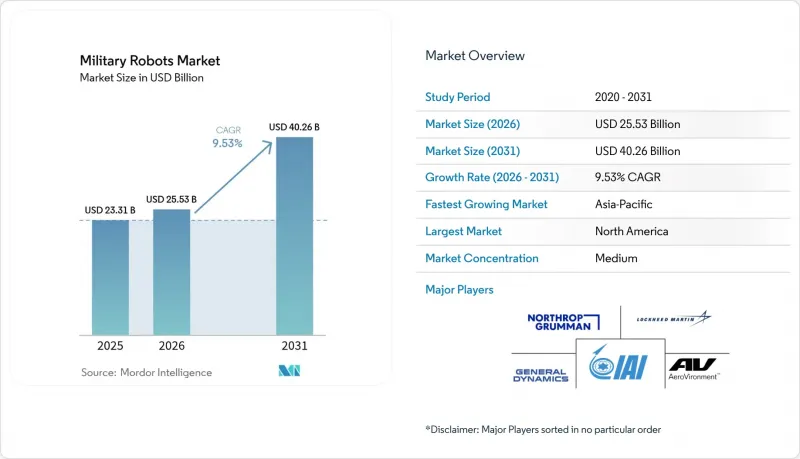
Mordor Intelligence에 의하면, 군용 로봇 시장 규모는 2025년 233억 1,000만 달러로 평가되었습니다. 2026년에는 255억 3,000만 달러로 확대되어 2026-2031년에 걸쳐 CAGR 9.53%로 성장을 지속하여, 2031년에는 402억 6,000만 달러에 이를 것으로 예측됩니다.

본 보고서는 플랫폼(지상, 기타), 운용 모드(유인 운용, 기타), 용도(정보·감시·정찰(ISR), 기타), 탑재 장비(EO/IR 센서 스위트, 기타), 중량 등급(나노·마이크로, 기타), 이동성(트랙식 플랫폼, 기타),지역(북미, 유럽, 기타)별로 분류되어 있습니다. 시장 예측은 금액(달러) 기준으로 제시되어 있습니다.
세계의 군용 로봇 시장 동향 및 인사이트
NATO와 AUKUS에 의한 전장 디지털화 프로그램 가속화
미국의 동맹국들의 국방 예산은 지속적으로 증가하고 있으며, 그 자금은 네트워크 대응 무인 플랫폼에 투입되고 있습니다. 미 육군 각 사단은 2026년까지 드론 배치를 계획하고 있으며, AUKUS 파트너 각국은 ‘플러그 앤 파이트(plug-and-fight)’를 통한 상호 운용성을 실현하기 위해 지휘통제 아키텍처의 통합을 추진하고 있습니다. 주요 프라임 계약업체들은 여러 로봇이 데이터 링크를 공유할 수 있도록 오픈 컨트롤러의 표준화를 추진하고 있으며, 이를 통해 통합 주기가 단축됨과 동시에 전파 방해에 대한 내성을 강화한 소프트웨어 정의 무선(SDR)을 제공하는 벤더들이 우위를 점하고 있습니다. 유럽의 연간 국방 지출은 현재 6.1%의 성장세를 보이고 있으며, 기존 유인 자산에서 디지털화된 부대 구성에 적합한 기동성이 높은 임무 특화형 로봇으로의 조달 정책 전환이 가속화되고 있습니다. 이러한 동향들이 맞물려, 금세기 말까지 군용 로봇 시장을 지탱할 새로운 수주 전망이 열리고 있습니다.
우크라이나 전쟁에서 소모성 지상 드론 스웜에 대한 수요
2025년 3월 도네츠크에서 발생한 완전 로봇화를 통한 공격은 저비용 UGV(무인 지상 차량)와 FPV(1인칭 시점)의 조합이 더 중장갑인 전차를 무력화할 수 있음을 입증했습니다. 이에 따라 NATO 전선 부대는 대량 투입이 가능한 소모형 플랫폼을 중심으로 기동 여단의 재구성을 추진하고 있습니다. 수천 대의 단순한 로봇을 신속하게 공급할 수 있는 스타트업 기업에는 자본이 유입되고 있으며, 기본 계약에서는 계획된 손실률을 상정한 비용 상한선이 점점 더 명확히 명시되고 있습니다. 그 결과, 군사 로봇 시장에서는 단가당 이익률이 축소된 부문에서도 판매량이 증가하고 있으며, 최종 조립 및 검사를 자동화할 수 있는 대규모 기업들이 혜택을 보고 있습니다.
제네바 협약에 대한 우려로 인한 치명적 자율 무기 수출 허가 지연
유엔 결의안 78/241과 국제적십자위원회(ICRC)의 구속력 있는 규정 제정 요청으로 인해 규정 준수 부담이 증가하고 있습니다. 이로 인해 유럽의 수출 허가 절차가 지연되고, 서류 작성 비용이 증가하며, AI가 탑재된 치명적 무기의 개발 주기가 장기화되고 있습니다. 이는 ‘휴먼 온 더 루프(Human-in-the-Loop)’ 방식의 안전 대책에 대한 혁신을 촉진하는 한편, 일부 단기 수주를 규제가 완화된 지역으로 이동시키고, 인증된 수요를 분산시켜 군사 로봇 시장의 성장 모멘텀을 둔화시키고 있습니다.
부문별 분석
2025년, 군용 로봇 시장 매출의 45.92%를 항공 로봇이 차지했습니다. 그러나 실전에서 그 실력이 입증된 무인 지상 차량(UGV)이 돌파 작전, 부상자 이송, 센서 중계 임무에 필수적임이 밝혀짐에 따라 지상 플랫폼은 연평균 성장률(CAGR) 13.12%로 확대되고 있습니다. ‘Ghost X’와 같은 대형 쿼드콥터는 여전히 여단급 ISR(정보·감시·정찰)에 필수적인 비행 거리와 고도를 제공하고 있지만, 막대한 손실을 감당할 수 있는 소모성 지상 스웜에 대한 수요가 급격히 증가하고 있습니다. 우크라이나가 도입한 25만 달러 상당의 드론을 탑재한 USV(무인수상정)는 해군 운용자들을 군사 로봇 시장으로 끌어들이는 크로스 도메인 혁신을 여실히 보여주고 있습니다.
육상 로봇의 성장은 더 저렴한 구동 시스템, 경량 복합재 장갑, GPS 없이도 장애물을 회피할 수 있는 AI 스택에 의해 더욱 가속화되고 있습니다. 이에 반해 항공 플랫폼은 그 존재 가치를 유지하기 위해 다중 탑재 장비 베이 및 전자 공격 포드를 추가하는 방식으로 대응하고 있습니다. 비율은 작지만, 해병대용 로봇에는 석유 터미널 방어에 중점을 두는 GCC(걸프협력회의) 해군으로부터 표적형 자금이 투입되고 있습니다. 도메인 간의 상호작용은 공급업체의 비즈니스 기회를 확대하고, 군사 로봇 시장에 새로운 진입자를 불러오고 있습니다.
2025년 시점에서 군사 로봇 시장 점유율의 55.74%를 유인형 로봇이 차지했습니다. 이는 치명적인 행동에 대해서는 여전히 정책상 인간의 확인이 요구되기 때문입니다. 그러나 위협을 밀리초 단위로 분류하는 탑재형 신경망 가속기 덕분에 완전 자율 모드는 연평균 성장률(CAGR) 12.65%로 발전하고 있습니다. CJADC2와 같은 프로그램에는 시간 민감형 네트워킹이 통합되어 있어, 지휘관은 단일 콘솔에서 지연 없이 함대의 임무를 재할당할 수 있습니다. 이는 혁명적인 변화라기보다는 진화적인 변화라고 할 수 있습니다.
반자율형은 인지적 부하를 분산시키기 때문에 여전히 주류를 이루고 있습니다. 즉, 운영자가 임무 목표를 정의하고, 자율 시스템이 채널 계획이나 장애물 회피를 관리하는 구조입니다. 오버랜드 AI의 ‘Ultra’ 차량은 한 명의 병사가 여러 자매 유닛을 함께 제어할 수 있도록 설계되었으며, 근무 주기에 따른 모니터링 체계가 인력의 부담을 경감시키는 좋은 사례입니다. 교리적 신뢰도가 높아짐에 따라, 군사 로봇 시장에서는 미리 정의된 규칙 집합의 범위 내에서 자율적으로 시작되는 교전 옵션이 등장할 전망입니다.
지역별 분석
북미는 여전히 최대 지출 지역이며, Replicator에 대한 10억 달러의 자금 지원과 2026년까지 미 육군 전 사단에 드론 배치가 의무화된 점이 그 기반이 되고 있습니다. 캐나다 NORAD(북미 항공우주방위사령부)의 업그레이드는 극지 환경에서도 견딜 수 있는 자율형 북극 모니터링 타워의 배치를 통해 이러한 노력을 보완하고 있습니다. 대기업에서 신생 기업에 이르기까지 아우르는 성숙한 공급업체 기반이 기술적 리더십을 뒷받침하며, 이 지역 내 군사 로봇 시장의 지속적인 우위를 확보하고 있습니다.
아시아태평양은 중국의 ‘군민융합’ 정책에 따른 보조금이 국내에서의 대규모 배치를 가속화하고, 인도, 한국, 일본의 대응을 촉발하고 있어 가장 빠르게 성장하는 부문으로 자리 잡고 있습니다. 베이징의 휴머노이드 로봇 및 대규모 스웜 추진에 따라, 지역 조달 동향은 저렴하고 대량 도입이 가능한 시스템으로 전환되고 있는 반면, 서울의 한화 에어로스페이스는 비무장지대(DMZ) 순찰에 최적화된 무장 UGV를 배치하고 있습니다. 남중국해의 해양 분쟁을 계기로, USV와 해저 모니터링용 크롤러에 대한 병행 투자가 진행되고 있습니다.
유럽의 국방 예산은 우크라이나 전쟁의 교훈을 통해 추적 가능한 드론과 지상 스웜의 유효성이 입증됨에 따라, 2035년까지 연평균 6.1% 씩 증가하고 있습니다. 프랑스의 ‘DROIDE’ 프레임워크와 독일의 새로운 연방군 로봇 계획은 NATO 동부 전선의 강화가 시급하다는 점을 반영하고 있습니다. 치명적 자율성에 대한 수출 허가 심사는 출하 속도를 늦추는 한편, 연구개발 자금을 ‘휴먼 인 더 루프(Human-in-the-Loop)’ 방식의 안전 대책에 재할당하게 함으로써, 군사 로봇 시장에서 유럽의 기여도를 타 지역과 차별화하고 있습니다.
중동에서는 석유 터미널을 방어하기 위한 해군용 무인수상정(USV)에 대한 지출에 중점을 두고 있습니다. 이스라엘의 ‘RobDozer’와 로봇화된 M113 파생형의 실전 배치는 혹독한 사막 전장에서의 신뢰성을 입증하고 있습니다. 한편, 아랍에미리트의 EDGE 그룹은 ‘비전 2030’의 현지화 목표에 따라 국산 보트와 지상 로봇의 생산 능력을 구축하고 있습니다. 사우디아라비아의 자율형 초계정 관련 합작 사업은 틈새 시장이지만 수익성이 높은 군사 로봇 시장의 부문을 더욱 확대되고 있습니다.
남미 국가들은 선택적으로 투자를 진행하고 있습니다. 브라질의 2025년도 국방 예산 237억 달러에는 광활한 국경과 아마존 지역을 감시하기 위한 네트워크화된 포병 시스템 및 감시 드론에 대한 자금이 편성되었습니다. 경제적 제약으로 인해 도입 규모는 제한적이지만, 마약 단속 모니터링이나 재난 구조와 같은 지역 특유의 필요에 따라 정글 환경에 적합한 견고하고 비용 효율적인 로봇에 대한 수요가 발생하고 있습니다.
기타 혜택
- 엑셀 형식 시장 예측(ME) 시트
- 3개월간의 애널리스트 지원
자주 묻는 질문
목차
제1장 서론
제2장 조사 방법
제3장 주요 요약
제4장 시장 구도
제5장 시장 규모 및 성장 예측
제6장 경쟁 구도
제7장 시장 기회 및 향후 전망
KTH 26.09.08According to Mordor Intelligence, the military robots market size is expected to grow from USD 23.31 billion in 2025 to USD 25.53 billion in 2026 and is forecast to reach USD 40.26 billion by 2031 at 9.53% CAGR over 2026-2031.
This report is Segmented by Platform (Land, and More), Mode of Operation (Human Operated, and More), Application (Intelligence, Surveillance and Reconnaissance (ISR), and More), Payload (EO/IR Sensor Suites, and More), Weight Class (Nano/Micro, and More), Mobility (Tracked Platforms, and More), and Geography (North America, Europe, and More). The Market Forecasts are Provided in Terms of Value (USD).
Global Military Robots Market Trends and Insights
Accelerated NATO and AUKUS Battlefield-Digitisation Programs
Sustained increases in allied defense budgets are earmarked for network-ready unmanned platforms, with every US Army division slated to field drones by 2026 and AUKUS partners harmonizing command architectures to enable plug-and-fight interoperability. Larger primes are standardizing open controllers so multiple robots can share data links, shortening integration cycles and favoring vendors that provide software-defined radios hardened against jamming. Europe's annual defense spending now grows 6.1%, reinforcing a procurement pivot from legacy crewed assets to agile, mission-specific robots that fit within digitised formations. Collectively, these dynamics add fresh order visibility that underpins the military robots market through the end of the decade.
Ukraine-War Demand for Attritable Land-Drone Swarms
The March 2025 fully robotic assault in Donetsk proved that low-cost UGV-and-FPV combinations can neutralise heavier armour, prompting NATO front-line armies to re-engineer manoeuvre brigades around massed expendable platforms. Capital flows to start-ups able to deliver thousands of simple robots at pace, and framework contracts increasingly specify cost ceilings that assume planned loss rates. As a result, the military robots market sees rising volumes even where unit margins compress, rewarding scale players that can automate final assembly and test.
Geneva-Convention Concerns Delaying Lethal-Autonomy Exports
The UN Resolution 78/241 and the ICRC's call for binding rules add compliance layers that slow European export licences, increase documentation costs, and lengthen development cycles for AI-enabled lethal payloads. While this spurs innovation in "human-on-the-loop" safeguards, it shifts some near-term orders to regions with fewer constraints, fragmenting certified demand and tempering growth momentum within the military robots market.
Other drivers and restraints analyzed in the detailed report include:
- The US DoD "Replicator" USD 1 billion Initiative
- Edge-AI Breakthroughs for Compliant Target Recognition
- EW-Jamming Vulnerabilities of Commercial Links
For complete list of drivers and restraints, kindly check the Table Of Contents.
Segment Analysis
Airborne robots generated 45.92% of the military robots market revenue in 2025. Yet, land platforms expand at a 13.12% CAGR as battle-tested UGVs prove indispensable for breaching, casualty evacuation, and sensor-relay missions. Large quadrotors such as the Ghost X still provide the reach and height essential for brigade ISR, but demand for attritable ground swarms that can absorb heavy losses is rising sharply. Ukraine's USD 250,000 drone-carrying USVs underscore cross-domain innovation that pulls naval operators into the military robots market.
Land-robot growth is further propelled by cheaper drivetrains, lighter composite armour, and AI stacks that enable obstacle negotiation without GPS. Air platforms respond by adding multi-payload bays and electronic-attack pods to stay relevant. Although a small slice, Marine robots receive targeted spending from GCC navies focused on oil-terminal defense. The interplay across domains broadens supplier opportunities and brings fresh entrants into the military robots market.
Human-operated robots held 55.74% of the military robots market share in 2025 because policy still requires human confirmation for lethal action. Fully autonomous modes, however, advance at 12.65% CAGR thanks to onboard neural-network accelerators that classify threats within milliseconds. Programs such as CJADC2 integrate time-sensitive networking so commanders can retask fleets from a single console without latency, representing evolutionary rather than revolutionary change.
Semi-autonomy remains the workhorse because it splits cognitive load: operators define mission goals while autonomy manages route-planning and obstacle avoidance. Overland AI's Ultra vehicle, one soldier can control alongside multiple sister units, illustrates how duty-cycled oversight eases workforce demands. As doctrinal trust grows, the military robots market will likely see autonomously initiated engagement options bounded by predefined rulesets.
Complete Report Scope:
- By Platform
- Land
- Airborne
- Marine
- By Mode of Operation
- Human Operated
- Semi-Autonomous
- Fully Autonomous
- By Application
- Intelligence, Surveillance, and Reconnaissance (ISR)
- Combat Support/Strike
- Logistics and EOD
- Search and Rescue
- Fire-fighting and CBRN response
- By Payload
- EO/IR Sensor Suites
- Radar and Lidar Modules
- Electronic-Warfare Pods
- Lethal Weapon Stations
- Non-lethal Systems (Tasers, Nets)
- By Weight Class
- Nano/Micro ( less than 10 kg)
- Small (10-200 kg)
- Medium (200-2,000 kg)
- Heavy (more than 2,000 kg)
- By Mobility
- Tracked Platforms
- Wheeled Platforms
- Legged/Bionic Platforms
- Hybrid (Tracked-Wheeled)
- By Geography
- North America
- United States
- Canada
- Mexico
- South America
- Brazil
- Rest of South America
- Europe
- United Kingdom
- France
- Germany
- Italy
- Russia
- Rest of Europe
- Asia-Pacific
- China
- India
- Japan
- South Korea
- Rest of Asia-Pacific
- Middle East and Africa
- Middle East
- Saudi Arabia
- United Arab Emirates
- Israel
- Rest of Middle East
- Africa
- South Africa
- Nigeria
- Rest of Africa
- Middle East
- North America
Geography Analysis
North America remains the largest spender, anchored by USD 1 billion in Replicator funding and mandated drone deployment across all US Army divisions by 2026. Canada's NORAD upgrade complements these efforts by fielding autonomous Arctic surveillance towers resilient to polar conditions. A mature supplier base spanning primes and start-ups sustains technology leadership, ensuring continued dominance of the military robots market in the region.
Asia-Pacific is the fastest-growing segment as China's civil-military fusion subsidies accelerate domestic scale-out and spur responses from India, South Korea, and Japan. Beijing's push for humanoid robots and mass-swarms shifts regional procurement toward cheap, numerous systems, while Seoul's Hanwha Aerospace rolls out armed UGVs optimised for DMZ patrols. Maritime disputes in the South China Sea trigger parallel investment in USVs and seabed-monitoring crawlers.
Europe's defense budgets grow 6.1% annually through 2035, driven by the lessons of the Ukraine war that validate attributable drones and ground swarms. France's DROIDE framework and Germany's new Bundeswehr robotics plan reflect the urgency of reinforcing NATO's eastern flank. Export-licence scrutiny over lethal autonomy tempers shipment speed yet channels R&D funds into "human-in-the-loop" safeguards, differentiating European contributions to the military robots market.
The Middle East focuses on spending on naval USVs to guard oil terminals. Israel's operational deployment of RobDozer and robotic M113 variants proves reliability in austere desert theatres. At the same time, the UAE's EDGE Group builds indigenous boats and ground-robot capacity that is aligned with Vision 2030's localisation goals. Saudi Arabia's joint ventures on autonomous patrol craft further expand a niche but lucrative slice of the military robots market.
South America invests selectively; Brazil's USD 23.7 billion 2025 defense budget allocates funds for networked artillery and surveillance drones to police vast borders and Amazonia. Economic constraints limit volume, yet region-specific needs for anti-narcotics monitoring and disaster relief open opportunities for rugged, cost-efficient robots tailored to jungle conditions.
- Northrop Grumman Corporation
- Lockheed Martin Corporation
- General Dynamics Corporation
- AeroVironment, Inc.
- Teledyne Technologies Incorporated
- QinetiQ Group plc
- Elbit Systems Ltd.
- Israel Aerospace Industries Ltd.
- Thales Group
- BAE Systems plc
- Saab AB
- Textron Inc.
- Boston Dynamics, Inc.
- Rheinmetall AG
- Milrem AS
- Anduril Industries, Inc.
- Ghost Robotics Corporation
- HYUNDAI MOTOR GROUP
- Hanwha Corporation
- EDGE Group PJSC
- Shield AI
Additional Benefits:
- The market estimate (ME) sheet in Excel format
- 3 months of analyst support
TABLE OF CONTENTS
1 INTRODUCTION
- 1.1 Study Assumptions and Market Definition
- 1.2 Scope of the Study
2 RESEARCH METHODOLOGY
3 EXECUTIVE SUMMARY
4 MARKET LANDSCAPE
- 4.1 Market Overview
- 4.2 Market Drivers
- 4.2.1 Accelerated NATO and AUKUS battlefield-digitization programs
- 4.2.2 Ukraine-war-driven demand for attritable land-drone swarms
- 4.2.3 US DoD "Replicator" USD 1 Bn initiative for expendable autonomous systems
- 4.2.4 Edge-AI breakthroughs enabling compliant autonomous target recognition
- 4.2.5 Oil-infrastructure protection spurring naval USV adoption
- 4.2.6 China's civil-military fusion subsidies
- 4.3 Market Restraints
- 4.3.1 Geneva-Convention concerns delaying lethal-autonomy export clearances
- 4.3.2 EW-jamming vulnerabilities of COTS comm-links
- 4.3.3 Battery energy-density limits constraining desert-operations
- 4.3.4 US export-control curbs on rad-hardened AI chips
- 4.4 Value Chain Analysis
- 4.5 Regulatory or Technological Outlook
- 4.6 Porter's Five Forces Analysis
- 4.6.1 Bargaining Power of Buyers
- 4.6.2 Bargaining Power of Suppliers
- 4.6.3 Threat of New Entrants
- 4.6.4 Threat of Substitutes
- 4.6.5 Intensity of Competitive Rivalry
5 MARKET SIZE AND GROWTH FORECASTS (VALUE)
- 5.1 By Platform
- 5.1.1 Land
- 5.1.2 Airborne
- 5.1.3 Marine
- 5.2 By Mode of Operation
- 5.2.1 Human Operated
- 5.2.2 Semi-Autonomous
- 5.2.3 Fully Autonomous
- 5.3 By Application
- 5.3.1 Intelligence, Surveillance, and Reconnaissance (ISR)
- 5.3.2 Combat Support/Strike
- 5.3.3 Logistics and EOD
- 5.3.4 Search and Rescue
- 5.3.5 Fire-fighting and CBRN response
- 5.4 By Payload
- 5.4.1 EO/IR Sensor Suites
- 5.4.2 Radar and Lidar Modules
- 5.4.3 Electronic-Warfare Pods
- 5.4.4 Lethal Weapon Stations
- 5.4.5 Non-lethal Systems (Tasers, Nets)
- 5.5 By Weight Class
- 5.5.1 Nano/Micro ( less than 10 kg)
- 5.5.2 Small (10-200 kg)
- 5.5.3 Medium (200-2,000 kg)
- 5.5.4 Heavy (more than 2,000 kg)
- 5.6 By Mobility
- 5.6.1 Tracked Platforms
- 5.6.2 Wheeled Platforms
- 5.6.3 Legged/Bionic Platforms
- 5.6.4 Hybrid (Tracked-Wheeled)
- 5.7 By Geography
- 5.7.1 North America
- 5.7.1.1 United States
- 5.7.1.2 Canada
- 5.7.1.3 Mexico
- 5.7.2 South America
- 5.7.2.1 Brazil
- 5.7.2.2 Rest of South America
- 5.7.3 Europe
- 5.7.3.1 United Kingdom
- 5.7.3.2 France
- 5.7.3.3 Germany
- 5.7.3.4 Italy
- 5.7.3.5 Russia
- 5.7.3.6 Rest of Europe
- 5.7.4 Asia-Pacific
- 5.7.4.1 China
- 5.7.4.2 India
- 5.7.4.3 Japan
- 5.7.4.4 South Korea
- 5.7.4.5 Rest of Asia-Pacific
- 5.7.5 Middle East and Africa
- 5.7.5.1 Middle East
- 5.7.5.1.1 Saudi Arabia
- 5.7.5.1.2 United Arab Emirates
- 5.7.5.1.3 Israel
- 5.7.5.1.4 Rest of Middle East
- 5.7.5.2 Africa
- 5.7.5.2.1 South Africa
- 5.7.5.2.2 Nigeria
- 5.7.5.2.3 Rest of Africa
- 5.7.5.1 Middle East
- 5.7.1 North America
6 COMPETITIVE LANDSCAPE
- 6.1 Market Concentration
- 6.2 Strategic Moves
- 6.3 Market Share Analysis
- 6.4 Company Profiles (includes Global-level Overview, Market-level Overview, Core Segments, Financials as available, Strategic Information, Market Rank/Share, Products and Services, Recent Developments)
- 6.4.1 Northrop Grumman Corporation
- 6.4.2 Lockheed Martin Corporation
- 6.4.3 General Dynamics Corporation
- 6.4.4 AeroVironment, Inc.
- 6.4.5 Teledyne Technologies Incorporated
- 6.4.6 QinetiQ Group plc
- 6.4.7 Elbit Systems Ltd.
- 6.4.8 Israel Aerospace Industries Ltd.
- 6.4.9 Thales Group
- 6.4.10 BAE Systems plc
- 6.4.11 Saab AB
- 6.4.12 Textron Inc.
- 6.4.13 Boston Dynamics, Inc.
- 6.4.14 Rheinmetall AG
- 6.4.15 Milrem AS
- 6.4.16 Anduril Industries, Inc.
- 6.4.17 Ghost Robotics Corporation
- 6.4.18 HYUNDAI MOTOR GROUP
- 6.4.19 Hanwha Corporation
- 6.4.20 EDGE Group PJSC
- 6.4.21 Shield AI
7 Market Opportunities and Future Outlook
- 7.1 White-space and Unmet-Need Assessment


